Scrutinize vs Scrutinise comes down to regional spelling conventions, not meaning. Scrutinize is the standard spelling in American English, while scrutinise is more common in British, Australian, and New Zealand English. Both words mean to examine something closely and carefully, whether you are reviewing financial records, checking scientific evidence, or evaluating a new policy.
The difference also affects related forms, including scrutinized vs. scrutinised and scrutinizing vs. scrutinising. However, some British publishers follow Oxford spelling and prefer -ize endings, so the distinction is not always as simple as American versus British English. Knowing these conventions will help you choose the right spelling for professional emails, academic papers, legal documents, and published articles.
Scrutinize vs Scrutinise: The Quick Answer
Scrutinize is the preferred spelling in American English, while scrutinise is the usual spelling in British, Australian, and New Zealand English. Both spellings have the same definition and pronunciation. The correct choice depends on your audience, publication, or style guide.
Here is the basic rule:
- American English: Scrutinize
- British English: Scrutinise is the usual form, although some publishers use scrutinize.
- Australian English: Scrutinise is the usual form.
- New Zealand English: Scrutinise is the usual form.
- Oxford spelling: Scrutinize is preferred under this editorial convention, including in some British publications.
For example, an American financial analyst might write, “We need to scrutinize the company’s annual report.” A British analyst could write, “We need to scrutinise the company’s annual report.”
Both sentences are correct. Neither spelling changes the meaning, and neither version suggests a different level of attention or accuracy.
The key is consistency. If you start a document using American English, keep scrutinize, scrutinized, and scrutinizing throughout. If you follow mainstream British spelling, use scrutinise, scrutinised, and scrutinising instead.
What Is the Difference Between Scrutinize and Scrutinise?
The difference between scrutinize and scrutinise is the spelling of the final syllable. American English generally uses -ize, whereas mainstream British and Commonwealth usage often uses -ise for this word. Both forms describe the same action: examining something closely to understand it, check its accuracy, or identify problems.
Meaning of Scrutinize and Scrutinise
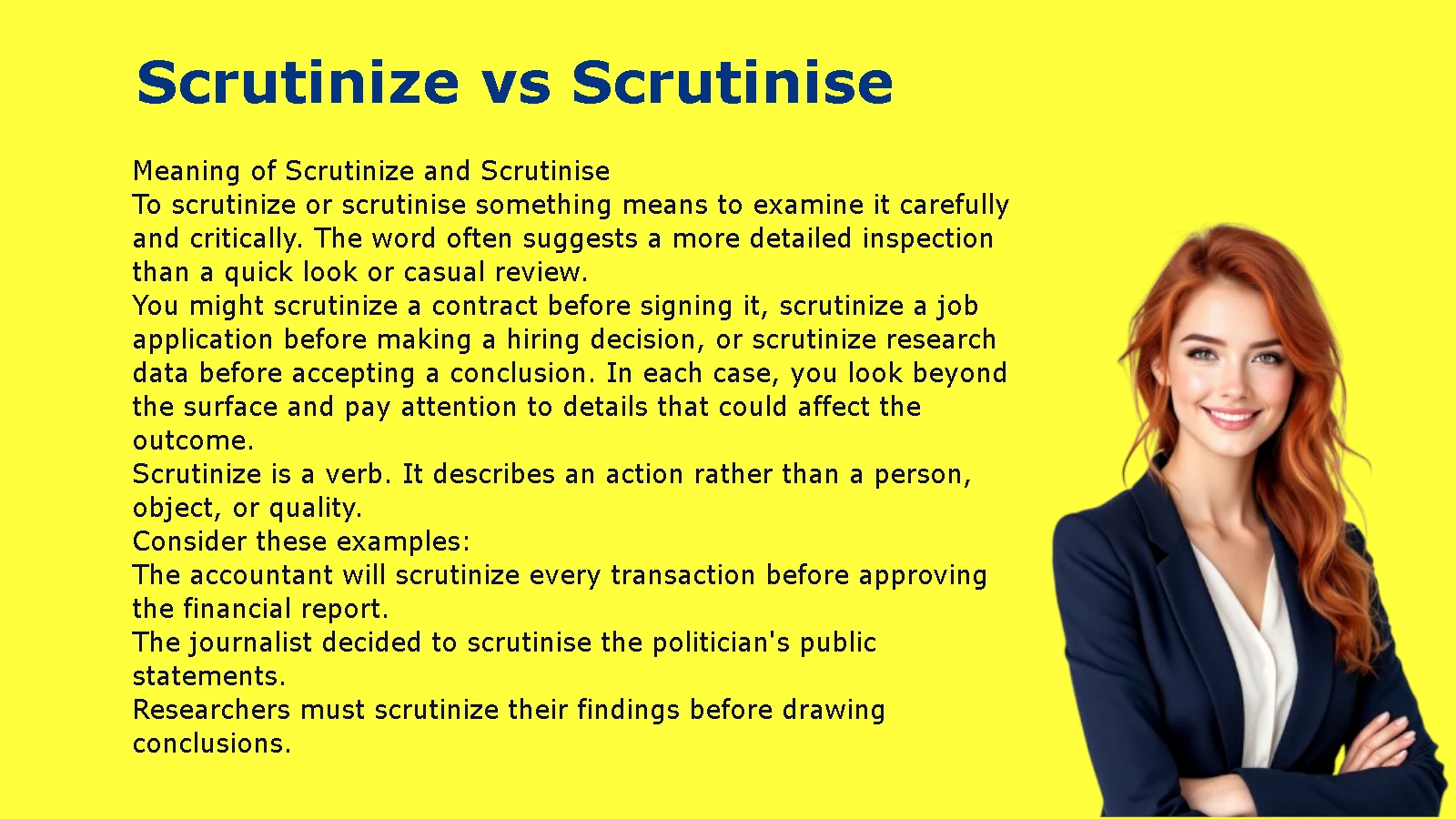
To scrutinize or scrutinise something means to examine it carefully and critically. The word often suggests a more detailed inspection than a quick look or casual review.
You might scrutinize a contract before signing it, scrutinize a job application before making a hiring decision, or scrutinize research data before accepting a conclusion. In each case, you look beyond the surface and pay attention to details that could affect the outcome.
Scrutinize is a verb. It describes an action rather than a person, object, or quality.
Consider these examples:
- The accountant will scrutinize every transaction before approving the financial report.
- The journalist decided to scrutinise the politician’s public statements.
- Researchers must scrutinize their findings before drawing conclusions.
- The hiring manager scrutinised each application for relevant experience.
- The review committee is scrutinising the proposed changes.
These examples show how the verb works in different tenses. The spelling changes according to regional convention, but the meaning remains the same.
The word also carries a slightly more analytical tone than expressions such as look at or check. If you say that someone scrutinized a document, you suggest that the person examined it closely rather than simply reading it.
For example, compare these sentences:
- Maria looked at the contract.
- Maria scrutinized the contract before signing it.
The first sentence says little about the depth of Maria’s examination. The second suggests that she paid close attention to the terms and looked for possible problems.
Why Do the Two Spellings Exist?
English spelling developed through several historical influences, including French, Latin, and Greek. Over time, different regions adopted different conventions for writing certain word endings. The -ize vs. -ise distinction is one example of this variation.
American English generally favors -ize in words such as organize, recognize, and scrutinize. Mainstream British English often uses -ise in the same words, producing organise, recognise, and scrutinise.
This spelling variation is also seen in summarize vs summarise, synchronize vs synchronise, and catalyze vs catalyse, where American and British English may use different endings.
However, British English also includes established -ize spellings. The Oxford spelling convention, for instance, favors -ize in many words where the suffix is appropriate. Therefore, it would be inaccurate to claim that every British writer must use -ise.
The same principle applies to other English-speaking countries. Australia and New Zealand generally favor -ise in everyday publishing, while Canadian English uses a mixture of British and American conventions. The preferred spelling can depend on the publication or organization.
The important distinction is between regional spelling preference and grammatical correctness. A spelling can be standard in one variety of English and less common in another without changing the word’s meaning.
Scrutinize vs Scrutinise in American and British English
The spelling you choose should reflect the English variety you are writing in. American publications generally expect scrutinize, while mainstream British publications commonly use scrutinise. Australian and New Zealand publications usually follow the latter convention, although individual style guides can establish different rules.
American English: Scrutinize
Scrutinize is the standard spelling in American English. Writers use it in journalism, education, business, government, law, and everyday communication.
American spelling typically retains the letter z in several verbs ending in -ize. Common examples include:
- Organize
- Recognize
- Realize
- Authorize
- Analyze
- Scrutinize
These words follow familiar American spelling patterns, although analyze has a slightly different ending from the other examples.
For another common example of this American–British spelling difference, compare organize vs organise.
In American writing, scrutinise may look out of place because readers generally expect the z spelling. A word processor set to US English may also flag the British form, depending on its dictionary and settings.
Here are some examples of scrutinize in American English:
Business: The accounting department will scrutinize the expenses before approving the quarterly budget.
Law: The defense attorney scrutinized the witness’s statement for inconsistencies.
Education: The professor asked students to scrutinize the evidence before accepting the researcher’s conclusion.
Journalism: Reporters scrutinize public records to verify claims made by government officials.
Everyday use: I always scrutinize product reviews before spending money on an expensive appliance.
Each sentence uses the American spelling. Notice that the word fits situations where careful inspection, evaluation, or verification matters.
If your audience is primarily American, use scrutinize in the main text, headings, captions, and related word forms. This small adjustment makes the article feel consistent with familiar US spelling conventions.
British English: Scrutinise
Scrutinise is the usual spelling in mainstream British English. It appears in newspapers, professional documents, academic writing, and everyday communication.
British English commonly uses -ise in words that American English spells with -ize. For example:
| American English | British English |
| Scrutinize | Scrutinise |
| Organize | Organise |
| Recognize | Recognise |
| Realize | Realise |
| Authorize | Authorise |
| Specialize | Specialise |
These differences are primarily matters of spelling. The words retain their meanings, grammatical roles, and general pronunciation.
Here are examples using scrutinise in British English:
- The committee will scrutinise the proposed changes before reaching a decision.
- The solicitor scrutinised the agreement before advising the client.
- Journalists are scrutinising the government’s latest announcement.
- The school will scrutinise its admission procedures next term.
- The manager asked the team to scrutinise the figures for possible errors.
For a British audience, scrutinise is usually the natural choice. However, some British publishers use Oxford spelling or another house style that prefers scrutinize. Always check the relevant editorial requirements when preparing formal work.
Australian, New Zealand, and Canadian English
English-speaking countries do not all follow exactly the same spelling system. Australian and New Zealand English generally favor scrutinise, while Canadian English often combines British and American conventions.
Australian English: Use scrutinise in ordinary Australian writing unless the relevant publication or organization specifies another convention.
Example: The research team will scrutinise the survey responses before publishing its findings.
New Zealand English: Scrutinise is also the usual form in New Zealand English.
Example: The panel scrutinised the applications against the published selection criteria.
Canadian English: Both spelling traditions influence Canadian writing. Some Canadian publications prefer scrutinize, while others follow British-style conventions or their own editorial rules.
Example: The committee will scrutinize the proposed budget before approving the project.
For Canadian writing, do not assume that every word with an -ize ending must change to -ise. Instead, check the publication’s spelling policy and apply it consistently.
If you are writing for an international audience, the best approach is to identify your primary readership before drafting. A consistent spelling system is easier to read and edit than a document that switches between regional conventions without a reason.
Scrutinize vs Scrutinise: Spelling Comparison Table
The table below compares the preferred forms across major English varieties. Use it as a quick reference when editing an article, preparing a report, or checking a document before submission.
| Region or style | Preferred verb | Past tense | Continuous form |
| American English | Scrutinize | Scrutinized | Scrutinizing |
| Mainstream British English | Scrutinise | Scrutinised | Scrutinising |
| Australian English | Scrutinise | Scrutinised | Scrutinising |
| New Zealand English | Scrutinise | Scrutinised | Scrutinising |
| Oxford spelling | Scrutinize | Scrutinized | Scrutinizing |
The Oxford spelling row describes a particular editorial convention rather than a separate regional dialect. Similarly, the table shows common preferences, not rules that every publication follows without exception.
A few practical points will help you apply these spellings correctly:
- Use scrutinize and its related forms for standard American English.
- Use scrutinise and its related forms for mainstream British, Australian, and New Zealand English.
- Follow a publisher’s house style when it specifies Oxford spelling or another convention.
- Check Canadian editorial requirements instead of assuming that Canadian English always follows one side.
- Keep the spelling consistent throughout the document.
Consistency matters most when a document contains several related forms. For example, an article that uses scrutinize in one paragraph and scrutinising in another may look as if it has not received a final proofreading pass.
A single regional spelling system avoids that problem and makes the writing look more professional.
The Oxford Spelling Exception: Why Some British Writers Use Scrutinize
Oxford spelling is an editorial convention associated with Oxford University Press and other publications that favor -ize endings in words where that spelling is appropriate. As a result, a British writer can use scrutinize without making a spelling mistake if the chosen style guide calls for it.
This exception explains why you may see scrutinize in British books, academic materials, or international publications even though scrutinise is common in British English.
What Is Oxford Spelling?
Oxford spelling generally favors -ize over -ise in certain verbs, including:
- Organize
- Recognize
- Realize
- Scrutinize
- Specialize
The convention does not mean that every word ending in a similar sound should use z. Words such as advertise, revise, and surprise retain their established spellings. Oxford spelling follows particular word-formation and editorial conventions rather than applying a simple letter replacement to every word.
The choice of -ize also has a historical basis. The ending is associated with a Greek-derived suffix that entered English through later linguistic development. However, the existence of that historical connection does not make -ize universally correct in every variety of English.
Both -ize and -ise have long histories in English usage. The main practical issue for modern writers is to follow the convention their audience or publication expects.
For example, an academic paper prepared for a British publisher that uses Oxford spelling might contain this sentence:
“The authors scrutinize the evidence before proposing a revised model.”
A British newspaper following a mainstream -ise house style might write:
“The authors scrutinise the evidence before proposing a revised model.”
Both versions can be correct within their respective editorial systems.
Is Scrutinize Correct in British English?
Yes. Scrutinize is acceptable in British English when the writer follows a style that uses the -ize spelling. The spelling is not limited to American English, although it is the standard American form.
British spelling conventions vary between publishers, institutions, and organizations. Many use scrutinise, while others prefer scrutinize. The correct choice therefore depends on the style requirements of the document.
Consider these situations:
- A British newspaper: Follow the newspaper’s established spelling policy.
- A university assignment: Use the spelling convention required by the department or institution.
- An academic journal: Check the journal’s author guidelines.
- An international organization: Follow its editorial style guide rather than assuming it uses either British or American English throughout.
- A personal blog: Choose the spelling that suits your target audience and use it consistently.
The same advice applies to other words with -ize and -ise variants. Do not change a spelling simply because it appears in a different regional form. First, establish which convention the document follows.
Scrutinizing vs. Scrutinising: How to Spell Other Word Forms
The regional difference between scrutinize and scrutinise carries over to several related forms. American English generally keeps the z, while mainstream British and Commonwealth usage generally uses s. Understanding these forms helps prevent inconsistent spelling when you change the tense or grammatical function of the verb.
Scrutinized vs. Scrutinised
Scrutinized is the standard American past-tense and past-participle form. Scrutinised is the usual British, Australian, and New Zealand form.
Both forms describe an examination that happened in the past or an action completed before another point in time.
Examples:
- American: The auditor scrutinized the financial statements last week.
- British: The auditor scrutinised the financial statements last week.
- American: The proposal has been scrutinized by several experts.
- British: The proposal has been scrutinised by several experts.
The grammatical function remains identical in each pair. You do not need to change the sentence structure simply because the spelling convention changes.
Both forms can also appear in passive constructions, such as “The records were scrutinized.” In this case, the sentence emphasizes the records and the action performed on them rather than the person who performed the examination.
Scrutinizing vs. Scrutinising
Scrutinizing is the American spelling of the present participle and gerund. Scrutinising is the usual British and Commonwealth spelling.
The -ing form can describe an action in progress or act as a noun within a sentence.
Examples of the present participle:
- American: The committee is scrutinizing the proposed regulations.
- British: The committee is scrutinising the proposed regulations.
Examples of the gerund:
- American: Scrutinizing the data takes time and patience.
- British: Scrutinising the data takes time and patience.
In the first pair, the word forms part of a continuous verb tense. In the second pair, the -ing form functions as the subject of the sentence.
The spelling changes, but the grammar does not. Both forms are valid when they match the document’s chosen English variety.
Scrutinizer vs. Scrutiniser
The noun forms follow the same regional pattern. A scrutinizer is someone who scrutinizes something, while a scrutiniser is the corresponding form used in spelling conventions that favor -ise.
Examples:
- American: The independent scrutinizer checked the records for discrepancies.
- British: The independent scrutiniser checked the records for discrepancies.
These nouns are less common in everyday writing than expressions such as reviewer, examiner, inspector, or analyst. The best alternative depends on the context.
For example, auditor may be more precise when someone examines financial records as part of a formal audit. Reviewer may fit a person evaluating an article or proposal. Inspector may suit someone checking whether an object or facility meets established requirements.
Choose scrutinizer or scrutiniser when you specifically need a noun related to the verb scrutinize or scrutinise.
How to Keep the Spelling Consistent
Consistent spelling is particularly important in long articles, business reports, academic papers, and legal documents. A document may contain the same word several times in different forms, so checking only the main verb can leave errors behind.
Use this simple editing process:
- Choose your English variety. Decide whether the document follows American, British, Australian, New Zealand, or a specific editorial style.
- Set your proofing language. Select the appropriate language and regional setting in your word processor.
- Search for related forms. Check scrutinize, scrutinise, scrutinized, scrutinised, scrutinizing, and scrutinising.
- Review the exceptions. Confirm whether quotations, official titles, or source material need to retain their original spelling.
- Proofread the complete document. Look for other words that follow the same -ize and -ise convention.
A word processor can help identify inconsistencies, but its suggestions are not a substitute for an editorial decision. A spellchecker may accept both variants or flag one simply because its language settings do not match your document.
For example, if your article follows American English, a search for scrutinising can reveal a British spelling that slipped into the draft. You can then decide whether to change it to scrutinizing.
Do not replace every occurrence blindly. If you are quoting a British source in an American article, retaining the source’s original wording may be appropriate. The goal is consistent editorial style, not unnecessary changes to quoted material.
Examples of Scrutinize and Scrutinise in Sentences
Sentence examples make the difference easier to understand because they show how the verb works in practical contexts. The following examples cover business, education, law, research, and everyday decisions.
Examples Using Scrutinize
Use scrutinize when writing in American English or following a style guide that prefers the -ize form.
Business and finance
- The finance director will scrutinize the quarterly figures before approving the budget.
- Investors should scrutinize a company’s financial statements before making an investment decision.
- The purchasing team scrutinized the supplier’s quotation for hidden costs.
Law and government
- The attorney will scrutinize the contract for clauses that could create unnecessary risks.
- Investigators scrutinized the evidence before deciding which leads to pursue.
- The public scrutinized the proposal after officials released the details.
Education and research
- Students must scrutinize the source material before using it in an academic paper.
- The research team scrutinized the results for inconsistencies.
- The professor encouraged the class to scrutinize the assumptions behind the theory.
Everyday decisions
- I scrutinize product specifications before buying a new laptop.
- She scrutinized the restaurant menu before choosing a meal.
- He scrutinized the travel itinerary to make sure the connection times were realistic.
These examples show that scrutinize often appears when the writer wants to emphasize careful attention. It may suggest looking for errors, checking reliability, or evaluating details before reaching a decision.
Examples Using Scrutinise
Use scrutinise in mainstream British, Australian, and New Zealand English unless your chosen style guide prefers scrutinize.
Business and finance
- The finance director will scrutinise the quarterly figures before approving the budget.
- Investors should scrutinise a company’s financial statements before making an investment decision.
- The purchasing team scrutinised the supplier’s quotation for hidden costs.
Law and government
- The solicitor will scrutinise the contract before advising the client.
- Investigators scrutinised the evidence before deciding which leads to pursue.
- The public scrutinised the proposal after officials released the details.
Education and research
- Students must scrutinise the source material before using it in an academic paper.
- The research team scrutinised the results for inconsistencies.
- The professor encouraged the class to scrutinise the assumptions behind the theory.
Everyday decisions
- I scrutinise product specifications before buying a new laptop.
- She scrutinised the restaurant menu before choosing a meal.
- He scrutinised the travel itinerary to make sure the connection times were realistic.
The examples use the same sentence structures as their American counterparts. Only the spelling changes, which reinforces the main rule: choose the regional form that matches your intended audience.
Common Mistakes to Avoid
Even though the spelling difference is straightforward, writers sometimes confuse regional preferences with grammatical rules. Avoid these common mistakes when editing your work.
Mistake: Treating scrutinise as universally incorrect
Incorrect assumption: “Scrutinise is a misspelling because American English uses scrutinize.”
Correction: Scrutinise is a standard spelling in mainstream British, Australian, and New Zealand English.
Mistake: Assuming scrutinize is never British English
Incorrect assumption: “Every British writer must use scrutinise.”
Correction: Some British publishers and institutions follow Oxford spelling or another style that favors scrutinize.
Mistake: Mixing related forms
Inconsistent example: “The committee will scrutinize the report before scrutinising the recommendations.”
Better American version: “The committee will scrutinize the report before scrutinizing the recommendations.”
Better British version: “The committee will scrutinise the report before scrutinising the recommendations.”
Mistake: Assuming the words have different meanings
Incorrect assumption: “Scrutinize means to inspect, while scrutinise means to criticize.”
Correction: Both forms have the same meaning. Although close examination can reveal problems, the verb does not automatically mean to criticize or condemn.
Mistake: Ignoring the style guide
A publication may require a specific spelling system even when other forms are accepted in English. Follow the instructions provided by the editor, publisher, university, or employer.
Which Spelling Should You Use?
Choose the spelling based on your target audience and any editorial requirements that apply. If you are writing for a specific publication or institution, its style guide takes priority over a general regional preference.
For American Readers and Publications
Use scrutinize, scrutinized, and scrutinizing in standard American English.
This convention suits US-focused blog posts, business reports, academic assignments, news articles, and general professional communication.
For example:
“The compliance team will scrutinize the revised policy before approving its implementation.”
If you are preparing an article for an American website, apply the same spelling pattern to related words such as organize, recognize, and authorize when appropriate.
A consistent American spelling system helps readers focus on the content rather than noticing unexpected regional variations.
For British, Australian, and New Zealand Readers
Use scrutinise, scrutinised, and scrutinising for mainstream British, Australian, and New Zealand English.
For example:
“The compliance team will scrutinise the revised policy before approving its implementation.”
This spelling pattern generally matches the expectations of readers in those markets. However, some publishers follow Oxford spelling, so check the relevant style guide before editing a document for publication.
The same approach applies to related verbs. If you choose the -ise convention, check words such as organise, recognise, and authorise for consistency.
For Academic, Legal, and International Writing
Formal writing often comes with explicit spelling requirements. Universities, law firms, journals, government agencies, and international organizations may maintain their own style guides.
Before submitting your document, check these details:
| Writing situation | What to do |
| University assignment | Follow the institution’s spelling and style requirements. |
| Academic journal submission | Check the journal’s author guidelines. |
| Legal document | Follow the jurisdiction’s conventions and the organization’s drafting policy. |
| International report | Use the organization’s editorial style. |
| Business communication | Match the company’s preferred English variety. |
| Personal website | Choose a spelling system that suits your main readership. |
Consistency can matter more than choosing one regional spelling over another when both are accepted in the relevant context. However, a document should not switch between conventions without a clear reason.
A Practical Editing Example
Imagine you are preparing a 2,000-word report for a British consulting firm. Your first draft uses scrutinise, organize, and scrutinizing. Although readers will understand the message, the spelling switches between common conventions.
To correct the draft, check the firm’s style guide. If it follows mainstream British spelling, change the relevant forms to scrutinise, organise, and scrutinising. If the firm follows Oxford spelling, retain the appropriate -ize forms instead.
This approach is more reliable than changing individual words based on personal preference. It also makes later editing easier because the document follows one clear system.
Frequently Asked Questions
Is Scrutinise a Spelling Error?
No. Scrutinise is a correct and standard spelling in mainstream British English, and it is commonly used in Australian and New Zealand English. American English generally favors scrutinize. The two forms have the same meaning, so the choice depends on regional convention or the style guide you follow.
Which Is Correct in the UK: Scrutinize or Scrutinise?
Both can be correct in British English. Scrutinise is the usual form in mainstream British publishing, while scrutinize appears in publications that follow Oxford spelling or another -ize convention. If you are writing for a British newspaper, university, or publisher, check its style guide before choosing a form.
Is Scrutinize American or British English?
Scrutinize is the standard American spelling, but it is not exclusive to the United States. Some British publishers use it as well, particularly when they follow Oxford spelling. The spelling alone does not determine whether a text is American or British English because writers may follow different editorial conventions.
Do Scrutinize and Scrutinise Mean the Same Thing?
Yes. Both words mean to examine something closely and carefully, often to identify errors, assess evidence, or evaluate details. The difference is purely a matter of spelling convention. Neither form implies a different level of examination, and neither automatically means to criticize or disapprove of something.
Should I Write Scrutinizing or Scrutinising?
Use scrutinizing in standard American English and scrutinising in mainstream British, Australian, and New Zealand English. If a publisher follows Oxford spelling, it may prefer scrutinizing. Keep the spelling consistent with the rest of your document and check the relevant style guide when writing for a specific organization.
How Do You Spell Scrutinize in the Past Tense?
The American past-tense and past-participle form is scrutinized. The usual British, Australian, and New Zealand form is scrutinised. For example, an American writer might say, “The committee scrutinized the proposal,” while a British writer might say, “The committee scrutinised the proposal.” Both sentences are grammatically correct.
Conclusion: Choose Scrutinize or Scrutinise by Style
The difference between Scrutinize vs Scrutinise is simple: American English generally uses scrutinize, while mainstream British, Australian, and New Zealand English generally favor scrutinise. Both spellings mean to examine something closely and carefully.
The distinction continues across related forms. American English uses scrutinized and scrutinizing, while mainstream British and Commonwealth usage generally uses scrutinised and scrutinising. Oxford spelling provides an important exception because it favors -ize in many words where that suffix is appropriate.
When in doubt, follow three practical rules:
- Match your audience: Use the spelling familiar to your primary readers.
- Follow your style guide: Give priority to the requirements of your publisher, institution, or employer.
- Stay consistent: Check the verb and its related forms before you publish or submit your work.