Have you ever written “than” or “then” and paused because you weren’t sure which word was correct? While Than or Then may look like a small spelling difference, these two words have completely different meanings and uses.
Than is mainly used to make comparisons, while then usually refers to a time, sequence, or result. Although they sound similar and differ by only one letter, using the wrong word can change the meaning of your sentence.
Examples:
- Sarah is taller than her brother.
- Finish your homework, then you can watch TV.
The confusion is understandable. People often search for than vs then, when to use than or then, than or then meaning, or how to remember the difference between than and then because both words appear frequently in everyday English. And here’s the kicker: one tiny letter can make the sentence mean something entirely different.
In this guide, you’ll learn the complete difference between than and then, including their meanings, definitions, pronunciation, correct usage, and examples in sentences. You’ll also discover an easy way to remember than vs then, common mistakes to avoid, and how to choose the right word every time.
Than vs. Then: Quick Answer
The fastest way to remember than or then is this:
| Word | Main meaning | Typical use | Example |
| than | Comparison | Comparing two things | Maria is taller than Anna. |
| then | Time | Referring to a particular time | I lived there then. |
| then | Sequence | Showing what happens next | Eat breakfast, then leave. |
| then | Result | Showing a consequence | If you’re ready, then let’s go. |
| then | In that case | Responding to a situation | If that’s true, then we need a new plan. |
So, ask yourself one simple question:
Am I comparing something?
If the answer is yes, you probably need than.
If you’re talking about when something happens, what happens next, or what follows from a condition, you probably need then.
The easiest rule
Than = comparison.
Then = time, sequence, or result.
For example:
- This road is longer than the other one.
- Drive down this road, then turn left.
- I was younger then.
- If you finish early, then you can leave.
Cambridge Dictionary defines than as a preposition and conjunction used to join parts of a comparison. It defines then as an adverb that can refer to time, sequence, addition, or a result.
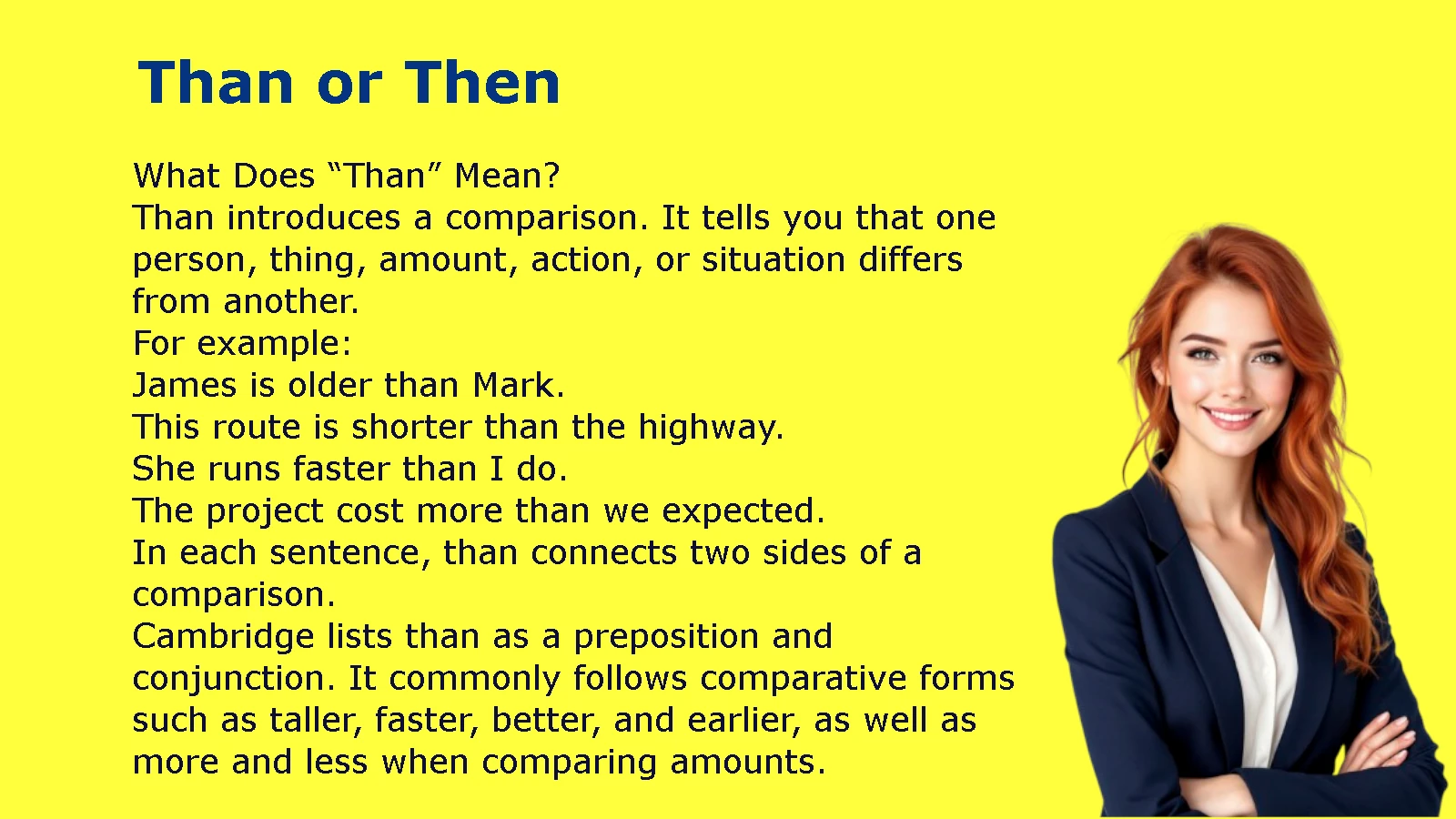
What Does “Than” Mean?
Than introduces a comparison. It tells you that one person, thing, amount, action, or situation differs from another.
For example:
- James is older than Mark.
- This route is shorter than the highway.
- She runs faster than I do.
- The project cost more than we expected.
In each sentence, than connects two sides of a comparison.
Cambridge lists than as a preposition and conjunction. It commonly follows comparative forms such as taller, faster, better, and earlier, as well as more and less when comparing amounts.
“Than” after comparative adjectives
Comparative adjectives frequently take than.
Examples include:
- taller than
- shorter than
- older than
- younger than
- faster than
- slower than
- larger than
- smaller than
- stronger than
- weaker than
- better than
- worse than
- easier than
- harder than
Consider these examples:
The blue car is faster than the red car.
Today’s test was harder than yesterday’s.
This explanation is clearer than the previous one.
The word than works because each sentence compares two things.
“Than” With More, Less, Better, and Worse
One of the most common places you’ll see than is after more or less.
Examples:
- She earns more than I do.
- The project took less time than expected.
- We need more information than we currently have.
- He spent less money than his brother.
- This option is better than the first one.
- The second result was worse than the first.
Cambridge specifically notes that than is used with more and less to compare numbers or amounts.
Common mistakes
❌ This costs more then that one.
✅ This costs more than that one.
❌ It took less then an hour.
✅ It took less than an hour.
❌ The new version is better then the old one.
✅ The new version is better than the old one.
The mistake happens because then sounds natural when spoken quickly. In writing, though, the comparison requires than.
“Than” With Rather
The expression rather than is another frequent source of mistakes.
Use than, not then.
Examples:
- I’d rather walk than drive.
- She chose tea rather than coffee.
- We decided to stay home rather than go out.
- He focused on quality rather than speed.
Here, rather than introduces an alternative or preference.
Rather than vs. rather then
❌ I’d rather stay home then go out.
✅ I’d rather stay home than go out.
The second sentence compares two choices. That’s why than belongs there.
“Than” With Other
The phrase other than generally means except, apart from, or besides.
Examples:
- I don’t know anyone other than Sarah.
- Other than Monday, I’m available all week.
- Do you need anything other than the receipt?
- The store sells nothing other than handmade furniture.
The MLA Style Center gives other than as another established use of than.
This isn’t always an obvious comparison. That’s why the broader rule is useful: than has established grammatical uses beyond basic adjective comparisons.
What Does “Then” Mean?
Then has several meanings, but most of them connect to time, order, or consequence.
You can use then to mean:
- at that time
- next
- after that
- in that case
- as a result
- in addition
- belonging to a particular time
Cambridge lists these different uses, including time, sequence, addition, and result.
That’s why the shortcut “then means next” isn’t quite enough.
“Then” for Time
Use then when you mean at that time.
The time can be in the past or future.
Examples:
- I lived in Boston then.
- She was only sixteen then.
- I’ll call you then.
- We didn’t know the answer then.
- By then, everyone had left.
In these sentences, then points to a particular time.
Compare:
I was much younger then.
Here, then means “at that time.”
But:
I was younger than my sister.
Here, than introduces a comparison.
The difference becomes obvious once you identify what the word connects.
Cambridge gives then the meaning “at that time” for both past and future references.
“Then” for Sequence
Use then when one event follows another.
Think:
First → next → then
Examples:
First, wash the vegetables. Then, cut them into small pieces.
She finished her homework and then watched TV.
Open the document, then select the settings menu.
We had dinner and then went for a walk.
Here, then means something close to next or after that.
Cambridge identifies this as one of the basic uses of then, with examples involving instructions and events that occur one after another.
A useful replacement test
If you can replace then with next or after that, then is usually correct.
Finish your work, then call me.
Try the substitution:
Finish your work, after that, call me.
The meaning still works.
That tells you you’re dealing with then, not than.
“Then” for a Result or Consequence
This use often appears in if…then sentences.
Examples:
- If you study, then you’ll improve.
- If the weather gets worse, then we’ll leave.
- If you agree, then we can begin.
- If the price is too high, then we’ll choose another option.
In these sentences, then introduces the result that follows from the condition.
The basic structure is:
If X happens, then Y happens.
For example:
If you finish the assignment, then you can go home.
The first clause establishes a condition. The second clause gives the consequence.
Cambridge specifically describes this use of then as meaning “as a result” or “in that case.”
Do you always need “then” after “if”?
No.
English often leaves then out:
If you finish the assignment, you can go home.
That’s completely grammatical.
Adding then can make the relationship between the condition and result more explicit:
If you finish the assignment, then you can go home.
So don’t assume every if sentence requires then. The word is optional in many ordinary constructions.
“Then” to Mean “In That Case”
Sometimes then means something like in that case.
For example:
If that’s your decision, then I’ll support you.
This means:
If that’s your decision, in that case, I’ll support you.
Another example:
You don’t want dessert? Then I’ll have it.
Here, then responds to the situation that was just mentioned.
This use is common in everyday conversation because it lets speakers connect a conclusion to something someone has just said.
“Then” as a Reference to a Former Time
Then can also describe something that was true at a particular time but isn’t necessarily true now.
For example:
The then president announced the policy.
Here, then president means the person who was president at that time.
Another example:
The then CEO approved the deal.
The phrase doesn’t necessarily say that person is still CEO. It identifies the person who held that position during the period being discussed.
Cambridge lists this as an adjective use of then, while the MLA Style Center also explains this function with examples such as “the then treasurer.”
Than or Then: How to Tell Which One You Need
When you’re stuck between than or then, don’t guess based on how the sentence sounds. Use the meaning.
Ask whether you’re making a comparison
If you’re comparing two things, use than.
My phone is newer than yours.
This route is shorter than the other route.
She works faster than I do.
The blue shirt looks better than the black one.
Ask whether you’re talking about what happens next
If one event follows another, use then.
Finish your lunch and then leave.
She called her mother and then went home.
Ask whether you’re referring to a particular time
If you mean “at that time,” use then.
I lived there then.
Things were different then.
Ask whether you’re showing a consequence
If you mean “in that case” or “as a result,” use then.
If the store is closed, then we’ll come back tomorrow.
This four question test handles most everyday cases.
Than vs. Then Examples
The following table shows how easily one letter can change the meaning or correctness of a sentence.
| Incorrect or confusing | Correct | Reason |
| She is taller then me. | She is taller than me. | Comparison |
| Finish this than call me. | Finish this, then call me. | Sequence |
| It’s better then before. | It’s better than before. | Comparison |
| I’ll eat and than leave. | I’ll eat and then leave. | Sequence |
| I’d rather stay then go. | I’d rather stay than go. | Preference |
| If you agree, than we’ll start. | If you agree, then we’ll start. | Result |
| I was happier than. | I was happier then. | Time |
| It costs more then $50. | It costs more than $50. | Amount comparison |
| Do this than press Enter. | Do this, then press Enter. | Sequence |
| Other then Monday, I’m free. | Other than Monday, I’m free. | Established phrase |
| No later then Friday. | No later than Friday. | Comparison of timing |
| She arrived and than sat down. | She arrived and then sat down. | Sequence |
The most important thing to notice is that than and then aren’t interchangeable. Their spelling difference reflects a difference in grammatical function.
Common “Than” vs. “Then” Mistakes
More Than vs. More Then
The correct phrase is more than when you compare quantities.
The building has more than 20 floors.
She spent more than expected.
I waited for more than an hour.
Use then only when you’re talking about time, sequence, or consequence.
I’ll finish this, then I’ll call you.
Better Than vs. Better Then
Use better than for a comparison.
This solution is better than the old one.
I feel better than I did yesterday.
Use then when you mean “at that time”:
I didn’t feel better then.
The first sentence compares two states. The second refers to a point in time.
Rather Than vs. Rather Then
The established expression is rather than.
I’d rather walk than take a taxi.
She chose to study rather than go out.
Don’t write:
❌ I’d rather walk then take a taxi.
Other Than vs. Other Then
The correct phrase is other than.
I don’t need anything other than a pen.
No one other than John knew about the meeting.
Again, the phrase uses than, not then.
Less Than vs. Less Then
Use less than when comparing an amount.
The trip takes less than two hours.
The box weighs less than five pounds.
This is one of the clearest comparison patterns in English.
No Later Than vs. No Later Then
The correct phrase is no later than.
Please submit the application no later than Friday.
Arrive no later than 8:00 a.m.
The construction compares a deadline with the latest acceptable time.
Than or Then in Everyday Writing
These two words appear everywhere, from text messages to formal reports.
At Work
Consider these sentences:
The revised proposal is more detailed than the original.
I’ll review the proposal and then send my comments.
The first sentence compares two documents.
The second describes a sequence of actions.
A small spelling mistake can therefore change the grammatical relationship in the sentence.
In School
Students commonly encounter both words in academic writing:
The second experiment produced better results than the first.
First, record the measurements. Then, calculate the average.
The first sentence compares results. The second gives instructions in sequence.
In Text Messages
Casual writing often creates confusion because people type quickly.
Someone might write:
I’ll call you then.
That’s correct if they mean at that time.
But:
You’re better than me at this.
That’s correct because it compares two people.
Even in informal messages, knowing the distinction helps prevent confusing or distracting errors.
Than or Then in Professional and Academic Writing
The distinction becomes especially important when writing about results, data, arguments, performance, costs, and procedures.
For example:
Group A performed better than Group B.
This sentence makes a comparison.
Now consider:
The researchers collected the data and then analyzed the results.
This sentence describes a process.
A professional report might contain both:
The second treatment produced fewer side effects than the first. Researchers then analyzed the results across both groups.
The two words perform completely different jobs even though they appear close together.
Than or Then With Pronouns
The choice between than I and than me creates a separate grammar question.
Consider:
She is taller than I am.
and:
She is taller than me.
Both constructions occur in modern English. The first makes the comparison explicit by using a full clause. The second treats than as a preposition followed by the pronoun me. The MLA Style Center notes that than can function as either a conjunction or preposition.
Than I am
She is taller than I am.
The implied comparison is:
She is taller than I am tall.
That full form sounds awkward, but the grammatical structure is clear.
Than me
She is taller than me.
This is common in everyday American English.
For formal writing, expanding the comparison can sometimes remove ambiguity.
“Than I” vs. “Than Me”: Why Context Matters
Some sentences become genuinely ambiguous when you don’t complete the comparison.
Consider:
John likes Sarah more than me.
This can have two meanings:
- John likes Sarah more than he likes me.
- John likes Sarah more than I like Sarah.
You can eliminate the ambiguity by completing the thought.
Meaning one
John likes Sarah more than he likes me.
Meaning two
John likes Sarah more than I do.
This is a useful lesson beyond than vs. then: sometimes the clearest sentence isn’t the shortest one.
Is “Than” a Conjunction or a Preposition?
Than can function as both a conjunction and a preposition.
As a conjunction, it can introduce a clause:
She is older than I am.
As a preposition, it can be followed by a noun or pronoun:
She is older than me.
The technical distinction matters in grammar discussions, but most writers don’t need to analyze the parts of speech every time they use than.
The practical point is simpler:
Than introduces a comparison.
That rule remains useful whether the comparison contains a full clause or a shorter phrase.
Is “Then” Always About Time?
No.
This is one of the most important details to understand.
Then can refer to time:
I lived there then.
It can show sequence:
Finish the report and then send it.
It can show a result:
If the plan fails, then we’ll try another approach.
It can mean “in that case”:
If you don’t want it, then I’ll take it.
It can also refer to a former status:
The then manager approved the proposal.
Cambridge’s entries for then include time, sequence, result, and other uses.
So the rule “then = time” is helpful as a starting point, but it isn’t complete.
Are “Than” and “Then” Homophones?
Than and then can sound extremely similar, especially in connected speech. Cambridge gives than the pronunciations /ðæn/ and the weaker /ðən/ in its American English entry, while then is represented as /ðen/.
Their similar sound explains why people frequently confuse them in writing.
However, spelling should follow meaning, not sound.
Think of it this way:
Your ears hear the sound. Your sentence tells you which word to write.
If the sentence compares two things, write than.
If the sentence refers to time, sequence, or a result, write then.
Easy Memory Tricks for Than vs. Then
The main memory trick
Remember:
Than = comparison.
Then = time or sequence.
That’s the most reliable shortcut.
Use the “comparison” test
Ask:
Am I comparing two things?
If yes, choose than.
This coffee is stronger than that one.
Use the “next” test
Ask:
Could I replace this word with “next” or “after that”?
If yes, choose then.
Finish your breakfast, then brush your teeth.
Use the “at that time” test
Ask:
Could I replace it with “at that time”?
If yes, choose then.
I didn’t understand it then.
Remember the letters
A simple visual reminder can also help:
ThAN → comparison
ThEN → timE
It isn’t a grammar rule. It’s simply a memory device.
Than or Then: A Practical Decision Tree
When you’re editing a sentence, run through this sequence:
Are you comparing two things?
→ Yes: Use than.
No.
Are you talking about what happens next?
→ Yes: Use then.
No.
Are you referring to a particular time?
→ Yes: Use then.
No.
Are you showing a result or saying “in that case”?
→ Yes: Use then.
This approach is more dependable than trying to memorize dozens of isolated phrases.
Than vs. Then: Real Sentence Patterns
Certain structures make the correct choice almost automatic.
Comparative adjective + than
bigger than
faster than
older than
better than
Example:
The new engine is more efficient than the old one.
More or less + than
more than
less than
Example:
The repair took less than an hour.
Rather + than
rather than
Example:
She chose to walk rather than wait.
First + then
First, check the settings. Then, restart the device.
Event + then + event
He finished his shift and then went home.
If + condition + then + result
If the weather improves, then we’ll go hiking.
Recognizing these patterns can make proofreading much faster.
Than or Then: Common Questions
Is it “better than” or “better then”?
Better than is correct when you’re comparing two things.
This model is better than the previous one.
Is it “more than” or “more then”?
Use more than for a comparison or amount.
The book has more than 300 pages.
Is it “rather than” or “rather then”?
The correct expression is rather than.
I’d rather stay home than go out.
Is it “other than” or “other then”?
Use other than.
I don’t need anything other than your approval.
Is it “no later than” or “no later then”?
Use no later than.
Please arrive no later than 9 a.m.
Is “then” used for time?
Yes.
I was living in New York then.
It can mean at that time.
Is “then” used for sequence?
Yes.
Finish the first task, then start the second.
Here, it means next or after that.
Is “than” only used after adjectives?
No.
Than can introduce comparisons involving quantities, adverbs, nouns, pronouns, preferences, and other structures.
Examples:
She runs faster than I do.
It costs more than expected.
I’d rather read than watch television.
I need nothing other than your signature.
Can “then” appear in an if sentence?
Yes.
If you finish early, then you can leave.
The word introduces the result or consequence. However, English often omits it:
If you finish early, you can leave.
Both are grammatical.
Can “than” refer to time?
Not in the ordinary sense of then.
If you mean at that time, use then:
I was living there then.
If you’re comparing something, use than:
I was younger than my brother.
Than or Then Practice Quiz
Choose than or then in each sentence.
Questions
- This book is better ___ the other one.
- Finish your work and ___ take a break.
- She was much younger ___.
- I’d rather walk ___ drive.
- The project cost more ___ expected.
- If you’re ready, ___ let’s begin.
- We ate dinner and ___ watched a movie.
- He runs faster ___ his brother.
- Nothing ___ a complete redesign will solve the problem.
- Things were different ___.
- The second option is cheaper ___ the first.
- First, save the file. ___ close the program.
- I haven’t seen her since ___.
- The new process is more efficient ___ the old one.
- If that happens, ___ we’ll need another plan.
Answer Key
| # | Answer | Why |
| 1 | than | Compares two books |
| 2 | then | Shows the next action |
| 3 | then | Refers to a past time |
| 4 | than | Compares two choices |
| 5 | than | Compares an amount |
| 6 | then | Introduces a result |
| 7 | then | Shows sequence |
| 8 | than | Compares speed |
| 9 | than | Used in the comparison phrase “other than” |
| 10 | then | Means “at that time” |
| 11 | than | Compares prices |
| 12 | then | Shows the next step |
| 13 | then | Refers to a previous time |
| 14 | than | Compares efficiency |
| 15 | then | Introduces a consequence |
A Simple Case Study: How One Letter Changes the Meaning
Consider these two sentences:
The new model is faster than the old one.
and:
The new model is tested, then shipped.
The first sentence answers:
Which model is faster?
It compares two models. Therefore, than is correct.
The second sentence answers:
What happens after testing?
Shipping follows testing. Therefore, then is correct.
Now put both words into one sentence:
The new model is faster than the old one, and it is tested before it is then shipped.
The sentence is a little formal, but it demonstrates the point. Than handles the comparison. Then handles sequence.
This is why meaning matters more than pronunciation.
Than vs. Then: A Final Comparison
| Question | Use Than | Use Then |
| Are you comparing two things? | ✓ | |
| Are you comparing amounts? | ✓ | |
| Are you using “more” or “less”? | ✓ | |
| Are you using “rather than”? | ✓ | |
| Are you using “other than”? | ✓ | |
| Do you mean “at that time”? | ✓ | |
| Do you mean “next”? | ✓ | |
| Do you mean “after that”? | ✓ | |
| Are you showing a result? | ✓ | |
| Do you mean “in that case”? | ✓ | |
| Are you referring to a former position or status? | ✓ |
Final Rule: Than = Comparison, Then = Time or Sequence
The difference between than or then becomes much easier once you stop relying on how the words sound.
Use than when you compare:
This option is cheaper than the other one.
Use then when you describe time:
I lived there then.
Use then when you describe sequence:
Finish the first step, then move to the second.
Use then when you show a result:
If the plan fails, then we’ll try something else.
The simplest rule to carry with you is:
Than compares. Then connects time, sequence, or consequence.
When you’re unsure, look at the relationship between the ideas in the sentence. If one thing is being measured against another, choose than. If one event follows another, a condition leads to a result, or you’re pointing to a particular time, choose then.
Once you see that distinction, this commonly confused pair becomes much easier to get right.