Have you ever read a sentence about swathes of people, swathes of land, or swathes of countryside and wondered exactly what it means? While Swathes Meaning may look confusing at first, the word has a simple meaning once you understand how it is used in a sentence.
Swathes is the plural form of swathe, which means large areas or broad sections of something. It is often used to describe large stretches of land, groups of people, or parts of something that share a particular quality.
Examples:
- Swathes of farmland were damaged by the storm.
- The policy affected swathes of the population.
The confusion is understandable. People often search for what does swathes mean, swathes meaning in English, swathes meaning in a sentence, or swathes of land meaning because the word can have slightly different meanings depending on the context. And here’s the kicker: swathe can also mean a long strip or band of material wrapped around something.
In this guide, you’ll learn the complete Swathes Meaning, its definition, pronunciation, origin, correct usage, and examples in sentences. You’ll also discover the difference between swathe and swathes, common phrases such as swathes of land, and how to use this word naturally in everyday English.
What Does “Swathes” Mean?
Swathes has two main grammatical uses.
As a plural noun, swathes means large areas, broad stretches, or long strips of something. The word often describes land, forests, countryside, clouds, sunlight, or other things that occupy a broad area.
As a verb, swathes means wraps or covers something. This use normally appears in formal or descriptive writing.
Here’s the simplest way to remember the difference:
| Use | Meaning | Example |
| Swathes as a noun | Large areas or broad stretches | Swathes of forest were destroyed. |
| Swathes as a verb | Wraps or covers | Mist swathes the valley. |
Oxford defines the noun swathe as a long piece of land or a large piece or area of something. It also identifies swath as a variant.
Cambridge similarly defines swathe as a “long strip or large area,” particularly of land. It also recognizes its use for a large part of something such as public opinion.
Swathes as a Noun
When swathes works as a noun, it is the plural form of swathe.
For example:
Vast swathes of farmland surround the village.
Here, swathes means large areas or stretches of farmland.
The word often creates an image of something broad and continuous rather than a tiny, isolated patch. If someone says “a swathe of forest,” imagine a broad stretch of trees extending across a landscape.
You can use it for both literal and figurative areas:
- swathes of farmland
- swathes of forest
- swathes of countryside
- swathes of rainforest
- swathes of desert
- swathes of cloud
- swathes of sunlight
- swathes of the population
- swathes of public opinion
The noun can therefore describe physical space as well as a broad section of people or ideas.
Swathes as a Verb
The word swathes can also be the third person singular form of the verb swathe.
In this use, it means wraps, covers, or surrounds something.
For example:
Morning mist swathes the hills.
The sentence doesn’t mean that the mist occupies a large area in the noun sense. Instead, it means that the mist covers or envelops the hills.
Oxford lists swathe as a formal verb meaning “to wrap or cover somebody/something in something.” Its verb forms include swathe, swathes, swathed, and swathing.
Other examples include:
- The patient was swathed in bandages.
- Fog swathes the mountain each morning.
- The designer swathes the model in silk.
- Snow swathes the rooftops.
- The valley is swathed in mist.
This verb often appears in descriptive writing because it gives the reader a strong visual image.
Swathes Meaning in Simple English
In simple English, swathes means large areas or broad stretches when it functions as a noun.
For example:
“Large swathes of forest were destroyed.”
Simply put, this means:
“Large areas of forest were destroyed.”
When swathes functions as a verb, it means covers or wraps.
For example:
“Fog swathes the city.”
This means:
“Fog covers the city.”
The table below makes the distinction easy to see:
| Sentence | Meaning of “swathes” |
| Large swathes of forest disappeared. | Large areas |
| Vast swathes of farmland were flooded. | Broad areas |
| Swathes of sunlight entered the room. | Broad stretches |
| The village was swathed in fog. | Covered or surrounded |
| She swathes the fabric around the statue. | Wraps or covers |
A useful trick is to look at what comes immediately after the word. If you see “swathes of”, the word is usually a plural noun. If you see a subject directly performing the action, such as “mist swathes the valley,” it is a verb.
Swathes Pronunciation
The pronunciation of swathes can confuse English learners because swathe has different pronunciations in British and American English.
Cambridge gives /sweɪð/ for the British pronunciation of swathe and /swɑːθ/ or /swɑθ/ for the American pronunciation.
A simple pronunciation guide is:
- British: “swayth”
- American: roughly “swahth”
The final sound also changes between the two varieties.
For the British pronunciation, the ending sounds like the “th” in “breathe.” For the American pronunciation, the ending is closer to the “th” in “bath.”
How to Pronounce “Swathes”
When swathes is the plural noun, the British pronunciation can be thought of as:
swathes = “swaythz”
When you’re reading an American text, you may encounter swaths instead. Its pronunciation is generally closer to:
swaths = “swawths”
Don’t let the spelling trip you up. The meaning becomes much easier once you recognize the noun and verb forms.
Swathes vs. Swaths
One of the most common questions about swathes concerns swaths.
The two words can represent the same noun idea. Swathe and swath are variant forms of the noun. Oxford’s American dictionary lists swathe as another form of swath.
The main difference comes down to regional usage and pronunciation.
| Word | Common association | Meaning |
| Swathe | British English | A long strip or large area |
| Swath | American English | A long strip or large area |
| Swathes | British plural | Large areas or stretches |
| Swaths | American plural | Large areas or stretches |
For example:
British English:
Vast swathes of countryside have changed.
American English:
Vast swaths of countryside have changed.
Neither version changes the basic idea. The choice mainly reflects the variety of English being used.
Cambridge explicitly lists swath as a noun variant of swathe.
Is “Swathes” American or British?
Swathes is especially common in British English, while swaths is particularly common in American English.
That doesn’t mean an American reader will find swathes incorrect. It simply has a stronger British flavor in ordinary usage.
If you’re writing for a US audience, swaths will often sound more natural:
Vast swaths of the country experienced drought.
If you’re following British English conventions, swathes may be the more natural choice:
Vast swathes of the country experienced drought.
The important point is consistency. Choose the form that fits the variety of English you’re using.
Swathes vs. Swathe
Swathe is the singular noun, while swathes is its plural form.
Consider these examples:
- A swathe of forest was cleared.
- Several swathes of forest were cleared.
The first sentence talks about one broad area. The second talks about multiple broad areas.
However, there’s a second grammatical distinction. Swathe can also function as a verb.
| Form | Part of speech | Meaning | Example |
| Swathe | Noun | One large area or strip | A swathe of land |
| Swathes | Noun | More than one large area or strip | Vast swathes of land |
| Swathe | Verb | Wrap or cover | They swathe the statue in cloth. |
| Swathes | Verb | Wraps or covers | Mist swathes the valley. |
| Swathed | Verb | Wrapped or covered | The valley was swathed in fog. |
| Swathing | Verb | Wrapping or covering | The workers were swathing the pipes. |
This distinction matters because the same spelling can look familiar while performing a completely different grammatical job.
How “Swathes” Is Used in a Sentence
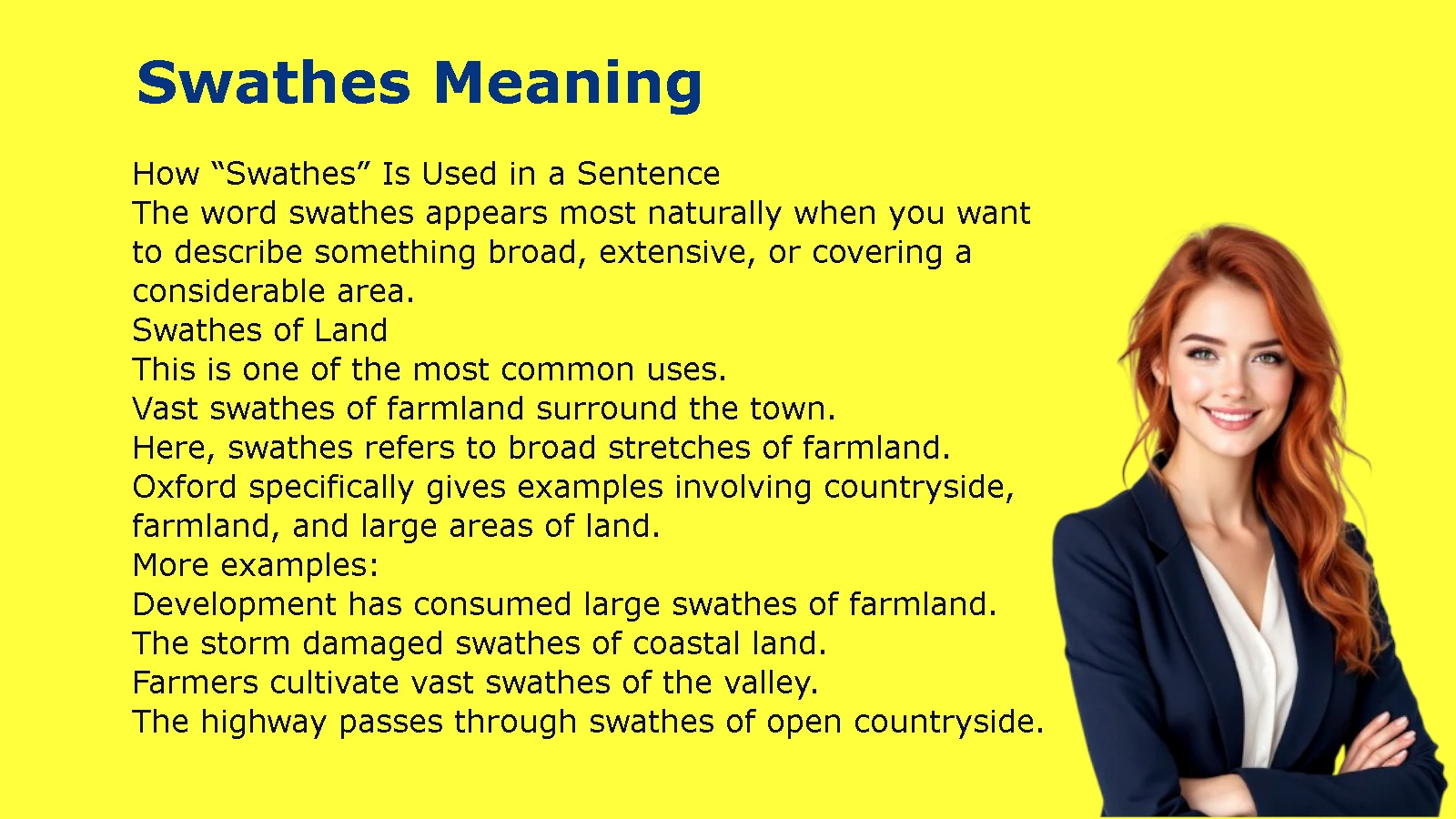
The word swathes appears most naturally when you want to describe something broad, extensive, or covering a considerable area.
Swathes of Land
This is one of the most common uses.
Vast swathes of farmland surround the town.
Here, swathes refers to broad stretches of farmland.
Oxford specifically gives examples involving countryside, farmland, and large areas of land.
More examples:
- Development has consumed large swathes of farmland.
- The storm damaged swathes of coastal land.
- Farmers cultivate vast swathes of the valley.
- The highway passes through swathes of open countryside.
Swathes of Forest
The word works especially well when describing forests because a forest can cover a broad, continuous area.
The wildfire destroyed huge swathes of forest.
The sentence means that the fire destroyed large areas of forest.
You may also see:
- swathes of rainforest
- swathes of woodland
- swathes of jungle
- swathes of trees
Cambridge gives the example of huge swathes of rainforest being cleared for farming and mining.
Swathes of People
The word can move beyond geography.
For example:
The policy attracted support from broad swathes of the population.
Here, swathes doesn’t refer to physical land. It means large sections or groups of people.
This use is common in journalism, politics, social commentary, and formal writing.
You might read:
- broad swathes of voters
- large swathes of the population
- wide swathes of society
- broad swathes of the public
The meaning is essentially large sections of a group.
Swathes of Public Opinion
Another established figurative use involves opinions and viewpoints.
The proposal received support from a wide swathe of public opinion.
Cambridge specifically identifies swathe as a literary term for a large part of something that includes several different things, giving public opinion as an example.
This usage helps writers avoid repeating words such as part, section, or group.
Compare:
A large part of the population supported the plan.
with:
A broad swathe of the population supported the plan.
The second version sounds more formal and emphasizes the breadth of the group.
Swathes of Color, Light, or Cloud
Writers also use swathe for something that appears as a broad visual strip.
For example:
A swathe of sunlight stretched across the wooden floor.
Or:
Dark clouds formed a swathe across the horizon.
Oxford provides examples involving thick cloud and sunlight.
This use is especially effective in descriptive writing because the word suggests a shape that stretches across a surface.
Common Phrases With “Swathes”
Large Swathes of Forest
This means large areas of forest.
Mining has affected large swathes of forest.
Swathes of Countryside
This phrase refers to broad areas of rural land.
New development threatens swathes of countryside.
Swathes of the Population
This means large sections of the population.
The reform could affect broad swathes of the population.
Swathes of Public Opinion
This describes broad sections of people who share a particular opinion.
The proposal has won support across wide swathes of public opinion.
Swathes of Sunlight
This describes a broad area of light.
Swathes of sunlight poured through the windows.
Swathes of Cloud
This refers to a broad stretch or mass of cloud.
Swathes of cloud covered the mountain peaks.
These combinations work because swathe emphasizes breadth and extent. It gives a stronger sense of scale than a simple word such as area.
What Does “Cut a Swathe Through” Mean?
The phrase “cut a swathe through something” is an established idiom.
It means to move through an area while destroying a large part of it.
For example:
The wildfire cut a swathe through the forest.
The meaning is that the wildfire moved through the forest and destroyed a large area.
Oxford defines the idiom as describing a person, fire, or other force passing through an area while destroying a large part of it.
The phrase has a strong connection to the original agricultural sense of swathe. A scythe cuts a strip through grass or crops. The modern figurative expression carries that image into other contexts.
Examples of “Cut a Swathe Through”
- The hurricane cut a swathe through the coastal region.
- The fire cut a destructive swathe through the woodland.
- The construction project cut a swathe through the hillside.
- The army cut a swathe through the countryside.
The phrase doesn’t always describe literal destruction. Writers can also use it more broadly to emphasize a dramatic effect.
Swathes Word Origin
The history of swathe reaches back more than a thousand years.
Oxford traces the noun to Old English swæth or swathu, meaning a track or trace. It relates to words found in other Germanic languages. Oxford also explains that the Middle English sense referred to a measure of the width of grassland, probably based on the sweep of a mower’s scythe.
That history helps explain the modern meaning.
Picture a farmer swinging a scythe through a field. Each sweeping movement cuts a strip of grass. That strip becomes a swathe.
Over time, the word developed a broader sense: a strip, stretch, or area.
Etymological sources also trace the verb to Old English swathian, meaning to swathe or wrap.
So the noun and verb have an old connection:
Noun: a strip or area
Verb: to wrap or cover
Both ideas involve something being spread, enclosed, or marked across an area.
Swathes as a Figurative Word
One reason swathes appears so often in polished writing is its ability to move from a physical meaning to an abstract one.
A literal swathe might be:
a broad strip of forest
A figurative swathe might be:
a broad section of society
The physical image remains underneath the figurative meaning. You’re essentially imagining a broad section being drawn across a larger whole.
This makes swathe more vivid than some plain alternatives.
Compare:
The change affected a large part of society.
with:
The change affected a broad swathe of society.
Both sentences communicate the basic idea. The second creates a stronger sense of breadth and range.
Swathes vs. Areas, Stretches, and Expanses
These words overlap, but they don’t always sound the same.
| Word | Main idea | Example |
| Swathe | A broad strip or section | A swathe of forest |
| Area | A general region or space | An area of forest |
| Stretch | A continuous length or extent | A stretch of forest |
| Expanse | A wide, open area | A vast expanse of forest |
| Tract | A defined area, often of land | A tract of farmland |
| Section | A part of a larger whole | A section of the forest |
Swathe often suggests a broad strip or sweep.
Area is more neutral.
Expanse emphasizes openness or size.
Tract often sounds technical or geographical.
Section works for almost anything but lacks the visual quality of swathe.
Choosing among them depends on the image you want the sentence to create.
Synonyms for Swathes
The best synonym depends on which meaning you’re using.
When “Swathes” Means Large Areas
Useful alternatives include:
- areas
- stretches
- expanses
- tracts
- regions
- sections
- portions
- parts
- belts
- strips
For example:
Vast swathes of forest were destroyed.
could become:
Vast areas of forest were destroyed.
or:
Large stretches of forest were destroyed.
However, these aren’t perfect substitutes in every sentence. Swathe often carries a stronger sense of a broad, continuous strip.
When “Swathes” Means Wraps or Covers
Useful alternatives include:
- wraps
- covers
- surrounds
- envelops
- drapes
- encases
- enfolds
- conceals
For example:
Mist swathes the valley.
could become:
Mist covers the valley.
Or:
Mist envelops the valley.
Envelops can preserve some of the atmospheric quality that swathes creates.
Examples of “Swathes” in Sentences
Here are examples covering the most important uses of the word:
- Vast swathes of farmland were affected by the drought.
- The fire destroyed large swathes of woodland.
- Development has transformed broad swathes of countryside.
- The road passes through swathes of open desert.
- Huge swathes of rainforest face continued pressure from development.
- The reform could affect broad swathes of the population.
- The proposal has support across wide swathes of public opinion.
- A swathe of sunlight crossed the room.
- Dark clouds formed a broad swathe across the sky.
- The hurricane cut a swathe through the coastal region.
- Morning mist swathes the hills.
- The injured man’s arm was swathed in bandages.
- The designer swathes the figure in flowing fabric.
- Snow swathes the mountain village in white.
- Fog swathes the valley before sunrise.
Notice how context tells you whether the word refers to an area or an action.
Common Mistakes With “Swathes”
Although the word isn’t especially difficult once you understand it, several mistakes appear regularly.
Mistake: Confusing Swathe and Swathes
Don’t use swathes when you mean one area.
Incorrect:
A swathes of forest surrounds the village.
Correct:
A swathe of forest surrounds the village.
For multiple areas:
Swathes of forest surround the village.
Mistake: Assuming Swathes Only Refers to Land
Land is one of its most common uses, but it isn’t the only one.
You can also have:
- swathes of sunlight
- swathes of cloud
- swathes of people
- swathes of public opinion
- swathes of society
The core idea is a broad section or area.
Mistake: Confusing Swathes With Swathed
These forms perform different jobs.
Swathes can mean:
covers or wraps
Swathed means:
covered or wrapped
Compare:
Mist swathes the valley.
The valley is swathed in mist.
Oxford lists swathed as the past tense and past participle of swathe.
Mistake: Assuming Swaths Is Incorrect
Swaths is not an incorrect spelling.
It is the common American noun form of the word. Dictionaries recognize swath as a variant of swathe.
So these are both legitimate:
Vast swathes of countryside
Vast swaths of countryside
The choice often depends on regional English.
Is “Swathes” Singular or Plural?
When swathes functions as a noun, it is plural.
The singular is:
swathe
The plural is:
swathes
For example:
A swathe of forest was cleared.
Several swathes of forest were cleared.
However, swathes can also be a singular verb form because it is the third person singular form of swathe.
For example:
The fog swathes the valley.
Here, swathes is not plural. It is a verb.
A quick test helps:
“swathes of + noun” → usually plural noun
“subject + swathes + object” → verb
For example:
Swathes of land were flooded.
Noun.
Fog swathes the land.
Verb.
Is “Swathes” Formal or Informal?
Swathes is generally more formal than everyday conversational vocabulary.
You might use area or part in casual conversation:
A large part of the forest burned.
In formal writing, journalism, or descriptive prose, you might encounter:
A vast swathe of forest burned.
The second sentence has a more polished and visual quality.
That doesn’t mean you should force the word into every sentence. If area communicates the idea clearly, there’s no reason to replace it.
Use swathe when it adds something useful, particularly a sense of breadth, extent, or visual shape.
A Quick Grammar Guide to Swathe and Swathes
| Word | Function | Example |
| Swathe | Singular noun | A swathe of grass |
| Swathes | Plural noun | Several swathes of grass |
| Swath | Variant singular noun | A swath of land |
| Swaths | Variant plural noun | Several swaths of land |
| Swathe | Base verb | They swathe the statue in cloth. |
| Swathes | Third person singular verb | Fog swathes the valley. |
| Swathed | Past tense/past participle | The valley was swathed in fog. |
| Swathing | Present participle | Workers were swathing the pipes. |
Keeping this table in mind can eliminate most grammatical confusion around the word.
Swathes Meaning in Different Contexts
The meaning stays connected to the idea of breadth or covering, but the context changes the exact interpretation.
Geography
The country contains vast swathes of desert.
Meaning: large areas of desert.
Agriculture
The machine left neat swathes of cut grass.
Meaning: long strips or rows of cut grass.
Environment
Mining has affected large swathes of rainforest.
Meaning: large areas of rainforest.
Society
The policy affects broad swathes of the population.
Meaning: large sections of the population.
Public Opinion
The idea has attracted support from a wide swathe of voters.
Meaning: a broad section of voters.
Weather
Fog swathes the valley.
Meaning: fog covers or envelops the valley.
Clothing and Fabric
She swathed herself in a long silk scarf.
Meaning: she wrapped herself in the scarf.
The surrounding words usually make the intended meaning obvious.
A Practical Way to Remember “Swathes”
Think of swathes as a word with two visual ideas:
A broad strip → swathe
A covering layer → swathe
Imagine a farmer cutting a wide strip through a field. That’s a swathe.
Now imagine someone wrapping a blanket around themselves. To swathe them means to cover or wrap them.
Those two pictures make the word much easier to remember.
Case Study: Understanding “Swathes” in a News Sentence
Consider this sentence:
“The wildfire destroyed vast swathes of woodland.”
A reader unfamiliar with swathes might pause at the word.
Replace it with a simpler term:
The wildfire destroyed vast areas of woodland.
The meaning becomes immediately clear.
Now look at another sentence:
“The valley was swathed in fog.”
Replace swathed:
The valley was covered in fog.
Again, the meaning becomes clear.
This comparison reveals an important distinction:
- Swathes as a noun → large areas
- Swathed as a verb form → covered or wrapped
Once you know those two meanings, the word becomes much less intimidating.
Why Writers Use “Swathes”
The word swathes does more than replace areas. It can create a stronger image.
Compare:
Large areas of sunlight entered the room.
with:
Broad swathes of sunlight entered the room.
The second sentence makes the sunlight feel more like a visible strip spreading across the room.
Likewise:
Large areas of forest were destroyed.
is straightforward.
Vast swathes of forest were destroyed.
sounds more expansive. It draws attention to the scale and sweep of the destruction.
That descriptive quality explains why the word appears frequently in journalism, formal writing, environmental reporting, and literary descriptions.
Frequently Asked Questions About Swathes
What does “swathes” mean?
Swathes usually means large areas, broad stretches, or long strips of something. It can also be the verb form meaning wraps or covers.
What is the difference between swathes and swaths?
Swathes and swaths are plural noun forms connected to swathe/swath. Swathes is especially common in British English, while swaths is especially common in American English.
Is swathes a plural word?
Yes, when swathes functions as a noun, it is the plural of swathe.
However, swathes can also be a third person singular verb, as in “Fog swathes the valley.”
What does “vast swathes” mean?
Vast swathes means very large areas or broad stretches.
For example:
Vast swathes of forest were destroyed.
This means that very large areas of forest were destroyed.
What does “swathed” mean?
Swathed means wrapped or covered. It is the past tense and past participle of the verb swathe.
The mountain was swathed in mist.
This means the mist covered the mountain.
What is another word for swathes?
Depending on the context, alternatives include areas, stretches, expanses, tracts, sections, parts, and strips.
When swathe functions as a verb, alternatives include wraps, covers, surrounds, envelops, drapes, and encases.
How do you pronounce swathes?
In British English, swathe is pronounced /sweɪð/, roughly like “swayth.” In American English, swathe is pronounced /swɑθ/, with the noun commonly appearing as swath.
Is “swathes” American or British?
Swathes is particularly common in British English. American English commonly uses swaths for the noun. Both are recognized forms.
Can “swathes” refer to people?
Yes. In formal or literary writing, swathes can refer to large sections of a population or group.
The policy affects broad swathes of society.
Here, it means broad sections of society.
Can “swathes” describe things other than land?
Yes. It can describe cloud, sunlight, forests, public opinion, populations, society, and other broad areas or sections.
Is “swathe” a noun or a verb?
It can be both.
As a noun, it means a long strip or large area.
As a verb, it means to wrap or cover something.
Swathes Meaning at a Glance
| Feature | Answer |
| Word | Swathes |
| Main noun meaning | Large areas, broad stretches, or long strips |
| Verb meaning | Wraps or covers |
| Singular noun | Swathe |
| Plural noun | Swathes |
| American noun variant | Swath |
| American plural | Swaths |
| British pronunciation | /sweɪð/ for swathe |
| American pronunciation | /swɑθ/ for swathe/swath |
| Common phrase | Vast swathes of land |
| Related idiom | Cut a swathe through something |
| Word style | Often formal or literary |
| Example | Vast swathes of forest were destroyed. |
Final Takeaway: Swathes Meaning Explained
The easiest way to understand swathes meaning is to remember “large areas or broad stretches.” When you read about swathes of forest, swathes of farmland, or swathes of countryside, the writer means large areas or stretches of those things.
The word can also describe broad sections of people or ideas, as in “broad swathes of the population.” In this figurative use, it means large sections or groups.
There’s also a separate verb meaning. Swathes can mean wraps or covers, as in “mist swathes the valley.”
Finally, don’t confuse swathes with swaths. Both can serve as plural noun forms, but swathes is particularly common in British English while swaths is especially common in American English.
Once you recognize whether the word describes a broad area or an action that covers something, its meaning becomes straightforward. It may look like a fancy word at first, but at heart, swathes simply describes something broad, extensive, or covering a surface.