Successful is the correct spelling, while succesful is a common misspelling caused by leaving out one s. If you’ve come across “successful vs succesful” and wondered which spelling is correct, how to remember it, or why succesful is incorrect, the difference comes down to the correct spelling of the base word success and the suffix -ful.
The successful vs succesful difference is simple: successful is the standard English spelling, while succesful is incorrect. The word successful means achieving a desired goal, producing the intended result, or having achieved success. Related words and forms include success, successfully, succeed, achievement, accomplishment, prosperous, and effective, but each has a slightly different meaning or grammatical use.
In this guide, you’ll learn which spelling is correct, why “successful” has two s’s before “ful,” what “successful” means, how to use it in sentences, and why “succesful” is a common spelling mistake. You’ll also see clear examples and an easy way to remember the correct spelling.
By the end, you’ll know exactly why successful is correct and how to use this commonly misspelled word naturally and correctly in your writing.
Successful vs Succesful at a Glance
Here is the essential difference:
| Spelling | Correct? | Explanation |
| successful | ✅ Yes | Standard English spelling |
| succesful | ❌ No | Common misspelling |
| successfully | ✅ Yes | Correct adverbial form |
| succesfully | ❌ No | Common misspelling |
| unsuccessful | ✅ Yes | Correct negative form |
| unsuccesful | ❌ No | Incorrect spelling |
Successful is an adjective. It describes a person, action, attempt, business, project, event, or other thing that achieves a desired or positive result.
For example:
- She had a successful interview.
- The experiment was successful.
- They launched a successful business.
- His second attempt was successful.
- The campaign was highly successful.
Major English dictionaries recognize successful as the standard form. Cambridge defines it as achieving the results wanted or hoped for and also uses it for people or things that have achieved a lot, become popular, or made money.
The form succesful, by contrast, is not an alternative English spelling. It is simply a spelling error.
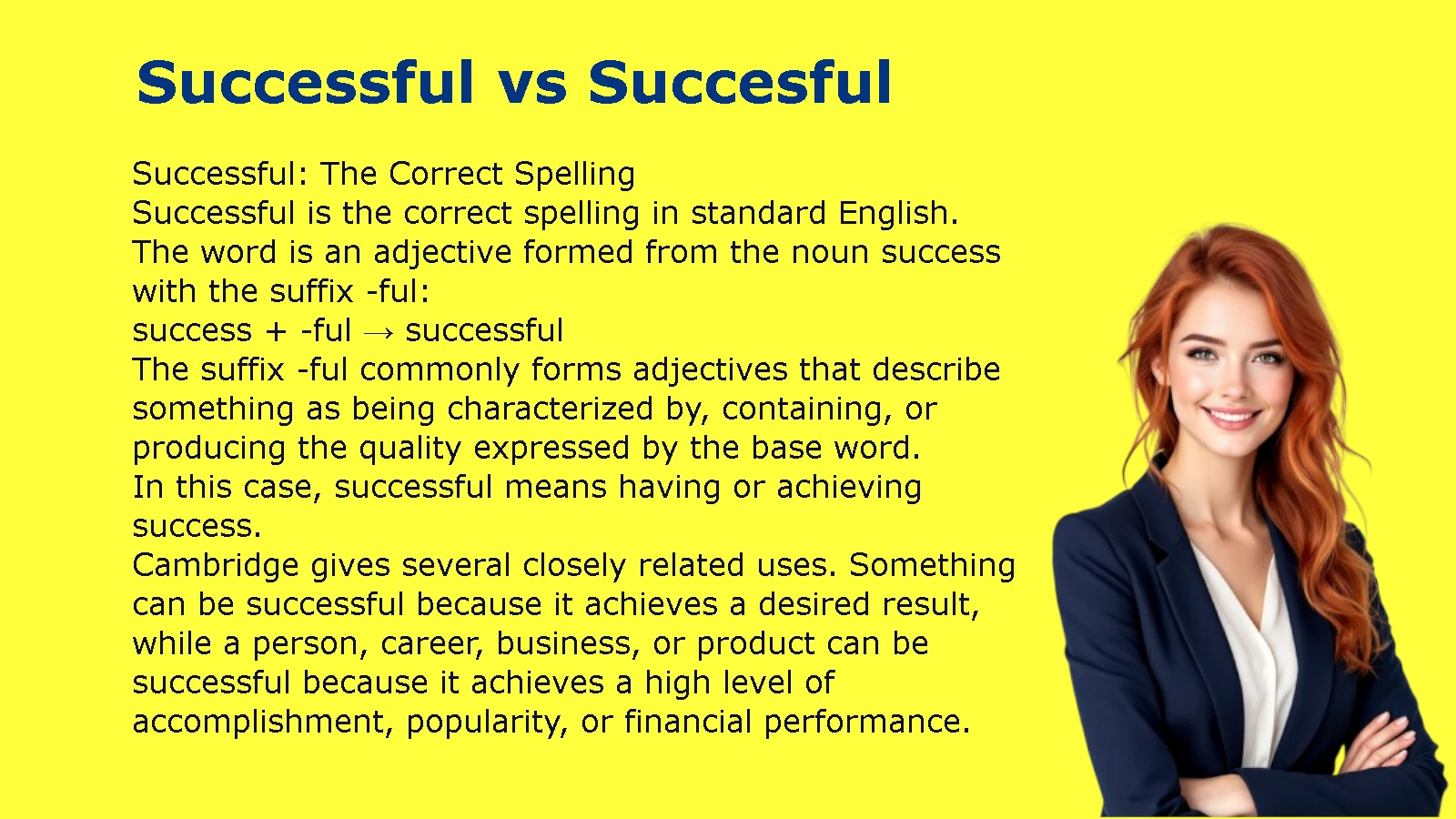
Successful: The Correct Spelling
Successful is the correct spelling in standard English.
The word is an adjective formed from the noun success with the suffix -ful:
success + -ful → successful
The suffix -ful commonly forms adjectives that describe something as being characterized by, containing, or producing the quality expressed by the base word.
In this case, successful means having or achieving success.
Cambridge gives several closely related uses. Something can be successful because it achieves a desired result, while a person, career, business, or product can be successful because it achieves a high level of accomplishment, popularity, or financial performance.
What Does Successful Mean?
The meaning of successful depends somewhat on context, but the central idea is achieving a desired or positive result.
For example:
The experiment was successful.
Here, successful means that the experiment produced the intended result.
Compare that with:
She has a successful career.
Here, successful describes a career in which the person has achieved significant accomplishments or recognition.
The word can therefore describe both results and people or things associated with achievement.
Common uses include:
- successful attempt
- successful experiment
- successful treatment
- successful business
- successful career
- successful student
- successful author
- successful product
- successful campaign
- successful negotiation
The dictionary meaning is broad enough to cover many situations, but the basic concept remains the same: the desired or expected result has been achieved, or substantial achievement has occurred.
Succesful: Is This Spelling Correct?
No. Succesful is not the standard spelling.
The problem is that succesful removes one of the two s’s at the end of the base word success.
The correct sequence is:
success → successful
Not:
succes → succesful
The noun itself is spelled success, with two s’s at the end:
s-u-c-c-e-s-s
When -ful is added, those letters remain:
s-u-c-c-e-s-s-f-u-l
Therefore:
successful
The incorrect form succesful contains only one final s before the f:
s-u-c-c-e-s-f-u-l
That is why the spelling is wrong.
Why Do People Write Succesful?
The mistake is understandable because successful has several repeated letters and can be difficult to spell from memory.
There are two c’s in the middle and two s’s at the end of success. When the suffix -ful is added, the word becomes longer and visually more complicated.
The correct spelling is:
successful
It contains:
- two c’s
- two s’s
- one f
- one l
A useful way to see the structure is:
suc + cess + ful
Or, more directly:
success + ful
The important point is that adding -ful does not remove the final s from success.
Why Is Successful Spelled With Two S’s?
The easiest explanation is that successful comes from success + -ful.
The base noun is success, and that word already ends in ss.
When the suffix -ful is attached, the spelling remains:
success + ful = successful
Dictionaries identify the origin of successful as success + -ful, with the word recorded in English from the late sixteenth century.
There is no spelling rule that requires you to reduce the final ss to a single s before adding -ful.
That is the key reason succesful is incorrect.
The Base Word Is Success
Start with the noun:
success
The spelling is:
s-u-c-c-e-s-s
Now add -ful:
success + ful
The result is:
successful
This gives you a reliable spelling method because you do not have to memorize successful as an isolated word.
Instead, remember its relationship with success.
If you can spell “success,” you already have the spelling foundation for “successful.”
Success + -ful: Understanding the Word Formation
The suffix -ful appears in many English adjectives:
- hope → hopeful
- help → helpful
- care → careful
- use → useful
- beauty → beautiful
- success → successful
In each case, the suffix helps form an adjective.
For successful, the base is success:
success + -ful = successful
This is especially useful for spelling because the base word remains recognizable.
The same pattern also explains why successfully contains the complete spelling of success:
success + ful + ly → successfully
So these forms are connected:
success → successful → successfully
Learning them as a word family is more reliable than trying to memorize each spelling separately.
Successful vs Succesful Examples
The difference becomes particularly clear when the two spellings are placed in real sentences.
| Incorrect | Correct |
| She had a succesful interview. | She had a successful interview. |
| The experiment was succesful. | The experiment was successful. |
| He built a succesful company. | He built a successful company. |
| Their first attempt was succesful. | Their first attempt was successful. |
| The project was highly succesful. | The project was highly successful. |
| She enjoyed a succesful career. | She enjoyed a successful career. |
| The treatment was succesful. | The treatment was successful. |
| It became a succesful product. | It became a successful product. |
The pattern is consistent: whenever the adjective is intended, use successful.
Case Study: A School Assignment
Imagine a student writes:
The science experiment was very succesful.
The sentence is understandable, but the spelling is incorrect.
The corrected sentence is:
The science experiment was very successful.
The meaning has not changed. Only the spelling needs correction.
The best way to prevent the error is to connect the adjective to the noun:
success → successful
The student can think:
“The experiment was a success, so it was successful.”
That connection reinforces both meaning and spelling.
Case Study: A Business Sentence
Consider:
The company became succesful after several years.
The corrected version is:
The company became successful after several years.
Here, successful describes the company’s achievement or performance. Cambridge specifically lists uses such as a successful business, successful career, and successful entrepreneur.
This demonstrates why successful is not limited to one particular type of achievement. It can describe businesses, careers, people, projects, products, and outcomes.
How to Remember the Spelling of Successful
The simplest spelling trick is to remember:
success + ful = successful
Do not try to spell successful only by sound.
Instead, identify the base word first.
Use the Word Family
Think of the following sequence:
success
↓
successful
↓
successfully
This helps you retain the two final s’s because they are already present in success.
Remember the Double S
A useful visual reminder is:
success → successful
The ending of success is ss, and that spelling is preserved when -ful is added.
So:
❌ succesful
✅ successful
Remember the Complete Base Word
Another practical method is to mentally separate the word:
SUCCESS + FUL
This makes the spelling easier to reconstruct.
You do not need to remember every letter independently. You only need to remember that the base word is success.
Successful in a Sentence
Successful is commonly used before nouns.
Here are examples from several contexts:
Successful Person
She became a successful writer after years of practice.
Here, successful describes the writer’s achievements or career.
Successful Career
He enjoyed a successful career in engineering.
The adjective describes the overall outcome of the person’s career.
Successful Business
The company developed a successful business model.
The word indicates that the business model achieved positive results.
Successful Attempt
Her second attempt was successful.
Here, successful means the attempt achieved its intended result.
Successful Project
The team completed the project on time and delivered a successful result.
The adjective describes the outcome of the project.
Successful Outcome
The negotiations resulted in a successful outcome for both sides.
Here, successful refers specifically to the result.
Successful Product
The company launched a successful product in several markets.
The word can indicate strong performance, popularity, or achievement.
Successful vs Successfully: What’s the Difference?
One of the most important related spelling questions is the difference between successful and successfully.
They come from the same word family, but they perform different grammatical jobs.
Successful is an adjective.
Successfully is an adverb.
Compare:
The experiment was successful.
and:
The researchers completed the experiment successfully.
In the first sentence, successful describes the experiment.
In the second, successfully describes how the researchers completed the experiment.
Successful as an Adjective
Use successful to modify a noun or describe a subject.
Examples:
- a successful project
- a successful student
- a successful business
- a successful attempt
- The project was successful.
Successfully as an Adverb
Use successfully when describing an action.
Examples:
- She successfully completed the course.
- The team successfully solved the problem.
- They successfully launched the product.
- The patient was successfully treated.
Cambridge lists successfully as the adverb associated with successful.
The spelling also retains the original success:
success + ful + ly = successfully
Therefore, the incorrect form succesfully has the same basic spelling problem as succesful.
Successful vs Unsuccessful
The opposite of successful is unsuccessful.
The prefix un- creates the opposite meaning:
successful → unsuccessful
For example:
The first attempt was successful.
means the attempt achieved its intended result.
But:
The first attempt was unsuccessful.
means it did not achieve the intended result.
Cambridge explicitly lists unsuccessful as the opposite of successful.
Correct Spelling of Unsuccessful
The correct spelling is:
unsuccessful
Not:
- ❌ unsuccesful
- ❌ unsucessful
- ❌ unsuccessfull
The spelling can again be understood through the base word:
un + success + ful
Therefore:
unsuccessful
This is another reason learning the word family is useful. Once you know the spelling of success, several related words become easier to spell.
Common Mistakes With Successful
The most common mistakes are not differences between British and American English. They are simply misspellings.
Succesful
❌ succesful
Correct:
✅ successful
The missing letter is the second s before f.
Succesfully
❌ succesfully
Correct:
✅ successfully
The word still contains the complete base success.
Sucessful
❌ sucessful
Correct:
✅ successful
This version incorrectly drops one of the two c’s as well as creating problems with the s sequence.
Successfull
❌ successfull
Correct:
✅ successful
The suffix is -ful, not -full.
This is an important distinction.
The correct spelling ends:
-ful
not:
-full
So:
✅ successful
❌ successfull
A Quick Error Checklist
When checking your spelling, look at these three areas:
- Does success have two c’s? Yes.
- Does success end in two s’s? Yes.
- Does successful end in -ful, with one l? Yes.
The complete spelling is:
s-u-c-c-e-s-s-f-u-l
How to Spell Successful Correctly
If you need to spell the word from scratch, use this simple sequence:
Step 1: Start with success.
Step 2: Keep the complete spelling of the base word.
3: Add -ful.
4: Check that the ending is -ful, not -full.
The final word is:
successful
You can then form the related adverb:
successful + ly → successfully
And the opposite adjective:
un + successful → unsuccessful
The Successful Word Family
| Word | Part of speech | Meaning |
| success | noun | Achievement of a desired result |
| successful | adjective | Achieving or associated with success |
| successfully | adverb | In a successful manner |
| unsuccessful | adjective | Not successful |
| successes | plural noun | More than one success |
Cambridge defines success as achieving wanted or hoped-for results and also as something that achieves positive results.
Understanding this word family is more useful than memorizing a single spelling in isolation.
Pronunciation of Successful
The pronunciation of successful can also contribute to spelling confusion because English spelling and pronunciation do not always correspond perfectly.
Cambridge gives the pronunciation as approximately /səkˈses.fəl/ in both US and UK entries, with minor phonetic notation differences between dictionary systems.
The word is commonly heard as three syllables:
suc-cess-ful
The middle portion is particularly important because the spelling contains:
cc and ss
The pronunciation, however, does not simply pronounce every written letter separately. That is one reason spelling the word from sound alone can be difficult.
For spelling purposes, it is better to connect the pronunciation with the written word:
success → successful
rather than trying to reconstruct every letter from the spoken form.
Successful vs Other Commonly Misspelled Forms
Successful belongs to a group of words that people frequently misspell because of repeated letters and suffixes.
Here are some common forms:
| Common error | Correct form |
| succes | success |
| succesful | successful |
| sucessful | successful |
| successfull | successful |
| succesfully | successfully |
| sucessfully | successfully |
| unsuccesful | unsuccessful |
| unsucessful | unsuccessful |
These errors have different causes, but most involve dropping or adding letters from the original word.
The most reliable solution is to recognize the base:
success
Once that is secure, the derived forms become easier to reconstruct.
Successful in American and British English
There is no standard US-versus-UK spelling difference between successful and succesful.
The correct spelling is successful in both American and British English.
The difference you may notice is pronunciation notation rather than spelling. Cambridge provides both US and UK pronunciation entries for the word while retaining the same spelling.
This means you should not treat succesful as a British spelling or an American spelling.
It is simply incorrect in standard English.
For example:
American English:
She had a successful career.
British English:
She had a successful career.
The spelling successful stays the same.
Synonyms for Successful
Depending on the context, several words can express an idea similar to successful.
Possible alternatives include:
- effective — produces the intended result
- accomplished — highly skilled or achieved a lot
- prosperous — financially successful or flourishing
- thriving — growing or developing strongly
- fruitful — producing useful or positive results
- victorious — having won a contest or conflict
- productive — producing useful results
However, these words are synonyms or related expressions, not alternative spellings of successful.
For example:
She had a successful career.
could sometimes become:
She had a prosperous career.
But you cannot replace the correct spelling successful with succesful. The latter is simply an error.
When to Use Successful
Use successful when you want to describe someone or something that has achieved a desired result or a significant level of achievement.
Common contexts include:
Academic Writing
The study was successful in identifying several important patterns.
Business Writing
The company launched a successful marketing campaign.
Everyday Conversation
The party was really successful.
Professional Writing
The team completed a successful implementation.
Formal Reports
The project was successful in meeting its primary objectives.
The word works across formal and informal contexts because it is a standard, widely established adjective.
When Not to Use Successful
The main issue is not whether successful is formal enough. It is whether the sentence actually requires the adjective.
For example:
She completed the project successful.
This is incorrect because successful is an adjective, while the sentence needs an adverb describing completed.
The correct version is:
She completed the project successfully.
Compare:
The project was successful.
with:
She completed the project successfully.
This distinction prevents a grammatical error that is separate from the spelling problem.
Successful or Successfully?
A useful test is to ask what the word is describing.
If it describes a person, thing, project, attempt, or result, successful may be appropriate.
If it describes how an action happened, successfully is generally appropriate.
For example:
They made a successful attempt.
But:
They successfully completed the task.
Quick Comparison: Successful vs Succesful
| Feature | Successful | Succesful |
| Standard spelling | ✅ Yes | ❌ No |
| Dictionary form | ✅ Yes | ❌ No |
| Contains success | ✅ Yes | ❌ No |
| Double s before ful | ✅ Yes | ❌ No |
| Appropriate in formal writing | ✅ Yes | ❌ No |
| Appropriate in academic writing | ✅ Yes | ❌ No |
| Appropriate in professional writing | ✅ Yes | ❌ No |
| Alternative US/UK spelling | No distinction | No |
| Meaning | Achieving a desired result or significant achievement | — |
The distinction is therefore not a matter of preference.
Successful is the standard spelling.
Succesful is a misspelling.
A Simple Memory Trick for Successful
If you regularly forget whether successful has one or two s’s, remember this:
SUCCESS stays complete when you add -FUL.
Write:
SUCCESS + FUL
Then combine them:
SUCCESSFUL
You can also remember the visual sequence:
success
successful
successfully
All three retain the important ss at the end of success before the added material.
Another useful check is:
success has two c’s and two s’s.
When you add -ful, do not remove either pair.
So:
success → successful
not:
succes → succesful
Frequently Asked Questions
Is “Succesful” a correct spelling?
No. Succesful is a misspelling. The correct form is successful, with two s’s before -ful.
Is “Successful” spelled with one or two S’s?
Successful has two s’s at the end of the base word success:
s-u-c-c-e-s-s-f-u-l
The two s’s occur immediately before f.
Why is successful spelled with two S’s?
Because it is formed from success + -ful. The base word success already ends in ss, and that spelling is retained when -ful is added. Dictionary sources identify the word formation as success + -ful.
How do you spell successful correctly?
Spell the base word first:
success
Then add:
-ful
The result is:
successful
What is the difference between successful and succesful?
Successful is the correct English spelling. Succesful is an incorrect spelling that omits one of the two final s’s from success.
Is “Successfully” spelled with two S’s?
Yes.
The correct spelling is:
successfully
It is formed from successful + -ly and retains the spelling of success.
What is the correct spelling of unsuccessful?
The correct spelling is:
unsuccessful
It combines un-, success, and -ful:
un + success + ful = unsuccessful
Is successful the same in American and British English?
Yes. Successful is the standard spelling in both American and British English. The spelling does not change between the two varieties. Cambridge provides US and UK pronunciation information while using the same written form.
What is the noun form of successful?
The main noun is success.
For example:
Her hard work led to success.
The adjective is:
She had a successful career.
The adverb is:
She successfully completed the project.
These three forms belong to the same word family.
Final Answer: Successful or Succesful?
When choosing between successful vs succesful, always use successful.
Successful is the correct standard-English spelling. Succesful is a common misspelling caused by dropping one of the two s’s in the base word success.
The easiest way to remember the spelling is:
success + -ful = successful
The same pattern helps with related words:
- success
- successful
- successfully
- unsuccessful
- successes
The important spelling sequence is ss, not a single s, before -ful.
So, if you are writing an email, essay, report, article, application, or school assignment, choose:
✅ successful
rather than:
❌ succesful
Once you recognize success as the base word, the spelling becomes much easier to remember and apply correctly.