The spendthrift meaning refers to a person who spends money wastefully, extravagantly, or without enough concern for financial consequences. A spendthrift may buy unnecessary luxuries, exhaust an inheritance, or continue spending despite having unpaid bills. Although the word contains “thrift,” which is commonly associated with saving money, a spendthrift does the opposite.
Understanding the word spendthrift involves more than memorizing its definition. You should also know its origin, how it differs from a big spender or a miser, and how to use it naturally in everyday conversation and formal writing. Learning its synonyms, antonyms, and sentence examples will help you choose the right word for different situations. The term also appears in legal language, especially in the phrase spendthrift trust, which describes a type of trust designed to protect a beneficiary’s financial interests under certain conditions.
What Does Spendthrift Mean?
A spendthrift is someone who spends money carelessly, extravagantly, or wastefully instead of managing it responsibly. The word usually describes a person who uses money without considering future needs, savings, or financial obligations. It carries a negative meaning because it suggests that someone spends more than necessary or fails to control their spending.
For example, someone who spends an entire paycheck on designer clothes while ignoring overdue rent might be described as a spendthrift.
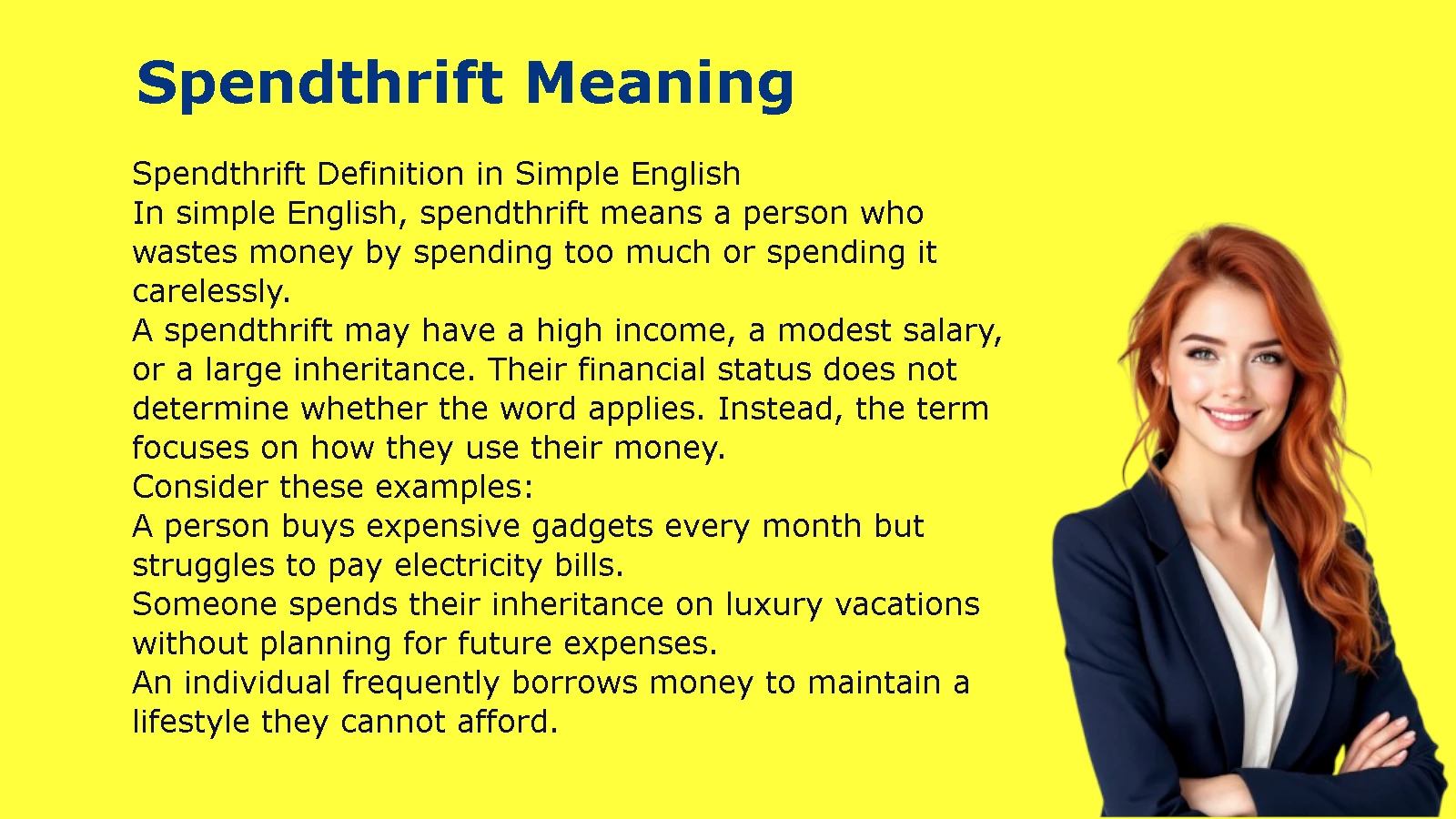
Spendthrift Definition in Simple English
In simple English, spendthrift means a person who wastes money by spending too much or spending it carelessly.
A spendthrift may have a high income, a modest salary, or a large inheritance. Their financial status does not determine whether the word applies. Instead, the term focuses on how they use their money.
Consider these examples:
- A person buys expensive gadgets every month but struggles to pay electricity bills.
- Someone spends their inheritance on luxury vacations without planning for future expenses.
- An individual frequently borrows money to maintain a lifestyle they cannot afford.
These behaviors may describe a spendthrift because they show a pattern of wasteful spending.
However, spending a large amount of money does not automatically make someone a spendthrift. A person who buys an expensive house, supports their family, or enjoys luxury products within a well-managed budget is not necessarily financially irresponsible.
The key distinction is wastefulness, not the amount of money spent.
Spendthrift Meaning at a Glance
The following table summarizes the word’s most important features.
| Feature | Explanation |
| Word | Spendthrift |
| Part of speech | Noun and adjective |
| Simple meaning | Someone who spends money wastefully |
| Main association | Extravagance and financial irresponsibility |
| Connotation | Usually negative |
| Common context | Personal finance, behavior, lifestyle, and public spending |
| Opposite ideas | Thrift, frugality, and careful saving |
| Example | He was a spendthrift who quickly exhausted his savings. |
The word can describe a person directly or characterize their behavior. For instance, a spendthrift identifies someone, while spendthrift habits describes a pattern of excessive spending.
Spendthrift Meaning in Everyday Life
In everyday life, a spendthrift is someone whose spending habits repeatedly create financial problems or waste valuable resources.
Imagine two people who each earn $4,000 a month. The first spends $1,500 on rent, $500 on groceries, $400 on transportation, and saves the remainder after covering other necessary expenses. The second spends heavily on entertainment, expensive clothing, and unnecessary upgrades, then borrows money to cover essential bills.
Both people spend money, but their financial choices differ. The second person may be described as a spendthrift because their spending consistently undermines their financial stability.
This example illustrates an important point: spendthrift behavior depends on spending patterns and consequences, not income alone.
A person can also be a spendthrift without buying luxury products. Frequently ordering food that goes uneaten, purchasing duplicate items, or paying for unused subscriptions may reflect wasteful spending when these habits continue despite financial pressure.
Why Is It Called a Spendthrift?
The word spendthrift combines spend and thrift. Its meaning seems contradictory because modern English often uses thrift to describe careful spending and saving. Historically, however, thrift also referred to prosperity, wealth, or the growth of one’s resources. A spendthrift is therefore someone who spends away their wealth rather than preserving it.
The Meaning of Spend
The word spend means to use money, time, energy, or other resources for a particular purpose.
When you spend money, you exchange it for goods, services, experiences, or obligations. Spending is a normal part of life. It becomes wasteful when someone repeatedly uses resources without sufficient purpose or regard for the consequences.
For example:
- Spending money on groceries is a normal household expense.
- Spending money on a necessary repair can protect a valuable asset.
- Spending money on products you never use may represent waste.
- Spending money you cannot afford on unnecessary luxuries can create financial problems.
The word spend itself does not imply irresponsibility. The negative meaning comes from the way it combines with thrift in spendthrift.
What Did Thrift Originally Mean?
The word thrift has historically carried a broader meaning than simply saving money. It was associated with prosperity, success, and the growth or preservation of resources.
Over time, thrift became strongly associated with economical habits, careful spending, and avoiding waste. That modern meaning explains why the word spendthrift may confuse English learners.
Consider the difference:
- Thrift: Careful management of money and resources.
- Thrifty: Economical, resourceful, and careful about spending.
- Spendthrift: Someone who spends wealth wastefully.
Although the words share the same linguistic element, their meanings are not identical.
A thrifty person tries to make money go further. A spendthrift tends to use money without adequate regard for its long-term value.
How Spendthrift Acquired Its Meaning
The combined word developed to describe someone who spends or squanders their accumulated wealth. Rather than building or preserving prosperity, a spendthrift uses it up.
Think of a person who receives a substantial inheritance. They have enough money to invest, pay necessary expenses, and support themselves for years. Instead, they spend most of it on extravagant purchases within a short period.
That person has effectively spent their wealth away. The term spendthrift captures this behavior.
The word also provides a useful reminder about English vocabulary: a word’s meaning does not always equal the sum of its modern components. Historical usage shapes how people understand and use words today.
Characteristics of a Spendthrift
A spendthrift typically shows a pattern of wasteful or poorly planned spending. Common characteristics include impulsive purchases, spending beyond one’s means, and prioritizing immediate gratification over long-term financial needs. These traits can help explain the term, but no single expensive purchase proves that someone is a spendthrift.
Impulsive and Unnecessary Purchases
One common characteristic of a spendthrift is buying things without considering whether they are necessary, affordable, or useful.
For example, someone might see a new smartphone advertised online and purchase it immediately, even though their current phone works perfectly. A few days later, they might buy expensive headphones, shoes, or accessories for the same reason.
The problem is not necessarily the individual purchase. The concern arises when repeated impulse buying consumes money intended for more important expenses.
Common examples include:
- Buying products simply because they are on sale.
- Purchasing duplicate items that serve the same purpose.
- Shopping to relieve boredom without considering the cost.
- Frequently upgrading functioning devices.
- Paying for memberships or subscriptions that go unused.
A practical way to recognize wasteful spending is to ask three questions before buying something:
- Do I genuinely need or want this item?
- Can I afford it without neglecting essential expenses?
- Will I still consider this purchase worthwhile after the initial excitement fades?
These questions help separate thoughtful spending from habits that may be financially harmful.
Spending Beyond One’s Means
A spendthrift may maintain a lifestyle that their income cannot comfortably support.
This can involve using credit cards for routine expenses, borrowing money for unnecessary purchases, or repeatedly postponing bill payments to fund discretionary spending.
For example, a person earning $3,000 a month might lease an expensive vehicle, dine at costly restaurants several times a week, and buy luxury clothing on credit. If these choices leave them unable to pay rent or repay their debts, their spending pattern could reasonably be called spendthrift.
Signs of spending beyond one’s means include:
- Regularly carrying balances on credit cards because of unnecessary purchases.
- Borrowing money to pay for luxuries.
- Ignoring bills while continuing discretionary spending.
- Having no financial cushion despite earning a reasonable income.
- Relying on future income to justify purchases that are unaffordable today.
Not every person with debt is a spendthrift. Medical bills, job loss, emergencies, and other circumstances can create financial difficulties without irresponsible spending. The term is most appropriate when wasteful choices form a recognizable pattern.
Prioritizing Immediate Gratification
Spendthrift behavior often involves choosing immediate pleasure over future financial security.
A person might enjoy the excitement of buying a new outfit today but give little thought to next month’s rent, an upcoming tuition payment, or retirement savings.
This does not mean people should never enjoy their money. Recreation, travel, dining, and hobbies can all be reasonable parts of a budget. The problem develops when short-term rewards consistently take priority over important obligations.
For example, imagine someone who wants to build an emergency fund. Each month, they plan to save $200 but spend that money on entertainment before transferring it to savings. After a year, they have missed their intended savings goal by $2,400, assuming they could otherwise have saved the full amount.
This example shows how repeated small choices can produce a significant result.
A more balanced approach is to cover essential bills, set aside money for savings, and then spend the remaining discretionary amount on enjoyable activities. This allows a person to enjoy the present without routinely sacrificing the future.
Is Every Big Spender a Spendthrift?
No. A big spender is someone who spends freely or generously, while a spendthrift is someone whose spending is wasteful or irresponsible.
A wealthy person may spend thousands of dollars on travel, dining, or hobbies while maintaining savings, paying bills on time, and investing for the future. Calling that person a spendthrift would not necessarily be accurate.
Compare two situations:
Person A: Earns $150,000 a year, pays all bills on time, invests regularly, and spends $10,000 annually on vacations within a planned budget.
Person B: Earns $50,000 a year, spends beyond their means on luxury purchases, misses loan payments, and repeatedly borrows money to maintain the same lifestyle.
Person A may be a big spender in some contexts. Person B’s behavior more closely fits the meaning of spendthrift.
The distinction is useful in both writing and conversation because it prevents the word from becoming a general criticism of anyone who enjoys expensive things.
Spendthrift vs. Miser vs. Thrifty
The terms spendthrift, miser, and thrifty describe different attitudes toward money. A spendthrift spends carelessly, a miser is excessively reluctant to spend, and a thrifty person manages money carefully. Understanding these differences helps you choose the right word without confusing extravagance with generosity or sensible saving.
Spendthrift vs. Thrifty
A spendthrift wastes money, while a thrifty person tries to use money efficiently.
A thrifty person may compare prices, repair useful possessions instead of replacing them, cook at home to reduce expenses, and avoid paying for services they do not need. These choices are usually practical rather than extreme.
For example, a thrifty shopper might compare the price per ounce of two products and buy the better value. A spendthrift shopper might buy several expensive products simply because they look appealing, even when cheaper alternatives would meet the same needs.
The key difference is the purpose behind the spending.
| Feature | Spendthrift | Thrifty Person |
| Spending style | Wasteful or extravagant | Careful and economical |
| Main priority | Immediate wants or careless spending | Value and efficient use of resources |
| Saving habits | May neglect savings | Usually tries to save |
| Purchasing decisions | Often poorly planned | Often compares options |
| Financial outlook | May overlook future consequences | Considers future needs |
| Example | Buys unnecessary items despite unpaid bills | Sets a budget and avoids waste |
Being thrifty does not mean refusing every pleasure or always choosing the cheapest option. A sensible person considers quality, durability, convenience, and price. Sometimes spending more initially can save money over time.
Spendthrift vs. Miser
A spendthrift spends too freely, while a miser is someone who hoards money and is excessively unwilling to spend it.
These terms describe opposite extremes.
A spendthrift might spend an entire bonus on luxury products within days. A miser might have plenty of money but refuse to replace worn-out shoes or pay for necessary repairs because they cannot bear to part with their cash.
Consider this example:
- A spendthrift spends $500 on unnecessary decorations despite having overdue bills.
- A miser refuses to spend $50 on an essential household repair even though they can comfortably afford it.
- A financially balanced person pays for the repair, covers necessary expenses, and decides whether the decorations fit their budget.
The miser’s behavior may seem economical, but excessive reluctance to spend can create its own problems. Money is a resource that can support basic needs, comfort, safety, and meaningful experiences.
A thrifty person differs from both. They try to avoid waste without treating all spending as a mistake.
Spendthrift vs. Big Spender
A big spender enjoys spending money, often on expensive purchases, gifts, or experiences. The phrase does not always imply irresponsibility.
A spendthrift, by contrast, spends in a way that suggests wastefulness or poor financial judgment.
For example, a person who regularly buys thoughtful gifts for family members while staying within their budget may be a big spender. Someone who borrows money for lavish gifts and cannot meet essential obligations may be a spendthrift.
The terms also differ in tone:
- Big spender: Can be neutral, positive, or negative depending on context.
- Spendthrift: Usually negative.
- Thrifty: Generally positive.
- Miser: Usually negative when describing excessive unwillingness to spend.
When writing about someone’s financial habits, choose the word that accurately describes the behavior rather than assuming all high spending is wasteful.
Spendthrift Synonyms and Antonyms
The best synonyms for spendthrift include profligate, squanderer, wastrel, and prodigal. Each word emphasizes a slightly different aspect of wasteful behavior. Common antonyms include thrifty, frugal, and saver, which describe careful spending or preserving money for future needs.
Common Synonyms for Spendthrift
Here are the most useful alternatives and their differences.
| Synonym | Meaning | Example |
| Profligate | Recklessly extravagant or wasteful | His profligate spending depleted the family fortune. |
| Squanderer | Someone who wastes money or resources | The squanderer wasted an opportunity to build a secure future. |
| Wastrel | A person who wastes resources or behaves irresponsibly | The novel portrayed him as a careless wastrel. |
| Prodigal | Lavish or wasteful in spending | Her prodigal habits soon became a concern. |
| Big spender | Someone who spends freely or generously | He was a big spender who enjoyed expensive restaurants. |
| Extravagant person | Someone who spends more than necessary or favors luxury | The extravagant buyer ordered another designer bag. |
| Spendthrift individual | A person who spends money wastefully | The spendthrift individual ignored repeated warnings about debt. |
Profligate is a strong choice for formal writing because it suggests reckless excess. Squanderer emphasizes the act of wasting something valuable, whether money, time, or opportunity. Wastrel often carries a judgmental tone and may sound literary or old-fashioned.
Prodigal can describe lavish spending, although readers may also recognize it from the phrase prodigal son. In that expression, the emphasis is on a son who wastes his inheritance before returning home.
Big spender is more conversational and does not always carry the same criticism as spendthrift. Use it when you want to describe generous or enthusiastic spending without automatically suggesting financial irresponsibility.
Antonyms of Spendthrift
Antonyms help describe people who handle money carefully or avoid unnecessary expenses.
| Antonym | Meaning | Example |
| Saver | Someone who sets money aside | The saver built an emergency fund over several years. |
| Thrifty person | Someone who uses resources efficiently | The thrifty homeowner repaired the furniture instead of replacing it. |
| Frugal person | Someone who avoids unnecessary spending | A frugal traveler compares prices before booking a hotel. |
| Economizer | Someone who reduces spending or waste | The careful economizer reviewed every recurring expense. |
| Prudent spender | Someone who makes sensible financial decisions | A prudent spender checks the budget before making a major purchase. |
| Penny-pincher | Someone reluctant to spend money | His friends teased him for being a penny-pincher. |
Not all antonyms have the same tone. Saver, frugal person, and prudent spender are generally neutral or positive. Penny-pincher can be critical because it suggests that someone is excessively reluctant to spend.
Choose an antonym according to the behavior you want to describe. A person who saves regularly is a saver, while someone who carefully evaluates purchases is better described as thrifty or prudent.
How to Choose the Right Spendthrift Synonym
Although synonyms share related meanings, they are not always interchangeable.
Use these guidelines:
- Choose profligate for formal descriptions of reckless extravagance.
- Choose squanderer when someone wastes money, time, talent, or opportunities.
- Choose wastrel when a stronger, judgmental, or literary tone fits.
- Choose prodigal when emphasizing lavish or excessive spending.
- Choose big spender when describing someone who spends freely without necessarily criticizing them.
- Choose frugal or thrifty when describing sensible financial habits.
- Choose miser when the problem is an excessive reluctance to spend rather than excessive spending.
For example, “The company was profligate with its advertising budget” sounds formal and critical. “He was a big spender on birthdays” may simply describe someone who enjoys buying generous gifts.
The right choice depends on the behavior, context, and tone you want to convey.
Spendthrift Examples in Sentences
Spendthrift can function as both a noun and an adjective. As a noun, it identifies a person who spends money wastefully. As an adjective, it describes habits, behavior, policies, or lifestyles characterized by excessive or irresponsible spending.
Spendthrift as a Noun
When spendthrift acts as a noun, it names the person displaying the behavior.
Examples include:
- He proved to be a hopeless spendthrift after spending his inheritance in a few years.
- Her family worried that the young spendthrift would run out of money.
- Despite earning a high salary, the spendthrift struggled to pay his bills.
- The businessman was known as a spendthrift who wasted money on unnecessary luxuries.
- His friends encouraged him to stop acting like a spendthrift and start saving.
- The former athlete regretted his spendthrift ways after his income declined.
- Everyone expected the spendthrift to exhaust his savings unless he changed his habits.
- The story follows a wealthy spendthrift who learns the value of careful financial planning.
In each example, the word identifies a person whose spending habits are considered wasteful.
Spendthrift as an Adjective
When spendthrift acts as an adjective, it describes a noun related to excessive spending.
Examples include:
- Her spendthrift habits prevented her from building an emergency fund.
- His spendthrift lifestyle left little money for future expenses.
- The report criticized the company’s spendthrift approach to its budget.
- Their spendthrift behavior created unnecessary financial pressure.
- The family tried to discourage his spendthrift tendencies.
- The organization reviewed its spendthrift policies after costs increased.
- Years of spendthrift decisions had weakened the business’s finances.
- Her spendthrift ways became difficult to maintain after she changed jobs.
Here, the word modifies habits, lifestyle, approach, behavior, tendencies, policies, decisions, and ways.
This adjective form is useful when discussing patterns of spending rather than labeling a particular person.
Spendthrift in Different Contexts
The word appears in everyday conversation, literature, financial commentary, and discussions about organizational spending.
In everyday conversation:
“My brother can be a spendthrift when he shops online.”
This sentence suggests that the speaker believes their brother spends carelessly in that situation.
In formal writing:
“The board questioned the director’s spendthrift management of company resources.”
This example uses the adjective to criticize wasteful management.
In a story:
“Although the young heir was a spendthrift, he eventually learned to manage his inheritance.”
Here, the word helps establish a character’s weakness and suggests room for personal growth.
In financial commentary:
“The family’s spendthrift lifestyle consumed much of its accumulated wealth.”
This sentence describes a pattern of excessive spending and its consequences.
Common Mistakes When Using Spendthrift
Several mistakes can make the word sound inaccurate or unnatural.
Mistake: Treating spendthrift as a synonym for wealthy
Incorrect idea: “She is a spendthrift because she earns a high salary.”
A high salary does not prove that someone spends irresponsibly.
Better: “She became a spendthrift after repeatedly spending beyond her means.”
Mistake: Confusing spendthrift with thrifty
Incorrect: “He is spendthrift because he compares prices and saves money.”
Better: “He is thrifty because he compares prices and avoids waste.”
Mistake: Assuming every expensive purchase is wasteful
Incorrect idea: “He bought an expensive house, so he must be a spendthrift.”
Better: “He showed spendthrift behavior when he repeatedly bought unnecessary luxuries despite being unable to meet his financial obligations.”
Mistake: Ignoring the word’s negative connotation
Calling someone a spendthrift can sound critical or insulting. If you only mean that the person enjoys shopping, big spender may be more suitable.
What Is a Spendthrift Trust?
A spendthrift trust is a legal arrangement that includes provisions restricting a beneficiary’s ability to transfer or pledge their interest in trust assets. Depending on the trust terms and applicable law, these provisions may also protect the beneficiary’s interest from certain creditor claims. The purpose is often to preserve assets for the beneficiary rather than allowing unrestricted access to the entire fund.
The legal meaning differs from the everyday meaning of spendthrift. In ordinary language, the word describes wasteful spending. In trust law, it refers to a protective arrangement that may be useful when a beneficiary has difficulty managing money.
How a Spendthrift Trust Works
A trust generally involves a person who establishes it, a trustee who manages the assets, and one or more beneficiaries who receive benefits from those assets.
A spendthrift provision places restrictions on the beneficiary’s ability to transfer their interest in the trust. For example, the beneficiary may not be able to sell, assign, or pledge their future trust distributions freely.
The trustee manages the assets according to the trust document and applicable law. Depending on the arrangement, the beneficiary may receive regular distributions for living expenses, education, healthcare, or other permitted purposes rather than controlling the entire fund directly.
Consider a simplified example.
A parent establishes a trust for an adult child who has repeatedly struggled with debt and impulsive spending. Instead of transferring a large inheritance directly to the child, the parent appoints a trustee to manage the assets and distribute funds according to the trust’s terms.
The arrangement may help preserve the inheritance and reduce the risk that the beneficiary will spend the entire amount quickly.
However, a spendthrift trust does not guarantee protection in every situation. The effectiveness of its restrictions depends on the governing jurisdiction, the trust’s terms, the type of claim involved, and other applicable legal rules.
Why Would Someone Create a Spendthrift Trust?
Families and other trust creators may consider this arrangement when they want to preserve assets for a beneficiary who needs additional financial safeguards.
Possible reasons include:
- Protecting an inheritance: The trust may prevent a beneficiary from freely transferring their interest in the trust.
- Supporting long-term needs: Distributions can be structured to support living expenses over time.
- Managing financial risk: The arrangement may help limit certain risks associated with a beneficiary’s debts or spending habits.
- Preserving family assets: The trust can establish rules for how and when beneficiaries receive funds.
- Providing structured support: A trustee can manage distributions according to the trust’s terms rather than handing over the entire fund at once.
For instance, parents may want to provide for a child without giving them immediate control over a substantial inheritance. A properly drafted trust can establish a framework for administering those assets.
Anyone considering this arrangement should consult a qualified estate-planning attorney familiar with the relevant jurisdiction. Trust laws differ, and a spendthrift provision is not a universal solution for every creditor or financial situation.
Frequently Asked Questions About Spendthrift Meaning
Is Spendthrift a Compliment or an Insult?
Spendthrift is usually a negative or critical word. It suggests that someone spends money wastefully or irresponsibly. Calling someone a spendthrift may imply that they lack financial discipline or fail to consider future consequences. If you simply mean that someone enjoys spending money, big spender is often a less judgmental alternative.
What Is the Difference Between a Spendthrift and a Miser?
A spendthrift spends money too freely, while a miser is excessively reluctant to spend money. A spendthrift may waste savings on unnecessary luxuries, whereas a miser may refuse to spend even on reasonable needs despite having sufficient funds. A thrifty person differs from both by balancing spending and saving sensibly.
What Is the Opposite of Spendthrift?
The opposite of spendthrift is generally thrifty, frugal, or careful with money. A saver is another suitable alternative when the emphasis is on putting money aside for future needs. The best choice depends on context: frugal describes avoiding unnecessary expenses, while saver focuses on accumulating money.
Can Spendthrift Be Used as an Adjective?
Yes. Spendthrift can function as both a noun and an adjective. As a noun, it identifies someone who spends money wastefully: “He is a spendthrift.” As an adjective, it describes wasteful behavior or spending: “His spendthrift habits caused financial problems.” Both uses are grammatically correct.
What Is a Simple Example of a Spendthrift?
A simple example of a spendthrift is someone who spends most of their paycheck on unnecessary purchases while leaving essential bills unpaid. For instance, a person might buy expensive clothes and electronics every month but repeatedly borrow money for rent. This pattern illustrates wasteful spending rather than merely enjoying occasional luxuries.
What Does Spendthrift Mean in Law?
In law, spendthrift commonly appears in the phrase spendthrift trust. It refers to a trust containing provisions that restrict a beneficiary’s ability to transfer or pledge their interest in the trust. Depending on applicable law, those provisions may also protect trust assets from certain creditor claims. The precise protections vary by jurisdiction and trust terms.
Conclusion: Understand and Use Spendthrift Correctly
The spendthrift meaning centers on wasteful, extravagant, or irresponsible spending. A spendthrift uses money without enough regard for its value, future needs, or financial obligations. The word can describe a person as a noun or characterize habits and behavior as an adjective.
Remember the key differences:
- A spendthrift spends wastefully.
- A thrifty person manages money carefully.
- A miser is excessively reluctant to spend.
- A big spender spends freely but is not necessarily irresponsible.
Understanding these distinctions will help you use spendthrift accurately in conversations, essays, stories, and professional writing. You can also strengthen your vocabulary by learning related words such as profligate, squanderer, frugal, and prudent.