Have you ever seen prosciutto written as proscuitto and wondered which spelling is correct? The difference in Prosciutto vs Proscuitto is easy to make because the letters can seem confusing when you hear or pronounce the word. However, only one spelling is considered correct in standard English.
Prosciutto is the correct spelling, while proscuitto is a common misspelling. The word prosciutto comes from Italian and generally refers to dry-cured ham, especially the thinly sliced ham associated with Italian cuisine. Unlike spelling differences such as color and colour, prosciutto and proscuitto do not represent different regional spellings.
Examples:
- We ordered thinly sliced prosciutto with cheese and bread.
- The recipe calls for prosciutto and fresh mozzarella.
The confusion is understandable. People often search for prosciutto vs proscuitto, prosciutto or proscuitto, which spelling is correct, or proscuitto meaning in English because the unusual combination of letters makes the word easy to misspell. However, proscuitto is not an accepted alternative spelling. The correct form is prosciutto.
In this guide, you’ll learn the complete difference between Prosciutto vs Proscuitto, including their meaning, pronunciation, origin, correct spelling, and usage. You’ll also learn why proscuitto is commonly misspelled and see clear examples to help you remember the correct spelling.
What Does Prosciutto Mean?
Prosciutto is an Italian word for ham. In English, the term commonly refers to Italian dry-cured ham that has been aged and sliced very thinly.
Cambridge Dictionary specifically describes prosciutto as Italian dried ham made from the meat of a pig’s leg or shoulder.
The Italian meaning has a somewhat broader scope than the way English speakers often use the word.
The Italian dictionary Treccani defines prosciutto as pork leg that has been salted and dried under suitable conditions for preservation. It also notes that the word can refer to pork shoulder treated in the same way.
So, depending on the context, prosciutto can refer to more than the thinly sliced cured ham commonly seen on an American charcuterie board.
Prosciutto in English
In everyday American English, prosciutto usually brings to mind thinly sliced, dry-cured Italian ham.
You might see it on:
- Pizza
- Sandwiches
- Panini
- Salads
- Pasta dishes
- Charcuterie boards
- Antipasto plates
- Melon and prosciutto appetizers
- Restaurant menus
For example:
The pizza was topped with mozzarella, prosciutto, and fresh arugula.
Here, prosciutto clearly refers to the cured ham used as a topping.
Why Is Proscuitto Incorrect?
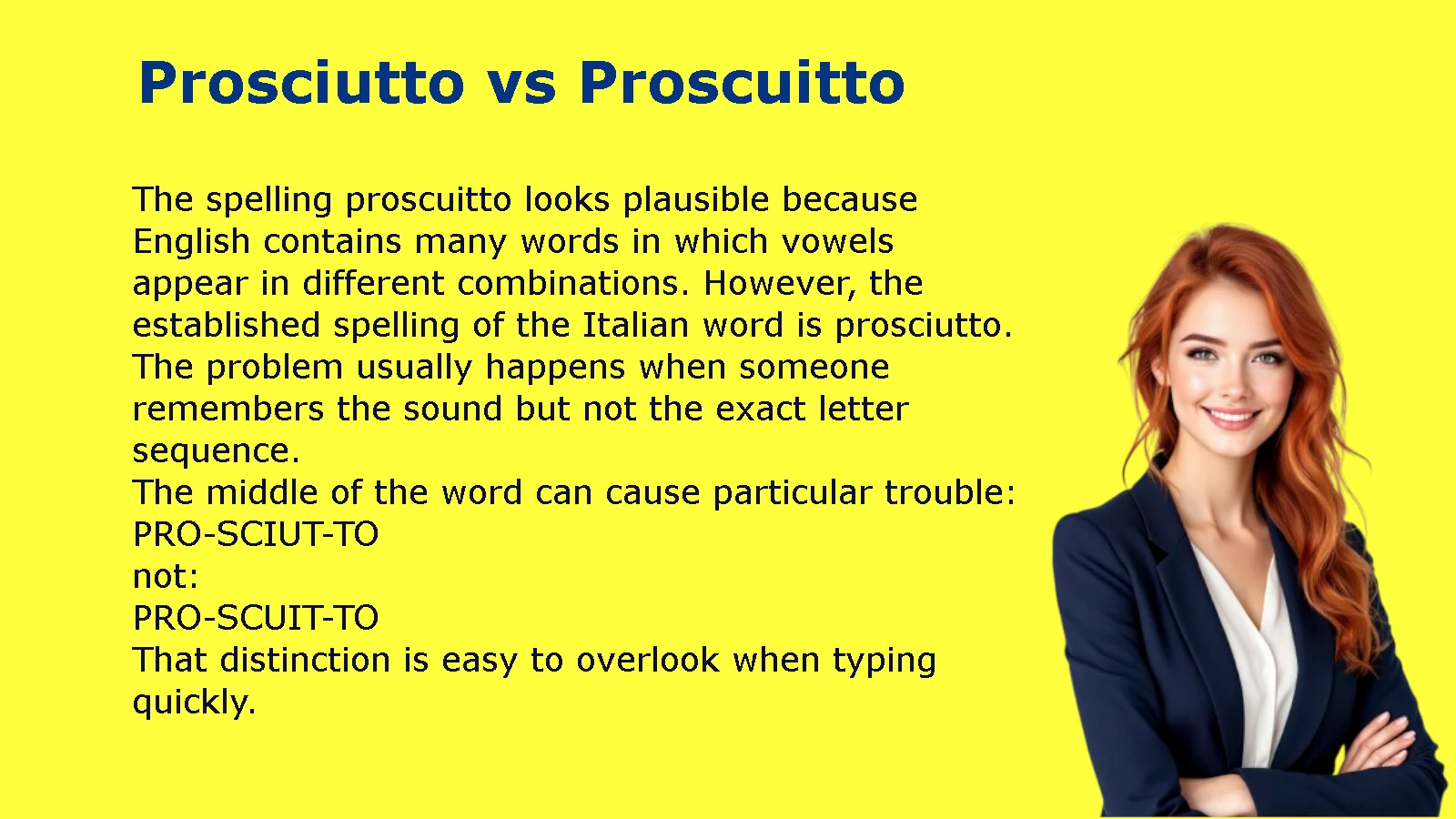
The spelling proscuitto looks plausible because English contains many words in which vowels appear in different combinations. However, the established spelling of the Italian word is prosciutto.
The problem usually happens when someone remembers the sound but not the exact letter sequence.
The middle of the word can cause particular trouble:
PRO-SCIUT-TO
not:
PRO-SCUIT-TO
That distinction is easy to overlook when typing quickly.
A Simple Way to Remember the Spelling
Break the word into three visual parts:
PRO + SCIUT + TO
The important part is SCIUT.
Think:
PRO-SCIUT-TO
The I comes before the U.
That’s the detail that separates prosciutto from proscuitto.
Prosciutto vs Proscuitto Pronunciation
Spelling isn’t the only part of this word that can confuse English speakers. Prosciutto also has a pronunciation that may not be obvious from its written form.
Cambridge gives the US English pronunciation as /prəˈʃuː.t̬oʊ/.
A simple English approximation is:
pruh-SHOO-toh
The middle sci doesn’t sound like the English word sci in something such as science. Instead, the sound is closer to sh.
The stress falls on the middle syllable:
pruh-SHOO-toh
That’s why someone hearing the word in conversation might not immediately know how to spell it.
Why Pronunciation Can Cause the Spelling Mistake
English spelling and pronunciation often don’t line up neatly. Foreign food terms can make that problem even more noticeable.
When you hear prosciutto, the pronunciation doesn’t clearly reveal that the written form contains sciutto.
Someone might remember the sound correctly but reconstruct the spelling incorrectly:
- Heard: pruh-SHOO-toh
- Remembered incorrectly: proscuitto
- Correct spelling: prosciutto
The best solution is to remember the written pattern rather than trying to spell the word entirely from its sound.
Prosciutto Meaning in Italian
The word prosciutto has a specific place in Italian food vocabulary.
Treccani describes prosciutto as pork leg that has been salted and dried for preservation. It also explains that different treatments produce varieties such as prosciutto crudo and prosciutto cotto.
The Italian-English Cambridge Dictionary translates prosciutto as ham and specifically lists:
- prosciutto crudo = raw or cured ham
- prosciutto cotto = cooked ham
This distinction matters because the simple English word prosciutto often makes people think specifically of cured ham.
What Does Prosciutto Crudo Mean?
Prosciutto crudo refers to cured ham that hasn’t been cooked.
Here, crudo means “raw” in the relevant food context. Treccani also notes that prosciutto crudo is commonly understood as cured ham.
The ham undergoes preservation through processes such as salting and aging rather than ordinary cooking.
When people in the United States order or buy “prosciutto,” this is generally the style they have in mind.
What Does Prosciutto Cotto Mean?
Prosciutto cotto means cooked ham.
The word cotto means “cooked.” Treccani notes that cotto can be used informally as a shortened reference to prosciutto cotto.
So the two terms describe different preparations:
| Italian term | English meaning | Basic preparation |
| Prosciutto crudo | Cured/raw ham | Salted and aged |
| Prosciutto cotto | Cooked ham | Cooked |
This distinction also shows why simply treating every use of prosciutto as identical can create confusion.
How Is Prosciutto Made?
Traditional prosciutto production involves much more than simply salting a piece of pork.
For cured varieties, the process relies on controlled preservation and aging. Treccani’s encyclopedia describes a traditional process involving salting, resting, cleaning, drying, and extended aging.
The exact process depends on the specific product and protected regional tradition.
A simplified overview looks like this:
- The pork leg is prepared.
- Salt is applied to help preserve the meat.
- The meat rests under controlled conditions.
- Additional preparation and cleaning take place.
- The ham undergoes drying and aging.
- The finished product is inspected and prepared for sale.
- The ham is sliced thinly when served.
The aging period can make a major difference in the finished product’s texture and flavor.
That’s one reason prosciutto can have a delicate texture despite coming from a relatively simple list of basic ingredients and processes.
Prosciutto vs Ham: Are They the Same?
Prosciutto is a type of ham, but the words aren’t perfect synonyms in every context.
The word ham is much broader. It can describe many different preparations of pork from the hind leg.
Prosciutto, on the other hand, identifies an Italian term and a particular tradition of preparing ham.
A useful comparison looks like this:
| Term | General meaning |
| Ham | Broad English term for preserved or prepared pork, especially from the hind leg |
| Prosciutto | Italian term for ham, commonly associated in English with thinly sliced cured ham |
| Prosciutto crudo | Cured ham |
| Prosciutto cotto | Cooked ham |
Therefore, saying that prosciutto is “ham” is broadly correct. However, calling every type of ham prosciutto would be inaccurate.
Think of it like this: ham is the larger category, while prosciutto identifies a particular Italian tradition and style within that broad category.
Prosciutto vs Proscuitto in Food Writing
If you’re writing about food, the spelling matters more than it might seem.
A misspelled ingredient can make an otherwise polished recipe look careless.
Compare these two examples:
Add two ounces of prosciutto and a handful of fresh basil.
and:
Add two ounces of proscuitto and a handful of fresh basil.
The first sentence uses the standard spelling. The second contains a spelling error.
Where You Should Use Prosciutto
Use prosciutto when referring to:
- A specific Italian ham
- A recipe ingredient
- A restaurant dish
- A pizza topping
- A sandwich ingredient
- A cured meat product
- An Italian food tradition
For example:
The recipe calls for thinly sliced prosciutto.
She wrapped the asparagus in prosciutto before roasting it.
The restaurant serves prosciutto with melon as an appetizer.
In each case, prosciutto is the correct form.
Prosciutto in Common Dishes
The popularity of prosciutto comes partly from its versatility.
Its thin slices work well in dishes where a small amount of strongly flavored meat can add saltiness and depth without overwhelming the other ingredients.
Prosciutto on Pizza
Prosciutto is often added to pizza alongside ingredients such as mozzarella, arugula, mushrooms, or fresh vegetables.
Its salty flavor can contrast nicely with milder or slightly sweet ingredients.
Prosciutto in Sandwiches
Thin slices of prosciutto work especially well in sandwiches and panini.
Common pairings include:
- Prosciutto and mozzarella
- Prosciutto and provolone
- Prosciutto and arugula
- Prosciutto and roasted vegetables
- Prosciutto and fresh tomato
Prosciutto With Melon
One classic combination pairs prosciutto with melon.
The salty cured meat contrasts with the fruit’s sweetness. That’s a good example of why prosciutto doesn’t need complicated preparation to make a dish interesting.
Prosciutto on Charcuterie Boards
Prosciutto is also common on charcuterie boards.
Because it can be sliced extremely thinly, it adds a delicate cured-meat option alongside firmer meats, cheeses, fruit, crackers, and other accompaniments.
How to Use Prosciutto in a Sentence
Seeing the word in context makes its meaning and spelling easier to remember.
Here are several natural examples.
Food Examples
I ordered a sandwich with mozzarella, tomatoes, and prosciutto.
The chef added thinly sliced prosciutto to the pasta.
We served prosciutto and melon as an appetizer.
She wrapped each asparagus spear in prosciutto before baking it.
Restaurant Examples
The menu lists a pizza topped with prosciutto and arugula.
The restaurant serves imported prosciutto with fresh mozzarella.
He asked whether the sandwich contained prosciutto or cooked ham.
Informational Examples
Prosciutto is an Italian term for ham.
The correct spelling is prosciutto, not proscuitto.
Prosciutto crudo refers to cured ham, while prosciutto cotto refers to cooked ham.
These examples also show that prosciutto works naturally as an uncountable noun in English when referring to the food as a substance or ingredient.
Common Mistakes With Prosciutto
The most obvious mistake is writing proscuitto instead of prosciutto. However, a few other errors can appear when people aren’t familiar with the word.
Mistake: Writing Proscuitto
Incorrect:
We ordered a sandwich with proscuitto.
Correct:
We ordered a sandwich with prosciutto.
Remember that the sequence is:
SCIUT
not:
SCUIT
Mistake: Treating Prosciutto as a Different Spelling of Proscuitto
There aren’t two standard spellings here.
This isn’t a case like color and colour, where both forms are accepted in different varieties of English.
Instead:
- prosciutto = standard spelling
- proscuitto = misspelling
Mistake: Assuming Prosciutto Always Means Cooked Ham
The term can refer to ham more broadly in Italian, while prosciutto crudo and prosciutto cotto distinguish cured and cooked varieties.
Therefore, context matters.
If a menu simply says prosciutto in an English-speaking setting, it commonly refers to the thinly sliced cured variety.
A Quick Case Study: Why the Spelling Gets Mixed Up
Consider someone who hears the word at a restaurant for the first time.
The server says:
“The sandwich comes with prosciutto.”
The customer recognizes the food but hasn’t seen the word written down. Later, they search for it from memory.
They may type:
proscuitto
Why?
The pronunciation doesn’t make the exact spelling obvious. The middle of the word sounds roughly like shoo, so the listener has little reason to know whether the written form uses sci, scu, or another combination.
Now compare that with someone who remembers the word visually:
pro-sciut-to
The second person has a much easier time reproducing the correct spelling.
The Lesson
When a foreign word has an unfamiliar spelling, visual memory can be more reliable than pronunciation alone.
For prosciutto, the key visual pattern is:
PRO + SCIUT + TO
That’s the pattern worth remembering.
Prosciutto vs Proscuitto: Quick Comparison
Here’s the entire distinction at a glance:
| Feature | Prosciutto | Proscuitto |
| Spelling | Correct | Incorrect |
| Standard word | Yes | No |
| Italian term | Yes | No |
| Meaning | Ham, commonly cured Italian ham in English | Intended misspelling of prosciutto |
| Used in recipes | Yes | No |
| Used on menus | Yes | No |
| Standard dictionary form | Yes | No |
| Key spelling pattern | SCIUT | SCUIT |
The important point is simple: there’s no meaning difference between the two forms because proscuitto isn’t the standard word.
How to Remember Prosciutto Correctly
If you repeatedly make the same spelling mistake, don’t try to memorize every letter individually.
Focus on the troublesome section.
Remember “SCIUT”
The correct word contains:
SCIUT
So write it mentally as:
PRO-SCIUT-TO
The incorrect version rearranges the vowels:
PRO-SCUIT-TO
The I comes before the U in the correct spelling.
A Visual Memory Trick
Imagine the word in three blocks:
PRO | SCIUT | TO
Now remove the spaces:
PROSCIUTTO
That visual pattern is easier to recall than trying to reconstruct the entire word from pronunciation.
Quick Spelling Test
Which one looks correct?
- Proscuitto
- Prosciutto
The second one is correct.
Which middle sequence belongs in the word?
- SCUIT
- SCIUT
Again, SCIUT wins.
Is Proscuitto a Word?
Proscuitto is generally a misspelling of prosciutto.
The standard dictionaries consulted for this article recognize prosciutto as the established word. Cambridge lists the English noun and gives its pronunciation and definition.
The Italian Treccani dictionary also lists prosciutto as the standard Italian term.
Therefore, if you’re proofreading an article, recipe, menu, or school assignment and you see proscuitto, the appropriate correction is normally prosciutto.
Is Prosciutto Italian?
Yes. Prosciutto is an Italian word.
Italian dictionaries define it as a term for preserved or prepared pork, especially ham produced through salting and drying or through cooking depending on the variety.
The word has also become familiar in English, especially in discussions of Italian food.
That’s why you’ll find prosciutto in English-language menus, cookbooks, food packaging, restaurant reviews, and recipes.
It generally keeps its original Italian spelling rather than being translated into an English spelling.
Is Prosciutto the Same as Parma Ham?
The terms overlap in some contexts, but they aren’t identical in every use.
Parma ham commonly refers to Prosciutto di Parma, a specific Italian cured ham associated with Parma. Cambridge defines Parma ham as Italian dried ham and identifies prosciutto as the related term.
However, prosciutto is a broader term.
There are different regional and protected varieties of Italian prosciutto. Treccani notes famous examples associated with places such as Parma and San Daniele.
So:
Parma ham is a type of prosciutto, but not all prosciutto is Parma ham.
That distinction becomes important when discussing specific food products.
Why Is Prosciutto Usually Sliced So Thinly?
Thin slicing isn’t just a matter of presentation.
Cured prosciutto has a concentrated flavor and a delicate texture. Very thin slices allow the meat to soften in the mouth while spreading its salty, savory flavor across the palate.
That’s also why thick slices can feel noticeably different.
A thin slice can be:
- Delicate
- Soft
- Easy to fold
- Easy to pair with other ingredients
- Strong in flavor without being bulky
This makes prosciutto particularly useful in appetizers, sandwiches, salads, and other dishes where texture matters as much as flavor.
Prosciutto Spelling in Menus, Recipes, and Formal Writing
The spelling prosciutto should remain unchanged in standard English writing.
On a Menu
Use:
Prosciutto and mozzarella panini
Not:
Proscuitto and mozzarella panini
In a Recipe
Use:
Add four thin slices of prosciutto.
Not:
Add four thin slices of proscuitto.
In an Article
Use:
Prosciutto is commonly served in thin slices.
Not:
Proscuitto is commonly served in thin slices.
In Search Queries
If you’re searching for recipes, restaurants, or information, prosciutto is the spelling to use.
Searching for proscuitto may still produce results related to the correct word because search engines often recognize common misspellings. However, that doesn’t make the misspelling correct.
Prosciutto vs Proscuitto: Frequently Asked Questions
Is prosciutto or proscuitto correct?
Prosciutto is correct. Proscuitto is a misspelling.
How do you spell prosciutto?
The correct spelling is:
P-R-O-S-C-I-U-T-T-O
The easiest part to remember is SCIUT.
What does prosciutto mean?
Prosciutto is an Italian word for ham. In English, it commonly refers to thinly sliced Italian dry-cured ham.
Is proscuitto a word?
Proscuitto is not the standard spelling. It’s generally a misspelling of prosciutto.
How do you pronounce prosciutto?
In US English, Cambridge gives the pronunciation /prəˈʃuː.t̬oʊ/. A simple approximation is pruh-SHOO-toh.
Is prosciutto cooked?
It depends on the type. Prosciutto crudo is cured rather than cooked, while prosciutto cotto is cooked ham.
Is prosciutto the same as ham?
Prosciutto is a type of ham, but ham is a broader term. In English, prosciutto usually refers to Italian-style cured ham.
What is prosciutto crudo?
Prosciutto crudo is cured ham. The term distinguishes it from prosciutto cotto, which is cooked ham.
What is prosciutto cotto?
Prosciutto cotto means cooked ham. Cotto means cooked, and the phrase refers to a cooked form of prosciutto.
Is prosciutto Italian?
Yes. Prosciutto is an Italian word and a traditional part of Italian food terminology. Treccani lists it as an Italian noun for preserved or prepared pork ham.
Is prosciutto the same as Parma ham?
Not exactly. Parma ham generally refers to the specific product known as Prosciutto di Parma, while prosciutto is a broader term.
Why do people spell prosciutto as proscuitto?
The mistake usually comes from the unfamiliar letter sequence sciut. Because the pronunciation doesn’t clearly reveal the spelling, people sometimes switch the i and u.
What is the easiest way to remember prosciutto?
Remember:
PRO-SCIUT-TO
The key sequence is SCIUT, with I before U.
Final Verdict: Prosciutto vs Proscuitto
When comparing prosciutto vs proscuitto, there’s a clear winner.
Prosciutto is the correct spelling.
Proscuitto is a misspelling.
The word prosciutto refers to ham in Italian and commonly means thinly sliced Italian dry-cured ham in English. Cambridge lists it as Italian dried ham, while Treccani defines the Italian term more broadly and distinguishes varieties such as prosciutto crudo and prosciutto cotto.
The spelling becomes easier once you focus on the middle:
PRO-SCIUT-TO
Remember SCIUT, not SCUIT.
So the next time you’re writing about an Italian sandwich, pizza, appetizer, recipe, or charcuterie board, skip proscuitto and use the standard spelling:
Prosciutto.