A permanent thing is something that is intended to last indefinitely or remain unchanged for a very long time. If you’ve come across the words “permanent” and “permament” and wondered which spelling is correct, the confusion usually comes from accidentally switching the “n” and “m” sounds or letters. The correct spelling is closely connected with words such as lasting, fixed, enduring, long-term, temporary, and permanent.
The permanent vs permament distinction is simple: “permanent” is the correct spelling, while “permament” is a misspelling. The word permanent is used to describe something that lasts for a long time or is not intended to be temporary. Permament, on the other hand, is not a standard English spelling and should not be used in formal or standard writing.
In this guide, you’ll learn which spelling is correct, why “permament” is incorrect, what “permanent” means, how to use it in sentences, and how to remember the correct spelling. You’ll also see clear examples and comparisons with related words such as temporary, lasting, enduring, and permanent.
By the end, you’ll know exactly whether to use permanent or permament and how to spell and use permanent naturally and correctly in your writing.
Permanent vs Permament: Which One Is Correct?
The correct spelling is permanent.
Permament is an incorrect spelling and should not be used in standard English.
| Spelling | Status | Example |
| Permanent | Correct | She accepted a permanent position. |
| Permament | Incorrect | She accepted a permament position. |
The difference is only one letter, but that letter matters. The correct spelling contains n after perma:
perma + nent = permanent
The incorrect form replaces that n with m:
perma + ment = permament
That makes permament look similar to words ending in -ment, such as development, agreement, and management. However, permanent does not follow that spelling pattern.
The Correct Spelling
Write the word as:
PERMANENT
Letter by letter:
P – E – R – M – A – N – E – N – T
A useful visual reminder is:
PERMA + NENT
The important part to remember is the NENT at the end.
The Incorrect Spelling
Avoid:
PERMAMENT
Although people sometimes type or write this form, it is not the standard spelling of the adjective permanent.
For formal writing, schoolwork, applications, business communication, websites, reports, and other edited content, use permanent.
What Does Permanent Mean?
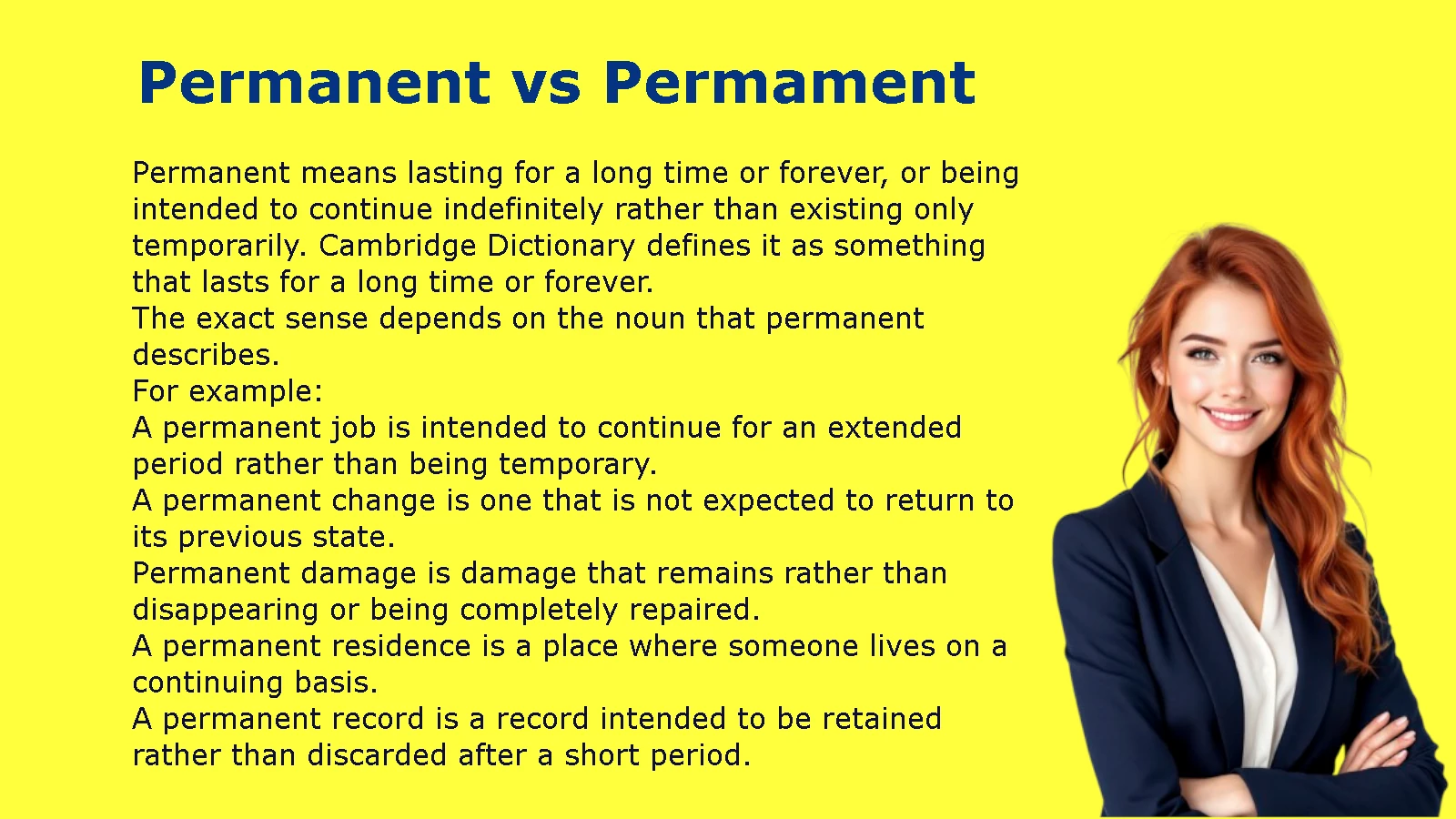
Permanent means lasting for a long time or forever, or being intended to continue indefinitely rather than existing only temporarily. Cambridge Dictionary defines it as something that lasts for a long time or forever.
The exact sense depends on the noun that permanent describes.
For example:
- A permanent job is intended to continue for an extended period rather than being temporary.
- A permanent change is one that is not expected to return to its previous state.
- Permanent damage is damage that remains rather than disappearing or being completely repaired.
- A permanent residence is a place where someone lives on a continuing basis.
- A permanent record is a record intended to be retained rather than discarded after a short period.
The word does not always mean literally forever. In ordinary usage, permanent can mean lasting indefinitely or expected to continue for a very long time.
Simple Definition of Permanent
In simple English:
Permanent means lasting for a long time or indefinitely and not temporary.
For example:
She found a permanent job.
This means the job is intended to continue rather than being a short-term position.
Why Is Permament Incorrect?
The spelling permament is incorrect because the standard English word is permanent, ending in -nent, not -ment.
One reason this mistake is easy to make is that English contains many common words ending in -ment:
- agreement
- development
- improvement
- management
- movement
- treatment
- government
Because permanent sounds as though it might fit a familiar -ment pattern, a writer may accidentally produce permament.
However, spelling should be learned from the established form of the word rather than from the spelling pattern of unrelated words.
Compare the two forms:
Correct: permanent
Incorrect: permament
The correct word contains n after the second a:
perma-nent
That small difference is enough to distinguish the standard spelling from the common misspelling.
How to Spell Permanent Correctly
The easiest way to remember the spelling is to focus on the ending:
Permanent = PERMA + NENT
Do not write:
PERMA + MENT
The complete spelling is:
P-E-R-M-A-N-E-N-T
A Simple Spelling Trick
Remember this:
Permanent has an N before the final ENT.
You can also divide the word visually:
PER | MA | NENT
The final part is NENT, not MENT.
This can be particularly helpful if you frequently make the permament spelling mistake while typing.
Permanent in a Sentence
Here is a straightforward example:
The company offered her a permanent position.
The word permanent describes the type of position.
Another example is:
The repair was intended to be permanent.
Here, permanent describes the expected duration of the repair.
Permanent Meaning and Usage
Permanent is most commonly used as an adjective. It describes a person, thing, condition, arrangement, situation, or change that is expected to remain for a long time or indefinitely.
Cambridge also identifies permanently as the related adverb and permanence as the related noun.
Here are some common patterns.
| Expression | Meaning |
| Permanent job | A job intended to continue rather than being temporary |
| Permanent employee | An employee hired on a continuing basis |
| Permanent residence | A continuing home or residence |
| Permanent change | A change expected to remain |
| Permanent damage | Damage that does not disappear or fully reverse |
| Permanent record | A record intended to be retained |
| Permanent solution | A solution intended to resolve a problem on a lasting basis |
| Permanent address | An address regarded as a person’s continuing address |
| Permanent resident | A person who has permanent residence status in a particular country |
| Permanent display | Something kept on display continuously or for an indefinite period |
Permanent as an Adjective
In its most common grammatical use, permanent modifies a noun.
Examples:
- permanent employment
- permanent staff
- permanent residence
- permanent solution
- permanent damage
- permanent record
- permanent structure
You can also use it after a linking verb:
The change is permanent.
Their new arrangement became permanent.
In both cases, permanent describes the condition or status of the subject.
Permanent vs Temporary
The clearest opposite of permanent is temporary.
Permanent describes something expected to last indefinitely or for a long time. Temporary describes something intended to last only for a limited period.
| Permanent | Temporary |
| Intended to last indefinitely | Intended to last for a limited period |
| Continuing | Short-term |
| Not merely provisional | Provisional or limited |
| Permanent employee | Temporary employee |
| Permanent solution | Temporary solution |
| Permanent residence | Temporary accommodation |
| Permanent change | Temporary change |
Consider these sentences:
She has a permanent position at the company.
This indicates an ongoing employment arrangement.
She has a temporary position at the company.
This indicates an employment arrangement that is limited in duration.
The distinction is especially important in employment, housing, business, administration, and everyday descriptions.
Cambridge’s Business English definition specifically uses permanent for jobs, contracts, employment, and employees that continue for a long period.
Permanent in Different Contexts
The word permanent appears in many areas of everyday English. Its basic idea remains the same, but the practical meaning depends on what it describes.
Permanent Job
A permanent job is a position intended to continue rather than being limited to a specific short-term assignment.
For example:
After working as a temporary assistant for six months, Maya was offered a permanent job.
The contrast with temporary is important here. A permanent job does not necessarily mean the person can never leave the position. It describes the intended nature of the employment arrangement.
Permanent Residence
Permanent residence generally refers to a continuing place of residence or, in immigration contexts, a formal status allowing someone to live in a country on a permanent basis.
For example:
He applied for permanent residence after meeting the required conditions.
Because immigration terminology can have specific legal definitions, the precise meaning of permanent resident depends on the country and its laws.
Permanent Change
A permanent change is a change expected to remain rather than return to the previous condition.
For example:
The renovation made a permanent change to the layout of the building.
The word does not necessarily mean that reversal is physically impossible. It communicates the expectation that the change will remain.
Permanent Damage
Permanent damage means damage that remains and is not expected to disappear completely.
For example:
The accident caused permanent damage to the equipment.
The phrase is also common in medical contexts, where the exact meaning should be interpreted according to the relevant medical information rather than the word alone.
Permanent Record
A permanent record is a record intended to be kept for a very long time or indefinitely.
For example:
The decision was added to the organization’s permanent record.
The phrase can occur in schools, workplaces, institutions, archives, and other settings.
Permanent Solution
A permanent solution is a solution intended to resolve a problem on a lasting basis rather than merely addressing it temporarily.
For example:
The engineers are looking for a permanent solution to the leak.
The phrase permanent solution describes the intended durability of the solution. It does not guarantee that the solution will literally last forever.
Permanent Pronunciation
The standard pronunciation of permanent is approximately:
PUR-muh-nuhnt in American English.
Cambridge gives the American pronunciation as /ˈpɝː.mə.nənt/ and the British pronunciation as /ˈpɜː.mə.nənt/.
The pronunciation can help explain why some people have difficulty spelling the word. The unstressed middle sounds are not pronounced as clearly as each individual written letter might suggest.
Still, pronunciation should not be used to invent the spelling.
The correct written form remains:
permanent
Not:
permament
Does Permanent Sound Like Permament?
The two spellings may look or sound similar when spoken quickly, but they are not two accepted spellings of the same standard word.
Permanent is the established English spelling.
Permament is a misspelling.
If you are unsure while writing, remember the written ending:
-nent
Examples of Permanent in Sentences
Seeing the word in different contexts makes its meaning and spelling easier to remember.
- She accepted a permanent position at the company.
- The museum has a permanent exhibition of local artwork.
- The storm caused permanent damage to several buildings.
- He is looking for a permanent place to live.
- The company offered him a permanent contract.
- They needed a permanent solution to the problem.
- The accident left a permanent mark on the surface.
- She moved abroad and established a permanent residence there.
- The information became part of the permanent record.
- The renovation resulted in a permanent change to the building.
- Some birds are permanent residents of the island.
- The artwork is on permanent display.
The important point is that permanent describes something intended to remain or continue rather than something merely temporary. Cambridge provides similar examples involving jobs, residence, damage, hearing loss, and permanent displays.
Common Mistakes With Permanent
Spelling permanent correctly becomes easier once you understand the mistakes people commonly make.
Writing Permament Instead of Permanent
This is the central mistake addressed by this article.
Incorrect:
The company offered a permament position.
Correct:
The company offered a permanent position.
The correct spelling has n after perma.
Confusing the Ending With -ment
The spelling permament may arise because the writer expects the word to end in -ment.
However, the actual spelling is:
perma + nent
rather than:
perma + ment
This is one reason it helps to memorize the complete word rather than trying to construct it from a familiar suffix.
Using Permanent When You Mean Temporary
Spelling is not the only possible problem. The meaning can also be misunderstood.
Compare:
The company hired a permanent employee.
with:
The company hired a temporary employee.
The first describes an ongoing employment arrangement. The second describes a limited arrangement.
Choosing the wrong word can change the meaning of an entire sentence.
Assuming Permanent Always Means Literally Forever
In ordinary English, permanent often means lasting indefinitely or intended to last for a very long time rather than mathematically or physically impossible to change.
For example:
The company made a permanent change to its policy.
This expresses an intention or expectation that the change will continue. It does not logically guarantee that the policy could never be changed again.
That distinction is useful when choosing between permanent, lasting, long-term, and stronger words such as eternal.
Permanent vs Permament: Correct and Incorrect Examples
The following table makes the spelling difference easy to review.
| Incorrect | Correct |
| Permament job | Permanent job |
| Permament address | Permanent address |
| Permament solution | Permanent solution |
| Permament damage | Permanent damage |
| Permament employee | Permanent employee |
| Permament residence | Permanent residence |
| Permament change | Permanent change |
| Permament record | Permanent record |
| Permament position | Permanent position |
| Permament contract | Permanent contract |
A quick proofreading rule is simple: whenever you write permanent, check the letters immediately after perma.
You want:
NENT
not:
MENT
Synonyms for Permanent
Several words can have a meaning close to permanent, but they are not interchangeable in every sentence.
Lasting
Lasting means continuing for a long time.
They developed a lasting friendship.
This is often more natural than permanent when discussing relationships, effects, impressions, or influence.
Enduring
Enduring describes something that continues over a long period despite changes or difficulties.
The writer left an enduring legacy.
Perpetual
Perpetual generally suggests something continuing indefinitely or without interruption.
The machine appeared to be in perpetual motion.
It can sound more formal or emphatic than permanent.
Fixed
Fixed can describe something established or not subject to change.
The company offers a fixed schedule.
However, fixed does not always mean permanent.
Lifelong
Lifelong means lasting throughout a person’s life.
They formed a lifelong friendship.
It is more specific than permanent.
Everlasting
Everlasting suggests something that lasts forever.
The poem explores the idea of everlasting love.
This is stronger and more absolute than the everyday use of permanent.
Antonyms of Permanent
The most direct opposite is temporary.
Other words can express related ideas:
- temporary
- short-term
- transitory
- fleeting
- impermanent
- provisional
These words have different shades of meaning.
For example, temporary is a normal everyday opposite of permanent, while fleeting emphasizes something that lasts only a very short time.
Compare:
a permanent position
with:
a temporary position
And:
a permanent impression
with:
a fleeting impression
The correct opposite depends on the context.
Is Permanent a Noun, Verb, or Adjective?
Permanent is primarily an adjective.
It describes a noun:
a permanent job
a permanent address
It can also appear after a linking verb:
The arrangement is permanent.
The damage became permanent.
Related Word Forms
The word has several related forms.
| Word | Part of speech | Meaning |
| permanent | Adjective | Lasting for a long time or indefinitely |
| permanently | Adverb | In a permanent manner or condition |
| permanence | Noun | The quality or state of being permanent |
| permanency | Noun | The condition of being permanent |
For example:
The company made the arrangement permanent.
She moved there permanently.
The building was designed for permanence.
The distinction matters when constructing sentences because these forms perform different grammatical roles.
Permanent as a Noun
Although permanent is most commonly encountered as an adjective, dictionaries also recognize a noun use in the context of hair styling.
A permanent, often shortened to perm, can refer to a chemical process that makes hair curly or to the resulting hairstyle. Cambridge lists this noun sense, while Merriam-Webster also defines perm as a shortened form of permanent.
For example:
She got a permanent at the salon.
This use is less common in everyday American English than simply saying:
She got a perm.
This noun meaning is separate from the general adjective meaning of permanent.
The History of the Word Permanent
The spelling becomes easier to understand when you look at the word’s history.
The English adjective permanent dates to the early 15th century. Etymonline traces it through Old French permanent and ultimately to Latin permanentem, meaning “remaining,” from permanere, meaning to endure, continue, or stay to the end.
The Latin word is built from elements associated with the ideas of through and remain.
That history fits the modern meaning remarkably well: something permanent is something that remains.
The related noun permanence also goes back to the same Latin source and has been used in English since the early 15th century.
Why Etymology Helps With the Spelling
The history does not provide a foolproof spelling rule, but it reinforces an important idea: permanent is connected with the concept of remaining.
So when you need to remember the spelling, think:
permanent → remains
Then check the actual spelling:
PERMANENT
This is more useful than trying to force the word into an -ment spelling pattern.
A Quick Way to Remember Permanent
If permament is a recurring spelling mistake, use this three-step check:
Step one: Write PERMA.
two: Add NENT.
Step three: Read the complete word:
PERMA + NENT = PERMANENT
You can also remember:
Permanent has an N before ENT.
That single detail separates the correct spelling from the common misspelling.
A Practical Proofreading Test
When proofreading a sentence, search visually for:
permament
If you find it, replace it with:
permanent
For digital writing, a spell checker will often flag permament, but you should not rely entirely on automatic correction. Understanding the correct spelling lets you catch errors even when the software does not identify them.
Case Study: Catching the Permanent Spelling Error
Consider this sentence:
The company offered Maria a permament contract after her probation period.
The meaning is understandable, but the spelling is incorrect.
The corrected sentence is:
The company offered Maria a permanent contract after her probation period.
Why?
The adjective permanent describes a contract intended to continue rather than a short-term or temporary contract.
The important spelling pattern is:
perma + nent
not:
perma + ment
Now consider a different sentence:
The company offered Maria a temporary contract.
Here, temporary changes the meaning. The contract is limited rather than intended to continue permanently.
This simple comparison demonstrates why both spelling and meaning matter. Correcting permament to permanent fixes the spelling, while understanding permanent versus temporary ensures that the right word has been chosen.
Facts to Remember About Permanent vs Permament
Here are the key facts to keep in mind:
- Permanent is the correct standard spelling.
- Permament is a misspelling.
- Permanent is primarily an adjective.
- It describes something lasting for a long time or indefinitely.
- Temporary is its most common everyday opposite.
- The correct spelling contains NENT after perma.
- Permanently is the related adverb.
- Permanence is the related noun.
- The word dates back to the early 15th century in English.
- Its history is connected with the Latin idea of remaining or continuing.
- Permanent can also function as a noun in the specialized sense of a permanent wave, although perm is the more familiar shortened form in modern usage.
Permanent vs Permament: Final Comparison
| Feature | Permanent | Permament |
| Standard English spelling | Yes | No |
| Correct dictionary form | Yes | No |
| Meaning | Lasting for a long time or indefinitely | — |
| Part of speech | Primarily adjective | — |
| Example | permanent job | permament job |
| Key spelling pattern | -nent | Incorrect -ment |
| Opposite | temporary | — |
The answer is therefore straightforward:
Permanent is correct. Permament is incorrect.
FAQs About Permanent vs Permament
Is permanent or permament correct?
Permanent is correct. Permament is a misspelling.
The correct spelling is P-E-R-M-A-N-E-N-T.
Is permament a word?
Permament is not the standard English spelling of the word. If you mean something that lasts for a long time or indefinitely, use permanent.
What is the correct spelling of permanent?
The correct spelling is:
PERMANENT
A useful way to remember it is:
PERMA + NENT
What does permanent mean?
Permanent means lasting for a long time or indefinitely rather than being temporary. The exact meaning depends on context.
For example:
She found a permanent job.
This describes a job intended to continue rather than a temporary position.
What is the opposite of permanent?
The most common opposite is temporary.
Permanent describes something intended to continue, while temporary describes something intended to last for a limited period.
Is permanent an adjective?
Yes. Permanent is primarily an adjective.
Examples include:
- permanent job
- permanent residence
- permanent change
- permanent damage
- permanent solution
How do you pronounce permanent?
In American English, permanent is pronounced approximately PUR-muh-nuhnt. Cambridge gives the American pronunciation as /ˈpɝː.mə.nənt/ and the British pronunciation as /ˈpɜː.mə.nənt/.
How do you remember the spelling of permanent?
Remember:
Permanent has an N before the final ENT.
So write:
PERMA-NENT
not:
PERMA-MENT
What is the difference between permanent and temporary?
Permanent describes something intended to last indefinitely or for a long time, while temporary describes something intended to last for a limited period.
For example:
He has a permanent job.
He has a temporary job.
The first suggests continuing employment, while the second suggests a limited arrangement.
What are some synonyms for permanent?
Depending on the context, synonyms include lasting, enduring, fixed, perpetual, lifelong, and everlasting.
They are not always exact replacements. For example, lifelong specifically refers to someone’s lifetime, while everlasting can suggest something that lasts forever.
Conclusion
When choosing between Permanent vs Permament, there is only one correct spelling in standard English: permanent.
The common error is adding m before the final -ent, producing permament. The correct spelling instead contains n:
PERMANENT
The word generally means lasting for a long time or indefinitely, and it commonly appears in expressions such as permanent job, permanent residence, permanent change, permanent damage, permanent solution, and permanent record.
Remember the simple spelling pattern:
PERMA + NENT = PERMANENT
If you keep confusing the two forms, focus on the NENT ending. Once that pattern becomes familiar, permanent vs permament becomes an easy spelling choice.
For standard English writing, use permanent every time you mean something that is lasting or not temporary.