Patient vs patience is a common English confusion because the two words look and sound closely related, but they have different meanings and grammatical uses. If you’ve wondered whether to use patient or patience in a sentence, the difference becomes much clearer when you understand that one can describe a person or something related to medical care, while the other refers to the ability to remain calm and wait without becoming annoyed.
The patient vs patience difference mainly comes down to part of speech and meaning. Patient is usually an adjective meaning calm, tolerant, or willing to wait, and it can also be a noun referring to someone receiving medical treatment. Patience is a noun that means the ability to stay calm, tolerate delays or difficulties, and wait without becoming frustrated. Related words and expressions include patient person, be patient, have patience, patience is a virtue, and lose patience, but they cannot always be used interchangeably.
In this guide, you’ll learn the difference between patient and patience, what each word means, how to use them correctly in sentences, and when to use “patient” instead of “patience.” You’ll also see clear examples, grammatical explanations, and practical comparisons to help you avoid this common mistake.
By the end, you’ll know exactly when to use patient and patience and how to use both words naturally and correctly in everyday and formal English.
Patient vs Patience: Key Difference
The main difference between patient and patience is their grammatical role and meaning.
| Word | Part of Speech | Main Meaning | Example |
| Patient | Adjective | Able to wait calmly or tolerate difficulty | She is very patient with children. |
| Patient | Noun | A person receiving medical treatment | The patient is waiting for the doctor. |
| Patience | Noun | The ability to remain calm while waiting or facing difficulty | Learning a language requires patience. |
In simple terms:
Patient describes someone. Patience describes a quality.
There is one important complication: patient also has a completely different noun meaning in healthcare.
Consider these three sentences:
- Maria is patient with her students.
- Maria has a lot of patience with her students.
- Maria’s doctor examined the patient.
This distinction explains most of the confusion surrounding Patient vs Patience.
What Does Patient Mean?
Patient has two major everyday meanings.
First, it can be an adjective describing someone who can wait calmly or tolerate something difficult without becoming annoyed.
Second, it can be a noun referring to someone receiving medical care.
The spelling is identical in both cases, but the context tells you which meaning is intended.
Patient as an Adjective
As an adjective, patient describes someone who can wait, tolerate delays, or deal with difficulties without becoming angry or frustrated.
For example:
- She is patient with young children.
- Please be patient while we review your application.
- You need to be patient when learning a new skill.
- He was patient enough to explain the process again.
- Good teachers are often patient with beginners.
The adjective commonly appears with be:
- be patient
- is patient
- was patient
- remain patient
- stay patient
It can also be followed by with when you identify the person or situation being tolerated.
For example:
She is patient with her students.
Here, patient describes she, while with her students identifies the people with whom she is patient.
Both Cambridge and Oxford define the adjective in terms of being able to wait or tolerate difficulties without becoming annoyed or angry.
Patient as a Noun
Patient is also a noun in medical contexts.
A patient is a person receiving medical care from a doctor, dentist, nurse, hospital, or other healthcare professional. Oxford also notes that the word can refer to someone receiving treatment from a particular doctor or dentist.
Examples include:
- The patient was admitted to the hospital.
- The doctor examined the patient.
- Several patients were waiting in the clinic.
- The nurse spoke with the patient about the treatment.
- The dentist saw three patients that morning.
This medical meaning is unrelated to the immediate grammatical difference between patient and patience, but it is important because it explains why patient can be either an adjective or a noun.
Patient in Grammar
There is also a specialized grammatical meaning of patient.
In linguistics, a patient can be the person or thing affected by the action of a verb. Oxford gives the example of car in the sentence “I started the car.”
This technical meaning is different from the everyday meanings discussed above.
For most English learners, however, the two meanings that matter most are:
- patient = able to wait calmly
- patient = person receiving medical care
What Does Patience Mean?
Patience is a noun that refers to the ability to remain calm when something takes time, becomes difficult, or causes annoyance.
It can involve waiting, tolerating problems, continuing an activity, or dealing calmly with another person.
For example:
- Learning to play the piano takes patience.
- Thank you for your patience.
- She has a lot of patience with children.
- His patience was tested by the repeated delays.
- You need patience to complete a project like this.
Oxford describes patience as the ability to stay calm and accept delays or annoying situations without complaining. It also recognizes the ability to spend considerable time doing something difficult that requires attention and effort.
Cambridge similarly defines patience as the ability to wait or continue despite difficulties, or to tolerate something without becoming annoyed.
Patience Describes a Quality
One useful way to understand patience is to think of it as a personal quality or ability.
You can have patience, show patience, lose patience, exercise patience, or run out of patience.
For example:
Teaching a difficult subject requires patience.
The sentence does not describe the teacher directly as patient. Instead, it identifies a quality needed for teaching.
You could also say:
A good teacher needs to be patient.
The meaning is closely related, but the grammar changes.
Compare:
- A good teacher is patient.
- A good teacher has patience.
The first uses the adjective patient.
The second uses the noun patience.
Patience Can Involve Persistence
Patience is not limited to sitting quietly and waiting.
It can also describe the ability to continue working on something difficult without giving up or becoming frustrated.
For example:
- Writing a book requires patience.
- Learning a new language requires patience and practice.
- Building a detailed model takes patience.
- Solving a difficult problem can require considerable patience.
This broader sense is important because someone can need patience even when they are not literally waiting.
Patient vs Patience Examples
Seeing the two words side by side makes the difference much easier to understand.
Examples With Patient
Here are examples of patient as an adjective:
- Please be patient; the results will be available soon.
- She is patient with her younger brother.
- He remained patient despite the long delay.
- You have to be patient when learning a difficult skill.
- The teacher was patient with students who needed extra help.
Here are examples of patient as a medical noun:
- The patient is waiting for the doctor.
- The nurse called the next patient.
- The patient returned for a follow-up appointment.
- The doctor spoke with the patient about the treatment.
Examples With Patience
Now compare those examples with patience:
- Please have patience while we finish the work.
- Thank you for your patience.
- Learning a language requires patience.
- She has remarkable patience with children.
- The long delay tested everyone’s patience.
- He eventually lost his patience.
The word patience refers to the quality itself, not the person who possesses it.
Patient or Patience in a Sentence?
A useful comparison is to place similar sentences next to each other.
| Patient | Patience |
| She is patient with her students. | She has patience with her students. |
| Please be patient. | Please have patience. |
| He is patient during difficult situations. | He shows patience during difficult situations. |
| Try to be patient while waiting. | Try to have patience while waiting. |
| The patient saw the doctor. | The doctor appreciated the patient’s patience. |
The words can appear in similar contexts, but they cannot simply replace each other.
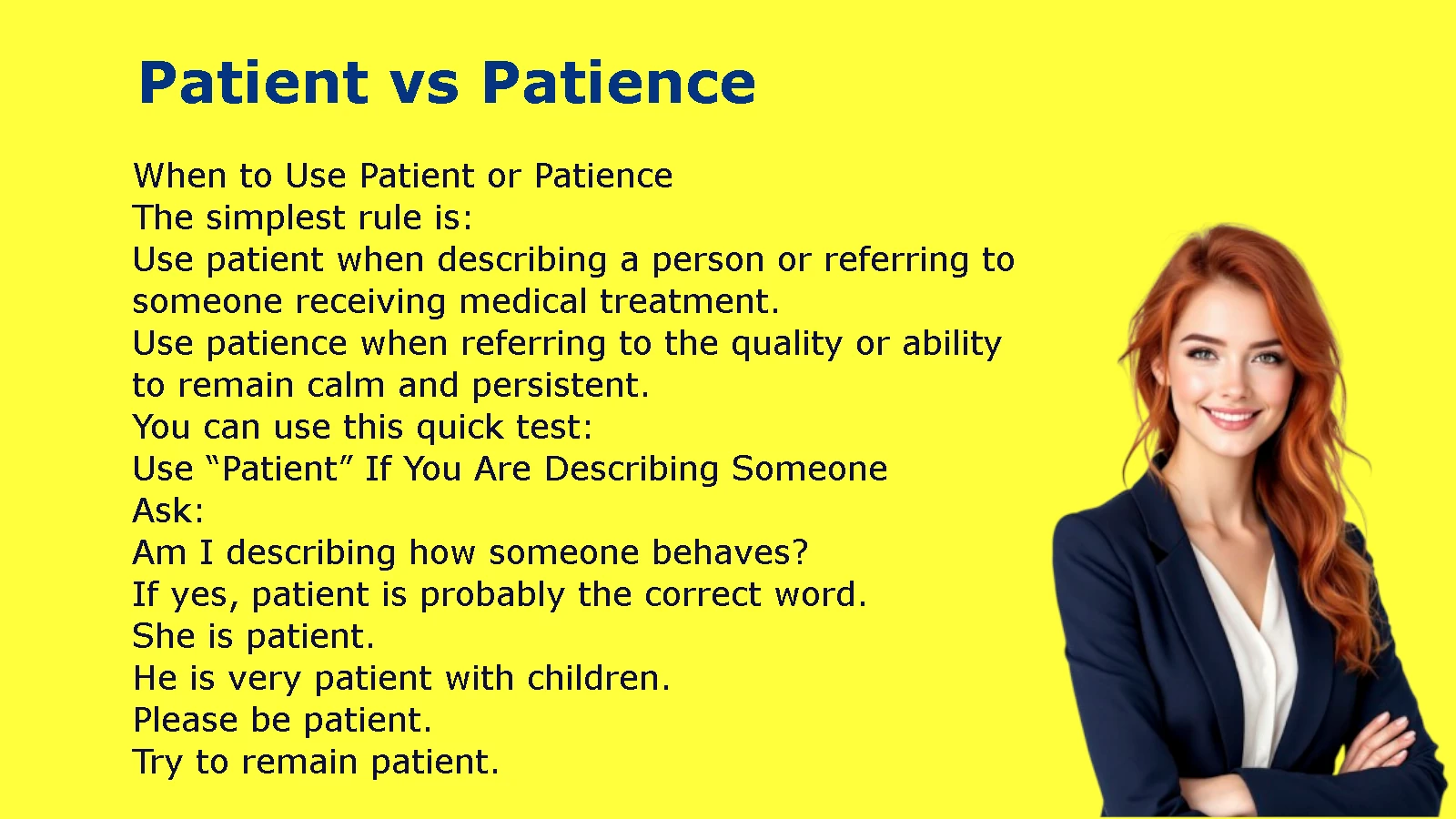
When to Use Patient or Patience
The simplest rule is:
Use patient when describing a person or referring to someone receiving medical treatment.
Use patience when referring to the quality or ability to remain calm and persistent.
You can use this quick test:
Use “Patient” If You Are Describing Someone
Ask:
Am I describing how someone behaves?
If yes, patient is probably the correct word.
- She is patient.
- He is very patient with children.
- Please be patient.
- Try to remain patient.
Use “Patience” If You Are Naming a Quality
Ask:
Am I talking about the ability to wait or tolerate something calmly?
If yes, use patience.
- She has a lot of patience.
- Thank you for your patience.
- I am running out of patience.
- This work requires patience.
A Simple Grammar Pattern
You can remember the difference through these common patterns:
Subject + be + patient
She is patient.
Subject + have + patience
She has patience.
Please + be + patient
Please be patient.
Thank you for + possessive determiner + patience
Thank you for your patience.
These patterns cover many of the situations in which English learners confuse the two words.
Patient or Patience in Common Phrases
Some expressions cause more confusion than others.
“Thanks for Being Patient”
“Thanks for being patient” is correct.
Here, patient is an adjective describing the person being thanked.
For example:
Thanks for being patient while I finish the report.
The grammatical structure is:
being + adjective
Just as you can say:
- Thanks for being kind.
- Thanks for being helpful.
- Thanks for being understanding.
- Thanks for being patient.
You cannot say “Thanks for being patience” because patience is a noun.
“Thanks for Your Patience”
“Thanks for your patience” is also correct.
Here, patience is a noun.
The sentence means that you appreciate someone’s ability to wait calmly or tolerate a delay.
For example:
Thanks for your patience while we resolve the issue.
This expression is particularly common in customer service, business communication, technical support, and situations involving delays.
“Thanks for Being Patient” vs. “Thanks for Your Patience”
Both expressions are correct, but their grammatical structures differ.
| Expression | Correct? | Why? |
| Thanks for being patient. | ✓ | Patient is an adjective. |
| Thanks for your patience. | ✓ | Patience is a noun. |
| Thanks for being patience. | ✗ | Patience cannot function as the adjective here. |
| Thanks for your patient. | ✗ | Patient does not mean the quality of waiting calmly. |
There is also a subtle difference in emphasis.
“Thanks for being patient” focuses more directly on the person’s behavior.
“Thanks for your patience” focuses on the quality they have shown.
In everyday English, both sound natural.
“Please Be Patient”
“Please be patient” is correct because patient is an adjective.
For example:
Please be patient while your order is being processed.
The same construction appears in:
- Please be patient with me.
- Please be patient with the children.
- Please be patient while we investigate the problem.
- Please be patient for a few more minutes.
The opposite is:
Please be impatient.
But this is rarely something you actually want to tell someone.
“Have Patience”
“Have patience” is also grammatically correct.
For example:
Have patience; everything will work out eventually.
However, in many modern everyday situations, “be patient” or “have some patience” may sound more natural depending on the context.
Compare:
- Please be patient.
- Please have some patience.
- You need to have patience.
- You need to be patient.
All are possible, but they use different grammatical structures.
“Lose Patience”
Lose patience is a standard expression meaning to stop being able to remain calm because something has become frustrating or annoying.
Examples:
- I lost my patience after waiting for two hours.
- She eventually lost patience with the repeated interruptions.
- The customers were beginning to lose patience.
Cambridge lists lose your patience, test someone’s patience, and similar expressions as established uses of the noun patience.
“Test Someone’s Patience”
If something tests your patience, it makes it difficult for you to remain calm.
For example:
The constant delays really tested my patience.
This does not necessarily mean that you became angry. It means the situation challenged your ability to remain calm.
You can also say:
- The noise tested my patience.
- The repeated mistakes tested his patience.
- The long wait was testing everyone’s patience.
“Run Out of Patience”
When someone runs out of patience, they can no longer tolerate a situation calmly.
For example:
After answering the same question five times, she ran out of patience.
Other common expressions include:
- my patience is wearing thin
- lose your patience
- test someone’s patience
- try someone’s patience
- have the patience of a saint
- the patience of Job
Oxford and Cambridge both recognize several of these as established expressions.
Patient vs Patience Pronunciation
Both begin with the same basic sound, but their endings differ.
Patient Pronunciation
Patient is commonly pronounced:
/ˈpeɪ.ʃənt/
A simple approximation is:
PAY-shunt
The first syllable receives the main stress.
Patience Pronunciation
Patience is commonly pronounced:
/ˈpeɪ.ʃəns/
A simple approximation is:
PAY-shuns
The ending changes from the -ent sound in patient to the -ence sound in patience.
Cambridge gives the American pronunciations as approximately /ˈpeɪ.ʃənt/ for patient and /ˈpeɪ.ʃəns/ for patience.
Patient vs Patience Pronunciation Comparison
| Word | IPA | Simple Guide |
| patient | /ˈpeɪ.ʃənt/ | PAY-shunt |
| patience | /ˈpeɪ.ʃəns/ | PAY-shuns |
| patiently | /ˈpeɪ.ʃənt.li/ | PAY-shunt-lee |
The difference is small, which is one reason English learners may confuse the words when speaking as well as writing.
Is Patient Related to Patience?
Yes. Patient and patience are historically related words.
Oxford traces patient through Middle English and Old French to Latin patient-, connected with the Latin verb pati, meaning to suffer or endure.
Oxford gives a similar origin for patience, tracing it through Middle English and Old French to Latin patientia.
The historical connection makes sense because the original ideas behind the words involved enduring, suffering, tolerating, and remaining steady through difficulty.
Over time, the modern meanings developed into the forms we use today:
- patient → someone who can endure waiting or difficulty calmly
- patience → the quality or ability that allows someone to do so
The medical noun patient also developed from the same historical family, reflecting an older sense connected with someone undergoing or enduring treatment or suffering.
So the similarity between the words is not accidental. They are connected by their history as well as their meaning.
Common Mistakes With Patient and Patience
Because the words are closely related, several mistakes appear frequently in writing.
“Thanks for Your Patient”
Incorrect:
❌ Thanks for your patient.
Correct:
✅ Thanks for your patience.
Why?
The phrase refers to someone’s ability to wait calmly, so the noun patience is required.
The word patient would be appropriate if you were referring to a person receiving medical care:
The doctor spoke with her patient.
“Thanks for Being Patience”
Incorrect:
❌ Thanks for being patience.
Correct:
✅ Thanks for being patient.
After being, you need an adjective when describing someone’s state or behavior.
Compare:
- being patient ✓
- being helpful ✓
- being kind ✓
- being careful ✓
Patience is a noun, so it does not fit this construction.
“Please Have Patient”
Incorrect:
❌ Please have patient.
Correct:
✅ Please have patience.
Here, have is followed by a noun. Patience is the noun.
You can also say:
Please be patient.
That version uses the adjective.
“He Is Very Patience”
Incorrect:
❌ He is very patience.
Correct:
✅ He is very patient.
The sentence describes he, so an adjective is needed.
He is very patient.
The noun version would be:
He has a lot of patience.
“She Has a Lot of Patient”
Incorrect:
❌ She has a lot of patient.
Correct:
✅ She has a lot of patience.
The phrase a lot of can modify a noun here, and patience is the appropriate noun.
Patient vs Patience: A Practical Usage Guide
A useful way to choose between the words is to look at the word immediately before the blank.
| Sentence | Correct Word | Reason |
| Please be ___ with me. | patient | Adjective after be |
| Thank you for your ___. | patience | Noun after your |
| She is very ___. | patient | Adjective after is |
| He has a lot of ___. | patience | Noun after a lot of |
| The doctor examined the ___. | patient | Medical noun |
| Learning this takes ___. | patience | Names a required quality |
| Don’t lose your ___. | patience | Fixed noun expression |
| You need to be ___. | patient | Adjective after be |
This approach is more reliable than trying to memorize individual phrases.
Patient vs Patience: Mini Usage Case Studies
Case Study: Customer Service Delay
Imagine a customer has been waiting for an order.
A support representative might write:
Thank you for your patience while we investigate the delay.
Here, patience is correct because the representative is thanking the customer for the quality they have demonstrated.
The representative could also write:
Thank you for being patient while we investigate the delay.
Now patient is correct because it describes the customer’s behavior.
Both sentences communicate essentially the same idea.
Case Study: Teaching a Beginner
Suppose a teacher is helping someone learn a difficult skill.
You could say:
The teacher is very patient with beginners.
Here, patient describes the teacher.
You could also say:
The teacher has a great deal of patience with beginners.
Here, patience names the quality the teacher possesses.
The meaning overlaps, but the grammatical perspective changes.
Case Study: A Medical Context
Consider this sentence:
The patient is waiting for the doctor.
Here, patient has nothing to do with waiting calmly. It means a person receiving medical care.
Now compare:
The patient remained patient while waiting for the doctor.
This sentence contains both meanings.
- The first patient is a noun meaning a person receiving medical care.
- The second patient is an adjective meaning calm and willing to wait.
That example demonstrates why context matters so much with this word.
Patient vs Patience: Easy Memory Trick
The easiest memory trick is:
Patient = person or personality.
Patience = quality.
Think of these pairs:
- She is patient.
- She has patience.
And:
- Be patient.
- Have patience.
The ending -ence in patience can remind you that you are dealing with a noun representing a quality, while patient commonly functions as an adjective describing someone.
Another useful association is:
Patient waits; patience is what helps you wait.
This is not a complete grammatical rule for every possible context, but it works extremely well for everyday usage.
Patient vs Patience FAQs
What is the difference between patient and patience?
Patient is usually an adjective meaning able to wait calmly or tolerate difficulty. It is also a noun meaning someone receiving medical care.
Patience is a noun meaning the ability to remain calm while waiting, dealing with annoyance, or continuing through difficulty.
Is patient an adjective or a noun?
Patient can be both.
As an adjective:
She is patient with children.
As a noun:
The patient is waiting for the doctor.
The context determines which meaning applies.
Is patience an adjective?
No. Patience is a noun.
The related adjective is patient.
Compare:
- She is patient.
- She has patience.
You would not normally say:
❌ She is patience.
Is “Thanks for being patient” correct?
Yes.
“Thanks for being patient” is grammatically correct because patient is an adjective describing the person being thanked.
For example:
Thanks for being patient while I finish this.
Is “Thanks for your patience” correct?
Yes.
“Thanks for your patience” is also correct. Here, patience is a noun referring to the person’s ability to wait calmly or tolerate a delay.
Both “Thanks for being patient” and “Thanks for your patience” are natural English expressions.
Should I say “Please be patient” or “Please have patience”?
Both are grammatically possible.
“Please be patient” uses the adjective and is extremely common.
“Please have patience” uses the noun and emphasizes the quality of patience.
In ordinary conversation, “Please be patient” is often the more direct choice.
How do you pronounce patient and patience?
Patient is commonly pronounced /ˈpeɪ.ʃənt/, approximately PAY-shunt.
Patience is commonly pronounced /ˈpeɪ.ʃəns/, approximately PAY-shuns.
Are patient and patience related words?
Yes. Both words ultimately trace back through French to Latin forms associated with enduring or suffering. Their modern meanings developed from this historical connection.
What is the opposite of patient?
The common opposite of patient is impatient.
For example:
- She is patient.
- She is impatient.
The corresponding noun is impatience.
- He showed patience.
- He showed impatience.
What are common expressions with patience?
Common expressions include:
- have patience
- show patience
- lose patience
- run out of patience
- test someone’s patience
- try someone’s patience
- my patience is wearing thin
- have the patience of a saint
- the patience of Job
These expressions all use patience, not patient, because they refer to the quality or capacity for remaining calm.
Patient vs Patience: Quick Summary
The difference between Patient vs Patience becomes simple once you identify the grammatical role of each word.
| Word | Meaning | Example |
| Patient | Able to wait calmly or tolerate difficulty | Please be patient. |
| Patient | A person receiving medical care | The patient saw the doctor. |
| Patience | The ability to remain calm or persistent | Thank you for your patience. |
Remember these four sentences:
She is patient.
She has patience.
The patient is waiting for the doctor.
Thank you for your patience.
If you are describing someone, use patient.
If you are naming the quality that allows someone to wait or endure, use patience.
And if you are talking about someone receiving medical treatment, patient is the noun you need.
Once you understand that distinction, common expressions such as “Please be patient,” “Thanks for being patient,” “Thanks for your patience,” and “I lost my patience” become much easier to use correctly.