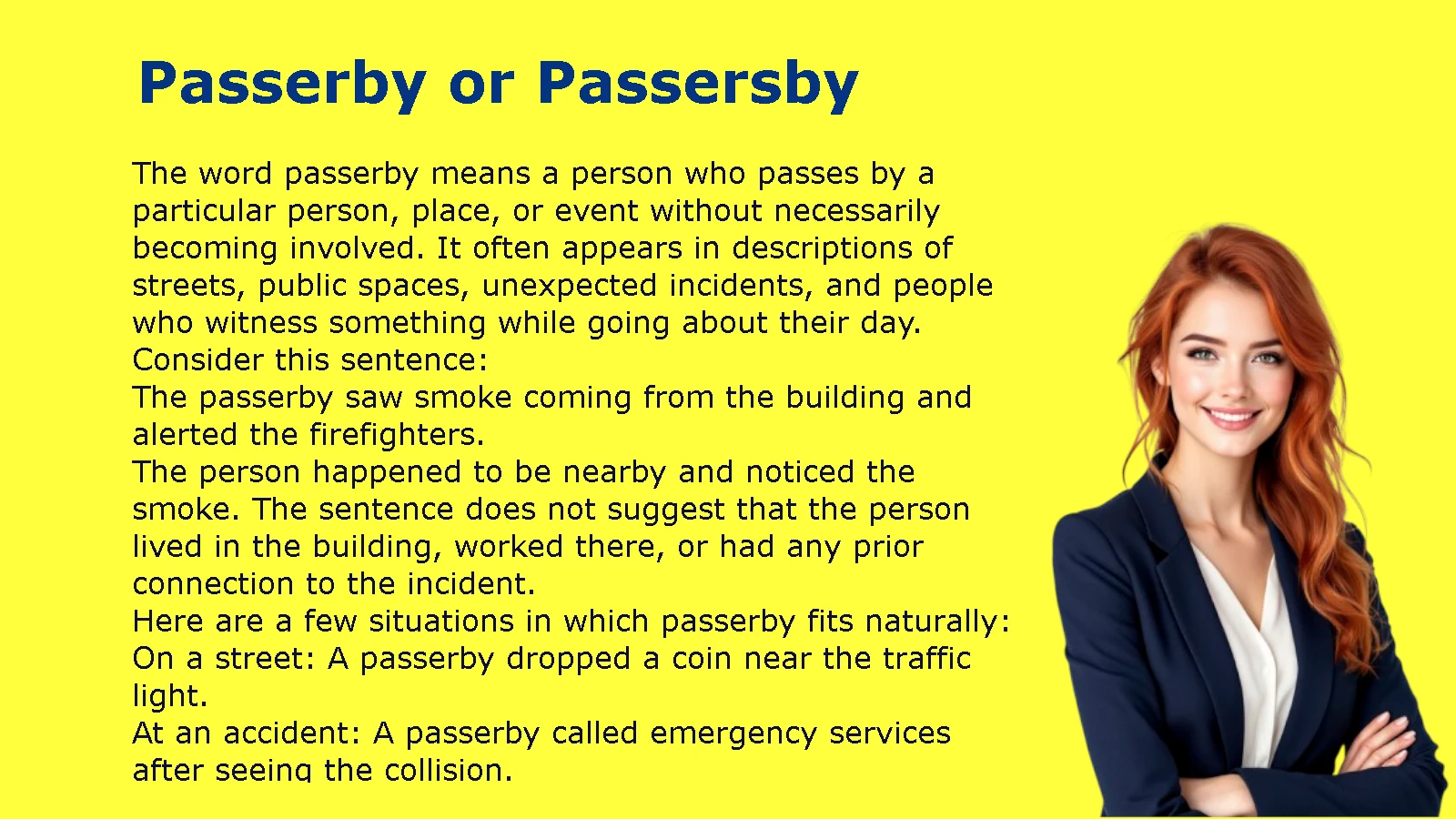
The passerby or passersby meaning depends on how many people you’re describing. Use passerby when referring to one person and passersby when referring to multiple people. Unlike most English nouns, which form their plurals by adding -s or -es at the end, passerby changes to passersby because passer is the main noun and by functions as an adverbial element. Both forms are correct, but they cannot always be used interchangeably.
A passerby is a person who happens to walk or travel past a particular place, while passersby is the plural form used when referring to two or more people. If you’ve come across the words “passerby” and “passersby” and wondered which one is correct, the difference comes down to singular and plural forms, spelling rules, everyday usage, and sentence structure.
In this guide, you’ll learn whether to use passerby or passersby, what each word means, how to spell the plural correctly, and how to use both forms in sentences. You’ll also see clear examples, common mistakes, and comparisons with related expressions such as bystander, pedestrian, and passer-by.
By the end, you’ll know exactly when to use passerby and passersby and how to choose the correct form naturally and confidently in your writing.
Passerby or Passersby at a Glance
Passerby is the singular noun, and passersby is its plural. Use passerby when referring to one person passing a place and passersby when referring to two or more people. Do not use passerbys as the standard plural spelling.
| Word or phrase | Correct? | Meaning | Example |
| Passerby | Yes | One person passing a place | A passerby offered to help. |
| Passersby | Yes | Two or more people passing a place | Several passersby stopped to look. |
| Passerbys | No | Incorrect plural spelling | Incorrect: Three passerbys watched. |
| Passerby’s | Yes | Something belonging to one passerby | The passerby’s phone rang. |
| Passersby’s | Yes | Something belonging to multiple passersby | The passersby’s comments were recorded. |
The most important rule is simple: the plural of passerby is passersby, not passerbys.
Remember that the apostrophe in passerby’s and passersby’s indicates possession, not an ordinary plural. If you only want to describe several people, write passersby without an apostrophe.
Passerby: The Correct Singular Form
A passerby is a person who passes someone or something, often while walking along a street, traveling through a public place, or moving past an event. The word usually describes someone who happens to be nearby rather than someone directly involved in the situation.
For example:
- A passerby noticed the wallet lying beside the bus stop.
- The injured cyclist asked a passerby to call for help.
- A passerby stopped to admire the flowers outside the shop.
- One passerby recognized the missing dog from a neighborhood poster.
In each sentence, passerby refers to one person. The individual might stop, offer assistance, observe something, or continue walking.
The word does not require the person to be walking. Someone riding a bicycle or traveling past a location may also be described as a passerby if the context supports that meaning.
What Does Passerby Mean?
The word passerby means a person who passes by a particular person, place, or event without necessarily becoming involved. It often appears in descriptions of streets, public spaces, unexpected incidents, and people who witness something while going about their day.
Consider this sentence:
The passerby saw smoke coming from the building and alerted the firefighters.
The person happened to be nearby and noticed the smoke. The sentence does not suggest that the person lived in the building, worked there, or had any prior connection to the incident.
Here are a few situations in which passerby fits naturally:
- On a street: A passerby dropped a coin near the traffic light.
- At an accident: A passerby called emergency services after seeing the collision.
- Outside a business: A passerby stopped to read the restaurant’s menu.
- At a public event: A passerby paused to listen to a musician playing in the square.
The term often appears in news reports because it describes someone who witnesses an event without necessarily being a participant.
For instance, a report might say, “A passerby alerted authorities after noticing a broken window.” This wording identifies the person by their role in the situation without implying any personal connection to the property.
When to Use Passerby
Use passerby when the sentence refers to exactly one person passing a location or encountering something along the way.
The article before the noun can help you identify the correct form. Phrases such as a passerby, one passerby, and the passerby normally refer to a single person.
Examples:
- A passerby returned the envelope to its owner.
- One passerby offered directions to the lost tourist.
- The passerby who found the keys left them at the reception desk.
- Every passerby seemed interested in the unusual street display.
Notice that passerby remains singular even when the sentence includes additional information about the person.
For example, “The passerby who stopped to help was a retired nurse” still refers to one individual. The relative clause who stopped to help adds detail but does not change the noun’s number.
When referring to several people, however, you must switch to passersby.
Passersby: The Correct Plural Form
Passersby is the standard plural form of passerby. It refers to two or more people passing a place or encountering something while traveling through a public area. The word keeps by at the end while adding the plural ending to passer.
Examples include:
- Several passersby gathered near the fountain.
- The street artist thanked the passersby who stopped to watch.
- Passersby reported seeing a loose dog near the school.
- A few passersby ignored the advertisement displayed outside the store.
In these sentences, passersby describes multiple people. The noun can appear at the beginning, middle, or end of a sentence, depending on the intended meaning.
The word is common in both American and British English. Its plural spelling does not change between the two varieties.
Why Is the Plural Passersby Instead of Passerbys?
The plural is passersby because passerby is a compound noun whose first element takes the plural ending. English forms some compound plurals by changing the main noun rather than simply adding -s to the final word.
The word consists of two elements:
- Passer: A person who passes or moves past something.
- By: A word that indicates passing near or alongside something in this expression.
When the noun refers to more than one person, passer becomes passers. The complete compound therefore becomes passersby.
The formation looks like this:
passer + by → passerby
passers + by → passersby
The final y does not change to ies because the plural ending does not attach directly to by. Instead, the plural form develops from the first element, passer.
This pattern may seem unusual if you expect every plural ending to appear at the end of a word. However, English has several compound nouns that follow a similar pattern.
| Singular | Plural | Explanation |
| Passerby | Passersby | The first element takes the plural ending. |
| Mother-in-law | Mothers-in-law | The main noun becomes plural. |
| Runner-up | Runners-up | The main noun becomes plural. |
| Editor-in-chief | Editors-in-chief | The main noun becomes plural. |
These examples show why adding -s to the last element is not always the correct way to pluralize a compound noun.
Writing passerbys treats the entire word as though it followed the ordinary rule for most simple nouns. The standard spelling instead preserves the compound’s structure.
Passersby in Example Sentences
The best way to understand passersby is to see how writers use it in different situations.
On a busy street
Passersby hurried along the pavement as the rain grew heavier.
The sentence describes several people moving through a public area. It does not suggest that they know one another or share a destination.
At an accident scene
Several passersby stopped after hearing the crash and offered assistance.
The plural form identifies multiple people who happened to be nearby. It does not automatically mean that every person helped or witnessed the entire incident.
Watching a street performer
The guitarist attracted passersby with a lively tune played outside the station.
Here, the word describes people who encountered the performance while moving through the area. Some may stop to listen, while others continue walking.
In a news report
Passersby alerted local authorities after noticing damage to the storefront.
This sentence uses the plural form to describe an unspecified group of people. It avoids naming individuals when their identities are not important to the report.
In a public space
The sculpture drew the attention of passersby throughout the afternoon.
The word works naturally in descriptive writing because it conveys movement, public access, and brief encounters.
Across all these examples, the spelling remains the same. Whether the people are watching, reporting, helping, or simply walking past, the correct plural is passersby.
Passerby’s vs. Passersby: What’s the Difference?
The difference between passerby’s, passersby, and passersby’s comes down to number and possession. Passerby’s is singular possessive, passersby is plural without possession, and passersby’s is plural possessive.
An apostrophe does not automatically make a noun plural. Its position helps show whether something belongs to one person or several people.
| Form | Grammatical use | Meaning | Example |
| Passerby | Singular | One person | A passerby waved. |
| Passerby’s | Singular possessive | Belonging to one person | The passerby’s bag was missing. |
| Passersby | Plural | Multiple people | Passersby waved. |
| Passersby’s | Plural possessive | Belonging to multiple people | The passersby’s bags were missing. |
The distinction matters because a small punctuation change can alter the meaning of an entire sentence.
Passerby’s: Singular Possessive
Passerby’s indicates that something belongs to one passerby or is associated with that person.
To form the singular possessive, add an apostrophe and s to passerby.
Examples:
- The passerby’s umbrella rolled into the street.
- A shopkeeper returned the passerby’s wallet.
- The passerby’s quick reaction prevented further damage.
- We could not identify the passerby’s car in the security footage.
In each example, the apostrophe shows a relationship between one person and something connected to them.
Compare these two sentences:
- A passerby found a wallet.
- A passerby’s wallet was found near the entrance.
The first sentence says that a person found a wallet. The second says that the wallet belonged to a person passing by.
The possessive form is useful when the owner matters to the sentence. Without the apostrophe, the intended relationship may become unclear.
Passersby: Plural Without Possession
Passersby refers to multiple people without showing ownership. It is the correct choice whenever you want to describe more than one passerby.
Examples:
- Passersby watched the parade from the sidewalk.
- Several passersby stopped to help the stranded driver.
- The announcement caught the attention of nearby passersby.
- Passersby often paused to photograph the historic building.
None of these sentences uses an apostrophe because the noun simply identifies a group of people.
A useful test is to replace the word with people passing by. If that substitution preserves the intended meaning, passersby is likely the right form.
For example:
Several passersby stopped to watch the performance.
This means:
Several people passing by stopped to watch the performance.
No possession appears in either version, so an apostrophe is unnecessary.
Passersby’s: Plural Possessive
Passersby’s indicates that something belongs to, or is associated with, more than one passerby.
First, form the plural passersby. Then add an apostrophe and s to create the plural possessive.
Examples:
- The passersby’s comments helped the reporter understand what happened.
- The passersby’s photographs showed different views of the event.
- We collected the passersby’s opinions about the new pedestrian crossing.
- The passersby’s responses varied depending on where they stood.
The plural possessive can look awkward because the apostrophe appears before the final s in the written form. However, this is the standard way to mark possession when the plural noun does not end in the usual letter s.
Compare:
- Passersby: The people stopped near the entrance.
- Passersby’s: The people’s belongings were left near the entrance.
The first identifies the people. The second identifies something connected to them.
Common Spelling Mistakes With Passerby
Most mistakes involving passerby happen when writers apply a familiar plural rule to an unusual compound noun or confuse plural forms with possessives.
The correct spelling depends on the sentence’s grammatical meaning, not simply on which version looks more familiar.
Passerbys
Passerbys is an incorrect standard plural spelling of passerby. The correct form is passersby because the plural ending applies to passer, not to the entire word’s final element.
Incorrect: Three passerbys stopped outside the building.
Correct: Three passersby stopped outside the building.
Incorrect: The performer waved at the passerbys.
Correct: The performer waved at the passersby.
The mistake is understandable. Most English nouns form their plurals by adding -s or -es to the end. However, compound nouns do not all follow that pattern.
If you are unsure, remember the transformation: passer becomes passers, and by remains unchanged.
Passer by
Passerby is the standard one-word spelling when you use the noun to describe a person passing a place. The separate words passer by may appear in a different grammatical construction, but they do not replace the established noun spelling.
Compare these examples:
- Correct noun: A passerby noticed the damaged fence.
- Correct noun plural: Several passersby noticed the damaged fence.
- Different construction: As the car passed by, the driver waved.
In the last sentence, passed by is a verb followed by a particle or adverb. It does not function as the noun passerby.
For most everyday writing, use passerby as one word when you mean a person and passersby when you mean multiple people.
Passerby’s vs. Passersby’s
These two forms are both correct, but they do not mean the same thing.
- Passerby’s: Something belongs to one person.
- Passersby’s: Something belongs to multiple people.
Consider the following examples:
The passerby’s statement helped clarify the incident.
This sentence refers to the statement of one person.
The passersby’s statements helped clarify the incident.
This sentence refers to statements made by multiple people.
Another common error is adding an apostrophe to the ordinary plural.
Incorrect: The passerby’s gathered outside the store.
Correct: The passersby gathered outside the store.
The incorrect sentence uses a possessive form where a simple plural is required. If you are not expressing ownership or association, leave out the apostrophe.
How to Remember the Plural of Passerby
The easiest way to remember the plural of passerby is to focus on the word’s first element. Think of passer as the person and by as the element that completes the compound. When more than one person is involved, make passer plural.
Apply the Plural to the Main Word
Break the word into two parts:
- Passer refers to the person who passes.
- By completes the compound noun.
Then change only the first element:
One passerby → Two passersby
You can use the same method when checking a sentence.
For example:
- One passerby noticed the sign.
- Two passersby noticed the sign.
- Several passersby noticed the sign.
The first sentence needs the singular form. The other two need the plural.
This method is more reliable than trying to remember whether the complete word should end in -s or -ies.
Remember Similar Compound Words
English has several compound nouns in which the main noun takes the plural ending before another element.
Examples include:
| Singular | Plural |
| Passerby | Passersby |
| Mother-in-law | Mothers-in-law |
| Runner-up | Runners-up |
| Editor-in-chief | Editors-in-chief |
You do not need to memorize every compound noun at once. The useful lesson is that the plural ending belongs to the main noun element in these examples.
When you encounter an unfamiliar compound, consider which part identifies the person or thing being counted. That can help you determine where the plural ending belongs, although individual compounds may follow different conventions.
Passersby in American and British English
The spellings passerby and passersby are standard in both American and British English. You do not need to change the plural form when writing for readers in the United States or the United Kingdom.
Examples:
- American English: A passerby reported the damaged traffic signal.
- British English: A passerby reported the damaged traffic signal.
- American English: Several passersby gathered outside the station.
- British English: Several passersby gathered outside the station.
The spelling remains the same. Differences between American and British English affect some words, such as color and colour, but passerby does not have a corresponding American-versus-British spelling variation.
Writers should still follow the spelling and style requirements of their intended publication. However, there is no need to choose passerbys for one variety of English and passersby for the other.
Passerby vs. Bystander: What’s the Difference?
A passerby is someone who passes a place, often by chance. A bystander is someone who is present at an event but is not directly involved in it. The words can describe the same person, but they emphasize different aspects of the situation.
For example, someone walking down a street may be a passerby. If that person witnesses a collision and remains nearby while others respond, the person may also be described as a bystander.
| Word | Main emphasis | Example |
| Passerby | Someone passing a place | A passerby noticed a wallet on the pavement. |
| Bystander | Someone present but not directly involved | A bystander watched while the paramedics treated the cyclist. |
| Passersby | Multiple people passing a place | Passersby stopped to watch the street performance. |
| Bystanders | Multiple people present but not directly involved | Bystanders described what they had seen. |
The distinction is especially useful in news writing.
Suppose a person walking past a shop sees someone break a window. At the moment of discovery, passerby emphasizes that the person was moving through the area. If the report discusses people who witnessed the incident, bystanders may be more suitable.
Neither word necessarily implies that the person helped, ignored the situation, or took sides. The surrounding sentence supplies that information.
Frequently Asked Questions
Is Passerbys a Correct Spelling?
No. Passerbys is not the standard plural spelling of passerby. Use passersby when referring to two or more people who pass a place. For example, write, “Several passersby stopped to watch the parade,” rather than “Several passerbys stopped to watch the parade.”
Is It Passerby or Passersby?
Both are correct, but they serve different purposes. Passerby is singular and refers to one person. Passersby is plural and refers to two or more people. Use a passerby for one individual and several passersby for a group.
What Is the Plural of Passerby?
The plural of passerby is passersby. The plural ending applies to passer, while by remains unchanged. This is why passerbys is incorrect in standard English.
Why Is Passersby Not Spelled Passerbys?
The word passerby is a compound noun, and its plural follows a pattern in which the main noun element takes the plural ending. Passer becomes passers, producing passersby. Adding an s to the very end would not follow this established spelling.
Is Passerby’s Singular or Plural?
Passerby’s is the singular possessive form. It indicates that something belongs to or is associated with one passerby. For example, “The passerby’s phone fell onto the pavement” identifies the phone as belonging to one person.
Is Passersby’s Grammatically Correct?
Yes. Passersby’s is the plural possessive form of passerby. It indicates possession or association involving multiple passersby. For example, “The passersby’s accounts differed” means that the accounts belonged to or came from several people.
Does Passersby Have an Apostrophe?
No. The ordinary plural passersby does not require an apostrophe. Use passerby’s for singular possession and passersby’s for plural possession. For example, “The passersby stopped” requires no apostrophe, while “The passersby’s photographs were published” uses one to indicate possession.
Is Passerby One Word or Two?
When used as a noun meaning a person who passes a place, passerby is written as one word. Its plural is also one word: passersby. Do not write passer by when you intend to use the established noun.
Is Passersby the Same in American and British English?
Yes. Both American and British English use passerby for the singular and passersby for the plural. The spelling does not change between the two varieties.
Final Answer: Passerby or Passersby?
The correct spelling depends on whether you mean one person or several people:
- Passerby: One person passing a place.
- Passersby: Two or more people passing a place.
- Passerby’s: Something belonging to one passerby.
- Passersby’s: Something belonging to multiple passersby.
- Passerbys: Incorrect as the standard plural spelling.
The key is to remember that the plural ending applies to passer, not to the end of the complete compound word.
For example, write, “A passerby stopped to help,” when describing one person. If several people stopped, write, “Several passersby stopped to help.”
When editing your next article, email, or report, check both the number of people and whether you intend to show possession. That quick check will help you choose the correct form every time.