Humorous is the correct spelling in American English. It means funny, amusing, or causing laughter. Humourous is a less common spelling variant associated with British English, where humour is the standard spelling of the noun. However, the standard British spelling of the adjective is also humorous, without the extra u.
Examples:
- His humorous stories made everyone laugh.
- She has a humorous way of explaining difficult topics.
The confusion is understandable. People often search for humorous vs humourous, humorous or humourous, which spelling is correct, or humourous meaning because the British spelling of humour includes a u, making it seem natural to retain that letter in the adjective. But here’s the key point: humorous is the standard spelling in both American and British English.
In this guide, you’ll learn the complete difference between Humorous vs Humourous, including their meaning, correct spelling, pronunciation, origin, and usage. You’ll also discover why humourous is a common spelling mistake, along with clear examples to help you remember the correct form.
Humorous vs Humourous: Quick Answer
Humorous is the correct spelling in both American and British English. Humourous is a misspelling, even though British English spells the related noun as humour. The adjective drops the extra u in both varieties, so write a humorous story, a humorous person, or a humorous comment.
Here’s a quick comparison:
| Word or phrase | Correct? | Explanation |
| Humorous | Yes | Standard adjective spelling in American and British English |
| Humourous | No | Common misspelling influenced by the spelling humour |
| Humor | Yes | Standard American English noun |
| Humour | Yes | Standard British English noun |
| Humorously | Yes | Standard adverb spelling |
| Humourously | No | Nonstandard spelling of the adverb |
Examples:
- Correct: The teacher told a humorous story about his first day at school.
- Incorrect: The teacher told a humourous story about his first day at school.
- American English: Her sense of humor makes every meeting more enjoyable.
- British English: Her sense of humour makes every meeting more enjoyable.
Notice the pattern: the noun changes between American and British English, but the adjective humorous does not.
If you remember only one thing from this guide, remember this: humor or humour, but always humorous.
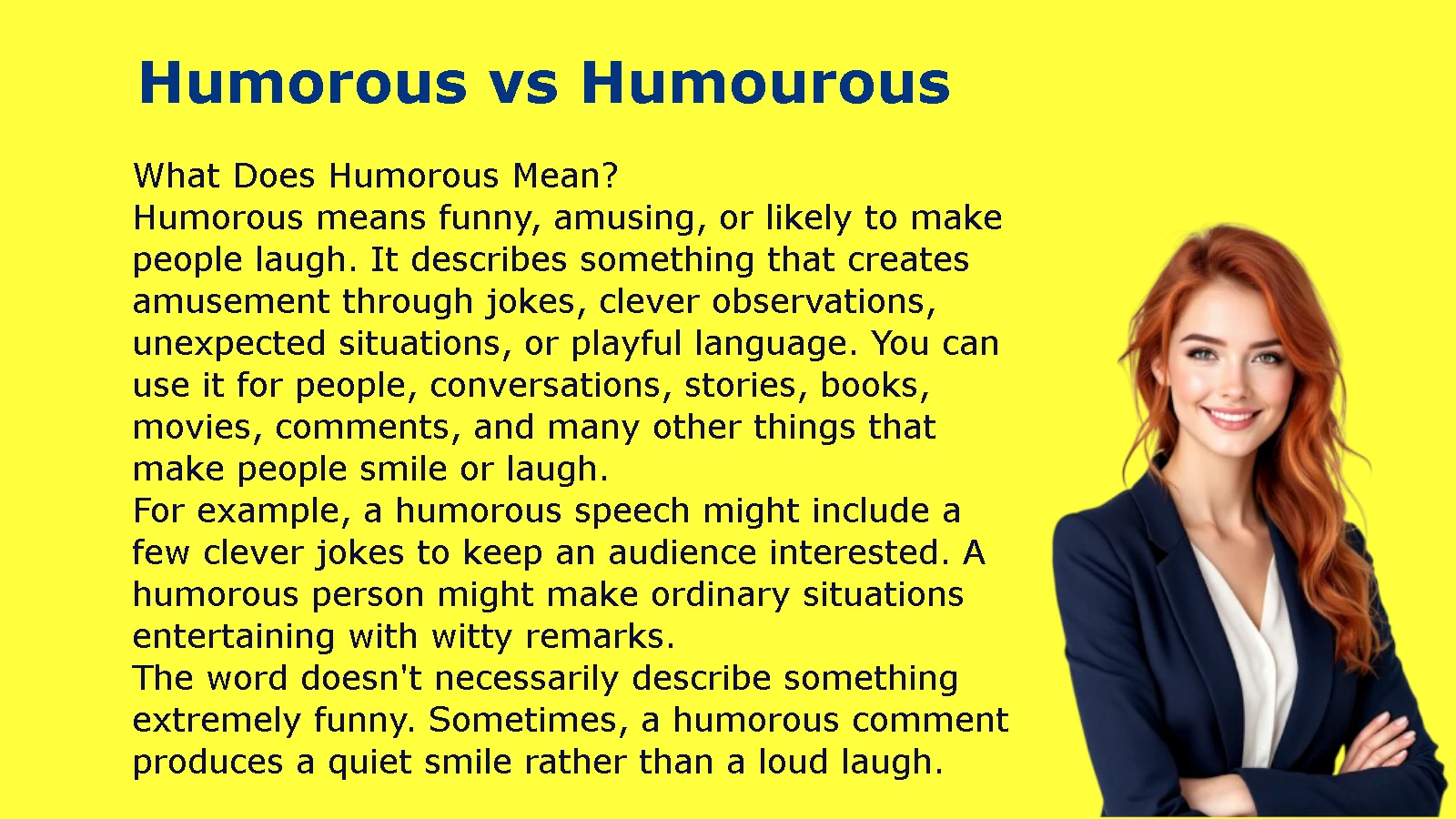
What Does Humorous Mean?
Humorous means funny, amusing, or likely to make people laugh. It describes something that creates amusement through jokes, clever observations, unexpected situations, or playful language. You can use it for people, conversations, stories, books, movies, comments, and many other things that make people smile or laugh.
For example, a humorous speech might include a few clever jokes to keep an audience interested. A humorous person might make ordinary situations entertaining with witty remarks.
The word doesn’t necessarily describe something extremely funny. Sometimes, a humorous comment produces a quiet smile rather than a loud laugh.
Humorous Meaning and Definition
The adjective humorous describes a person, remark, situation, or piece of writing that displays or produces humor.
It can refer to several kinds of comedy, including:
- Witty humor: Clever remarks that reveal an unexpected connection or observation.
- Situational humor: Comedy that comes from an amusing event or awkward circumstance.
- Playful humor: Lighthearted jokes that create a friendly atmosphere.
- Satirical humor: Comedy that criticizes behavior, institutions, or social problems.
- Self-deprecating humor: Jokes someone makes about their own habits, mistakes, or shortcomings.
Consider these examples:
- Witty: Her humorous response turned an awkward question into a clever joke.
- Situational: The humorous mix-up sent both families to the wrong birthday party.
- Playful: He made a humorous comment about his terrible dancing skills.
- Satirical: The humorous sketch poked fun at politicians who promised everything but delivered little.
- Self-deprecating: She used a humorous story about her cooking disaster to break the ice.
Although these examples involve different types of comedy, humorous works in every sentence because each situation creates amusement.
One important distinction: calling something humorous doesn’t automatically mean it’s appropriate for every audience. A joke can be amusing to one group but offensive or uncomfortable to another. Context matters just as much as the wording.
Humorous in a Sentence
The word humorous usually appears before a noun or after a linking verb such as is, was, seems, or became.
Here are original examples showing both patterns.
| Sentence | How humorous is used |
| The author wrote a humorous novel about a chaotic family reunion. | Describes a novel |
| His humorous observations made the presentation more engaging. | Describes observations |
| The conversation became humorous after everyone relaxed. | Describes the conversation |
| My grandfather tells humorous stories about his childhood. | Describes stories |
| Her response was humorous without being unkind. | Describes a response |
| The film combines humorous scenes with serious moments. | Describes scenes |
| We enjoyed a humorous exchange between the two presenters. | Describes an exchange |
| His humorous approach helped ease the tension. | Describes an approach |
You can also use humorous in professional and academic writing. It isn’t restricted to casual conversations.
For example:
- The report includes a humorous anecdote to introduce the topic.
- The speaker adopted a humorous tone without distracting from the main argument.
- The advertisement uses a humorous scenario to make the product memorable.
Writing tip: Use humorous when you want to describe something as amusing. If you mean that a person actively tells jokes, funny or witty might sound more natural in some sentences.
Is Humourous a Word?
Humourous is not the standard spelling of the adjective in modern American or British English. The accepted spelling is humorous. People often write humourous because they know that British English uses humour rather than the American spelling humor. The extra letter seems logical, but standard spelling doesn’t follow that pattern here.
Why People Spell It as Humourous
The confusion starts with a genuine difference between American and British spelling.
American English commonly uses humor, while British English commonly uses humour. When people form the adjective, they may assume that the British spelling should retain the same letter sequence.
That produces this mistaken pattern:
- Humor → Humorous
- Humour → Humourous
The first pattern is correct. The second is not.
The mistake is understandable because many English words preserve their spelling when they change grammatical form. For instance, color becomes colorful in American English, while colour becomes colourful in British English.
However, English spelling doesn’t apply one rule to every word. The standard adjective humorous uses the same spelling in both varieties.
Another reason for the error is visual familiarity. Someone who regularly reads British publications may see humour so often that humourous looks more consistent. A spell-checker or editor might catch the error, but a reader may not notice it immediately.
The best approach is to learn the adjective as a separate spelling rather than constructing it from the noun every time.
Is Humourous Ever Correct?
In ordinary modern English writing, use humorous, not humourous.
You might encounter humourous in an old document, an informal online post, a spelling discussion, or a text that reproduces someone else’s original wording. Its appearance doesn’t make it the standard spelling.
There are a few situations where you might intentionally reproduce the nonstandard form:
- Quoting an original text: Preserve the spelling if you’re discussing a historical document or reproducing a writer’s exact words.
- Explaining a spelling mistake: You may write humourous to identify the error and explain why it’s incorrect.
- Discussing language usage: The misspelling itself may be the subject of your discussion.
Outside those situations, choose humorous.
For example:
- Standard: The columnist wrote a humorous review of the restaurant.
- Nonstandard: The columnist wrote a humourous review of the restaurant.
The meaning remains clear in the second sentence, but the spelling doesn’t meet standard written English conventions.
Why Is Humorous Spelled Without a U?
Humorous is spelled without a u because that is the established spelling of the adjective in standard English. Although the related noun has two common regional forms, humor and humour, the adjective is spelled humorous in both American and British English. The noun’s regional spelling doesn’t determine the adjective’s spelling.
The Connection Between Humor and Humorous
The noun humor or humour refers to the quality of being amusing, a person’s sense of what is funny, or the ability to create amusement.
The adjective humorous describes something that expresses or produces that quality.
Compare these sentences:
- Noun: His humor helped everyone relax.
- Adjective: His humorous remarks helped everyone relax.
In the first sentence, humor names a quality. In the second, humorous describes the remarks.
The spelling relationship isn’t as symmetrical as you might expect. Even though British English uses humour as a noun, it doesn’t normally carry that spelling into the adjective.
Here are other useful forms:
| Part of speech | Standard spelling | Example |
| Noun, American English | Humor | Her humor makes difficult days easier. |
| Noun, British English | Humour | His humour appeals to a wide audience. |
| Adjective | Humorous | The speaker gave a humorous introduction. |
| Adverb | Humorously | She described the mistake humorously. |
| Related adjective | Humourless / Humorless | The humorless response surprised everyone. |
The last row needs a little care. American English generally uses humorless, while British English commonly uses humourless. Unlike humorous, this related adjective usually follows the regional spelling of the noun.
This contrast explains why humorous can feel inconsistent. English has conventional spelling patterns, but not every related word follows the same regional variation.
Why Humourous Looks Correct in British English
British English often preserves the letter u in words such as colour, favour, honour, and humour. American English generally drops it from those forms.
That difference is real, but it doesn’t mean that every word related to humour must contain a u.
Consider the following comparison:
| American English | British English |
| Color | Colour |
| Favor | Favour |
| Honor | Honour |
| Humor | Humour |
| Humorous | Humorous |
| Humorously | Humorously |
The final two entries are the ones worth memorizing. The adjective and its adverb retain the spelling without u in both varieties.
Why does this matter? Because spelling is based on established usage, not just on what seems logical from the root word.
When you write for a British audience, you can use humour in a sentence such as, “Her sense of humour is excellent.” If you want to describe her delivery, however, write, “Her humorous delivery made the speech memorable.”
Both sentences are correct British English.
Humorous vs Humourous: Examples
The easiest way to understand the spelling difference is to compare correct and incorrect sentences. In every standard example below, humorous is the correct adjective.
Correct Spelling: Humorous
Use humorous when describing something amusing, witty, or funny.
Here are original examples from different situations:
- The novelist created a humorous character who always misunderstood simple instructions.
- Her humorous introduction made the audience feel comfortable.
- We watched a humorous short film about a man who couldn’t follow a recipe.
- His humorous observations made the long train journey feel shorter.
- The teacher used a humorous example to explain a difficult grammar rule.
- That was a humorous way to respond to an uncomfortable question.
- The article takes a humorous look at everyday office problems.
- Their humorous exchange became the highlight of the meeting.
- My friend has a humorous way of describing ordinary inconveniences.
- The presentation included a humorous story about a failed science experiment.
Each example uses the same spelling, regardless of the subject or setting.
Incorrect Spelling: Humourous
The spelling humourous is incorrect in standard modern English. These examples show how to correct it.
| Incorrect sentence | Correct sentence |
| She told a humourous story. | She told a humorous story. |
| His humourous remarks surprised everyone. | His humorous remarks surprised everyone. |
| The book has a humourous ending. | The book has a humorous ending. |
| We enjoyed a humourous conversation. | We enjoyed a humorous conversation. |
| The comedian gave a humourous performance. | The comedian gave a humorous performance. |
| It was a humourous way to explain the problem. | It was a humorous way to explain the problem. |
Notice that you don’t need to change the sentence structure or meaning. Simply replace humourous with humorous.
Quick proofreading trick: When you see humourous, remove the u after the o. Then check that the word reads humorous.
This correction works whether you’re writing a social media post, an essay, a business email, or a published article.
Humorous in a Sentence
The adjective humorous works in everyday conversations, creative writing, workplace communication, and entertainment reviews. The best word choice depends on what you’re describing and how formal the situation is.
Humorous Conversation
A humorous conversation includes amusing comments, playful exchanges, or witty observations.
Examples:
- The humorous conversation continued long after dinner ended.
- Their humorous exchange helped settle an argument.
- We had a humorous discussion about the strange names people give their pets.
- A humorous remark turned an ordinary chat into an entertaining conversation.
In this context, humorous describes the overall tone or character of the conversation.
Humorous Story
A humorous story uses amusing events, characters, misunderstandings, or unexpected outcomes to entertain readers or listeners.
Examples:
- My uncle told a humorous story about accidentally attending the wrong wedding.
- The book opens with a humorous account of a disastrous camping trip.
- She wrote a humorous story about a dog that seemed to understand every household rule except bedtime.
A humorous story doesn’t have to consist entirely of jokes. It can use a believable situation and let the comedy develop naturally.
Humorous Person
A humorous person often makes others laugh through jokes, witty remarks, or amusing observations.
Examples:
- Our new colleague is humorous without being disrespectful.
- He’s a humorous storyteller who can make a simple shopping trip sound extraordinary.
- She has a humorous personality that helps people feel at ease.
There’s a subtle difference between describing someone as humorous and calling them a comedian. A humorous person can make people laugh in ordinary interactions. A comedian usually performs comedy for an audience, whether professionally or as an amateur.
Humorous Writing
Humorous writing uses comedy to entertain, persuade, criticize, or make an idea easier to understand.
Examples include:
- The blogger used humorous descriptions to discuss the challenges of working from home.
- Her humorous essay explored the chaos of raising a puppy.
- The writer adopted a humorous tone while explaining common workplace misunderstandings.
- The advertisement used a humorous story to demonstrate the product’s benefits.
Humor can make writing more engaging, but it shouldn’t obscure the main point. In educational or professional writing, a brief humorous example often works better than a joke that takes over the entire explanation.
Humor vs Humour vs Humorous
The words humor, humour, and humorous are related, but they serve different purposes. The first two are regional spelling variants of a noun. The third is an adjective with one standard spelling in both American and British English.
Humor vs Humour
Humor is the standard American English spelling, while humour is the standard British English spelling. Both words refer to the quality of being funny, a person’s ability to recognize or create amusement, or the style of comedy used in a situation.
Examples:
- American English: I appreciate her dry humor.
- British English: I appreciate her dry humour.
- American English: The movie combines dark humor with a serious story.
- British English: The film combines dark humour with a serious story.
Neither spelling is inherently better. The right choice depends on your audience and your preferred variety of English.
If you’re writing an article for American readers, use humor. For British readers, humour is generally the natural choice.
The main point is that this regional difference doesn’t carry over to every related word.
Humorous vs Humourous
Humorous is the correct adjective in both varieties of English. Humourous is a nonstandard spelling, not the British alternative.
| Feature | Humorous | Humourous |
| Standard spelling | Yes | No |
| American English | Correct | Incorrect |
| British English | Correct | Incorrect |
| Part of speech | Adjective | Intended as an adjective |
| Example | A humorous story | A humourous story |
Here are two examples that demonstrate the distinction:
- Correct: The presenter gave a humorous explanation of the mistake.
- Incorrect: The presenter gave a humourous explanation of the mistake.
Even if the rest of your article follows British spelling conventions, keep humorous unchanged.
Humorous vs Funny
Humorous and funny have similar meanings, but they don’t always sound equally natural.
Funny is the more common, flexible word. It can describe something that makes you laugh, but it can also mean strange or suspicious.
Humorous usually emphasizes the quality of being amusing or expressing humor.
Compare these sentences:
- The movie was funny. — A simple, everyday description.
- The movie was humorous. — A slightly more descriptive or formal assessment.
- That’s a funny smell. — Here, funny means unusual, not amusing.
- She made a humorous observation about the situation. — Her comment was amusing.
Use funny in casual conversation when you want a straightforward word. Choose humorous when you want to describe a person’s style, a piece of writing, or the tone of a remark.
For example, “The article takes a humorous approach to budgeting” sounds natural in a review or professional discussion. “The article is funny” is simpler and more conversational.
Common Mistakes With Humorous
The most obvious mistake is adding an unnecessary u, but other errors can appear when writers use related forms or choose a similar adjective without considering its meaning.
Humourous
The correct spelling is humorous.
Incorrect: The manager gave a humourous response to the complaint.
Correct: The manager gave a humorous response to the complaint.
Remember that humour is a valid British English noun, but humourous isn’t the standard adjective.
Humourously vs Humorously
The standard adverb is humorously, even in British English. It describes the way someone says or does something.
Examples:
- She humorously described the chaos in her kitchen.
- The author humorously portrayed the challenges of modern office life.
- He responded humorously rather than becoming defensive.
In British English, you can write, “Her sense of humour is excellent, and she tells stories humorously.”
The noun follows British spelling, while the adverb retains the standard spelling without the extra u.
Humorous vs Hilarious
Both words describe something funny, but they differ in intensity.
- Humorous: Amusing or funny.
- Hilarious: Extremely funny or likely to cause strong laughter.
For example:
- The article included a humorous comment about office meetings.
- The comedian’s final story was hilarious.
The first sentence describes something amusing. The second suggests a stronger reaction.
Don’t automatically replace humorous with hilarious. If something is mildly amusing, humorous may be more accurate. If it makes people laugh uncontrollably, hilarious may fit better.
How to Remember the Correct Spelling of Humorous
The easiest way to remember the spelling is to learn humorous as a complete word rather than adding an ending to humour.
Remember the Spelling of Humorous
Keep this simple rule in mind:
Humor or humour, but humorous.
You don’t need to change the spelling of the adjective to match the noun’s regional form.
A useful comparison is:
- American: humor → humorous
- British: humour → humorous
Say the pair aloud as you write it. Repeating the pattern can help you recognize the correct form when proofreading.
Use a Simple Example Sentence
Choose a short sentence that you’ll remember easily:
His humorous comment made everyone smile.
The sentence contains the correct adjective in a natural context.
You can also create your own examples:
- The humorous book made my commute enjoyable.
- Her humorous reply ended the awkward silence.
- We watched a humorous film after dinner.
Writing the word in different contexts helps reinforce its spelling more effectively than memorizing an isolated list of letters.
When proofreading, search your document for humourous. If you find it, replace it with humorous unless you’re intentionally reproducing a nonstandard spelling from an original source.
Is Humorous American or British English?
Humorous is standard in both American and British English. The noun differs by region: Americans generally write humor, while British writers generally use humour. However, both varieties use humorous as the adjective and humorously as the adverb.
Here are the main differences:
| Meaning or form | American English | British English |
| Noun | Humor | Humour |
| Adjective | Humorous | Humorous |
| Adverb | Humorously | Humorously |
| Opposite adjective | Humorless | Humourless |
For example, an American might write, “His sense of humor makes him popular.” A British writer might write, “His sense of humour makes him popular.”
Both could then describe him as a humorous person.
If you write for an international audience, humorous is a safe choice. You don’t need to adjust its spelling for American or British readers.
Frequently Asked Questions About Humorous vs Humourous
Is It Humorous or Humourous?
Humorous is correct. Humourous is a common misspelling in both American and British English. Although British English uses humour as a noun, the standard adjective is still humorous.
Example: The writer published a humorous account of his travels.
Why Is Humorous Spelled Without a U?
English spelling doesn’t always preserve every letter from a related word. Although humour is standard in British English, humorous is the established adjective spelling in both varieties. The extra u in humourous isn’t part of the standard form.
Is Humourous British English?
No. Humourous isn’t the standard British spelling. British English uses humour as a noun but humorous as an adjective. The distinction is easy to miss because many other British words retain their u in related forms.
How Do You Spell Humorous?
Spell it h-u-m-o-r-o-u-s. The correct form is humorous, with no u immediately after the o in humor. A useful example is: “The humorous story made the entire class laugh.”
What Is the Difference Between Humor and Humorous?
Humor is a noun that refers to the quality of being funny or the ability to create amusement. Humorous is an adjective that describes something amusing.
For example, “Her humor is infectious” uses the noun, while “Her humorous remarks are memorable” uses the adjective.
In British English, the noun is commonly spelled humour, but the adjective remains humorous.
What Is the Adverb Form of Humorous?
The standard adverb is humorously. It describes an action performed in an amusing or funny way.
Example: He humorously explained why he had arrived late.
Avoid humourously in standard writing, including British English.
What Is a Synonym for Humorous?
Common synonyms include funny, amusing, witty, comical, entertaining, and comic.
The best choice depends on context:
| Synonym | Best use |
| Funny | General, everyday amusement |
| Amusing | Something that causes mild enjoyment or laughter |
| Witty | Clever humor based on language or ideas |
| Comical | Something that appears funny or ridiculous |
| Entertaining | Something that holds attention and provides enjoyment |
| Comic | Something related to comedy or intended to amuse |
These words overlap, but they’re not always interchangeable. A witty comment, for example, usually involves cleverness, while an amusing situation doesn’t necessarily require it.
Final Verdict: Humorous vs Humourous
The difference between humorous and humourous comes down to one unnecessary letter. Humorous is the correct spelling in both American and British English. Although humor and humour are both correct nouns, the adjective doesn’t follow the same regional variation.
Remember these three points:
- Write humor for the American English noun and humour for the British English noun.
- Use humorous in both varieties when describing something funny or amusing.
- Choose humorously as the standard adverb, regardless of whether you’re writing for an American or British audience.
The next time you describe a funny story, a clever remark, or an entertaining person, stick with humorous. It’s short, simple, and correct.
Ready to proofread your writing? Search your draft for humourous and replace it with humorous wherever you intend to use the standard adjective.
Meta Title: Humorous vs Humourous: Which Spelling Is Correct?
Meta Description: Humorous vs humourous: Learn the correct spelling, the difference between American and British English, and how to use humorous in sentences.