Understanding the Anhedonia Meaning can help you recognize changes in your emotional life, distinguish them from ordinary boredom, and decide when to seek support. It can also help you make sense of related questions about anhedonia tests, ADHD, Adderall, and emotional numbness.
Anhedonia means losing the ability to feel pleasure from activities you once enjoyed. You might stop looking forward to your favorite meal, feel disconnected from friends, or finish something exciting without feeling the satisfaction you expected. Although anhedonia often occurs with depression, it can also appear alongside other mental health conditions or certain medical and medication-related factors.
Imagine listening to a song that used to give you chills. You know it’s a song you love, and you remember how it made you feel. Yet now, it sounds ordinary. You aren’t necessarily sad, but the enjoyment seems to have disappeared.
That experience can help illustrate what anhedonia feels like.
What Does Anhedonia Mean?
Anhedonia is a reduced or absent ability to experience pleasure from activities, experiences, or interactions that would normally feel enjoyable or rewarding. It can affect physical sensations, social relationships, hobbies, food, music, and everyday achievements. Anhedonia is a symptom rather than a standalone diagnosis, and its severity varies from person to person.
In simple terms, anhedonia makes enjoyable experiences feel less enjoyable than they used to.
You might still attend a party, eat your favorite food, or spend time with someone you love. However, the positive feelings you once associated with those experiences may feel weak, distant, or completely absent.
Anhedonia doesn’t necessarily mean you feel sad all the time. Some people experience sadness, while others describe emotional flatness, emptiness, or a sense that life has lost its color.
The experience can affect two related aspects of pleasure:
- Anticipatory pleasure: The enjoyment you expect to feel before an activity.
- Consummatory pleasure: The enjoyment you actually experience while doing it.
For example, you might stop looking forward to a weekend trip because you expect it to feel pointless. Alternatively, you might feel excited about the trip beforehand but experience little enjoyment once you arrive.
These experiences can overlap, but they aren’t always identical.
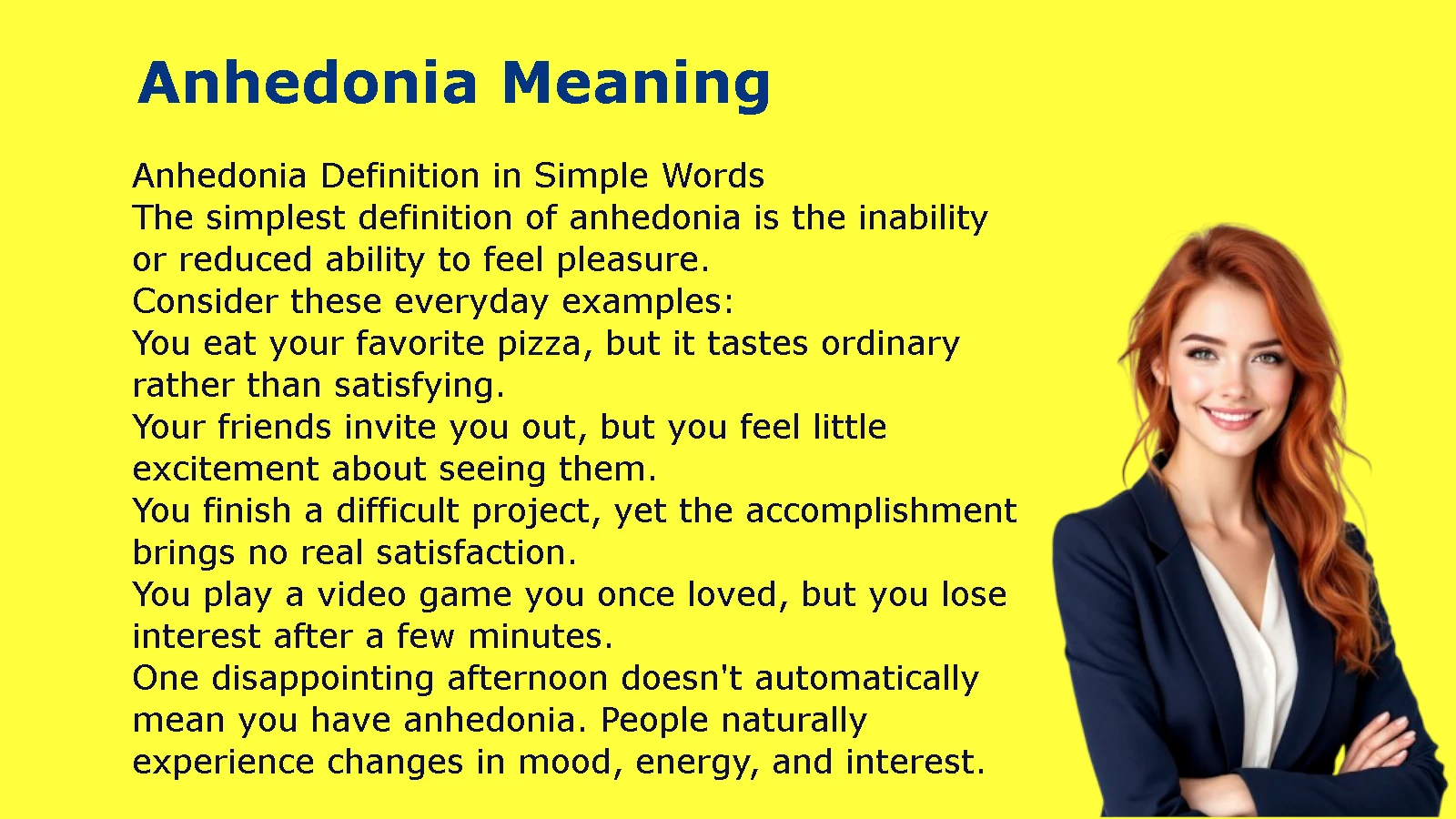
Anhedonia Definition in Simple Words
The simplest definition of anhedonia is the inability or reduced ability to feel pleasure.
Consider these everyday examples:
- You eat your favorite pizza, but it tastes ordinary rather than satisfying.
- Your friends invite you out, but you feel little excitement about seeing them.
- You finish a difficult project, yet the accomplishment brings no real satisfaction.
- You play a video game you once loved, but you lose interest after a few minutes.
One disappointing afternoon doesn’t automatically mean you have anhedonia. People naturally experience changes in mood, energy, and interest.
The concern becomes more significant when the loss of enjoyment persists, affects several areas of life, or interferes with your relationships, work, or daily routine.
How to Pronounce Anhedonia
Anhedonia is commonly pronounced an-hee-DOH-nee-uh.
The word has five syllables:
- An
- hee
- doh
- nee
- uh
The primary stress falls on the third syllable, DOH.
You may encounter this word in discussions about depression, psychology, neuroscience, and mental health assessments. Knowing its pronunciation can make it easier to discuss your experiences with a healthcare professional.
Anhedonia Word Origin
The word anhedonia comes from Greek elements associated with absence and pleasure. The prefix an- means “without,” while hēdonē means “pleasure.”
The name reflects the central feature of the experience: a reduction in the pleasure someone receives from activities or sensations.
The term is used in modern psychology and psychiatry to describe a symptom that can occur in several conditions. It isn’t simply another word for sadness, unhappiness, or boredom.
This distinction matters because someone can feel emotionally neutral rather than sad and still experience a substantial loss of pleasure.
What Does Anhedonia Feel Like? Real-Life Examples
Anhedonia can feel like going through the motions without receiving the emotional reward you once experienced. You may continue participating in familiar activities, but they no longer feel satisfying. Some people notice a gradual decline in enjoyment, while others recognize a more sudden change after a difficult period, illness, or medication adjustment.
The experience isn’t identical for everyone. A person might lose interest in social activities while continuing to enjoy music. Another person might struggle to enjoy almost everything.
Here are some practical examples of how anhedonia can appear in everyday life.
Examples of Anhedonia in Everyday Life
Example one: Food no longer feels rewarding.
You order your favorite meal after a stressful week. Usually, the first bite makes you happy. This time, you eat because you’re hungry, but the meal provides little enjoyment.
This doesn’t necessarily mean your sense of taste has changed. You may recognize the flavor perfectly well while experiencing less pleasure from it.
Example two: Socializing feels empty.
You meet close friends you haven’t seen for months. You understand their jokes, participate in conversations, and remember that you normally enjoy their company. Yet you feel strangely disconnected throughout the evening.
You aren’t necessarily angry with your friends. The positive emotional response simply feels weaker.
Example three: Achievements bring little satisfaction.
You receive a promotion or complete an important project. Instead of feeling proud, you think, “That’s done,” and move on.
A lack of satisfaction after one achievement is common. Repeatedly experiencing little pleasure or accomplishment across different areas of life may deserve closer attention.
Example four: Hobbies lose their appeal.
You used to spend hours painting, reading, exercising, or playing video games. Now, you struggle to enjoy those activities, even when you have enough time and energy to participate.
You may remember how much you loved them without being able to recapture the same feeling.
Is Anhedonia the Same as Emotional Numbness?
Anhedonia and emotional numbness overlap, but they describe different experiences.
Anhedonia primarily involves reduced pleasure. Emotional numbness describes a broader sense of reduced or absent emotional responsiveness.
For example, a person with anhedonia might still experience anger, anxiety, grief, or frustration while struggling to feel happiness or enjoyment.
Someone experiencing emotional numbness might describe feeling disconnected from both positive and negative emotions. They may understand that a situation is important without feeling much emotional reaction to it.
| Feature | Anhedonia | Emotional numbness |
| Main characteristic | Reduced pleasure | Reduced emotional responsiveness |
| Happiness | Often diminished | May feel diminished |
| Sadness or anger | Can remain present | May also feel muted |
| Common description | “Nothing feels enjoyable.” | “I don’t feel much of anything.” |
| Possible overlap | Can occur with emotional numbness | Can include reduced pleasure |
Neither experience identifies a specific diagnosis on its own. If either persists or disrupts daily life, a professional assessment can help clarify what’s happening.
Can You Have Anhedonia and Still Feel Sad?
Yes. Anhedonia doesn’t mean you have lost every emotion.
You might feel worried about your future, frustrated by work, or sad about a personal loss while finding little enjoyment in things that once made you happy.
For example, you may cry during a difficult conversation but feel no pleasure when spending time with friends afterward.
This combination can be confusing because people often assume that feeling sad and feeling pleasureless are the same thing. They aren’t.
Anhedonia concerns the capacity to experience pleasure, not the complete absence of emotional experience. It can also coexist with emotional numbness, anxiety, or other symptoms.
What Are the Two Main Types of Anhedonia?
Anhedonia is commonly discussed in two broad forms: social anhedonia and physical anhedonia. Social anhedonia involves reduced pleasure from social interaction, while physical anhedonia involves reduced enjoyment of sensory or physical experiences. These categories help describe someone’s symptoms, although real experiences don’t always fit neatly into one group.
Understanding the difference can help you describe what has changed in your life.
Social Anhedonia
Social anhedonia describes a reduced ability to experience pleasure from social interactions and interpersonal relationships.
You might still want friends, understand social cues, and enjoy meaningful conversations in principle. However, actually spending time with people may provide less emotional satisfaction than it once did.
Examples include:
- Feeling little enjoyment during conversations with close friends.
- Finding family gatherings emotionally unrewarding.
- Losing interest in group activities you previously enjoyed.
- Feeling disconnected during celebrations or social events.
- Having less motivation to seek social connection because it no longer feels rewarding.
Social anhedonia doesn’t automatically mean you dislike people.
You might care deeply about your family while struggling to feel the warmth you normally experience when you’re together. You might also prefer quiet evenings without experiencing anhedonia at all.
The important distinction is whether your reduced social engagement reflects a genuine loss of pleasure or simply a personal preference for less social activity.
Introversion, for example, describes a personality tendency, not an inability to experience pleasure. An introverted person can enjoy close friendships and meaningful conversations without wanting to attend large gatherings.
Social anhedonia can also vary in severity. Someone may enjoy one-on-one conversations but feel little pleasure in group settings. Another person may struggle to enjoy nearly all forms of social contact.
Physical or Sensory Anhedonia
Physical anhedonia refers to reduced pleasure from bodily sensations and sensory experiences.
These experiences may include eating, listening to music, enjoying pleasant smells, receiving a comforting hug, or participating in physical activities that once felt rewarding.
For example, imagine that you love listening to music while driving. You still recognize your favorite songs, remember the lyrics, and appreciate their technical quality. However, the music no longer gives you the emotional lift it once did.
That difference helps illustrate an important point: recognizing a pleasurable stimulus isn’t the same as experiencing pleasure from it.
Possible examples of reduced physical or sensory enjoyment include:
- Food tastes familiar but provides little satisfaction.
- Music sounds clear but no longer feels emotionally moving.
- A warm shower feels ordinary rather than comforting.
- Favorite leisure activities seem less rewarding.
- Physical affection provides less enjoyment than before.
Physical anhedonia doesn’t necessarily mean that your senses have stopped working. You might still taste, hear, smell, and feel things normally while experiencing less pleasure from them.
It also doesn’t automatically imply a physical disorder. Changes in sensory function and changes in emotional reward are different issues, although they can sometimes overlap.
Social Anhedonia vs. Physical Anhedonia
| Feature | Social anhedonia | Physical or sensory anhedonia |
| Primary focus | Pleasure from social connection | Pleasure from sensory or physical experiences |
| Typical example | Conversations feel less rewarding | Favorite music feels less enjoyable |
| Possible behavioral change | Withdrawing from social activities | Losing interest in familiar sensory pleasures |
| Can occur with depression? | Yes | Yes |
| Does it always occur with the other type? | No | No |
These categories describe patterns rather than separate diagnoses. You can experience one, both, or symptoms that don’t fit neatly into either category.
What Are the Symptoms of Anhedonia?
The main symptom of anhedonia is reduced pleasure from experiences that would normally feel enjoyable or rewarding. You may notice less excitement, satisfaction, interest, or emotional connection. Some people also withdraw from activities they once valued, particularly when those activities no longer seem worth the effort.
The symptoms can develop gradually, making them difficult to recognize at first.
You might assume you’re simply tired, busy, or going through a boring phase. Over time, however, you may notice that the change affects several parts of your life.
Common Emotional Symptoms
Emotional symptoms can include:
- Reduced enjoyment: Activities you once loved no longer provide the same satisfaction.
- Less anticipation: You stop looking forward to holidays, weekends, hobbies, or social events.
- Emotional flatness: Positive experiences feel muted or unremarkable.
- Reduced sense of reward: Completing tasks or achieving goals brings little satisfaction.
- Disconnection: You feel less emotionally engaged with experiences that used to matter to you.
These symptoms don’t necessarily occur together. One person might struggle mainly with anticipation, while another might enjoy planning an activity but feel little pleasure when participating.
For example, you may spend days planning a birthday celebration, only to feel emotionally flat when the day arrives.
That doesn’t automatically establish anhedonia. The pattern, duration, context, and impact on daily functioning all matter.
Behavioral and Social Symptoms
Anhedonia can influence what you do, not just how you feel.
When activities provide little reward, you may gradually stop making time for them. This can create a difficult cycle: you participate less, receive fewer opportunities for enjoyment, and become increasingly disconnected from your usual routines.
Possible behavioral changes include:
- Declining invitations you would previously have accepted.
- Spending less time on hobbies or creative projects.
- Losing interest in activities that once helped you relax.
- Finding it difficult to begin tasks that usually feel rewarding.
- Going through daily routines without feeling engaged.
- Avoiding celebrations because they seem emotionally unimportant.
Consider someone who used to play basketball every Saturday. They stop attending because the game no longer feels exciting. After several weeks, they become less active and lose touch with their teammates.
The withdrawal may then affect their routine and social connections, even if anhedonia wasn’t the original cause of every change.
This is why it helps to look beyond a single symptom and consider the broader pattern.
Anhedonia vs. Apathy: What’s the Difference?
Anhedonia and apathy can look similar because both may reduce engagement with everyday activities. However, anhedonia centers on pleasure, while apathy centers more on motivation, interest, or goal-directed behavior.
| Situation | Possible experience of anhedonia | Possible experience of apathy |
| Starting a hobby | You begin but feel little enjoyment | You feel little motivation to begin |
| Seeing friends | You attend but feel little pleasure | You feel little interest in arranging a meeting |
| Completing a task | You finish but feel little satisfaction | You struggle to initiate or pursue the task |
| Planning a holiday | You anticipate little enjoyment | You lack the drive to make plans |
These differences aren’t absolute. A person can experience both anhedonia and apathy, and other conditions can produce similar symptoms.
A professional assessment considers the full picture rather than relying on one behavioral clue.
What Causes Anhedonia?
Anhedonia can develop in association with several psychological, psychiatric, medical, and medication-related factors. Depression is one well-known association, but it isn’t the only possible explanation. The cause in an individual case depends on the person’s symptoms, medical history, medications, and other circumstances.
It’s important not to assume that a single symptom reveals what’s happening inside your brain or identifies a particular condition.
Anhedonia and Depression
Anhedonia is a recognized symptom of depression. Some people experience it alongside persistent sadness, while others describe a loss of interest or pleasure as the most noticeable change.
For example, someone experiencing depression may continue working, caring for their family, and completing daily responsibilities. From the outside, their routine might look unchanged. Internally, however, familiar activities no longer feel rewarding.
Depression can also involve other symptoms, including:
- Persistent low mood.
- Changes in sleep or appetite.
- Fatigue or reduced energy.
- Feelings of worthlessness or excessive guilt.
- Difficulty concentrating.
- Changes in movement or activity levels.
- Thoughts of death or suicide.
Not everyone experiences every symptom. The duration, severity, and combination of symptoms help clinicians determine whether someone meets the criteria for a depressive disorder.
Anhedonia alone doesn’t establish a diagnosis of depression. It can occur in other circumstances, and some people experience reduced pleasure without meeting the full criteria for a depressive disorder.
If you notice a persistent loss of enjoyment alongside other changes in mood or functioning, consider speaking with a qualified healthcare professional.
Can ADHD Cause Anhedonia?
ADHD and anhedonia can overlap, but anhedonia isn’t a defining symptom of ADHD.
Attention-deficit/hyperactivity disorder can affect attention, impulse control, activity levels, organization, and the ability to manage tasks. Some people with ADHD also experience difficulties with motivation, reward processing, or emotional regulation.
These difficulties can sometimes resemble or contribute to experiences that people describe as anhedonia.
For example, someone with ADHD may struggle to stay engaged with a hobby because attention shifts quickly. Another person may still enjoy the hobby but find it difficult to start because organizing the activity feels overwhelming.
Neither situation necessarily indicates anhedonia.
The distinction is worth considering:
- Difficulty sustaining attention: You enjoy an activity but repeatedly lose focus.
- Difficulty initiating a task: You want to participate but struggle to get started.
- Reduced pleasure: You participate but experience less enjoyment than before.
These experiences can coexist. ADHD can also occur alongside depression or other conditions that involve anhedonia.
If you’ve noticed a persistent loss of pleasure while taking medication for ADHD, or alongside changes in your ADHD symptoms, discuss the timing and pattern with your clinician. Don’t assume that ADHD alone explains the change.
Can Stress, Burnout, or Trauma Cause Anhedonia?
Prolonged stress, exhaustion, and traumatic experiences can affect emotional well-being and the ability to enjoy everyday life.
After months of demanding work, poor sleep, or caregiving responsibilities, you might find that activities you once enjoyed feel like additional obligations. You may have little energy for socializing or feel emotionally depleted even when you have free time.
However, ordinary exhaustion and anhedonia aren’t identical.
A tired person may regain their usual enjoyment after rest. Someone experiencing persistent anhedonia may continue to feel little pleasure even after sleeping well or taking time away from responsibilities.
Traumatic experiences can also affect how someone experiences safety, connection, and positive emotions. Some people describe feeling detached or emotionally numb afterward.
These patterns deserve attention when they persist or interfere with daily functioning. Stress, burnout, and trauma are possible contributors, but the presence of anhedonia doesn’t prove that any one of them is responsible.
Can Adderall Cause Anhedonia?
Adderall is a prescription medication containing amphetamine salts used to treat ADHD and, in certain circumstances, narcolepsy. Some people report emotional blunting, reduced enjoyment, or changes in motivation while taking stimulant medications. However, these experiences don’t establish that Adderall directly caused anhedonia in every case.
Several factors may need consideration:
- Medication effects: Some people experience unwanted emotional or mood changes while taking a stimulant.
- Dose and timing: Symptoms may vary during the day or as medication effects change.
- Rebound symptoms: Some people experience a return or temporary worsening of symptoms as a dose wears off.
- Underlying conditions: Depression, anxiety, sleep problems, or other concerns may contribute to the experience.
- Individual differences: People respond differently to the same medication.
Imagine someone who begins ADHD treatment and notices that they can concentrate more easily but feel less excited about hobbies. The timing makes a medication-related effect worth discussing, but it doesn’t prove causation. Other changes may have occurred at the same time.
The most useful next step is to document when the symptoms began, how they change throughout the day, and whether they coincide with medication use.
Don’t stop taking Adderall, change the dose, or alter the timing on your own. Contact the prescribing clinician to discuss persistent emotional blunting or loss of pleasure. They can review possible causes and decide whether a change in treatment is appropriate.
Other Possible Medical and Medication-Related Factors
Anhedonia can occur in a broader range of health circumstances. Depending on the person’s symptoms, a clinician may consider neurological conditions, other psychiatric conditions, sleep disturbances, substance use, or medication effects.
For instance, someone experiencing a new loss of enjoyment alongside major changes in sleep, energy, concentration, or physical functioning may need a broader medical assessment.
Some medications can also affect mood or emotional responsiveness. That doesn’t mean a medication is necessarily responsible whenever anhedonia appears.
A clinician will generally consider:
- When the symptoms started.
- Whether the change was sudden or gradual.
- Whether symptoms vary throughout the day.
- Current medications and recent changes.
- Sleep, stress, and substance use.
- Other emotional, cognitive, or physical symptoms.
This broader approach helps avoid attributing everything to one explanation when several factors may be involved.
How to Test for Anhedonia
An anhedonia test usually involves a questionnaire designed to measure how much pleasure someone experiences in different situations. These tools can help identify patterns of reduced enjoyment, but an online test cannot independently diagnose anhedonia, depression, ADHD, or the underlying cause of someone’s symptoms.
If you’ve searched for an anhedonia test or anhedonia quiz, you’re probably looking for a way to understand what you’re experiencing. A structured assessment can be a useful starting point, provided you understand its limitations.
What Is an Anhedonia Test?
An anhedonia test is an assessment that explores your ability to experience pleasure.
Depending on the tool, questions may cover experiences such as:
- Enjoying a favorite meal.
- Looking forward to an upcoming activity.
- Listening to music.
- Spending time with friends.
- Feeling satisfied after accomplishing something.
- Enjoying hobbies and other leisure activities.
Some assessments focus on general pleasure, while others concentrate on particular areas, such as social interaction.
Your answers can help identify experiences that deserve further attention. However, a score is only one part of the picture.
For example, someone who recently experienced a major loss may report less enjoyment than usual. Another person may report similar symptoms because of depression, medication effects, or a different concern.
The same questionnaire score doesn’t necessarily mean the same thing for both people.
A useful assessment considers not only what you feel but also when the symptoms began, how long they’ve lasted, how much they affect your life, and what else may be contributing to them.
Common Anhedonia Assessment Tools
One commonly used instrument is the Snaith–Hamilton Pleasure Scale (SHAPS).
SHAPS is a self-report questionnaire designed to assess hedonic capacity, or the ability to experience pleasure. Its items cover different areas of everyday experience, including food, social interaction, sensory experiences, and interests.
Clinicians and researchers may use it to measure pleasure-related symptoms and monitor changes over time.
Other instruments may be more appropriate when the assessment focuses on social pleasure, depression, or another specific concern.
A few points matter when interpreting any assessment:
- Purpose: Some tools measure general pleasure, while others assess a narrower symptom pattern.
- Scoring: Different questionnaires use different scoring systems. A cutoff from one instrument shouldn’t be applied to another.
- Context: Sleep, recent events, health conditions, and medications can influence responses.
- Limitations: A questionnaire cannot replace a comprehensive clinical evaluation.
You may see websites describing a particular score as proof that you have anhedonia. Treat such claims cautiously unless the test’s purpose, validation, and interpretation are clearly explained.
Can an Online Anhedonia Quiz Tell You Whether You Have It?
An online anhedonia quiz can help you reflect on changes in your ability to experience pleasure. It may highlight patterns you hadn’t noticed, but it cannot reliably determine the cause of those changes or provide a diagnosis by itself.
If you want to assess your experience informally, consider these questions:
- Do I enjoy activities less than I did a few months ago?
- Have I stopped looking forward to things that once excited me?
- Do I participate in enjoyable activities but feel little satisfaction?
- Has this change affected several areas of my life?
- Have my sleep, energy, mood, or concentration changed?
- Did the symptoms begin after a medication change or a stressful event?
These questions aren’t a diagnostic test. They’re prompts to help you describe your experience more clearly.
If your answers suggest a persistent change, consider recording specific examples and discussing them with a healthcare professional.
For instance, instead of saying, “I don’t enjoy anything anymore,” you might explain, “For the past six weeks, I’ve stopped enjoying meals with friends, music, and my usual hobbies. I also feel less motivated at work.”
That description gives a clinician more useful information than a quiz score alone.
What Is a Social Anhedonia Test?
A social anhedonia test focuses on how much pleasure you experience from social interactions and interpersonal relationships.
Depending on the assessment, questions may explore whether you enjoy conversations, feel connected to others, or look forward to spending time with friends.
Some questionnaires specifically measure social anhedonia, while others assess broader patterns of social functioning.
A social anhedonia assessment may be useful if you notice that social activities no longer feel rewarding. However, reduced social interaction doesn’t automatically indicate a problem.
You might prefer solitude because you’re introverted, busy, overwhelmed, or simply satisfied with a small social circle.
The more relevant question is whether your experience has changed in a way that causes distress or interferes with relationships you value.
For example, someone who has always preferred quiet evenings may not have social anhedonia. Someone who previously enjoyed close friendships but now feels no pleasure during almost every interaction may benefit from further assessment.
A social anhedonia test should help describe your experiences, not label your personality or replace professional judgment.
When Should You Seek a Professional Evaluation?
Consider seeking professional support when reduced pleasure persists, worsens, or interferes with your everyday life.
You don’t need to wait until every activity feels meaningless before asking for help.
A healthcare professional may be able to help if you notice:
- A lasting loss of interest or enjoyment.
- Increasing withdrawal from friends or family.
- Changes in sleep, appetite, energy, or concentration.
- Difficulty completing ordinary responsibilities.
- Emotional changes following a medication adjustment.
- Reduced pleasure alongside persistent sadness, anxiety, or hopelessness.
A clinician may ask about your symptoms, medical history, current medications, and recent life changes. They may also use validated questionnaires or recommend additional evaluation when appropriate.
If you experience suicidal thoughts or feel unable to keep yourself safe, seek urgent help through local emergency services or an appropriate crisis service.
How Is Anhedonia Treated?
Treatment for anhedonia depends on its possible causes, associated symptoms, and impact on daily life. Options may include psychotherapy, treatment for an underlying condition, medication review, and structured activities that help restore engagement with everyday experiences. No single approach works for everyone.
The goal isn’t to force yourself to feel happy. It’s to understand what’s contributing to the loss of pleasure and find appropriate ways to improve your functioning and well-being.
Psychotherapy and Psychological Support
Psychotherapy may help people experiencing anhedonia, particularly when it occurs alongside depression, anxiety, stress, or other psychological difficulties.
The appropriate approach depends on the individual’s needs and clinical circumstances.
For example, cognitive behavioral therapy (CBT) can help people identify unhelpful thought patterns and develop more effective ways of responding to difficulties.
Behavioral approaches may also help people reduce avoidance and gradually reengage with activities that support their daily functioning.
Imagine someone who has stopped meeting friends because socializing no longer feels rewarding. Over time, they become increasingly isolated and find it harder to return to their usual routine.
A therapist might help them identify the barriers preventing social engagement, set manageable goals, and evaluate their experiences without expecting immediate emotional improvement.
Progress may be gradual. The aim is to develop a more sustainable routine and address contributing problems rather than demand instant enjoyment.
Medication and Treatment of Underlying Conditions
When anhedonia occurs alongside a treatable mental health condition, a clinician may recommend treatment for that condition.
Depending on the circumstances, options may include medication, psychotherapy, or a combination of approaches.
If someone develops emotional blunting after starting a medication, the clinician may review the dose, timing, other medications, and the person’s underlying symptoms.
For example, a person taking medication for ADHD might notice reduced enjoyment after a treatment adjustment. A prescriber can assess whether the medication may be contributing, whether another condition deserves attention, and whether an alternative treatment plan makes sense.
Never start, stop, or adjust prescription medication solely because you suspect anhedonia. Medication decisions require an individualized assessment, including consideration of potential benefits, risks, and withdrawal or rebound effects.
Can Lifestyle Changes Help With Anhedonia?
Lifestyle changes may support recovery and improve general well-being, especially when sleep problems, inactivity, or social isolation contribute to someone’s difficulties.
They aren’t guaranteed cures, and they shouldn’t replace professional care when symptoms are persistent or severe.
Useful starting points include:
- Maintain a consistent sleep schedule. Aim for regular sleep and wake times rather than frequently shifting your routine.
- Move your body regularly. Choose manageable activities, such as walking, stretching, swimming, or cycling, based on your abilities.
- Keep some social contact. A short conversation with someone you trust may feel more manageable than a long social event.
- Continue meaningful activities in small doses. Read a few pages, prepare a simple meal, or spend ten minutes on a familiar hobby.
- Reduce unnecessary pressure. Avoid treating every activity as a test of whether you’re capable of feeling happy.
- Track changes over time. Note sleep, mood, activity, and enjoyment to identify patterns worth discussing with a clinician.
One practical principle is to separate doing an activity from feeling pleasure during it.
You can take a walk because movement supports your routine, even if the walk doesn’t feel wonderful. You can meet a friend because the relationship matters, even if your emotional response feels muted.
That approach can reduce the pressure to experience an immediate reward.
Behavioral Activation: How to Start Enjoying Activities Again
Behavioral activation is a structured approach often used in depression treatment. It encourages people to schedule activities that support their values, responsibilities, relationships, and potential sources of reward.
The basic idea is straightforward: when your mood or motivation drops, waiting until you feel ready to do anything can leave you stuck in an increasingly inactive routine.
Instead, you begin with manageable actions and observe how they affect your life.
Here is one way to apply the general principle.
Step one: Identify activities that once mattered to you.
Write down a few things you used to enjoy or still consider meaningful. Examples might include walking outdoors, cooking, reading, gardening, or talking with a friend.
Step two: Choose one small activity.
Avoid creating an ambitious schedule. If reading for an hour feels overwhelming, start with five or ten minutes.
Step three: Schedule it at a realistic time.
Attach the activity to an existing routine, such as reading after breakfast or taking a short walk after work.
Step four: Participate without demanding a particular feeling.
The objective is to complete the activity, not to prove that you can experience pleasure on command.
Step five: Record what happened.
You might note your mood beforehand, whether you completed the activity, and how you felt afterward. Look for patterns over time rather than judging one experience.
Consider this illustrative example:
A person who once loved gardening stops tending their plants because the activity feels pointless. Instead of committing to an entire afternoon in the garden, they spend ten minutes watering a few plants three times a week.
At first, they feel little enjoyment. However, the smaller commitment helps them rebuild a routine and reconnect with an activity they value.
This example illustrates a possible strategy, not a guarantee that anhedonia will resolve through activity alone. Persistent symptoms may require professional treatment.
Anhedonia vs. Similar Experiences
Anhedonia can resemble several other emotional experiences, including depression, boredom, apathy, and emotional blunting. The differences matter because each term describes a slightly different pattern, and the same outward behavior can have different explanations.
Anhedonia vs. Depression
Anhedonia is a symptom, while depression is a broader mental health condition that can involve changes in mood, thinking, energy, sleep, appetite, and daily functioning.
A person experiencing depression may lose interest in activities they once enjoyed. However, anhedonia can also occur without someone meeting the diagnostic criteria for major depressive disorder.
For example, someone may experience a persistent reduction in pleasure but not report the broader combination of symptoms associated with a depressive episode.
The distinction requires more than checking whether someone feels happy. A professional considers the duration, severity, associated symptoms, and effects on everyday life.
Anhedonia vs. Emotional Blunting
Emotional blunting refers to a reduction in the intensity of emotional experiences. It may affect positive emotions, negative emotions, or both.
Anhedonia focuses specifically on reduced pleasure.
For example, someone with anhedonia might still feel anxious about an upcoming deadline but experience little enjoyment when spending time with friends. Someone experiencing broader emotional blunting might describe both experiences as unusually muted.
Emotional blunting can sometimes occur in connection with medication use, but its presence doesn’t automatically establish a medication-related cause.
Anhedonia vs. Boredom
Boredom usually occurs when an activity feels repetitive, uninteresting, or insufficiently stimulating. Anhedonia involves reduced pleasure even when an activity would normally feel rewarding.
Consider two people watching the same movie.
One feels bored because the plot is predictable and would enjoy a different film. The other watches a movie they previously loved but experiences little pleasure regardless of what they choose.
That difference can help distinguish ordinary boredom from a broader loss of enjoyment.
However, a single disappointing experience isn’t enough to identify anhedonia. The pattern across time and activities matters more.
Anhedonia vs. Apathy
Apathy primarily involves reduced motivation, interest, or goal-directed behavior. Anhedonia centers on reduced pleasure.
Imagine that you want to play the guitar but struggle to get started. That may reflect difficulty with motivation, although other explanations are possible.
Now imagine that you play for an hour but experience almost none of the enjoyment you previously associated with music. That experience more directly reflects the central feature of anhedonia.
The two can occur together. Someone may find it difficult to begin an activity because they expect little pleasure from it.
| Term | Main feature | Example |
| Anhedonia | Reduced pleasure | Your favorite hobby no longer feels rewarding |
| Depression | A broader pattern of mood and related symptoms | Persistent low mood and loss of interest |
| Emotional blunting | Reduced emotional intensity | Both excitement and sadness feel muted |
| Boredom | Lack of interest or stimulation | A repetitive activity feels dull |
| Apathy | Reduced motivation or initiative | You struggle to begin an activity |
These comparisons can help you describe your experience, but they aren’t substitutes for a clinical assessment.
Frequently Asked Questions About Anhedonia
What Is the Simplest Meaning of Anhedonia?
Anhedonia means having a reduced ability to feel pleasure from activities or experiences you would normally enjoy. You might still participate in your favorite hobbies, eat familiar foods, or spend time with friends, but those experiences may feel less rewarding than they once did.
Can You Have Anhedonia Without Depression?
Yes. Anhedonia is commonly associated with depression, but it doesn’t automatically mean someone has major depressive disorder. It can occur in other clinical or medical circumstances. A professional evaluation can help determine whether another condition, medication effect, or contributing factor may explain the symptoms.
Is Anhedonia Permanent?
Anhedonia isn’t necessarily permanent. Its course depends on the underlying causes, associated conditions, and response to treatment. Some people experience improvement as contributing problems resolve or treatment takes effect. Others need more sustained support. Persistent symptoms deserve attention rather than an assumption that nothing can change.
Can Anhedonia Go Away on Its Own?
Temporary reductions in enjoyment may improve when circumstances change, stress decreases, or sleep and daily routines improve. However, persistent or worsening loss of pleasure shouldn’t be ignored. If it interferes with relationships, work, self-care, or other important activities, consider seeking professional guidance.
Does Anhedonia Mean You Don’t Love Anyone?
No. Anhedonia doesn’t automatically mean you’ve stopped loving or caring about other people. You may value your relationships while struggling to experience the warmth or pleasure you once felt during interactions. Emotional connection and the immediate experience of pleasure aren’t identical, although persistent changes in either can be distressing.
What Is the Best Test for Anhedonia?
There isn’t one universally best test for every situation. The Snaith–Hamilton Pleasure Scale (SHAPS) is a commonly used instrument for assessing hedonic capacity. A clinician may select it or another appropriate measure based on your symptoms. Online quizzes can help you reflect on your experiences, but they cannot independently establish a diagnosis.
Conclusion: Understanding Anhedonia Is the First Step
Anhedonia means experiencing less pleasure from activities, relationships, and sensations that once made life enjoyable. It can affect your social life, hobbies, motivation, and sense of satisfaction, sometimes without causing obvious sadness.
The experience can take different forms. You might struggle to enjoy music, feel disconnected from friends, or find that achievements no longer bring the satisfaction they once did. You may also experience anhedonia alongside depression, ADHD, medication-related concerns, or other difficulties.
Recognizing these patterns doesn’t mean you should diagnose yourself. Instead, use what you’ve noticed to understand your experience and decide whether further support would help.
If you’ve experienced a persistent loss of pleasure, start by writing down when it began, which activities feel different, and whether your sleep, mood, energy, or medication use has changed. Share those observations with a qualified healthcare professional who can help you explore possible causes and appropriate treatment options.
You don’t have to wait until every part of life feels empty to ask for help. If the things that once mattered to you no longer bring enjoyment, taking that change seriously is a sensible first step.