Have you ever written “enviroment” and wondered whether it is the correct spelling? The correct form is environment, while enviroment is a common misspelling. This confusion often happens because the word contains several vowels and can be difficult to spell from pronunciation alone.
Environment refers to the surroundings, conditions, or circumstances in which people, animals, plants, or other things exist. It can describe the natural world, such as air, water, ecosystems, and wildlife, as well as a person’s physical or social surroundings. The word is also commonly used in phrases such as natural environment, work environment, living environment, and environmental protection.
In this guide, you’ll learn the difference between environment vs enviroment, why enviroment is incorrect, how to spell environment correctly, and how to use the word in sentences. You’ll also see common spelling mistakes and related forms such as environmental and environmentally.
By the end, you’ll know which spelling to use and why environment is the only standard spelling in English.
Environment vs Enviroment: Quick Answer
Environment is the only standard spelling of the word.
| Spelling | Correct? | Explanation |
| Environment | ✅ Yes | Standard English spelling |
| Enviroment | ❌ No | Common misspelling |
| Environmental | ✅ Yes | Adjective related to environment |
| Environs | ✅ Yes | A different word meaning surrounding area |
The most common error is leaving out the n before ment. Writing enviroment changes the standard spelling and should be corrected in schoolwork, professional writing, websites, reports, and other formal contexts.
Correct example
We should protect the environment from pollution.
Incorrect example
We should protect the enviroment from pollution.
The second sentence may still be understandable to a reader, but enviroment is not the standard spelling.
What Does Environment Mean?
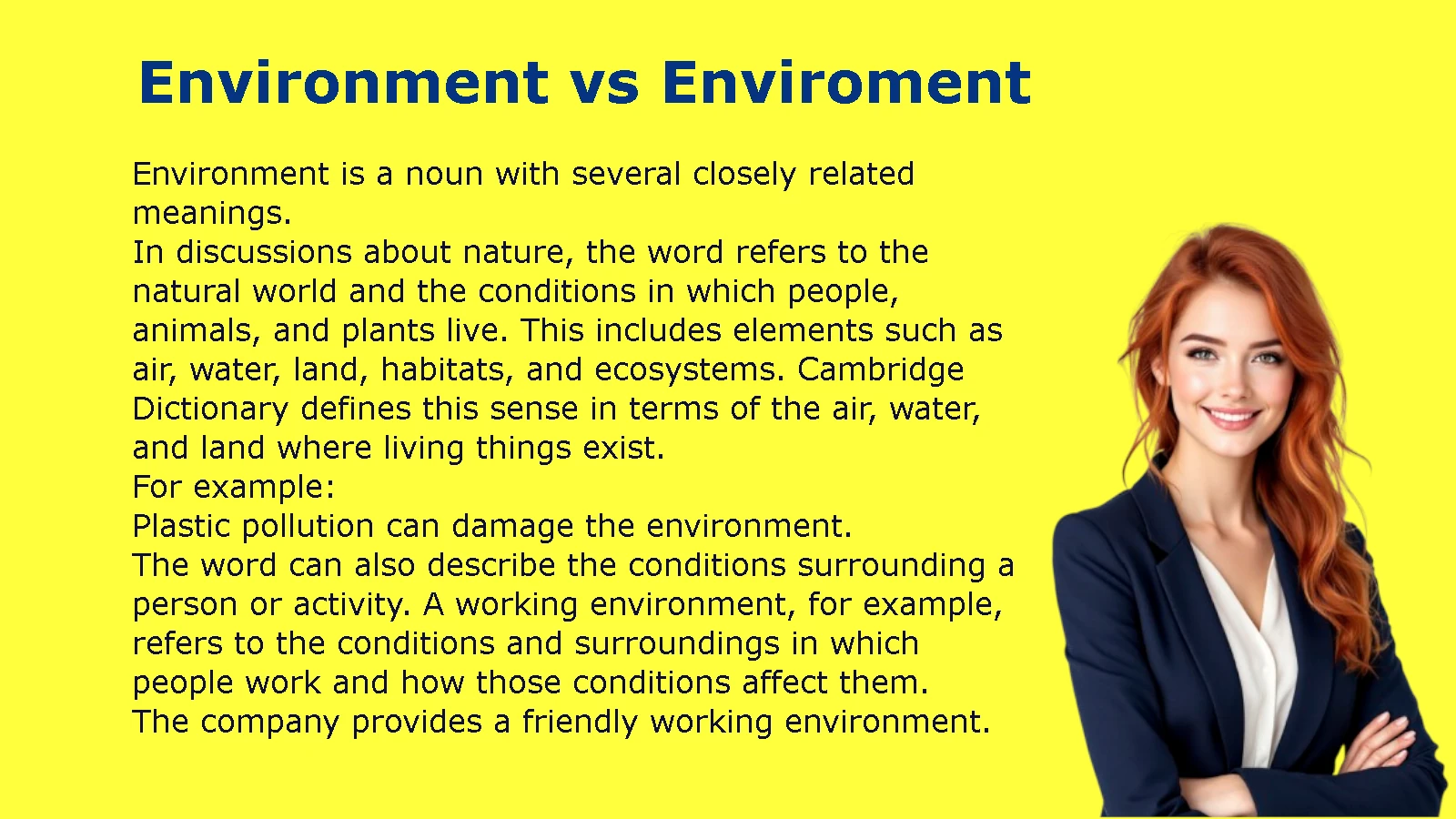
Environment is a noun with several closely related meanings.
In discussions about nature, the word refers to the natural world and the conditions in which people, animals, and plants live. This includes elements such as air, water, land, habitats, and ecosystems. Cambridge Dictionary defines this sense in terms of the air, water, and land where living things exist.
For example:
Plastic pollution can damage the environment.
The word can also describe the conditions surrounding a person or activity. A working environment, for example, refers to the conditions and surroundings in which people work and how those conditions affect them.
The company provides a friendly working environment.
This broader meaning applies to many situations.
You can have a:
- home environment
- school environment
- learning environment
- working environment
- business environment
- social environment
- natural environment
- marine environment
- urban environment
Cambridge also recognizes an IT-related use in which an environment means the system or setting in which a computer program operates.
Simple definition of environment
In simple terms, environment means the surroundings, conditions, or natural world in which someone or something exists.
Why Is Enviroment Incorrect?
Enviroment is incorrect because the standard English spelling is environment, with an n before the m in the final -ment ending.
The spelling can be difficult because the pronunciation does not make every letter equally obvious. When people say the word quickly, the middle sounds can blend together, making it easy to omit a letter when writing.
Compare the two forms:
environment
enviroment
The difference is small visually, but it matters in standard written English.
The correct word contains:
environment
The common misspelling leaves out the n:
enviroment
This is a spelling mistake rather than a separate English word with a different meaning.
A useful way to remember the spelling
Do not try to spell the word purely from how it sounds. Instead, memorize the written form:
environment
Then practice it in familiar combinations:
- natural environment
- working environment
- learning environment
- healthy environment
- clean environment
- environmental protection
Seeing the correct spelling repeatedly makes the letter sequence easier to remember.
Environment vs Enviroment Examples
Examples make the spelling difference especially clear.
| Correct sentence | Incorrect sentence |
| We need to protect the environment. | We need to protect the enviroment. |
| The company created a positive work environment. | The company created a positive work enviroment. |
| Children need a safe learning environment. | Children need a safe learning enviroment. |
| Pollution can harm the natural environment. | Pollution can harm the natural enviroment. |
| A healthy home environment can support development. | A healthy home enviroment can support development. |
| The new policy could benefit the environment. | The new policy could benefit the enviroment. |
Only the spelling of the target word changes. The meaning does not change between the two sentences; the problem is simply that enviroment is misspelled.
More examples with environment
Natural environment:
Many species depend on a stable natural environment.
Work environment:
Employees reported that the new office provides a better working environment.
Learning environment:
A quiet classroom can create an effective learning environment.
Home environment:
A supportive home environment can help children feel secure.
Business environment:
Companies must adapt to a changing business environment.
Marine environment:
Oil spills can cause long-term damage to the marine environment.
How to Spell Environment Correctly
The correct spelling is:
E-N-V-I-R-O-N-M-E-N-T
There are 11 letters in environment.
A common mistake is to write the word as:
E-N-V-I-R-O-M-E-N-T
That version has 10 letters because it leaves out the n.
The important spelling sequence is:
environ + ment
The word historically developed from environ plus -ment. Etymonline traces environment to around 1600, originally referring to the state of being surrounded, while the broader sense of the conditions in which a person or thing lives developed later.
This history also explains why the word has the environ- spelling rather than enviro-.
Environment and its related forms
Learning related words can reinforce the spelling:
| Word | Part of speech | Meaning |
| environment | noun | Surroundings or conditions |
| environmental | adjective | Related to the environment |
| environmentally | adverb | In a way relating to the environment |
| environmentalist | noun | A person associated with environmental protection or environmentalism |
| environmentalism | noun | A movement or approach concerned with environmental issues |
The spelling environment remains visible in each related form.
Environment Pronunciation
The pronunciation of environment can contribute to spelling confusion because some of its sounds are reduced or less prominent in natural speech.
Cambridge gives the pronunciation as /ɪnˈvaɪ.rə.mənt/ in British English and /ɪnˈvaɪ.rə.mənt/ in its listed UK/US presentation, with American pronunciation also represented in its American dictionary entry. Oxford gives /ɪnˈvaɪrənmənt/.
The main stress falls on the second syllable.
A learner-friendly syllable division is:
en-VI-ron-ment
The exact sound can vary somewhat by accent, but the spelling remains environment.
Why pronunciation can cause the spelling mistake
English spelling does not always correspond perfectly to pronunciation. In environment, the middle portion can sound less distinct when spoken quickly.
Someone may therefore hear something closer to the rhythm of the word and write enviroment, unconsciously dropping the n.
This is a useful reminder:
Do not rely entirely on pronunciation when spelling environment.
Use the established written form instead.
Environment in American and British English
The spelling environment is standard in both American and British English.
There is no standard American spelling enviroment and no standard British spelling enviroment.
Therefore, unlike pairs such as color/colour or organize/organise, you do not need to choose between different national spellings here.
| Variety | Correct spelling |
| American English | environment |
| British English | environment |
| Canadian English | environment |
| Australian English | environment |
The same basic spelling applies internationally in standard English.
Environment: Common Uses and Contexts
One reason environment appears so frequently in English is that it works in many different contexts.
Natural Environment
The natural environment refers to the natural surroundings and systems in which organisms live.
This can include:
- forests
- rivers
- oceans
- mountains
- soil
- air
- wildlife habitats
- wetlands
- ecosystems
For example:
Human activity can have a significant effect on the natural environment.
Oxford defines the environmental sense of environment as the natural world in which people, animals, and plants live.
Social Environment
A social environment consists of the people, relationships, communities, and social conditions surrounding an individual.
For example:
A child’s social environment can influence how they communicate with others.
Here, environment does not refer specifically to forests, rivers, or the climate. It refers to the surrounding social conditions.
Work Environment
A work environment refers to the surroundings and conditions in which people work.
For example:
The company has created a collaborative work environment.
This can include physical surroundings as well as factors such as workplace relationships, expectations, and organizational conditions.
Cambridge specifically gives working environment as an example of the broader meaning of conditions in which people live or work and how those conditions influence people.
Learning Environment
A learning environment is the setting in which education or learning takes place.
For example:
Teachers can create a positive learning environment by encouraging questions and discussion.
The term can apply to classrooms, universities, online courses, training programs, libraries, and other educational settings.
Home Environment
A home environment refers to the conditions and surroundings in a person’s home.
For example:
A calm home environment can make it easier for children to concentrate on their studies.
Again, the word describes more than physical surroundings. Depending on context, it can include social and emotional conditions as well.
Environment vs Environmental
Both are related words, but they have different grammatical functions.
Environment is a noun.
The environment needs protection.
Environmental is an adjective.
The company follows strict environmental standards.
The adjective means related to the environment. Cambridge defines environmental as relating to the environment, while Oxford includes uses involving natural conditions and conditions that affect behavior or development.
Compare these examples:
| Noun | Adjective |
| The environment is changing. | Environmental changes can affect wildlife. |
| We must protect the environment. | The company adopted new environmental policies. |
| Pollution harms the environment. | Pollution is an environmental concern. |
| The natural environment is important. | The project requires an environmental assessment. |
A simple rule is:
Use environment when you are naming the thing or surroundings. Use environmental when you are describing something related to it.
Environment vs Environs
Both look similar, but they are not interchangeable.
Environment is the common noun used for surroundings, conditions, or the natural world.
The factory has affected the local environment.
Environs is a plural noun referring to the surrounding area or areas around a particular place.
The town and its environs attract many visitors.
The distinction becomes clearer in context.
| Word | Meaning | Example |
| environment | Surroundings or conditions | The school provides a safe learning environment. |
| environs | The surrounding area of a place | The city and its environs are densely populated. |
Do not replace environment with environs simply because the words look similar.
Common Misspellings of Environment
The most important misspelling for this comparison is:
enviroment ❌
Correct:
environment ✅
The error usually involves deleting the n in the middle of the word.
Other typing errors can occur, especially when the word is entered quickly, but enviroment is the form most directly associated with this spelling question.
Why people write enviroment
Several factors can contribute to the mistake:
- The word is relatively long.
- The middle syllables are not strongly pronounced in every accent.
- The n can be easy to overlook.
- Writers may spell the word according to how they hear it.
- Fast typing can cause letters to be skipped.
- The related adjective environmental can reinforce uncertainty about the word’s internal structure.
The solution is straightforward: learn the standard spelling environment and recognize that enviroment is missing the n.
Common Mistakes With Environment
Leaving out the n
This is the central error:
enviroment ❌
Instead:
environment ✅
Confusing environment with environmental
These words have different grammatical roles.
Incorrect:
We need to protect the environmental.
Correct:
We need to protect the environment.
But:
We need stronger environmental protection.
In the second sentence, environmental correctly modifies protection.
Using enviroment in formal writing
Because enviroment is a misspelling, avoid it in:
- essays
- resumes
- cover letters
- academic papers
- business reports
- websites
- presentations
- applications
- professional emails
Spell-checking tools can catch many instances, but you should still learn the correct spelling rather than relying completely on automatic correction.
Assuming similar-looking words are interchangeable
Words such as environment, environmental, and environs are related in form but have different grammatical functions and meanings.
Understanding those differences helps you avoid both spelling and usage errors.
Environment in a Sentence
Here are examples showing how environment works in different types of writing.
Everyday English
We should keep our environment clean.
Academic writing
Researchers examined how temperature changes affect organisms in their environment.
Workplace writing
The company is trying to create a more productive work environment.
School writing
A positive classroom environment can encourage students to participate.
Environmental writing
Plastic waste poses a serious threat to the marine environment.
Technology
The software runs in a secure development environment.
The last example demonstrates an important point: environment is not limited to discussions about nature.
Is Enviroment Ever Correct?
No. “Enviroment” is not the standard English spelling of the noun environment.
You may encounter enviroment in online comments, social media posts, search queries, drafts, or other user-generated material. Its appearance in real-world text does not make it an accepted alternative spelling.
If you are writing standard English, use:
environment
not:
enviroment
This distinction matters particularly in formal or published writing, where spelling accuracy affects clarity and professionalism.
Environment Spelling Tip
The most reliable approach is to memorize the complete spelling:
environment
Pay particular attention to the n in the middle:
environnment
Rather than inventing a complicated mnemonic, practice the word in common phrases.
For example:
- natural environment
- healthy environment
- clean environment
- working environment
- learning environment
- social environment
- business environment
- environmental protection
Repeated exposure to these phrases makes the correct spelling easier to recognize automatically.
Another useful technique is to write the word slowly once:
E-N-V-I-R-O-N-M-E-N-T
Then compare it with the common mistake:
E-N-V-I-R-O-M-E-N-T
The missing N becomes much easier to notice.
The History and Origin of Environment
The spelling becomes more understandable when you look at the word’s history.
Etymonline traces environment to around 1600, when it referred to the state of being surrounded or encompassed. The broader meaning involving the conditions in which a person or thing lives developed by the early 19th century. Its specialized ecological sense emerged much later.
The word is connected with the verb environ, meaning to surround or encircle. Etymonline traces environ to Old French environer, meaning to surround, enclose, or encircle.
This historical connection helps explain why the word contains environ:
environ + ment → environment
The related adjective environmental was recorded in the late 19th century, while its ecological sense developed later.
Understanding the word’s structure can therefore help reinforce its spelling.
Environment vs Enviroment: Quick Comparison
| Point | Environment | Enviroment |
| Standard spelling | Yes | No |
| Part of speech | Noun | — |
| Standard English word | Yes | No |
| Meaning | Surroundings or conditions | — |
| Refers to nature | Yes | — |
| Refers to workplaces | Yes | — |
| Refers to learning settings | Yes | — |
| Used in formal writing | Yes | No |
| Common spelling error | No | Yes |
The central distinction is simple: environment is correct; enviroment is a misspelling.
Environment vs Enviroment: Case Study
Consider a student writing an essay about pollution.
The student writes:
Human activities are damaging the natural enviroment.
The meaning is clear, but the spelling is incorrect.
After proofreading, the sentence becomes:
Human activities are damaging the natural environment.
Nothing else needs to change. The noun, grammar, sentence structure, and meaning are already correct.
Now consider a workplace example:
Our company wants to create a better enviroment for employees.
The correction is:
Our company wants to create a better environment for employees.
This demonstrates why recognizing the spelling issue is useful. The word works in both environmental and non-environmental contexts, but the spelling remains the same.
Facts to Remember About Environment vs Enviroment
Keep these points in mind:
- Environment is the correct spelling.
- Enviroment is a misspelling.
- The correct word contains 11 letters.
- The common mistake drops the n before the final -ment.
- Environment is a noun.
- Environmental is an adjective.
- Environment can refer to nature, surroundings, conditions, workplaces, schools, technology, and other settings.
- The spelling is environment in both American and British English.
- The word is historically connected with environ, meaning to surround.
- The natural-world sense is only one of several established meanings.
- The pronunciation can make the spelling difficult because some middle sounds are less prominent in connected speech.
- In formal writing, always use environment, never enviroment.
Frequently Asked Questions
Is environment or enviroment correct?
Environment is correct. Enviroment is a misspelling. The correct form contains an n before the final -ment.
Why do people spell environment as enviroment?
The word is relatively long, and its middle sounds can be difficult to distinguish when it is spoken quickly. As a result, writers sometimes omit the n when spelling it.
How do you spell environment correctly?
Spell it:
E-N-V-I-R-O-N-M-E-N-T
The easiest point to remember is the n in the middle of the word.
Is enviroment a word?
No. Enviroment is not the standard English spelling of the word. It is a common misspelling of environment.
What is the meaning of environment?
Environment means the surroundings or conditions in which someone or something exists. It can refer to the natural world or to settings such as homes, schools, workplaces, businesses, and computer systems.
How do you pronounce environment?
The word is commonly pronounced with the main stress on the second syllable. Cambridge lists /ɪnˈvaɪ.rə.mənt/, while Oxford lists /ɪnˈvaɪrənmənt/. Pronunciation can vary somewhat by accent.
Is environment spelled differently in British English?
No. Environment is the standard spelling in both British and American English.
What is the difference between environment and environmental?
Environment is a noun referring to surroundings or conditions. Environmental is an adjective meaning related to the environment.
We need to protect the environment.
We need stronger environmental regulations.
What is the difference between environment and environs?
Environment refers to surroundings or conditions. Environs refers to the surrounding area or areas around a particular place.
The natural environment is changing.
The city and its environs have grown rapidly.
What is the plural of environment?
The plural is environments.
For example:
Children may learn in very different environments.
Is environment a noun?
Yes. Environment is a noun.
It can be used to describe natural surroundings, living conditions, workplaces, educational settings, social surroundings, and other contexts.
Conclusion: Environment vs Enviroment
When choosing between environment and enviroment, the answer is straightforward: environment is correct.
The spelling enviroment is a common error caused mainly by dropping the n in the middle of the word. It is not an accepted alternative spelling.
Remember the correct form:
Environment ✅
The word can describe the natural world, but it can also refer to the conditions surrounding people, workplaces, schools, businesses, and even computer systems. Its related adjective is environmental, while environs is a separate word with a different meaning.
The best way to remember the spelling is to practice environment in familiar phrases such as natural environment, working environment, learning environment, and environmental protection.
If you are proofreading your writing and see enviroment, correct it to environment.