Have you ever stopped while writing because you weren’t sure whether defendant or defendent was the correct spelling? You’re not alone. The two forms look very similar, and the spelling can be easy to mix up because the word is commonly pronounced differently from how some people expect it to be spelled.
Defendant is the correct spelling. Defendent is a common misspelling and is not the standard spelling of the word. Defendant refers to a person, company, or organization accused or sued in a legal case.
The correct spelling is:
d-e-f-e-n-d-a-n-t
Defendent is not an alternative spelling of defendant. It is simply a misspelling and should not be used in standard English.
| Spelling | Correct? | Meaning |
| Defendant | ✅ Correct | A person or entity accused or sued in a legal case |
| Defendent | ❌ Incorrect | Misspelling of defendant |
The confusion is understandable because defendant contains the familiar word defend, which can make the ending easy to spell incorrectly. People often search for defendant vs defendent, defendant or defendent, which spelling is correct, defendant or defendent, or how to spell defendant when they want to confirm the correct form.
The key point is simple: use defendant, not defendent.
In this guide, you’ll learn the complete difference between Defendant vs Defendent, including their meaning, pronunciation, correct spelling, legal usage, origin, and examples. You’ll also learn why defendent is incorrect and how to remember the correct spelling of defendant.
Defendant vs Defendent: Which Spelling Is Correct?
Defendant is the correct spelling.
Defendent is a misspelling. Although you may see defendent in informal writing, documents, online discussions, or search queries, it is not the standard spelling of the legal term.
| Spelling | Correct? | Meaning |
| Defendant | ✅ Yes | A person or entity defending against a legal action |
| Defendent | ❌ No | Common misspelling of defendant |
| Defandant | ❌ No | Misspelling |
| Defandent | ❌ No | Misspelling |
The easiest way to remember the correct form is to connect it with defend:
Defend → defendant
Defendant Is the Correct Spelling
The word is spelled:
D-E-F-E-N-D-A-N-T
Notice the final four letters:
A-N-T
The word begins with defend, which is also useful for remembering its spelling:
defend + ant = defendant
For example:
- The defendant entered the courtroom.
- The judge questioned the defendant.
- The defendant denied the allegation.
- The court ordered the defendant to pay damages.
Defendent Is a Common Misspelling
The incorrect form defendent probably feels natural because English contains many words ending in -ent, and the pronunciation of defendant does not make the final spelling especially obvious.
However, pronunciation is not a reliable way to determine whether the final letters should be -ant or -ent.
If you are writing the word in a legal document, academic paper, article, report, or other formal context, use defendant.
What Does Defendant Mean?
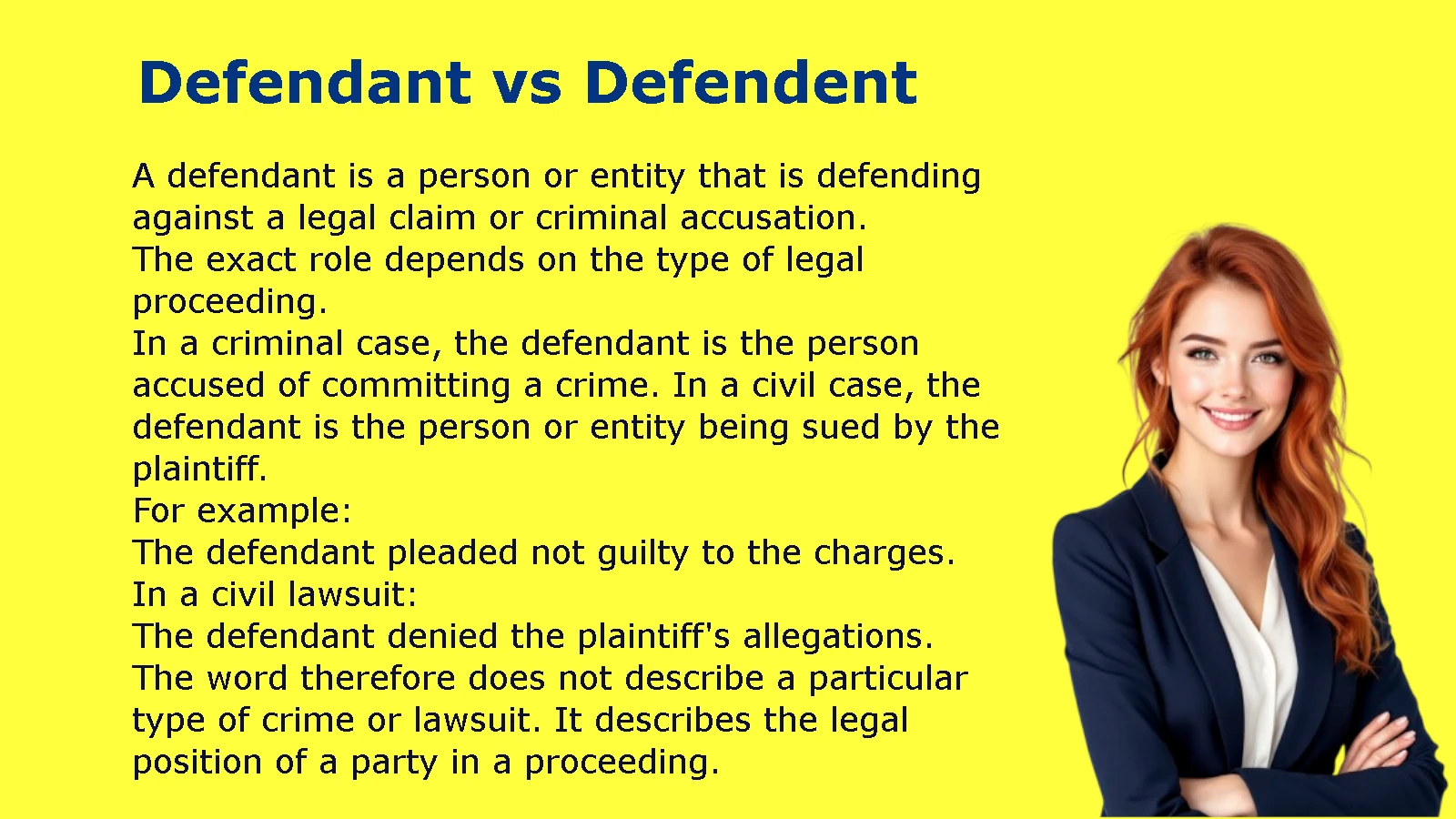
A defendant is a person or entity that is defending against a legal claim or criminal accusation.
The exact role depends on the type of legal proceeding.
In a criminal case, the defendant is the person accused of committing a crime. In a civil case, the defendant is the person or entity being sued by the plaintiff.
For example:
The defendant pleaded not guilty to the charges.
In a civil lawsuit:
The defendant denied the plaintiff’s allegations.
The word therefore does not describe a particular type of crime or lawsuit. It describes the legal position of a party in a proceeding.
Defendant in a Criminal Case
In a criminal case, the defendant is the person accused of committing a crime.
For example, suppose prosecutors accuse someone of burglary. The accused person becomes the defendant in the criminal proceeding.
You might see sentences such as:
- The defendant pleaded not guilty.
- The defendant appeared before the judge.
- The defendant’s attorney questioned the witness.
- The jury heard evidence against the defendant.
- The defendant was acquitted.
Importantly, calling someone a defendant does not by itself mean that the person is guilty.
The word identifies the person’s role in the legal proceeding. It does not state the final outcome.
Defendant in a Civil Case
The word defendant is also used in civil lawsuits.
A civil case generally involves a legal dispute that is not a criminal prosecution. A plaintiff files a lawsuit against a defendant, who responds to the claims. Common civil disputes can involve contracts, personal injury, property, business matters, and other legal issues.
For example:
The plaintiff filed a lawsuit against the defendant for breach of contract.
A defendant in a civil case can be an individual or an entity.
This is why you can correctly write:
- The company was named as a defendant.
- The defendant filed a response to the complaint.
- The court ordered the defendant to pay damages.
Why Is Defendant Spelled With -ant, Not -ent?
The spelling becomes easier to understand when you look at the history of the word.
Defendant is related to the verb defend. The word entered English through Anglo-French and Old French, ultimately relating to the Latin defendere. Etymological sources date the legal noun defendant to around the 1400s.
The important spelling connection for everyday writing is:
defend → defendant
The word contains the complete form defend before the ending:
defend + ant
That gives you:
defendant
rather than:
defendent
A Simple Way to Remember Defendant
Use this short memory trick:
A defendant must defend.
Think of the words together:
defend → defendant
This is more useful than trying to memorize an isolated sequence of letters.
You can also break the spelling into parts:
de + fend + ant
The most important part to remember is that defendant ends in -ant.
Defendant in a Sentence: Correct Examples
Seeing the word in context makes the difference between defendant and defendent much easier to remember.
Examples With Defendant
Here are several natural examples:
- The defendant appeared in court on Monday.
- The defendant denied the allegations.
- The judge questioned the defendant about the evidence.
- The defendant’s attorney presented a different argument.
- The jury found the defendant not guilty.
- The plaintiff filed a complaint against the defendant.
- The court ordered the defendant to pay damages.
- The defendant requested additional time to respond.
- Two defendants were named in the lawsuit.
- The defendant appealed the court’s decision.
Each sentence uses the standard spelling defendant.
Incorrect Examples With Defendent
The following sentences contain the common spelling error:
- ❌ The defendent appeared in court.
- ❌ The judge questioned the defendent.
- ❌ The defendent denied the allegations.
Correct versions:
- ✅ The defendant appeared in court.
- ✅ The judge questioned the defendant.
- ✅ The defendant denied the allegations.
The issue in these examples is spelling, not grammar.
Defendant vs Defendent: Common Spelling Mistake
The main difference is simple:
Defendant = correct
Defendent = incorrect
The error occurs because writers may expect the word to end in -ent. The pronunciation also does not strongly highlight the letter a in the final syllable.
This makes defendent an understandable spelling mistake, but it remains a mistake.
Why People Spell Defendant as Defendent
Several factors can contribute to the error:
- The words look very similar.
- The final vowel is not strongly emphasized in ordinary speech.
- English uses both -ant and -ent endings.
- Writers may spell the word from pronunciation rather than memory.
- The connection between defend and defendant may not be obvious.
The solution is straightforward: remember the relationship between defend and defendant.
Defendant vs Defendent in Formal Writing
Use defendant in:
- Legal documents
- Court-related writing
- Academic writing
- News articles
- Reports
- Business writing
- Essays
- Professional correspondence
Avoid defendent because it is a spelling error.
If you encounter defendent in someone else’s writing, the intended word is almost certainly defendant when the context concerns a person or entity involved in a legal case.
Defendant vs Plaintiff
Defendant and plaintiff describe different parties in a civil lawsuit.
A plaintiff is the party that initiates a civil lawsuit by filing a complaint. The defendant is the party against whom the lawsuit is brought.
| Term | Meaning |
| Plaintiff | The party that initiates a civil lawsuit |
| Defendant | The party being sued |
| Defendent | Incorrect spelling of defendant |
A simple way to remember the relationship is:
Plaintiff brings the lawsuit; defendant responds to it.
For example:
Maria files a lawsuit against a company alleging breach of contract.
In this situation:
- Maria = plaintiff
- Company = defendant
The exact legal terminology can vary with the type of proceeding, but this distinction is fundamental to ordinary civil litigation terminology.
Defendant vs Accused vs Respondent
These terms are related, but they are not simply interchangeable in every legal context.
Defendant vs Accused
Accused generally refers to someone alleged to have committed a crime.
Defendant identifies the person’s procedural role in a legal case.
For example:
The accused was charged with theft.
Once the criminal prosecution is proceeding in court, that person may be referred to as the defendant.
The distinction matters because accused focuses on the allegation, while defendant identifies a party’s role in the proceeding.
Defendant vs Respondent
Respondent is another legal term whose use depends on the type of proceeding.
The Legal Information Institute explains that a respondent is the party against whom a petition is filed, especially in an appeal. A respondent can be the plaintiff or defendant from the lower court because either party may become the responding party in an appeal.
For example, imagine:
- Person A sues Person B.
- Person B is the defendant in the original lawsuit.
- Person B later appeals the judgment.
- Person A may then be the respondent in the appeal.
So defendant and respondent can refer to the same person at different stages of litigation, but the terms describe different procedural roles.
Grammar and Usage of Defendant
Is Defendant a Noun?
Yes.
Defendant is primarily used as a noun.
It names a person or entity involved in a legal proceeding in the role described above.
Examples:
- The defendant entered the courtroom.
- The judge addressed the defendant.
- The attorney represented the defendant.
You can use the word as either the subject or object of a sentence:
The defendant answered the question.
The lawyer questioned the defendant.
What Is the Plural of Defendant?
The plural of defendant is defendants.
Simply add -s:
defendant → defendants
Examples:
The defendants appeared before the court.
Two defendants were named in the case.
The judge addressed both defendants.
The plural does not become defendents.
What Is the Possessive Form of Defendant?
For one defendant, use defendant’s:
The defendant’s attorney filed a motion.
For multiple defendants, use defendants’:
The defendants’ attorneys met before the hearing.
| Form | Use | Example |
| defendant | Singular | The defendant appeared. |
| defendants | Plural | The defendants appeared. |
| defendant’s | Singular possessive | The defendant’s lawyer spoke. |
| defendants’ | Plural possessive | The defendants’ lawyers spoke. |
These forms follow the normal English rules for singular and plural possessives.
How to Remember the Spelling of Defendant
If you frequently write defendent, use a simple association:
Defend → Defendant
The word defendant contains defend:
DEFEND + ANT
That gives you:
DEFENDANT
not:
DEFENDENT
Another useful sentence is:
The defendant must defend against the claim or accusation.
The sentence links the meaning and spelling at the same time.
A Quick Spelling Test
When you’re unsure, ask yourself:
Does the word come from defend?
If you’re referring to the legal party, write:
defendant
The final part is -ant.
Common Mistakes With Defendant
Writing Defendent Instead of Defendant
This is the most common spelling issue addressed by the keyword.
❌ defendent
✅ defendant
The incorrect spelling should be replaced wherever it appears in standard writing.
Confusing Defendant With Plaintiff
Another common mistake is mixing up the roles.
A plaintiff initiates a civil lawsuit, while the defendant is the party being sued.
For example:
The plaintiff sued the defendant.
This sentence shows the relationship clearly.
Assuming Defendant Means Guilty
Being a defendant does not itself mean that a person has been found guilty.
In a criminal case, the defendant is the person accused of the crime. The legal process then determines the outcome.
Therefore, these statements are not equivalent:
The person is the defendant.
and
The person is guilty.
The first identifies a legal role. The second asserts an outcome.
Using Defendant for Every Legal Proceeding
Not every legal proceeding uses the word defendant for every party.
For example, respondent is commonly used for a party responding to an appeal or petition.
This does not make defendant wrong. It simply means that legal terminology depends on the type and stage of the proceeding.
Defendant Pronunciation and Word Breakdown
For readers who want to understand the word more closely, here is a quick breakdown:
| Feature | Defendant |
| Correct spelling | defendant |
| Part of speech | Noun |
| Plural | defendants |
| Related verb | defend |
| Common misspelling | defendent |
| Main field of use | Law |
| Basic meaning | Person or entity defending against a legal action |
The pronunciation can vary somewhat by accent, but the spelling remains defendant.
The important point for spelling is that the word ends in -ant, regardless of how clearly that vowel is heard in speech.
The Origin of the Word Defendant
The history of defendant also explains why it is closely connected with defend.
The noun defendant is recorded from around the 1400s in the legal sense of a party sued in court. It came through Anglo-French and Old French from defendre, related to the English verb defend. Earlier English use of the related form dates to around the 1300s.
The underlying idea is therefore closely connected with defending.
That historical relationship gives us a useful modern spelling connection:
defend → defendant
This is a more reliable memory aid than treating defendant as an unrelated string of letters.
A Practical Case Study: Defendant vs Defendent in a Sentence
Consider this short example:
The plaintiff filed a complaint against the defendent. The defendent denied the allegations.
Both occurrences contain the same spelling error.
The corrected version is:
The plaintiff filed a complaint against the defendant. The defendant denied the allegations.
There are two separate concepts in this example:
- Plaintiff identifies the party bringing the civil lawsuit.
- Defendant identifies the party against whom the lawsuit is brought.
- Defendent is not the correct spelling.
This demonstrates why spelling and meaning should be considered separately. A reader may understand what defendent means from context, but that does not make the spelling correct.
Defendant vs Defendent: Quick Comparison
| Question | Defendant | Defendent |
| Is it correctly spelled? | Yes | No |
| Is it a standard English word in this legal sense? | Yes | No |
| Used for a party in a criminal case? | Yes | No |
| Used for a party in a civil lawsuit? | Yes | No |
| Plural | defendants | Incorrect |
| Related verb | defend | — |
| Recommended in formal writing? | Yes | No |
If you’re deciding between the two, there is no spelling choice to make:
Always use defendant.
Frequently Asked Questions About Defendant vs Defendent
Is defendant or defendent correct?
Defendant is correct. Defendent is a misspelling.
Is defendent a word?
Defendent is not the standard spelling of the legal noun. If you mean the person or entity involved in a legal case in this role, use defendant.
How do you spell defendant correctly?
The correct spelling is:
D-E-F-E-N-D-A-N-T
A useful way to remember it is:
defend + ant = defendant
Why is defendant spelled with an a?
The word is historically related to defend and entered English through Anglo-French and Old French. The legal noun defendant has been used in English since around the 1400s.
For modern spelling purposes, remember that defendant ends in -ant, not -ent.
What does defendant mean?
A defendant is a person or entity defending against a legal action. In a criminal case, the defendant is the person accused of a crime. In a civil case, the defendant is the person or entity being sued by the plaintiff.
What is the plural of defendant?
The plural is defendants.
Example:
The defendants appeared in court.
What is the difference between a defendant and a plaintiff?
A plaintiff initiates a civil lawsuit, while a defendant is the party against whom the lawsuit is brought.
Is defendant used in civil and criminal cases?
Yes. In criminal cases, the defendant is the person accused of the crime. In civil cases, the defendant is the person or entity being sued.
Is defendant a noun?
Yes. Defendant is a noun.
Example:
The defendant entered the courtroom.
Is defendant the same as accused?
Not always. Accused describes someone alleged to have committed a crime, while defendant identifies the person’s role as a party in a legal proceeding. The terms can refer to the same person in a criminal case, but they emphasize different aspects of the situation.
Is defendant the same as respondent?
No. The terms can overlap in some proceedings, but they are not universally interchangeable. Respondent is commonly used for the party responding to a petition or appeal, and the respondent may have been either the plaintiff or defendant in the lower court.
Conclusion: Defendant vs Defendent
When comparing defendant vs defendent, the answer is straightforward: defendant is the correct spelling, while defendent is a misspelling.
The correct word is spelled:
D-E-F-E-N-D-A-N-T
The easiest way to remember it is to connect the noun with the verb defend:
defend → defendant
A defendant is a person or entity involved in a legal proceeding in the role of defending against a criminal accusation or civil claim. In a civil lawsuit, the defendant is the party being sued by the plaintiff.
Remember these three points:
- Defendant = correct spelling
- Defendent = common misspelling
- Defend → defendant = useful spelling connection
So, if you’re writing a sentence such as:
The defendant appeared in court.
you have both the spelling and usage right.
When in doubt, don’t write defendent. Write defendant.













