Have you ever paused while writing because you weren’t sure if convenient or convienient was the correct spelling? You’re not alone. These two spellings look almost identical, and it’s easy to place the i and e in the wrong order when writing from memory.
Convenient is the correct spelling. Convienient is a common misspelling that incorrectly switches the position of the i and e in the middle of the word. Convenient means easy, useful, suitable, or accessible because it saves time, effort, or trouble.
The correct spelling is:
c-o-n-v-e-n-i-e-n-t
Convienient is not an alternative spelling of convenient. It is simply a misspelling and should not be used in standard English.
| Spelling | Correct? | Meaning |
|---|---|---|
| Convenient | ✅ Correct | Easy, useful, suitable, or accessible |
| Convienient | ❌ Incorrect | Misspelling of convenient |
The confusion is understandable because convenient contains a vowel sequence that can be easy to mix up, especially when you’re writing quickly. People commonly search for convenient vs convienient, convenient or convienient, and how to spell convenient when they want to confirm the correct form.
The key point is simple: use convenient, not convienient.
In this guide, you’ll learn the complete difference between Convenient vs Convienient, including their meaning, pronunciation, correct spelling, origin, and usage. You’ll also learn why convienient is incorrect, how to remember the correct spelling of convenient, and how to use the word naturally in clear English sentences.
Convenient vs Convienient: Which Spelling Is Correct?
Convenient is the only standard spelling.
The incorrect form convienient usually results from moving the letters around in the middle of the word. Writers sometimes remember the sound of the word but not its exact spelling, which makes the extra i easy to insert.
Compare the two:
Correct: convenient
Incorrect: convienient
The correct sequence after conv is:
e-n-i-e-n-t
So the middle of the word is:
convenient
not:
convienient
Major English dictionaries list convenient as the adjective. Oxford defines it as something “useful, easy or quick to do” and also uses it for something near or easy to get to. Cambridge similarly defines it in terms of suitability, ease, and accessibility.
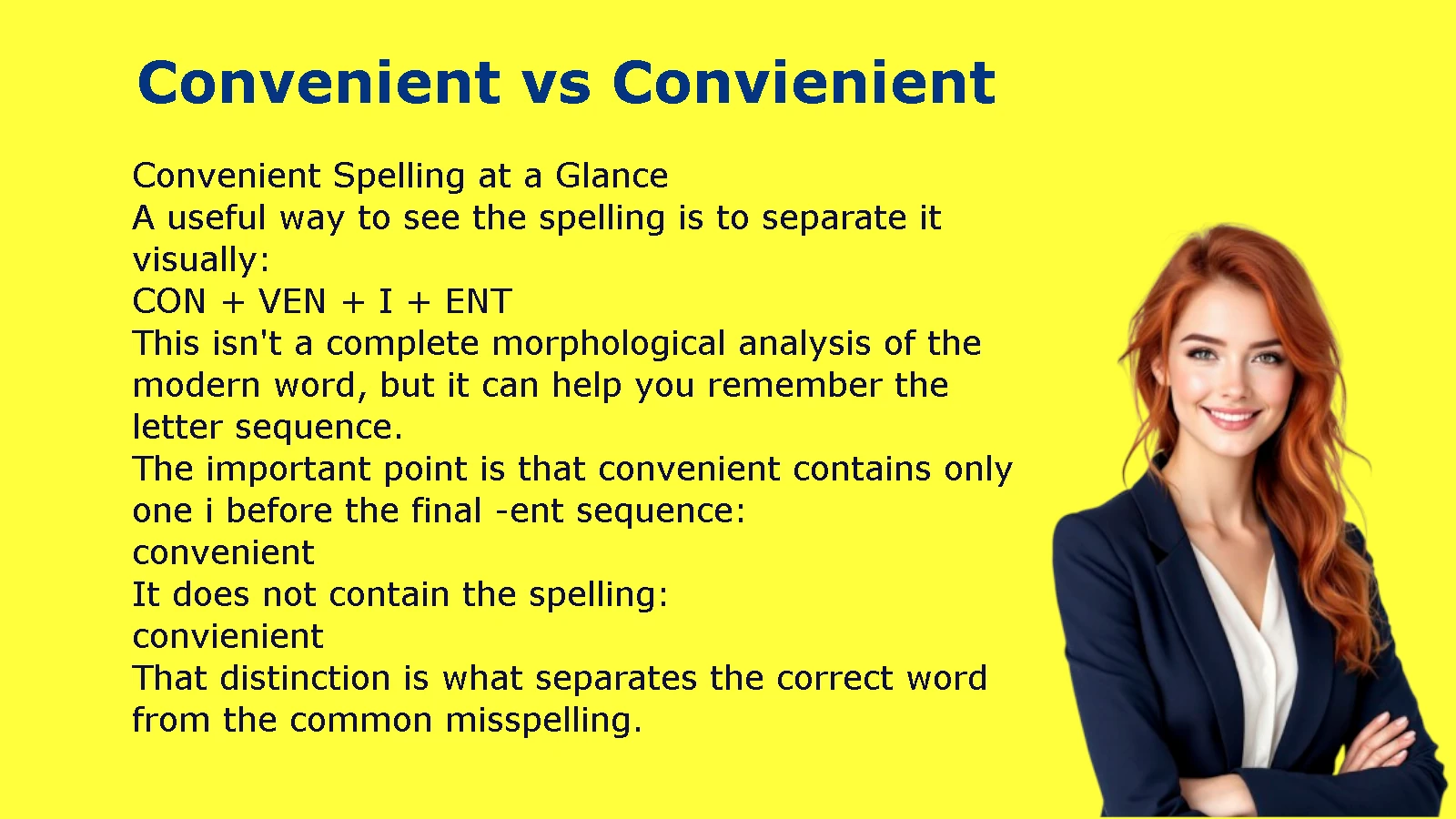
Convenient Spelling at a Glance
A useful way to see the spelling is to separate it visually:
CON + VEN + I + ENT
This isn’t a complete morphological analysis of the modern word, but it can help you remember the letter sequence.
The important point is that convenient contains only one i before the final -ent sequence:
convenient
It does not contain the spelling:
convienient
That distinction is what separates the correct word from the common misspelling.
What Does Convenient Mean?
Convenient is an adjective used to describe something that makes a situation easier, more practical, or more suitable.
Oxford gives two main modern uses. The first concerns something that is easy or useful to do. The second concerns something that is near or easy to reach.
For example:
Online banking is convenient because I can pay bills from home.
Here, convenient means that online banking makes the task easier.
Now consider:
The hotel is convenient to downtown.
Here, the word describes location and accessibility.
Cambridge likewise distinguishes between something that suits your needs or causes little difficulty and something that is near or easy to get to.
Convenient Meaning in Simple English
In simple terms, something is convenient when it works well for your needs and doesn’t create unnecessary difficulty.
Depending on the context, it can mean:
- Easy to use
- Easy to access
- Suitable
- Practical
- Helpful
- Well-timed
- Close or easy to reach
For example:
The supermarket is convenient because it is only five minutes from my house.
The supermarket is convenient because its location makes shopping easier.
Another example:
Friday afternoon would be convenient for me.
Here, the time is suitable for the speaker’s schedule.
Convenient Can Describe Time
One of the most common uses of convenient relates to time.
You might ask:
Would 3 p.m. be convenient for you?
This means:
Would 3 p.m. suit your schedule?
Other natural examples include:
- Is Monday convenient for you?
- What time would be convenient?
- Let me know when it is convenient for you.
- We can meet at a mutually convenient time.
- Please suggest a convenient time for the meeting.
Cambridge specifically gives examples involving a convenient time and a time that suits someone’s plans or schedule.
Examples of Convenient in a Sentence
Seeing the word in different contexts makes its meaning and spelling easier to remember.
Convenient for a Person
Is this time convenient for you?
Friday would be convenient for me.
Please choose a time that is convenient for everyone.
Here, convenient for indicates that something suits a person’s needs or schedule.
Convenient Location
The apartment is in a convenient location near the station.
We chose the restaurant because it has a convenient location.
The hotel is convenient to the city center.
The idea is accessibility. The location makes reaching the place easier.
Convenient Way
Paying online is a convenient way to manage your bills.
A bicycle can be a convenient way to travel around a small city.
This app provides a convenient way to organize your appointments.
Convenient Service
The store offers convenient delivery options.
The bank has convenient opening hours.
Online check-in is convenient for travelers.
Convenient Option
Taking the train is the most convenient option.
The nearby parking lot is a convenient option for visitors.
In each sentence, convenient describes something that reduces difficulty or fits the person’s needs.
Why Is “Convienient” Incorrect?
The spelling convienient is incorrect because standard English dictionaries recognize convenient as the adjective.
The error usually involves the arrangement of the letters in the middle of the word.
Compare:
convenient
c-o-n-v-e-n-i-e-n-t
versus:
convienient
c-o-n-v-i-e-n-i-e-n-t
The incorrect version introduces an extra i and changes the sequence of letters.
This is a spelling issue, not a difference in meaning. Convienient does not represent a separate English word with a different definition.
Why the Mistake Looks Plausible
The mistake is understandable because English spelling does not always map neatly onto pronunciation.
The word is pronounced roughly as:
kuhn-VEE-nee-uhnt in many varieties of English.
Cambridge gives the British pronunciation as /kənˈviː.ni.ənt/ and the American pronunciation as /kənˈviː.ni.ənt/.
When people write the word based on how it sounds, they may place the i incorrectly.
That is why the misspelling can look convincing even though it isn’t standard.
How to Spell Convenient Correctly
The safest approach is simply to memorize the correct form:
convenient
A useful visual pattern is:
convenient = conven + ient
You can also compare it with related words:
- convenient
- convenience
- inconvenient
- inconvenience
- conveniently
Seeing the word family together can make the spelling easier to recognize.
A Simple Trick to Remember Convenient
Focus on the sequence:
VEN-I-ENT
The word begins:
CON + VEN
Then comes:
I + ENT
So you get:
CON + VEN + I + ENT
That produces:
CONVENIENT
The biggest spelling trap is adding an extra i after the v.
If you remember convenient as con + ven + ient, you’re less likely to produce convienient.
Convenient vs Convienient in Sentences
The difference becomes especially obvious when the two spellings appear side by side.
| Incorrect | Correct |
| This location is very convienient. | This location is very convenient. |
| Is tomorrow convienient for you? | Is tomorrow convenient for you? |
| Online payment is convienient. | Online payment is convenient. |
| We need a convienient time. | We need a convenient time. |
| The hotel is convieniently located. | The hotel is conveniently located. |
The incorrect forms should be replaced with the standard forms.
Correct Example
The new office is conveniently located near the train station.
Incorrect Example
The new office is convieniently located near the train station.
The second sentence contains a spelling error. The adverb should be conveniently, not convieniently. Oxford lists conveniently as the adverb derived from convenient.
How to Use Convenient Correctly
Although convenient is a straightforward adjective, certain grammatical patterns appear especially often.
Convenient for Someone
Convenient for is very common when you are talking about a person’s schedule, needs, or circumstances.
Examples:
Is this time convenient for you?
The location is convenient for us.
Monday morning isn’t convenient for me.
We need to find a date that is convenient for everyone.
Oxford specifically gives the pattern convenient for somebody/something and examples involving mutually suitable meeting times.
This pattern is especially natural when someone needs to accommodate another person’s schedule.
Convenient to Someone
Convenient to also occurs, particularly when talking about proximity or accessibility.
For example:
The hotel is convenient to downtown.
Oxford notes that convenient to something is used in North American English for something near a particular place.
So the choice between for and to can depend on the relationship being expressed.
Compare:
Is 5 p.m. convenient for you?
This concerns a person’s schedule.
The hotel is convenient to the airport.
This concerns location.
The two constructions aren’t simply interchangeable in every context.
Convenient to Do Something
Another useful pattern is:
It is convenient to + verb
Examples:
It is convenient to pay online.
It is convenient to have everything delivered.
Oxford records the construction it is convenient to do something.
This structure describes an action that is easy or practical under the circumstances.
Convenient for Someone to Do Something
You can also use:
It is convenient for someone to + verb
For example:
It is more convenient for me to take the train.
It is convenient for customers to pay online.
This construction identifies the person for whom the action is easy or suitable.
Convenient Time: What Does It Mean?
A convenient time is a time that suits someone’s schedule or circumstances.
For example:
Please call me at a convenient time.
This doesn’t necessarily mean the time is objectively ideal. It means the time works for the person involved.
You might also say:
When would be a convenient time to meet?
Let me know a convenient time for a call.
We can arrange a mutually convenient time.
The phrase appears frequently in professional communication because it allows you to ask about someone’s availability without demanding a particular time.
However, convenient can sound slightly formal in some casual conversations. In everyday speech, people may simply say:
What time works for you?
Both expressions are grammatical. They differ mainly in tone.
Convenient Location: What Does It Mean?
A convenient location is a place that is easy to reach or well positioned for the people using it.
For example:
The clinic is in a convenient location near the bus station.
The location is convenient because transportation makes it easy to reach.
Similarly:
We chose a convenient location for the meeting.
This could mean that the location is easy for the participants to reach.
Oxford defines one sense of convenient as being “near to a particular place; easy to get to.”
Convenient vs Convenience
A common source of confusion is the difference between convenient and convenience.
They belong to the same word family, but they perform different grammatical jobs.
| Word | Part of Speech | Basic Meaning | Example |
| convenient | Adjective | Easy, suitable, or accessible | The location is convenient. |
| convenience | Noun | The quality or benefit of being convenient | I appreciate the convenience. |
| conveniently | Adverb | In a convenient way | The store is conveniently located. |
| inconvenient | Adjective | Causing difficulty or not suitable | The time is inconvenient. |
| inconvenience | Noun/verb | Difficulty or trouble caused by something | Sorry for the inconvenience. |
Oxford defines convenience as the quality of being useful, easy, or suitable, and it can also refer to something that makes a task easier or quicker.
Convenient Is an Adjective
An adjective describes a noun or follows a linking verb.
This is a convenient location.
The time is convenient.
Online shopping is convenient.
Convenience Is a Noun
A noun names the quality, situation, or thing itself.
Online shopping provides convenience.
I appreciate the convenience of home delivery.
The store was designed for the convenience of its customers.
You wouldn’t normally replace convenient with convenience without changing the grammar.
Incorrect:
The location is very convenience.
Correct:
The location is very convenient.
Correct noun construction:
The location offers great convenience.
Convenient vs Conveniently
Another important distinction is between convenient and conveniently.
Convenient is an adjective.
Conveniently is an adverb.
Compare:
The store is convenient.
The store is conveniently located.
In the first sentence, convenient describes the store’s accessibility.
In the second, conveniently modifies the way the store is located.
Oxford defines conveniently as meaning in a way that is useful, easy, or quick to do, and it can also describe something that is easy to reach.
More Examples
The website is convenient for customers.
Customers can conveniently place orders online.
The apartment is convenient.
The apartment is conveniently situated near the station.
This distinction is useful when proofreading because convieniently is not just misspelled; it also contains the same spelling error found in convienient.
Common Mistakes With Convenient
The most common problem is simply writing the letters in the wrong order.
Writing “Convienient”
Incorrect:
This would be very convienient for me.
Correct:
This would be very convenient for me.
Writing “Convienience”
The noun is also commonly misspelled by carrying the same letter-order mistake into the related word.
Incorrect:
Thank you for your convienience.
Correct:
Thank you for your convenience.
Writing “Convieniently”
The adverb follows the correct spelling of the adjective.
Incorrect:
The hotel is convieniently located.
Correct:
The hotel is conveniently located.
Confusing Convenient With Convenience
Incorrect:
This is a great convenience location.
Correct:
This is a great convenient location.
Or, depending on the intended meaning:
This location offers great convenience.
The choice depends on whether you need an adjective or noun.
Is Convenient a Formal Word?
Yes. Convenient is a standard English adjective used in everyday conversation, professional communication, academic writing, and formal prose.
It isn’t restricted to one level of formality.
For example, you can use it casually:
Is 6 p.m. convenient?
You can use it professionally:
Please let me know a convenient time for the meeting.
And you can use it in formal writing:
The facility provides convenient access to public transportation.
The word itself is therefore not something you need to avoid in formal writing.
Convenient in Professional Emails
The expression at your convenience is especially common in professional communication.
For example:
Please review the document at your convenience.
This means the recipient can review it at a time suitable for them.
However, there is a subtle point worth knowing: at your earliest convenience is more demanding than simply at your convenience.
At your convenience means when it suits you.
At your earliest convenience conventionally asks the person to do something as soon as reasonably possible. Oxford labels this expression as a business/formal phrase.
For example:
Please reply at your convenience.
versus:
Please reply at your earliest convenience.
The second suggests greater urgency.
Convenient Synonyms
The best synonym depends on the meaning of convenient in the sentence.
| Synonym | Best Used When Convenient Means | Example |
| handy | Easy to access or use | Keep the phone handy. |
| practical | Sensible and useful | This is a practical solution. |
| useful | Helpful for a particular purpose | This tool is useful. |
| accessible | Easy to reach or obtain | The building is accessible. |
| suitable | Appropriate for a particular situation | This is a suitable time. |
| easy | Requiring little difficulty | Online payment is easy. |
| helpful | Providing assistance | The feature is helpful. |
These words overlap with convenient, but they are not perfect substitutes in every sentence.
For instance:
Is 4 p.m. convenient for you?
can become:
Is 4 p.m. suitable for you?
But replacing it with:
Is 4 p.m. handy for you?
would sound unusual in many contexts.
The surrounding sentence determines the most natural choice.
Convenient vs Handy vs Practical
These three words are often related but have different shades of meaning.
Convenient
Convenient emphasizes ease, suitability, accessibility, or timing.
The train station is convenient for commuters.
Handy
Handy often suggests something that is useful or readily available.
Keep a flashlight handy.
Practical
Practical focuses more on whether something makes sense and works effectively in real circumstances.
A small car is a practical choice for city driving.
A single object can be convenient, handy, and practical, but each adjective highlights a slightly different quality.
A Real-World Spelling Case Study
Imagine someone writing an email to a colleague:
Would Thursday afternoon be convienient for you?
The meaning is perfectly clear. The problem is spelling.
A corrected version would be:
Would Thursday afternoon be convenient for you?
Nothing about the intended meaning changes. The correction simply replaces the nonstandard spelling with the established spelling.
Now consider a second sentence:
Please choose a convienient location.
Again, the intended meaning is obvious, but the spelling needs correction:
Please choose a convenient location.
This illustrates an important point about spelling errors: readers may understand them without difficulty, but that doesn’t make the spelling correct.
In professional, academic, or published writing, using the standard form matters because spelling contributes to clarity and credibility.
Convenient and Its Word Family
Understanding the related forms can make the spelling easier to remember.
The main forms include:
- convenient — adjective
- convenience — noun
- conveniently — adverb
- inconvenient — adjective
- inconvenience — noun and verb
- inconveniently — adverb
The underlying word family has a long history. Oxford traces convenient to Latin through the idea of things coming together, agreeing, or fitting.
Dictionary.com likewise traces the word to Latin convenire, associated with being suitable or coming together.
This historical connection helps explain why convenient, convene, and related forms share recognizable spelling elements, although modern speakers generally learn these words as separate vocabulary items.
Convenient vs Inconvenient
The natural opposite of convenient is inconvenient.
| Word | Meaning |
| Convenient | Easy, suitable, or accessible |
| Inconvenient | Causing difficulty or unsuitable |
For example:
10 a.m. is convenient for me.
10 p.m. is inconvenient for me.
Oxford defines inconvenient as something that causes trouble or problems, particularly in relation to someone’s needs or wishes.
The prefix in- changes the meaning to its opposite.
The spelling remains:
convenient
when the word stands alone.
With the negative prefix:
inconvenient
There is still no spelling variation such as convienient.
Is “Convenient for You” Correct?
Yes.
Convenient for you is a standard and natural construction.
Examples:
Would Friday be convenient for you?
Let me know what time is convenient for you.
I can meet whenever it’s convenient for you.
This expression is particularly useful when arranging a meeting or asking about someone’s availability.
A more casual alternative is:
What time works for you?
Both are correct. The difference is mainly in style and conversational tone.
Is “At Your Convenience” Correct?
Yes.
At your convenience is a standard phrase meaning at a time that is suitable for you. Oxford lists this expression and gives examples involving contacting someone at a suitable time.
For example:
Please call me at your convenience.
The phrase is especially common in formal and professional communication.
Another related expression is:
at your earliest convenience
This asks someone to act as soon as reasonably possible.
For example:
Please send the completed form at your earliest convenience.
Because the second phrase can imply urgency, it shouldn’t automatically be treated as interchangeable with at your convenience.
Is “Convenient” the Same as “Easy”?
Not always.
Convenient and easy overlap, but convenient often includes the idea of suitability or reduced inconvenience.
Compare:
The instructions are easy to follow.
This focuses on difficulty.
The online system is convenient.
This focuses on the overall usefulness or suitability of the system.
Something can also be convenient because of location, timing, availability, or accessibility, even when the task itself isn’t particularly easy.
For example:
The pharmacy is convenient because it is open late.
The important feature is the opening schedule, not necessarily the simplicity of buying something there.
Key Facts About Convenient vs Convienient
Here are the main points to remember:
- Convenient is the correct spelling.
- Convienient is a misspelling.
- Convenient is an adjective.
- It can mean easy, useful, suitable, practical, or accessible depending on context.
- Convenience is the related noun.
- Conveniently is the related adverb.
- Inconvenient is the opposite adjective.
- Convenient for you is a standard construction.
- At your convenience is a standard phrase.
- A convenient time is a time that suits someone’s schedule.
- A convenient location is easy to reach or suitable because of its position.
- The spelling convienient should be corrected in formal and edited writing.
Frequently Asked Questions About Convenient vs Convienient
Is “convienient” correct?
No. Convienient is a misspelling. The correct spelling is convenient.
How do you spell convenient correctly?
The correct spelling is:
C-O-N-V-E-N-I-E-N-T
A useful visual form is:
con + ven + ient
Is it convenient or convienient?
Use convenient.
Convenient is the standard spelling, while convienient is incorrect.
What does convenient mean?
Convenient means easy, useful, suitable, practical, or accessible in a particular situation. It can describe an action, time, location, service, method, or option.
Is convenient an adjective?
Yes. Convenient is an adjective.
For example:
This is a convenient location.
What is the noun form of convenient?
The noun is convenience.
For example:
Online shopping offers greater convenience.
Oxford identifies convenience as the noun related to the quality or benefit of being convenient.
What is the adverb form of convenient?
The adverb is conveniently.
For example:
The hotel is conveniently located near the station.
Is “convenient for you” grammatically correct?
Yes. It is a common construction used when asking if a time, place, or arrangement suits someone.
Would Tuesday be convenient for you?
Is “at your convenience” correct?
Yes. At your convenience means at a time that is suitable for you.
What is the opposite of convenient?
The opposite is inconvenient.
For example:
The meeting time is inconvenient for me.
What is a convenient time?
A convenient time is a time that suits the person or people involved.
Would 2 p.m. be a convenient time to call?
What is a convenient location?
A convenient location is a place that is easy to reach or well suited to the people who need to use it.
Is convenient a formal word?
Yes. Convenient works in casual, professional, academic, and formal writing. The surrounding phrase determines how formal the sentence sounds.
Why do people spell convenient as convienient?
The misspelling probably comes from the similar appearance and pronunciation of the word. Writers may insert or rearrange the i in the middle. The standard spelling, however, is convenient.
Conclusion: Convenient or Convienient?
When you’re deciding between convenient vs convienient, the answer is straightforward: convenient is correct, and convienient is a misspelling.
Convenient is an adjective that describes something easy, useful, suitable, practical, or accessible. You can use it for a convenient time, convenient location, convenient option, or convenient way of doing something.
Remember the correct spelling:
CONVENIENT
not:
CONVIENIENT
The related forms follow the same word family:
- convenient
- convenience
- conveniently
- inconvenient
- inconvenience
Once you remember the correct letter sequence con-ven-i-ent, the most common spelling mistake becomes much easier to avoid.
If you’re proofreading an email, essay, website, or other piece of writing, replace convienient with convenient whenever you see it. That’s the standard form used by major English dictionaries.