Have you ever paused while writing because you weren’t sure if comparison or comparision was the correct spelling? You’re not alone. The two forms look nearly identical, and the extra i in comparision can easily slip in because of the way the word is pronounced.
Comparison is the correct spelling. Comparision is a common misspelling that incorrectly adds an i before the s. Comparison means the act of examining two or more people, things, or ideas to identify their similarities and differences.
The correct spelling is:
c-o-m-p-a-r-i-s-o-n
Comparision is not an alternative spelling of comparison. It is simply a misspelling and should not be used in standard English.
| Spelling | Correct? | Meaning |
| Comparison | ✅ Correct | The act of examining similarities and differences |
| Comparision | ❌ Incorrect | Misspelling of comparison |
The confusion is understandable. The word comparison comes from the verb compare, and the ending can make it tempting to insert an extra i when writing the word from memory. However, the correct form contains -ison, not -ision.
People commonly search for comparison vs comparision, comparison or comparision, which spelling is correct, comparison or comparision, or how to spell comparison when they want to confirm the correct form.
The key point is simple: use comparison, not comparision.
In this guide, you’ll learn the complete difference between Comparison vs Comparision, including their meaning, pronunciation, correct spelling, origin, and usage. You’ll also learn why comparision is incorrect, how to remember the correct spelling of comparison, and how to use the word correctly in clear English sentences.
Comparison vs Comparision: Which Spelling Is Correct?
Comparison is the correct spelling.
Comparision is incorrect in standard English.
The easiest way to remember the difference is to look closely at the middle of the word:
- Correct: comparison
- Incorrect: compariison
The incorrect form inserts an extra i before the s.
Comparison vs Comparision at a Glance
| Point | Comparison | Comparision |
| Standard spelling | ✅ | ❌ |
| Standard English word | ✅ | ❌ |
| Used in formal writing | ✅ | ❌ |
| Used in American English | ✅ | ❌ |
| Used in British English | ✅ | ❌ |
| Dictionary entry | ✅ | ❌ |
| Meaning | Act or result of comparing | Intended as comparison |
So if you’re writing an essay, report, article, email, résumé, academic paper, or professional document, use comparison.
Correct Examples
The study provides a comparison of three different methods.
We made a comparison between the two products.
The price comparison revealed a significant difference.
Incorrect Examples
The study provides a comparision of three different methods. ❌
We made a comparision between the two products. ❌
The price comparision revealed a significant difference. ❌
The mistake doesn’t change the intended meaning, but it does make the spelling incorrect.
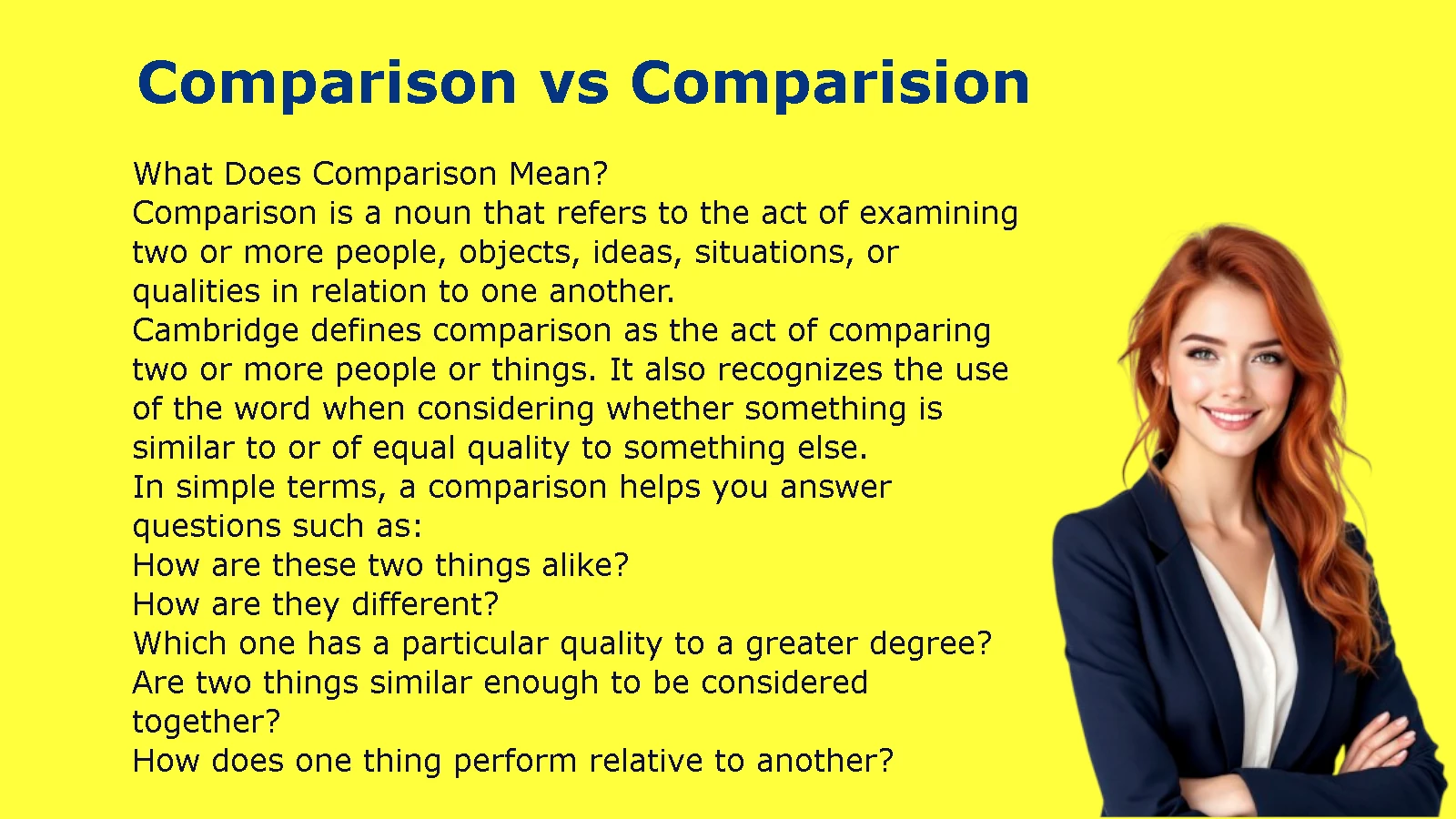
What Does Comparison Mean?
Comparison is a noun that refers to the act of examining two or more people, objects, ideas, situations, or qualities in relation to one another.
Cambridge defines comparison as the act of comparing two or more people or things. It also recognizes the use of the word when considering whether something is similar to or of equal quality to something else.
In simple terms, a comparison helps you answer questions such as:
- How are these two things alike?
- How are they different?
- Which one has a particular quality to a greater degree?
- Are two things similar enough to be considered together?
- How does one thing perform relative to another?
For example:
The report includes a comparison of the two companies.
Here, comparison refers to the examination of the companies in relation to each other.
Comparison as a Noun
Comparison is a noun derived from the verb compare.
Compare these forms:
- Compare → verb
- Comparison → noun
- Comparable → adjective
- Comparative → adjective/noun
- Comparatively → adverb
For example:
We compare the two products.
We make a comparison of the two products.
The products are comparable in price.
This is a comparative analysis.
The word changes form depending on its grammatical role, but comparison remains the standard noun spelling.
Why Is “Comparision” Incorrect?
The main spelling problem in comparision is the extra i.
The standard word is:
comparison
not:
comparision
A useful visual breakdown is:
comparison
compar + ison
The incorrect version is:
comparision
compar + i + ison
That extra i isn’t part of the standard spelling.
Why Does “Comparision” Look Right?
The misspelling is understandable because English contains many words in which an i appears before a suffix beginning with another letter. Writers may also associate the word with compare, comparative, and other related forms.
There is another source of confusion: the pronunciation doesn’t make every letter obvious. Cambridge gives the word’s pronunciation as /kəmˈpær.ɪ.sən/ in UK English and /kəmˈper.ɪ.sən/ in US English.
Because the spoken word doesn’t clearly signal every letter, someone who has learned it mainly by hearing it may spell it incorrectly.
The important point is that comparision is not an accepted alternative spelling of comparison.
Comparison Spelling: How to Spell It Correctly
The correct spelling is:
C-O-M-P-A-R-I-S-O-N
A practical way to remember it is to focus on the ending:
-ison
not:
-iison
So:
compar + ison = comparison
not:
compar + iison = comparision
A Simple Spelling Memory Trick
Think:
COMPARE → COMPARISON
The noun doesn’t become comparision. The standard spelling is comparison.
You can also remember the visual pattern:
comparISON
The ending begins with i, followed by s, not two consecutive i letters.
Quick Spelling Test
Which sentence is correct?
A. The report contains a detailed comparision of the results.
B. The report contains a detailed comparison of the results.
The answer is B.
Comparison Meaning and Examples
The word comparison appears in everyday speech, academic writing, business communication, journalism, research, and technical writing.
Here are several natural examples.
Comparing Products
We conducted a comparison of the two laptops before buying one.
The comparison could involve price, battery life, screen quality, storage, or performance.
Comparing Prices
The website provides a comparison of prices from several retailers.
Here, the comparison helps readers see how prices differ.
Comparing Ideas
The essay includes a comparison of traditional and modern approaches.
The writer examines the two approaches in relation to each other.
Comparing People
The article draws a comparison between the two athletes.
This could involve their records, playing styles, achievements, or other relevant characteristics.
Comparing Situations
A comparison of the two situations reveals several important differences.
Here, comparison refers to the analytical process itself.
Comparing Academic Results
Researchers conducted a comparison of the results from three different experiments.
This use is common in academic and scientific writing.
Comparison Pronunciation
The spelling comparison can be confusing partly because its pronunciation isn’t obvious from every letter.
Cambridge gives these pronunciations:
- UK: /kəmˈpær.ɪ.sən/
- US: /kəmˈper.ɪ.sən/
The primary stress falls on the second syllable.
The word is commonly heard as roughly three syllables:
com-PAR-i-son
The exact vowel quality in the first stressed syllable differs between varieties of English.
Does Pronunciation Change the Spelling?
No.
Even though American and British pronunciation can differ slightly, the spelling remains:
comparison
There is no standard American spelling comparision and no standard British spelling comparision.
Comparison in American and British English
One useful point for people searching “comparison spelling UK” is that there is no UK-versus-US spelling difference here.
Both varieties use:
comparison
The spelling doesn’t change to comparision in British English.
This differs from words such as:
- color / colour
- organize / organise
- center / centre
Those words have recognized regional spelling variants.
Comparison does not have that kind of standard US/UK spelling variation.
| Variety | Correct spelling |
| American English | comparison |
| British English | comparison |
| Canadian English | comparison |
| Australian English | comparison |
So if you see comparision, don’t interpret it as a British spelling. It is simply a misspelling.
Comparison vs Compare
Comparison and compare are closely related, but they perform different grammatical jobs.
Compare is usually a verb.
Comparison is a noun.
| Word | Part of speech | Function | Example |
| Compare | Verb | Examines things in relation to each other | Compare the two plans. |
| Comparison | Noun | The act or result of comparing | The comparison was useful. |
Compare
Let’s compare the two proposals.
Here, compare describes an action.
Comparison
Let’s make a comparison of the two proposals.
Here, comparison names the process or result.
This distinction matters because substituting one for the other can create an ungrammatical sentence.
Related Word Forms
The word family includes several useful forms:
| Word | Function | Example |
| Compare | Verb | Compare the two reports. |
| Comparison | Noun | The comparison was detailed. |
| Comparable | Adjective | The two products are comparable. |
| Comparative | Adjective/Noun | The study uses comparative analysis. |
| Comparatively | Adverb | The second option is comparatively inexpensive. |
The noun you need when referring to the act or result of comparing is comparison.
Comparison vs Contrast
Comparison and contrast are related, but they aren’t perfect synonyms.
A comparison can consider both similarities and differences.
A contrast generally emphasizes differences.
Cambridge describes comparison as examining differences as well as considering similarities or relative qualities.
Example
The essay compares city life with rural life.
This could discuss:
- similarities
- differences
- advantages
- disadvantages
- lifestyle
- costs
- social factors
Now consider:
The essay contrasts city life with rural life.
This wording puts greater emphasis on how the two differ.
Comparison vs Contrast Table
| Term | Main focus | Example |
| Comparison | Similarities and/or differences | The comparison revealed several similarities. |
| Contrast | Differences | The contrast between the two designs was obvious. |
So you shouldn’t automatically replace comparison with contrast.
The right word depends on what you want to emphasize.
Comparison Between vs Comparison Of
Both comparison between and comparison of are standard constructions.
The choice depends partly on the structure of the sentence and what you’re describing.
Comparison Between
Use comparison between when highlighting the relationship between two or more entities.
The study makes a comparison between the two groups.
There is a clear comparison between the two approaches.
Cambridge gives examples of the construction comparison between, including comparisons involving multiple groups.
Comparison Of
Use comparison of when identifying the things being examined.
The report contains a comparison of the two systems.
We completed a comparison of several products.
Both constructions are normal English.
Comparison Between vs Comparison Of
| Construction | Example |
| comparison between | A comparison between the two studies |
| comparison of | A comparison of the two studies |
Neither construction requires the misspelling comparision.
Common Grammar Mistakes With Comparison
Spelling isn’t the only potential problem. Writers sometimes misuse the word in grammatical constructions as well.
Using “Comparision” Instead of “Comparison”
This is the most obvious error.
❌ The article provides a detailed comparision.
✅ The article provides a detailed comparison.
Confusing Comparison With Compare
❌ We will comparison the two products.
✅ We will compare the two products.
Or:
✅ We will make a comparison of the two products.
Comparison is a noun, so it cannot normally replace the verb compare.
Assuming Comparison Means Only Difference
A comparison can identify differences, but it can also identify similarities.
The comparison revealed that both products use similar materials.
That’s still a perfectly valid comparison.
Using Contrast as an Exact Replacement
A contrast generally emphasizes differences.
If your discussion includes similarities and differences, comparison may be the more accurate term.
Comparison in Different Contexts
The word has broad practical use because people constantly evaluate things relative to other things.
Product Comparison
The buyer created a comparison of five smartphones.
The comparison might examine:
- price
- display
- battery
- storage
- camera
- processor
- warranty
Academic Comparison
The assignment requires a comparison of two historical events.
An academic comparison usually needs clear criteria rather than unsupported statements.
For example, a strong comparison might examine:
- causes
- chronology
- participants
- consequences
- similarities
- differences
Business Comparison
Management requested a comparison of the two suppliers.
Relevant criteria could include:
- price
- delivery time
- quality
- reliability
- contract terms
Statistical Comparison
The researchers performed a comparison of the results from both groups.
Here, the word refers to analytical examination rather than a casual opinion.
Literary Comparison
The paper presents a comparison of the two novels.
The writer might compare:
- themes
- characters
- narrative structure
- setting
- symbolism
- language
Comparison Synonyms
There are several words that can overlap with comparison, but they don’t all mean exactly the same thing.
Contrast
Focuses primarily on differences.
The contrast between the two designs was striking.
Evaluation
Focuses on judging or assessing something against criteria.
The evaluation considered cost and performance.
Analysis
Focuses on examining something in detail.
The analysis identified several important patterns.
Assessment
Often refers to judging quality, value, performance, or condition.
The assessment examined the project’s risks.
Juxtaposition
Refers to placing things close together, often to highlight similarities or differences.
The juxtaposition of the two images emphasized their differences.
These words can be related to comparison, but they aren’t interchangeable in every sentence.
Comparison and Its Related Word Forms
Understanding the word family makes the spelling easier to remember.
Compare
it is the verb.
Compare the two options before making a decision.
Comparison
Comparison is the noun.
The comparison helped us identify the differences.
Comparable
Comparable is an adjective meaning similar enough to be compared.
The two products are comparable in price.
Comparative
Comparative can describe something involving comparison.
The researchers used a comparative approach.
In grammar, comparative also refers to forms such as larger, faster, or more interesting.
Comparatively
Comparatively is an adverb meaning in relation to something else.
The second model is comparatively inexpensive.
Seeing these forms together helps explain why comparison belongs to a larger word family without changing its spelling to comparision.
The History of the Word Comparison
The spelling becomes easier to understand when you look at the word’s history.
The modern English word comparison comes through Old French comparaison from Latin comparatio, connected to comparare, meaning to bring together, match, or compare.
The historical development also explains the connection between compare and comparison.
Etymonline traces comparison to the mid-14th century and gives earlier senses involving equality, resemblance, similarity, and the act of putting things together for consideration.
The related verb compare also has a long history. Etymonline traces it through Old French and Latin roots associated with bringing things together or treating them as equal.
So comparison isn’t a recently created spelling or an arbitrary combination of letters. It has a long established history in English.
Why the Extra “I” Is a Common Error
The spelling comparision is easy to produce because English spelling isn’t always predictable from pronunciation.
A writer may mentally construct the noun from:
compare → compari…
and then insert another i before sion.
Another factor is analogy. English has many words containing sequences such as -ition, -ision, and -iation, so writers sometimes apply a familiar spelling pattern to a word that doesn’t use it.
The important practical lesson is simple:
Don’t spell the noun from how you think the ending sounds. Remember the established form: comparison.
A quick visual check can catch the mistake:
comparison → one i before s
comparision → two i letters in that area
Case Study: Correcting “Comparision” in a Formal Sentence
Consider this sentence:
❌ The research provides a detailed comparision between the two methods.
The intended meaning is clear, but the spelling is wrong.
Correct it to:
✅ The research provides a detailed comparison between the two methods.
Now consider another version:
❌ We conducted a comparision of the costs.
Correct:
✅ We conducted a comparison of the costs.
The correction doesn’t require rewriting the entire sentence. You only need to replace the misspelled noun.
This illustrates an important point: comparision isn’t a different grammatical form with a different meaning. It’s simply the wrong spelling of comparison.
Comparison vs Comparision in Real Writing
Here’s a useful editing checklist for anyone proofreading a document.
Before Publishing, Check:
- Is the word spelled comparison?
- Did you accidentally insert an extra i?
- Are you using comparison as a noun?
- Are you using compare when you need a verb?
- Does contrast better describe a discussion focused specifically on differences?
- Is comparison between or comparison of appropriate for your sentence?
- Are you maintaining the same spelling throughout the document?
Quick Editing Example
Original:
The report gives a comparision of the performance of three models and compares their prices.
Corrected:
The report gives a comparison of the performance of three models and compares their prices.
Notice that both comparison and compares are correct because they serve different grammatical functions.
Quick Reference: Comparison vs Comparision
| Question | Answer |
| Which spelling is correct? | Comparison |
| Is comparision correct? | No |
| What does comparison mean? | The act or result of comparing |
| Is comparison a noun? | Yes |
| Is compare a verb? | Yes |
| Is comparison used in US English? | Yes |
| Is comparison used in UK English? | Yes |
| Is there a UK spelling “comparision”? | No |
| Can comparison include similarities? | Yes |
| Can comparison include differences? | Yes |
| Is contrast a synonym in every context? | No |
| Is “comparison between” correct? | Yes |
| Is “comparison of” correct? | Yes |
Frequently Asked Questions About Comparison vs Comparision
Is comparison or comparision correct?
Comparison is correct. Comparision is a misspelling.
Use comparison in academic, professional, casual, and formal writing.
Is comparision a word?
No. Comparision is not the standard spelling of the English noun. If you intend to refer to the act or result of comparing things, use comparison.
How do you spell comparison correctly?
The correct spelling is:
C-O-M-P-A-R-I-S-O-N
The word contains one i before the s, not two.
What does comparison mean?
Comparison means examining two or more people or things in relation to one another, often to identify similarities, differences, or relative qualities. Cambridge lists these uses in its dictionary definition.
How do you pronounce comparison?
Cambridge gives /kəmˈpær.ɪ.sən/ for UK English and /kəmˈper.ɪ.sən/ for US English.
Is comparison spelled differently in British English?
No. Comparison is the standard spelling in both British and American English.
What is the difference between comparison and contrast?
Comparison can examine both similarities and differences. Contrast generally emphasizes differences.
Should I say comparison between or comparison of?
Both are standard constructions.
For example:
A comparison between the two studies
and:
A comparison of the two studies
The choice depends on how the sentence is structured.
What is the difference between compare and comparison?
Compare is a verb, while comparison is a noun.
Compare the two reports.
Make a comparison of the two reports.
What are synonyms for comparison?
Depending on context, related words include contrast, evaluation, analysis, assessment, and juxtaposition. They don’t have exactly the same meaning, so choose based on what you want to express.
Final Answer: Comparison Is Correct
When deciding between Comparison vs Comparision, there is no spelling ambiguity: comparison is the correct form.
Comparision is a misspelling created by adding an unnecessary i. The standard noun is comparison, and it refers to the act or result of examining two or more things in relation to each other.
Remember this simple pattern:
compare → comparison
Not:
compare → comparision
The correct spelling works in both American and British English, and the word is widely used in academic, professional, business, technical, and everyday writing. Dictionary evidence also confirms its established meaning and pronunciation.
So, if you’re proofreading a sentence and see comparision, change it to comparison.
Correct: The article provides a detailed comparison of the two approaches.
Incorrect: The article provides a detailed comparision of the two approaches.