Have you ever seen Cognisant and Cognizant and wondered which spelling is correct? While both words have the same meaning, the difference between Cognisant or Cognizant comes down to English spelling conventions and the variety of English being used.
Cognizant is the standard spelling in American English, while Cognisant is the standard spelling in British English and other varieties that follow British spelling. Both words mean aware of, informed about, or conscious of something.
Examples:
- She is cognizant of the risks involved.
- He was cognisant of the changes in the industry.
The confusion is understandable. People often search for Cognisant or Cognizant, Cognizant vs Cognisant, is cognisant or cognizant correct, or Cognisant American or British spelling because the two forms look almost identical. And here’s the kicker: neither spelling is wrong. You simply need to match the spelling to the type of English you’re using.
In this guide, you’ll learn the complete difference between Cognisant and Cognizant, including their meaning, definition, pronunciation, correct spelling, and usage in sentences. You’ll also discover whether Cognizant or Cognisant is preferred in American and British English and how to choose the right form for your writing.
Cognisant or Cognizant: What’s the Difference?
The difference between cognisant and cognizant is mainly a matter of regional spelling.
| Word | Common spelling convention | Meaning | Example |
| cognizant | American English | Aware or informed | He was cognizant of the risks. |
| cognisant | British English | Aware or informed | He was cognisant of the risks. |
There isn’t a separate definition hiding behind the s and z. Both words describe someone who knows about something, understands it, or recognizes its importance.
Collins gives the same basic definition for both forms and identifies cognisant as the British form of cognizant.
Is Cognizant American or British?
Cognizant is the standard spelling in American English. However, it isn’t exclusively American.
British English also recognizes cognizant, although cognisant is commonly used in British writing. Cambridge describes cognisant as the usual British form, while Oxford explicitly lists it as the British English alternative.
That distinction matters because language varieties don’t always divide neatly into “one country, one spelling.” British dictionaries can recognize the z spelling even when s is the more typical British choice.
Is Cognisant British Spelling?
Yes. Cognisant is a British English spelling of cognizant.
Collins specifically lists cognisant as British and directs readers to cognizant.
This makes the choice fairly simple when you’re writing according to a specific regional standard:
- US English: cognizant
- UK English: cognisant
- Meaning: the same
- Part of speech: adjective
- Typical construction: cognizant/cognisant of something
What Does Cognizant Mean?
Cognizant means aware of something or having knowledge or understanding of it.
Cambridge defines the adjective as “understanding or realizing something” and marks it as formal. Oxford similarly defines it as having knowledge or understanding of something and also labels it formal.
In plain English, cognizant usually means aware.
Consider these examples:
- The manager was cognizant of the problem.
- She remained cognizant of the possible consequences.
- The researchers were cognizant of the study’s limitations.
- You should be cognizant of the deadline.
- The company is cognizant of changing customer expectations.
In each sentence, the person or organization knows about something and recognizes its importance.
Cognizant Meaning in Simple English
If cognizant feels overly formal, replace it with aware.
Cognizant = aware, informed, or conscious of something.
For example:
Formal:
The team was cognizant of the financial risks.
Simpler:
The team was aware of the financial risks.
The meaning remains almost identical. The difference is tone.
Is Cognizant a Formal Word?
Yes. Major dictionaries describe cognizant as formal.
You might see it in:
- Business writing
- Academic writing
- Government documents
- Legal contexts
- Professional reports
- Policy discussions
- Formal presentations
It can appear in ordinary conversation, but aware usually sounds more natural.
For instance, saying “I’m aware of the issue” feels relaxed and direct. Saying “I’m cognizant of the issue” sounds more deliberate and formal.
Neither is grammatically wrong. They’re simply different choices of register.
What Does Cognisant Mean?
Cognisant means the same thing as cognizant.
The only major difference is the spelling convention.
For example:
- She was cognisant of the risks.
- The board was cognisant of the financial pressure.
- They remained cognisant of their responsibilities.
- He was fully cognisant of the consequences.
These sentences use the British spelling.
Collins defines cognisant as the British form of cognizant, while Oxford identifies it as the British English alternative.
Cognisant Meaning in Simple English
Think of cognisant as a British spelling of aware or informed.
For example:
The company was cognisant of the risks.
means:
The company was aware of the risks.
The first version sounds more formal. The second is simpler and more conversational.
Are Cognisant and Cognizant the Same Word?
For normal modern usage, yes. They are spelling variants of the same adjective.
Here’s the easiest way to remember the relationship:
cognizant → American spelling
cognisant → British spelling
The distinction is similar to other regional spelling differences in English. The spelling may change while the underlying word remains the same.
The dictionaries support this directly. Cambridge gives cognizant as the main entry and marks it “UK usually cognisant.” Oxford lists cognizant and notes “(British English also cognisant).”
So don’t treat cognisant and cognizant as two words with different meanings.
They’re two spellings of the same word.
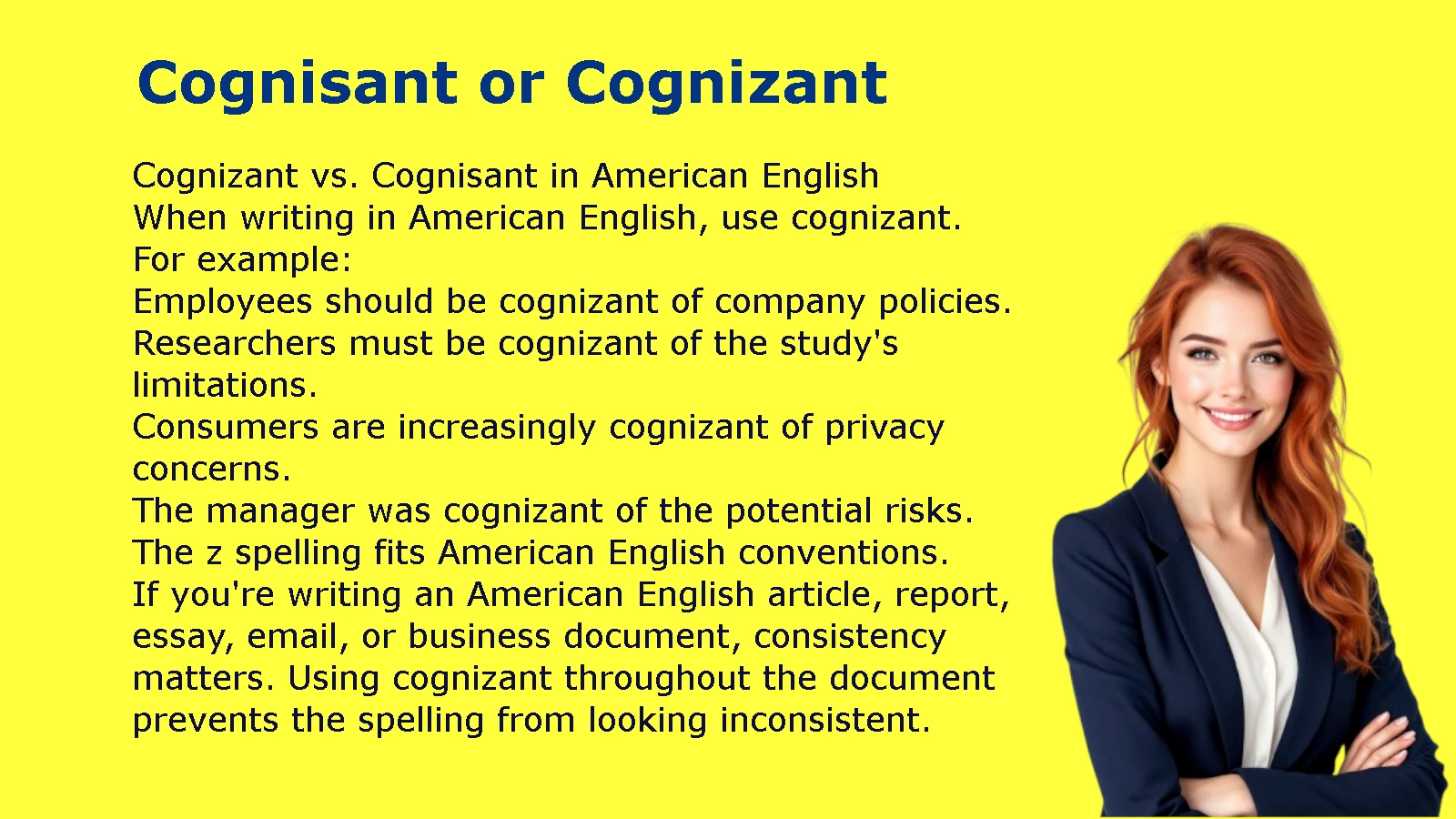
Cognizant vs. Cognisant in American English
When writing in American English, use cognizant.
For example:
- Employees should be cognizant of company policies.
- Researchers must be cognizant of the study’s limitations.
- Consumers are increasingly cognizant of privacy concerns.
- The manager was cognizant of the potential risks.
The z spelling fits American English conventions.
If you’re writing an American English article, report, essay, email, or business document, consistency matters. Using cognizant throughout the document prevents the spelling from looking inconsistent.
American English Examples
| American English sentence | Simpler alternative |
| We are cognizant of the issue. | We are aware of the issue. |
| She is cognizant of the risks. | She understands the risks. |
| They were cognizant of the deadline. | They knew about the deadline. |
| The company remains cognizant of market changes. | The company remains aware of market changes. |
Notice something important: cognizant doesn’t always need to be replaced. In formal business or academic writing, it can fit perfectly well.
Cognizant vs. Cognisant in British English
British English commonly uses cognisant.
Examples include:
- The committee was cognisant of the concerns.
- She was cognisant of the potential consequences.
- The organization remained cognisant of its obligations.
- They were fully cognisant of the situation.
The s spelling is especially useful when the surrounding document consistently follows British English conventions.
However, don’t assume that cognizant is incorrect in British English. Major British dictionaries recognize it. Oxford lists cognisant as the British English alternative to cognizant, while Cambridge says British English usually uses cognisant.
That’s an important distinction:
Preferred regional form does not necessarily mean exclusive form.
Cognizant vs. Cognisant in Other English Varieties
English has never been a one-size-fits-all language. Regional varieties often mix spelling conventions, especially in international business, education, publishing, and technology.
For that reason, it’s safer to follow the style guide and English variety required by your audience rather than treating every regional preference as an absolute rule.
If you’re writing for an American publication, cognizant is the straightforward choice.
If you’re writing for a British publication, cognisant is the natural choice.
For international content, choose one spelling system and use it consistently.
How to Use Cognizant in a Sentence
The most common grammatical pattern is:
cognizant + of + noun or noun phrase
For example:
She was cognizant of the risks.
Here, of the risks tells the reader what she was aware of.
Other examples include:
- He was cognizant of the consequences.
- The company was cognizant of its responsibilities.
- We need to remain cognizant of changing conditions.
- The students became cognizant of the problem.
- The researchers were cognizant of the limitations.
Oxford specifically illustrates the pattern with cognizant of the importance of the case.
Cognizant of Something
Cognizant of is the most useful construction to remember.
Examples:
- cognizant of the risks
- cognizant of the problem
- cognizant of the consequences
- cognizant of the situation
- cognizant of the limitations
- cognizant of the importance
- cognizant of changing expectations
A common mistake is to use the word without completing the relationship.
For example:
❌ She was cognizant the risks.
Better:
✅ She was cognizant of the risks.
Cognizant That
You may also encounter cognizant that.
For example:
- The company was cognizant that the market could change.
- Officials were cognizant that the policy had limitations.
This construction appears in real English usage. Collins includes examples of cognizant that in its dictionary material.
Still, cognizant of is the safer pattern to remember when you’re learning the word.
Cognizant of the Fact That
Another construction is:
cognizant of the fact that + clause
For example:
The researchers were cognizant of the fact that the results had limitations.
It’s grammatical, but it can sound heavy.
A cleaner version is often:
The researchers were aware that the results had limitations.
This is a useful writing principle: correct doesn’t always mean best.
If a shorter phrase communicates the same idea, use it.
How to Use Cognisant in a Sentence
The British spelling follows the same grammar.
For example:
- She was cognisant of the risks.
- They were cognisant of the consequences.
- The company remained cognisant of its obligations.
- He was fully cognisant of the situation.
- The researchers were cognisant of the study’s limitations.
The spelling changes from z to s, but the sentence structure stays the same.
Cognisant of Something
The standard pattern is:
cognisant of + something
Examples:
- cognisant of the problem
- cognisant of the risks
- cognisant of the evidence
- cognisant of the consequences
- cognisant of the changes
This is the British counterpart to cognizant of.
Cognizant vs. Aware: Are They the Same?
Cognizant and aware are close synonyms, but they don’t always sound equally natural.
Cambridge lists aware, conscious, and witting among words related to cognizant.
The main difference is register.
| Word | Tone | Example |
| aware | Everyday and direct | She was aware of the problem. |
| cognizant | Formal | She was cognizant of the problem. |
| cognisant | Formal, British | She was cognisant of the problem. |
| informed | Neutral to formal | She was informed about the problem. |
| conscious | Neutral, depending on context | She was conscious of the problem. |
If you’re writing a friendly email, aware will often sound better.
If you’re writing a formal report, cognizant may fit the tone.
When “Aware” Is Better
Consider this sentence:
Please be cognizant of the fact that the office closes at 5 p.m.
It’s grammatical, but it sounds unnecessarily formal.
A cleaner version is:
Please be aware that the office closes at 5 p.m.
The second sentence gets to the point faster.
That doesn’t make cognizant a bad word. It simply means you should match your vocabulary to your audience.
Cognizant vs. Conscious: What’s the Difference?
Cognizant and conscious overlap when they mean awareness, but they’re not interchangeable in every situation.
Conscious can describe someone’s physical state.
For example:
The patient was conscious after the accident.
You can’t naturally replace conscious with cognizant here.
Cognizant, by contrast, focuses on knowledge or awareness of a particular fact, issue, condition, or consequence.
For example:
The patient was cognizant of what had happened.
The distinction becomes clearer in a table:
| Sentence | Meaning |
| She was conscious after the accident. | She was awake rather than unconscious. |
| She was conscious of the risks. | She was aware of the risks. |
| She was cognizant of the risks. | She understood or recognized the risks. |
So, while conscious of and cognizant of can overlap, conscious has a wider range of meanings.
Common Mistakes With Cognizant and Cognisant
A handful of mistakes appear repeatedly when people use these words.
Mistake: Treating Cognisant and Cognizant as Different Meanings
This is the biggest misconception.
They have the same basic meaning.
The spelling changes according to regional convention.
Mistake: Assuming Cognisant Is Wrong in American English
If you’re following US English, cognizant is the better choice.
That doesn’t mean cognisant is an invented or meaningless spelling. It is a recognized British form. Collins identifies cognisant as British and links it directly to cognizant.
Mistake: Assuming Cognizant Is Wrong in British English
That’s also too absolute.
British dictionaries recognize cognizant. Oxford specifically gives cognisant as the British English alternative.
The practical rule is about preferred regional usage, not a simple right-versus-wrong test.
Mistake: Forgetting “Of”
The common pattern is:
cognizant of something
For example:
✅ She was cognizant of the risks.
❌ She was cognizant the risks.
The same applies to the British form:
✅ She was cognisant of the risks.
Mistake: Using Cognizant When Aware Sounds More Natural
Formal vocabulary can become clutter when you use it simply because it sounds sophisticated.
Compare:
Employees should be cognizant of the rules.
with:
Employees should be aware of the rules.
Both work. The second is simpler.
Good writing isn’t about choosing the longest word in the toolbox. It’s about choosing the right one.
Real World Usage Cases for Cognizant and Cognisant
The distinction becomes easier when you see how the words work in different contexts.
Case: American Business Writing
An American company might write:
Employees must remain cognizant of the company’s security policies.
Here, cognizant fits because the sentence has a formal workplace tone.
A simpler internal message might say:
Employees must be aware of the company’s security policies.
Both are clear. The first sounds more formal.
Case: British Formal Writing
A British organization might write:
Staff should remain cognisant of their legal responsibilities.
Here, cognisant follows the British spelling convention.
The equivalent American version would be:
Staff should remain cognizant of their legal responsibilities.
The meaning remains unchanged.
Case: Academic Writing
Academic writers often need to describe awareness of limitations or conditions.
For example:
Researchers must be cognizant of the limitations of the available data.
This works because cognizant communicates deliberate awareness in a formal context.
A less formal version would be:
Researchers must be aware of the limitations of the available data.
Neither sentence changes the underlying idea.
Cognizant and Cognisant Example Sentences
Here are practical examples showing the words in different contexts.
Workplace Examples
- Managers should be cognizant of employee concerns.
- The team was cognizant of the tight deadline.
- Employees must be cognizant of workplace policies.
- The company remains cognizant of changing customer expectations.
British versions:
- Managers should be cognisant of employee concerns.
- The team was cognisant of the tight deadline.
- Employees must be cognisant of workplace policies.
- The company remains cognisant of changing customer expectations.
Academic Examples
- Students should be cognizant of the difference between correlation and causation.
- Researchers must be cognizant of potential limitations.
- The authors were cognizant of the study’s narrow scope.
These examples show why the word often appears in formal academic prose.
Everyday Examples
The word can appear in everyday contexts, although aware will usually sound more natural.
- Be cognizant of the weather before leaving.
- She was cognizant of the noise coming from the next room.
- He became cognizant of the mistake.
More conversational alternatives would be:
- Be aware of the weather before leaving.
- She noticed the noise.
- He realized his mistake.
The choice depends on the tone you want.
Cognizant Synonyms and Cognisant Synonyms
The closest alternatives include:
- aware
- informed
- knowledgeable
- conscious
- familiar
- acquainted
- witting
- understanding
Collins lists knowledgeable, aware, familiar, and informed among synonyms for cognizant.
However, these words aren’t perfect substitutes in every sentence.
Aware
Aware is the closest everyday alternative.
She was aware of the risks.
Informed
Informed emphasizes having received information.
The committee was informed of the changes.
Knowledgeable
Knowledgeable usually describes someone who has substantial knowledge about a subject.
She is knowledgeable about financial markets.
Conscious
Conscious can mean aware, but it has additional meanings involving physical awareness and deliberate attention.
He was conscious of the criticism.
Familiar
Familiar suggests that someone knows something through previous experience or exposure.
She was familiar with the procedure.
Choosing among these words requires more than swapping synonyms mechanically. Think about what kind of awareness you actually mean.
Cognizance and Cognisant: Where Do These Words Come From?
The related noun cognizance helps explain the vocabulary family.
Cognizance means knowledge or understanding and is also a formal word. Cambridge lists cognizance as the main spelling and notes that British English usually uses cognisance.
Oxford traces cognizance to Middle English conisance, from Old French conoisance, based on Latin cognoscere, meaning “get to know.” Oxford also notes that the spelling with g, influenced by Latin, arose in the 15th century and gradually affected pronunciation.
This gives us a useful word family:
| Word | Meaning |
| cognizant | Aware or informed |
| cognisant | British spelling of cognizant |
| cognizance | Knowledge or understanding |
| cognisance | British spelling of cognizance |
| cognize | To perceive, become aware of, or know |
| cognise | British spelling of cognize |
Collins recognizes both cognize and cognise, with the latter identified as the British form.
The spelling pattern is therefore broader than one isolated adjective.
Why Does Cognizant Use “Z” While Cognisant Uses “S”?
The s/z difference reflects a wider pattern in English spelling.
In British English, words such as these may use s where American English often uses z:
- cognisant / cognizant
- cognisance / cognizance
- cognise / cognize
This doesn’t mean the British form is less correct or that the American form is more correct. English developed multiple standardized spelling traditions.
The important point for practical writing is consistency.
If your document follows US English, use the z spelling.
If it follows British English, use the s spelling when that is the convention preferred by your publication or organization.
Cognisant or Cognizant: Which One Should You Use?
Use this quick guide:
| Your situation | Best choice |
| Writing in American English | cognizant |
| Writing in British English | cognisant |
| Following a US style guide | cognizant |
| Following a UK style guide | cognisant |
| Writing for a mixed international audience | Choose one style and stay consistent |
| Want a simpler everyday word | aware |
The safest rule is simple:
Match the spelling to the English variety you’re using.
If the rest of your document uses American spellings such as color, favor, and center, cognizant fits naturally.
If your document uses British spellings such as colour, favour, and centre, cognisant is likely the better fit.
Consistency makes the writing look intentional.
Cognizant or Cognisant: Quick Comparison
| Feature | Cognizant | Cognisant |
| Meaning | Aware or informed | Aware or informed |
| Part of speech | Adjective | Adjective |
| US English | Standard choice | British variant |
| UK English | Recognized | Common British choice |
| Formality | Formal | Formal |
| Common construction | cognizant of | cognisant of |
| Simple alternative | aware | aware |
| Example | She was cognizant of the issue. | She was cognisant of the issue. |
The key takeaway is that the difference is spelling, not meaning.
Is “Cognizant of” Grammatically Correct?
Yes.
Cognizant of is a standard and common construction.
Examples include:
- We are cognizant of the problem.
- She was cognizant of the risks.
- They remained cognizant of the consequences.
- The researchers were cognizant of the limitations.
Collins explicitly gives cognizant of as a normal construction and provides the example We are cognizant of the problem. Oxford also illustrates the adjective with cognizant of.
The British equivalent is:
- We are cognisant of the problem.
- She was cognisant of the risks.
Is Cognizant a Better Word Than Aware?
Not necessarily.
Cognizant is more formal, but formal doesn’t automatically mean better.
Use cognizant when the tone calls for it. Use aware when a direct, natural sentence works better.
Compare:
The organization is cognizant of the challenges.
with:
The organization is aware of the challenges.
The first has a more formal, institutional tone. The second is shorter and easier to read.
For most everyday writing, aware is the plain-English winner.
For formal reports, academic work, professional analysis, or policy language, cognizant can be appropriate.
Is Cognisant or Cognizant More Correct?
Neither is universally “more correct.”
Both are legitimate spellings.
The choice depends on the variety of English you’re following.
Choose Cognizant When:
- You’re writing in American English.
- Your publication uses American spelling.
- Your organization’s style guide prefers American English.
- Your audience primarily expects US English.
Choose Cognisant When:
- You’re writing in British English.
- Your publication uses British spelling.
- Your organization’s style guide follows British conventions.
- You want to maintain consistent British spelling.
The important thing isn’t picking the “superior” spelling. It’s choosing the appropriate spelling and sticking with it.
Frequently Asked Questions About Cognisant or Cognizant
Is cognisant or cognizant correct?
Both are correct. Cognizant is the standard American spelling, while cognisant is the British spelling commonly used in British English. Major dictionaries recognize the relationship between the two forms.
Is cognizant American or British?
Cognizant is the standard American form, although British English also recognizes it. British English commonly uses cognisant.
Is cognisant British spelling?
Yes. Cognisant is the British English spelling of cognizant. Collins labels it British, and Oxford lists it as the British English alternative.
Do cognizant and cognisant mean the same thing?
Yes. Both mean aware, informed, or having knowledge or understanding of something.
What is the American spelling of cognisant?
The American spelling is cognizant.
What is the British spelling of cognizant?
The commonly used British spelling is cognisant.
Is cognizant a formal word?
Yes. Cambridge and Collins both identify cognizant as formal.
What is the simplest synonym for cognizant?
Aware is usually the simplest and most natural synonym.
What is the opposite of cognizant?
The clearest opposite is unaware. Cambridge lists unaware as an opposite of cognizant.
Is “cognizant of” correct?
Yes. Cognizant of is a standard grammatical construction.
Example:
The manager was cognizant of the risks.
Can you say “cognizant that”?
Yes. Cognizant that appears in real English usage, although cognizant of is the more familiar construction for many writers. Collins includes examples using cognizant that.
Is cognisant the same as conscious?
Not exactly. Cognisant can overlap with conscious when both mean aware, but conscious has additional meanings, including being awake or not unconscious. Cognisant specifically focuses on awareness or knowledge.
Final Verdict: Cognisant or Cognizant?
Cognisant and cognizant are both correct. They have the same core meaning and function as adjectives describing awareness or knowledge.
The practical difference is regional:
- 🇺🇸 American English: cognizant
- 🇬🇧 British English: cognisant
- Meaning: aware, informed, or understanding something
- Common grammar: cognizant/cognisant of + noun
- Formal alternative: cognizant/cognisant
- Simple everyday alternative: aware
So, if you’re writing in US English, use cognizant. If you’re following British English, cognisant is the natural regional spelling.
And when the formal tone isn’t necessary, don’t be afraid to use aware. Sometimes the clearest word is the one that’s been sitting right under your nose all along.