If you’ve ever wondered whether the correct spelling is cemetery or cementary, you’re not alone. These words look very similar, but only one is the standard spelling in English. Cemetery is the correct spelling for a place where dead people are buried, while cementary is a common misspelling that does not appear as the standard form in dictionaries. Understanding the difference can help you avoid spelling mistakes in writing, schoolwork, formal documents, and everyday communication.
The cemetery or cementary question comes down to spelling rather than meaning. Cemetery is the correct word, and it refers to a burial ground or place where people are laid to rest. The incorrect form cementary is often written because the pronunciation of cemetery can make its spelling difficult to remember. Related terms such as graveyard, burial ground, churchyard, tomb, and memorial park have similar meanings but are not always interchangeable.
In this guide, you’ll learn whether “cemetery” or “cementary” is correct, what cemetery means, why “cementary” is a common misspelling, how to remember the correct spelling, and how to use “cemetery” correctly in sentences. You’ll also see clear examples and a simple comparison to make the difference easy to understand.
By the end, you’ll know exactly why cemetery is correct, why cementary is incorrect, and how to spell and use this commonly confused word naturally and correctly.
| Word | Correct? | Meaning | Example |
| cemetery | ✅ Yes | A place where people are buried | We visited the cemetery on Sunday. |
| cementary | ❌ No | Misspelling of cemetery | Avoid this spelling in standard English. |
So, if you’re wondering “cemetery or cementary?”, the answer is simple: cemetery.
Cemetery or Cementary: Quick Answer
The correct spelling is cemetery, with an e after the m and another e before the final ry.
Correct: cemetery
Incorrect: cementary
For example:
The historic cemetery contains graves that are more than a century old.
Not:
The historic cementary contains graves that are more than a century old. ❌
The word cemetery is a countable noun. You can write a cemetery, the cemetery, or several cemeteries. Cambridge defines cemetery as an area of ground in which dead bodies are buried and lists cemeteries as its plural form.
Cemetery vs. Cementary at a Glance
| Feature | Cemetery | Cementary |
| Standard English | ✅ Yes | ❌ No |
| Meaning | A place for burials | No standard meaning in this spelling |
| American English | ✅ Yes | ❌ No |
| British English | ✅ Yes | ❌ No |
| Part of speech | Noun | Misspelling |
| Plural | Cemeteries | — |
There is no American-versus-British spelling difference here. Unlike color/colour or center/centre, you should write cemetery in both varieties of English.
What Does Cemetery Mean?
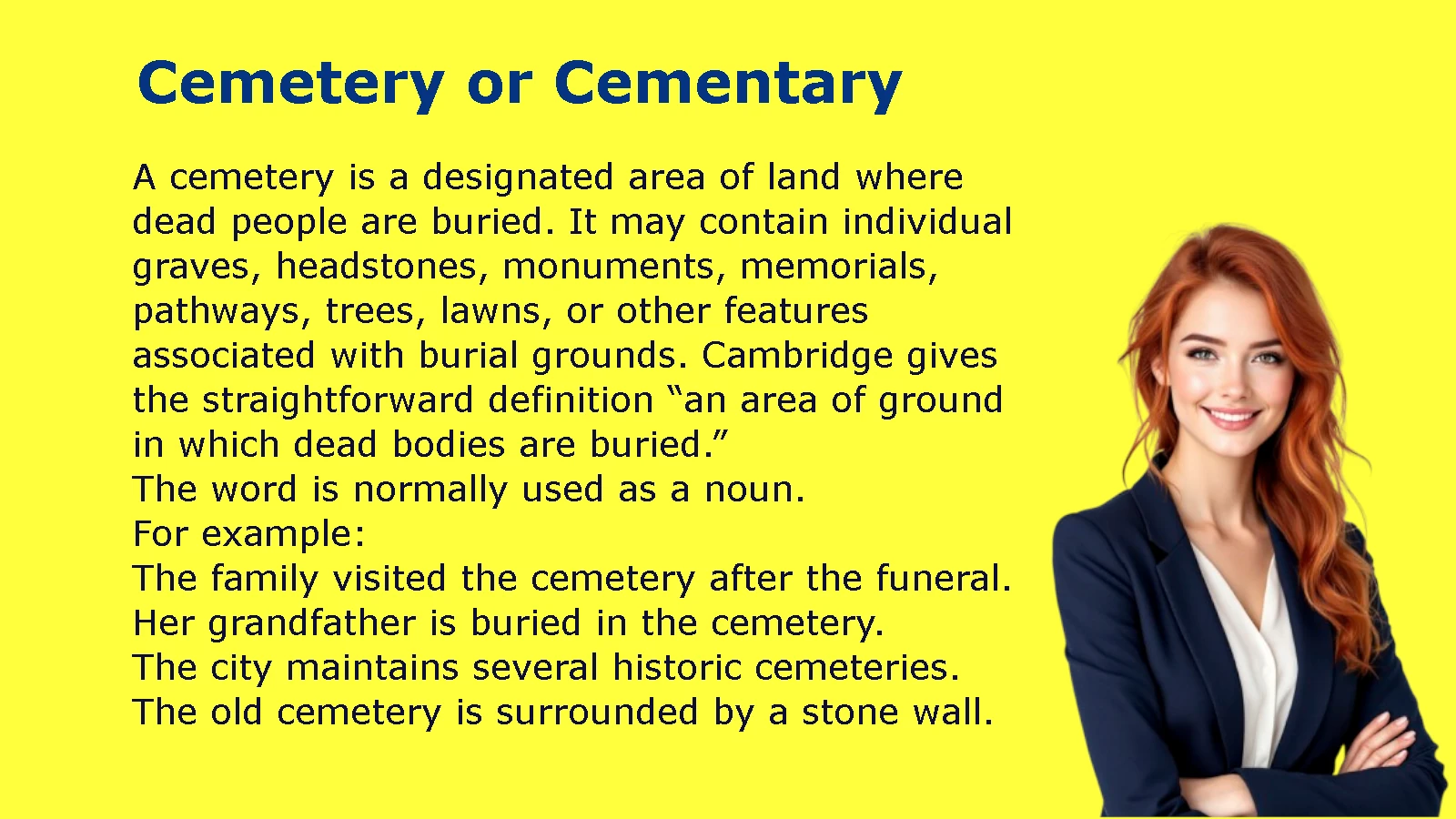
A cemetery is a designated area of land where dead people are buried. It may contain individual graves, headstones, monuments, memorials, pathways, trees, lawns, or other features associated with burial grounds. Cambridge gives the straightforward definition “an area of ground in which dead bodies are buried.”
The word is normally used as a noun.
For example:
- The family visited the cemetery after the funeral.
- Her grandfather is buried in the cemetery.
- The city maintains several historic cemeteries.
- The old cemetery is surrounded by a stone wall.
A cemetery can be small or extensive. It can be located in an urban area, outside a town, beside a religious building, or on land specifically developed for burials.
The term also appears in many established names, such as Arlington National Cemetery in the United States.
Examples of Cemetery in a Sentence
Here are some natural examples showing how cemetery is used:
The family placed flowers on the grave at the cemetery.
The historic cemetery contains elaborate stone monuments.
The church maintains a small cemetery behind the building.
Several generations of the family are buried in the same cemetery.
The city plans to preserve the old cemetery as a historic site.
Notice that cemetery refers to the entire burial ground, while a grave refers to an individual place of burial.
That distinction matters. You can say that someone is buried in a cemetery, but you would normally say that the person is buried in a grave within that cemetery.
Why Is “Cementary” Incorrect?
Cementary is a misspelling of cemetery.
The problem usually comes from the way the word sounds and from its visual resemblance to another familiar English word: cement.
When people hear or say cemetery, they may mentally construct a spelling containing cement, resulting in:
cement + ary → cementary
But that is not how the word is spelled.
The standard form is:
c-e-m-e-t-e-r-y
There is no n after the second e, and there is no a before the final r.
Why People Spell Cemetery as Cementary
There are several practical reasons the mistake occurs.
The pronunciation does not transparently reveal every letter. The word is not pronounced exactly as someone might expect from looking at the spelling.
The word “cement” creates a spelling association. Since cemetery begins with cem-, it can be tempting to connect it to cement.
The middle of the word is easy to rearrange. Writers sometimes remember the general sound but not the exact sequence of vowels and consonants.
Repeated exposure to the misspelling can reinforce it. If someone sees cementary repeatedly online, the incorrect form can begin to look familiar even though familiarity does not make it correct.
The solution is simple: memorize the spelling as a complete word rather than trying to construct it from its pronunciation.
CEMETERY = C-E-M-E-T-E-R-Y
Cemetery Spelling and Pronunciation
One reason cemetery causes spelling problems is that its pronunciation varies slightly between British and American English.
Cambridge gives the British pronunciation as approximately /ˈsem.ə.tri/ and the US pronunciation as /ˈsem.ə.ter.i/.
A simple learner-friendly approximation is:
CEM-uh-tree — British English
CEM-uh-ter-ee — American English
The important point is that pronunciation does not change the spelling.
Whether you pronounce the final part closer to tree or ter-ee, the written form remains:
cemetery
Is Cemetery Pronounced Like It Is Spelled?
Not perfectly.
English spelling often preserves historical forms that do not correspond neatly to modern pronunciation. In the case of cemetery, the unstressed syllables can become reduced in ordinary speech.
That makes it particularly easy to spell the word based on what you hear rather than what you have seen.
For spelling purposes, remember the written form:
cem-e-ter-y
rather than trying to spell it phonetically.
How to Remember the Spelling of Cemetery
The most useful approach is to memorize the word visually.
Think: CEMETERY, Not CEMENTARY
Write the correct form several times:
C-E-M-E-T-E-R-Y
Then compare it with the common error:
C-E-M-E-N-T-A-R-Y ❌
The incorrect version inserts the sequence “nta”, which does not belong in cemetery.
A useful visual cue is:
CEMETERY has “ETER” in the middle.
You can mentally divide the word like this:
CEM + ETER + Y
That is not a formal linguistic division. It is simply a memory aid.
Another practical strategy is to connect the spelling directly with the meaning:
CEMETERY = a place where people are buried
When you learn the spelling and meaning together, you are less likely to reconstruct the word incorrectly from its sound.
A Quick Spelling Test
Cover the word and try to complete this:
C E M _ T E R Y
The missing letter is:
E
So:
C E M E T E R Y
That simple visual pattern can help distinguish it from cementary.
Cemetery vs. Graveyard vs. Burial Ground
Cemetery, graveyard, and burial ground can all refer to places associated with human burial, but they are not always exact substitutes in every historical or cultural context.
| Term | General Meaning |
| Cemetery | A designated area where people are buried |
| Graveyard | A burial area, traditionally associated with a church or church grounds |
| Burial ground | A general term for land used for burials |
| Churchyard | The grounds surrounding a church, often containing graves |
Cambridge lists burial ground and graveyard among synonyms or closely related terms for cemetery.
Cemetery
A cemetery is the broadest and most neutral term in many modern contexts.
For example:
The city opened a new cemetery outside the residential district.
Graveyard
Graveyard often has a more traditional or historical association with a church.
For example:
The old village church has a small graveyard behind it.
However, everyday usage can overlap, so the distinction is not an absolute rule for every place.
Burial Ground
Burial ground is a broader descriptive term.
For example:
Archaeologists discovered an ancient burial ground near the settlement.
It can refer to historical burial sites as well as more conventional cemeteries.
Churchyard
A churchyard specifically refers to the land surrounding a church. Such land may contain graves.
So while a churchyard can function as a burial place, churchyard describes the location in relation to a church rather than simply meaning any cemetery.
Is Cemetery the American or British Spelling?
Cemetery is the standard spelling in both American and British English.
There is no accepted British spelling cementary and no American spelling cementary.
This is important because English has many genuine US/UK spelling differences, which can make people assume that unusual-looking spellings may be regional variants.
For example:
| American English | British English |
| color | colour |
| center | centre |
| organize | organise* |
| cemetery | cemetery |
*Usage of -ize/-ise varies by British style and dictionary, so it is not as straightforward as the first two examples.
The key point is that cemetery does not change spelling between the two major varieties of English.
Cemetery in American English
American English uses cemetery:
The family visited the cemetery where their relatives were buried.
Cambridge’s American dictionary defines cemetery as a place where dead people are buried and gives cemeteries as the plural.
Cemetery in British English
British English also uses cemetery:
The church is next to an old cemetery.
Cambridge gives the British pronunciation as /ˈsem.ə.tri/ while retaining the same spelling.
Therefore, if you’re writing for an American audience, a British audience, or a general international audience, cemetery is the safe and correct spelling.
Common Mistakes With Cemetery
Cementary is not the only spelling error people make. Because the word contains several unstressed syllables, writers sometimes omit or rearrange letters.
Here are three common incorrect forms.
Cemetery vs. Cementary
Correct: cemetery
Incorrect: cementary
Example:
We visited the historic cemetery.
The incorrect form adds n and changes the ending:
We visited the historic cementary. ❌
This is the specific spelling confusion behind the search “cemetery or cementary.”
Cemetery vs. Cemetary
Correct: cemetery
Incorrect: cemetary
The mistake here is easier to spot when you compare the words:
cemetery
cemetary
The incorrect version removes the second e from the middle of the word.
Cemetery vs. Cemetry
Correct: cemetery
Incorrect: cemetry
Here, another e has disappeared:
cemetery
cemetry
Because the unstressed syllables can be difficult to hear, this shortened spelling may seem reasonable to someone spelling the word from pronunciation.
Common Cemetery Misspellings at a Glance
| Misspelling | Correct Form |
| cementary | cemetery |
| cemetary | cemetery |
| cemetry | cemetery |
| cemetry | cemetery |
When in doubt, return to the complete spelling:
C-E-M-E-T-E-R-Y
Cemetery in Everyday Sentences
Seeing the word in context is one of the best ways to make the spelling familiar.
Here are examples across several situations:
The family visited the cemetery after the funeral.
The old cemetery is surrounded by mature trees.
A new cemetery was established on the outskirts of the town.
The historian is researching people buried in the cemetery.
Several famous writers are buried in the cemetery.
The city is responsible for maintaining several public cemeteries.
The cemetery contains both old and recently marked graves.
Visitors are asked to respect the quiet atmosphere of the cemetery.
Cemetery as a Countable Noun
Cemetery is a countable noun.
You can therefore use:
- a cemetery
- one cemetery
- the cemetery
- two cemeteries
- several cemeteries
- many cemeteries
For example:
The county has three cemeteries.
You would not normally use cemetery as an uncountable noun when referring to burial grounds in this ordinary sense.
What Is the Plural of Cemetery?
The plural of cemetery is cemeteries.
This is another spelling point worth remembering because simply adding s would produce the incorrect form cemeterys.
Cemetery → Cemeteries
The standard spelling is:
cemetery → cemeteries
Examples:
The city has several historic cemeteries.
Many rural cemeteries require regular maintenance.
The researcher visited five cemeteries during the study.
The spelling change follows a familiar English pattern in which a noun ending in a consonant plus y changes y to ies when pluralized.
For example:
- cemetery → cemeteries
- city → cities
- library → libraries
But this pattern does not apply to every word ending in y. Words ending in a vowel plus y generally take -s, such as boy → boys and day → days.
For cemetery, however, the correct plural is unambiguously cemeteries. Cambridge also lists cemeteries as the plural form.
Cemetery Word Origin
The unusual spelling becomes easier to understand when you look at the word’s history.
Cemetery ultimately traces back to the Greek koimētērion, a word associated with a sleeping place or resting place. It passed through Latin and French before developing into the English word used today.
That history also helps explain why cemetery should not be treated as though it were derived from cement.
The visual similarity between cemetery and cement is misleading.
Cemetery Is Not Derived From Cement
This is an important distinction:
cemetery ≠ cement + ary
The word cemetery has a separate historical origin connected with the idea of a resting place.
So although cementary looks as if it could be constructed from cement, that spelling does not reflect the actual history of the word.
This is one reason memorizing the correct form is better than trying to reason out its spelling from related-looking words.
Cemetery or Cementary: Easy Way to Remember the Difference
If you frequently mix up cemetery and cementary, use one simple rule:
A burial place is a CEMETERY.
Then memorize the sequence:
C-E-M-E-T-E-R-Y
A particularly useful visual cue is:
CEM + ETER + Y
The middle is ETER, not ENTAR.
The One-Line Memory Trick
Cemetery has “eter” in the middle.
That gives you:
CEM-ETER-Y
You do not need a complicated mnemonic. The goal is simply to recognize the correct letter sequence quickly.
Write It Three Times
When you are learning a difficult spelling, writing the correct form repeatedly can be more useful than inventing an elaborate phrase.
cemetery
cemetery
cemetery
Then use it in a sentence:
My grandparents are buried in the cemetery.
That connects the spelling, pronunciation, and meaning.
Cemetery or Cementary Examples: Correct vs. Incorrect
The fastest way to see the difference is to compare the two forms directly.
| Incorrect Sentence | Correct Sentence |
| We visited the old cementary. ❌ | We visited the old cemetery. ✅ |
| The church is beside a cementary. ❌ | The church is beside a cemetery. ✅ |
| Several relatives are buried in the cementary. ❌ | Several relatives are buried in the cemetery. ✅ |
| The historic cementary attracts visitors. ❌ | The historic cemetery attracts visitors. ✅ |
| They planted trees around the cementary. ❌ | They planted trees around the cemetery. ✅ |
Correct Usage in Context
Consider this example:
The town’s historic cemetery contains graves from several generations.
There is no reason to use cementary, even if the word sounds similar when spoken.
Another example:
Researchers documented the inscriptions on gravestones throughout the cemetery.
Again, cemetery is the only standard spelling.
Cemetery vs. Cemetery-Related Words
It can also help to distinguish cemetery from words that describe particular parts or features of a burial site.
| Word | Meaning |
| Cemetery | The burial ground as a whole |
| Grave | A place where a body is buried |
| Gravestone | A stone or marker identifying a grave |
| Headstone | A stone marker placed at the head of a grave |
| Tomb | A structure or chamber used for burial |
| Mausoleum | A building or structure containing one or more burial chambers |
| Memorial | Something created to remember a person or event |
This vocabulary matters because writers sometimes use these terms interchangeably when they are not exact synonyms.
For example:
The cemetery contains hundreds of graves.
A cemetery is the larger setting. A grave is an individual burial place within it.
Similarly:
A marble headstone marks the grave.
The headstone is the marker, not the cemetery itself.
Cemetery and Graveyard: Are They the Same?
In many everyday situations, cemetery and graveyard can communicate essentially the same basic idea: a place where people are buried.
However, the terms have different historical associations.
A graveyard traditionally refers to a burial ground associated with a church. A cemetery, especially in modern usage, can be an independent burial ground that is not part of a churchyard.
That distinction is useful, but it should not be treated as an absolute rule for every place or historical period.
For ordinary writing, cemetery is usually the neutral term when you simply mean a designated place for burials.
Cambridge includes graveyard and burial ground among words associated with the meaning of cemetery.
Cemetery or Cementary: Which One Should You Use?
Use cemetery.
There is no situation in standard English where you should substitute cementary for cemetery simply because it sounds right.
Here is the practical rule:
- Writing about a burial place? Use cemetery.
- Writing in American English? Use cemetery.
- Writing in British English? Use cemetery.
- Writing in formal English? Use cemetery.
- Referring to more than one? Use cemeteries.
- See cementary in your draft? Correct it to cemetery.
The spelling does not change according to the country or level of formality.
Correct Forms
Singular: cemetery
The cemetery is near the church.
Plural: cemeteries
The region contains several historic cemeteries.
Possessive: cemetery’s
The cemetery’s records were carefully preserved.
Plural possessive: cemeteries’
The cemeteries’ boundaries were documented.
These forms all retain the correct spelling of the base word.
A Quick Case Study: Why the Mistake Happens
Imagine someone needs to write:
The town built a new cemetery.
They know the word’s meaning and pronunciation but have rarely written it.
They might reason:
“Cem-… It sounds like cement, so maybe it’s cementary.”
That produces:
The town built a new cementary. ❌
The problem isn’t a misunderstanding of the sentence. It is a spelling reconstruction error.
Now compare that with someone who has memorized the visual form:
cemetery = C-E-M-E-T-E-R-Y
They don’t have to guess which letters belong in the middle.
This illustrates a useful general spelling principle: words with reduced or unclear syllables are often easier to spell when learned visually and in context rather than purely from pronunciation.
Facts About the Word Cemetery
Here are the key facts worth remembering:
| Fact | Answer |
| Correct spelling | cemetery |
| Common misspelling | cementary |
| Part of speech | Noun |
| Meaning | A place where people are buried |
| US spelling | cemetery |
| UK spelling | cemetery |
| Plural | cemeteries |
| US pronunciation | /ˈsem.ə.ter.i/ |
| UK pronunciation | /ˈsem.ə.tri/ |
| Related terms | graveyard, burial ground |
| Origin | Ultimately from Greek, through Latin/French forms |
The pronunciation difference between British and American English does not create a spelling difference. Cambridge records the two pronunciations while using the same written form.
Frequently Asked Questions About Cemetery or Cementary
Is it cemetery or cementary?
Cemetery is correct. Cementary is a misspelling.
A cemetery is a place where people are buried.
What is the correct spelling of cemetery?
The correct spelling is:
C-E-M-E-T-E-R-Y
The form cementary is incorrect.
Is cementary a word?
Cementary is not the standard spelling for a burial place. If you mean a place where people are buried, use cemetery.
Why is cemetery so hard to spell?
The word can be difficult because its unstressed syllables are not always easy to identify from pronunciation. Its beginning can also remind people of cement, which may lead to the incorrect spelling cementary.
Is cemetery spelled differently in British English?
No. Cemetery is the standard spelling in both British and American English. The pronunciation can differ slightly, but the spelling remains the same.
What is the plural of cemetery?
The plural is cemeteries.
The city maintains several historic cemeteries.
Cambridge lists cemeteries as the plural form.
How do you pronounce cemetery?
A simple approximation is CEM-uh-tree in British English and CEM-uh-ter-ee in American English. Cambridge gives /ˈsem.ə.tri/ for UK English and /ˈsem.ə.ter.i/ for US English.
What is the difference between a cemetery and a graveyard?
Both can refer to places where people are buried. Graveyard traditionally has a stronger association with burial grounds around churches, while cemetery is a broader modern term for a designated burial ground.
Is “cemetary” correct?
No. Cemetary is another common misspelling. The correct spelling is cemetery.
Is “cemetry” correct?
No. Cemetry leaves out a letter from the standard spelling. The correct form is cemetery.
Does cemetery have anything to do with cement?
No. The similarity is mainly a spelling trap. Cemetery has a different historical origin and should not be spelled by adding the suffix -ary to cement.
Final Answer: Cemetery or Cementary?
If you’re choosing between cemetery or cementary, choose cemetery every time.
Cemetery is the correct standard spelling for a place where people are buried. Cementary is a misspelling, not a British or American variant. The plural is cemeteries, and the word is used in both American and British English.
The easiest way to remember it is:
CEMETERY = C-E-M-E-T-E-R-Y
Don’t let the word cement influence the spelling. There is no n in the middle of cemetery.
So when you write about a burial ground, use:
“The cemetery is located outside the town.” ✅
Not:
“The cementary is located outside the town.” ❌
Once you remember cemetery, cemetaries, cemetry, and similar variations become much easier to identify and correct.