Have you ever paused while writing and wondered whether you should use Breath or Breathe? These two words look and sound similar, but they have different meanings and functions in English. Knowing the difference can help you avoid a common grammar mistake.
Breath is a noun that refers to the air you take into or release from your lungs. Breathe is a verb that means to take air into your lungs and let it out. Although the words are closely related, you cannot always use one in place of the other.
Examples:
- Take a deep breath before you speak.
- Try to breathe slowly and relax.
The confusion is understandable. People often search for breath or breathe, breath vs breathe, what is the difference between breath and breathe, or how to use breath and breathe in a sentence because their meanings are connected and their pronunciation is easy to mix up. And here’s the kicker: one is a thing you take, while the other is an action you do.
In this guide, you’ll learn the complete difference between Breath and Breathe, including their meanings, definitions, pronunciations, parts of speech, and correct usage. You’ll also see clear examples of breath vs breathe in sentences, learn an easy way to remember the difference, and discover when to use each word.
Breath vs. Breathe: The Quick Difference
The easiest way to remember the difference is this:
You take a breath, but you breathe.
| Word | Part of speech | Meaning | Pronunciation | Example |
| breath | Noun | Air taken into or released from the lungs; an amount of air | /brɛθ/ | Take a deep breath. |
| breathe | Verb | To take air into the lungs and release it | /briːð/ | Try to breathe slowly. |
Cambridge defines breath as the noun for air that goes into and out of your lungs. It defines breathe as the verb for moving air into and out of your lungs.
Oxford gives the same basic distinction. It also identifies breath as a noun and breathe as a verb, with different pronunciations.
A Simple Way to Tell Them Apart
Look at the job the word does in the sentence.
If you’re naming the thing or amount of air, use breath.
Take a deep breath.
If you’re describing the action, use breathe.
Try to breathe deeply.
That one distinction solves most cases.
What Does “Breath” Mean?
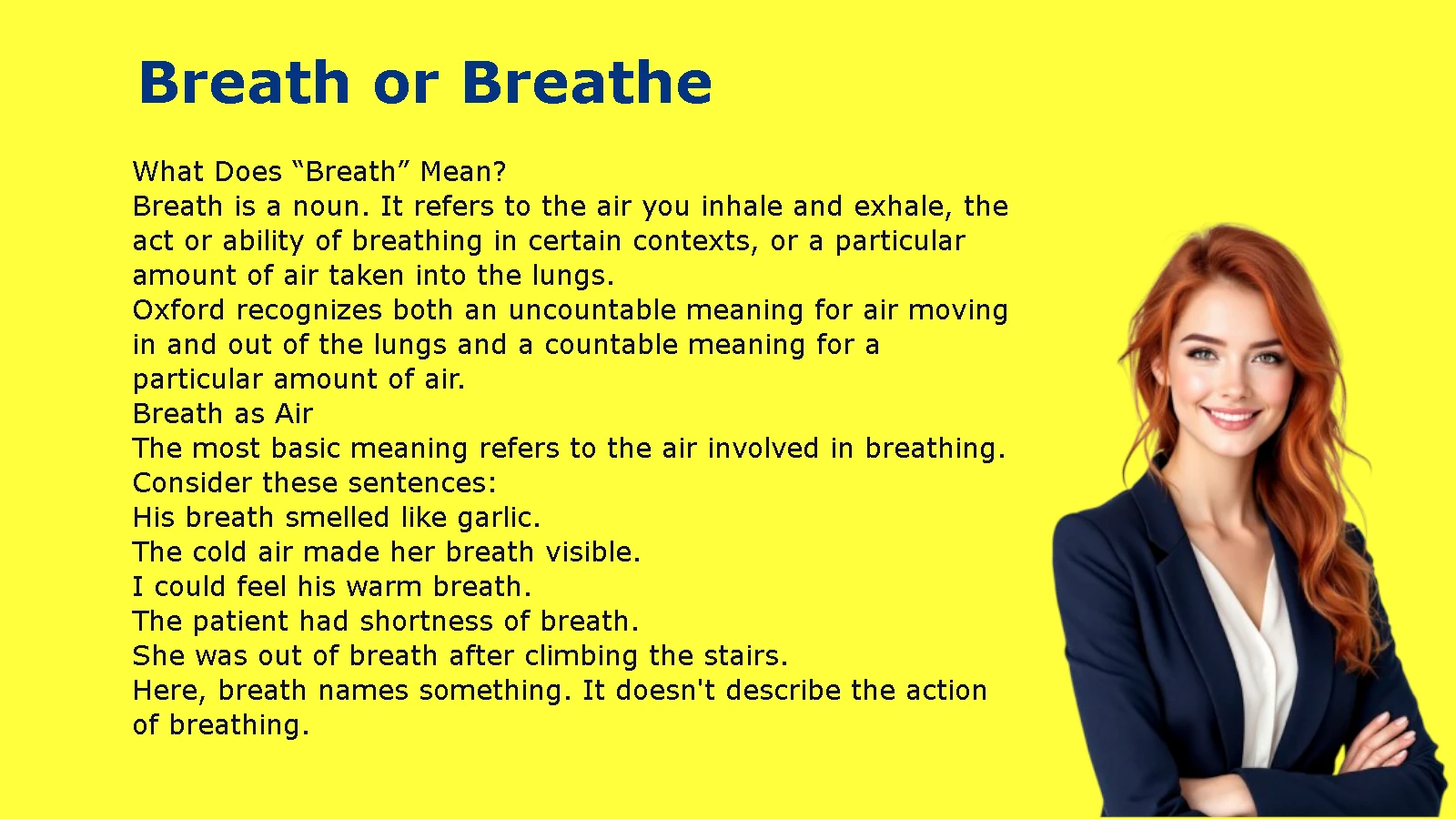
Breath is a noun. It refers to the air you inhale and exhale, the act or ability of breathing in certain contexts, or a particular amount of air taken into the lungs.
Oxford recognizes both an uncountable meaning for air moving in and out of the lungs and a countable meaning for a particular amount of air.
Breath as Air
The most basic meaning refers to the air involved in breathing.
Consider these sentences:
- His breath smelled like garlic.
- The cold air made her breath visible.
- I could feel his warm breath.
- The patient had shortness of breath.
- She was out of breath after climbing the stairs.
Here, breath names something. It doesn’t describe the action of breathing.
Breath as One Amount of Air
Breath can also refer to one inhalation or exhalation, or a particular amount of air.
For example:
- Take a deep breath.
- He let out a long breath.
- She recited the entire poem in one breath.
- Take several slow breaths.
- He held his breath while waiting.
Oxford specifically gives the meaning of breath as an amount of air that enters the lungs at one time.
This explains why take a breath is correct. You’re naming the amount of air you’re taking in.
You aren’t describing the action itself.
What Does “Breathe” Mean?
Breathe is a verb. It describes the action of taking air into your lungs and sending it out again through your nose or mouth.
For example:
- Try to breathe slowly.
- I couldn’t breathe in the smoke.
- She breathed deeply before speaking.
- The baby is breathing normally.
- He was breathing heavily after the race.
Oxford defines breathe as taking air into the lungs and sending it out through the nose or mouth.
Merriam-Webster gives the same core meaning and lists breathed as the past tense and breathing as the -ing form.
Breathe Describes an Action
A useful test is to ask:
Can the word describe something someone does?
If yes, breathe is likely the correct choice.
I need to breathe.
She began to breathe more slowly.
They could hardly breathe.
The word describes an action in each sentence.
Breath or Breathe Pronunciation
Spelling isn’t the only difference between these words. Breath and breathe have different vowel and consonant sounds.
How to Pronounce “Breath”
Breath is pronounced /brɛθ/.
The vowel sounds like the vowel in words such as bed or red. The final th is unvoiced.
Oxford gives the pronunciation as /breθ/ in its learner dictionary, while its American dictionary represents it as /brɛθ/.
How to Pronounce “Breathe”
Breathe is pronounced /briːð/.
The middle vowel is the long ee sound. The final th is voiced.
Oxford gives the pronunciation as /briːð/.
Merriam-Webster also notes the pronunciation distinction and points out that the final e in breathe can help you remember the long ee sound.
Why Do Breath and Breathe Sound Different?
The spelling gives you a useful clue:
- breath → short vowel + unvoiced th
- breathe → long ee vowel + voiced th
Compare:
breath → /brɛθ/
breathe → /briːð/
The difference becomes much easier to hear once you say the two words aloud.
When Should You Use “Breath”?
Use breath when you need a noun.
A noun names a person, place, thing, idea, or concept. In this case, breath names the air involved in breathing or a particular amount of that air.
Common Examples of “Breath”
- Take a breath.
- Take a deep breath.
- Hold your breath.
- Catch your breath.
- I was out of breath.
- She took several slow breaths.
- He spoke under his breath.
- The smell of his breath was unpleasant.
Notice how naturally words such as a, your, deep, one, and several can come before breath.
That’s a useful clue.
A Practical Grammar Test
Try placing a determiner before the word.
a breath
your breath
one breath
a deep breath
If the sentence works naturally, you’re probably dealing with the noun breath.
This isn’t a universal grammar rule, but it provides a handy shortcut when you’re choosing between the two words.
When Should You Use “Breathe”?
Use breathe when you need a verb.
The word describes the act of moving air into and out of the lungs.
Common Examples of “Breathe”
- I need to breathe.
- Try to breathe slowly.
- She couldn’t breathe properly.
- He learned to breathe more efficiently.
- Remember to breathe.
- They stopped to breathe.
- The athlete breathed deeply after the race.
The infinitive construction is particularly helpful.
Whenever you see to, the base verb follows:
to breathe
Not:
to breath
So:
I need to breathe.
is correct.
I need to breath.
is incorrect.
Breath or Breathe in a Sentence?
Seeing the words side by side makes the distinction clearer.
Example: Take a Breath
Correct:
Take a deep breath.
Why? Breath is a noun. You’re referring to one amount of air.
Incorrect:
Take a deep breathe.
The verb doesn’t fit after a in this construction.
Example: Try to Breathe
Correct:
Try to breathe slowly.
Why? Breathe is the verb describing the action.
Incorrect:
Try to breath slowly.
The word following to needs to be the verb breathe.
Example: Catch Your Breath
Correct:
Give me a minute to catch my breath.
Incorrect:
Give me a minute to catch my breathe.
The expression uses the noun breath.
Example: Hard to Breathe
Correct:
It was hard to breathe after the sprint.
Incorrect:
It was hard to breath after the sprint.
The phrase hard to is followed by the verb breathe.
Cambridge uses the same type of contrast in its grammar guidance, including examples involving “deep breath” and “could hardly breathe.”
Common Mistakes With Breath and Breathe
These mistakes usually happen because the two words share the same basic idea and differ by only one letter.
Mistake: “Take a Breathe”
❌ Take a deep breathe.
✅ Take a deep breath.
Why: Breath is the noun.
Mistake: “I Need to Breath”
❌ I need to breath.
✅ I need to breathe.
Why: Breathe is the verb.
Mistake: “Catch Your Breathe”
❌ I need to catch my breathe.
✅ I need to catch my breath.
Why: The established expression is catch your breath.
Mistake: “Out of Breathe”
❌ I was out of breathe.
✅ I was out of breath.
Why: Out of breath is a fixed expression using the noun breath.
Mistake: “Breath In”
❌ Breath in slowly.
✅ Breathe in slowly.
Why: You’re describing an action, so you need the verb breathe.
Mistake: “Hold Your Breathe”
❌ Hold your breathe.
✅ Hold your breath.
Why: You’re holding the noun, not performing the action of breathing.
Breath vs. Breathe vs. Breathing
There’s a third related word worth knowing: breathing.
These three forms aren’t interchangeable.
| Word | Part of speech | Basic function | Example |
| breath | Noun | Names the air or an amount of air | Take a breath. |
| breathe | Verb | Names the action | Try to breathe slowly. |
| breathing | Present participle / gerund | Refers to the action or process | Her breathing slowed. |
Breath
He took a deep breath.
The word names the thing or amount of air.
Breathe
He began to breathe slowly.
The word describes what he did.
Breathing
His breathing became slower.
Here, breathing refers to the ongoing process or activity.
The American Oxford dictionary lists breathe as a verb and gives breathe, breathes, breathed, and breathing as its forms.
Breathe In and Breathe Out
One reason people write breath in instead of breathe in is that the two forms sound similar.
The correct phrasal verbs are:
- breathe in
- breathe out
Both are built from the verb breathe, not the noun breath. Oxford identifies breathe in and breathe out as phrasal verbs.
Common Expressions With “Breath”
Breath appears in many everyday expressions. Learning these phrases can make the spelling much easier because the noun becomes part of a familiar pattern.
Take a Breath
This means to inhale or pause briefly.
Take a breath before you answer.
Catch Your Breath
This can mean recovering normal breathing after exertion. It can also describe a moment of surprise or shock.
We stopped to catch our breath after the climb.
The announcement made everyone catch their breath.
Oxford lists both uses.
Hold Your Breath
Literally, this means temporarily stop breathing.
Hold your breath and count to five.
It can also describe waiting anxiously for something.
We waited with bated breath for the result.
Out of Breath
This means having difficulty breathing, often after physical activity.
She was out of breath after running upstairs.
Under Your Breath
This means speaking so quietly that others may not hear you.
He muttered something under his breath.
A Breath of Fresh Air
Literally, this refers to clean air. Figuratively, it describes a person, idea, or change that feels fresh and welcome.
Her new approach was a breath of fresh air.
Oxford documents this figurative meaning as well as the literal one.
Take Someone’s Breath Away
This means to surprise, amaze, or deeply impress someone.
The view took my breath away.
Save Your Breath
This informal expression means that continuing to argue or explain something won’t accomplish anything.
Save your breath. He has already made his decision.
Common Expressions With “Breathe”
Breathe also appears in several established expressions.
Breathe Easily
To breathe easily can mean to breathe without difficulty. Figuratively, it can mean to feel relieved.
Once the problem was solved, everyone could breathe easily again.
Breathe New Life Into Something
This means to make something more interesting, effective, or successful by introducing fresh ideas.
The redesign breathed new life into the old website.
Oxford records this as an established idiom.
Live and Breathe Something
This means to be extremely enthusiastic or deeply involved in something.
She lives and breathes music.
Breathe Down Someone’s Neck
This informal expression means to watch someone closely in a way that makes them uncomfortable or anxious.
I can’t concentrate with my manager breathing down my neck.
These figurative uses are still built around the verb breathe.
Other Uses of “Breathe”
The basic meaning of breathe is physical breathing, but English uses the verb in several extended ways.
Breathe as a Quality of Material
A material can breathe when air or moisture can move through it.
This fabric allows your skin to breathe.
This use is common when people talk about clothing, footwear, fabrics, and other materials. Oxford includes this meaning for cloth, leather, and skin.
Breathe as a Property of Wine
When wine is said to breathe, it means allowing air to interact with the wine before drinking it.
Let the wine breathe before serving it.
This is a specialized but established use of the verb.
Breathe as “Say Quietly”
In literary writing, breathe can mean to say something softly.
“I’m here,” she breathed.
This use is less common in ordinary conversation, but it is a legitimate dictionary meaning.
Breathe in Figurative Expressions
The verb can also describe giving something energy or character.
The new design breathed new life into the brand.
Merriam-Webster records several figurative uses, including expressions involving freedom, rest, life, and the expression of qualities.
A Simple Memory Trick for Breath or Breathe
Here’s the easiest rule to keep in your head:
Breath = thing. Breathe = action.
Merriam-Webster recommends a similar memory aid: breathe has the long /ee/ sound and ends with an e.
Another Useful Clue
Think about the final letter:
breath → no final e
breathe → final e
That final e isn’t just decorative. It helps distinguish the spelling and corresponds to a different pronunciation.
Breath or Breathe: A Quick Decision Guide
When you’re unsure, run through these questions.
Are You Naming Something?
Use breath.
Take a breath.
I held my breath.
She was out of breath.
Are You Describing an Action?
Use breathe.
I need to breathe.
Try to breathe slowly.
He couldn’t breathe.
Does “To” Come Before the Word?
Use breathe.
I want to breathe.
She needs to breathe.
They tried to breathe normally.
Does “A,” “Your,” or “My” Come Before It?
You will often need breath.
a breath
your breath
my breath
Again, this is a practical clue rather than a rule that applies to every possible sentence.
Breath or Breathe Examples
The following examples show how the two words work in everyday English.
Examples With “Breath”
- Take a deep breath.
- He held his breath underwater.
- She was completely out of breath.
- I need a moment to catch my breath.
- His breath smelled strongly of coffee.
- The cold air caught in my breath.
- She took one long breath before speaking.
- He whispered the answer under his breath.
- The view was enough to take your breath away.
- We stepped outside for a breath of fresh air.
Examples With “Breathe”
- Try to breathe slowly.
- I couldn’t breathe through the smoke.
- She began to breathe more calmly.
- Remember to breathe before you start.
- He breathed deeply after the race.
- The baby was breathing normally.
- Breathe in through your nose.
- Breathe out slowly.
- The fabric lets your skin breathe.
- The new campaign breathed new life into the brand.
Breath or Breathe: A Practical Case Study
Imagine someone has just finished running up several flights of stairs.
They might say:
“I need a breath.”
The noun breath refers to the amount of air they’re taking.
They could also say:
“I need to breathe.”
Here, breathe describes the action they need to perform.
Now consider a third sentence:
“I’m out of breath.”
Again, breath is correct because out of breath is an established expression.
But:
“It’s hard to breathe after running.”
uses breathe because the sentence describes an action.
The situation hasn’t changed much. The grammatical role has.
That’s the key.
Breath vs. Breathe in Different Sentence Patterns
| Sentence pattern | Correct word | Example |
| take a + ___ | breath | Take a deep breath. |
| hold your + ___ | breath | Hold your breath. |
| catch your + ___ | breath | Catch your breath. |
| out of + ___ | breath | I’m out of breath. |
| under your + ___ | breath | He spoke under his breath. |
| to + ___ | breathe | I need to breathe. |
| can + ___ | breathe | She can breathe now. |
| try to + ___ | breathe | Try to breathe slowly. |
| ___ in | breathe | Breathe in deeply. |
| ___ out | breathe | Breathe out slowly. |
This table gives you a quick reference when you’re proofreading an email, essay, social post, or other piece of writing.
The Word Forms of Breathe
Because breathe is a verb, it changes form depending on the sentence.
| Verb form | Example |
| breathe | I breathe slowly. |
| breathes | She breathes deeply. |
| breathed | He breathed a sigh of relief. |
| breathing | They are breathing normally. |
Oxford lists these forms in its entry for breathe.
The spelling can become especially confusing with breathes.
For example:
She breathes slowly.
This is the third-person singular form of the verb breathe.
It isn’t the plural of breath.
The plural of the noun is:
breaths
For example:
He took several deep breaths.
Breath, Breaths, Breathe, and Breathes
These four forms are worth separating:
| Word | Meaning | Example |
| breath | Singular noun | Take a breath. |
| breaths | Plural noun | Take several breaths. |
| breathe | Base verb | I need to breathe. |
| breathes | Third-person singular verb | She breathes slowly. |
The spelling differences may look tiny, but their grammatical jobs are different.
Breath or Breathe: Common Questions
Is It “Take a Breath” or “Take a Breathe”?
Take a breath is correct.
Breath is the noun referring to the amount of air.
Take a deep breath.
Is It “Hard to Breath” or “Hard to Breathe”?
Hard to breathe is correct.
The word follows to, so you need the verb.
It was hard to breathe in the smoky room.
Cambridge specifically uses this type of construction in its explanation of breath and breathe.
Is It “Hold Your Breath” or “Hold Your Breathe”?
Hold your breath is correct.
Hold your breath for a few seconds.
Is It “Breathe In” or “Breath In”?
Breathe in is correct.
Breathe in slowly.
Here, breathe is a verb.
Is It “Out of Breath” or “Out of Breathe”?
Out of breath is correct.
I was out of breath after the race.
Is “Breathing” a Form of “Breathe”?
Yes.
Breathing is the -ing form of breathe.
She is breathing normally.
Is “Breathed” a Form of “Breathe”?
Yes.
Breathed is the past tense and past participle of breathe.
He breathed deeply before speaking.
Oxford lists breathed and breathing among the forms of the verb.
Why Does “Breathe” Have an E at the End?
The final e helps distinguish breathe from breath in spelling and is associated with its different pronunciation. Breathe has the long /iː/ vowel, while breath has the shorter /ɛ/ vowel in American English.
Breath or Breathe: Quick Quiz
Test yourself before checking the answers.
- Take a deep ___.
- I need to ___ slowly.
- She was out of ___ after the race.
- Try to ___ through your nose.
- He held his ___.
- It was difficult to ___ in the smoke.
- She took three deep ___.
- ___ in slowly and relax.
- He could barely ___.
- I finally caught my ___.
Answers
- breath
- breathe
- breath
- breathe
- breath
- breathe
- breaths
- Breathe
- breathe
- breath
The pattern should now be clear: breath functions as a noun, while breathe functions as a verb.
Why Breath and Breathe Are So Easy to Confuse
The confusion isn’t random.
The two words are closely related in meaning and spelling. Merriam-Webster traces breathe to Middle English and identifies breath as its source, while Oxford traces both words through older English forms.
They also describe closely connected ideas.
You breathe to take air into and out of your lungs.
A breath is the air or amount of air involved in that process.
Think of the relationship like this:
breathe = the action
breath = the thing or amount associated with the action
Similar noun-and-verb relationships appear throughout English:
- run → a run
- walk → a walk
- drink → a drink
- sleep → sleep
- breathe → breath
However, English doesn’t always make these pairs with exactly the same spelling pattern. That’s why memorizing the specific distinction still helps.
Breath or Breathe: The Bottom Line
The difference between breath and breathe is straightforward once you focus on grammar.
Breath is a noun. It refers to the air you inhale and exhale or to an amount of air.
Take a deep breath.
Breathe is a verb. It describes the action of taking air into your lungs and sending it out again.
Try to breathe slowly.
The pronunciation differs too:
- breath → /brɛθ/
- breathe → /briːð/
Oxford and Cambridge both support this noun-versus-verb distinction, while Merriam-Webster also highlights the pronunciation and spelling difference.
If you remember only one sentence, make it this:
You take a breath, but you breathe.
That simple rule will help you choose the right word in most everyday sentences.