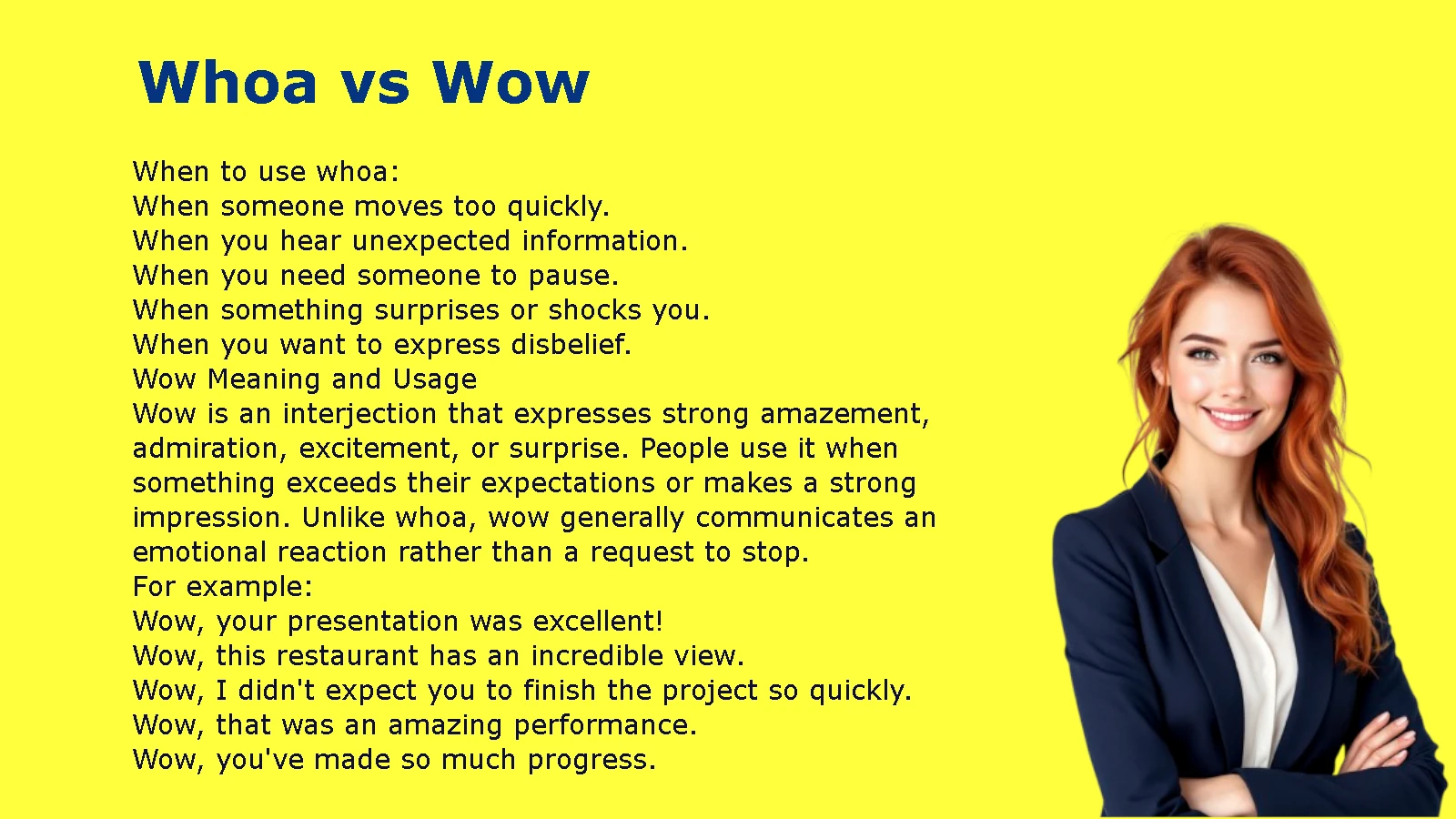
Whoa and wow are both correct English words, but they express different reactions. Whoa usually communicates surprise, hesitation, or a request to stop, while wow expresses amazement, excitement, or admiration. Although people sometimes confuse them with woah and woe, each spelling has a different role in English.
Understanding whoa vs wow also means knowing how to pronounce these expressions, when to use them, and why woe is me is different from whoa is me. The distinctions become easier when you look at their meanings, grammatical functions, and examples in everyday conversations.
| Question | Answer |
| What is the difference between whoa and wow? | Whoa expresses surprise or hesitation; wow expresses amazement or admiration. |
| Is it whoa or woah? | Whoa is the standard spelling. Woah is an informal variant. |
| How do you pronounce whoa? | Whoa is pronounced /woʊ/, with one syllable. |
| What does wow mean? | Wow expresses strong surprise, excitement, or admiration. |
| What does woe mean? | Woe is a noun meaning sorrow, distress, or misfortune. |
Whoa vs Wow: What’s the Difference?
Whoa and wow are interjections that express reactions, but they serve different conversational purposes. Wow communicates amazement, admiration, or excitement. For example, say “Whoa, slow down!” to request caution and “Wow, that’s impressive!” to express admiration.
The easiest way to remember the difference is to consider what you want another person to understand.
- Whoa: You want someone to pause, notice something surprising, or slow down.
- Wow: You want to show that something impresses, amazes, or excites you.
Both expressions appear in casual conversations, text messages, social media posts, and informal writing. However, replacing one with the other can change the meaning of a sentence.
Whoa Meaning and Usage
Whoa is an interjection that expresses surprise, disbelief, caution, or a request to stop. People use it when something unexpected happens or when they want another person to slow down. The expression can communicate excitement, concern, or astonishment depending on the situation.
For example:
- Whoa, that car came around the corner too fast!
- Whoa, I didn’t know you could play the guitar.
- Whoa, wait a minute. Let me understand what happened.
- Whoa, that’s a huge improvement.
- Whoa, be careful with that glass.
Notice that whoa does not always communicate happiness. Someone might say it after seeing an impressive performance, but they might also use it when witnessing a dangerous situation.
The word also has a practical connection to controlling horses. Traditionally, riders used whoa as a command to stop or slow a horse. Its modern conversational use developed around the same basic idea of stopping, pausing, or reacting to something that demands attention.
When to use whoa:
- When someone moves too quickly.
- When you hear unexpected information.
- When you need someone to pause.
- When something surprises or shocks you.
- When you want to express disbelief.
Wow Meaning and Usage
Wow is an interjection that expresses strong amazement, admiration, excitement, or surprise. People use it when something exceeds their expectations or makes a strong impression. Unlike whoa, wow generally communicates an emotional reaction rather than a request to stop.
For example:
- Wow, your presentation was excellent!
- Wow, this restaurant has an incredible view.
- Wow, I didn’t expect you to finish the project so quickly.
- Wow, that was an amazing performance.
- Wow, you’ve made so much progress.
People also use wow as a verb. In this form, it means to impress someone greatly.
For example:
- Her singing voice really wowed the audience.
- The new design wowed the customers.
- His presentation wowed everyone in the room.
In these sentences, wow describes the effect that someone or something has on other people.
When to use wow:
- When someone achieves something impressive.
- When you see something beautiful.
- When you receive exciting news.
- When a performance exceeds expectations.
- When you want to show admiration.
Whoa vs Wow Examples in Sentences
Comparing both words in similar situations helps you understand their differences more clearly.
| Whoa example | Wow example |
| Whoa, that car is moving too fast! | Wow, that’s an expensive car! |
| Whoa, I wasn’t expecting that news. | Wow, that’s wonderful news! |
| Whoa, hold on. What did you just say? | Wow, I can’t believe you said that! |
| Whoa, that’s a big change. | Wow, that’s an impressive transformation! |
| Whoa, be careful near the edge. | Wow, what a beautiful view! |
Consider this practical situation:
Imagine your friend shows you a photograph of a mountain they recently climbed.
You might say:
“Wow, that’s an incredible view!”
This reaction communicates admiration.
However, if your friend tells you they climbed the mountain during a dangerous storm, you might respond:
“Whoa, you did that during a storm?”
Here, whoa communicates surprise and disbelief.
The subject remains the same, but the emotional purpose changes.
Whoa or Woah: Which Spelling Is Correct?
Whoa is the standard spelling used in modern English. Woah is an informal spelling variant that appears in online conversations, text messages, and creative writing. Although readers generally understand both forms, whoa is the safer choice for schoolwork, professional communication, and edited content.
The confusion happens because English spelling does not always match the way people expect words to look or sound. Since both forms are associated with the same pronunciation, writers sometimes switch the letter order.
However, standard written English generally favors whoa.
Is Woah a Word or a Misspelling?
Woah is commonly used as an informal variant of whoa. You may encounter it in social media comments, song lyrics, text messages, and casual online discussions.
For example:
- Woah, that was unexpected!
- Woah, look at the size of that building!
- Woah, I didn’t see that coming.
Readers can usually understand the intended meaning. Still, whoa remains the conventional spelling in standard edited English.
The distinction matters when you write for different audiences.
| Writing situation | Recommended spelling |
| Academic assignments | Whoa |
| Professional emails | Whoa |
| Business articles | Whoa |
| Social media comments | Whoa or informal woah |
| Creative dialogue | Either, depending on style |
| Formal publications | Whoa |
If you are unsure which spelling to choose, use whoa. It communicates the intended meaning without creating unnecessary spelling questions.
Whoa vs Woah Examples
Here are examples showing how the two spellings appear in everyday writing.
Standard spelling:
- Whoa, that was a close call.
- Whoa, I never expected this.
- Whoa, you need to slow down.
Informal variant:
- Woah, that was a close call.
- Woah, I never expected this.
- Woah, you need to slow down.
The intended meaning remains the same. The difference concerns spelling convention rather than pronunciation or grammatical function.
For an educational website, spelling guide, or professional article, use whoa consistently. Mixing both forms without a clear stylistic reason can make your writing look inconsistent.
Why Do People Confuse Whoa and Woah?
Several factors explain why writers confuse these spellings.
Similar pronunciation: Both forms generally represent the same spoken expression. People often write what they think the word should look like based on its sound.
Informal communication: Social media and messaging platforms encourage quick writing. Users frequently adopt alternative spellings without considering formal conventions.
Visual expectations: Some writers expect the letters to appear in a different order because of familiar English spelling patterns.
Creative influence: Music, entertainment, and online culture expose readers to different spellings. Repeated exposure can make an informal variant look standard.
The practical rule is simple: choose whoa for standard writing and reserve woah for situations where an informal or stylistic spelling serves a purpose.
Whoa vs Wow Pronunciation: How Do You Say Them?
Wow and Whoa each have one syllable, but their vowel sounds differ. Whoa has the /oʊ/ sound, while wow has the /aʊ/ sound. The first word ends with a long, moving vowel similar to the sound in “go,” whereas the second has a vowel sound similar to “how.”
Although the words look and function similarly in some conversations, their pronunciation makes them easy to distinguish.
How to Pronounce Whoa
The standard pronunciation of whoa is /woʊ/.
It contains one syllable and begins with the consonant sound /w/. The vowel then moves toward the sound heard at the end of words such as go and show.
A few words with a similar vowel sound include:
- Go
- No
- Show
- Slow
- Snow
Try saying “Whoa, slow down!” aloud. The vowel sound should remain consistent with the pronunciation of the word.
Pronunciation tips:
- Start with the /w/ sound.
- Move naturally into the long vowel.
- Keep the word to one syllable.
- Avoid adding an extra syllable.
How to Pronounce Wow
The standard pronunciation of wow is /waʊ/.
Like whoa, wow contains one syllable and begins with /w/. However, its vowel changes toward the sound heard in words such as how, now, and cow.
Examples:
- Wow, that’s amazing!
- Wow, what a surprise!
- Wow, you did a fantastic job.
The vowel movement is the main difference between wow and whoa.
Whoa Meaning and Pronunciation Differences
The two expressions have different vowel sounds, even though they begin with the same consonant.
| Feature | Whoa | Wow |
| IPA | /woʊ/ | /waʊ/ |
| Syllables | One | One |
| Beginning sound | /w/ | /w/ |
| Vowel sound | As in go | As in how |
| Typical use | Surprise, caution, stopping | Amazement, admiration |
| Example | Whoa, wait! | Wow, amazing! |
A useful practice exercise is to say these sentences one after another:
- Whoa, that’s unexpected.
- Wow, that’s impressive.
Listen to the vowel in each expression. Once you recognize the difference, you will find it easier to use the correct word in spoken English.
What Does Whoa Mean in Different Contexts?
Whoa can communicate several reactions, including surprise, disbelief, caution, and a request to stop. Its exact meaning depends on the situation and the speaker’s tone. Someone might use it to react to unexpected information, interrupt a conversation, or warn another person about something dangerous.
Understanding context is especially important because whoa does not always express the same emotion.
Whoa as an Expression of Surprise
People commonly use whoa when something happens unexpectedly.
The reaction may involve excitement, shock, or disbelief. It can also introduce a comment about something unusual.
Examples:
- Whoa, I didn’t know you were moving abroad!
- Whoa, that concert was louder than I expected.
- Whoa, your new house looks completely different.
- Whoa, you finished the entire assignment already?
In each example, the speaker reacts to information or an event that catches their attention.
Practical context: Imagine your colleague announces that they have received a promotion. You might say, “Whoa, congratulations! I didn’t know that was happening.”
The expression introduces surprise, while the rest of the sentence communicates your response.
Whoa as a Command to Stop
Whoa can also function as a direct command.
This meaning has a historical connection to controlling horses. Riders traditionally used the expression to signal that an animal should stop or slow down.
Modern speakers use the same expression in everyday situations.
Examples:
- Whoa! Stop the car.
- Whoa, slow down before you turn.
- Whoa, don’t move that table yet.
- Whoa, wait until everyone is ready.
The command can be serious or playful.
For instance, a parent might say “Whoa, don’t run into the street!” to warn a child. A friend might say “Whoa, slow down!” when someone explains something too quickly.
Whoa as an Expression of Disbelief
Sometimes whoa communicates that a person finds something difficult to believe.
The speaker may not be asking anyone to stop physically. Instead, they want a moment to process what they have heard.
Examples:
- Whoa, you met the president?
- Whoa, they actually canceled the entire event?
- Whoa, that apartment costs that much?
- Whoa, I never imagined he would say that.
In these situations, the word acts as a verbal pause.
It gives the speaker time to react before continuing the conversation.
What Does Woe Mean?
Woe is a noun that means deep sorrow, distress, suffering, or misfortune. It describes an unpleasant situation or emotional hardship rather than an expression of surprise. For example, “The family experienced great woe after losing their home” uses woe to describe serious suffering.
Although woe sounds different from whoa and wow, people sometimes confuse the words because they appear in similar discussions about English vocabulary.
The distinction is straightforward:
- Whoa: An expression of surprise or a request to stop.
- Wow: An expression of amazement or admiration.
- Woe: A noun describing sorrow or misfortune.
Woe Meaning in Everyday English
Woe describes a condition of suffering, sadness, or hardship. It can refer to personal problems, financial difficulties, emotional pain, or unfortunate events.
For example:
- The family faced financial woe after the business closed.
- Her story described the woe of people affected by the disaster.
- He spoke openly about his personal woes.
- The sudden loss brought great woe to the community.
Unlike wow and whoa, woe is not an interjection in these sentences. It functions as a noun.
You will also encounter the plural form woes.
For example:
- Everyone experiences personal woes from time to time.
- The article discusses the financial woes of small businesses.
- She shared her worries and woes with her closest friend.
Woes refers to multiple difficulties or problems.
Woe in a Sentence: 10 Practical Examples
The following examples show how to use woe naturally in different situations.
| Sentence | Meaning |
| The family experienced great woe after the accident. | The family suffered deep sadness. |
| Financial woes forced the company to reduce its expenses. | Money problems affected the company. |
| She shared her personal woes with her sister. | She discussed her difficulties. |
| The villagers faced woe after the flood destroyed their homes. | The flood caused serious suffering. |
| His decision brought woe to everyone involved. | His decision caused distress. |
| The novel explores the woe of a lonely traveler. | The novel describes emotional suffering. |
| Their business woes continued throughout the year. | Their business problems persisted. |
| The loss filled the entire community with woe. | The community experienced deep sadness. |
| He wanted to forget his troubles and escape his woes. | He wanted relief from his problems. |
| The story describes the woe caused by greed and dishonesty. | The story discusses suffering resulting from harmful behavior. |
Writing tip: Woe often carries a stronger emotional tone than ordinary words such as problem or difficulty. Use it when the situation involves significant sadness, hardship, or misfortune.
Common Expressions That Use Woe
Several established English expressions use woe. Learning them helps you understand the word beyond its basic dictionary definition.
Woe is me
This expression communicates sadness, disappointment, or self-pity.
Example: “Woe is me! I have three assignments to finish before tomorrow.”
The speaker uses dramatic language to complain about an unpleasant situation.
Woe betide
This expression warns that someone will face trouble or unpleasant consequences.
Example: “Woe betide anyone who damages the equipment.”
It often appears in formal, humorous, or dramatic writing.
Financial woes
This phrase describes money-related problems.
Example: “The company struggled to overcome its financial woes.”
Personal woes
This expression refers to an individual’s emotional or personal difficulties.
Example: “She decided to keep her personal woes private.”
Woes and worries
This phrase groups together problems, concerns, and sources of stress.
Example: “He needed a break from his daily woes and worries.”
What Does “Woe Is Me” Mean?
“Woe is me” is an established English expression that communicates sadness, disappointment, or self-pity. A person uses it when describing an unfortunate situation, sometimes with an exaggerated or humorous tone.
For example:
- Woe is me! I forgot my wallet at home.
- Woe is me! The weekend ended too quickly.
- Woe is me! I have another long meeting tomorrow.
The expression has a somewhat old-fashioned or dramatic style. People often use it humorously rather than to describe serious suffering.
Remember: The correct expression is “woe is me,” not “whoa is me.”
The distinction comes from meaning:
- Woe describes sorrow or misfortune.
- Whoa expresses surprise or signals a pause.
Can You Use Woe as a Verb? Understanding “To Woe Someone”
Woe is primarily a noun in modern English, not a standard verb meaning to make someone sad. Therefore, “to woe someone” is generally not the correct expression when you want to describe causing distress. Use phrases such as “cause someone sorrow,” “bring someone hardship,” or “make someone miserable” instead.
This distinction matters because some English words have related noun and verb forms, but woe does not normally follow that pattern in everyday usage.
For example:
Incorrect or unnatural: “The decision will woe the employees.”
Better: “The decision will cause distress among the employees.”
The second sentence communicates the intended meaning clearly.
Correct Alternatives to “To Woe Someone”
Choose an alternative based on the type of suffering or difficulty you want to describe.
| Alternative | Meaning | Example |
| Cause someone distress | Create emotional discomfort | The argument caused her considerable distress. |
| Bring someone sorrow | Make someone deeply sad | The unexpected loss brought the family sorrow. |
| Make someone miserable | Cause unhappiness | Constant criticism made him miserable. |
| Cause someone hardship | Create difficult circumstances | The economic crisis caused families hardship. |
| Bring someone grief | Cause emotional pain | The incident brought the community great grief. |
| Trouble someone | Create concern or difficulty | The unresolved issue continued to trouble her. |
These expressions are more natural than trying to use woe as a verb.
Woe vs Woo: Two Different Words
Woo and Woe look similar, but they have different meanings and grammatical functions.
Woe is a noun that describes sorrow, distress, or misfortune.
Woo is a verb that means to seek someone’s affection, attention, support, or approval.
Examples of woe:
- The family experienced great woe.
- His financial woes continued for months.
- The disaster brought woe to the entire region.
Examples of woo:
- He tried to woo her with thoughtful gifts.
- The company launched a campaign to woo new customers.
- The candidate worked hard to woo undecided voters.
Notice how the words communicate completely different ideas.
A person might woo someone romantically, but they would experience woe during a period of suffering.
Whoa, Wow, Woah, and Woe: Key Differences at a Glance
These four spellings are easy to confuse because they appear in discussions about surprise, emotion, and pronunciation. However, they do not all serve the same grammatical purpose. Whoa and wow are interjections, woah is an informal spelling variant of whoa, and woe is a noun describing sorrow or misfortune.
The comparison below provides a quick reference.
| Word | Part of speech | Main meaning | Example |
| Whoa | Interjection | Surprise, hesitation, or stopping | Whoa, wait a minute! |
| Wow | Interjection, verb | Amazement or admiration | Wow, that’s incredible! |
| Woah | Informal spelling variant | Usually intended as whoa | Woah, that’s unexpected! |
| Woe | Noun | Sorrow, distress, or misfortune | He faced financial woes. |
Which Word Should You Use?
The correct choice depends on the message you want to communicate.
Use whoa when:
- You want someone to stop or slow down.
- Something catches you off guard.
- You need a moment to process unexpected information.
Use wow when:
- Something impresses you.
- You feel admiration or excitement.
- You want to express amazement.
woah when:
- You are intentionally using an informal spelling in casual writing.
- The context allows a nonstandard variant.
Use woe when:
- You describe sadness or suffering.
- You discuss personal or financial difficulties.
- You use established expressions such as “woe is me.”
A quick memory trick can help:
- Whoa = Hold on!
- Wow = Amazing!
- Woe = Sorrow!
Common Mistakes When Using Whoa, Wow, and Woe
Writers sometimes confuse these words because they look or sound similar. However, the main mistakes usually involve incorrect spelling, misunderstood expressions, or choosing a word that does not fit the sentence.
Knowing the differences helps you avoid awkward wording.
Whow vs Wow: Which Is Correct?
Wow is the correct spelling when expressing amazement, admiration, or surprise. Whow is not the standard spelling of this interjection. If you want to react to something impressive, write wow rather than whow.
Incorrect: Whow, that’s a beautiful house!
Correct: Wow, that’s a beautiful house!
Incorrect: Whow, you finished the project!
Correct: Wow, you finished the project!
The confusion may occur when people type quickly or try to represent a spoken expression using an unfamiliar spelling.
However, whow should not replace wow in standard English.
Quick rule: Use wow when you want to express amazement.
Whoas Me vs Woe Is Me
“Whoas me” is not a standard English expression. The established phrase is “woe is me,” which communicates sadness, disappointment, or self-pity.
Compare the following:
| Incorrect or nonstandard | Correct expression |
| Whoas me! | Woe is me! |
| Whoa is me! | Woe is me! |
| Whoas are my problems. | My woes are difficult to manage. |
Examples:
- Woe is me! I lost my favorite book.
- Woe is me! I have so much work to finish.
- He often complains about his personal woes.
The phrase uses woe because the speaker expresses unhappiness rather than surprise.
Confusing Whoa With Woe
Whoa and woe may look similar, but they have completely different meanings.
Whoa is an interjection. Woe is a noun.
Consider these examples:
- Whoa, that was a terrible accident!
- The accident brought great woe to the family.
The first sentence expresses an immediate reaction. The second describes the suffering caused by an event.
Another comparison:
- Whoa, I can’t believe the company closed.
- The company’s closure caused financial woe.
The distinction becomes clear when you identify the grammatical role of each word.
Using Wow When You Mean Whoa
Another common mistake involves using wow when the intended reaction is actually whoa.
For example:
“Wow, stop the car!”
This sentence can sound like an expression of amazement followed by a command. It does not communicate the same immediate reaction as:
“Whoa, stop the car!”
The second version makes the speaker’s intention clearer.
Compare these situations:
| Situation | Better expression | Reason |
| Someone is driving too quickly | Whoa! | Signals caution or stopping. |
| Someone shows you an impressive painting | Wow! | Communicates admiration. |
| Someone shares shocking news | Whoa! | Expresses disbelief. |
| Someone wins an important award | Wow! | Expresses excitement and admiration. |
| Someone makes an unexpected announcement | Either, depending on reaction | Both can express surprise, but with different emphasis. |
The important point is not that these words can never overlap. Both can express surprise. Their difference lies in the type of reaction they emphasize.
Conclusion: Whoa vs Wow vs Woe
Understanding whoa vs wow comes down to recognizing the purpose of each expression. Whoa communicates surprise, hesitation, disbelief, or a request to stop. Wow expresses amazement, admiration, and excitement. Although woah appears in informal writing, whoa remains the standard spelling.
Woe has a completely different meaning. It is a noun that describes sorrow, suffering, or misfortune, as in the familiar expression “woe is me.”
Remember these simple distinctions:
- Whoa: Use it to express surprise or tell someone to pause.
- Wow: Use it to communicate amazement or admiration.
- Woah: An informal spelling variant of whoa.
- Woe: Use it when describing sadness or hardship.
When writing, choose the expression that matches your intended meaning rather than relying on how similar the words look.
Want to improve your English spelling and vocabulary? Explore more commonly confused words and spelling comparisons to learn how small differences can change the meaning of a sentence.













