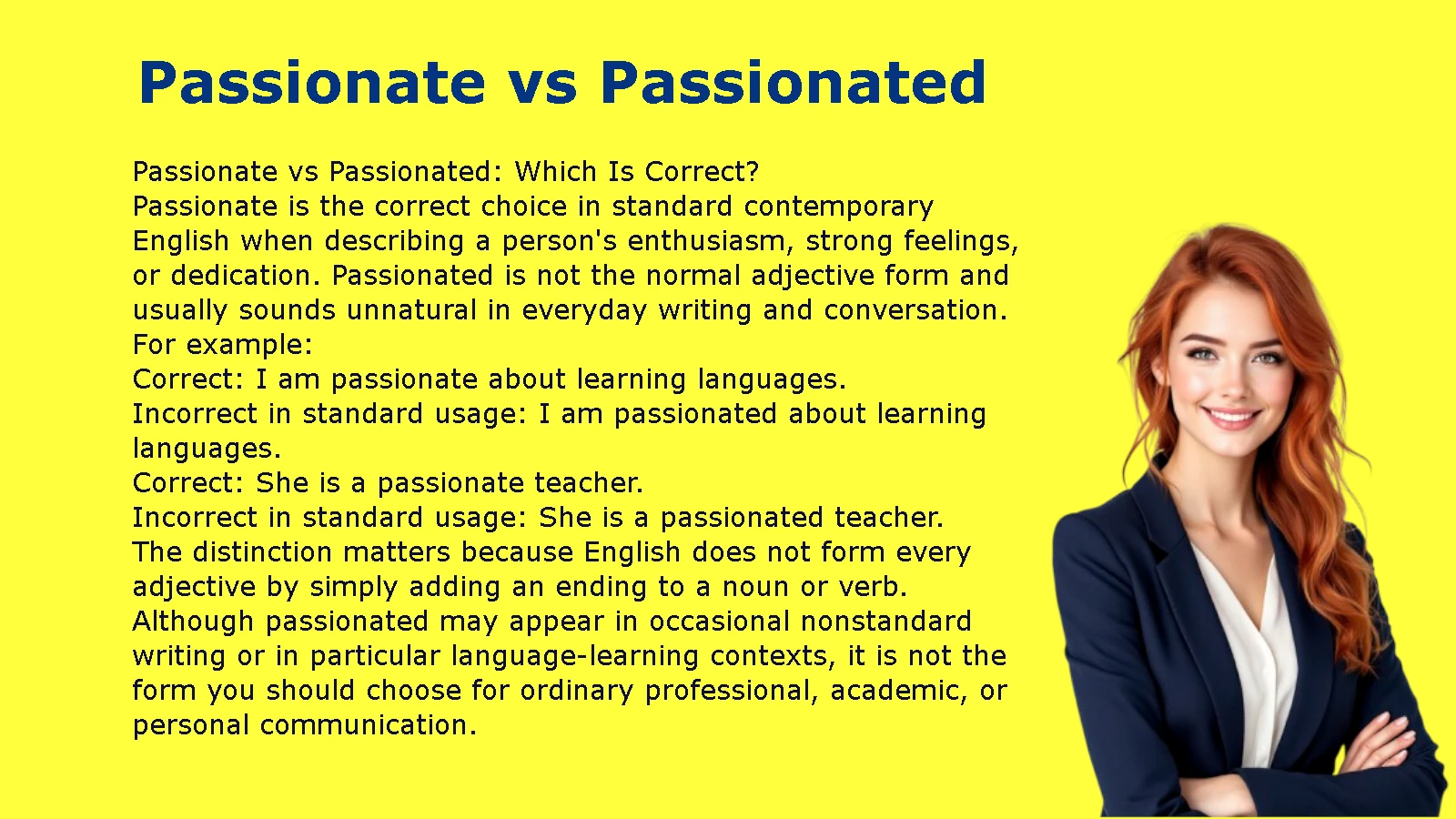
Passionate vs Passionated: Passionate is the correct standard English adjective for describing someone who has strong enthusiasm, interest, dedication, or feelings about something. Passionated is generally considered nonstandard in modern everyday English, so you should write “I am passionate about teaching,” not “I am passionated about teaching.”
Understanding the difference between passionate and passionated helps you avoid common spelling and grammar mistakes. It also helps you use passion, passionate, and passionately correctly in sentences. Whether you’re writing a professional bio, describing a hobby, expressing your feelings, or preparing an essay, choosing the right word makes your message clearer and more natural.
Quick Answer: Passionate vs Passionated
| Question | Answer |
| Is it passionate or passionated? | Passionate is the standard adjective. |
| Is “I am passionated” correct? | Use “I am passionate” in standard English. |
| What does passionate mean? | Having or showing strong enthusiasm, interest, commitment, or emotion. |
| What is the difference between passion and passionate? | Passion is a noun; passionate is an adjective. |
| How do you use passionate in a sentence? | “She is passionate about helping others.” |
Passionate vs Passionated: Which Is Correct?
Passionate is the correct choice in standard contemporary English when describing a person’s enthusiasm, strong feelings, or dedication. Passionated is not the normal adjective form and usually sounds unnatural in everyday writing and conversation.
For example:
- Correct: I am passionate about learning languages.
- Incorrect in standard usage: I am passionated about learning languages.
- Correct: She is a passionate teacher.
- Incorrect in standard usage: She is a passionated teacher.
The distinction matters because English does not form every adjective by simply adding an ending to a noun or verb.
Although passionated may appear in occasional nonstandard writing or in particular language-learning contexts, it is not the form you should choose for ordinary professional, academic, or personal communication.
Passionate or Passionated: The Correct Spelling
The standard spelling is passionate.
The word describes someone or something that expresses or involves passion. You can use it to discuss interests, hobbies, careers, relationships, beliefs, and emotional expressions.
Examples:
- Maria is passionate about photography.
- Our coach is passionate about helping young athletes.
- He delivered a passionate speech about education.
- They are passionate supporters of the local team.
Notice that passionate remains the same regardless of whether the subject is singular or plural.
- She is passionate about science.
- They are passionate about science.
You don’t need to change passionate to passionates or passionated to agree with the subject.
I Am Passionated or Passionate: Which Should You Say?
Use “I am passionate” when you want to describe your strong interest, enthusiasm, or commitment.
The word am is a form of the linking verb be. It connects the subject I with the adjective passionate.
Examples:
- I am passionate about writing.
- I am passionate about my career.
- I am passionate about helping children.
- I am passionate about improving my skills.
- I am passionate about environmental protection.
Avoid constructions such as:
- I am passionated about fitness.
- I feel passionated for music.
- She seems passionated about her work.
Instead, write:
- I am passionate about fitness.
- I feel passionate about music.
- She seems passionate about her work.
Practical writing tip: If you’re writing a résumé, cover letter, professional biography, or personal statement, use a specific example to support your claim.
Instead of writing:
“I am passionate about marketing.”
You could write:
“I am passionate about marketing, especially creating campaigns that help small businesses reach new customers.”
The second sentence communicates the interest more clearly.
Why Do People Say Passionated?
People may use passionated because it seems to follow familiar English word-building patterns.
English contains many adjectives ending in -ed, including:
- Interested
- Excited
- Dedicated
- Motivated
- Talented
Because these words often describe feelings or personal qualities, someone learning English might assume that passionated works in the same way.
However, familiar patterns don’t always produce standard words.
The established adjective is passionate, which developed from passion. English uses it directly without adding -ed.
Compare these expressions:
| Nonstandard or unnatural | Standard expression |
| I am passionated about music. | I am passionate about music. |
| She is passionated about teaching. | She is passionate about teaching. |
| He feels passionated for sports. | He feels passionate about sports. |
A useful rule is to learn the natural adjective form of each word rather than creating one based on another adjective.
Passionate Meaning and Examples
Passionate means having or showing strong enthusiasm, interest, commitment, or emotion toward someone or something. It can describe a person, a belief, an activity, a relationship, or an emotional expression. The exact meaning depends on context, but the word usually suggests more intensity than ordinary interest.
What Does Passionate Mean?
A passionate person cares deeply about something. That interest may motivate them to spend time, develop skills, support a cause, or express strong feelings.
For example, someone who enjoys cooking occasionally might say:
“I like cooking.”
Someone with a deeper interest might say:
“I am passionate about cooking because I love experimenting with flavors and creating meals for people.”
Both sentences are correct. However, passionate communicates a stronger emotional connection.
The word can describe several kinds of feelings.
| Meaning | Explanation | Example |
| Enthusiasm | Strong enjoyment of an activity | She is passionate about dancing. |
| Dedication | Deep commitment to a goal | He is passionate about education. |
| Conviction | Strong belief in an idea | They are passionate about equal opportunities. |
| Emotional intensity | Strongly expressed feelings | She gave a passionate response. |
| Romantic feeling | Strong affection or desire | They shared a passionate kiss. |
Important distinction: Passionate doesn’t automatically mean skilled, successful, or knowledgeable.
A person can be passionate about painting without being an experienced artist. Likewise, an expert can perform excellent work without describing that work as a personal passion.
Passionate Person Meaning
A passionate person is someone who feels strongly about an interest, goal, belief, activity, or relationship.
People often use this expression to describe individuals who show enthusiasm, commitment, curiosity, and emotional investment.
For example:
- A passionate teacher enjoys helping students understand difficult concepts.
- A passionate musician spends time practicing and exploring new sounds.
- A passionate volunteer cares deeply about supporting a community.
- A passionate entrepreneur feels strongly about solving a particular problem.
However, passion looks different from one person to another.
One person might express it through energetic conversations. Another might show it through quiet persistence, careful research, or consistent effort.
You shouldn’t assume that every passionate person is naturally outspoken or highly emotional.
Passion is often easier to understand through actions than labels. Someone who consistently works toward a meaningful goal may demonstrate commitment more convincingly than someone who simply describes themselves as passionate.
Passionate Meaning in Life
When people discuss being passionate in life, they usually mean having meaningful interests, goals, activities, or relationships that give them a sense of purpose or fulfillment.
A passion can involve:
- Building a career around an interesting subject.
- Learning a musical instrument.
- Helping people through volunteer work.
- Exploring science, technology, or history.
- Supporting a cause that reflects personal values.
- Spending meaningful time with family and friends.
For example:
“She’s passionate about making education more accessible.”
This sentence suggests that education matters deeply to her and may influence her decisions or actions.
Another example:
“I’m passionate about learning new things.”
This expresses a broad interest in personal growth rather than one specific career or hobby.
It’s also worth remembering that people don’t need one lifelong passion to live meaningful lives.
Interests can change with experience, circumstances, and personal priorities. Someone who once felt passionate about competitive sports may later discover a deeper interest in teaching, business, or creative work.
Passion can provide direction, but it isn’t the only source of a meaningful life.
Passionate Connotation Meaning
The connotation of passionate is the feeling or impression that the word creates beyond its basic definition.
The word often has a positive connotation because it suggests enthusiasm, commitment, sincerity, or strong motivation. However, it can also suggest emotional intensity that may feel overwhelming or confrontational.
Consider these examples:
Positive connotation:
“She is a passionate advocate for children’s education.”
Here, passionate suggests dedication and a sincere commitment to a cause.
Neutral or descriptive connotation:
“The two researchers had a passionate debate.”
This describes a discussion involving strong feelings or convictions. It doesn’t necessarily tell us whether the debate was constructive or hostile.
Potentially negative connotation:
“He became so passionate during the argument that he stopped listening.”
In this sentence, the intensity becomes a problem.
The word itself isn’t automatically negative. The surrounding sentence determines whether the intensity seems admirable, neutral, or excessive.
This distinction is useful when writing professional content. For example, describing someone as a passionate leader generally sounds positive, while describing a decision as passionate rather than evidence-based may imply that emotion outweighed analysis.
Passion and Passionate: What’s the Difference?
Passion is a noun that describes a strong feeling, interest, enthusiasm, or commitment. Passionate is an adjective that describes a person, thing, or expression connected with that feeling. Use passion to name the interest and passionate to describe it or the person experiencing it.
Passion vs. Passionate: Grammar and Meaning
The simplest way to understand the difference is to examine how each word functions in a sentence.
Passion names something.
Examples:
- Music is her passion.
- His passion for science began in childhood.
- Teaching has always been a passion of mine.
- Their passion for the project inspired the team.
Passionate describes someone or something.
Examples:
- She is passionate about music.
- He is a passionate science teacher.
- I’m passionate about teaching.
- Their passionate commitment inspired the team.
Compare these two sentences:
“Photography is his passion.”
“ He is passionate about photography.”
The first sentence identifies photography as his strong interest. The second describes his feelings toward photography.
Both communicate a similar idea, but their grammar differs.
Passion, Passionate, and Passionately
These three related words have different grammatical functions.
| Word | Part of speech | Meaning | Example |
| Passion | Noun | A strong interest or feeling | Reading is her passion. |
| Passionate | Adjective | Showing strong interest or feeling | She is passionate about reading. |
| Passionately | Adverb | In a way that shows strong feeling | She spoke passionately about reading. |
Use each form according to the role it plays in your sentence.
For example:
“His passion for wildlife inspires his work.”
“His passionate interest in wildlife inspires his work.”
“He speaks passionately about wildlife conservation.”
These sentences share a topic, but each word performs a different grammatical job.
Passionate Adjective: How to Use It
Passionate is an adjective. It describes nouns and can appear after linking verbs such as be, seem, become, and feel.
You can use it before a noun:
- A passionate teacher
- A passionate writer
- A passionate supporter
- A passionate discussion
- A passionate response
You can also use it after a linking verb:
- She is passionate about design.
- He seems passionate about the project.
- They became passionate supporters of the organization.
- I feel passionate about this issue.
The adjective doesn’t require a noun immediately after it.
For example, “She is passionate about science” is complete because the phrase describes her interest.
A common mistake is treating passionate as an adverb.
Incorrect: “He argued passionate.”
Correct: “He argued passionately.”
However, you can say:
“He made a passionate argument.”
Here, passionate modifies the noun argument.
How to Use Passionate Correctly in a Sentence
Use passionate before a noun or after a linking verb to describe strong enthusiasm, commitment, or emotion. The most common pattern is passionate about + noun or -ing verb. For example, “I am passionate about helping people” is natural and grammatically correct.
Passionate About: The Most Common Sentence Pattern
The expression passionate about is the safest and most natural choice when discussing interests, hobbies, careers, beliefs, or causes.
The basic structure is:
Subject + linking verb + passionate about + noun or gerund.
Examples:
- I am passionate about education.
- She is passionate about painting.
- We are passionate about customer service.
- He is passionate about improving healthcare.
- They are passionate about protecting wildlife.
When you use an action after about, the verb usually takes the -ing form.
Correct:
- I’m passionate about helping people.
- She’s passionate about teaching children.
- He’s passionate about learning Spanish.
- They are passionate about developing useful software.
Incorrect:
- I’m passionate about help people.
- She’s passionate about teach children.
- He’s passionate about to learn Spanish.
Compare:
“I am passionate about writing.”
“I have a passion for writing.”
Both sentences are correct. The first uses an adjective, while the second uses a noun.
Passionate For, Passionate In, and Passionate On
The preposition following passionate can affect how natural a sentence sounds.
Although some constructions are possible in specific contexts, passionate about is generally the best choice for ordinary interests and activities.
Passionate about
Use this for interests, hobbies, professions, causes, and subjects.
Examples:
- She is passionate about literature.
- He is passionate about his career.
- We are passionate about helping local businesses.
Passionate for
This construction can occur in certain styles and contexts, but it is often less natural than passionate about when describing interests.
For many sentences, use passionate about or change the structure to have a passion for.
Less natural for many readers:
“She is passionate for photography.”
More natural:
“She is passionate about photography.”
Also natural:
“She has a passion for photography.”
The phrase passion for is especially common.
Passionate in
This construction may work when the phrase identifies an area or context of expression, but it isn’t the standard default for describing an interest.
For example:
“She was passionate in her defense of the proposal.”
This is possible, although “She passionately defended the proposal” may sound more direct.
Avoid using passionate in automatically whenever you want to describe a hobby.
Passionate on
The phrase passionate on is usually unnatural when you want to name an interest.
Instead of:
“He is passionate on technology.”
Write:
“He is passionate about technology.”
However, on can appear naturally in a related sentence:
“She delivered a passionate speech on technology.”
Here, on technology describes the topic of the speech. It doesn’t function as the usual complement of passionate.
This is an important distinction because the correct preposition depends on the entire sentence, not just the topic.
Passionate in a Sentence: Everyday Examples
These examples show how to use passionate naturally in different situations.
Work and careers
- I’m passionate about creating helpful content for readers.
- Our manager is passionate about developing talented employees.
- She is a passionate advocate for accessible education.
- He is passionate about building better customer experiences.
Education and learning
- My sister is passionate about learning languages.
- The teacher is passionate about helping students succeed.
- They are passionate about scientific research.
Hobbies and creativity
- Daniel is passionate about photography.
- She’s a passionate reader who enjoys historical novels.
- I’m passionate about writing original stories.
Sports and fitness
- Our coach is passionate about youth development.
- He is passionate about running long distances.
- They are passionate supporters of their favorite team.
Relationships and emotions
- She spoke passionately about her family.
- They shared a passionate kiss.
- He is passionate about building a healthy relationship.
Community and social causes
- Volunteers are passionate about protecting animals.
- She is passionate about improving public libraries.
- The organization has a passionate team of supporters.
Each example uses the adjective or a related form according to the intended meaning.
Passionately Sentences: How to Use Passionately
Passionately is an adverb. It describes how someone performs an action, especially when that action involves strong feelings, enthusiasm, or conviction.
Examples:
- She passionately defended her research.
- He spoke passionately about climate action.
- The students passionately supported the proposal.
- They passionately debated the future of education.
- Maria passionately described her new business idea.
- The audience passionately cheered for the performers.
The word often modifies verbs such as:
- Speak
- Argue
- Defend
- Support
- Believe
- Describe
- Debate
Compare these constructions:
| Adjective | Adverb |
| She is passionate about art. | She speaks passionately about art. |
| He is a passionate supporter. | He passionately supports the cause. |
| They gave a passionate speech. | They spoke passionately. |
A useful editing trick is to ask what the word describes.
If it describes a noun, use passionate.
If it describes how someone performs an action, passionately may be the correct choice.
Passionate Pronunciation and Word Forms
Passionate is commonly pronounced /ˈpæʃənət/ in standard English. It has three syllables, with stress on the first syllable. Its related forms include passion, passionate, and passionately, which serve different grammatical functions in everyday communication.
How to Pronounce Passionate
The IPA pronunciation is:
/ˈpæʃənət/
A simple learner-friendly guide is:
PASH-uh-nuht
The first syllable receives the main stress.
To pronounce the word naturally:
- Start with the sound in pan.
- Move into the sh sound.
- Keep the middle vowel relatively weak.
- Finish with a light ending.
The exact vowel quality may vary slightly by accent.
One common pronunciation mistake is giving every syllable equal emphasis. In natural speech, the first syllable carries the strongest stress.
Practice with these sentences:
- I am passionate about reading.
- She’s a passionate teacher.
- They passionately support the cause.
Listening to the word in context can help you recognize its rhythm and stress.
Passionate Word Forms
The main related forms include:
| Word | Word type | Example |
| Passion | Noun | Writing is my passion. |
| Passionate | Adjective | I am passionate about writing. |
| Passionately | Adverb | She writes passionately about her experiences. |
You may also encounter these expressions:
- Passion for: A strong interest in something.
- Passionate about: Having strong interest or feelings toward something.
- Passionately: Acting with strong emotion or conviction.
Remember that passionated is not the normal standard form of the adjective.
Common Mistakes to Avoid When Using Passionate
The most common mistakes involve using passionated instead of passionate, choosing an unnatural preposition, or confusing passion with passionate. You can avoid these errors by checking the part of speech and using familiar patterns, especially passionate about for interests and activities.
Passionated About vs. Passionate About
This is one of the most important corrections to remember.
Incorrect in standard usage:
“I am passionated about digital marketing.”
Correct:
“I am passionate about digital marketing.”
Incorrect in standard usage:
“She is passionated about helping students.”
Correct:
“She is passionate about helping students.”
The same correction applies in professional writing.
Before:
“We are passionated about providing excellent service.”
After:
“We are passionate about providing excellent service.”
The corrected sentence sounds natural and communicates the intended meaning without unnecessary wording.
Proofreading tip: Search your document for passionated. If you intended to describe enthusiasm, dedication, or strong feelings, replace it with passionate.
Passionate vs. Passionately
These words are related, but they don’t serve the same grammatical role.
Use passionate to describe a person, thing, or expression.
Use passionately to describe an action.
Incorrect:
“She spoke passionate about her research.”
Correct:
“She spoke passionately about her research.”
Also correct:
“She was passionate about her research.”
Another example:
Incorrect: “He is passionately about music.”
Correct: “He is passionate about music.”
The distinction becomes easier when you examine the sentence structure.
- A passionate person
- A passionate argument
- Speak passionately
- Argue passionately
Passionate vs. Passionate: Why This Comparison Is Redundant
The phrases passionate vs. passionate and passionate or passionate contain the same word on both sides.
They don’t create a meaningful spelling comparison unless the writer intended different words or meanings.
For example, these are genuine comparisons:
- Passionate vs Passionated
- Passion vs. passionate
- Passionate vs. passionately
If you encounter passionate vs. passionate in a search query, the intended question may concern a typo, a repeated word, or a comparison that wasn’t entered correctly.
For spelling and grammar purposes, the useful comparison is Passionate vs Passionated.
Practical Examples: Choosing Passionate in Real Writing
Knowing a definition is helpful, but choosing the right wording in context makes the rule easier to apply.
Consider these three writing situations.
Example: Writing a Résumé or Professional Bio
Suppose you’re applying for a content writing position.
Weak:
“I am passionate about writing.”
This sentence is grammatically correct, but it doesn’t explain what makes your interest relevant.
Stronger:
“I am passionate about creating clear, useful content that helps readers solve problems and make informed decisions.”
The second version connects your interest to a practical skill and professional purpose.
When describing yourself professionally, avoid stacking too many claims such as passionate, motivated, dedicated, and hardworking without evidence.
One clear example can communicate more than several adjectives.
Example: Writing About a Hobby
Suppose you enjoy photography.
You could write:
“Photography is my passion.”
Or:
“I am passionate about photography.”
Or:
“I photograph local landscapes because I’m passionate about capturing changing light and natural details.”
Each sentence is correct, but the last version provides more context.
This illustrates a useful principle: the best word choice depends on what you want the reader to understand.
Example: Describing a Strong Opinion
Imagine someone discussing public transportation.
Sentence A:
“She has a passion for public transportation.”
Sentence B:
“She is passionate about public transportation.”
Sentence C:
“She passionately argued for better public transportation.”
All three sentences are grammatically correct.
However:
- Sentence A emphasizes her interest.
- Sentence B describes her feelings or commitment.
- Sentence C emphasizes the manner in which she argued.
Choosing among them helps you control emphasis and tone.
Frequently Asked Questions
Is It Passionate or Passionated?
Passionate is the standard English adjective. Use it to describe someone who feels strong enthusiasm, dedication, interest, or emotion. Passionated is generally nonstandard in everyday English.
Example: “She is passionate about teaching.”
Is It Correct to Say I Am Passionated?
In standard contemporary English, use “I am passionate.” The construction I am passionated is generally considered nonstandard.
Correct example: “I am passionate about improving my communication skills.”
What Does Passionate Mean in Simple Words?
Passionate means caring deeply about something or feeling strong enthusiasm for it.
For example, a passionate reader enjoys books deeply and may spend a lot of time reading or discussing them.
What Is the Difference Between Passion and Passionate?
Passion is a noun, while passionate is an adjective.
- Passion: “Cooking is her passion.”
- Passionate: “She is passionate about cooking.”
The noun names the interest or feeling, while the adjective describes it or the person experiencing it.
Can You Say Passionate On Something?
Usually, passionate about something is the natural expression when describing an interest.
Write:
“He is passionate about technology.”
However, on can work in phrases such as “a passionate speech on technology,” where it identifies the speech’s subject.
Is Passionate a Positive or Negative Word?
Passionate usually has a positive connotation because it suggests enthusiasm, commitment, or strong interest. However, it can also describe intense emotions during disagreements, debates, or arguments. Context determines the impression.
Is Passionate an Adjective?
Yes. Passionate is an adjective that describes people, actions, expressions, or things associated with strong feelings or enthusiasm.
Example: “She is a passionate artist.”
How Do You Use Passionately in a Sentence?
Use passionately as an adverb to describe how someone performs an action.
Example: “He passionately explained why education matters.”
The adjective version would be: “He is passionate about education.”
Conclusion: Choose Passionate, Not Passionated
When deciding between Passionate vs Passionated, choose passionate for standard English writing and conversation.
Use passionate to describe enthusiasm, dedication, strong interests, and emotional intensity. Choose passion when you need a noun and passionately when you want to describe how someone performs an action.
Keep these practical rules in mind:
- Write passionate about when describing an interest or cause.
- Use passion for when the noun construction sounds more natural.
- Choose passionately when modifying an action.
- Avoid passionated in ordinary standard English.
- Support descriptions of passion with specific examples whenever possible.













