Hogtied meaning refers to being tied or restrained so that movement becomes difficult or impossible. In slang, hogtied can also describe someone who feels trapped, restricted, powerless, or unable to make decisions freely. The word functions as the past tense and past participle of hogtie, and it can also work as an adjective.
The expression has both literal and figurative uses. You may encounter it in conversations about physical restraint, workplace restrictions, relationships, rules, or situations where someone has very little freedom. Understanding its pronunciation, Hindi and Kannada translations, synonyms, and grammatical forms makes it easier to recognize and use correctly.
| Question | Answer |
| What does hogtied mean? | Tied or restrained so movement becomes difficult or impossible. |
| What does hogtied mean in slang? | Feeling trapped, restricted, or unable to act freely. |
| How do you pronounce hogtied? | HOG-tide (/ˈhɔːɡ.taɪd/). |
| What is hogtied meaning in Hindi? | बंधा हुआ or जकड़ा हुआ, depending on context. |
| What is hogtied meaning in Kannada? | ಬಿಗಿಯಾಗಿ ಕಟ್ಟಲ್ಪಟ್ಟ or ನಿರ್ಬಂಧಿತ, depending on context. |
What Does Hogtied Mean?
Hogtied means securely tied or restrained, traditionally referring to a method of tying an animal’s legs together. In everyday English, the word can also describe a person who feels restricted by circumstances, rules, responsibilities, or limitations. Its figurative meaning focuses on a lack of freedom, movement, or control.
The word comes from hogtie, a verb associated with restraining an animal. Over time, English speakers extended its meaning to situations where someone cannot act independently.
For example:
- Literal: The farmer found the animal hogtied.
- Figurative: Strict company policies left the employees hogtied.
- Conversational: I’m hogtied by all these deadlines.
These examples show why context matters. The first sentence describes physical restraint, while the other two describe limitations on someone’s choices or actions.
Hogtied Meaning in Simple English
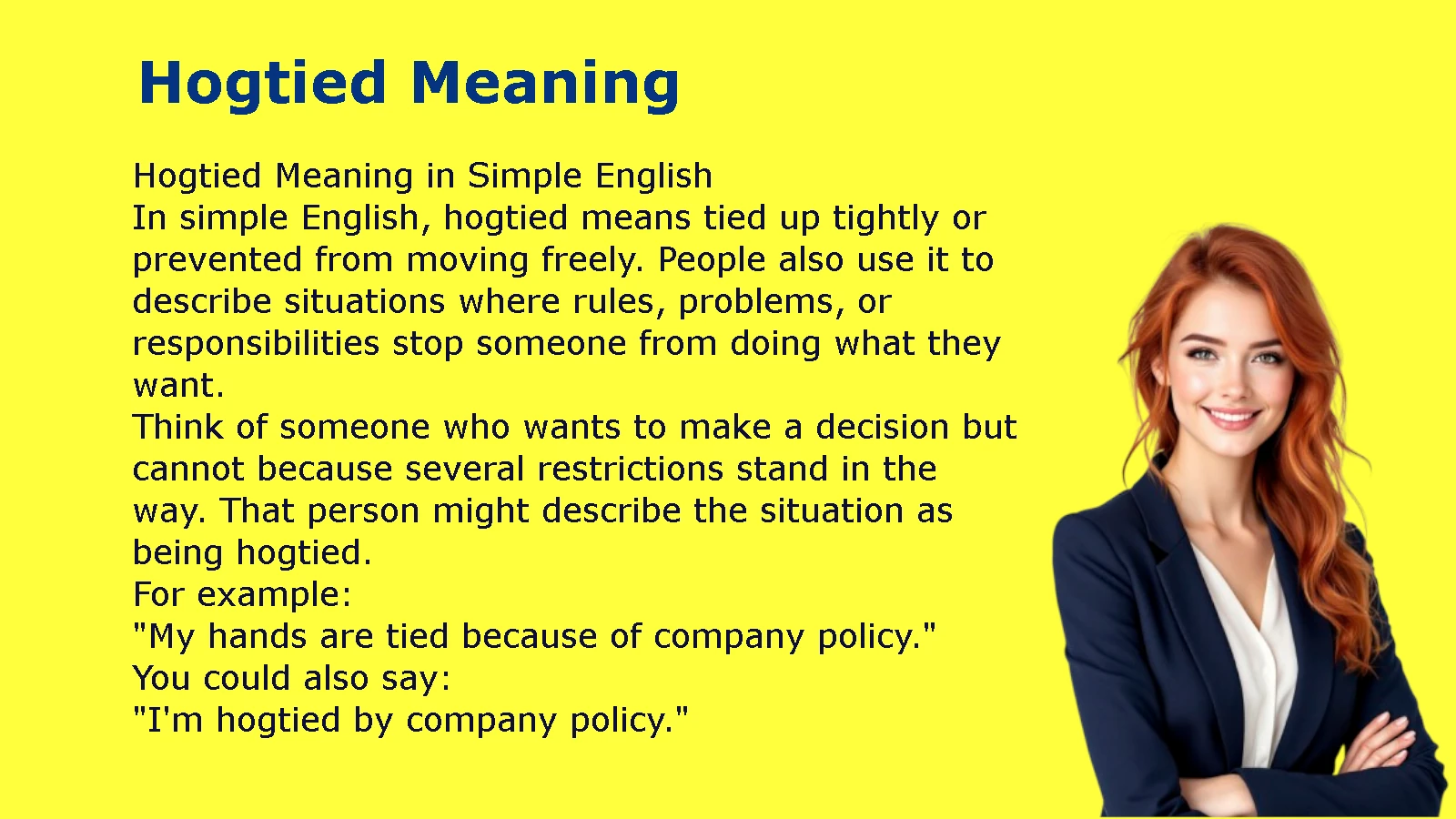
In simple English, hogtied means tied up tightly or prevented from moving freely. People also use it to describe situations where rules, problems, or responsibilities stop someone from doing what they want.
Think of someone who wants to make a decision but cannot because several restrictions stand in the way. That person might describe the situation as being hogtied.
For example:
“My hands are tied because of company policy.”
You could also say:
“I’m hogtied by company policy.”
Both sentences communicate that the speaker lacks the freedom to act.
Literal Meaning of Hogtied
The literal meaning of hogtied relates to physical restraint. Traditionally, hog-tying refers to securing an animal’s legs together to limit its movement.
The term has a connection to livestock handling, particularly the handling of pigs. However, its modern usage extends beyond farming.
Consider these contexts:
- Agriculture: A livestock-related discussion may use hogtie to describe an animal-restraint method.
- Fiction: A novel might describe a character as hogtied to communicate that the character cannot move.
- News and reporting: The word may appear in descriptions of alleged physical restraint.
- Everyday speech: Someone may use it figuratively to describe a frustrating limitation.
The literal meaning is more specific than simply being tied. It suggests a particular form of restraint rather than an ordinary knot or loose binding.
Hogtied Meaning in Slang
Hogtied meaning in slang usually describes a person who feels trapped, powerless, or restricted by circumstances. Someone might use the expression when rules, responsibilities, financial problems, or other limitations prevent them from acting freely. It is generally informal and often communicates frustration or a lack of control.
In slang and casual conversation, hogtied often works as a metaphor. The speaker does not necessarily mean that someone has physically tied them up.
Instead, the word communicates that something has limited their freedom.
For example:
“The contract has us completely hogtied.”
This sentence means the contract creates restrictions that prevent the people involved from making certain decisions.
What Does It Mean When Someone Says They Are Hogtied?
When someone says they are hogtied, they usually mean they cannot do something because an outside condition restricts their choices.
The expression can communicate several related feelings:
- Powerlessness: Someone cannot change a situation.
- Restriction: Rules or conditions limit available choices.
- Frustration: A person wants to act but cannot.
- Dependence: Someone needs approval or assistance before moving forward.
- Lack of control: Circumstances determine what happens next.
Here are some practical examples:
At work:
“I’m hogtied by the company’s approval process.”
Meaning: The employee cannot complete the task without receiving permission.
In relationships:
“He feels hogtied by the expectations placed on him.”
Meaning: He feels restricted by other people’s expectations.
In business:
“The small company is hogtied by its limited budget.”
Meaning: Financial restrictions prevent the company from pursuing certain opportunities.
In everyday life:
“I’m hogtied until my car gets repaired.”
Meaning: The speaker cannot travel conveniently until the repair is complete.
Hogtied as a Metaphor
A metaphor describes one thing through the qualities of another. In this expression, physical restraint represents a lack of personal freedom.
Imagine a person whose legs are tied together. That person cannot move normally. Figuratively, someone who faces strict rules or limited choices experiences a similar restriction.
This metaphor makes hogtied particularly useful when describing situations involving:
- Government regulations.
- Employment contracts.
- Financial obligations.
- Family responsibilities.
- Administrative procedures.
- Limited resources.
- Strict organizational policies.
For example:
“The outdated software has the entire department hogtied.”
The software does not physically restrain anyone. Instead, its limitations prevent employees from completing their work efficiently.
Another example:
“Without additional funding, the research team is hogtied.”
Here, the team lacks the financial resources needed to continue its work.
Examples of Hogtied in Slang Sentences
The following original examples demonstrate how people use the word figuratively.
| Sentence | Meaning |
| I’m hogtied by these deadlines. | Deadlines limit my freedom to work on other things. |
| The company feels hogtied by regulations. | Regulations restrict its decisions. |
| She felt hogtied by family expectations. | Other people’s expectations limited her choices. |
| Our team is hogtied until management approves the budget. | The team cannot proceed without approval. |
| He’s hogtied by his financial commitments. | His financial responsibilities restrict his options. |
| The outdated system has us hogtied. | The system prevents us from working effectively. |
Usage tip: Hogtied is informal enough for everyday conversation, but it can also appear in professional writing when you want to emphasize restrictions. In formal reports, words such as constrained, restricted, and limited may sound more neutral.
Hogtied Meaning in Hindi
Hogtied meaning in Hindi depends on the context. Its literal meaning can be translated as बंधा हुआ (tied up) or जकड़ा हुआ (tightly restrained). In figurative situations, it can mean प्रतिबंधित (restricted) or मजबूर (helpless or compelled). The correct translation depends on whether the sentence describes physical restraint or limited freedom.
Hindi does not have one perfect equivalent for every use of hogtied. Therefore, choosing a natural translation is more important than translating the English word mechanically.
Hogtied Meaning in Hindi in Different Contexts
Here are useful Hindi equivalents:
| English expression | Hindi meaning | Context |
| Hogtied | बंधा हुआ | Physically tied |
| Tightly hogtied | कसकर बंधा हुआ | Securely restrained |
| Hogtied by circumstances | परिस्थितियों से जकड़ा हुआ | Figurative restriction |
| Hogtied by rules | नियमों से प्रतिबंधित | Limited by rules |
| Feeling hogtied | खुद को बंधा हुआ महसूस करना | Feeling restricted |
| Completely hogtied | पूरी तरह जकड़ा हुआ | Completely restricted |
The distinction between बंधा हुआ and जकड़ा हुआ is worth understanding.
- बंधा हुआ generally describes someone or something that has been tied.
- जकड़ा हुआ suggests being tightly held, trapped, or restricted.
- प्रतिबंधित describes something that is limited by rules or restrictions.
- मजबूर describes a person who has little choice or feels compelled to do something.
For example, if a person is physically tied, बंधा हुआ is appropriate. If a person cannot make a decision because of workplace rules, प्रतिबंधित or जकड़ा हुआ may communicate the meaning more naturally.
Hogtied Meaning in Hindi with Examples
These English-Hindi examples show how context changes the translation.
Example 1
English: The animal was hogtied.
Hindi: जानवर को कसकर बांधा गया था।
Meaning: The sentence describes physical restraint.
Example 2
English: The employees are hogtied by strict company rules.
Hindi: कर्मचारी कंपनी के सख्त नियमों से बंधे हुए हैं।
Meaning: The rules restrict the employees’ freedom.
Example 3
English: I’m hogtied by my financial responsibilities.
Hindi: मैं अपनी आर्थिक जिम्मेदारियों के कारण बंधा हुआ महसूस करता हूँ।
Meaning: Financial obligations limit the speaker’s choices.
Example 4
English: The team feels hogtied by the lack of resources.
Hindi: संसाधनों की कमी के कारण टीम खुद को सीमित महसूस करती है।
Meaning: The team cannot work freely because it lacks resources.
Translation tip: When translating slang, focus on the speaker’s intended message. A figurative expression often needs a natural Hindi phrase rather than a literal word-for-word translation.
Hogtied Meaning in Kannada
Hogtied meaning in Kannada can be expressed as ಬಿಗಿಯಾಗಿ ಕಟ್ಟಲ್ಪಟ್ಟ (tied tightly) when describing physical restraint. In a figurative context, it can mean ನಿರ್ಬಂಧಿತ (restricted), ಸೀಮಿತ (limited), or ಬಂಧನಕ್ಕೊಳಗಾದ (held in bondage), depending on the sentence.
Like Hindi, Kannada uses different expressions for physical restraint and a lack of freedom. The best translation depends on what the speaker wants to communicate.
Hogtied Meaning in Kannada in Different Contexts
Here are the most useful Kannada translations:
| English expression | Kannada meaning | Context |
| Hogtied | ಕಟ್ಟಲ್ಪಟ್ಟ | Tied up |
| Tightly hogtied | ಬಿಗಿಯಾಗಿ ಕಟ್ಟಲ್ಪಟ್ಟ | Tightly restrained |
| Hogtied by rules | ನಿಯಮಗಳಿಂದ ನಿರ್ಬಂಧಿತ | Restricted by rules |
| Feeling hogtied | ಬಂಧನದಲ್ಲಿರುವಂತೆ ಭಾಸವಾಗುವುದು | Feeling trapped |
| Hogtied by circumstances | ಪರಿಸ್ಥಿತಿಗಳಿಂದ ಸೀಮಿತಗೊಂಡ | Limited by circumstances |
| Completely hogtied | ಸಂಪೂರ್ಣವಾಗಿ ನಿರ್ಬಂಧಿತ | Completely restricted |
A few Kannada expressions deserve particular attention:
- ಬಿಗಿಯಾಗಿ ಕಟ್ಟಲ್ಪಟ್ಟ: Describes someone or something that has been tied tightly.
- ನಿರ್ಬಂಧಿತ: Describes a person or activity restricted by rules or conditions.
- ಸೀಮಿತ: Means limited or confined within certain boundaries.
- ಬಂಧನಕ್ಕೊಳಗಾದ: Suggests being held in confinement or bondage.
For example, a physically restrained animal might be described as ಬಿಗಿಯಾಗಿ ಕಟ್ಟಲ್ಪಟ್ಟ. However, someone whose employer prevents independent decisions would more naturally be described as ನಿರ್ಬಂಧಿತ.
Hogtied Meaning in Kannada with Examples
The following examples show how to translate hogtied naturally.
Example 1
English: The animal was hogtied.
Kannada: ಪ್ರಾಣಿಯನ್ನು ಬಿಗಿಯಾಗಿ ಕಟ್ಟಲಾಗಿತ್ತು.
Meaning: The sentence describes physical restraint.
Example 2
English: The workers are hogtied by strict company policies.
Kannada: ಕಾರ್ಮಿಕರು ಕಂಪನಿಯ ಕಟ್ಟುನಿಟ್ಟಿನ ನಿಯಮಗಳಿಂದ ನಿರ್ಬಂಧಿತರಾಗಿದ್ದಾರೆ.
Meaning: Company policies limit what the workers can do.
Example 3
English: She feels hogtied by her responsibilities.
Kannada: ತನ್ನ ಜವಾಬ್ದಾರಿಗಳಿಂದ ತಾನು ಸೀಮಿತಗೊಂಡಿದ್ದೇನೆ ಎಂದು ಅವಳು ಭಾವಿಸುತ್ತಾಳೆ.
Meaning: Her responsibilities restrict her freedom.
Example 4
English: The team is hogtied by a lack of money.
Kannada: ಹಣದ ಕೊರತೆಯಿಂದ ತಂಡದ ಕಾರ್ಯಗಳು ಸೀಮಿತಗೊಂಡಿವೆ.
Meaning: Financial limitations prevent the team from progressing.
Translation tip: Do not use the same Kannada expression in every situation. Physical restraint, emotional pressure, and restrictions imposed by rules have different meanings.
Hogtie Pronunciation: How to Pronounce Hogtied
Hogtied is pronounced HOG-tide, with two syllables and emphasis on the first syllable. Its standard American English pronunciation is commonly represented as /ˈhɔːɡ.taɪd/. The first syllable sounds like “hog,” while the second rhymes with “tide.” The final sound is a clear /d/.
Pronunciation matters because the word contains two recognizable sound parts: hog and tied.
American English pronunciation
Hogtied: /ˈhɔːɡ.taɪd/
Hogtied Pronunciation in American English
Break the word into two syllables:
- HOG: Pronounce the first part with a short, clear opening consonant.
- TIDE: Pronounce the second part like the English word “tide.”
The primary stress falls on the first syllable.
A simple way to practice is to say each part separately before combining them:
- Hog
- Tied
- Hogtied
Avoid pronouncing the second syllable as “tid.” The word tied contains the long /aɪ/ vowel sound, as in time, ride, and wide.
Hogtie vs. Hogtied Pronunciation
Hogtie and hogtied share the same first syllable, but their final sounds differ.
| Word | Pronunciation | Syllables | Meaning |
| Hogtie | /ˈhɔːɡ.taɪ/ | 2 | To restrain using a hogtie |
| Hogtied | /ˈhɔːɡ.taɪd/ | 2 | Restrained or tied up |
| Hog-tying | /ˈhɔːɡˌtaɪ.ɪŋ/ | 3 | The act of hogtying |
The main difference is the final consonant. Hogtie ends with the sound /aɪ/, while hogtied ends with /aɪd/.
How to Use Hogtied in a Sentence
Hogtied works as a verb form and an adjective. You can use it to describe someone who has been physically restrained or someone whose choices are limited by external circumstances. The surrounding words usually make the intended meaning clear.
The word is particularly useful when ordinary terms such as limited or restricted do not express the full sense of helplessness.
Literal Examples of Hogtied
These sentences use hogtied to describe physical restraint.
| Example sentence | Explanation |
| The fictional character was found hogtied in the abandoned building. | The character had been physically restrained. |
| The report described the victim as hogtied. | The report describes a form of physical restraint. |
| The animal appeared hogtied in the story. | The animal was described as having restricted movement. |
| The detective discovered that the prisoner had been hogtied. | The prisoner had been tied up. |
These examples demonstrate the literal meaning without confusing it with ordinary restrictions.
In real-world situations, physical restraint can involve serious safety and legal concerns. The word itself describes a condition; it does not establish whether the restraint was lawful or justified.
Figurative Examples of Hogtied
Figurative usage is common when discussing situations that limit personal or professional freedom.
| Example sentence | Intended meaning |
| The manager feels hogtied by corporate policies. | Company rules limit the manager’s decisions. |
| Rising expenses have left the business hogtied. | Financial pressure limits business activity. |
| The students feel hogtied by the strict schedule. | The schedule leaves little room for flexibility. |
| She was hogtied by her previous commitments. | Existing responsibilities prevent her from making new plans. |
| The legal agreement has the partners hogtied. | Contractual terms restrict their options. |
| We are hogtied until the client approves the proposal. | The team cannot move forward without approval. |
| The outdated system has the entire department hogtied. | Technical limitations prevent employees from working efficiently. |
Notice how each sentence uses the same word to describe a different kind of restriction.
Hogtied in Casual Conversations
People often use hogtied in informal conversations when they want to express frustration about having limited choices.
Here are a few natural dialogue examples.
Conversation 1: Workplace
Alex: Why haven’t you started the new project?
Sam: I’m hogtied until the manager approves the budget.
Meaning: Sam cannot begin because the manager must approve the money.
Conversation 2: Personal responsibilities
Mia: Are you coming to the weekend trip?
Jordan: I’d love to, but I’m hogtied by family responsibilities this weekend.
Meaning: Jordan has commitments that prevent joining the trip.
Conversation 3: Business restrictions
Employee: Can we change the delivery schedule?
Manager: Not right now. The current contract has us hogtied.
Meaning: Contractual conditions prevent the company from changing the schedule.
Conversation 4: Technology
Chris: Why are you still using the old software?
Taylor: The company is hogtied by its existing IT agreement.
Meaning: The agreement makes switching systems difficult.
These conversations show that hogtied often expresses more than a simple lack of availability. It suggests that the speaker has little control over the restriction.
Hogtied Synonyms and Related Words
Hogtied synonyms include restrained, bound, tied up, trapped, confined, restricted, and constrained. However, these words do not always mean exactly the same thing. Some describe physical restraint, while others emphasize limited freedom, emotional pressure, or a lack of available choices.
Choosing the right synonym depends on the sentence and the level of restriction you want to communicate.
Synonyms of Hogtied
| Synonym | Meaning | Example |
| Restrained | Prevented from moving or acting freely | The employee felt restrained by the rules. |
| Bound | Tied or restricted | The character was bound by the agreement. |
| Tied up | Physically or figuratively occupied | I’m tied up with work today. |
| Confined | Kept within a limited space or situation | The workers felt confined by the policy. |
| Restricted | Limited by rules or conditions | Access to the facility was restricted. |
| Trapped | Unable to escape a difficult situation | She felt trapped in her current job. |
| Immobilized | Unable to move | The injured person was temporarily immobilized. |
| Constrained | Limited in freedom or action | The budget constrained the project. |
| Handcuffed | Physically restrained or metaphorically restricted | The team was handcuffed by its limited resources. |
| Shackled | Restrained or prevented from acting freely | The outdated process shackled innovation. |
Best synonym by context:
- Physical restraint: bound, restrained, tied up.
- Workplace restrictions: constrained, restricted, handcuffed.
- Emotional or personal limitations: trapped, confined.
- Limited movement: immobilized.
One important distinction: handcuffed can describe actual handcuffs, while hogtied describes a different form of restraint. Do not treat the two as identical in literal descriptions.
Antonyms of Hogtied
An antonym expresses the opposite of a word. Since hogtied suggests restraint or restriction, its antonyms communicate freedom, independence, or the absence of limitations.
| Antonym | Meaning | Example |
| Free | Not restrained | The person was finally free. |
| Unrestrained | Not held back | The team had unrestrained creative freedom. |
| Released | Set free from restraint | The animal was released. |
| Independent | Able to act without control from others | She became financially independent. |
| Unrestricted | Not limited by rules or conditions | Employees enjoyed unrestricted access. |
| Liberated | Freed from control or oppression | The new policy liberated the department. |
| Unconfined | Not restricted to a particular space | The animals were unconfined. |
For figurative usage, free, independent, and unrestricted are usually the most useful opposites.
Hogtied vs. Tied Up vs. Restrained
These three expressions are related, but they have different levels of specificity.
| Expression | Main meaning | Typical usage | Tone |
| Hogtied | Restrained in a particular way or figuratively restricted | Physical descriptions and metaphors | Informal |
| Tied up | Occupied, bound, or unavailable | Everyday conversation | Casual |
| Restrained | Held back or prevented from acting | Physical, professional, and formal contexts | Neutral |
| Constrained | Limited by circumstances or conditions | Business and formal writing | Professional |
| Trapped | Unable to escape or change a situation | Emotional and physical contexts | Strong |
| Confined | Restricted to a space or condition | Formal and descriptive writing | Neutral |
Consider these examples:
- “I’m tied up today” means you are busy.
- “I’m hogtied by company policy” means company rules restrict your choices.
- “I’m constrained by the budget” means financial limitations prevent certain actions.
- “I’m trapped in this situation” communicates a stronger feeling of helplessness.
Writing advice: Use hogtied when you want a vivid, conversational expression. Choose constrained or restricted when writing a formal report, business proposal, or academic explanation.
What Is a Barrow Hog?
A barrow hog is a male pig that has been castrated, usually before reaching sexual maturity. Farmers raise barrows primarily for meat production because castration can reduce unwanted breeding behavior and make livestock management easier. The word barrow identifies the animal’s sex and reproductive status, not a method of restraint.
Although barrow hog and hogtied contain the word hog, they have different meanings. One describes a type of farm animal, while the other describes physical restraint or figurative restriction.
What Does Barrow Mean in Farming?
In agricultural terminology, a barrow is a castrated male pig. Farmers commonly distinguish pigs by sex and reproductive status because these characteristics influence breeding and livestock management.
Here are some common pig-related terms:
| Term | Meaning |
| Barrow | A castrated male pig |
| Boar | An uncastrated male pig |
| Gilt | A young female pig that has not yet farrowed |
| Sow | A mature female pig that has given birth |
| Piglet | A young pig |
| Hog | A pig, particularly one raised for meat or a mature pig in common agricultural usage |
These terms help farmers, veterinarians, and livestock professionals describe animals accurately.
A barrow is generally raised for meat production rather than breeding. A boar, by contrast, may serve as a breeding animal.
Difference Between a Barrow Hog and a Hogtied Animal
The two expressions have completely different meanings.
| Feature | Barrow hog | Hogtied |
| Word type | Agricultural noun | Verb form or adjective |
| Meaning | Castrated male pig | Tied or restrained |
| Main context | Livestock and farming | Restraint and figurative speech |
| Describes | An animal’s reproductive status | A condition of restraint |
| Example | The farmer raised several barrow hogs. | The character was hogtied in the story. |
The word hog does not automatically make these expressions related. Their meanings depend on how English speakers use the complete terms.
Common Misunderstandings About Hogtied
People sometimes misunderstand hogtied because its literal and figurative meanings overlap. The word can describe physical restraint, but it can also express frustration, limited freedom, or an inability to make decisions. Recognizing the context prevents incorrect interpretations.
Here are some common mistakes worth avoiding.
Does Hogtied Always Mean Physically Tied Up?
No. Hogtied does not always describe physical restraint.
In figurative English, it can describe someone whose actions or decisions are limited by external circumstances.
For example:
“The new regulations have hogtied small businesses.”
This sentence does not suggest that anyone has physically tied up business owners. It means the regulations restrict their ability to operate freely.
Compare these examples:
- Literal: The character was hogtied in the fictional story.
- Figurative: The company was hogtied by its financial obligations.
- Conversational: I’m hogtied with work this week.
The surrounding words determine the intended meaning.
Is Hogtied a Formal or Informal Word?
Hogtied is primarily an informal and descriptive word, although writers can use it in professional or journalistic contexts.
Its suitability depends on the tone and purpose of the writing.
| Context | Is hogtied appropriate? | Better alternative when needed |
| Casual conversation | Yes | Tied up |
| Social media | Yes | Restricted |
| Fiction writing | Yes | Bound or restrained |
| Business communication | Sometimes | Constrained |
| Academic writing | Less common | Limited or restricted |
| Legal documents | Usually avoid it | Restrained or bound, where accurate |
For example, a business report might say:
“The department remains constrained by its current budget.”
This sounds more neutral than:
“The department is hogtied by its current budget.”
Both communicate restrictions, but the first suits formal business writing better.
Is Hogtied the Same as Being Trapped?
Not exactly. Both expressions can describe a lack of freedom, but they emphasize different ideas.
Hogtied suggests restraint or restrictions that prevent someone from acting freely. Trapped emphasizes being unable to escape a difficult situation.
Consider these examples:
- “I’m hogtied by my work schedule.” This means the schedule restricts the speaker’s choices.
- “I’m trapped in a job I hate.” This suggests the speaker feels unable to leave an unpleasant situation.
The words can overlap in figurative contexts, but they are not interchangeable in every sentence.
Practical Guide: Choosing the Right Meaning of Hogtied
Understanding a word becomes easier when you connect it to real situations. The following examples show how to identify the intended meaning without confusing literal restraint with figurative restrictions.
| Situation | Example | Correct interpretation |
| Farming | The animal was described as hogtied. | Physical restraint |
| Workplace | The manager is hogtied by company rules. | Limited authority |
| Finance | The business is hogtied by debt. | Financial restrictions |
| Relationships | He feels hogtied by expectations. | Limited personal freedom |
| Education | Students feel hogtied by rigid schedules. | Restricted choices |
| Technology | The outdated system has the team hogtied. | Technical limitations |
A Simple Three-Step Method to Understand Hogtied
Use this method when you encounter the word in a book, conversation, article, or social media post.
Step 1: Identify the subject.
Ask whether the sentence describes a person, animal, organization, or situation.
Step 2: Look for surrounding words.
Words such as ropes, legs, and restraint may indicate the literal meaning. Words such as rules, budget, responsibilities, and regulations often indicate figurative usage.
Step 3: Replace the word with a simple equivalent.
Try substituting:
- Physically restrained.
- Restricted by circumstances.
- Unable to act freely.
- Limited by rules.
If the sentence still makes sense, you have probably identified the intended meaning.
For example:
“The company is hogtied by its contract.”
Replace hogtied with restricted:
“The company is restricted by its contract.”
The meaning remains clear, confirming that the expression is figurative.
Frequently Asked Questions About Hogtied
What Does Hogtied Mean in Simple Words?
Hogtied means tied or restrained so that someone or something cannot move freely. In everyday conversation, it can also mean feeling trapped or restricted by rules, responsibilities, or circumstances. The exact meaning depends on whether the speaker describes physical restraint or a figurative limitation.
What Does Hogtied Mean in Slang?
In slang, hogtied means feeling powerless, trapped, or unable to make independent decisions. People often use it when discussing workplace policies, financial problems, responsibilities, or personal limitations. For example, “I’m hogtied by these rules” means the rules prevent the speaker from acting freely.
What Is the Difference Between Hogtie and Hogtied?
Hogtie is the base verb or a noun describing a method of restraint, while hogtied is its past-tense and past-participle form. Hogtied can also function as an adjective describing someone or something that is restrained or restricted.
Examples:
- Present: They hogtie the animal.
- Past: They hogtied the animal.
- Adjective: The hogtied character could not move.
How Do You Pronounce Hogtied?
Hogtied is pronounced HOG-tide, with two syllables and stress on the first syllable. Its American English IPA transcription is /ˈhɔːɡ.taɪd/. The first syllable sounds like “hog,” and the second rhymes with “tide.”
What Is Hogtied Meaning in Hindi and Kannada?
In Hindi, hogtied can mean बंधा हुआ or जकड़ा हुआ when describing physical restraint. In Kannada, it can mean ಬಿಗಿಯಾಗಿ ಕಟ್ಟಲ್ಪಟ್ಟ. Figuratively, Hindi expressions such as प्रतिबंधित and Kannada expressions such as ನಿರ್ಬಂಧಿತ communicate the idea of being restricted.
What Is a Barrow Hog?
A barrow hog is a castrated male pig raised primarily for meat production. The term belongs to agricultural vocabulary and has a different meaning from hogtied. Barrow describes the pig’s reproductive status, whereas hogtied describes physical restraint or figurative restriction.
Can Hogtied Be Used Figuratively?
Yes. Hogtied can describe situations where someone cannot act freely because of external restrictions. For example, “The company is hogtied by its limited budget” means financial limitations prevent the company from pursuing certain opportunities.
Is Hogtied One Word or Two Words?
Hogtied is commonly written as one word. The base form is hogtie, and its past-tense form is hogtied. You may also encounter the hyphenated spelling hog-tied, particularly in some editorial or descriptive contexts, but the closed form is widely used.
What Are the Best Synonyms for Hogtied?
The best synonyms depend on the context. For physical restraint, use bound, restrained, or tied up. For figurative restrictions, use constrained, restricted, trapped, or limited. These alternatives communicate similar ideas but differ in tone and precision.
Conclusion: Understanding the Meaning of Hogtied
The word hogtied has both a literal and a figurative meaning. Literally, it describes someone or something that has been restrained. In slang and everyday conversation, it often describes a person who feels trapped, powerless, or restricted by circumstances.
Understanding its different uses helps you interpret the word correctly in conversations, books, workplace discussions, and online content.
Here are the main points to remember:
- Hogtied meaning: Tied or restrained so movement becomes difficult.
- Hogtied meaning in slang: Feeling trapped, restricted, or unable to act freely.
- Hogtied meaning in Hindi: बंधा हुआ or जकड़ा हुआ.
- Hogtied meaning in Kannada: ಬಿಗಿಯಾಗಿ ಕಟ್ಟಲ್ಪಟ್ಟ.
- Hogtie pronunciation: HOG-tide.
- Barrow hog: A castrated male pig.
- Common synonyms: Restrained, bound, constrained, restricted, and trapped.













