The underwhelmed meaning refers to feeling unimpressed or disappointed because something does not live up to your expectations. The word describes a reaction that falls short of the excitement or strong positive response you expected. Terms such as unimpressed, disappointed, dissatisfied, let down, and underwhelming are related but can have slightly different uses.
An underwhelmed person feels less impressed, excited, or satisfied than they expected to feel. If you’ve come across the word “underwhelmed” and wondered what it means, how it is used, or why someone might describe an experience as underwhelming, the term is closely connected to disappointment, expectations, reactions, satisfaction, excitement, and lack of impact.
In this guide, you’ll learn what “underwhelmed” means, how the word is used in sentences, why people feel underwhelmed, and how “underwhelmed” differs from related expressions such as “unimpressed” and “disappointed.” You’ll also see clear examples to make the meaning easy to understand.
By the end, you’ll know exactly what underwhelmed means and how to use this useful word naturally and correctly.
What Does Underwhelmed Mean?
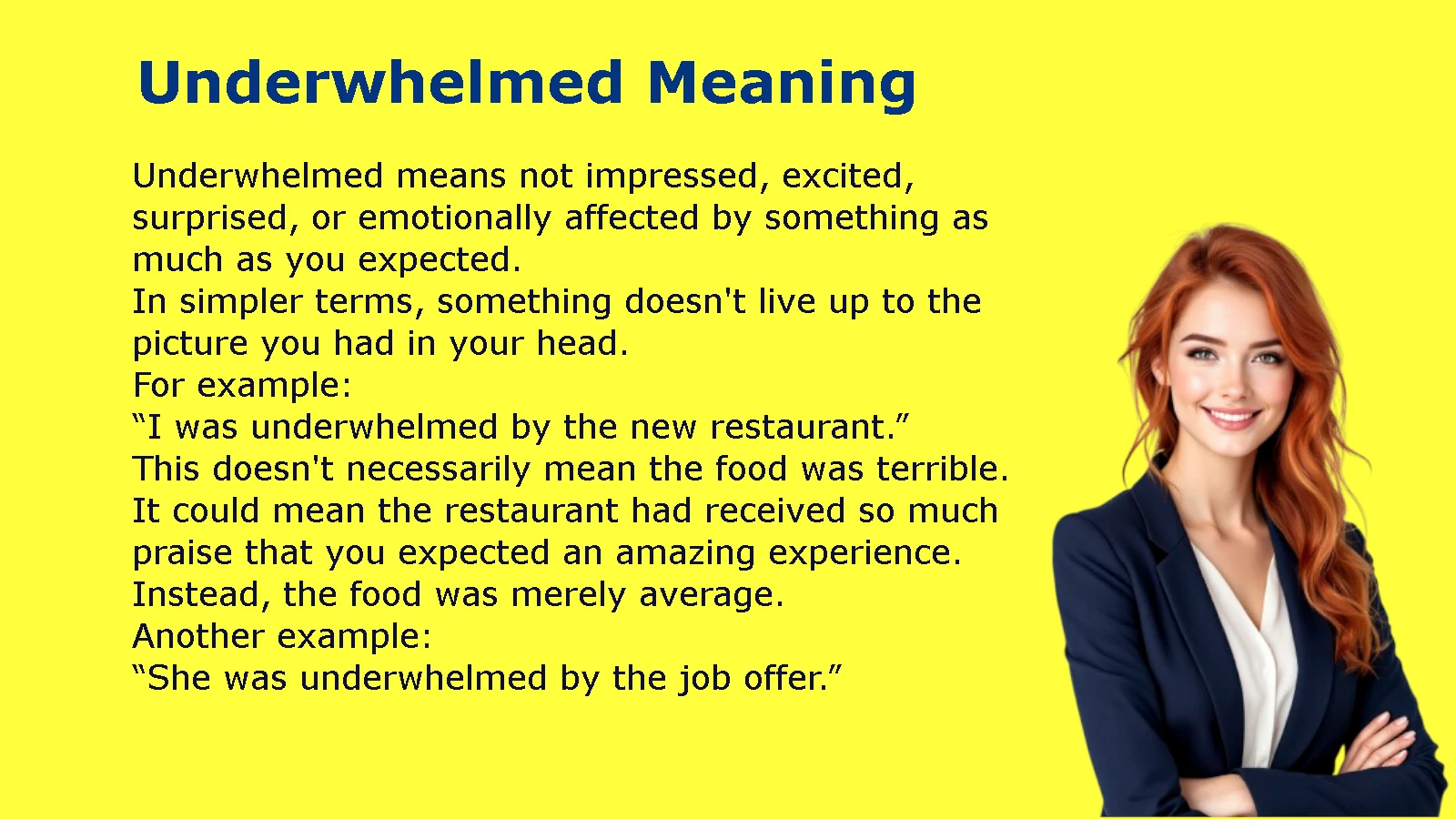
Underwhelmed means not impressed, excited, surprised, or emotionally affected by something as much as you expected.
In simpler terms, something doesn’t live up to the picture you had in your head.
For example:
“I was underwhelmed by the new restaurant.”
This doesn’t necessarily mean the food was terrible. It could mean the restaurant had received so much praise that you expected an amazing experience. Instead, the food was merely average.
Another example:
“She was underwhelmed by the job offer.”
The salary might have been acceptable. The benefits might have been decent. Yet the offer didn’t excite her because she expected something better.
Underwhelmed Definition at a Glance
| Term | Meaning |
| Underwhelmed | Not impressed or excited enough |
| Underwhelming | Failing to create a strong or positive impression |
| Underwhelm | To fail to impress, excite, or make a strong impact |
| Overwhelmed | Emotionally or mentally affected by something to an excessive degree |
The key idea is insufficient impact.
Something can be good and still be underwhelming. That’s what makes the word useful.
A $30 meal might taste good, but if you expected a once-in-a-lifetime dining experience, you could still walk away underwhelmed.
Underwhelmed Meaning in Simple Words
If you want the shortest possible explanation, think of underwhelmed as:
“I expected more.”
It can describe several shades of reaction:
- Not impressed
- Not excited
- Disappointed
- Unenthusiastic
- Unimpressed
- Let down
- Bored by something that was supposed to be exciting
- Less impressed than expected
Consider these situations:
- You watch a movie everyone calls a masterpiece. You think it’s just okay.
- You visit a famous tourist attraction and find it less impressive than the photos.
- Your company promises a major promotion, but the actual offer barely changes anything.
- A friend spends weeks hyping up a restaurant, but the meal tastes ordinary.
- You buy an expensive gadget expecting a huge upgrade, but it feels almost identical to your old one.
In every case, underwhelmed fits because reality falls short of expectation.
Underwhelmed vs. Underwhelming
These words are closely related, but they don’t perform the same grammatical job.
Underwhelmed usually describes a person’s reaction.
Underwhelming usually describes the thing causing that reaction.
Compare:
I was underwhelmed by the movie.
The movie was underwhelming.
The first sentence focuses on your emotional response. The second focuses on the movie’s lack of impact.
Examples of Underwhelmed and Underwhelming
| Word | Example | What It Describes |
| Underwhelmed | “I was underwhelmed by the concert.” | Your reaction |
| Underwhelming | “The concert was underwhelming.” | The event |
| Underwhelm | “The concert failed to underwhelm the critics.” | Verb form |
| Overwhelmed | “I was overwhelmed by the crowd.” | Excessive emotional impact |
A useful shortcut is:
You feel underwhelmed. Something is underwhelming.
That distinction makes the word much easier to use correctly.
The Difference Between Underwhelmed and Disappointed
Underwhelmed and disappointed overlap, but they aren’t perfect synonyms.
Disappointment usually carries a stronger sense that something failed to meet a specific hope, requirement, or expectation.
Being underwhelmed can be softer.
Imagine ordering a burger that you expected to be fantastic.
If it arrives cold and tastes awful, you’re probably disappointed.
If it tastes fine but doesn’t taste nearly as special as everyone promised, you’re probably underwhelmed.
Underwhelmed vs. Disappointed
| Underwhelmed | Disappointed |
| Not impressed | Dissatisfied with an outcome |
| Often relatively mild | Can be much stronger |
| Something lacks expected impact | Something fails an expectation |
| “That wasn’t as amazing as I thought.” | “That didn’t turn out the way I hoped.” |
| Can describe neutral or mediocre experiences | Usually carries a clearer negative emotion |
Of course, the two feelings can happen together.
“I was disappointed and underwhelmed by the final result.”
That sentence works because the speaker felt both dissatisfied and unimpressed.
Underwhelmed vs. Overwhelmed
These two words look like opposites, and in many contexts they describe opposite ends of an emotional spectrum.
Overwhelmed suggests that something feels like too much.
Underwhelmed suggests that something feels like too little.
Think of an emotional volume knob.
- Overwhelmed: The volume is painfully high.
- Balanced: The experience feels appropriate.
- Underwhelmed: The volume is barely loud enough to make an impression.
Underwhelmed vs. Overwhelmed
| Feature | Underwhelmed | Overwhelmed |
| Emotional intensity | Too low | Too high |
| Typical reaction | “I expected more.” | “This is too much.” |
| Common feeling | Boredom or mild disappointment | Stress, anxiety, excitement, or emotional overload |
| Trigger | Weak impact or unmet expectations | Excessive demands or intensity |
| Example | “The show was underwhelming.” | “The workload is overwhelming.” |
The contrast becomes especially clear in everyday examples.
Underwhelmed: “The concert was supposed to be incredible, but I wasn’t impressed.”
Overwhelmed: “There were so many people, lights, and sounds that I couldn’t process everything.”
One leaves you thinking “Is that all?”
The other leaves you thinking “I need a minute.”
Is “Whelmed” a Real Word?
This is where English gets weird.
Because underwhelmed and overwhelmed exist, people often wonder whether whelmed is a normal word that means being somewhere in the middle.
Historically, whelm is a real English verb. However, modern everyday English rarely uses it in the ordinary emotional sense that people imagine from overwhelmed. The word has older meanings connected with covering, engulfing, submerging, or overcoming. Etymology Online
The modern use of underwhelmed developed later as a playful formation based on overwhelmed. Oxford dates it to the 1950s, while etymological sources identify underwhelm as a humorous or facetious formation. Oxford Learner’s Dictionaries
So don’t assume this progression:
underwhelmed → whelmed → overwhelmed
That’s a neat linguistic joke, but it doesn’t accurately describe how everyday English developed.
What Does “Whelmed” Mean in Pop Culture?
You may have heard “whelmed” used to mean “neither impressed nor disappointed.”
That usage became especially recognizable through the movie 10 Things I Hate About You, where a character jokes that being “whelmed” is possible because “I think you can in Europe.”
The joke works precisely because whelmed sounds as though it should naturally sit between underwhelmed and overwhelmed.
In normal modern conversation, though, whelmed isn’t nearly as common as underwhelmed or overwhelmed.
Why Do People Feel Underwhelmed?
At its core, being underwhelmed often comes down to an expectation gap.
You imagine one experience.
Reality gives you another.
The bigger the gap, the more likely you are to feel underwhelmed.
The Expectation Gap
Suppose you hear about a new restaurant from five different people.
They call it:
- “The best restaurant in the city.”
- “Absolutely incredible.”
- “A must-try.”
- “The best meal I’ve ever had.”
Your expectations climb.
Then you visit.
The food is good. The service is fine. Nothing goes terribly wrong.
Yet you leave thinking:
“I don’t get what all the hype was about.”
The restaurant didn’t necessarily fail.
Your expectations became bigger than the experience.
That’s an important distinction.
Why Hype Can Make Something Feel Worse
Imagine two people watch the same movie.
Person A knows almost nothing about it. They expect an ordinary action movie.
Person B watches trailers, reads glowing reviews, sees social media posts, and hears friends call it a masterpiece.
The movie turns out to be good.
Person A might say:
“That was pretty fun.”
Person B might say:
“Honestly? I was underwhelmed.”
Same movie. Different expectations.
That doesn’t mean the second person is wrong. Their emotional response depends partly on what they anticipated.
Social Media Can Make Experiences More Underwhelming
Modern advertising and social media can create enormous expectations before you experience something yourself.
A restaurant doesn’t just advertise a meal anymore. It can become a lifestyle experience on Instagram and TikTok.
A vacation destination can appear perfect through carefully edited videos.
A new smartphone can be presented as revolutionary before anyone has used it.
A movie trailer can showcase its most spectacular two minutes.
By the time you experience the real thing, your mental version may be almost impossible to beat.
This creates a common pattern:
Hype → high expectations → ordinary reality → underwhelmed reaction
The experience might still be objectively good.
It simply doesn’t feel extraordinary.
Examples of Underwhelmed in Everyday Life
The word works across a surprisingly wide range of situations.
Underwhelmed by a Movie
“I had heard so much about the movie that I was underwhelmed when I finally watched it.”
This suggests the movie wasn’t necessarily terrible. It simply didn’t live up to the praise.
Underwhelmed by Food
“The restaurant looked amazing online, but I was underwhelmed by the food.”
Here, the expectation probably came from photos, reviews, recommendations, or hype.
Underwhelmed by a Product
“The new phone is nice, but I’m underwhelmed by the upgrade.”
This suggests that the new model works well but doesn’t offer enough improvement to feel exciting.
Underwhelmed by a Job Offer
“After three interviews, I was underwhelmed by the final offer.”
The offer may have been disappointing because the candidate expected better pay, benefits, flexibility, or responsibilities.
Underwhelmed by a Performance
“The singer sounded good, but the live performance was underwhelming.”
The performance wasn’t necessarily bad. It simply failed to create the expected excitement.
Underwhelmed by a Vacation
“We spent months planning the trip, but the destination was surprisingly underwhelming.”
This often implies that photos, reviews, or expectations created an image that reality couldn’t match.
Underwhelmed Meaning in Relationships
The word can also describe emotional reactions in relationships.
For example:
“I thought I’d feel more excited about our second date, but I was underwhelmed.”
Here, underwhelmed doesn’t necessarily mean the other person did something wrong.
It may simply mean that the expected chemistry wasn’t there.
The distinction matters.
Underwhelmed Does Not Always Mean “Bad”
Someone can be:
- Kind but underwhelming
- Attractive but underwhelming
- Talented but underwhelming
- Successful but underwhelming
- Interesting but underwhelming
Why?
Because underwhelming is relative to expectation.
A perfectly good experience can feel disappointing if you expected something extraordinary.
For instance, meeting a famous celebrity might sound exciting. But if the interaction lasts thirty seconds and feels completely ordinary, you might walk away underwhelmed.
The person didn’t necessarily do anything wrong.
The moment simply didn’t match the fantasy.
Underwhelmed Meaning at Work
Work provides another common use.
You might feel underwhelmed when:
- Your job doesn’t challenge you.
- Your responsibilities are repetitive.
- A promotion doesn’t offer meaningful benefits.
- A project receives little recognition.
- Your workplace promised growth but delivered routine tasks.
- A new position turns out to be less interesting than advertised.
Consider this example:
“I accepted the position because the company promised plenty of creative freedom. After six months, I felt underwhelmed by the role.”
The problem isn’t necessarily terrible working conditions.
The problem is the gap between expectation and reality.
Underwhelmed vs. Burned Out at Work
These feelings shouldn’t be confused.
Underwhelmed often means you aren’t sufficiently challenged or excited.
Burned out involves prolonged exhaustion and reduced capacity.
| Feeling | Typical Experience |
| Underwhelmed | “This isn’t challenging enough.” |
| Overwhelmed | “There’s too much to handle.” |
| Burned out | “I don’t have the energy for this anymore.” |
| Satisfied | “This works well for me.” |
| Excited | “I can’t wait to do this.” |
A person can move between these states depending on workload, environment, expectations, and personal circumstances.
Underwhelmed Meaning in Psychology
Underwhelmed isn’t a standalone psychological diagnosis.
It’s an everyday adjective describing a reaction.
Still, psychology helps explain why the feeling happens.
One useful concept is expectation versus outcome.
Your brain constantly predicts what will happen. When reality differs from that prediction, you evaluate the difference.
If reality dramatically exceeds expectations, you may feel delighted.
If it roughly matches expectations, you may feel satisfied.
A Simple Expectation Model
You can think about the experience like this:
Emotional reaction ≈ actual experience − expected experience
This isn’t a clinical equation. It’s simply a useful way to understand the idea.
For example:
- Expected: 10/10
- Actual: 8/10
- Result: “Pretty good, but underwhelming.”
Now change the expectation:
- Expected: 6/10
- Actual: 8/10
- Result: “Wow, that was great.”
The objective experience stayed the same.
The expectation changed the emotional reaction.
Can You Feel Underwhelmed Without Being Disappointed?
Yes.
You can feel mildly underwhelmed without being deeply disappointed.
Imagine someone recommends a new TV show.
You watch the first episode and think:
“It’s okay.”
You’re not angry.
You’re not upset.
You don’t regret watching it.
You’re simply not impressed enough to care strongly about it.
That’s classic underwhelmed territory.
The word can therefore express a relatively restrained reaction.
Instead of saying:
“This was terrible.”
you might say:
“I was a little underwhelmed.”
That softer wording can be useful when you want to criticize something without sounding harsh.
How Strong Is the Word “Underwhelmed”?
The intensity depends heavily on modifiers.
Mild
“I was a little underwhelmed.”
This sounds polite and restrained.
Moderate
“I was pretty underwhelmed by the experience.”
The speaker clearly didn’t enjoy it much.
Strong
“I was extremely underwhelmed by the results.”
The disappointment is much more obvious.
Very Strong
“I was completely underwhelmed.”
This can sound deliberately blunt, especially when the thing was heavily promoted.
Other useful modifiers include:
- Slightly underwhelmed
- Somewhat underwhelmed
- Rather underwhelmed
- Pretty underwhelmed
- Deeply underwhelmed
- Seriously underwhelmed
- Completely underwhelmed
- Distinctly underwhelmed
The phrase “distinctly underwhelmed” is especially common in polished or slightly formal writing.
Synonyms for Underwhelmed
The best synonym depends on what you want to emphasize.
Common Synonyms
- Unimpressed
- Disappointed
- Unenthused
- Unexcited
- Let down
- Uninspired
- Indifferent
- Bored
- Dissatisfied
- Understimulated
However, these words aren’t interchangeable in every sentence.
Underwhelmed vs. Unimpressed
Unimpressed means something failed to impress you.
Underwhelmed often adds the idea that you expected a stronger reaction.
“I was unimpressed by the presentation.”
This simply says the presentation didn’t impress you.
“I was underwhelmed by the presentation.”
This can imply that you expected the presentation to be much better.
Underwhelmed vs. Bored
Bored focuses on a lack of stimulation or interest.
Underwhelmed focuses on a lack of impact compared with expectations.
You can be bored without expecting anything impressive.
You can also be underwhelmed by something that is genuinely interesting but less impressive than anticipated.
Antonyms of Underwhelmed
The obvious opposites include:
- Impressed
- Excited
- Enthusiastic
- Amazed
- Thrilled
- Delighted
- Impressed
- Astonished
- Overwhelmed
The exact opposite depends on context.
If you were underwhelmed by a performance, impressed is probably the most natural opposite.
If you were underwhelmed by an emotional experience, thrilled or excited might work better.
How to Use “Underwhelmed” in a Sentence
The most common construction is:
underwhelmed by + noun
Examples:
“I was underwhelmed by the movie.”
“She was underwhelmed by the presentation.”
“They were underwhelmed by the results.”
Another common construction is:
underwhelmed with + noun
“He was underwhelmed with the new features.”
You can also use it after linking verbs:
“The audience seemed underwhelmed.”
“She looked underwhelmed by the announcement.”
More Original Sentence Examples
Here are practical examples across different contexts:
- “I was underwhelmed by the concert despite the incredible reviews.”
- “The new menu looks impressive, but the food was slightly underwhelming.”
- “He seemed underwhelmed by the promotion.”
- “We expected a huge announcement, so the news left us underwhelmed.”
- “The trailer was exciting, but the movie itself was underwhelming.”
- “She was underwhelmed with the hotel’s amenities.”
- “The results weren’t bad. They were simply underwhelming compared with last year’s numbers.”
- “I expected the museum to be spectacular, but I left feeling underwhelmed.”
- “The product works well, although the latest version is underwhelming.”
- “After all the hype, the finale felt surprisingly underwhelming.”
A Practical Case Study: Why Hype Creates an Underwhelming Experience
Consider a fictional new restaurant called North & Ember.
Before opening, it becomes a social media sensation. Food creators post dramatic videos. Local influencers call it “the restaurant of the year.” Reservations disappear within hours.
A customer finally gets a table.
The food is good.
The service is friendly.
The atmosphere is attractive.
But the customer leaves thinking:
“It was good. I just expected something incredible.”
That’s a textbook example of being underwhelmed.
Notice what happened:
| Stage | Experience |
| Initial expectation | Very high |
| Marketing exposure | Increased excitement |
| Actual experience | Good |
| Gap between expectation and reality | Significant |
| Final reaction | Underwhelmed |
If the same customer had walked in without seeing the hype, the restaurant might have felt excellent.
The experience didn’t necessarily change. The expectation did.
Is Being Underwhelmed a Bad Thing?
Not necessarily.
Sometimes being underwhelmed gives you useful information.
If you repeatedly feel underwhelmed by a job, hobby, relationship, product, or routine, you might need to ask why.
Maybe the experience genuinely isn’t meeting your needs.
Maybe you’re comparing ordinary life with highly curated content online.
Or perhaps you’ve simply outgrown something that used to excite you.
The feeling itself isn’t automatically a problem.
It’s a signal worth examining.
Ask Yourself These Questions
When something leaves you underwhelmed, consider:
- What did I expect to happen?
- Where did that expectation come from?
- Was the actual experience objectively poor or simply ordinary?
- Would I feel differently if I hadn’t seen the hype?
- Was the problem the experience or my expectations?
- Do I feel this way about everything or just this one thing?
Those questions can separate a temporary letdown from a broader pattern.
When Underwhelmed Becomes a Pattern
Feeling underwhelmed occasionally is completely ordinary.
However, if almost everything feels dull or emotionally flat for a long period, that’s a different issue from simply disliking a movie or restaurant.
Persistent loss of pleasure or interest can occur in several mental health conditions. Anhedonia, for example, refers to reduced ability to experience pleasure or interest. That is much broader than the everyday feeling of being underwhelmed.
The distinction matters.
“This movie didn’t impress me” is ordinary disappointment.
“Nothing in my life feels enjoyable anymore” describes a much broader experience.
A single word shouldn’t be used to diagnose yourself.
If emotional numbness or loss of interest persists and affects daily life, talking with a qualified mental health professional can provide a clearer picture.
Underwhelmed Meaning in Different Contexts
The meaning stays fairly consistent, but the reason for the reaction changes.
| Context | What “Underwhelmed” Usually Means | Example |
| Movies | The film wasn’t as impressive as expected | “I was underwhelmed by the ending.” |
| Food | The meal didn’t match the hype | “The burger was underwhelming.” |
| Travel | The destination wasn’t as spectacular as expected | “We were underwhelmed by the attraction.” |
| Work | The role or offer wasn’t exciting enough | “I was underwhelmed by the promotion.” |
| Products | New features aren’t impressive enough | “The upgrade feels underwhelming.” |
| Relationships | The expected excitement or connection wasn’t there | “I felt underwhelmed after the date.” |
| Sports | A player or team performed below expectations | “Fans were underwhelmed by the performance.” |
| Entertainment | The experience lacked impact | “The finale was underwhelming.” |
| Events | The event didn’t create the expected excitement | “The launch was surprisingly underwhelming.” |
Underwhelmed vs. Mid vs. Disappointing
Modern casual English has several ways to describe something that fails to impress.
Underwhelmed is especially useful because it focuses on the person’s reaction.
| Term | Meaning | Tone |
| Underwhelmed | Less impressed than expected | Mild to moderate |
| Underwhelming | Failing to make a strong impression | Critical |
| Mid | Mediocre or average | Casual/slang |
| Disappointing | Failing to meet expectations | Stronger criticism |
| Unimpressive | Not worthy of admiration | Direct |
| Boring | Lacking interest or excitement | Blunt |
| Mediocre | Only average in quality | More formal |
For example:
“The movie was mid.”
This is casual internet slang and usually means the movie was merely average.
“I was underwhelmed by the movie.”
This emphasizes the viewer’s reaction and often suggests that expectations were higher.
“The movie was disappointing.”
This makes the criticism stronger.
Frequently Asked Questions About Underwhelmed Meaning
What does underwhelmed mean in simple terms?
Underwhelmed means not being as impressed, excited, or amazed as you expected to be. It often describes an experience that fails to live up to its hype or expectations.
Is underwhelmed a negative word?
Usually, yes, but it is often mildly negative rather than harsh.
Calling something underwhelming suggests that it failed to impress you. However, it doesn’t necessarily mean the thing was terrible.
Is underwhelmed the opposite of overwhelmed?
Not perfectly, but they often work as contrasting ideas.
Overwhelmed means something feels like too much, while underwhelmed means something fails to have enough impact.
What is the difference between underwhelmed and disappointed?
Disappointed usually emphasizes that something failed to meet your hopes. Underwhelmed emphasizes that something didn’t impress or excite you enough.
You can experience both at the same time.
What is another word for underwhelmed?
Depending on context, alternatives include unimpressed, unenthused, disappointed, uninspired, unexcited, indifferent, and let down.
Is “underwhelming” the same as “underwhelmed”?
They’re related but grammatically different.
Underwhelmed describes the person experiencing the reaction:
“I was underwhelmed.”
Underwhelming describes the thing producing the reaction:
“The experience was underwhelming.”
Can you say “I was underwhelmed”?
Yes. That’s one of the most common ways to use the word.
“I was underwhelmed by the new restaurant.”
Can a person be underwhelming?
Yes.
If someone fails to make the positive impression you expected, you can describe them as underwhelming.
For example:
“The speaker was surprisingly underwhelming.”
That means the speaker didn’t make much of an impression.
Is “whelmed” the opposite of underwhelmed?
Not really in ordinary modern English.
Whelm is an old English verb, but the idea of whelmed as a normal emotional middle ground became popular largely as a linguistic joke. The modern word underwhelmed itself was created as a humorous counterpart to overwhelmed. Etymology Online
Why do people say they are underwhelmed?
People commonly feel underwhelmed when their expectations exceed reality.
Hype, advertising, social media, recommendations, personal fantasies, and previous experiences can all raise expectations before an event happens.
Can something be good but still underwhelming?
Absolutely.
A product, movie, meal, or performance can be objectively good while still feeling underwhelming because you expected something extraordinary.
That’s one of the most important nuances of the word.
Final Takeaway: What Does Underwhelmed Mean?
The simplest underwhelmed meaning is not impressed or excited enough because something failed to create the impact you expected.
It doesn’t necessarily mean something was bad. In many cases, it means something was fine, decent, or even good, but the reality couldn’t match the anticipation surrounding it.
Remember the basic distinction:
- Underwhelmed: You expected more.
- Underwhelming: Something failed to make a strong impression.
- Disappointed: Something failed to meet your hopes.
- Overwhelmed: Something feels like too much.
- Unimpressed: Something didn’t impress you.
The word is especially useful because it captures a very specific modern experience: the gap between hype and reality.
You can spend months waiting for a movie, product, vacation, promotion, concert, or big announcement. Then the moment finally arrives.
Nothing goes terribly wrong.
It just doesn’t hit the way you expected.
That’s when underwhelmed is the word you’re looking for.