Have you ever met someone who seems aggressive, hostile, or eager to argue and wondered what word best describes their behavior? The Truculent Meaning refers to a person or attitude that is fierce, aggressive, hostile, or ready to fight. While the word may sound unfamiliar, it is a useful way to describe someone who shows a strong and confrontational attitude.
Truculent is an adjective used to describe a person, behavior, or tone that is aggressively defiant or eager to fight. It can describe someone who is openly hostile, as well as words or actions that have a threatening or combative quality.
Examples:
- The truculent man refused to listen to anyone’s advice.
- Her truculent response turned a simple discussion into an argument.
The confusion is understandable. People often search for what does truculent mean, truculent meaning in a sentence, truculent definition, or truculent meaning in English because the word is less common in everyday conversation. Its meaning can also become clearer when you compare it with words such as aggressive, hostile, belligerent, and confrontational.
In this guide, you’ll learn the complete Truculent Meaning, its definition, pronunciation, part of speech, synonyms, antonyms, and examples in sentences. You’ll also discover how to use truculent correctly, understand its meaning in different contexts, and distinguish it from similar words.
What Does Truculent Mean?
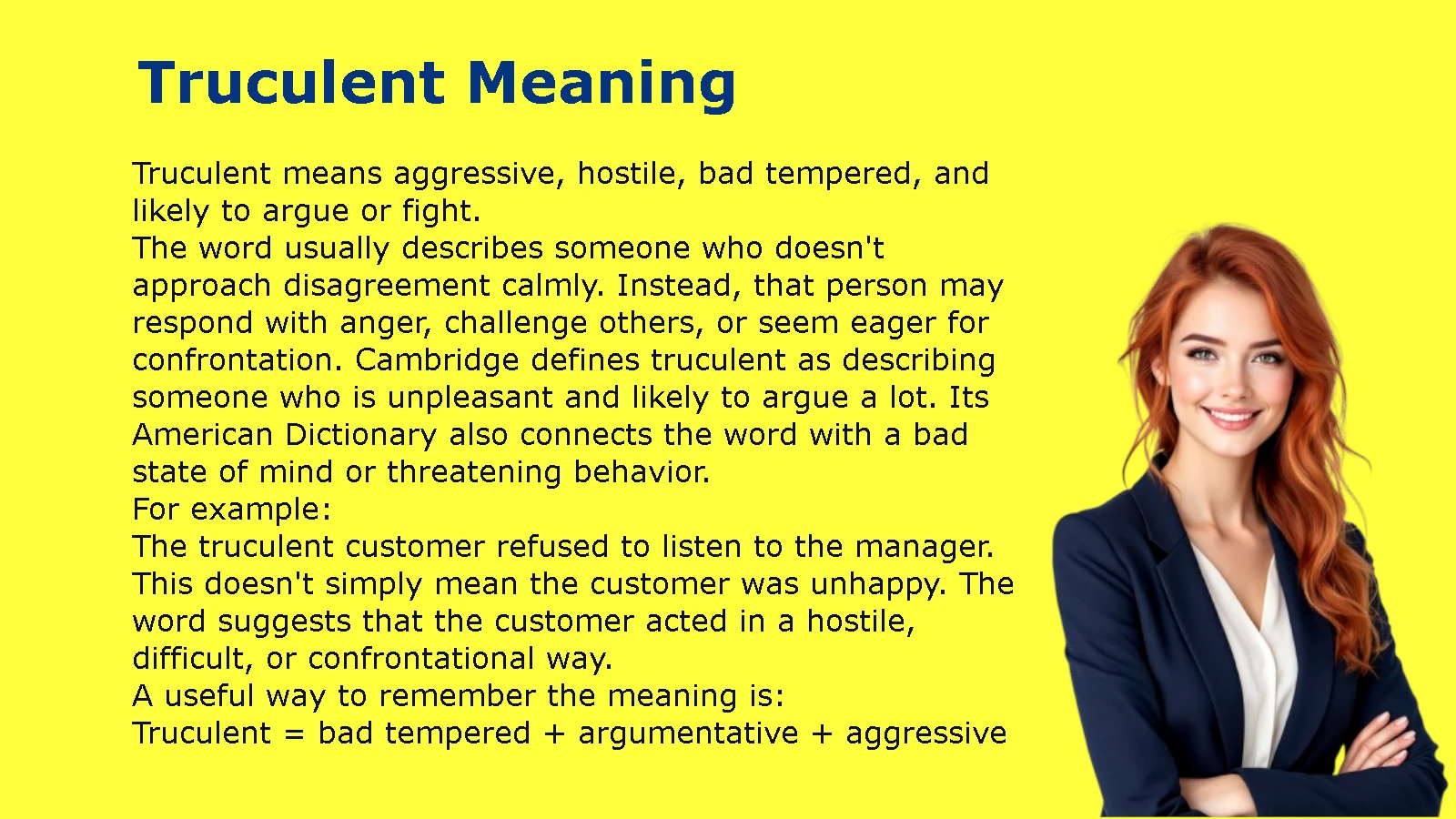
Truculent means aggressive, hostile, bad tempered, and likely to argue or fight.
The word usually describes someone who doesn’t approach disagreement calmly. Instead, that person may respond with anger, challenge others, or seem eager for confrontation. Cambridge defines truculent as describing someone who is unpleasant and likely to argue a lot. Its American Dictionary also connects the word with a bad state of mind or threatening behavior.
For example:
The truculent customer refused to listen to the manager.
This doesn’t simply mean the customer was unhappy. The word suggests that the customer acted in a hostile, difficult, or confrontational way.
A useful way to remember the meaning is:
Truculent = bad tempered + argumentative + aggressive
Not every truculent person wants to start a physical fight. The aggression can appear in words, attitude, tone, or behavior.
Truculent Meaning in Simple Words
In simple English, truculent means ready to argue, angry, hostile, or slightly aggressive.
Here are a few quick examples:
- A truculent employee keeps arguing with the supervisor.
- A truculent teenager responds angrily to every request.
- A truculent response sounds hostile rather than cooperative.
- A truculent attitude shows a willingness to challenge or confront others.
- Truculent criticism can be extremely harsh or cutting.
The exact shade of meaning depends on the noun it modifies.
Truculent Pronunciation
Truculent is pronounced:
TRUCK-yuh-lent
Its US pronunciation is represented as /ˈtrʌk.jə.lənt/ by Cambridge. Oxford gives the pronunciation as /ˈtrʌkjələnt/.
Break it into three parts:
| Part | Sound |
| tru | truck |
| cu | yuh |
| lent | luhnt |
| Full word | TRUCK-yuh-lent |
The stress falls on the first syllable.
Is Truculent Hard to Pronounce?
Not really. The spelling can look more complicated than the pronunciation.
Say it slowly:
TRUCK → yuh → luhnt
Then blend the parts together:
TRUCK-yuh-luhnt
Truculent Part of Speech
Truculent is an adjective.
That means it describes a person, thing, behavior, attitude, or quality.
Common combinations include:
- truculent person
- truculent teenager
- truculent employee
- truculent attitude
- truculent behavior
- truculent response
- truculent tone
- truculent criticism
- truculent language
- truculent approach
For example:
His truculent attitude made the negotiation more difficult.
Here, truculent describes the person’s attitude.
Another example:
The journalist used a truculent tone when challenging the official.
In this sentence, truculent describes the tone, not the person.
Truculent in a Sentence
Understanding the word becomes much easier when you see how it behaves in real sentences.
Examples of Truculent
- The truculent student argued with every instruction from the teacher.
- Her truculent response surprised everyone in the room.
- The manager became truculent when the team questioned his decision.
- His truculent attitude turned a simple disagreement into a heated argument.
- The article took a truculent approach to its criticism of the company.
- The dog looked truculent but remained behind the fence.
- After several failed negotiations, the two sides adopted a truculent stance.
- He sounded increasingly truculent as the interview continued.
- The politician’s truculent remarks made compromise more difficult.
- The usually calm player became truculent after the referee’s decision.
Notice something important: truculent doesn’t always describe physical aggression.
A person can be truculent through words alone.
A Simple Context Example
Imagine that two coworkers disagree about a project.
One says:
“I don’t think that approach will work. Let’s look at another option.”
That’s disagreement, but it isn’t necessarily truculent.
The other says:
“That’s ridiculous. I’m not changing anything, and don’t bother arguing with me.”
That response is much closer to truculent because it combines hostility, irritation, and confrontation.
Truculent Examples in Everyday Situations
The word often appears in situations where someone’s behavior becomes difficult or confrontational.
Truculent at Work
Imagine an employee receives ordinary feedback from a manager. Instead of discussing the issue calmly, the employee becomes defensive, challenges every point, and refuses to cooperate.
You could say:
The employee became truculent during the performance review.
The word captures more than anger. It suggests a combative reaction.
Truculent During an Argument
A person who disagrees with you isn’t automatically truculent.
If someone calmly explains a different opinion, truculent would be too strong.
However, if that person constantly interrupts, becomes hostile, and seems eager to turn the disagreement into a fight, truculent becomes a better fit.
Truculent in Speech or Writing
The word can also describe language.
For example:
The editorial used a truculent tone when criticizing the proposed policy.
Here, truculent means the criticism was aggressive and harsh.
Merriam Webster specifically recognizes truculent in the sense of “scathingly harsh” and gives truculent criticism as an example.
Truculent in Negotiations
A negotiation usually requires some degree of cooperation. A truculent approach pushes in the opposite direction.
For example:
The company’s truculent negotiating style left little room for compromise.
The company may not threaten anyone directly. Its representatives might simply reject every proposal, respond aggressively, or refuse to compromise.
That behavior can still be described as truculent.
What Is a Truculent Person Like?
A truculent person tends to display several traits associated with hostility and confrontation.
Such a person may:
- argue frequently
- become angry quickly
- react badly to criticism
- challenge other people’s statements
- speak in an aggressive tone
- resist compromise
- appear hostile
- behave in a threatening way
- respond sharply to ordinary questions
- turn minor disagreements into larger conflicts
However, truculent doesn’t mean permanently violent or cruel.
Someone can act truculently in one situation without being a violent person.
That’s an important distinction.
Truculent Synonyms
The best synonyms for truculent depend on the context. Some emphasize aggression, while others focus on anger, hostility, or argumentativeness.
Merriam Webster’s thesaurus includes words such as aggressive, hostile, belligerent, combative, confrontational, pugnacious, quarrelsome, argumentative, and irritable among related terms.
Common Truculent Synonyms
| Synonym | Main idea |
| Aggressive | Ready to attack, challenge, or dominate |
| Belligerent | Hostile and ready to fight |
| Hostile | Unfriendly or antagonistic |
| Combative | Inclined to fight or argue |
| Confrontational | Likely to challenge others directly |
| Argumentative | Often wants to argue |
| Quarrelsome | Frequently involved in arguments |
| Pugnacious | Eager or willing to fight |
| Irritable | Easily annoyed or angered |
| Surly | Bad tempered and unfriendly |
| Contentious | Likely to cause or engage in disagreement |
These words overlap, but they aren’t identical.
For example, irritable mainly describes someone who becomes annoyed easily. Belligerent suggests stronger hostility or willingness to fight. Argumentative focuses on arguing.
Truculent sits in the middle of several of these ideas. It can suggest bad temper, argumentativeness, hostility, and aggression at the same time.
Truculent vs. Aggressive
Truculent and aggressive are close in meaning, but truculent often carries a stronger suggestion of unpleasantness or argumentativeness.
Compare these sentences:
The dog became aggressive when someone approached its food.
This emphasizes threatening or attacking behavior.
The dog became truculent when the owner tried to move its bowl.
This can suggest a more generally hostile or difficult attitude.
Merriam Webster defines truculent as “aggressively self-assertive” and lists belligerent as a synonym.
The Key Difference
Aggressive is broader.
Truculent often adds a sense of hostility, bad temper, argument, or harshness.
Truculent vs. Belligerent
These two words are especially close.
Belligerent usually emphasizes hostility or a readiness to fight.
Truculent can describe that same aggression, but it can also suggest someone who is argumentative, bad tempered, or harsh.
| Word | Strongest idea |
| Truculent | Aggressive, argumentative, bad tempered |
| Belligerent | Hostile and ready to fight |
| Aggressive | Forceful, attacking, or dominant |
| Argumentative | Inclined to argue |
| Hostile | Unfriendly or antagonistic |
For example:
The belligerent crowd threatened to attack the security guards.
This strongly suggests a threat of physical violence.
The truculent customer argued with every employee who approached him.
This focuses more on hostile and argumentative behavior.
Truculent vs. Hostile
Hostile is one of the broadest words in this group.
A hostile person may be unfriendly, antagonistic, or openly opposed to someone. A hostile environment can also describe a difficult or dangerous setting.
Truculent is more specific when you want to emphasize bad temper, argument, or aggressive behavior.
Compare:
The manager was hostile toward the proposal.
This means the manager strongly opposed it.
The manager was truculent during the discussion.
This suggests the manager not only opposed the proposal but also behaved in an aggressive, difficult, or argumentative manner.
Truculent vs. Angry
Does truculent mean angry?
Sometimes, but not exactly.
Anger is an emotion. Truculent describes a person’s behavior, attitude, or manner.
Someone can be angry without being truculent.
For example:
She was angry about the mistake but discussed it calmly.
That doesn’t sound truculent.
Now consider:
She became truculent and began arguing with everyone in the room.
Here, the anger has turned into aggressive and confrontational behavior.
A useful distinction is:
Angry = feeling strong displeasure.
Truculent = behaving in an aggressive, argumentative, or hostile way.
Is Truculent a Positive or Negative Word?
Truculent is generally a negative word.
Oxford labels it formal and disapproving, which is an important clue about its tone.
Calling someone truculent usually means you see their behavior as unpleasant or unnecessarily aggressive.
For example:
He gave a truculent response to a reasonable question.
The sentence doesn’t praise him. It criticizes the way he responded.
There are situations where the word can describe determined or forceful behavior without making the person seem completely unreasonable. Still, the word usually carries a negative edge.
Is Truculent Always Insulting?
Not necessarily.
The word can describe behavior objectively:
The team’s truculent stance complicated the negotiations.
The writer doesn’t directly insult the team. Instead, truculent characterizes its stance as aggressive or confrontational.
Even so, readers will usually understand that the behavior is being viewed critically.
Truculent Word Forms
The word has several related forms.
| Word | Part of speech | Meaning |
| Truculent | Adjective | Aggressive, argumentative, hostile, or harsh |
| Truculence | Noun | The quality or state of being truculent |
| Truculently | Adverb | In a truculent manner |
Truculence Meaning
Truculence is the noun form of truculent.
It refers to the quality or state of being truculent. Cambridge defines it in those terms and provides examples involving argumentative and hostile behavior.
Example:
His truculence made productive negotiations almost impossible.
Here, truculence refers to his aggressive and argumentative manner.
Merriam Webster also defines truculence as the quality or state of being truculent and lists related ideas such as aggression, aggressiveness, hostility, and defiance.
Truculently Meaning
Truculently is the adverb form.
It means in a truculent manner.
Example:
He stared truculently at the opposing player.
The adverb explains how he stared.
Truculent Etymology
The history of truculent helps explain why the word feels so fierce.
English adopted the word from Latin in the mid 16th century. It comes from Latin truculentus, which developed from trux, meaning “fierce.” Oxford gives the same Latin origin and dates the word to the mid 16th century.
Merriam Webster explains that English speakers originally used truculent for things associated with cruelty and fierceness. Over time, the word developed broader uses. Modern English often uses it for people who are aggressive or surly and for language that is especially harsh.
This shift matters because today’s common use isn’t limited to literal savagery.
The word once had a much more intensely fierce flavor. Modern usage often softens it to mean argumentative, hostile, bad tempered, or harsh.
How to Use Truculent Correctly
The easiest way to use truculent correctly is to connect it with something that shows aggression, hostility, argument, or harshness.
Natural combinations include:
- truculent attitude
- truculent behavior
- truculent response
- truculent tone
- truculent criticism
- truculent stance
- truculent approach
- truculent teenager
- truculent customer
- truculent opponent
Examples of Correct Usage
The lawyer adopted a truculent tone during the hearing.
His truculent behavior made the meeting uncomfortable.
The article offered a truculent attack on the proposed changes.
The normally polite student became truculent after receiving the punishment.
The two sides took a truculent stance during negotiations.
Each example involves some form of confrontation or hostility.
When You Shouldn’t Use Truculent
Don’t use truculent simply because someone is sad, nervous, tired, disappointed, or mildly annoyed.
For example:
She was tired after working all day.
Calling her truculent wouldn’t make sense unless her tiredness led to hostile or argumentative behavior.
Likewise:
He was disappointed by the test result.
Disappointment alone doesn’t make someone truculent.
But if he responded by angrily challenging the teacher and picking fights with classmates, you could describe his behavior as truculent.
Truculent Requires More Than Simple Anger
Think of the word as a combination rather than a single emotion:
irritation + hostility + confrontation = truculent behavior
That isn’t a mathematical formula. It’s simply a useful memory trick.
Common Mistakes With Truculent
Because truculent has several related meanings, it’s easy to use it too broadly.
Mistake: Using It as a Direct Replacement for Angry
Not every angry person is truculent.
Better:
The customer was angry about the delay.
Stronger and more specific:
The customer became truculent when the employee explained the delay.
The second sentence tells readers that the person’s anger became confrontational.
Mistake: Assuming It Always Means Violent
A truculent person doesn’t necessarily attack anyone.
The aggression may appear through:
- words
- tone
- arguments
- refusal to cooperate
- hostile gestures
- confrontational behavior
Cambridge specifically includes argumentative and threatening behavior in its definitions and examples.
Mistake: Using It for Any Strong Opinion
Being confident isn’t the same as being truculent.
She confidently defended her position.
That’s not necessarily truculent.
She aggressively attacked everyone who disagreed with her.
That is much closer.
The distinction comes down to how the person expresses the position.
Truculent Tone: What Does It Mean?
A truculent tone sounds aggressive, hostile, challenging, or harsh.
Imagine someone responding to a simple question with:
“Why are you asking me that?”
The words aren’t automatically truculent. The tone and context determine the meaning.
If the speaker delivers them sharply and confrontationally, you might describe the response as truculent.
This is why truculent works well with words such as tone, response, criticism, and language.
The aggression doesn’t have to come from the topic itself. It can come from the manner of expression.
Truculent Attitude: What Does It Mean?
A truculent attitude is an aggressive or confrontational way of approaching people or situations.
For example:
His truculent attitude made it difficult to reach a compromise.
The person may reject suggestions, argue repeatedly, or treat reasonable disagreement as a challenge.
In other words, the problem isn’t simply what the person believes. It’s also how the person behaves.
Truculent Criticism: What Does It Mean?
Truculent criticism is unusually harsh, aggressive, or biting criticism.
Merriam Webster specifically lists scathingly harsh as one sense of truculent.
Compare:
The reviewer criticized the movie.
This is neutral.
The reviewer offered a truculent criticism of the movie.
This suggests the review was forceful, harsh, and possibly hostile.
The second sentence paints a much sharper picture.
A Practical Case Study: Truculent vs. Assertive
One of the most useful distinctions involves assertiveness.
Imagine a manager needs an employee to meet a deadline.
An assertive manager might say:
“This project needs to be finished by Friday. Let’s discuss what you need to meet the deadline.”
The manager is firm but constructive.
A truculent manager might say:
“I’ve already told you what I expect. Stop making excuses and get it done.”
Both managers are firm.
Only the second example clearly carries the aggressive, hostile quality associated with truculent.
This distinction matters because confidence and aggression aren’t the same thing.
| Behavior | Likely description |
| Calmly defending an opinion | Assertive |
| Clearly stating a boundary | Firm |
| Becoming annoyed easily | Irritable |
| Frequently arguing | Argumentative |
| Acting aggressively toward others | Aggressive |
| Acting hostile and confrontational | Truculent |
| Showing willingness to fight | Belligerent |
Truculent Antonyms
The opposite of truculent depends on which part of its meaning you want to contrast.
Useful antonyms include:
- peaceful
- gentle
- friendly
- amiable
- cooperative
- calm
- accommodating
- conciliatory
- agreeable
- good natured
Truculent vs. Peaceful
The truculent negotiator rejected every proposal.
versus:
The peaceful negotiator looked for common ground.
Truculent vs. Cooperative
His truculent attitude blocked progress.
versus:
Her cooperative attitude helped the team solve the problem.
The best opposite depends on the context.
If truculent means aggressive, peaceful works well. If it means unwilling to compromise, cooperative or accommodating may be better.
Truculent Meaning: Quick Reference Table
| Feature | Answer |
| Word | Truculent |
| Part of speech | Adjective |
| Pronunciation | TRUCK-yuh-lent |
| US pronunciation | /ˈtrʌk.jə.lənt/ |
| Basic meaning | Aggressive, hostile, argumentative, or bad tempered |
| Tone | Usually negative or disapproving |
| Common subjects | People, attitudes, behavior, responses, tones, criticism |
| Common synonyms | Aggressive, belligerent, hostile, combative |
| Common antonyms | Peaceful, gentle, friendly, cooperative |
| Noun form | Truculence |
| Adverb form | Truculently |
| Origin | Latin truculentus, from trux meaning “fierce” |
| English usage | Mid 16th century |
Oxford classifies truculent as formal and disapproving, while Cambridge focuses on its argumentative and unpleasant character. Merriam Webster includes broader senses involving belligerence, harsh criticism, ferocity, and destructiveness.
Facts About the Word Truculent
Here are several useful facts worth remembering:
- Truculent is an adjective.
- The word has been used in English since the 16th century.
- It comes from the Latin truculentus.
- Its Latin root trux means “fierce.”
- The modern word often describes people who are argumentative or aggressive.
- It can also describe a tone, attitude, response, or criticism.
- The word usually has a negative or disapproving tone.
- Truculence is the noun form.
- Truculently is the adverb form.
- The pronunciation begins with a sound like “truck.”
- Truculent is related in meaning to words such as belligerent, hostile, combative, and argumentative.
Frequently Asked Questions About Truculent Meaning
What does truculent mean in simple words?
Truculent means aggressive, argumentative, bad tempered, or hostile. It often describes someone who is unpleasant and likely to argue.
Is truculent a positive or negative word?
Truculent is generally negative. Oxford labels it formal and disapproving. It usually suggests that someone’s behavior is unnecessarily aggressive, hostile, or argumentative.
Does truculent mean angry?
Not exactly. Angry describes an emotion, while truculent describes a manner or behavior that is aggressive, hostile, or argumentative. An angry person isn’t necessarily truculent.
What is a synonym for truculent?
Common synonyms include aggressive, belligerent, hostile, combative, confrontational, argumentative, quarrelsome, and pugnacious. The best synonym depends on the context.
What is the opposite of truculent?
Common opposites include peaceful, gentle, friendly, cooperative, calm, agreeable, and accommodating.
How do you pronounce truculent?
In US English, pronounce it approximately TRUCK-yuh-lent, with the stress on the first syllable. Cambridge gives the pronunciation /ˈtrʌk.jə.lənt/.
What is the noun form of truculent?
The main noun form is truculence, meaning the quality or state of being truculent. Cambridge and Merriam Webster both recognize truculence as the noun form.
What is the adverb form of truculent?
The adverb is truculently, meaning in a truculent manner.
Can truculent describe speech?
Yes. You can describe speech, writing, criticism, or a tone as truculent when it sounds especially harsh, aggressive, or confrontational. Merriam Webster specifically recognizes truculent in the sense of scathingly harsh.
Is truculent the same as belligerent?
They’re very similar, but not identical. Belligerent strongly emphasizes hostility or willingness to fight. Truculent can also describe someone who is argumentative, bad tempered, or harsh.
Can truculent describe a person?
Yes. In fact, describing a person as truculent is one of its common uses. For example:
The truculent customer refused to discuss the problem calmly.
Cambridge uses examples involving a truculent teenager and a truculent bully.
Can truculent describe an attitude?
Yes. Truculent attitude is a natural combination. It describes an attitude that is aggressive, hostile, argumentative, or confrontational.
Is truculent a formal word?
Yes. Oxford labels truculent as formal and disapproving.
That doesn’t mean it’s restricted to academic writing. It appears in journalism, literature, commentary, and general written English. Still, everyday conversation often uses simpler words such as aggressive, hostile, or argumentative.
Final Takeaway: Truculent Meaning
The simplest way to remember truculent meaning is this:
Truculent describes someone or something that is aggressively hostile, argumentative, bad tempered, or harsh.
It goes beyond ordinary annoyance. A truculent person doesn’t simply feel angry. They may argue, challenge, confront, threaten, or respond harshly.
The word can describe a person:
The truculent customer argued with everyone.
It can describe an attitude:
His truculent attitude made compromise difficult.
It can describe a tone:
She answered in a truculent tone.
And it can describe criticism:
The reviewer delivered a truculent critique of the proposal.
Although truculent has roots in a Latin word meaning “fierce,” modern English commonly uses it for argumentative, hostile, and aggressive behavior.
So, when you need a word stronger and more specific than angry, but you want to emphasize hostility, argument, or confrontation, truculent can be an excellent choice.