Similes for mean help writers and speakers describe cruel, unkind, or hurtful behavior vividly and memorably. Instead of simply saying that someone is mean, a well-chosen comparison like as mean as wolf paints a stronger picture that readers can easily imagine. These expressions appear in novels, poems, speeches, classrooms, and everyday conversations because they add color and emotion to language. They also make characters more believable by showing their attitudes instead of just telling the audience about them.
Using figurative language for mean can improve literary writing by making descriptions more engaging and expressive. Students can use them in essays, teachers can introduce them in language lessons, and storytellers can use them to create unforgettable characters. If you are describing a strict villain, a rude classmate, or someone who speaks with sharp words, these comparisons make your writing more powerful.
The examples below are easy to understand, natural to use, and suitable for both formal and informal situations. Explore these unique comparisons and discover new ways to describe someone who acts in an unkind or hurtful manner.
Similes for Mean Examples
Like a snake ready to strike
Meaning:
This comparison describes someone who is secretly cruel and ready to hurt others with words or actions.
Example Sentences:
She was like a snake ready to strike whenever someone made a mistake.
His comments were like a snake ready to strike during the meeting.
When to Use It:
Works well in stories, character descriptions, and conversations about betrayal.
Verse Lines:
Like a snake ready to strike in the shade,
Mean words turned friendship into fading light.
Like a thorn in every handshake
Meaning:
It describes a person whose actions hurt others even during friendly moments.
Example Sentences:
He was like a thorn in every handshake at the party.
Her greetings felt like a thorn in every handshake.
When to Use It:
Ideal for creative writing and poetry.
Verse Lines:
Every smile carried hidden pain,
Like a thorn in every handshake.
Like bitter medicine without healing
Meaning:
Describes someone whose words are harsh without offering any benefit.
Example Sentences:
His advice was like bitter medicine without healing.
She criticized everyone like bitter medicine without healing.
When to Use It:
Useful for essays, stories, and everyday speech.
Verse Lines:
Harsh voices filled the room,
Like bitter medicine without healing.
Like ice in the middle of summer
Meaning:
Describes someone who is emotionally cold and unfriendly.
Example Sentences:
She was like ice in the middle of summer toward her classmates.
His response felt like ice in the middle of summer.
When to Use It:
Perfect for emotional descriptions.
Verse Lines:
Warm hearts searched for kindness,
But found ice in the middle of summer.
Like a wolf among lambs
Meaning:
Refers to someone who bullies or intimidates weaker people.
Example Sentences:
The bully acted like a wolf among lambs.
He entered the room like a wolf among lambs.
When to Use It:
Suitable for storytelling and classroom discussions.
Verse Lines:
Fear spread across the field,
Like a wolf among lambs.
Like sandpaper on soft skin
Meaning:
Describes words or behavior that feel painfully harsh.
Example Sentences:
Her remarks were like sandpaper on soft skin.
His jokes felt like sandpaper on soft skin.
When to Use It:
Great for descriptive writing.
Verse Lines:
Every sentence scratched the soul,
Like sandpaper on soft skin.
Like a storm without rain
Meaning:
Describes someone who creates trouble without any positive outcome.
Example Sentences:
He was like a storm without rain wherever he went.
Her attitude felt like a storm without rain.
When to Use It:
Useful in fiction and conversations.
Verse Lines:
Dark clouds gathered overhead,
Like a storm without rain.
Like vinegar poured on a wound
Meaning:
Describes words that make pain even worse.
Example Sentences:
His laughter was like vinegar poured on a wound.
Her reply felt like vinegar poured on a wound.
When to Use It:
Best for emotional scenes.
Verse Lines:
Old scars burned again,
Like vinegar poured on a wound.
Like a crow stealing from a nest
Meaning:
Describes someone who takes advantage of others without guilt.
Example Sentences:
He behaved like a crow stealing from a nest.
She mocked others like a crow stealing from a nest.
When to Use It:
Ideal for storytelling.
Verse Lines:
Trust disappeared with the wind,
Like a crow stealing from a nest.
Like broken glass under bare feet
Meaning:
Describes words that deeply hurt someone’s feelings.
Example Sentences:
His insults felt like broken glass under bare feet.
Every comment landed like broken glass under bare feet.
When to Use It:
Excellent for emotional writing.
Verse Lines:
Pain echoed with every step,
Like broken glass under bare feet.
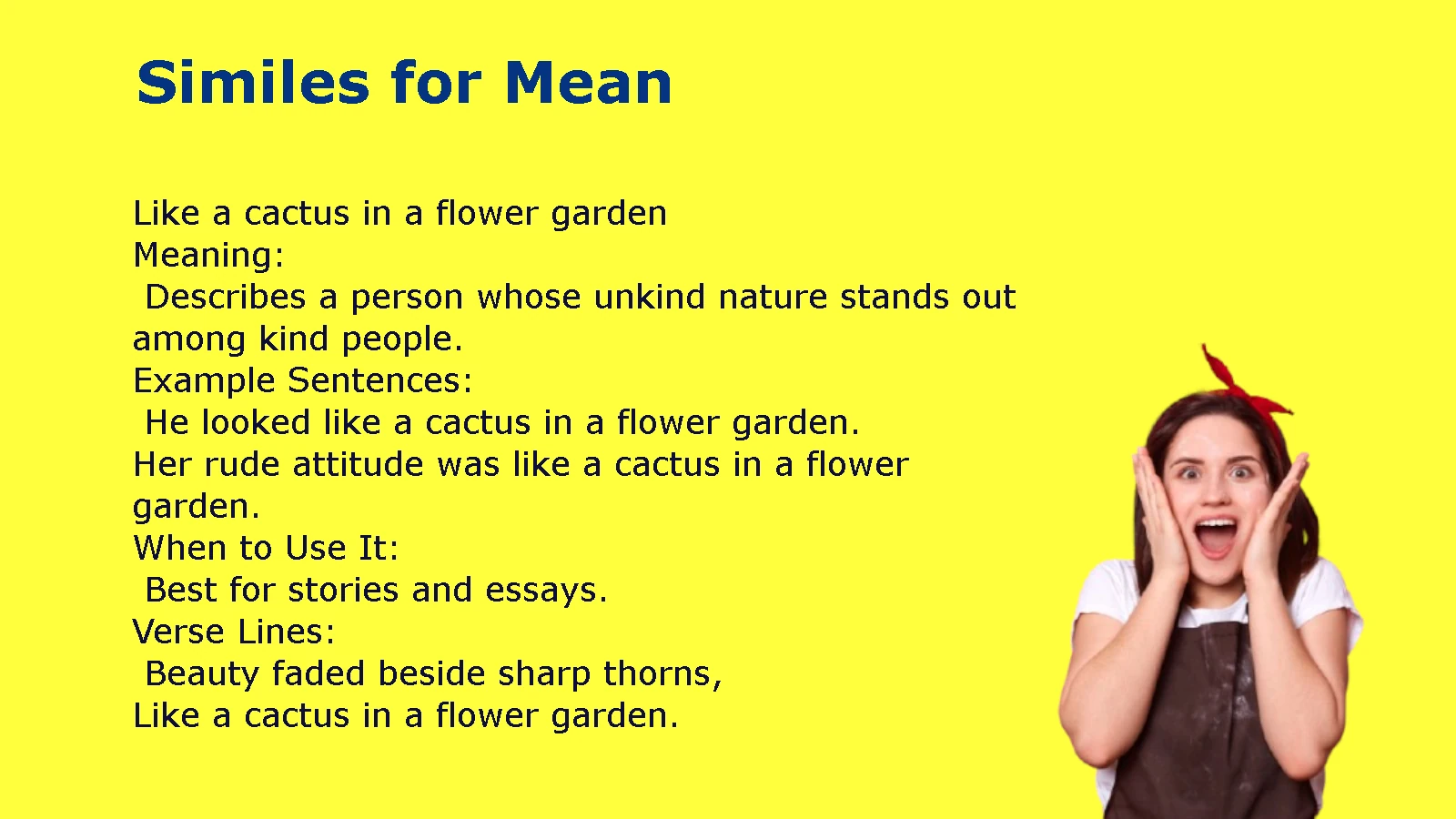
Like a cactus in a flower garden
Meaning:
Describes a person whose unkind nature stands out among kind people.
Example Sentences:
He looked like a cactus in a flower garden.
Her rude attitude was like a cactus in a flower garden.
When to Use It:
Best for stories and essays.
Verse Lines:
Beauty faded beside sharp thorns,
Like a cactus in a flower garden.
Like smoke filling a bright room
Meaning:
Describes someone whose negativity ruins a happy atmosphere.
Example Sentences:
His mood spread like smoke filling a bright room.
She entered like smoke filling a bright room.
When to Use It:
Useful for descriptive scenes.
Verse Lines:
Joy disappeared from every face,
Like smoke filling a bright room.
Like a hawk chasing sparrows
Meaning:
Describes someone who constantly picks on weaker people.
Example Sentences:
The older boy acted like a hawk chasing sparrows.
She criticized beginners like a hawk chasing sparrows.
When to Use It:
Suitable for storytelling.
Verse Lines:
Small wings trembled with fear,
Like a hawk chasing sparrows.
Like poison hidden in honey
Meaning:
Describes fake kindness hiding cruel intentions.
Example Sentences:
Her compliment was like poison hidden in honey.
His smile seemed like poison hidden in honey.
When to Use It:
Ideal for fiction and poetry.
Verse Lines:
Sweet words covered bitter hearts,
Like poison hidden in honey.
Like thunder without warning
Meaning:
Describes sudden bursts of anger or meanness.
Example Sentences:
His temper arrived like thunder without warning.
She shouted like thunder without warning.
When to Use It:
Perfect for dramatic scenes.
Verse Lines:
Peace vanished in a moment,
Like thunder without warning.
Like a cold wind through an open door
Meaning:
Describes someone whose presence makes others uncomfortable.
Example Sentences:
He entered like a cold wind through an open door.
Her attitude felt like a cold wind through an open door.
When to Use It:
Works well in stories and poems.
Verse Lines:
Warm laughter drifted away,
Like a cold wind through an open door.
Like a shadow over sunshine
Meaning:
Describes someone who ruins happy moments.
Example Sentences:
His insults were like a shadow over sunshine.
She arrived like a shadow over sunshine.
When to Use It:
Useful in emotional storytelling.
Verse Lines:
Bright smiles slowly disappeared,
Like a shadow over sunshine.
Like a whip across silence
Meaning:
Describes harsh words that shock everyone.
Example Sentences:
His voice cracked like a whip across silence.
Her criticism landed like a whip across silence.
When to Use It:
Best for dramatic dialogue.
Verse Lines:
Quiet hearts jumped with fear,
Like a whip across silence.
Like a locked gate before kindness
Meaning:
Describes someone unwilling to show compassion.
Meaning:
This comparison highlights a person who refuses to be warm or understanding.
Example Sentences:
He remained like a locked gate before kindness.
She acted like a locked gate before kindness.
When to Use It:
Useful for character development.
Verse Lines:
Mercy waited outside,
Like a locked gate before kindness.
Like ashes where flowers should grow
Meaning:
Describes someone whose meanness destroys happiness.
Example Sentences:
His behavior was like ashes where flowers should grow.
Her cruel words left ashes where flowers should grow.
When to Use It:
Ideal for poetry and reflective writing.
Verse Lines:
Hope searched for spring,
But found ashes where flowers should grow.
Like a blade hiding in velvet
Meaning: Someone who appears gentle but is secretly cruel.
Example Sentences:
She smiled like a blade hiding in velvet.
His compliments were like a blade hiding in velvet.
When to Use It: Hidden cruelty in stories.
Verse Lines:
Soft cloth concealed the pain,
Like a blade hiding in velvet.
Like frost on fresh leaves
Meaning: Describes someone who quickly destroys joy.
Example Sentences:
His words were like frost on fresh leaves.
She acted like frost on fresh leaves.
When to Use It: Nature-themed descriptions.
Verse Lines:
Morning beauty faded away,
Like frost on fresh leaves.
Like a scorpion in a shoe
Meaning: Describes an unexpectedly hurtful person.
Example Sentences:
He proved like a scorpion in a shoe.
Her reply felt like a scorpion in a shoe.
When to Use It: Dramatic storytelling.
Verse Lines:
Hidden pain waited below,
Like a scorpion in a shoe.
Like a fire fed by anger
Meaning: Someone whose cruelty grows stronger over time.
Example Sentences:
His temper burned like a fire fed by anger.
She argued like a fire fed by anger.
When to Use It: Emotional scenes.
Verse Lines:
The flames reached every heart,
Like a fire fed by anger.
Like nails across a chalkboard
Meaning: Describes extremely unpleasant words.
Example Sentences:
His insults were like nails across a chalkboard.
Her laughter sounded like nails across a chalkboard.
When to Use It: Everyday conversation and essays.
Verse Lines:
Harsh sounds filled the air,
Like nails across a chalkboard.
Like a fox guarding chickens
Meaning: Someone who cannot be trusted.
Example Sentences:
He was like a fox guarding chickens.
She acted like a fox guarding chickens.
When to Use It: Stories and fables.
Verse Lines:
Trust slipped away,
Like a fox guarding chickens.
Like cracked earth without rain
Meaning: Describes a heart without compassion.
Example Sentences:
His heart seemed like cracked earth without rain.
She remained like cracked earth without rain.
When to Use It: Poetry and descriptive writing.
Verse Lines:
Kindness searched for a place,
Across cracked earth without rain.
Like a needle in every word
Meaning: Every sentence hurts.
Example Sentences:
His comments were like a needle in every word.
She spoke like a needle in every word.
When to Use It: Conversations and fiction.
Verse Lines:
Tiny pains became deep wounds,
Like a needle in every word.
Like a bear robbed of sleep
Meaning: Describes someone acting constantly grumpy and mean.
Example Sentences:
He behaved like a bear robbed of sleep.
She answered like a bear robbed of sleep.
When to Use It: Informal writing.
Verse Lines:
Morning carried rough voices,
Like a bear robbed of sleep.
Like a trap beneath leaves
Meaning: Hidden cruelty waiting to surprise others.
Example Sentences:
His kindness was like a trap beneath leaves.
She smiled like a trap beneath leaves.
When to Use It: Mystery and fiction.
Verse Lines:
Danger hid in quiet places,
Like a trap beneath leaves.
Like dark clouds over a picnic
Meaning: Someone who ruins enjoyable moments.
Example Sentences:
He arrived like dark clouds over a picnic.
Her complaints spread like dark clouds over a picnic.
When to Use It: Everyday speech.
Verse Lines:
Laughter drifted away,
Like dark clouds over a picnic.
Like rust eating iron
Meaning: Cruelty slowly destroys relationships.
Example Sentences:
His meanness spread like rust eating iron.
Her attitude was like rust eating iron.
When to Use It: Essays and stories.
Verse Lines:
Strong bonds weakened each day,
Like rust eating iron.
Like a broom sweeping away smiles
Meaning: Describes someone who removes happiness.
Example Sentences:
He entered like a broom sweeping away smiles.
Her insults were like a broom sweeping away smiles.
When to Use It: Creative writing.
Verse Lines:
Joy vanished from every face,
Like a broom sweeping away smiles.
Like a shark smelling fear
Meaning: Someone who targets vulnerable people.
Example Sentences:
The bully acted like a shark smelling fear.
She mocked shy students like a shark smelling fear.
When to Use It: Character descriptions.
Verse Lines:
Weak hearts began to race,
Like a shark smelling fear.
Like dust covering a mirror
Meaning: Meanness hides goodness.
Example Sentences:
His attitude was like dust covering a mirror.
Her bitterness felt like dust covering a mirror.
When to Use It: Symbolic writing.
Verse Lines:
Light struggled to shine,
Through dust covering a mirror.
Like winter without sunlight
Meaning: Describes someone completely lacking warmth.
Example Sentences:
She seemed like winter without sunlight.
His greeting felt like winter without sunlight.
When to Use It: Emotional writing.
Verse Lines:
Cold days lingered on,
Like winter without sunlight.
Like a cracked bell ringing
Meaning: Describes hurtful words repeated often.
Example Sentences:
His voice sounded like a cracked bell ringing.
Her insults echoed like a cracked bell ringing.
When to Use It: Poetry and fiction.
Verse Lines:
Every echo carried pain,
Like a cracked bell ringing.
Like weeds choking roses
Meaning: Meanness destroys kindness.
Example Sentences:
His behavior was like weeds choking roses.
Her anger spread like weeds choking roses.
When to Use It: Symbolic descriptions.
Verse Lines:
Beauty fought to survive,
Like weeds choking roses.
Like a hammer on thin glass
Meaning: Extremely damaging words.
Example Sentences:
His joke landed like a hammer on thin glass.
Her insults struck like a hammer on thin glass.
When to Use It: Dramatic writing.
Verse Lines:
Gentle hearts shattered apart,
Like a hammer on thin glass.
Like a thorny vine around hope
Meaning: Cruel behavior traps happiness.
Example Sentences:
His anger wrapped around everyone like a thorny vine around hope.
She lived like a thorny vine around hope.
When to Use It: Poetry and essays.
Verse Lines:
Dreams reached for the sky,
Yet met a thorny vine around hope.
Like smoke after a wildfire
Meaning: Meanness leaves lasting pain.
Example Sentences:
His words lingered like smoke after a wildfire.
Her insults stayed like smoke after a wildfire.
When to Use It: Emotional storytelling.
Verse Lines:
Even after silence came,
Smoke after a wildfire remained.
Like a broken bridge over kindness
Meaning: Someone unable to connect with compassion.
Example Sentences:
He seemed like a broken bridge over kindness.
She acted like a broken bridge over kindness.
When to Use It: Reflective writing.
Verse Lines:
Hearts stood on opposite shores,
Like a broken bridge over kindness.
Like sharp rocks beneath calm water
Meaning: Hidden meanness beneath a pleasant appearance.
Example Sentences:
His smile hid like sharp rocks beneath calm water.
She appeared friendly like sharp rocks beneath calm water.
When to Use It: Character descriptions.
Verse Lines:
Still waters hid deep pain,
Like sharp rocks beneath calm water.
Like an empty well in a drought
Meaning: Describes someone with no kindness to offer.
Example Sentences:
His heart was like an empty well in a drought.
She remained like an empty well in a drought.
When to Use It: Poetry and emotional writing.
Verse Lines:
Compassion searched in vain,
Like an empty well in a drought.
Like a chain around happiness
Meaning: Someone who limits joy through constant cruelty.
Example Sentences:
His attitude was like a chain around happiness.
She spoke like a chain around happiness.
When to Use It: Stories and reflective essays.
Verse Lines:
Smiles struggled to be free,
Like a chain around happiness.
Conclusion
Similes for mean provide a powerful way to describe unpleasant attitudes, harsh actions, and unkind personalities with more creativity and emotion. Instead of simply saying someone is rude, cruel, or unfriendly, similes allow writers to create stronger images that help readers understand the behavior more clearly. Comparisons like these bring characters and situations to life by connecting difficult emotions with familiar objects, animals, and experiences.
Using similes can make stories, poems, essays, and everyday conversations more interesting because they add personality and depth to language. A well-chosen comparison can show the difference between someone who is slightly unpleasant and someone who is truly cold or hurtful. This makes descriptions more accurate and engaging.
The examples shared in this collection of similes for mean can help students, writers, and language learners expand their vocabulary and express ideas more memorably. By practicing these comparisons and understanding when to use them, you can make your writing more colorful and effective.
Keep exploring new ways to describe emotions and behaviors, and you’ll discover how powerful simple comparisons can be in communication.