Silhouette is the correct spelling. It refers to a dark shape or outline of a person, object, or scene shown against a lighter background. Silouette is a common misspelling that can appear when people are unsure about the word’s spelling or vowel order.
Examples:
- The sunset created a beautiful silhouette of the trees.
- Her silhouette was clearly visible against the bright window.
The confusion is understandable. People often search for silhouette vs silouette, silhouette or silouette, which spelling is correct, or silouette meaning because the word contains an unusual sequence of letters that’s easy to mix up. And here’s the kicker: silouette isn’t an alternative spelling with a different meaning. It’s simply a misspelling of silhouette.
In this guide, you’ll learn the complete difference between Silhouette vs Silouette, including their meaning, pronunciation, origin, correct spelling, and usage. You’ll also see clear examples and a simple way to remember how to spell silhouette correctly.
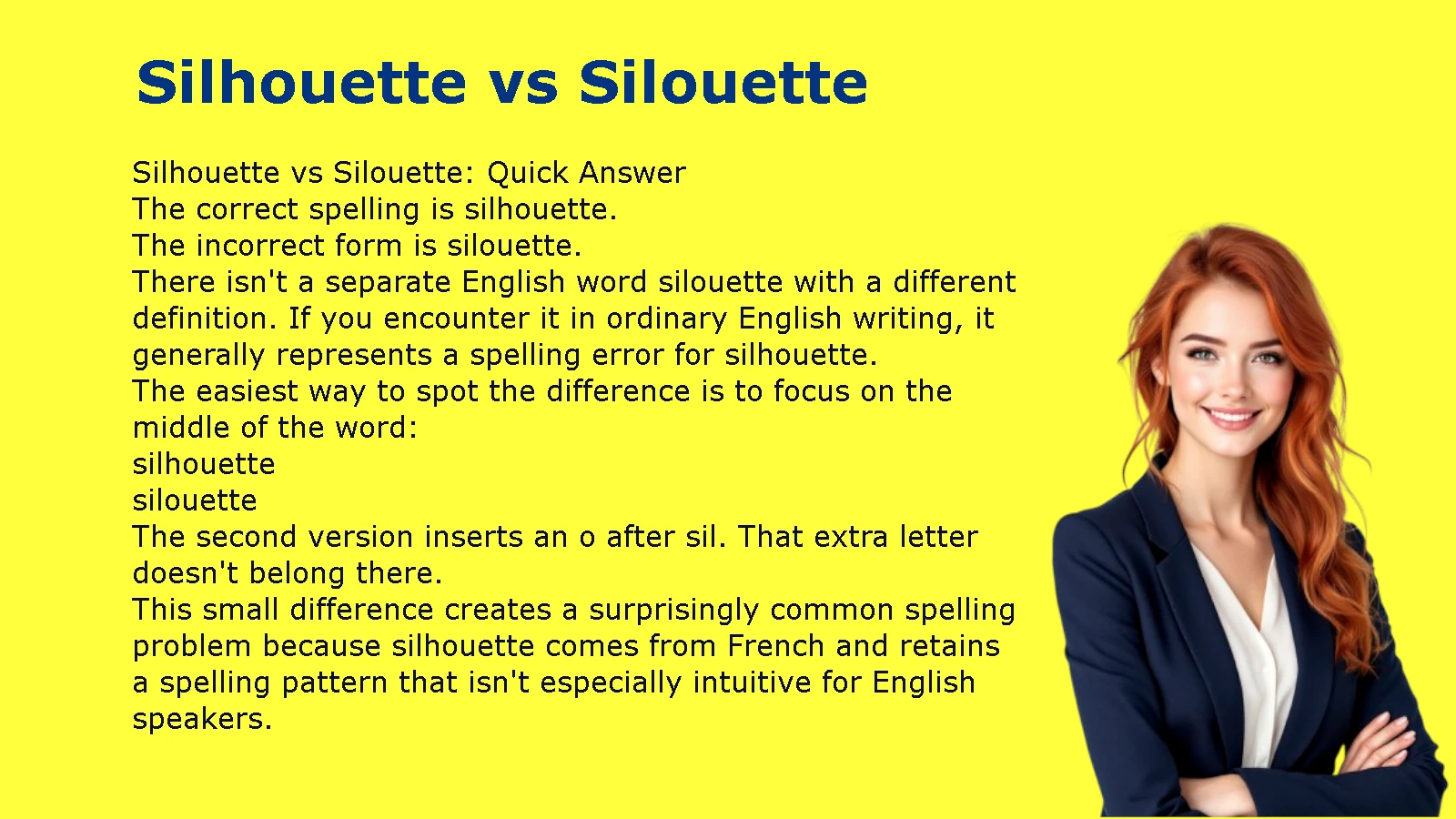
Silhouette vs Silouette: Quick Answer
The correct spelling is silhouette.
The incorrect form is silouette.
There isn’t a separate English word silouette with a different definition. If you encounter it in ordinary English writing, it generally represents a spelling error for silhouette.
The easiest way to spot the difference is to focus on the middle of the word:
silhouette
silouette
The second version inserts an o after sil. That extra letter doesn’t belong there.
This small difference creates a surprisingly common spelling problem because silhouette comes from French and retains a spelling pattern that isn’t especially intuitive for English speakers.
Correct spelling
silhouette
Incorrect spelling
silouette
A useful proofreading trick is to look for that extra o. If the word you’re about to write contains silou…, stop and check it. The standard spelling begins s-i-l-h-o-u…
What Does Silhouette Mean?
A silhouette is a dark shape or outline that appears against a lighter background. The contrast usually hides the object’s details while leaving its outer shape clearly visible. Cambridge Dictionary defines it as a dark shape seen against a light surface or background.
Imagine standing outside at sunset. A person stands between you and the bright orange sky. You can’t see the person’s facial features or clothing details. You can only see the dark shape of their body.
That’s a silhouette.
The same idea applies to objects. A tall building can form a silhouette against the sky. A tree can become a silhouette when the sun sits behind it. An animal can appear as a recognizable dark outline when strong light comes from behind.
The important idea is shape without visible detail.
Silhouette as a Noun
Most commonly, silhouette functions as a noun.
For example:
- The silhouette of the woman appeared in the doorway.
- The mountains formed a jagged silhouette against the sunset.
- The photographer captured the bird’s silhouette against the moon.
- A tall tree stood in silhouette against the pale sky.
In each sentence, the word identifies a visible outline or shape.
A silhouette doesn’t have to be perfectly black in every real-world situation. What matters is the visual effect: the subject appears primarily as a recognizable shape because the lighting or contrast prevents you from seeing its internal details clearly.
Silhouette as a Verb
Silhouette can also function as a verb.
When something silhouettes or is silhouetted, it appears as a dark outline against a lighter background. Cambridge recognizes this verb use and gives examples involving people and objects appearing in strong contrasting light.
For example:
- The bright doorway silhouetted the man.
- The trees were silhouetted against the morning sky.
- The photographer silhouetted the subject against the sunset.
The related forms are straightforward:
| Form | Example |
| silhouette | The mountain formed a silhouette. |
| silhouettes | The sunset silhouettes the trees. |
| silhouetted | The trees were silhouetted against the sky. |
| silhouetting | The bright light was silhouetting the figure. |
The spelling becomes particularly useful to remember here because the same root appears throughout the different forms.
Why Is Silouette Incorrect?
The spelling silouette looks plausible because the pronunciation contains a sound that can make the written form difficult to reconstruct.
English spelling often creates this problem with words borrowed from other languages. A reader hears a word and tries to build the spelling from its sounds. That strategy works reasonably well for some English words. It doesn’t work as reliably for words such as silhouette, whose spelling reflects its French history.
The main error in silouette is the extra o after sil.
Compare the two:
Correct: silhouette
Incorrect: silouette
The correct word contains:
s-i-l-h-o-u-e-t-t-e
The incorrect version contains:
s-i-l-o-u-e-t-t-e
That missing h and added o change the spelling substantially even though the two forms can look deceptively similar.
There’s another reason the error survives so easily: the pronunciation doesn’t strongly signal the written h. Cambridge gives the US pronunciation as /ˌsɪl.əˈwet/ and the UK pronunciation as /ˌsɪl.uˈet/.
In other words, you can’t simply listen to the word and expect the spelling to reveal itself letter by letter.
How to Spell Silhouette Correctly
The correct spelling is:
S-I-L-H-O-U-E-T-T-E
A useful visual strategy is to memorize the unusual middle rather than trying to spell the whole word from sound.
Break the Word Into Parts
You can look at it as:
sil + hou + ette
That isn’t a pronunciation guide or a formal linguistic division. It’s simply a visual memory aid.
The most important part to recognize is silhou.
Once you’ve learned that sequence, the rest becomes much easier:
silhou + ette = silhouette
Another helpful technique is to write the word several times while paying attention to the h:
- silhouette
- silhouette
- silhouette
- silhouette
The goal isn’t to memorize an elaborate mnemonic. It’s to make the unusual letter sequence familiar enough that silouette begins to look wrong.
A Simple Memory Trick
Think:
Silhouette has an H after SIL.
That single checkpoint catches the most obvious spelling mistake.
If you’re unsure while writing, don’t guess based on pronunciation. Check the spelling directly.
Silhouette Pronunciation
The pronunciation can also contribute to the spelling confusion.
Cambridge lists the US pronunciation as /ˌsɪl.əˈwet/ and the UK pronunciation as /ˌsɪl.uˈet/. The stress falls on the final syllable.
The exact vowel quality differs somewhat between US and UK English, but both pronunciations lead to the same standard spelling: silhouette.
The important point is that the word doesn’t sound exactly like its spelling looks.
For English learners, this is a good example of why pronunciation alone isn’t always enough to determine spelling. English has borrowed thousands of words from French and other languages, and some retained unusual letter combinations.
Silhouette is one of them.
Silhouette Examples in Sentences
Seeing the word in different contexts makes its meaning and spelling easier to remember.
Everyday Examples
- I could see the silhouette of a person standing behind the curtain.
- The palm trees created striking silhouettes against the sunset.
- Her silhouette appeared clearly in the doorway.
- The bird’s silhouette was visible against the bright moon.
- The old church created a distinctive silhouette on the horizon.
Photography Examples
Photographers often use backlighting to create silhouettes.
When the light source sits behind the subject, the camera may capture the subject primarily as a dark shape. This removes many interior details while emphasizing the outer contour.
For example:
The photographer captured the runner’s silhouette against the setting sun.
The sentence doesn’t mean the runner disappeared. It means the lighting made the runner’s outer shape stand out while reducing visible detail.
Art Examples
Silhouette art traditionally emphasizes a subject’s profile or outline rather than internal shading and detail.
For example:
The artist created a simple silhouette of the woman’s profile.
Historically, profile portraits cut from dark paper became closely associated with the word. That connection helps explain why silhouette can refer not only to a naturally occurring dark shape but also to an artistic representation.
Nature Examples
Nature provides countless silhouettes:
- trees against a sunset
- mountains against the sky
- birds against a bright moon
- buildings against the horizon
- people standing in doorways
- animals crossing bright open backgrounds
The common feature is contrast.
Silhouette vs Silouette in a Sentence
When you need the word in a sentence, use silhouette.
Correct
The silhouette of the tree stood out against the orange sky.
I could see her silhouette through the frosted glass.
The mountain’s silhouette became clearer as the sun went down.
Incorrect
The silouette of the tree stood out against the orange sky.
I could see her silouette through the frosted glass.
The meaning remains understandable in the incorrect examples, but the spelling is still wrong.
For polished writing, replace silouette with silhouette.
Common Mistakes With Silhouette
The extra o in silouette isn’t the only spelling issue people can encounter. Because the word contains an unusual combination of letters, writers sometimes rearrange or omit letters.
The safest approach is to verify each variant rather than assuming that every form you see online represents a legitimate alternative spelling.
Silouette
Silouette is an incorrect spelling of silhouette.
The problem is the replacement of the correct h sequence with an o.
Incorrect: silouette
Correct: silhouette
Silouet
Silouet is also incorrect in standard English. It omits letters from the established spelling.
Incorrect: silouet
Correct: silhouette
Don’t treat silouet as a shorter spelling. It isn’t the standard English form.
Silhuette
Silhuette can result from moving letters around or omitting the o from the correct sequence.
Incorrect: silhuette
Correct: silhouette
Again, the standard English word remains silhouette.
Silouhette
This version combines multiple spelling changes and should not be used as an alternative spelling.
Incorrect: silouhette
Correct: silhouette
When discussing spelling mistakes, it’s important to distinguish genuine variants from errors. A misspelled form may appear online many times without becoming an accepted spelling.
Silhouette or Silouette: Which One Should You Use?
Use silhouette.
That’s the entire spelling decision.
| If you’re writing… | Use |
| A school assignment | silhouette |
| A business document | silhouette |
| A website article | silhouette |
| A social media caption | silhouette |
| A photo description | silhouette |
| A creative story | silhouette |
| A professional email | silhouette |
There is no need to switch between silhouette and silouette based on region or writing style. Silouette isn’t a US-versus-UK spelling difference.
The standard English spelling is silhouette.
The Origin of the Word Silhouette
The history of silhouette is one of the more interesting parts of this spelling question.
Unlike many words whose origins are uncertain, silhouette has a documented connection to a real historical person: Étienne de Silhouette, a French finance minister who served in 1759.
The English word ultimately came from French silhouette. The Online Etymology Dictionary traces the English noun to the late 18th century and connects it with Étienne de Silhouette.
The story involves the fashion for inexpensive profile portraits.
During the 18th century, profile images could be produced as simple black outlines or cut-paper portraits. These were much cheaper than elaborate painted portraits. The term became associated with Silhouette’s name during his brief period as France’s finance minister.
There are competing explanations for exactly why his name became attached to these portraits. The commonly repeated account connects the term with his reputation for financial austerity. Other historical explanations point to the timing of the fashion or other associations with his name. The underlying connection between the French word and Étienne de Silhouette is well established, while the precise mechanism behind the naming has been explained in more than one way.
The English word later broadened beyond profile portraits.
According to the etymological record, silhouette came to refer more generally to a dark outline or shadow in profile by the 19th century. The verb developed later from the noun.
Why the Origin Matters for the Spelling
The history helps explain why silhouette doesn’t look like a typical English word.
It’s a French borrowing.
English didn’t build the word from familiar English spelling patterns. Instead, it adopted a form that came through French and preserved much of its unusual appearance.
That makes the spelling easier to understand historically, even if it doesn’t make it easier to spell from memory.
Silhouette and Its French Connection
Modern French still uses silhouette, although the French pronunciation differs from English pronunciation.
The French form refers to a person’s shape or figure and can also describe the outline or shape of an object. Cambridge’s French-English dictionary reflects these meanings.
This is useful because it shows how the English meaning developed from a broader European history of the word rather than from an ordinary English root.
The spelling remained distinctive as the word entered English.
That’s why trying to spell it entirely by sound can lead you toward forms such as silouette.
Silhouette Synonyms
Several words can overlap with silhouette, but they aren’t always exact replacements.
Useful related words include:
- outline
- profile
- contour
- shape
- figure
- form
The right choice depends on what you want to describe.
For example, an outline can simply be the outer line of an object. A silhouette usually carries the stronger visual idea of a shape appearing dark against a lighter background.
A profile can describe a side view of a person’s face or body. It doesn’t necessarily imply the same lighting conditions as a silhouette.
A contour emphasizes the boundary or shape of something. It also has technical uses in areas such as geography and anatomy.
So while these words overlap, they aren’t interchangeable in every sentence.
Silhouette vs Outline
Silhouette and outline are closely related, but the distinction matters.
An outline is the line or boundary that defines the outside edge of something. Dictionary definitions include the line by which a figure or object is bounded.
A silhouette, on the other hand, usually presents the subject as a visible shape, often dark against a lighter background.
Consider these two examples:
She drew the outline of the house.
This tells you that she drew the house’s outer boundary.
Now compare:
The house appeared as a silhouette against the sunset.
This creates a specific visual scene. The house stands out as a dark shape against the bright sky.
The words overlap, but silhouette is more visually specific.
| Word | Main idea | Example |
| Silhouette | A recognizable shape, often dark against light | The castle formed a silhouette against the sunset. |
| Outline | The boundary or outer line of something | She drew the outline of the castle. |
| Contour | The shape or boundary of a surface or object | The artist studied the contour of the face. |
| Profile | A side view or distinctive outline | The statue showed the profile of a face. |
Silhouette vs Profile
A profile usually describes a side view or the distinctive shape of something viewed from a particular angle.
For instance:
The artist drew her profile.
This commonly suggests a side view of the person’s face.
A silhouette can also show a person’s profile, especially in traditional silhouette portraits. However, the word emphasizes the solid visual shape and lack of interior detail, not simply the angle from which the subject is viewed.
That distinction becomes clear in photography.
A person standing in front of a bright sunset may appear as a silhouette even when you’re viewing their body from the front.
So:
Profile = a particular view or outline.
Silhouette = a visible shape created by contrast and reduced interior detail.
Silhouette in Fashion
The word has also developed a specialized use in fashion.
A garment’s silhouette refers to its overall shape or the broad form created when someone wears it. This usage extends beyond the literal idea of a dark shape.
For example, fashion writing might describe:
- a fitted silhouette
- a relaxed silhouette
- a straight silhouette
- an oversized silhouette
- a dramatic silhouette
In this context, nobody is necessarily standing against a bright background.
Instead, silhouette describes the overall visual form of the clothing.
The historical development of this sense is documented in the word’s etymology, which records a fashion-related meaning for the outline created by clothing by the early 20th century.
This broader meaning explains why you might encounter the word in fashion articles even when there is no shadow or backlighting involved.
Silhouette in Art and Design
Artists and designers use silhouettes because they reduce a complicated subject to its most recognizable shape.
That reduction can make an image striking.
A detailed portrait may contain hundreds of visual elements: eyes, hair, skin tones, clothing textures, shadows, and highlights. A silhouette removes nearly all of that information and leaves the outer form.
Yet the viewer can often still identify the subject.
That’s the power of a silhouette.
A familiar object may remain recognizable even when its internal details disappear. A bird’s wings, a person’s posture, a building’s roofline, or a tree’s branches can all communicate identity through shape alone.
Why Silhouettes Work So Well Visually
Silhouettes rely heavily on contrast.
When the subject and background have strongly different brightness levels, the boundary becomes easy to see. That makes the outer shape more prominent.
The effect is particularly useful in:
- photography
- graphic design
- logos
- posters
- theater
- animation
- illustration
- fashion
- paper-cut art
The simpler the internal image becomes, the more important the outer contour becomes.
Silhouette in Photography
Photographers often create silhouettes deliberately by placing a subject between the camera and a bright light source.
A sunset is the classic example.
Suppose the sky behind a person is much brighter than the person. If the exposure emphasizes the bright background, the person’s body may appear almost completely dark.
The resulting photograph can communicate:
- posture
- movement
- location
- emotion
- scale
- shape
without revealing facial details.
A silhouette can therefore tell a visual story with very little information.
A Simple Silhouette Spelling Case Study
Consider a writer describing a photograph:
Draft version
The silouette of the woman stood against the sunset.
The meaning is obvious, but the spelling is incorrect.
Corrected version
The silhouette of the woman stood against the sunset.
Only a few letters changed, yet the second sentence uses the standard English word.
Now consider a more complex sentence:
The photographer captured the silhouette of a cyclist as he crossed the bridge at sunset.
Here, silhouette describes the cyclist’s recognizable dark shape against the brighter background.
The word works naturally because the context supplies exactly the visual conditions associated with a silhouette.
Why People Often Misspell Silhouette
Several factors can make this word difficult.
The pronunciation isn’t fully predictable from the spelling
Cambridge’s US pronunciation is /ˌsɪl.əˈwet/, while the UK pronunciation is /ˌsɪl.uˈet/.
That means someone who has heard the word many times may still be uncertain about how its letters fit together.
The word contains an unusual letter sequence
The combination silhou isn’t common in everyday English vocabulary.
When a word contains an unfamiliar sequence, writers naturally try to reshape it into something that looks more familiar.
That’s one reason silouette can feel plausible at first glance.
The word comes from French
Borrowed words often preserve spelling patterns that don’t follow the most common English rules.
The history of silhouette traces it through French and ultimately connects the word to Étienne de Silhouette.
Knowing that doesn’t automatically solve the spelling problem, but it explains why the word behaves differently from a simple English word.
Silhouette Plural and Related Forms
The plural of silhouette is silhouettes.
Examples:
- The silhouettes of the trees filled the horizon.
- Several silhouettes appeared behind the screen.
- The artist created a collection of paper silhouettes.
The verb forms are also derived from the same spelling:
- silhouette
- silhouettes
- silhouetted
- silhouetting
Dictionary.com lists these forms and recognizes both noun and verb uses.
Notice that the unusual spelling remains intact.
silhouette → silhouettes → silhouetted → silhouetting
Learning the base word correctly therefore helps with all of its common forms.
Frequently Asked Questions About Silhouette vs Silouette
Is silhouette or silouette correct?
Silhouette is correct.
Silouette is a misspelling.
Is silouette a word?
Silouette is not the standard English spelling of the word. Use silhouette instead.
How do you spell silhouette?
The correct spelling is:
silhouette
It contains h after sil:
s-i-l-h-o-u-e-t-t-e
Why is silhouette so hard to spell?
The word has an unusual spelling and comes through French. Its pronunciation also doesn’t reveal every letter clearly, which can encourage phonetic misspellings such as silouette.
What is the meaning of silhouette?
A silhouette is a dark shape or outline seen against a lighter background. The word can also describe the general shape of an object, person, or garment.
Is silhouette a noun or a verb?
It can be both.
As a noun, it refers to a dark shape or outline.
The silhouette of the mountain was beautiful.
As a verb, it means to show or represent something as a silhouette.
The bright light silhouetted the trees.
What is the plural of silhouette?
The plural is silhouettes.
The silhouettes of the buildings appeared against the sky.
What is the difference between silhouette and outline?
An outline is the outer boundary or line of something. A silhouette usually refers to the recognizable shape of something, particularly when it appears dark against a lighter background.
What is the difference between silhouette and profile?
A profile generally refers to a side view or outline. A silhouette emphasizes the overall visible shape, often with the subject appearing as a dark form against a contrasting background.
Does silhouette have an H?
Yes.
The correct spelling is:
silhouette
The h appears immediately after sil.
Does silhouette have an O?
Yes, but its position matters.
The correct spelling is:
silhouette
It contains h-o-u after sil.
The incorrect spelling silouette removes the h and places the o directly after sil.
Is silhouette a French word?
The English word silhouette came from French silhouette. Its history is associated with Étienne de Silhouette, the French finance minister who served in 1759.
What does silhouetted mean?
Silhouetted means shown or appearing as a silhouette.
For example:
The trees were silhouetted against the bright sky.
Cambridge lists silhouetted as an adjective and gives examples of objects appearing as outlines against contrasting backgrounds.
Silhouette vs Silouette: Final Answer
When choosing between silhouette vs silouette, the correct choice is clear:
Silhouette = correct
Silouette = incorrect
Silhouette can mean a dark shape seen against a lighter background, an outline or general shape, or an artistic representation of a profile. It can also function as a verb.
The spelling can feel tricky because the word has a French history and an unusual combination of letters. Its pronunciation doesn’t neatly reveal the spelling either.
The easiest rule to remember is simple:
Don’t write silouette. Write silhouette.
If the word starts looking like silou…, check for the missing h.
Once silhouette becomes familiar, the spelling becomes much easier to recognize. And whether you’re describing a person against a sunset, a mountain on the horizon, a paper-cut portrait, or the overall shape of a garment, silhouette is the standard word to use.