Receive vs Recieve is a common spelling confusion, especially because the two words look almost identical. If you’ve ever wondered whether “receive” or “recieve” is the correct spelling, the answer is straightforward: receive is the correct standard English spelling, while recieve is a common misspelling. The confusion usually comes from the placement of “i” and “e,” making this pair a frequent source of spelling mistakes in everyday writing.
The receive vs recieve distinction is important because receive is a correctly spelled English verb meaning to get, accept, or be given something. For example, you might receive a message, receive an email, receive a gift, or receive payment. On the other hand, recieve does not have a standard dictionary meaning in modern English and should not be used in formal, academic, professional, or everyday writing.
In this guide, you’ll learn which spelling is correct, what “receive” means, why “recieve” is incorrect, how to remember the correct spelling, and how to use “receive” correctly in sentences. You’ll also see clear examples, common spelling mistakes, pronunciation guidance, and a simple explanation of the “i before e” spelling rule and its exceptions.
By the end, you’ll know exactly why receive is correct, why recieve is incorrect, and how to avoid this common spelling mistake whenever you write.
Quick Answer: Receive or Recieve?
Receive is the only standard spelling of the word.
| Spelling | Correct? | Meaning |
| receive | ✅ Yes | To get, be given, accept, or otherwise take something |
| recieve | ❌ No | A misspelling of receive |
Correct examples
- I will receive the package tomorrow.
- Did you receive my email?
- She received an award for her work.
- We have received your application.
- They are receiving visitors this afternoon.
Incorrect examples
- I will recieve the package tomorrow. ❌
- Did you recieve my email? ❌
- She recieved an award. ❌
- We are recieving payments. ❌
The mistake does not create a different word or a different meaning. Recieve is simply an incorrect spelling of receive.
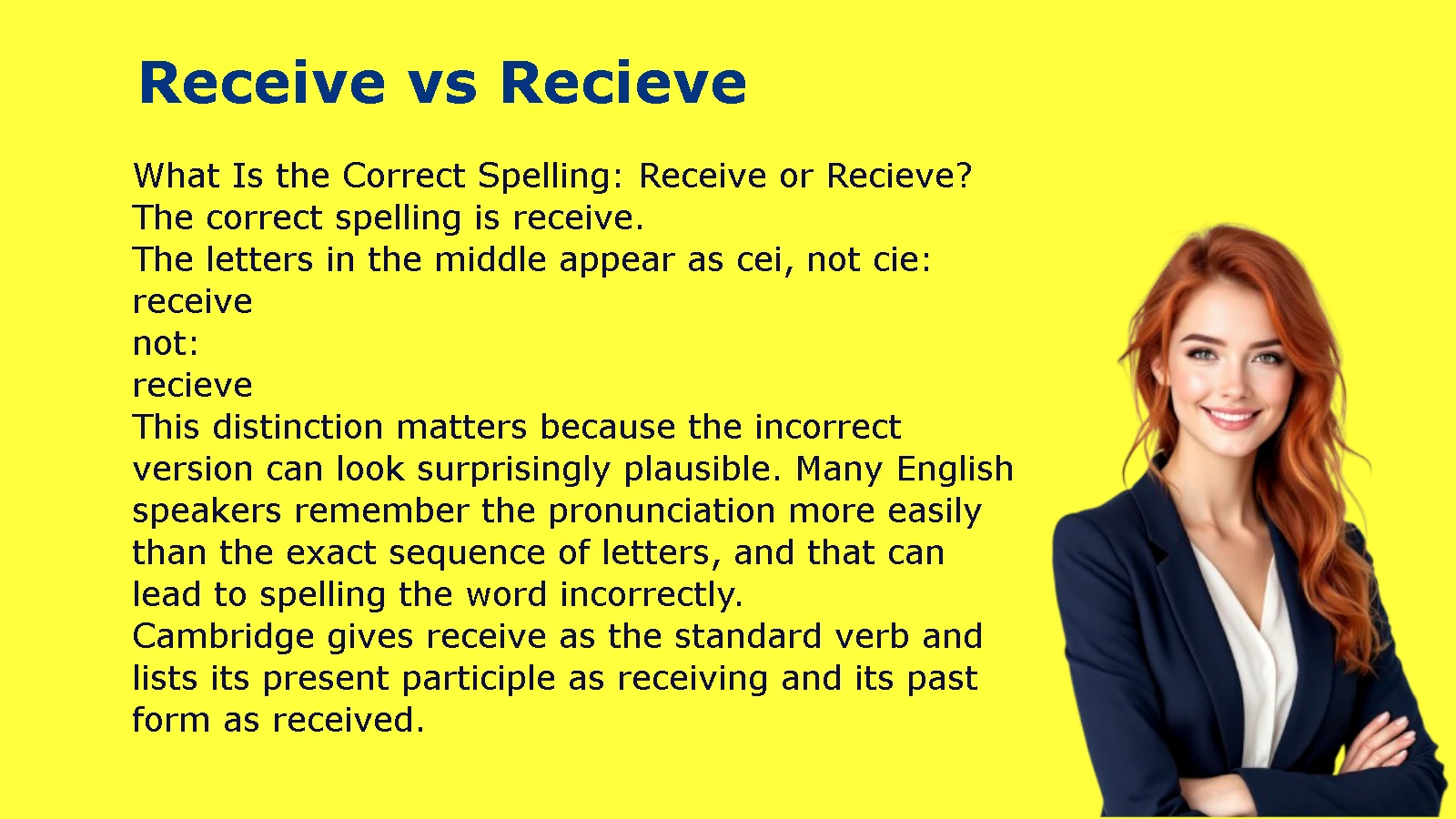
What Is the Correct Spelling: Receive or Recieve?
The correct spelling is receive.
The letters in the middle appear as cei, not cie:
receive
not:
recieve
This distinction matters because the incorrect version can look surprisingly plausible. Many English speakers remember the pronunciation more easily than the exact sequence of letters, and that can lead to spelling the word incorrectly.
Cambridge gives receive as the standard verb and lists its present participle as receiving and its past form as received.
What does receive mean?
In its most common sense, receive means to get or be given something.
For example:
I received your letter yesterday.
Here, received means that the letter reached me and I got it.
You can receive many different things:
- a letter
- an email
- a text message
- a package
- money
- payment
- information
- an invitation
- an award
- a gift
- permission
- feedback
- support
- treatment
The word can also describe how something is reacted to:
The proposal was well received.
In that sentence, received means that people reacted favorably to the proposal. Cambridge records this use as well as several other meanings.
Is receive a noun or a verb?
Receive is a verb.
It describes an action or process involving getting, accepting, welcoming, experiencing, or taking in something.
For example:
I receive several emails every day.
The verb changes according to tense and grammatical context:
- receive
- receives
- received
- receiving
Receive Meaning and Definition
The central meaning of receive is to get or be given something.
Cambridge defines it in this sense as getting something that someone has given or sent to you.
For example:
She received a letter from her brother.
The person did not necessarily go somewhere to collect the letter. The important point is that the letter was delivered to her and she got it.
Receive can describe many types of things
Receive a message
Did you receive my text?
Receive a package
I received the package this morning.
Receive payment
The company received payment on Friday.
Receive an invitation
We received an invitation to the conference.
Receive an award
The researcher received an award for her work.
Receive information
The team received new information about the project.
Receive permission
The students received permission to leave early.
The exact object changes, but the basic idea remains the same: something comes to the person or organization described by the verb.
Receive vs Recieve: The Key Difference
There is only one standard English spelling:
receive
The form recieve should not be used in standard English.
| Feature | Receive | Recieve |
| Standard English spelling | ✅ Yes | ❌ No |
| Part of speech | Verb | — |
| Meaning | Get, be given, accept, etc. | No standard meaning |
| Used in formal writing | ✅ Yes | ❌ No |
| Used in US English | ✅ Yes | ❌ No |
| Used in British English | ✅ Yes | ❌ No |
| Past tense | received | Incorrect: recieved |
| -ing form | receiving | Incorrect: recieving |
One useful point is that receive does not have a separate British spelling. Both American and British English use receive. Cambridge lists the same spelling in its US and UK dictionary entries.
So recieve is not a British variant.
It is simply a spelling error.
Why Is Receive Spelled With “ei”?
The spelling of receive is closely associated with the familiar spelling mnemonic:
“i before e, except after c.”
In receive, the letters come after c, so the sequence is ei:
rec + ei + ve
That gives you:
receive
This makes the word easier to remember:
After c, use ei: receive.
However, it is important not to treat “i before e, except after c” as an absolute rule for every English word. English has many spelling patterns and exceptions.
For receive, though, the c + ei pattern is a useful memory aid.
Words with a similar spelling pattern
Several familiar words have ei after c:
- receive
- deceive
- conceive
- perceive
Compare them:
| Word | Correct middle pattern |
| receive | cei |
| deceive | cei |
| conceive | cei |
| perceive | cei |
Seeing these words together can help reinforce the pattern.
A practical memory trick
Instead of trying to remember the entire word at once, focus on:
c + ei
Then build the word:
re + c + ei + ve
→ receive
This is more useful than trying to visualize all seven letters every time.
Why Do People Spell Receive as Recieve?
The misspelling recieve is understandable because English spelling often does not match pronunciation perfectly.
Several factors can contribute to the mistake.
Confusion about “ie” and “ei”
The most obvious problem is deciding which sequence comes first:
- ie
- ei
Someone who remembers the general “i before e” phrase may write:
recieve
But the correct spelling is:
receive
The c provides the useful clue.
Pronunciation does not reveal every letter
The word receive is pronounced approximately /rɪˈsiːv/ in both British and US English.
The pronunciation tells you how the word sounds, but it does not tell you that the middle must be written cei.
That is common in English. Spelling often preserves historical forms that cannot be reconstructed perfectly from pronunciation alone.
Writing from memory
People frequently make spelling mistakes when they know a word well enough to use it but have not consciously memorized its letter sequence.
That is especially common with words containing:
- ie/ei
- double consonants
- silent letters
- unusual suffixes
- letters that do not have obvious pronunciation cues
Receive falls into the first category.
Related words can also cause confusion
You may know words such as:
- believe
- achieve
- relieve
- piece
These commonly contain ie.
Then you encounter:
- receive
- deceive
- perceive
- conceive
The change in letter order can create uncertainty.
The best solution is to remember receive as part of the -ceive word family.
Receive Examples in Sentences
Seeing the correct spelling in different contexts is one of the easiest ways to reinforce it.
Receiving a message
I received your message this morning.
Receiving an email
Did you receive the email I sent yesterday?
Receiving a package
The customer will receive the package within three business days.
Receiving payment
The supplier has received payment in full.
Receiving an invitation
We were pleased to receive your invitation.
Receiving an award
She received an award for her research.
Receiving information
The committee received additional information before making its decision.
Receiving permission
The students received permission to use the laboratory.
Receiving feedback
The writer received useful feedback from her editor.
Receiving support
The organization received financial support from several donors.
Receiving treatment
The patient is receiving treatment at the hospital.
These examples show why receive is such a flexible verb. It is not limited to physical objects.
Receive in Different Contexts
The meaning of receive can become more specific depending on the context.
Receive in communication
In communication, receive usually means that information reaches someone.
Examples:
Did you receive my email?
I received your voicemail.
We received the instructions yesterday.
The office received hundreds of applications.
This usage is particularly common in business and professional writing because receive is more precise than the informal get.
Compare:
I got your email.
and:
I received your email.
Both are grammatically correct. The second sounds more neutral and formal.
Receive money or payment
Receive is also commonly used for money.
The company received payment on Monday.
She receives a monthly salary.
The charity received several donations.
Here, receive describes money coming into someone’s possession.
Receive an award
You can receive something that is formally given to you because of an achievement.
He received an award for outstanding service.
The researcher received a major grant.
She received a scholarship.
Receive visitors
The verb can also mean to formally welcome guests.
The host received the guests at the entrance.
Cambridge specifically records this meaning of receive: to formally welcome a visitor or guest.
This is more formal than simply saying:
The host greeted the guests.
Receive a reaction
Receive can describe how people react to an idea, performance, speech, book, or other work.
The film was well received by critics.
Her proposal was warmly received.
The announcement was poorly received.
This construction is particularly useful in formal writing.
Does Receive Always Mean “Get”?
No.
Get is the closest everyday equivalent in many situations, but receive has a wider range of established uses.
For example:
I received your email.
Here, receive means get.
But:
The audience received the announcement warmly.
Here, it refers to the audience’s reaction.
And:
The ambassador received the guests.
Here, it means formally welcomed them.
Cambridge also records receive in contexts involving radio and television signals and sports.
So replacing receive with get in every sentence would not preserve the meaning.
Receive vs Received
A frequent mistake is not the spelling of receive itself but choosing the wrong form.
Receive
Receive is the base form.
I receive several emails each day.
You will receive confirmation soon.
They may receive additional funding.
Receives
Receives is the third-person singular present form.
She receives dozens of messages every day.
The company receives applications throughout the year.
He receives regular updates.
Received
Received is the simple past form and also the past participle.
I received your letter yesterday.
She received the payment last week.
We have received your application.
Receiving
Receiving is the present participle and gerund form.
We are receiving applications now.
She is receiving treatment.
Receiving feedback can help improve your writing.
Cambridge identifies receiving as the present participle and received as the past tense and past participle.
Receive vs Received vs Receiving
| Form | Grammatical role | Example |
| receive | Base verb | I will receive the package. |
| receives | Third-person singular present | She receives the package every month. |
| received | Past tense | She received the package yesterday. |
| received | Past participle | She has received the package. |
| receiving | Present participle/gerund | She is receiving the package now. |
Common spelling mistakes in these forms
The incorrect spelling often follows the same ie/ei confusion:
- recieve ❌ → receive ✅
- recieved ❌ → received ✅
- recieving ❌ → receiving ✅
Notice that the correct forms consistently preserve the cei sequence.
Receive vs Recieve Examples: Correct and Incorrect
The following table gives common mistakes and their corrections.
| Incorrect | Correct |
| I will recieve your email. | I will receive your email. |
| Did you recieve the package? | Did you receive the package? |
| She recieved an award. | She received an award. |
| We have recieved your application. | We have received your application. |
| They are recieving payments. | They are receiving payments. |
| He recieves hundreds of messages. | He receives hundreds of messages. |
| I hope you recieve this letter. | I hope you receive this letter. |
| The company recieved several complaints. | The company received several complaints. |
The correction is consistent:
recieve → receive
recieved → received
recieving → receiving
recieves → receives
Receive vs Recieve in American and British English
Unlike some English spelling differences, receive is spelled the same in American and British English.
| Variety | Correct spelling |
| American English | receive |
| British English | receive |
| Canadian English | receive |
| Australian English | receive |
This means you do not need to choose between receive and recieve based on geography.
For comparison, English has genuine regional spelling differences such as:
- color / colour
- center / centre
- organize / organise
But recieve is not the British version of receive.
Both major varieties use receive.
Is Recieve Ever Correct?
No, not as the standard spelling of the English verb receive.
You may encounter recieve in:
- social media posts
- comments
- text messages
- emails
- online forums
- drafts
- documents containing typing mistakes
Its appearance in real-world writing does not make it an accepted alternative spelling.
For standard English, use:
receive
not:
recieve
This distinction is especially important in academic, professional, and published writing.
Receive in Formal Writing
Receive is completely appropriate in formal English.
You can use it in:
- business emails
- academic papers
- applications
- reports
- legal documents
- professional correspondence
- customer-service messages
- official notices
For example:
We have received your application and will review it shortly.
This sounds natural and professional.
Another example:
Please confirm that you have received the attached documents.
Again, received is the correct form.
Why spelling matters in professional writing
A single typo does not automatically make writing unclear. Most readers will understand recieve from context.
However, repeated spelling errors can make otherwise polished writing look careless.
Compare:
We have recieved your application and will recieve a response shortly.
with:
We have received your application and will provide a response shortly.
The first contains two spelling errors. The second is clean and professional.
Common Mistakes With Receive
Writing “Recieve” instead of “Receive”
This is the main spelling mistake.
Incorrect:
Please recieve the documents.
Correct:
Please receive the documents.
Writing “Recieved” instead of “Received”
The same letter-order mistake appears in the past tense.
Incorrect:
I recieved your message.
Correct:
I received your message.
Writing “Recieving” instead of “Receiving”
The -ing form keeps the spelling pattern.
Incorrect:
We are recieving new orders.
Correct:
We are receiving new orders.
Writing “Recieves” instead of “Receives”
The third-person singular form is:
receives
not:
recieves
Correct:
The office receives hundreds of applications each month.
Treating “Recieve” as a regional spelling
This is another misconception.
Recieve is not an American/British spelling difference.
It is a misspelling.
How to Remember the Spelling of Receive
The easiest memory strategy is to focus on the letters immediately after c.
Remember: C + EI
Think:
After C, use EI in receive.
So:
re + cei + ve
→ receive
You can reinforce the pattern with related words:
- receive
- deceive
- conceive
- perceive
All contain cei.
Use the word family
Instead of memorizing receive as an isolated word, recognize its related forms:
receive → received → receiving → receiver → reception
For example:
I receive emails.
I am receiving emails.
The receiver confirmed delivery.
The reception of the message was delayed.
The spelling connection becomes easier to see when the words are grouped together.
A quick visual trick
Remember:
reCEIve
The capitalized portion highlights the part that commonly causes trouble.
If you see reCIEve, stop and check it.
Receive vs Accept: What’s the Difference?
Both can overlap, but they are not always interchangeable.
Receive generally focuses on getting or being given something.
Accept often emphasizes willingness, agreement, approval, or consent.
Compare:
I received the invitation.
This tells us that the invitation reached me.
I accepted the invitation.
This tells us that I agreed to attend.
You can do both:
I received the invitation and accepted it.
That sentence makes the distinction particularly clear.
Another example
The university received her application.
This means the application arrived.
The university accepted her application.
This means the university approved the application.
Receiving an application does not necessarily mean accepting it.
That distinction is important in business, education, hiring, and administrative communication.
Receive vs Get: What’s the Difference?
Get is much more general and usually more conversational.
Receive is often more precise or formal when something is delivered, awarded, transmitted, or officially given.
Compare:
I got your email.
I received your email.
Both are correct.
The first sounds more conversational. The second is neutral and often more suitable for professional communication.
Another comparison:
She got an award.
She received an award.
Both work, but received an award is a standard formal expression.
Cambridge’s thesaurus lists get, obtain, acquire, secure, and other words as context-dependent alternatives to receive.
Receive Synonyms
The best synonym depends on what is being received.
| Receive can mean | Possible synonym |
| Get something | get |
| Obtain something | obtain |
| Gain something | gain |
| Acquire something | acquire |
| Be given something | be given |
| Secure something | secure |
| Accept something | accept |
| Welcome someone | welcome |
| React to something | respond to / react to |
These are not interchangeable in every sentence.
For example:
I received your email.
You can say:
I got your email.
But welcome your email changes the meaning.
Likewise:
The hotel received its guests.
does not mean exactly the same thing as:
The hotel acquired its guests.
Context determines the appropriate alternative.
Common Collocations With Receive
A collocation is a combination of words that commonly appears together.
Learning common collocations can make your English sound more natural.
Receive a message
I received your message this morning.
Receive an email
We received an email from the client.
Receive a response
You should receive a response within five business days.
Receive payment
The company has received payment.
Receive an award
She received an award for her contribution.
Receive an invitation
We were delighted to receive an invitation.
Receive feedback
Students receive feedback after each assignment.
Receive permission
You must receive permission before entering the facility.
Receive support
The project received financial support.
Receive information
The investigators received new information.
Receive treatment
The patient is receiving treatment.
These combinations are useful because they show how naturally receive functions across different areas of English.
Is Receive Grammatically Correct?
Yes. Receive is a standard transitive verb.
A transitive verb normally takes an object.
For example:
I received the package.
Here:
- I = subject
- received = verb
- the package = object
Receive + noun
She received an invitation.
We received your application.
They received the payment.
Receive + something + from someone
I received a letter from my sister.
The company received a complaint from a customer.
Receive in the passive voice
Receive also appears frequently in passive constructions:
The application was received yesterday.
The proposal was well received.
The documents were received by the office.
This is especially common in formal and administrative writing.
Receive and Its Word Family
Understanding related forms can make the spelling easier.
| Word | Part of speech | Example |
| receive | Verb | I receive emails daily. |
| receives | Verb | She receives emails daily. |
| received | Verb/adjective | We received the package. |
| receiving | Verb/gerund | They are receiving payment. |
| receiver | Noun | The receiver confirmed delivery. |
| reception | Noun | The reception of the signal was poor. |
| recipient | Noun | The recipient received the award. |
The forms are related historically and semantically, although their spelling does not remain identical throughout.
The word receive itself dates to around the early 14th century in English and ultimately traces through Old French to Latin recipere, meaning roughly to take back, take in, or take to oneself.
That history also helps explain why the spelling is not simply based on modern pronunciation.
The History of the Word Receive
Receive is an old English word with roots that go back through French to Latin.
The Online Etymology Dictionary traces it to Middle English receiven, from Old North French receivre and Old French recoivre, ultimately from Latin recipere. The Latin word carried meanings connected with taking back, taking in, accepting, or admitting.
Over time, receive developed several related meanings.
Its historical uses include:
- taking something into possession
- accepting something
- welcoming someone
- catching something
- obtaining something as a reward
- accepting an idea or authority
- experiencing an injury or blow
Later, receive developed technical uses connected with radio and television signals. The Online Etymology Dictionary dates the radio/television sense to the early 20th century.
This history explains why receive can appear in contexts that seem quite different at first glance.
Receive in Technology and Broadcasting
The word isn’t limited to people receiving physical objects.
A device can receive a signal.
For example:
The television receives digital signals.
The radio cannot receive the signal clearly.
Cambridge records this technical sense, explaining that radio or television equipment can receive a signal and convert it into sounds or pictures.
The same general concept appears in modern technology:
- receive a signal
- receive data
- receive a transmission
- receive a notification
- receive a request
- receive a connection
The basic idea remains the same: something is transmitted or sent, and another person, device, or system takes it in.
Receive in Sports
Receive also has specific uses in sports.
For example:
The player received the ball near the halfway line.
In sports such as tennis, volleyball, and cricket, receive can refer to dealing with a ball or serve directed toward you. Cambridge includes this sporting sense in its dictionary entry.
Examples:
She is ready to receive the serve.
The midfielder received the ball and passed it forward.
The batter received the next delivery.
This is another reason why receive cannot always be replaced with the simple word get.
Case Study: Correcting Receive in a Professional Email
Consider this sentence:
We have recieved your application and will recieve the supporting documents shortly.
There are two spelling mistakes.
Incorrect
We have recieved your application and will recieve the supporting documents shortly.
Corrected
We have received your application and will receive the supporting documents shortly.
The corrections are:
- recieved → received
- recieve → receive
The meaning of the sentence does not change. Only the spelling is corrected.
Why this matters
Professional writing often contains repeated words such as receive, received, and receiving.
Once you learn the underlying pattern, you can correct the entire word family rather than memorizing one form at a time.
Case Study: Receive vs Accept
Consider an application process.
The university received 5,000 applications.
This means the applications arrived at the university.
It does not mean that all 5,000 applicants were admitted.
Now compare:
The university accepted 800 applicants.
That describes an approval decision.
The distinction can be summarized as:
receive = get or take in
accept = agree to take, approve, or admit
This difference is particularly important in official writing because replacing one word with the other can change the factual meaning of a sentence.
A Quick Editing Test for Receive vs Recieve
Before publishing an article, email, essay, or report, search your document for:
recieve
If you find it, replace it with:
receive
Then search for these related errors:
- recieved
- recieving
- recieves
Correct them to:
- received
- receiving
- receives
Five-second test
Which sentence is correct?
A. I hope you recieve my message.
B. I hope you receive my message.
The answer is:
B. I hope you receive my message.
Another:
A. She recieved the package.
B. She received the package.
The answer is:
B. She received the package.
Receive vs Recieve: A Simple Spelling Checklist
When you are unsure, use this checklist:
- Receive is the correct spelling.
- The middle contains cei, not cie.
- Remember c + ei.
- Received is the past form.
- Receiving is the -ing form.
- Receives is the third-person singular form.
- Recieve is not a standard alternative spelling.
- Recieved is also incorrect.
- Recieving is also incorrect.
- Receive is spelled the same in American and British English.
The most useful visual memory aid is:
reCEIve
Frequently Asked Questions About Receive vs Recieve
Is receive or recieve correct?
Receive is correct. Recieve is a misspelling and should not be used in standard English.
How do you spell receive correctly?
The correct spelling is:
R-E-C-E-I-V-E
A useful way to remember it is re + cei + ve.
Why is receive spelled with “ei”?
The ei follows c, which fits the familiar spelling pattern often expressed as “i before e, except after c.” For receive, remembering c + ei is a useful practical spelling aid.
Is recieve a real word?
Recieve can appear in real-world writing as a spelling mistake, but it is not the standard spelling of the English verb. Use receive instead.
What is the past tense of receive?
The past tense is received.
I received your letter yesterday.
Is received spelled with ie or ei?
It is spelled with ei after c:
received
not:
recieved
What is the -ing form of receive?
The -ing form is receiving.
We are receiving applications now.
Not:
We are recieving applications. ❌
Is receive spelled differently in British English?
No. Receive is spelled the same in British and American English. Cambridge lists the same spelling for both varieties.
What does receive mean?
Most commonly, receive means to get or be given something.
She received a package.
It can also mean to formally welcome someone, react to something, receive a signal, or receive a ball in certain sports.
What are some synonyms for receive?
Depending on the context, possible synonyms include get, obtain, acquire, gain, secure, accept, and be given. These alternatives are not interchangeable in every sentence.
What is the difference between receive and accept?
Receive generally means to get or be given something.
Accept can mean to willingly take something, agree to something, approve something, or admit something.
For example:
I received the invitation.
I accepted the invitation.
The first says the invitation arrived. The second says I agreed to it.
What is the easiest way to remember receive?
Remember:
After C, use EI: receive.
You can also connect it with deceive, conceive, and perceive, which use the same cei pattern.
Final Answer: Receive Is Correct
When comparing receive vs recieve, there is no standard spelling choice to make.
Receive is correct.
Recieve is incorrect.
The most useful thing to remember is the middle of the word:
reCEIve
The same pattern carries into related forms:
- receive
- receives
- received
- receiving
The verb means to get, be given, accept, welcome, or take in something, depending on the context. It can describe receiving an email, package, payment, award, invitation, information, signal, or even a ball in sports.
It is also important to distinguish receive from accept. Receiving an application, for example, does not necessarily mean approving it.
If you are proofreading your writing, remember these four corrections:
| Incorrect | Correct |
| recieve | receive |
| recieved | received |
| recieving | receiving |
| recieves | receives |
So, whenever you hesitate between receive or recieve, choose receive.
Correct: I hope you receive my message.
Incorrect: I hope you recieve my message.
That simple c + ei pattern will help you avoid one of the most common spelling mistakes involving ie and ei.













