Pretty vs Preety is a common spelling question among English learners and writers. Pretty is the correct spelling, while preety is a misspelling. The word pretty describes someone or something attractive, pleasing, or beautiful. It can also work as an adverb meaning fairly or quite, as in “pretty good” or “pretty interesting.” Understanding its spelling, pronunciation, meaning, synonyms, and everyday usage will help you avoid mistakes and communicate more clearly.
| Question | Answer |
| Is it pretty or preety? | Pretty is the correct spelling. |
| Is preety a real English word? | No. Preety is a common misspelling of pretty. |
| What does pretty mean? | Attractive, pleasing, or fairly, depending on context. |
| What is the Hindi meaning of pretty? | सुंदर, खूबसूरत, or आकर्षक. |
| How do you pronounce pretty? | /ˈprɪt.i/ (two syllables). |
Pretty vs Preety: Which Spelling Is Correct?
Pretty is the correct spelling in standard English. Preety is incorrect and does not appear as a standard English word with an accepted dictionary meaning. Use pretty when describing an attractive person, a pleasant place, or something visually appealing.
For example:
- Correct: She wore a pretty dress to the party.
- Incorrect: She wore a preety dress to the party.
The difference comes down to the arrangement of the letters. Pretty contains one E followed by two Ts, while preety places an extra E before the T.
Although the incorrect version may look reasonable to some writers, it does not follow the established spelling of the English word.
Pretty or Preety: Quick Spelling Comparison
The following table shows the difference between both spellings.
| Word | Correct or Incorrect | Explanation |
| Pretty | Correct | Standard English spelling |
| Preety | Incorrect | Common misspelling |
| Pretty girl | Correct | Proper adjective and noun combination |
| Preety girl | Incorrect | Contains a spelling error |
| Pretty woman | Correct | Standard English expression |
| Preety woman | Incorrect | Incorrect spelling |
The correct spelling remains pretty regardless of the noun that follows it. You can write pretty girl, pretty woman, pretty dress, or pretty flowers.
Why Do People Spell Pretty as Preety?
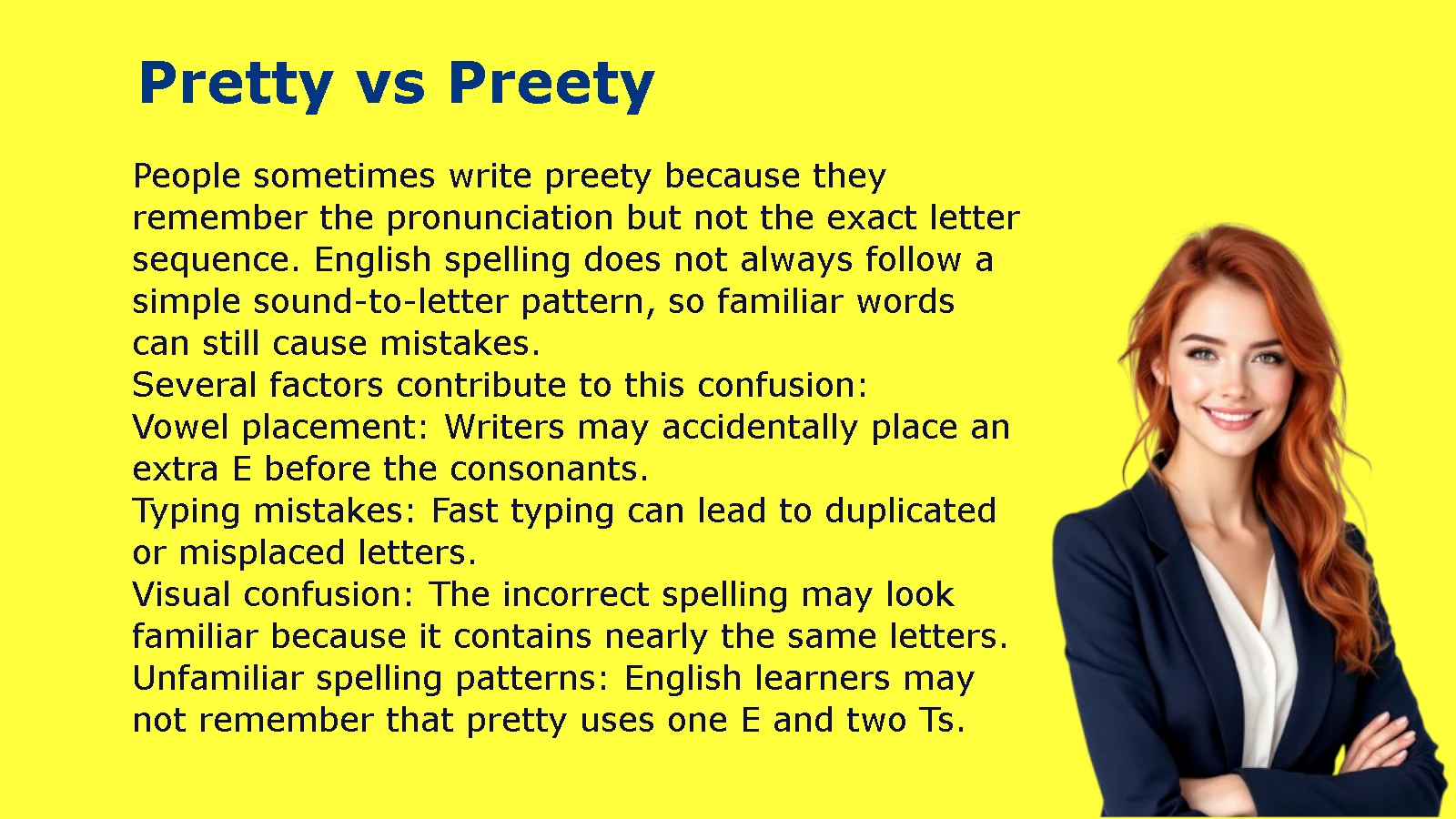
People sometimes write preety because they remember the pronunciation but not the exact letter sequence. English spelling does not always follow a simple sound-to-letter pattern, so familiar words can still cause mistakes.
Several factors contribute to this confusion:
- Vowel placement: Writers may accidentally place an extra E before the consonants.
- Typing mistakes: Fast typing can lead to duplicated or misplaced letters.
- Visual confusion: The incorrect spelling may look familiar because it contains nearly the same letters.
- Unfamiliar spelling patterns: English learners may not remember that pretty uses one E and two Ts.
A simple way to remember the correct spelling is to focus on the middle of the word: PRETTY. There is only one E before the double T.
Pretty or Preety: Which One Should You Use?
Always use pretty in formal writing, academic assignments, professional emails, social media posts, and everyday communication.
Consider these examples:
- Your daughter looks pretty in that photograph.
- We visited a pretty village during our vacation.
- The presentation has a pretty simple design.
- That was a pretty good performance.
Using preety instead can make your writing look careless and may distract readers from your message.
What Does Pretty Mean?
Pretty generally means attractive, pleasant, or pleasing to look at. People commonly use it to describe someone’s appearance, clothing, decorations, and surroundings. The word also functions as an adverb, where it means fairly or quite. Its exact meaning depends on how you use it in a sentence.
The word has two main grammatical roles:
| Part of Speech | Meaning | Example |
| Adjective | Attractive or pleasing | She has a pretty smile. |
| Adverb | Fairly or quite | The examination was pretty difficult. |
Recognizing these two uses helps you understand sentences without confusing the meaning.
Pretty Meaning as an Adjective
As an adjective, pretty describes something attractive, appealing, or pleasant to see. It often refers to physical appearance, but you can also use it for objects, places, patterns, and decorative details.
For example:
- She bought a pretty necklace for her sister.
- The garden looks pretty in spring.
- That is a pretty little house.
- He gave her a pretty greeting card.
- The village has pretty streets and colorful buildings.
In these examples, pretty describes the appearance of a person or thing.
The word often suggests a pleasant or delicate kind of attractiveness. It does not always communicate the same intensity as beautiful or gorgeous.
For instance, a pretty flower may have attractive colors and a pleasing shape. Calling the same flower beautiful can express a stronger appreciation of its appearance.
Pretty Meaning as an Adverb
Pretty can also function as an adverb. In this role, it modifies an adjective or another adverb and usually means fairly, quite, or reasonably.
For example:
- The movie was pretty interesting.
- She is pretty good at mathematics.
- The weather feels pretty cold today.
- I am pretty sure about the answer.
- He finished the assignment pretty quickly.
Here, pretty does not describe physical beauty. Instead, it adds emphasis to another description.
Compare these sentences:
| Sentence | Meaning |
| She looks pretty. | She looks attractive. |
| She is pretty intelligent. | She is fairly or quite intelligent. |
| This is a pretty house. | The house looks attractive. |
| This house is pretty expensive. | The house is fairly expensive. |
The surrounding words determine which meaning applies.
Pretty Meaning in Hindi
The Hindi meaning of pretty depends on its grammatical role and the context of the sentence.
When used as an adjective, common Hindi translations include:
- सुंदर
- खूबसूरत
- आकर्षक
- मनमोहक
When used as an adverb, pretty can mean:
- काफी
- बहुत हद तक
- कुछ हद तक
Consider these examples:
| English Sentence | Hindi Meaning |
| She is pretty. | वह सुंदर है। |
| What a pretty dress! | कितनी खूबसूरत पोशाक है! |
| She has a pretty face. | उसका चेहरा सुंदर है। |
| The movie was pretty good. | फिल्म काफी अच्छी थी। |
| I am pretty tired. | मैं काफी थका हुआ हूँ। |
The translation changes according to the intended meaning. For example, translating pretty good as खूबसूरत अच्छा would be incorrect because pretty functions as an adverb in that expression.
Pretty Girl Meaning
A pretty girl is a girl or young woman who has an attractive or pleasing appearance. The adjective pretty describes her appearance, while girl identifies the person.
People commonly use this expression in everyday conversations, descriptions, stories, and compliments.
Examples:
- She is a pretty girl with a lovely smile.
- The pretty girl standing near the window is my cousin.
- Everyone noticed the pretty girl in the photograph.
- He gave the pretty girl a compliment about her dress.
The expression describes physical attractiveness. It does not automatically tell you anything about someone’s personality, intelligence, character, or abilities.
You can also use words such as beautiful, charming, lovely, and attractive when describing someone.
Beautiful vs Pretty: What’s the Difference?
Pretty and beautiful both describe attractiveness, but they can communicate different levels and types of appeal. Pretty often suggests a pleasant, delicate, or charming appearance, while beautiful can express a stronger or broader sense of beauty. Beautiful also describes qualities beyond physical appearance, including art, nature, personality, and experiences.
Although people sometimes use these words interchangeably, their meanings are not identical in every situation.
Meaning and Strength of Pretty
Pretty usually describes something attractive in a pleasant, graceful, or appealing way.
It often appears in casual conversations and everyday descriptions.
Examples:
- She wore a pretty blue dress.
- That is a pretty painting.
- What a pretty garden!
- Your handwriting looks pretty.
The word can also sound softer and less intense than beautiful.
For example, saying “You look pretty” offers a friendly compliment. It focuses on someone’s attractive appearance without necessarily expressing a deeper emotional response.
Meaning and Strength of Beautiful
Beautiful describes something that creates a strong sense of attractiveness, pleasure, or admiration.
It can refer to physical appearance, but its meaning extends much further.
Examples:
- She has a beautiful smile.
- The mountains look beautiful at sunrise.
- That was a beautiful performance.
- He has a beautiful personality.
- We shared a beautiful moment together.
Unlike pretty, beautiful can describe emotional experiences, meaningful actions, artistic achievements, and natural scenery.
Pretty vs Beautiful Comparison Table
| Feature | Pretty | Beautiful |
| Basic meaning | Attractive or pleasing | Very attractive or full of beauty |
| Common usage | Everyday conversations | Everyday and formal conversations |
| Emotional strength | Often softer | Often stronger |
| Physical appearance | Yes | Yes |
| Nature and scenery | Yes | Yes |
| Personality | Less common | Common |
| Art and experiences | Yes | Yes |
| Example | A pretty dress | A beautiful painting |
Pretty vs Beautiful: Example Sentences
Understanding both words becomes easier when you compare them in similar contexts.
Describing a person:
- She is a pretty girl with bright eyes.
- She is a beautiful woman with a confident personality.
Describing clothing:
- She bought a pretty summer dress.
- She wore a beautiful wedding gown.
Nature:
- We found a pretty garden behind the house.
- The mountain view was beautiful.
Describing an experience:
- It was a pretty enjoyable evening.
- It was a beautiful and unforgettable evening.
Both adjectives can describe attractive things. However, beautiful often communicates a stronger or more meaningful impression.
Pretty Pronunciation and Spelling
The correct spelling is pretty, and its standard English pronunciation is /ˈprɪt.i/. The word has two syllables, with stress on the first syllable. It begins with the same vowel sound found in words such as sit and fit. Learning its pronunciation alongside its spelling can help you recognize and remember the word.
How to Pronounce Pretty
Pretty has two syllables:
- First syllable: /prɪ/
- Second syllable: /ti/
The stress falls on the first syllable.
In everyday American English, the T sound may become a quick flap, making it sound closer to a soft D. However, the underlying pronunciation remains the same.
A few words with a similar opening vowel sound include:
- Pretty
- Prettyish
- Prince
- Prison
Practice saying pretty in complete sentences:
- She looks pretty today.
- That is a pretty interesting idea.
- I bought a pretty notebook.
Practicing the word in context helps you become more comfortable using it naturally.
How to Spell Pretty Correctly
The correct spelling contains six letters:
P-R-E-T-T-Y
Remember these spelling details:
- The word begins with P.
- It contains one E.
- It has two consecutive Ts.
- It ends with Y.
A common mistake is writing PREETY, but the correct middle sequence is E-T-T, not E-E-T.
Here is a simple spelling comparison:
| Correct | Incorrect |
| Pretty | Preety |
| Pretty girl | Preety girl |
| Pretty dress | Preety dress |
| Pretty flowers | Preety flowers |
Spelling of Pretty Girl
The correct spelling is pretty girl, with pretty functioning as an adjective and girl functioning as a noun.
The adjective describes the noun and does not need a different spelling.
Examples:
- She is a pretty girl.
- I saw a pretty girl at the library.
- The pretty girl was wearing a yellow dress.
- That pretty girl has a wonderful smile.
Remember that pretty remains unchanged whether you use it with a singular or plural noun.
For example:
- Singular: a pretty girl
- Plural: pretty girls
You do not write pretties girls or preety girls in these sentences.
Pretty Synonyms: Other Words You Can Use
Pretty synonyms are words that express similar ideas, including attractiveness, charm, beauty, and pleasant appearance. Common alternatives include beautiful, lovely, attractive, gorgeous, charming, cute, elegant, and stunning. The best synonym depends on what you describe and how strongly you want to express its appeal.
Not every synonym works in every sentence. Some words describe physical beauty, while others suggest elegance, affection, or general attractiveness.
Common Synonyms for Pretty
Here are useful alternatives with their meanings and typical contexts.
| Synonym | Meaning or Usage |
| Beautiful | Very attractive or pleasing |
| Lovely | Attractive, delightful, or pleasant |
| Attractive | Appealing in appearance |
| Gorgeous | Extremely attractive |
| Charming | Pleasant and appealing |
| Cute | Attractive in an endearing way |
| Elegant | Graceful and stylish |
| Stunning | Extremely impressive or beautiful |
| Adorable | Very appealing or lovable |
| Delightful | Pleasant and enjoyable |
| Graceful | Attractive through smooth or elegant movement |
| Exquisite | Extremely beautiful and detailed |
For example, you can replace pretty with lovely when describing a pleasant experience or with elegant when describing something graceful and stylish.
Synonyms for Pretty When Describing a Person
When describing someone, choose a synonym that matches the type of compliment you want to give.
Beautiful: She has a beautiful smile.
Lovely: She is a lovely person.
Gorgeous: She looked gorgeous at the wedding.
Charming: He has a charming personality.
Attractive: She is an attractive and confident woman.
Elegant: The woman looked elegant in her formal dress.
These words have slightly different meanings. Gorgeous often communicates strong physical attractiveness, while charming can refer to personality and behavior.
Synonyms for Pretty When Describing Something
Pretty can also describe objects, places, decorations, and natural surroundings.
Here are some alternatives:
- Pleasant: The room has a pleasant appearance.
- Lovely: We visited a lovely little village.
- Delicate: The necklace has delicate details.
- Appealing: The design looks appealing.
- Decorative: The wall has decorative patterns.
- Attractive: The building has an attractive exterior.
Choosing the right word makes your descriptions more precise and helps you avoid repeating pretty throughout your writing.
How to Use Pretty in Everyday English
Pretty appears frequently in everyday English because it can describe physical attractiveness and modify other descriptions. You can use it before a noun as an adjective or before an adjective or adverb as an adverb. Understanding these grammatical patterns helps you construct natural sentences.
Pretty as an Adjective: Examples
As an adjective, pretty generally appears before a noun or after a linking verb.
Common patterns include:
- Pretty + noun
- Subject + linking verb + pretty
Examples:
- She bought a pretty handbag.
- The flowers look pretty in the sunlight.
- We stayed in a pretty hotel.
- My grandmother has a pretty garden.
- That is a pretty picture.
- The little girl wore a pretty pink dress.
- Their house looks pretty from the outside.
- I received a pretty birthday card.
In each sentence, pretty describes the appearance of a person or object.
You can also use it with more descriptive phrases:
- A pretty little cottage
- A pretty blue necklace
- A pretty floral design
- A pretty young woman
Pretty as an Adverb: Examples
As an adverb, pretty usually appears before an adjective or another adverb.
It adds a degree of emphasis without necessarily suggesting the highest possible level.
Examples:
- The assignment was pretty easy.
- She sings pretty well.
- I am pretty confident about my decision.
- The restaurant was pretty expensive.
- He arrived pretty late.
- The weather is pretty pleasant today.
- We finished the project pretty quickly.
- That explanation sounds pretty reasonable.
Notice that pretty modifies easy, well, confident, expensive, late, pleasant, quickly, and reasonable.
This grammatical use is common in informal and conversational English.
Pretty Good: Meaning and Usage
Pretty good means fairly good or quite good. It describes something that has a positive quality, but it does not necessarily suggest perfection or excellence.
People commonly use this expression when discussing performance, quality, skills, experiences, and results.
Examples:
- Your presentation was pretty good.
- The food at that restaurant was pretty good.
- I feel pretty good today.
- She is pretty good at playing the piano.
- The movie was pretty good, although the ending was predictable.
The phrase can express genuine satisfaction without making an exaggerated claim.
Consider these expressions:
| Expression | Meaning |
| Not bad | Acceptable or reasonably good |
| Pretty good | Fairly or quite good |
| Very good | Good to a high degree |
| Excellent | Extremely good |
| Outstanding | Exceptionally impressive |
The exact strength of pretty good depends on context and the speaker’s tone.
For example, if someone asks whether you enjoyed a movie and you respond, “It was pretty good,” you are expressing a positive opinion. However, you may not consider it your favorite movie.
Pretty Good or Pretty Good: Is There a Difference?
There is no spelling or meaning difference between the two identical expressions pretty good and pretty good.
Both use pretty as an adverb and good as an adjective.
The phrase is grammatically correct and works in many everyday situations.
Examples:
- The new laptop is pretty good.
- Your English is pretty good.
- We had a pretty good weekend.
- The restaurant serves pretty good food.
If you encounter the search phrase “pretty good or pretty good,” understand that it repeats the same expression rather than presenting two different spelling choices.
The more useful comparison is pretty good versus very good, which shows how the degree of emphasis changes.
Common Mistakes When Using Pretty
Although pretty is a familiar English word, writers sometimes make spelling and grammar mistakes when using it. Understanding these errors can improve your writing and help you choose the correct word for each sentence.
Writing Preety Instead of Pretty
This is the most common spelling confusion addressed by the pretty vs preety comparison.
Incorrect: She looks preety in that dress.
Correct: She looks pretty in that dress.
The correction requires only one change: remove the extra E and keep the double T.
Remember the correct spelling whenever you write the word, whether it describes a person, place, object, or experience.
Confusing Pretty With Beautiful
Pretty and beautiful share a similar meaning, but they do not always communicate the same level of attractiveness.
For example:
- She has a pretty face.
- She has a beautiful personality.
The first sentence describes physical appearance. The second describes someone’s personal qualities.
You can use both words for appearance, but beautiful has a wider range of applications.
Using Pretty Incorrectly as an Adverb
Some writers understand pretty only as a word that describes appearance. However, it can also modify adjectives and adverbs.
Incorrect: The movie was a pretty interesting.
Correct: The movie was pretty interesting.
In the correct sentence, pretty modifies interesting. You do not need the article a because pretty functions as an adverb.
Another example:
Incorrect: She is pretty a good singer.
Correct: She is a pretty good singer.
Here, the article a belongs before the adjective phrase pretty good.
Confusing Pretty Good With Very Good
Pretty good and very good both express positive opinions, but they can suggest different levels of quality.
For example:
- The service was pretty good.
- The service was very good.
The first statement communicates reasonable satisfaction. The second generally expresses stronger approval.
However, tone and context can change how listeners interpret both expressions.
Pretty vs Preety: Quick Comparison and Key Takeaways
The main difference between pretty and preety is spelling. Pretty is the accepted English word, while preety is an incorrect spelling. Once you understand this distinction, you can use the word confidently in descriptions, compliments, and everyday expressions.
| Question | Correct Answer |
| Pretty or preety? | Pretty |
| Is preety a word? | No, it is a misspelling. |
| What does pretty mean? | Attractive, pleasing, fairly, or quite |
| What is pretty’s pronunciation? | /ˈprɪt.i/ |
| What does pretty girl mean? | An attractive girl |
| What does pretty woman mean? | An attractive woman |
| What does pretty good mean? | Fairly good or quite good |
| What are pretty synonyms? | Lovely, beautiful, charming, and attractive |
| What is pretty in Hindi? | सुंदर, खूबसूरत, or आकर्षक |
| Is pretty an adjective or adverb? | It can function as both. |
A Simple Way to Remember Pretty
Use these tips to avoid the spelling mistake:
- Remember that pretty contains one E.
- Keep the two Ts together.
- Practice writing P-R-E-T-T-Y.
- Read the word in complete sentences.
- Check spelling before publishing important content.
For example, write “She looks pretty” rather than “She looks preety.”
A quick spelling check can prevent an otherwise simple mistake from appearing in your emails, assignments, articles, or social media posts.
Frequently Asked Questions
Is it pretty or preety?
Pretty is the correct spelling in standard English. Preety is an incorrect spelling and does not have an established standard English meaning. Use pretty when describing an attractive person, a pleasant place, or something visually appealing.
Why do people spell pretty as preety?
People sometimes write preety because they confuse the vowel arrangement or make typing mistakes. The correct spelling contains one E followed by two Ts. Remembering the sequence P-R-E-T-T-Y helps prevent this error.
What is the meaning of pretty in Hindi?
Pretty generally means सुंदर, खूबसूरत, or आकर्षक when used as an adjective. When it functions as an adverb, it can mean काफी or कुछ हद तक. For example, pretty good means काफी अच्छा, not खूबसूरत अच्छा.
Is pretty a synonym for beautiful?
Yes, pretty and beautiful are related synonyms because both describe attractiveness. However, pretty often suggests a pleasant or delicate appearance, while beautiful can express a stronger sense of beauty and describe personality, nature, art, and experiences.
What does pretty good mean?
Pretty good means fairly good or quite good. It expresses a positive opinion without necessarily suggesting perfection. For example, saying “The food was pretty good” means you enjoyed it or found its quality satisfactory.
How do you pronounce pretty?
Pretty is pronounced /ˈprɪt.i/. It has two syllables, with stress on the first. The opening vowel sounds like the vowel in sit and fit. In everyday American English, the T may sound like a quick flap.
Conclusion: Always Choose Pretty, Not Preety
The correct spelling is pretty, not preety. Pretty is a versatile English word that works as both an adjective and an adverb. It can describe an attractive person, a beautiful object, or a pleasant place. It can also express degree in phrases such as pretty good, pretty interesting, and pretty expensive.
Remember the correct spelling: P-R-E-T-T-Y. Use the word naturally, choose suitable synonyms when necessary, and pay attention to its meaning in different grammatical contexts.
If you are improving your English vocabulary, practice using pretty in your own sentences. A little attention to spelling and word choice can make your everyday writing clearer and more accurate.













