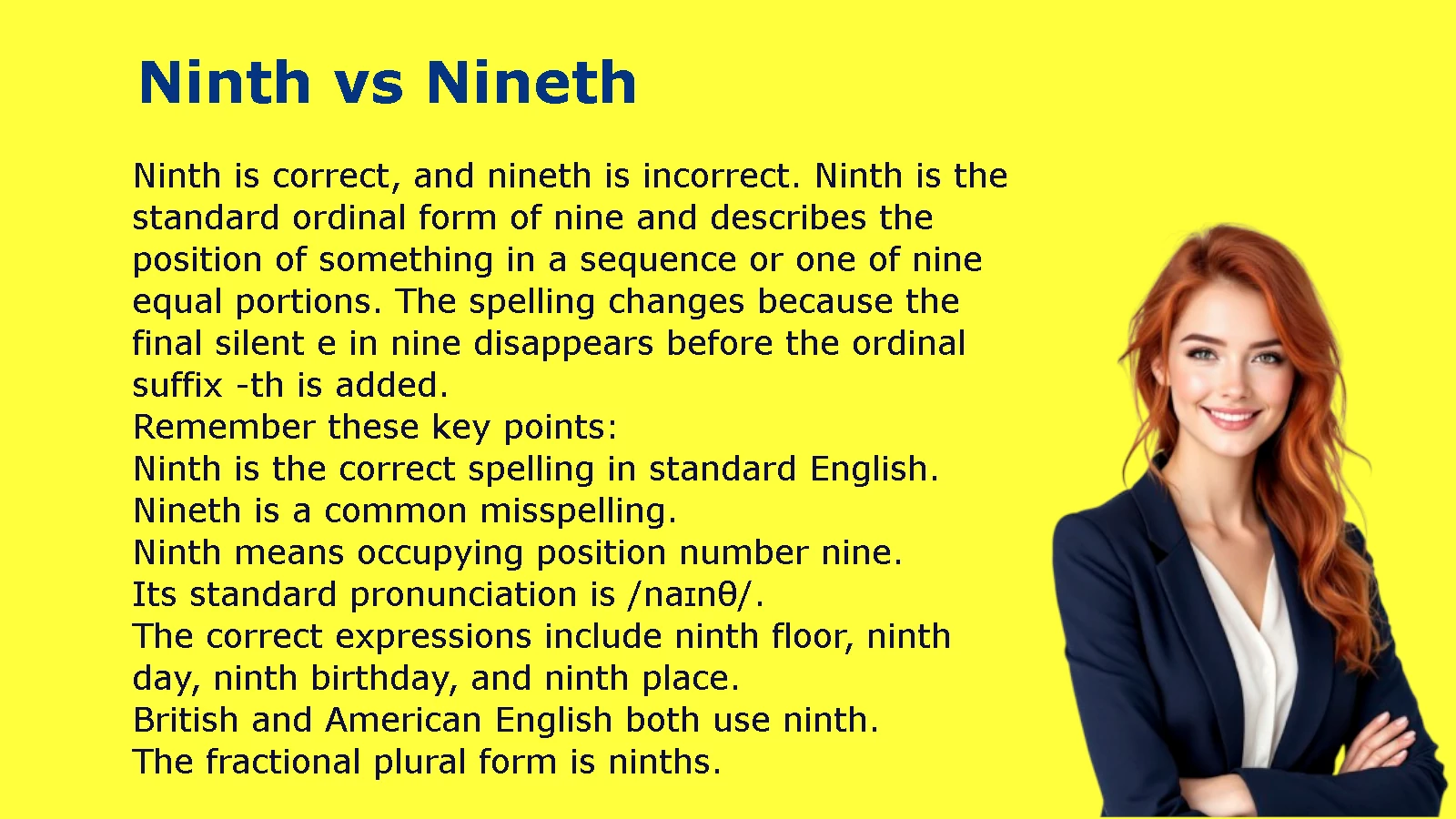
Ninth vs nineth: Ninth is the correct spelling, while nineth is a common spelling mistake. The word ninth is the ordinal form of the number nine and describes the position of something in a sequence, such as the ninth day, ninth floor, or ninth place. Although adding -th to nine might seem like it should produce nineth, English spelling rules require removing the final silent e before adding the suffix.
Understanding the difference between ninth and nineth helps you avoid spelling errors in everyday writing, academic assignments, dates, addresses, and professional documents. Both British and American English use ninth, and its standard pronunciation is /naɪnθ/. This guide explains its meaning, spelling transformation, pronunciation, grammar, and correct usage through practical examples.
| Question | Answer |
| Is it ninth or nineth? | Ninth is correct; nineth is incorrect. |
| What does ninth mean? | It means occupying position number nine in a sequence. |
| How do you pronounce ninth? | /naɪnθ/ (one syllable). |
| Is it ninth floor or nineth floor? | Ninth floor is correct. |
| Is ninth British or American spelling? | Both British and American English use ninth. |
Ninth or Nineth: Which Is Correct?
Ninth is the only correct standard English spelling of the ordinal number nine. It describes something that occupies the ninth position in a sequence or represents one of nine equal parts. Nineth is a misspelling and does not have an accepted place in standard English dictionaries or formal writing.
For example, if someone finishes a competition in position nine, they finish in ninth place. Similarly, a person celebrating nine years of marriage marks their ninth anniversary.
The confusion usually comes from the relationship between the cardinal number nine and its ordinal form ninth. English learners may assume that adding the suffix -th to nine produces nineth. However, the spelling changes because the final silent e disappears.
Why Is Ninth Correct?
The spelling ninth follows an established English spelling pattern. When forming the ordinal number from nine, the final silent e is removed before adding -th.
The transformation looks like this:
Nine → Ninth
The resulting word contains six letters and ends in the consonant combination nth.
Consider these examples:
- She finished in ninth place in the competition.
- Our office moved to the ninth floor.
- Today is the ninth day of the training program.
- He celebrated his ninth birthday last weekend.
- This is the ninth chapter of the book.
Each sentence uses ninth to identify a specific position or sequence.
The spelling does not change when you use the word in different contexts. Whether you describe a birthday, building floor, school grade, competition result, or chapter, ninth remains correct.
Why Is Nineth Incorrect?
Nineth is incorrect because it retains the final e from nine when the ordinal suffix -th is added.
Although this spelling might look logical, it does not follow the accepted spelling of the English ordinal number.
People commonly make this mistake for several reasons:
- They apply a simple suffix rule without considering spelling changes.
- They assume every ordinal number ending in -th follows the same formation pattern.
- They confuse the written form with the pronunciation of nine.
- They may have seen the incorrect spelling in informal messages or online content.
Here are some incorrect and corrected examples:
| Incorrect spelling | Correct spelling |
| Nineth floor | Ninth floor |
| Nineth day | Ninth day |
| Nineth birthday | Ninth birthday |
| Nineth position | Ninth position |
| Nineth chapter | Ninth chapter |
| Nineth anniversary | Ninth anniversary |
| Nineth attempt | Ninth attempt |
Remember that nineth is not an alternative British or American spelling. It is simply a spelling error.
Ninth vs. Nineth: Quick Comparison
The following comparison summarizes the essential differences:
| Feature | Ninth | Nineth |
| Spelling status | Correct | Incorrect |
| Part of speech | Ordinal number | No standard grammatical status |
| Base number | Nine | Nine |
| Meaning | Position number nine | No accepted standard meaning |
| Pronunciation | /naɪnθ/ | No standard pronunciation |
| British English | Correct | Incorrect |
| American English | Correct | Incorrect |
| Formal writing | Accepted | Avoid |
The easiest way to remember the distinction is to associate ninth with the number nine and its ordinal position. You should never add the final e back into the word.
What Does Ninth Mean?
Ninth means occupying the position immediately after eighth and immediately before tenth in an ordered sequence. It is the ordinal form of the cardinal number nine. The word can also represent one of nine equal portions when used as a fractional expression.
For example, if nine students participate in a race, the student who finishes after the eighth participant takes ninth place. Similarly, if you divide a cake into nine equal pieces, each piece represents one ninth of the whole.
The meaning depends on the context, but the central idea remains the same: ninth identifies a position or a part associated with nine.
Ninth as an Ordinal Number
An ordinal number identifies the position or rank of something in a sequence. Unlike cardinal numbers, which tell you how many items exist, ordinal numbers tell you where something stands.
For example:
- Cardinal: There are nine students in the classroom.
- Ordinal: The ninth student entered the classroom last.
The first sentence gives a quantity. The second identifies a position.
English uses ordinal numbers in several everyday situations:
- Dates and calendars
- School grades
- Building floors
- Competition rankings
- Numbered chapters
- Birthdays and anniversaries
- Ordered lists and instructions
Here is a comparison of common cardinal and ordinal numbers:
| Cardinal number | Ordinal number | Example |
| One | First | First place |
| Two | Second | Second floor |
| Three | Third | Third attempt |
| Four | Fourth | Fourth chapter |
| Five | Fifth | Fifth birthday |
| Six | Sixth | Sixth position |
| Seven | Seventh | Seventh day |
| Eight | Eighth | Eighth grade |
| Nine | Ninth | Ninth floor |
| Ten | Tenth | Tenth anniversary |
Notice that ninth follows eighth and comes before tenth. It always represents the same position, regardless of the subject.
Ninth as a Fraction
Ninth can also describe one of nine equal portions of a whole.
In mathematics, the fraction 1/9 is read as one ninth. The numerator represents one part, while the denominator indicates that the whole has been divided into nine equal parts.
For example, imagine a chocolate bar divided into nine equal pieces. If you take one piece, you have taken one ninth of the chocolate bar.
The fraction can appear in several forms:
| Fraction | Written form | Meaning |
| 1/9 | One ninth | One of nine equal parts |
| 2/9 | Two ninths | Two of nine equal parts |
| 3/9 | Three ninths | Three of nine equal parts |
| 4/9 | Four ninths | Four of nine equal parts |
The singular form is ninth, while the plural form is ninths.
For example:
- One ninth of the students chose mathematics.
- Two ninths of the land remained undeveloped.
- Three ninths of the total amount were distributed.
This fractional meaning is related to the ordinal meaning, but the grammatical function differs. An ordinal number identifies a position, while a fraction describes a portion of a whole.
Ninth in Everyday English
You will encounter ninth in many ordinary situations. It appears whenever you need to identify the ninth item, event, person, or stage in a sequence.
Consider these examples:
| Expression | Meaning |
| Ninth birthday | The birthday marking nine years of age |
| Ninth anniversary | The anniversary marking nine years |
| Ninth chapter | Chapter number nine |
| Ninth grade | The school grade following eighth grade |
| Ninth position | The position after eighth |
| Ninth attempt | The ninth effort to complete something |
| Ninth generation | The ninth generation in a sequence |
| Ninth month | The ninth month of the year, September |
The word works naturally with both people and objects.
For example, you might say, “My younger brother is celebrating his ninth birthday,” or “The company opened its ninth branch in the capital.”
In each case, ninth identifies a specific point in an ordered sequence.
Ninth or Nineth Pronunciation in English
The correct pronunciation of ninth is /naɪnθ/. It has one syllable and begins with the same vowel and consonant sounds as nine. However, it ends with an unvoiced th sound, which distinguishes it from the cardinal number nine.
The final sound can challenge English learners because it requires a different tongue position from the regular n sound. You produce it by placing your tongue lightly between your teeth and allowing air to pass without vibrating your vocal cords.
How to Pronounce Ninth
To pronounce ninth correctly, focus on three sound elements:
- /n/: Begin with the familiar consonant sound in words such as name and nine.
- /aɪ/: Produce the long vowel sound heard in time, light, and five.
- /nθ/: Finish with the n sound followed by the unvoiced th sound.
The complete IPA transcription is:
Ninth: /naɪnθ/
The word has one syllable. Do not separate it into two syllables or add an extra vowel sound after the final consonants.
Try practicing these expressions:
- Ninth day
- Ninth floor
- Ninth grade
- Ninth birthday
- Ninth place
Say each expression slowly before using your normal speaking speed.
Why Is Ninth Difficult to Pronounce?
Many English learners find ninth difficult because its final consonants create an unusual transition.
The tongue must move from the nasal n sound to the dental th sound. If you do not position your tongue correctly, the final sound may become unclear.
Common pronunciation mistakes include:
- Replacing the final th with a simple t.
- Adding an extra vowel sound after the final consonants.
- Pronouncing the word as if it were spelled nineth.
- Leaving out the final th sound entirely.
A practical way to improve is to practice the word in isolation before placing it inside longer expressions.
For example:
Nine → Ninth → Ninth floor
Start with nine, add the final consonant combination, and then practice the complete phrase.
Avoid rushing the final sound. Clear articulation matters more than speaking quickly.
Ninth Pronunciation vs. Nine Pronunciation
Although ninth and nine share most of their pronunciation, they are different words with different grammatical functions.
| Word | IPA pronunciation | Syllables | Meaning |
| Nine | /naɪn/ | One | Cardinal number 9 |
| Ninth | /naɪnθ/ | One | Ordinal number 9 |
The main pronunciation difference is the final unvoiced th sound in ninth.
Compare these sentences:
- There are nine people waiting outside.
- The ninth person in line is my friend.
The first sentence describes a quantity. The second identifies a position.
Pronouncing the final sound clearly helps listeners understand which word you intend to use.
Why Is Nine Spelled Ninth Instead of Nineth?
Nine becomes ninth because English removes the final silent e before adding the ordinal suffix -th. This creates the standard spelling ninth, rather than nineth. The change is part of English suffix formation, where a word’s final letters sometimes change when another element is added.
Understanding this transformation makes the spelling easier to remember. You do not need to memorize ninth as an unrelated word. Instead, learn how the base number changes when it becomes an ordinal number.
The Spelling Transformation From Nine to Ninth
The spelling transformation is straightforward:
Nine + th = Ninth
The final e disappears before the suffix -th.
Here is the process:
| Stage | Spelling | Explanation |
| Base number | Nine | The cardinal number |
| Remove final e | Nin | The spelling stem after removing e |
| Add -th | Ninth | The correct ordinal form |
The final result is ninth.
The silent e does not appear in the completed word because it is unnecessary in this spelling pattern.
Compare this transformation with other ordinal numbers:
- Five → Fifth
- Eight → Eighth
- Nine → Ninth
These examples demonstrate that English ordinal formation does not always involve simply attaching -th to the unchanged cardinal number.
However, do not assume that every number follows the same pattern. Some ordinal forms have irregular spellings, while others require changes to their final letters.
Understanding the -Th Ordinal Suffix
The suffix -th appears in many English ordinal numbers. It helps convert a cardinal number into an ordinal number.
A cardinal number answers the question “How many?”
An ordinal number answers the question “In what position?”
For example:
- Six students attended the meeting.
- The sixth student arrived late.
The first sentence gives a quantity. The second identifies a position.
The -th suffix appears in several common ordinal forms:
| Cardinal | Ordinal | Spelling pattern |
| Four | Fourth | Add -th |
| Six | Sixth | Add -th |
| Seven | Seventh | Add -th |
| Ten | Tenth | Add -th |
| Eleven | Eleventh | Add -th |
| Twelve | Twelfth | Spelling changes |
| Thirteen | Thirteenth | Add -th |
| Fourteen | Fourteenth | Add -th |
| Fifteen | Fifteenth | Spelling changes |
| Sixteen | Sixteenth | Add -th |
| Twenty | Twentieth | Final y changes to i before -eth |
| Thirty | Thirtieth | Final y changes to i before -eth |
The examples show that English ordinal spelling follows several patterns. Learning those patterns helps you avoid mistakes when writing numbers.
Other English Ordinal Numbers and Their Spelling Patterns
English ordinal numbers have both regular and irregular forms.
The first three numbers are especially different:
- One becomes first.
- Two becomes second.
- Three becomes third.
These forms do not follow the ordinary -th suffix pattern.
Other numbers use spelling changes that you should recognize.
| Number | Correct ordinal | Common mistake |
| One | First | Oneth |
| Two | Second | Twoth |
| Three | Third | Threeth |
| Four | Fourth | Fourthh |
| Five | Fifth | Fiveth |
| Six | Sixth | Sixeth |
| Seven | Seventh | Seventhth |
| Eight | Eighth | Eightth |
| Nine | Ninth | Nineth |
| Ten | Tenth | Tenthh |
| Twelve | Twelfth | Twelveth |
| Twenty | Twentieth | Twentyth |
The table demonstrates why you should learn the established ordinal forms rather than applying one suffix rule mechanically.
A useful memory trick: Associate nine with ninth by remembering that the final silent e disappears. This small spelling change separates the correct form from the common mistake nineth.
Ninth Floor or Nineth Floor: Which Is Correct?
Ninth floor is the correct expression because ninth identifies the floor occupying position number nine in a building. Nineth floor is incorrect in standard English. Use ninth floor when describing an apartment, office, hotel room location, or another space situated on the building’s ninth level.
The expression appears frequently in property listings, building directories, elevator instructions, office addresses, and everyday conversations.
For example, if someone asks where your office is, you can say, “My office is on the ninth floor.”
The spelling remains ninth regardless of the type of building.
Correct Examples of Ninth Floor
Here are several natural examples:
- Our new apartment is on the ninth floor.
- The conference room is located on the ninth floor.
- Take the elevator to the ninth floor.
- She moved her office to the ninth floor last month.
- The hotel offers a beautiful city view from its ninth floor.
- The company rents two offices on the ninth floor.
- His apartment overlooks the park from the ninth floor.
These sentences show how ninth works as an ordinal adjective before the noun floor.
You can also use the expression after a preposition:
- They live on the ninth floor.
- We met at the ninth-floor reception area.
- The elevator stopped at the ninth floor.
Notice the hyphen in ninth-floor reception area. When two words work together as a compound adjective before another noun, a hyphen can make their relationship clearer.
Common Mistakes When Writing Floor Numbers
The most common mistake is retaining the final e from nine.
Consider these corrections:
| Incorrect sentence | Correct sentence |
| My office is on the nineth floor. | My office is on the ninth floor. |
| She lives on the nineth level. | She lives on the ninth level. |
| The meeting is on the nineth floor. | The meeting is on the ninth floor. |
| Take the elevator to floor nineth. | Take the elevator to the ninth floor. |
There is another useful distinction when discussing buildings.
Ninth floor identifies a particular floor, while nine floors describes the total number of floors.
Compare:
- The building has nine floors.
- Our office is on the ninth floor.
The first expression uses a cardinal number because it describes quantity. The second uses an ordinal number because it identifies a position.
This distinction is important in real estate descriptions and property advertisements.
Ninth Day or Nineth Day: Which Is Correct?
Ninth day is the correct expression because ninth identifies the day occupying position number nine in a sequence. You can use it when describing a calendar date, a project schedule, a celebration, or an event lasting several days. Nineth day is a misspelling.
For example, if a training program lasts ten days, the day immediately before its final day is the ninth day.
The expression also appears in religious observances, travel schedules, challenges, countdowns, and historical descriptions.
Correct Examples Using Ninth Day
Here are some original sentences that demonstrate correct usage:
- We completed the assignment on the ninth day of the program.
- The festival reaches its final stage on the ninth day.
- She started feeling better on the ninth day of recovery.
- The ninth day of the challenge includes a difficult exercise.
- They announced the winners on the ninth day of the competition.
- Our team submitted the report on the ninth day of the project.
- The ninth day of the trip was reserved for sightseeing.
Each example uses ninth to identify a position within a sequence of days.
The spelling does not change when the phrase describes a short event or a long-term schedule.
Ninth Day in Dates and Calendars
Ordinal numbers help people identify positions within calendar months.
The ninth day of a month corresponds to the date 9.
For example:
- January 9: The ninth day of January.
- March 9: The ninth day of March.
- September 9: The ninth day of September.
- December 9: The ninth day of December.
In ordinary writing, you can express the date in several ways:
- September ninth.
- The ninth of September.
- September 9.
All three forms refer to the same calendar date.
However, there is a distinction between a calendar date and the ninth day of an event.
For example, if a conference begins on September 1, September 9 is its ninth calendar day only when September 1 counts as day one.
This matters when creating schedules, writing reports, or explaining the duration of an activity.
Practical example:
Imagine a 15-day fitness challenge that begins on April 1.
| Calendar date | Challenge day |
| April 1 | First day |
| April 2 | Second day |
| April 3 | Third day |
| April 7 | Seventh day |
| April 8 | Eighth day |
| April 9 | Ninth day |
| April 10 | Tenth day |
The calendar date and ordinal position work together, but they describe different things.
Is Ninth Spelled Differently in British and American English?
Ninth has the same spelling in British and American English. Both varieties use ninth as the correct ordinal form of nine. Neither standard variety accepts nineth as an alternative spelling. The pronunciation and grammatical function also remain essentially the same across the two forms of English.
Some English words have different British and American spellings. For example, British English commonly uses colour, while American English uses color. However, ninth does not follow this regional spelling difference.
Ninth in British English
British English uses ninth in formal documents, educational materials, everyday conversations, and professional writing.
Examples include:
- She lives on the ninth floor of the building.
- The ninth chapter covers the main subject.
- His birthday falls on the ninth of October.
- The school organized a ninth-grade science competition.
British writers should use ninth in all these situations.
There is no British spelling rule that changes ninth to nineth.
Ninth in American English
American English also uses ninth.
You will commonly see the word in school materials, property descriptions, event announcements, competition results, and business documents.
Examples include:
- My daughter is in ninth grade.
- Their apartment is on the ninth floor.
- We finished the ninth stage of the project.
- The ninth player joined the team.
The spelling stays the same regardless of whether you follow American or British English conventions.
Ninth or Nineth in UK English
If you are specifically searching for ninth or nineth UK, the answer is straightforward: ninth is correct in British English.
There is no regional variation that makes nineth acceptable.
| Feature | British English | American English |
| Correct spelling | Ninth | Ninth |
| Incorrect spelling | Nineth | Nineth |
| Ordinal meaning | Position nine | Position nine |
| Pronunciation | /naɪnθ/ | /naɪnθ/ |
| Ninth floor | Correct | Correct |
| Ninth day | Correct | Correct |
Some pronunciation details may vary slightly between individual speakers and accents, but the standard spelling remains identical.
If you write for an international audience, ninth is the safest and correct choice.
Common Sentences Using Ninth Correctly
Understanding a spelling rule becomes easier when you see how people use the word in different situations. Ninth works as an ordinal adjective, a position label, and part of fractional expressions.
The following examples cover common contexts.
Ninth in Everyday Conversations
People use ninth when discussing age, time, rankings, and personal experiences.
Examples:
- Today is my ninth birthday.
- This is the ninth time I have visited this city.
- Our team finished in ninth place.
- She lives in the ninth apartment on the left.
- We are celebrating our ninth anniversary.
- He received his ninth invitation this month.
- The ninth contestant performed exceptionally well.
These sentences show that ninth can describe a person, an event, or an object.
The word usually appears directly before the noun it modifies, although it can also appear after linking verbs.
For example:
“She finished ninth.”
In this sentence, ninth identifies her position without requiring the noun place.
Ninth in Academic and Professional Writing
Ninth also appears in formal and educational contexts.
Examples include:
- The researcher published the ninth section of the report.
- Students must complete the ninth chapter before the examination.
- Our company opened its ninth regional office.
- The ninth edition includes updated information.
- He teaches mathematics to ninth-grade students.
- The ninth applicant qualified for the final interview.
In academic writing, ninth helps readers follow the order of arguments, sections, chapters, and stages.
For instance, a report may contain ten sections. Referring to the ninth section helps readers locate a specific part without confusion.
Grammar note: Use a hyphen in compound modifiers such as ninth-grade students when the expression appears before a noun. However, write “students in ninth grade” without a hyphen.
Ninth in Dates, Rankings, and Measurements
Ninth has several practical applications in numerical descriptions.
Dates:
- The event begins on the ninth of June.
- Our appointment is scheduled for November ninth.
Rankings:
- The athlete finished ninth in the national competition.
- The company ranked ninth among the participating businesses.
Measurements and fractions:
- One ninth of the total budget remains.
- Divide the material into nine equal sections and use one ninth of it.
- Two ninths of the group selected the first option.
Sequences:
- The ninth item on the list needs revision.
- Turn to the ninth page of the document.
- The ninth stage requires additional preparation.
These examples demonstrate why the word appears across many types of writing.
Common Mistakes to Avoid When Using Ninth
The most common mistake is writing nineth instead of ninth. However, confusion can also arise when writers mix up cardinal and ordinal numbers, misunderstand fractional expressions, or apply spelling rules incorrectly.
Learning these differences will help you use ninth accurately.
Here are the mistakes worth watching for:
Retaining the final e
Incorrect: The nineth student arrived late.
Correct: The ninth student arrived late.
The final silent e disappears in the correct ordinal form.
Confusing nine with ninth
Incorrect: She finished in nine place.
Correct: She finished in ninth place.
Nine describes quantity, while ninth identifies position.
Using an incorrect date expression
Incorrect: Our appointment is on the nineth of July.
Correct: Our appointment is on the ninth of July.
Dates that identify the ninth day of a month require the ordinal form.
Using an incorrect building-floor expression
Incorrect: Their office is on the nineth floor.
Correct: Their office is on the ninth floor.
Use ninth when describing the floor’s position.
Misunderstanding plural fractions
Incorrect: Two ninth of the cake remained.
Correct: Two ninths of the cake remained.
When the numerator is greater than one, use the plural form ninths.
Quick Correction Table
| Incorrect | Correct |
| Nineth birthday | Ninth birthday |
| Nineth chapter | Ninth chapter |
| Nine place | Ninth place |
| Nineth of September | Ninth of September |
| Two ninth of the total | Two ninths of the total |
| Nineth-grade student | Ninth-grade student |
| The nineth attempt | The ninth attempt |
| On the nineth floor | On the ninth floor |
A simple proofreading habit can prevent most of these errors: whenever you write nineth, check whether you mean the ordinal number nine. If you do, replace it with ninth.
Nineth vs. Nineth: Final Verdict
Ninethis correct, and nineth is incorrect. Ninth is the standard ordinal form of nine and describes the position of something in a sequence or one of nine equal portions. The spelling changes because the final silent e in nine disappears before the ordinal suffix -th is added.
Remember these key points:
- Ninth is the correct spelling in standard English.
- Nineth is a common misspelling.
- Ninth means occupying position number nine.
- Its standard pronunciation is /naɪnθ/.
- The correct expressions include ninth floor, ninth day, ninth birthday, and ninth place.
- British and American English both use ninth.
- The fractional plural form is ninths.
When you need to describe the ninth item, person, event, date, or position, always choose ninth.
Make this spelling part of your everyday writing habits. A quick check of the final letters can help you avoid a mistake in emails, school assignments, reports, property descriptions, and other professional documents.
Frequently Asked Questions
Is It Ninth or Nineth?
Ninth is correct. It is the standard ordinal form of the number nine and describes the ninth position in a sequence. Nineth is an incorrect spelling that does not belong in standard English writing.
Why Is Ninth Not Spelled Nineth?
Ninth is not spelled nineth because the final silent e in nine disappears before the suffix -th is added. The correct transformation is nine to ninth. This spelling follows the accepted English ordinal form.
How Do You Pronounce Ninth in English?
Ninth is pronounced /naɪnθ/. It has one syllable and ends with an unvoiced th sound. Place your tongue lightly between your teeth to produce the final sound clearly.
Is It Ninth Floor or Nineth Floor?
Ninth floor is correct. Use this expression when describing the ninth level of a building, apartment block, hotel, or office. Nineth floor is a spelling mistake.
Is It Ninth Day or Nineth Day?
Ninth day is the correct expression. It identifies the ninth day in a calendar month, event, schedule, or sequence. Nineth day is incorrect in standard English.
Is Ninth Spelled Differently in British and American English?
No. Both British and American English use ninth. Neither variety recognizes nineth as a correct alternative spelling. The standard spelling remains the same across both varieties.













