The overthinking meaning refers to the habit of thinking about something too much or for too long, especially when the repeated thoughts become unhelpful or difficult to control. Overthinking can involve worrying about what might happen, replaying something that already happened, or analyzing every possible outcome of a decision. Related terms such as rumination, overanalyzing, worrying, second-guessing, and excessive thinking are similar but can have slightly different meanings.
Overthinking is more than simply thinking a lot. It involves repeatedly analyzing, questioning, or replaying thoughts, situations, decisions, or events, often without reaching a clear solution. If you’ve come across the question “What is overthinking?” and wondered what it means, how it affects your thoughts, or why people overthink certain situations, the term is closely connected to excessive thinking, worry, anxiety, self-doubt, rumination, decision-making, and mental stress.
In this guide, you’ll learn what overthinking means, what causes it, what overthinking looks like, common examples of overthinking, and how overthinking differs from normal thinking and careful decision-making. You’ll also see clear examples to make the concept easy to understand.
By the end, you’ll know exactly what overthinking is, why it happens, and how to recognize it in everyday situations.
The Quick Answer: What Is the Meaning of Overthinking?
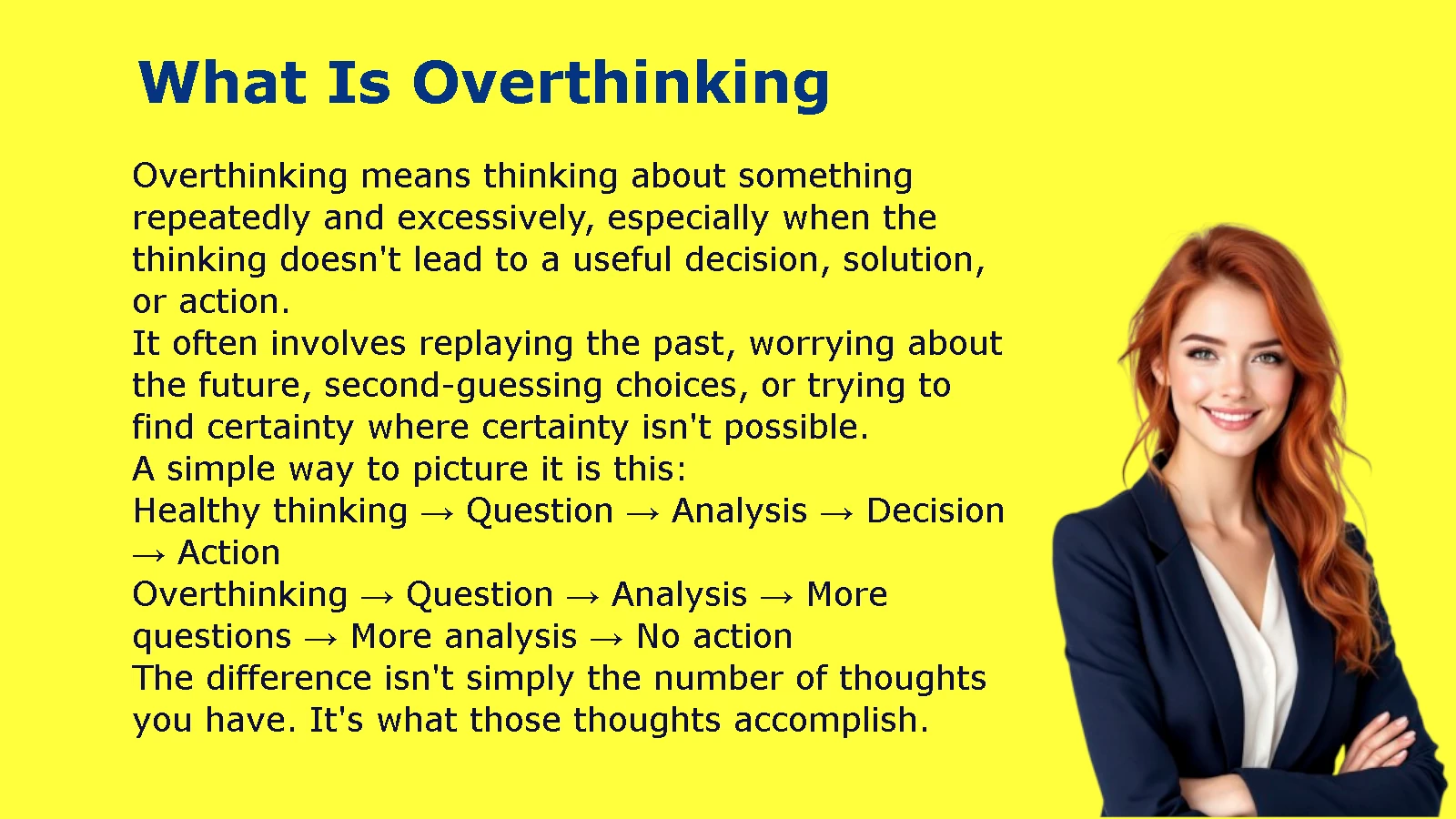
Overthinking means thinking about something repeatedly and excessively, especially when the thinking doesn’t lead to a useful decision, solution, or action.
It often involves replaying the past, worrying about the future, second-guessing choices, or trying to find certainty where certainty isn’t possible.
A simple way to picture it is this:
Healthy thinking → Question → Analysis → Decision → Action
Overthinking → Question → Analysis → More questions → More analysis → No action
The difference isn’t simply the number of thoughts you have. It’s what those thoughts accomplish.
If careful thinking helps you understand a problem and decide what to do next, it’s useful. If you keep analyzing the same issue while becoming more anxious and less capable of acting, you’ve likely entered an overthinking cycle.
What Does Overthinking Feel Like?
Overthinking can feel like your brain has dozens of browser tabs open at once.
You might notice:
- Replaying conversations
- Imagining negative outcomes
- Looking for hidden meanings
- Constantly questioning yourself
- Worrying about things you can’t control
- Reconsidering decisions you’ve already made
- Searching for reassurance
- Struggling to focus on the present
- Feeling mentally exhausted without having accomplished anything
The frustrating part is that overthinking can feel productive. You’re analyzing, evaluating, predicting, and reviewing. Yet the mental activity may not produce a practical solution.
That’s the paradox.
Your brain can work extremely hard while getting nowhere.
The Two Main Forms of Overthinking
Overthinking often points in one of two directions: backward toward the past or forward toward the future.
Psychologists commonly discuss related patterns such as rumination and worry. Catastrophizing is another thinking pattern that can intensify future-focused worry.
Rumination: Dwelling on the Past
Rumination involves repeatedly thinking about past events, problems, mistakes, or feelings.
You might replay an awkward conversation from three years ago and wonder why you said something a certain way.
You might think:
“Why did I say that?”
Then:
“They probably thought I was uninformed.”
Then:
“I should have answered differently.”
Then:
“Maybe that’s why they stopped talking to me.”
The mind keeps returning to the same event, often without discovering anything new.
Healthy reflection can teach you something from a past experience. Rumination tends to keep you emotionally stuck in it.
Common Examples of Rumination
- Replaying an argument
- Thinking about an embarrassing moment
- Reexamining a past relationship
- Dwelling on a mistake at work
- Repeatedly asking why someone treated you badly
- Thinking about missed opportunities
- Imagining how a past conversation could have gone differently
The key issue isn’t remembering the event.
It’s repeatedly reopening the same mental file without reaching a useful conclusion.
Catastrophizing: Worrying About the Future
Catastrophizing involves imagining or expecting an extreme negative outcome.
For example, you send an important email and don’t receive a response for several hours.
A balanced thought might be:
“They’re probably busy. I’ll wait until tomorrow.”
A catastrophizing thought might become:
“They didn’t respond because they’re angry. Maybe I made a mistake. What if I lose the opportunity? What if this ruins everything?”
Nothing has actually happened. Yet your brain has already built an entire disaster movie.
Catastrophizing can turn uncertainty into perceived danger.
Future-Focused Overthinking Can Sound Like This
- “What if I fail?”
- “What if everyone judges me?”
- “What if something goes wrong?”
- “What if I make the wrong choice?”
- “What if they don’t like me?”
- “What if I regret this later?”
- “What if I can’t handle it?”
Some planning is useful. In fact, anticipating problems can help you prepare.
The difference is whether your thinking produces preparation or paralysis.
Overthinking vs. Healthy Problem-Solving
Not every long thought process qualifies as overthinking.
Sometimes you need to spend considerable time thinking about a difficult decision. Choosing a career, moving to another city, handling a complicated relationship, or solving a major business problem naturally requires careful consideration.
The important question is:
Is your thinking moving you toward a useful response?
| Characteristic | Healthy Problem-Solving | Overthinking |
| Core focus | Finding a solution or deciding what to do | Repeatedly analyzing the same issue |
| Direction | Moves toward an answer | Circles around uncertainty |
| Emotional state | Usually manageable | Often anxious, tense, or distressed |
| Time frame | Has a reasonable stopping point | Can continue indefinitely |
| Questions | Clarify what action is needed | Generate more “what if” questions |
| Outcome | Leads to a decision or action | Often leads to doubt or paralysis |
| Attention | Focuses on relevant information | Searches for increasingly minor details |
| Afterward | Often brings clarity | Often brings more uncertainty |
The “Next Step” Test
Here’s a simple way to distinguish the two.
Ask yourself:
“What useful action will this thinking help me take?”
If you can identify a concrete next step, you’re probably problem-solving.
If your answer is something like:
“I just need to think about it a little more.”
then you’ve reached a point where further analysis may not help.
Sometimes the smartest move isn’t another hour of thinking.
It’s making the best decision you can with the information you have.
Top Signs You Are a Chronic Overthinker
Everyone overthinks occasionally. A difficult decision, stressful event, or uncertain situation can temporarily send your mind into overdrive.
The bigger concern is when the pattern becomes frequent and starts interfering with sleep, relationships, work, school, or everyday decisions.
Analysis Paralysis
Analysis paralysis happens when you have so many possibilities, risks, or details to consider that you struggle to make a decision.
Choosing between two restaurants becomes a 30-minute investigation.
Buying a pair of shoes requires reading dozens of reviews.
Sending a simple text becomes an exercise in linguistic archaeology.
You aren’t necessarily lacking information. You may actually have too much information and too little confidence in your decision.
Sleep Disturbances
Overthinking often becomes especially noticeable when you’re trying to sleep.
During the day, conversations, work, errands, entertainment, and other activities compete for your attention. At night, the environment becomes quieter.
Your mind suddenly has room to replay everything.
You might think:
“I should sleep.”
Then your brain responds:
“Sure. But first, let’s revisit that conversation from Tuesday.”
The cycle can keep you mentally alert when your body needs rest.
Re-Reading Text Messages
Another common sign involves repeatedly examining texts, emails, or social-media interactions.
You might reread a short message and wonder:
- “Why did they use a period?”
- “Why didn’t they use an emoji?”
- “Did that sound rude?”
- “Are they upset with me?”
- “Should I have responded differently?”
Sometimes the message means exactly what it says.
Overthinking adds a second story.
Second-Guessing Decisions
You make a choice, feel relieved for five minutes, and then start questioning it.
“Maybe I should’ve chosen the other option.”
Then you compare both choices again.
Then you imagine how the alternative might have worked out.
This pattern can make even good decisions feel wrong because your brain keeps reopening a question you’ve already answered.
Seeking Reassurance Repeatedly
You might ask several people for their opinions, search online for confirmation, or repeatedly revisit the same question.
Reassurance can provide temporary relief.
The problem is that the relief may fade quickly, sending you back to the same question.
This can create a cycle:
Doubt → Reassurance → Temporary relief → New doubt → More reassurance
Difficulty Letting Go of “What If?”
Overthinking loves hypothetical questions.
“What if?” can be useful when it helps you prepare for a realistic possibility.
But endless hypothetical thinking has no natural finish line.
There will always be another possible outcome.
That’s why trying to think your way into 100% certainty can become exhausting. Many important parts of life simply don’t offer perfect certainty.
What Causes Overthinking? A Psychological Look
Overthinking doesn’t have one universal cause.
Different people get caught in repetitive thought patterns for different reasons. Personality traits, stress, anxiety, past experiences, uncertainty, perfectionism, and learned habits can all play a role.
Perfectionism
Perfectionism can fuel overthinking because mistakes feel unusually costly.
If you believe you must make the perfect decision, you’ll naturally want more information before acting.
The problem?
Perfect information rarely exists.
A perfectionistic mindset might turn a simple decision into:
“What is the absolute best option?”
A healthier question is often:
“What is a good option that meets my needs?”
That small change can dramatically reduce unnecessary mental friction.
The Illusion of Control
Overthinking can also create the feeling that more thought equals more control.
Your brain may reason:
“If I analyze every possible outcome, I can prevent something from going wrong.”
Unfortunately, thinking cannot control every variable.
You can prepare for a presentation. You can’t control every question someone asks.
Recognizing the boundary between what you can influence and what you can’t control is a powerful part of breaking the cycle.
Anxiety and Stress
Stress can make your mind more alert to possible problems.
When you feel threatened or uncertain, your brain naturally pays more attention to potential risks. That’s useful when you need to respond to a genuine problem.
However, when the perceived threat is vague, distant, or hypothetical, that same mental alertness can become repetitive worry.
This is one reason overthinking often feels less like deliberate thinking and more like being unable to switch your brain off.
Uncertainty
Some people find uncertainty particularly uncomfortable.
If you don’t know what someone thinks, what will happen next, or whether you made the right choice, your mind may keep generating explanations.
Unfortunately, generating more explanations doesn’t necessarily create more certainty.
Sometimes it simply creates more possibilities to worry about.
Past Experiences
Previous experiences can influence how you interpret new situations.
If you experienced rejection after making a mistake, you may become especially alert to signs that another mistake could lead to rejection.
The brain is a pattern-recognition machine. That’s useful, but it can sometimes connect dots that don’t actually belong together.
How Overthinking Affects Your Daily Life
Overthinking doesn’t stay inside your head.
Repeated mental stress can affect how you feel, behave, sleep, work, and interact with other people.
Decision-Making Can Become Harder
When every decision feels like a high-stakes decision, ordinary choices become exhausting.
You may spend more time evaluating options while becoming less confident in the final choice.
This creates a strange contradiction:
More analysis doesn’t always create more confidence.
Sometimes it creates more opportunities to find reasons for doubt.
Concentration Can Suffer
It’s difficult to focus on today’s task when your attention keeps jumping into yesterday’s mistake or tomorrow’s hypothetical disaster.
You might be physically present at work while mentally reviewing a conversation from the previous evening.
That’s mentally expensive.
Relationships Can Become More Complicated
Overthinking can make you interpret ordinary behavior as evidence of hidden meaning.
A delayed reply becomes rejection.
A short response becomes anger.
A change in someone’s tone becomes proof that something is wrong.
The interpretation may be accurate sometimes. The problem is assuming that every uncertain signal has a negative explanation.
Physical Stress Can Build
Persistent mental stress can accompany physical symptoms such as:
- Muscle tension
- Headaches
- Fatigue
- Restlessness
- Trouble sleeping
- Stomach discomfort
- Changes in appetite
- Increased irritability
These symptoms can have many causes, so they shouldn’t automatically be attributed to overthinking.
Still, the mind and body aren’t separate islands. Prolonged stress can affect both.
4 Science-Informed Ways to Stop Overthinking
You don’t necessarily stop overthinking by trying to stop thinking.
That approach can backfire because monitoring whether you’re thinking often gives the thought even more attention.
A better goal is to notice the loop, create distance from it, and redirect your attention toward something useful.
Give Worry a Short, Defined Window
One practical technique is to create a brief, scheduled worry period.
Instead of allowing worry to occupy the entire day, write down what’s bothering you and set aside a specific period to examine it.
For example:
“I’ll spend 10 minutes thinking about this at 7:00 p.m.”
When the thought returns at 2:00 p.m., write it down and remind yourself that you’ll address it during the scheduled period.
This approach doesn’t tell your brain:
“Never think about this.”
It tells your brain:
“There is a time and place for this.”
That distinction can make the thought easier to postpone.
Challenge the Thought
Overthinking often treats assumptions as facts.
Try separating the two.
Ask:
- What do I actually know?
- What am I assuming?
- What evidence supports my interpretation?
- What evidence contradicts it?
- Is there another reasonable explanation?
- What action can I take right now?
For example:
Thought: “They haven’t replied because they’re angry with me.”
Fact: “They haven’t replied yet.”
Those are not the same statement.
The first contains an interpretation. The second describes an observable fact.
That small distinction can take some fuel away from an overthinking cycle.
Turn Thought Into Action
When your mind keeps circling a problem, ask:
“What is one thing I can actually do?”
If you’re worried about an upcoming presentation, prepare your slides.
If you’re worried about an unanswered email, decide when you’ll follow up.
Action breaks loops that analysis alone often can’t.
You don’t need to solve the entire problem. You only need to identify the next useful step.
Practice Mindfulness and Grounding
Mindfulness involves paying attention to the present moment rather than automatically following every thought.
You don’t have to empty your mind.
Instead, notice the thought without treating it as an instruction.
For example:
“I’m having the thought that I might fail.”
That wording creates a little distance.
Instead of:
“I’m going to fail.”
you’re recognizing:
“My mind is producing a prediction about failure.”
That difference matters.
Try the 5-4-3-2-1 Grounding Technique
When your thoughts feel overwhelming, the 5-4-3-2-1 technique can bring your attention toward your immediate surroundings.
Identify:
- 5 things you can see
- 4 things you can physically feel
- 3 things you can hear
- 2 things you can smell
- 1 thing you can taste
The exercise shifts attention away from abstract mental predictions and toward present sensory information.
It isn’t a magic switch.
Think of it more like moving your mental steering wheel back toward the road.
A Simple Overthinking Reset You Can Use Today
When you catch yourself spiraling, try this five-step reset.
Step 1: Name the Pattern
Say:
“I’m overthinking this.”
Naming the pattern can help you recognize that you’re experiencing a mental process rather than discovering a new fact.
Step 2: Separate Facts From Stories
Write down what you know and what you’re assuming.
For example:
Known: “They haven’t responded for six hours.”
Assumption: “They’re angry with me.”
Step 3: Identify Your Control
Ask:
“What part of this situation can I influence?”
Focus there.
Let the rest remain uncertain.
Step 4: Choose One Action
Pick the smallest useful action.
Maybe it’s sending an email, writing a plan, making a decision, taking a walk, or going to bed.
Step 5: Close the Mental Tab
Once you’ve taken the useful action, intentionally move your attention elsewhere.
You don’t need to keep checking whether you’ve stopped thinking about it.
That’s just another form of checking.
When Is Overthinking More Than an Everyday Habit?
Occasional overthinking is part of being human.
You might replay a conversation after an argument or worry before a major event. That doesn’t automatically indicate a mental health disorder.
The concern rises when persistent worry or repetitive thinking becomes hard to control and significantly interferes with daily life.
For example, consider seeking professional support if repetitive thoughts regularly:
- Disrupt your sleep
- Interfere with work or school
- Affect relationships
- Prevent you from making ordinary decisions
- Cause substantial distress
- Make it difficult to concentrate
- Keep you from participating in normal activities
A mental health professional can help determine what’s driving the pattern and whether another condition may be contributing to it.
Frequently Asked Questions About Overthinking
Is overthinking a mental illness?
Overthinking itself isn’t a standalone psychiatric diagnosis. It’s a common experience and can occur during periods of stress or uncertainty.
However, persistent rumination or excessive worry can occur alongside conditions such as anxiety disorders and depression. If repetitive thoughts are severe, difficult to control, or interfering with daily life, professional evaluation can help clarify what’s happening.
Why do I overthink more at night?
Nighttime often removes many of the distractions that occupy your attention during the day.
When you’re lying in bed without work, conversations, notifications, or other activities competing for your attention, unresolved concerns can become much more noticeable.
Fatigue can also make emotional regulation harder.
That’s why a small concern at 2 p.m. can feel enormous at 1 a.m.
A consistent sleep routine, reducing stimulating activities before bed, writing down worries, and setting aside time earlier in the day to deal with practical concerns may help.
If nighttime worry regularly prevents you from sleeping, it’s worth discussing the problem with a healthcare professional.
How does overthinking affect the body?
Persistent stress and worry can contribute to physical symptoms such as muscle tension, headaches, fatigue, restlessness, sleep problems, and digestive discomfort.
The exact symptoms vary from person to person.
Overthinking isn’t the only possible cause of these symptoms, though. New, severe, persistent, or unexplained physical symptoms deserve appropriate medical attention.
Can overthinking cause anxiety?
Overthinking and anxiety can reinforce each other.
Worry can lead to repetitive thinking, while repetitive negative thinking can increase worry. That creates a feedback loop:
Worry → More analysis → More uncertainty → More worry
Breaking the cycle often requires shifting from endless mental analysis toward evidence, action, acceptance of uncertainty, or present-moment attention.
Is overthinking the same as worrying?
Not exactly.
Worry usually focuses on potential future problems.
Overthinking is a broader term that can include future worry, past rumination, repeated decision-making, analyzing conversations, and searching for certainty.
So worry can be a form of overthinking, but overthinking isn’t limited to worry.
How can I stop overthinking about a decision?
Set a reasonable deadline, identify the most important factors, separate facts from assumptions, and decide what information would actually change your choice.
Then make the decision and move forward.
For low-stakes decisions, try limiting yourself to a small number of reasonable options. Not every choice deserves a full research project.
Why do I keep replaying conversations?
Your brain may be trying to understand what happened, determine how another person perceived you, or prevent a similar situation in the future.
Reflection can be useful once.
Repeatedly replaying the same conversation without learning anything new can become rumination.
Ask yourself:
“Is there something I can learn or do differently next time?”
If the answer is no, continuing to replay the conversation probably won’t change the past.
Final Takeaway: What Does Overthinking Mean?
Overthinking means repeatedly analyzing, worrying about, or revisiting thoughts and situations without reaching a useful conclusion or taking productive action.
It can involve the past, the future, or decisions you’re making right now.
The two major patterns are rumination, which dwells on past events, and future-focused worry, which anticipates potential problems. Catastrophizing can make future worries feel even more threatening by jumping to extreme outcomes.
The key distinction isn’t simply thinking versus not thinking.
It’s productive thinking versus repetitive thinking.
Healthy problem-solving usually has a destination. You gather information, evaluate your options, choose a course of action, and move forward.
Overthinking often has no finish line.
You ask another question. Then another. You search for one more piece of certainty. Suddenly, the original problem has become a maze.
When you notice that happening, try to step out of the maze.
Separate facts from assumptions. Identify what you can control. Choose one useful action. Then allow some uncertainty to remain.
You don’t need to think your way to perfect certainty.
Sometimes, clarity comes after you stop analyzing and start moving.













