Mobilize vs mobilise is a spelling difference between American and British English, not a difference in meaning. Mobilize is the standard spelling in American English, while mobilise is common in British English. Both words mean to organize or prepare people, resources, or forces for action. The same regional pattern appears in mobilization vs mobilisation, along with related forms such as mobilized vs mobilised and mobilizing vs mobilising.
Choosing the right spelling depends on your audience, publication, and preferred style guide. American writers generally use -ize, while British writers often use -ise. Canadian English commonly uses mobilize, although spelling preferences can vary across organizations and publications. Understanding these differences helps you write consistently in academic papers, business reports, news articles, and everyday communication.
Mobilize vs Mobilise: What’s the Difference?
Mobilize and mobilise have the same meaning, pronunciation, and grammatical function. The only difference is the spelling of the final syllable: American English generally uses -ize, whereas British English commonly uses -ise.
For example, an American newspaper might report that the government mobilized emergency workers, while a British newspaper might say that the government mobilised emergency workers. Both sentences describe the same action.
Mobilize vs Mobilise at a Glance
| Feature | Mobilize | Mobilise |
| Meaning | To organize or prepare for action | To organize or prepare for action |
| Common regional preference | American English | British English |
| Verb form | Mobilize | Mobilise |
| Past tense | Mobilized | Mobilised |
| Present participle | Mobilizing | Mobilising |
| Noun form | Mobilization | Mobilisation |
| Pronunciation | Same | Same |
| Correctness | Correct | Correct |
The main point is simple: neither spelling is universally more correct than the other. Each spelling belongs to a recognized English spelling convention.
American English favors mobilize, while British English frequently uses mobilise. However, British English also accepts many -ize spellings, so the distinction is not an absolute rule that applies to every word or every British publication.
Mobilize or Mobilise: Which One Should You Use?
Use mobilize when writing for an American audience and mobilise when following a British style guide that prefers -ise. If you write for a Canadian audience, mobilize is a widely used choice. When a publisher, employer, or university provides a style guide, follow that guide instead of relying on regional assumptions alone.
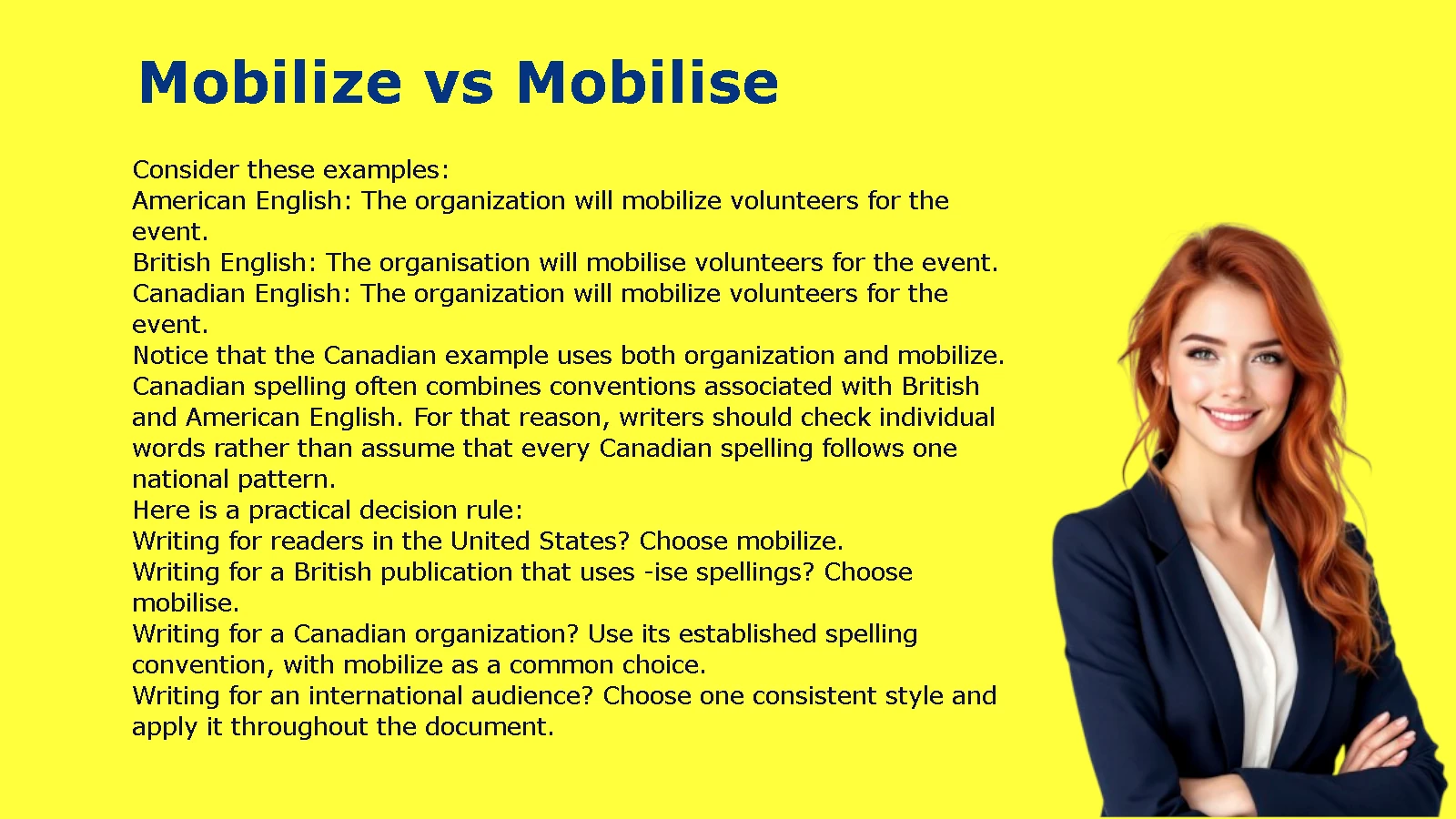
Consider these examples:
- American English: The organization will mobilize volunteers for the event.
- British English: The organisation will mobilise volunteers for the event.
- Canadian English: The organization will mobilize volunteers for the event.
Notice that the Canadian example uses both organization and mobilize. Canadian spelling often combines conventions associated with British and American English. For that reason, writers should check individual words rather than assume that every Canadian spelling follows one national pattern.
Here is a practical decision rule:
- Writing for readers in the United States? Choose mobilize.
- Writing for a British publication that uses -ise spellings? Choose mobilise.
- Writing for a Canadian organization? Use its established spelling convention, with mobilize as a common choice.
- Writing for an international audience? Choose one consistent style and apply it throughout the document.
Consistency matters more than switching between regional spellings to accommodate individual preferences. A report that uses mobilize, mobilisation, and mobilising without a deliberate reason may look poorly edited, even though readers can understand every word.
What Does Mobilize or Mobilise Mean?
Mobilize and mobilise mean to organize, assemble, activate, or prepare people and resources for a particular purpose. The words can describe military action, community campaigns, business projects, emergency responses, or efforts to encourage people to act. Their exact meaning depends on the context.
For example, a company can mobilize its employees to complete an urgent project. A government can mobilize emergency services after a natural disaster. A community group can mobilise volunteers to distribute food and supplies.
In each case, the word suggests moving people or resources from a state of readiness into coordinated action.
Definition of Mobilize and Mobilise
As verbs, mobilize and mobilise describe the process of making people, equipment, money, or other resources ready for action. The words can also describe encouraging a group to participate in a cause or respond to a situation.
The term has several common uses.
Military context: Mobilize means to prepare armed forces, personnel, or equipment for military service or operations.
Example: The government mobilized additional troops to reinforce the border.
Business context: Mobilize means to coordinate employees, funding, equipment, or other resources to achieve a goal.
Example: The project manager mobilized three teams to finish the software launch on time.
Community context: Mobilize means to organize people to support a campaign, solve a local problem, or respond to a public need.
Example: Residents mobilised volunteers to clean the park before the annual festival.
Emergency context: Mobilize means to activate emergency personnel and resources when a crisis occurs.
Example: The city mobilized rescue crews after severe flooding damaged several neighborhoods.
Political and social context: Mobilize can mean encouraging people to participate in a campaign, demonstration, public meeting, or collective effort.
Example: The campaign mobilized thousands of supporters ahead of the public meeting.
Although these examples use different situations, the central idea remains the same: people or resources become organized and ready to act.
Examples of Mobilize and Mobilise in Sentences
The following sentences show how the words work in different contexts. Both spellings are correct within their respective conventions.
| Context | American English | British English |
| Business | The company mobilized its staff. | The company mobilised its staff. |
| Emergency | Officials mobilized rescue teams. | Officials mobilised rescue teams. |
| Community | Volunteers mobilized local residents. | Volunteers mobilised local residents. |
| Military | The government mobilized its forces. | The government mobilised its forces. |
| Fundraising | The charity mobilized donors. | The charity mobilised donors. |
| Healthcare | The hospital mobilized extra resources. | The hospital mobilised extra resources. |
Here are additional original examples:
- The nonprofit plans to mobilize community support for its new housing program.
- Managers must mobilize available resources before the next phase of construction.
- Local leaders worked to mobilise public opinion around the proposed safety measures.
- The school mobilized parents and teachers to organize a weekend fundraiser.
- Emergency coordinators mobilised additional staff when the number of calls increased.
- The organization hopes to mobilize young people to participate in the cleanup campaign.
These sentences also demonstrate an important point about usage: mobilize does not always mean physically moving something. It can describe coordinating resources, encouraging participation, or creating the conditions for collective action.
Synonyms and Related Words
The best synonym for mobilize depends on what you want to describe. Some alternatives emphasize preparation, while others focus on organization, movement, or persuasion.
| Synonym | Meaning | Example |
| Organize | Arrange people or resources for a purpose | We organized a team to handle customer requests. |
| Activate | Make something operational or ready for use | The agency activated its emergency response plan. |
| Assemble | Bring people or things together | The manager assembled a team of specialists. |
| Deploy | Put people or resources into position or use | The company deployed additional technicians. |
| Rally | Bring people together around a shared cause | Residents rallied behind the neighborhood project. |
| Prepare | Make someone or something ready | The hospital prepared extra beds for patients. |
| Coordinate | Arrange activities so they work together | The director coordinated several volunteer groups. |
| Muster | Gather people, support, or resources | The candidate mustered support from local leaders. |
These words are related, but they are not interchangeable in every sentence.
For example, deploy often emphasizes putting resources into operation, while mobilize can describe the broader process of assembling and preparing those resources. Similarly, rally often involves motivating people around a cause, whereas organize can refer to a practical arrangement without any emotional or persuasive element.
Choose a synonym that preserves the intended meaning instead of replacing mobilize simply to avoid repetition.
Mobilize or Mobilise in the US, UK, and Canada
The choice between mobilize and mobilise depends largely on regional spelling conventions. American English generally favors -ize, while British English commonly uses -ise in words such as mobilise. Canadian English often uses mobilize, although its broader spelling system includes conventions associated with both American and British English.
Understanding these patterns helps you select the appropriate spelling for different readers.
Mobilize or Mobilise in American English
Mobilize is the standard American spelling. American writers also use mobilizes, mobilized, mobilizing, and mobilization.
Examples:
- The company will mobilize its technical team before the launch.
- The mayor mobilized emergency services after the storm.
- The charity is mobilizing donors to fund its new program.
- The campaign increased its mobilization efforts during the final week.
The same -ize preference appears in many other American English words:
- Organize
- Realize
- Recognize
- Modernize
- Prioritize
- Standardize
The same regional spelling pattern appears in organize vs organise, synchronize vs synchronise, subsidize vs subsidise, and monetize vs monetise, where American and British English may favor different endings.
However, American spelling does not use -ize for every word ending in a similar sound. Words such as advertise and exercise retain their established spellings. Therefore, the useful rule is to learn the conventional spelling of each word rather than mechanically replacing every s with a z.
If your audience primarily lives in the United States, using mobilize throughout your article, report, or website will align with familiar American usage.
Mobilize or Mobilise in British English
Mobilise is a common British spelling, especially in publications and style guides that prefer -ise endings. British writers often use mobilisation, mobilised, and mobilising alongside it.
Examples:
- The council plans to mobilise volunteers for the community event.
- The government mobilised emergency personnel.
- The charity is mobilising local businesses to support the project.
- The mobilisation of additional resources helped the team respond quickly.
British English also recognizes many -ize spellings. For example, organize and organise can both be acceptable in British usage, depending on the style convention a publication follows. Some British dictionaries and publishers prefer -ise, while others follow the traditional -ize convention for certain words.
This means you should not treat every -ize spelling as American-only. The spelling of mobilise is strongly associated with British English, but the correct choice for a particular British publication may depend on its house style.
For a British website, university assignment, or business report, check the preferred convention before editing related forms. If the document already uses organise, recognise, and prioritise, then mobilise will usually provide a consistent fit.
Mobilize or Mobilise in Canadian English
Mobilize is widely used in Canadian English. Canadian writing often follows American spelling for -ize words, even though it retains British-influenced forms in other areas, such as colour and centre.
Examples of common Canadian usage include:
- The provincial government will mobilize emergency crews.
- The nonprofit mobilized volunteers across several communities.
- The organization is mobilizing support for its new initiative.
- The campaign focused on community mobilization.
Canadian English does not follow a single rule that makes every word identical to either American or British English. Publications, universities, government departments, and private organizations may use different editorial standards.
For example, a Canadian publication might prefer colour rather than color but still use mobilize rather than mobilise. There is no contradiction in this combination because English spelling conventions vary by word.
If you are writing for a Canadian audience, follow these practical steps:
- Check the spelling used by the organization or publication.
- Review similar words throughout the document.
- Use mobilize when no specific house style requires another form.
- Keep the related noun and verb forms consistent.
The same advice applies to writers targeting readers in Australia, New Zealand, and other English-speaking regions. Regional preferences can guide your choice, but the target publication’s own rules should take priority.
Which Spelling Should International Writers Choose?
International writers should select the spelling that matches their primary audience or the style guide they have been asked to follow. The goal is not to prove that one spelling is better. It is to make the writing feel natural and consistent to its intended readers.
Consider a company that publishes one report for its American operations and another for its British office. The American report might use mobilize, organization, and prioritize, while the British report might use mobilise, organisation, and prioritise.
Both documents can be correct. The difference reflects the chosen editorial convention.
Use this checklist when making your decision:
- Identify the audience. Determine whether the document primarily targets American, British, Canadian, or international readers.
- Check the style guide. Follow the rules set by your employer, publisher, university, or client.
- Standardize related words. Apply the chosen convention to the verb, noun, past tense, and present participle.
- Review the whole document. Search for inconsistent forms before publishing.
- Avoid unnecessary switching. Do not alternate between mobilize and mobilise without a clear reason.
For SEO content, this approach also helps you write naturally for your target market. An article aimed at American readers should normally use mobilize in its title, headings, examples, and body text. A British-focused article may use mobilise instead.
You can still explain both forms when the spelling difference is the subject of the page.
Mobilization vs Mobilisation: What’s the Difference?
Mobilization and mobilisation are noun forms of mobilize and mobilise. Both describe the act or process of organizing people, resources, or forces for a particular purpose. American English generally uses mobilization, while British English commonly uses mobilisation.
The meaning does not change when the spelling changes. The main difference is the regional convention used to write the noun.
Mobilization vs Mobilisation Meaning
Mobilization means the process of preparing or organizing people and resources so they can act. The term can refer to military preparation, emergency planning, business operations, community campaigns, or collective political activity.
Mobilisation has the same definition but follows a spelling convention commonly associated with British English.
Compare these sentences:
- American English: The mobilization of emergency crews began shortly after the storm.
- British English: The mobilisation of emergency crews began shortly after the storm.
Both sentences describe the process of preparing and organizing emergency personnel. Neither spelling suggests a different level of urgency, scale, or type of action.
The noun is useful when you want to discuss the process itself rather than the action performed by a specific person or organization.
For example:
- Verb: The charity will mobilize volunteers.
- Noun: The charity’s mobilization of volunteers began last month.
The verb describes what the charity will do. The noun turns that action into a concept or process that can serve as the subject or object of a sentence.
Mobilization vs Mobilisation Examples
The following examples show how the noun works in different situations.
Business
- American: The mobilization of staff helped the company meet its deadline.
- British: The mobilisation of staff helped the company meet its deadline.
Emergency response
- American: Rapid mobilization of rescue teams reduced delays.
- British: Rapid mobilisation of rescue teams reduced delays.
Community projects
- American: Community mobilization played a major role in the cleanup campaign.
- British: Community mobilisation played a major role in the cleanup campaign.
Military planning
- American: The mobilization of additional forces required careful coordination.
- British: The mobilisation of additional forces required careful coordination.
Public campaigns
- American: The campaign’s mobilization efforts increased public participation.
- British: The campaign’s mobilisation efforts increased public participation.
In every pair, the spelling changes but the sentence retains the same meaning.
The noun mobilization can also appear in formal phrases such as resource mobilization, community mobilization, and military mobilization. These expressions describe different applications of the same general process: preparing and coordinating people or resources to achieve an objective.
Mobilize, Mobilise, Mobilization, and Mobilisation Compared
The verb and noun forms follow a recognizable spelling pattern. American English usually retains z, while the conventional British -ise pattern uses s in the corresponding forms.
| American English | Common British English form | Part of speech |
| Mobilize | Mobilise | Base verb |
| Mobilizes | Mobilises | Third-person singular verb |
| Mobilized | Mobilised | Past tense and past participle |
| Mobilizing | Mobilising | Present participle |
| Mobilization | Mobilisation | Noun |
This table gives you the main forms to check when editing a document. British publications that follow an -ize style may also use mobilize and mobilization, so always consider the applicable style guide.
Here is how the forms work in sentences:
Base verb: The agency will mobilize additional resources.
Third-person singular: The agency mobilizes volunteers every summer.
Past tense: The agency mobilized volunteers last summer.
Present participle: The agency is mobilizing volunteers for the next event.
Noun: The agency’s mobilization of volunteers took several weeks.
The British equivalents follow the same grammatical pattern: mobilise, mobilises, mobilised, mobilising, and mobilisation.
Remember that the spelling change does not alter the grammar. You still use the same verb tenses, sentence structures, and noun functions in both varieties of English.
Mobilize vs Mobilise: Common Grammar and Spelling Mistakes
Most errors involving mobilize and mobilise happen when writers mix regional spelling conventions or confuse a verb with its noun form. You can avoid these problems by checking the word’s grammatical role and applying the same spelling pattern throughout your document.
Mobilized vs Mobilised
Mobilized and mobilised are past-tense and past-participle forms of the same verb. American English generally uses mobilized, while British English commonly uses mobilised.
Examples:
- American: The company mobilized its staff to complete the project.
- British: The company mobilised its staff to complete the project.
Both forms can also work with helping verbs:
- American: The team has mobilized additional resources.
- British: The team has mobilised additional resources.
The past participle often appears with has, have, or had. The regional spelling changes, but the grammar stays the same.
A common editing mistake is to use mobilized in one paragraph and mobilised in another without following a deliberate style. Readers will usually understand the text, but the inconsistency can make the writing appear unfinished.
Mobilizing vs Mobilising
Mobilizing and mobilising are present participles. They can describe an action in progress or function as modifiers in a sentence.
Examples:
- American: The organization is mobilizing volunteers.
- British: The organisation is mobilising volunteers.
You can also use the form as part of a longer description:
- American: The mobilizing effort brought several local groups together.
- British: The mobilising effort brought several local groups together.
The spelling of related words may change as well. In the British example, organisation follows the common British -isation pattern, while the American example uses organization.
When you edit an article, check the entire family of related words instead of correcting only the main keyword. A consistent pattern improves readability and makes the text look professionally edited.
Mobilization vs Mobilisation in Formal Writing
Formal writing requires a consistent spelling convention, especially when a document includes several related terms. Academic papers, legal documents, company reports, and policy documents may follow strict editorial standards.
Suppose a company uses American English throughout a report. The document includes the following sentence:
“The mobilization plan will help us mobilise additional staff.”
The sentence mixes mobilization, an American spelling, with mobilise, a common British spelling. A consistent American version would read:
“The mobilization plan will help us mobilize additional staff.”
A British version following the -ise convention could read:
“The mobilisation plan will help us mobilise additional staff.”
Neither version changes the underlying meaning. The improvement comes from applying one convention consistently.
Before submitting a formal document, review these details:
- Check the base verb and noun.
- Check the past-tense and present-participle forms.
- Review related words such as organization/organisation when relevant.
- Use your publication’s required spelling style.
- Run a final spelling check, then review the results manually.
Automated spelling tools can help identify inconsistencies, but they may not understand the intended regional convention. Set the correct language variety in your word processor and check any flagged alternatives before accepting a change.
How to Remember Mobilize vs Mobilise
The easiest way to remember mobilize vs mobilise is to connect the spelling to your target audience. Use mobilize for standard American English and commonly for Canadian English. Use mobilise when following a British English convention that prefers -ise spellings.
The same choice should carry through to the noun form and other related words.
A Simple American and British Spelling Rule
Use this quick memory aid:
- American English: mobilize, mobilized, mobilizing, mobilization.
- British English using -ise: mobilise, mobilised, mobilising, mobilisation.
- Canadian English: mobilize is widely used, but follow the relevant publication or organizational guide.
You can apply the same approach to related spelling pairs such as organize/organise, prioritize/prioritise, and modernize/modernise, while remembering that British English accepts many -ize forms too.
Do not rely on the final letter alone to determine the correct spelling of every English word. English has several established spelling patterns, and some words follow their own conventions.
For the word mobilize, however, the regional pattern is straightforward enough to remember. Decide which spelling convention your document uses, then apply it to all related forms.
Quick Editing Checklist
Use this checklist before publishing an article, submitting an assignment, or sending a business report.
- Identify the main audience.
- Choose American English, British English, or the required house style.
- Use mobilize or mobilise consistently.
- Check mobilization or mobilisation.
- Review mobilized/mobilised and mobilizing/mobilising.
- Search for mixed spellings across headings, tables, examples, and body text.
- Confirm that your word processor uses the correct English language setting.
This process takes little time and prevents one of the most common problems in regional spelling: using individually valid words in an inconsistent combination.
For website owners, the same checklist can support content quality across multiple pages. If your website targets American readers, keep American spelling consistent across your glossary articles, category pages, and related posts. If you publish separate versions for different markets, edit each version to suit its audience.
Frequently Asked Questions
Is mobilize or mobilise correct?
Both mobilize and mobilise are correct. American English generally uses mobilize, while British English commonly uses mobilise. Choose the spelling that matches your intended audience or the style guide required for your document.
Is mobilise British or American?
Mobilise is commonly associated with British English. American English generally uses mobilize. Some British publications also accept or prefer -ize spellings, so the exact choice can depend on the publication’s editorial rules.
Do Canadians use mobilize or mobilise?
Mobilize is widely used in Canadian English. Canadian spelling combines several conventions, so preferences can differ across words and publications. If you are writing for a Canadian employer, university, or publisher, follow its style guide.
What is the difference between mobilization and mobilisation?
Mobilization and mobilisation have the same meaning: the process of organizing or preparing people, resources, or forces for action. Mobilization is the standard American spelling, while mobilisation is common in British English.
What does mobilisation mean?
Mobilisation means organizing or preparing people, resources, or forces for a particular purpose. For example, the mobilisation of emergency services describes the process of preparing and coordinating emergency personnel. American English generally spells the noun mobilization.
Is it mobilized or mobilised?
Both forms are correct. Mobilized is standard in American English, while mobilised is common in British English. Both are the past-tense and past-participle forms of the verb mobilize/mobilise.
Final Thoughts on Mobilize vs Mobilise
The difference between mobilize vs mobilise comes down to regional spelling, not meaning. Both words describe organizing or preparing people and resources for action. American English generally favors mobilize, British English commonly uses mobilise, and Canadian English widely uses mobilize.
The same pattern applies to mobilization vs mobilisation, as well as mobilized/mobilised and mobilizing/mobilising. Once you select a spelling convention, use it consistently throughout your writing.
If you are editing an article or website, start by identifying your target audience and checking the relevant style guide. Then review the verb, noun, and related forms before publishing. This simple step will help you produce clear, consistent content that fits your readers’ expectations.