Marvelous vs Marvellous is a common spelling question for people who write in American, British, Australian, or Canadian English. Both spellings are correct, and both mean wonderful, extraordinary, or exceptionally good. The difference comes down to regional spelling conventions: American English uses marvelous with one L, while British English generally uses marvellous with two Ls. Australian and New Zealand English also commonly prefer the double-L version, while Canadian usage can vary by publication and style guide.
Understanding this distinction helps you choose the right spelling for emails, school assignments, business documents, blog posts, and professional publications. It also explains related forms such as marvelously vs. marvellously, along with similar spelling differences such as traveled vs. travelled. Once you know which English variety your audience expects, choosing the correct version becomes simple.
Marvelous vs Marvellous: American and British Spelling Rules
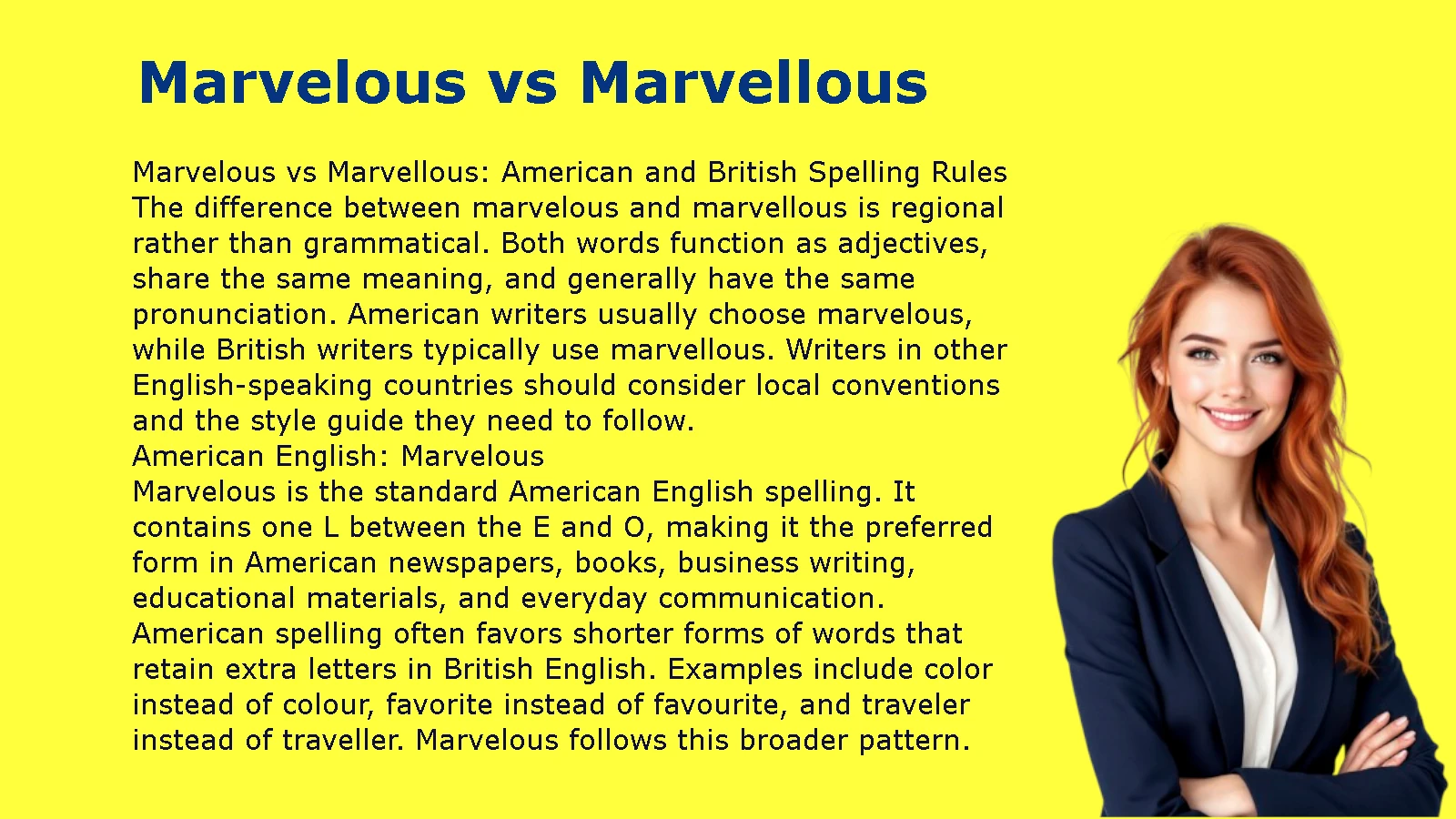
The difference between marvelous and marvellous is regional rather than grammatical. Both words function as adjectives, share the same meaning, and generally have the same pronunciation. American writers usually choose marvelous, while British writers typically use marvellous. Writers in other English-speaking countries should consider local conventions and the style guide they need to follow.
American English: Marvelous
Marvelous is the standard American English spelling. It contains one L between the E and O, making it the preferred form in American newspapers, books, business writing, educational materials, and everyday communication.
American spelling often favors shorter forms of words that retain extra letters in British English. Examples include color instead of colour, favorite instead of favourite, and traveler instead of traveller. Marvelous follows this broader pattern.
American spelling reformers, including Noah Webster, helped popularize several differences between American and British spelling. Webster’s dictionaries promoted a more distinct American spelling system, although not every modern spelling difference originated with him.
Here are some natural examples of marvelous in American English:
- The museum has a marvelous collection of contemporary paintings.
- We had a marvelous time celebrating my sister’s birthday.
- Her team developed a marvelous solution to a difficult technical problem.
- The hotel offers a marvelous view of the Pacific Ocean.
- Your presentation was marvelous, especially the section explaining the new strategy.
If you write for an American audience, use marvelous throughout your content. This spelling looks natural to American readers and aligns with the conventions used by most US publications.
British English: Marvellous
Marvellous is the preferred spelling in British English. It contains two Ls and follows the spelling convention commonly seen in British words such as travelled, cancelled, and jewellery.
British writers use marvellous in formal and informal settings. You might see it in a newspaper review, a novel, a workplace email, a restaurant review, or a conversation about an enjoyable experience.
The word can express genuine admiration, pleasant surprise, or enthusiastic approval. Its tone depends on the context. For example, calling a scientific discovery marvellous communicates admiration, while describing a friend’s dinner party as marvellous expresses enjoyment.
Examples of marvellous in British English include:
- What a marvellous idea for the community fundraiser!
- The garden looks marvellous after all the recent rain.
- She gave a marvellous performance in the school play.
- It was a marvellous opportunity to learn from experienced professionals.
- The engineers created a marvellous design that combines efficiency and simplicity.
British spelling is particularly important when preparing content for UK readers. A British editor may change marvelous to marvellous to maintain consistency with the publication’s house style.
Australian, Canadian, and New Zealand English
The spelling of marvelous varies across English-speaking countries. British conventions influence Australian and New Zealand English, while Canadian English combines British and American spelling patterns.
Australian English: Marvellous is the usual choice in Australian writing. It fits the broader preference for forms such as favourite, colour, and travelling. Australian businesses, schools, and publishers generally benefit from using the spelling expected by their audience.
New Zealand English: Marvellous is also commonly preferred in New Zealand. Writers should maintain the same regional spelling conventions across an entire document rather than switching between British-style and American-style forms.
Canadian English: Marvellous is an accepted Canadian spelling, but Canadian English does not follow British spelling in every case. Canadian usage varies by word, publisher, and style guide. For example, Canadians commonly write colour but may use program in contexts where British English would use programme. Check the requirements of the publication or organization instead of assuming that every Canadian writer must use marvellous.
For international websites, the most practical rule is to identify the main audience before writing. If your article targets readers in the United States, choose marvelous. If it targets readers in the United Kingdom or Australia, marvellous is usually the better fit.
Why Do Marvelous and Marvellous Have Different Spellings?
The difference between marvelous and marvellous developed through the history of English spelling. American and British English gradually established different preferences for certain words, even though speakers continued to understand the same vocabulary.
The Role of American Spelling Reform
American spelling became more standardized during the nineteenth century. Noah Webster, an American lexicographer and spelling reformer, advocated changes intended to make English spelling more consistent and distinctly American.
His influence helped establish forms such as color and favor in American English. However, it would be inaccurate to attribute every difference between American and British spelling directly to Webster. Many variations developed through broader historical and publishing practices.
The difference between marvelous and marvellous fits this larger pattern. American English favors the single-L spelling, while British English retains the double-L form.
Neither spelling is inherently more correct. Each belongs to a recognized regional standard.
Marvelous vs Marvellous and Other Spelling Differences
Comparing related words makes the distinction easier to remember.
| American English | British English | Meaning |
| Marvelous | Marvellous | Wonderful or extraordinary |
| Traveled | Travelled | Went from one place to another |
| Canceled | Cancelled | Called off or discontinued |
| Traveler | Traveller | A person who travels |
| Jewelry | Jewellery | Decorative items worn on the body |
| Color | Colour | The visual quality of an object |
| Favorite | Favourite | A preferred person or thing |
These examples show why regional spelling matters. The words usually retain their meaning and grammatical function, but their written forms differ.
One important detail is that English spelling does not follow a single rule in every situation. Some words differ because of historical development, while others reflect particular spelling conventions. Therefore, use these comparisons as helpful patterns rather than assuming that every word follows the same formula.
Marvelous vs Marvellous Meaning and Examples
Marvelous and marvellous mean wonderful, extraordinary, astonishing, or exceptionally good. Both words describe something that inspires admiration, produces delight, or stands out because of its quality. The spelling changes according to regional convention, but the definition does not. Both forms can describe people, experiences, ideas, achievements, objects, and events.
For example, a marvelous performance might impress an audience, while a marvellous discovery might change how scientists understand a problem. In both cases, the adjective expresses strong approval.
What Does Marvelous Mean?
The adjective marvelous describes something that causes wonder or earns admiration. It can refer to impressive quality, an enjoyable experience, an unexpected success, or an extraordinary achievement.
The word can carry different levels of enthusiasm depending on the situation. In a professional report, marvelous may describe an excellent result. In a casual conversation, it may simply mean that something was very enjoyable.
Consider these examples:
- The museum has a marvelous collection of modern art.
- We had a marvelous time at the dinner party last night.
- Her explanation made a complicated subject seem simple and marvelous to explore.
- The company achieved marvelous results after improving its customer service.
- He has a marvelous sense of humor that makes everyone feel comfortable.
The word is flexible, but context still matters. Calling a colleague’s work marvelous communicates strong praise. Using the same adjective in a formal scientific report may sound overly enthusiastic unless the surrounding tone supports it.
What Does Marvellous Mean?
Marvellous has the same definition as marvelous. British and Commonwealth writers use it to describe something wonderful, impressive, delightful, or extraordinary.
Examples include:
- The weather in Sydney has been absolutely marvellous this week.
- It is a marvellous piece of engineering that could improve public safety.
- The children had a marvellous time at the science exhibition.
- Her thoughtful advice made a marvellous difference to the project.
- What a marvellous achievement for such a small research team!
These sentences show that marvellous works in casual, descriptive, and professional contexts. The spelling does not make the adjective more formal, more enthusiastic, or more powerful than its American counterpart.
Are Marvelous and Marvellous Pronounced Differently?
In standard English usage, marvelous and marvellous generally share the same pronunciation. The extra L in the British spelling does not create an additional syllable or change the word’s intended sound.
Both forms are typically pronounced with three syllables. The exact vowel sounds can vary by accent, as they do with many English words.
This means that the distinction mainly matters in writing. When speaking, listeners generally understand the word from its pronunciation and context without knowing which spelling the speaker would use.
Marvelous Synonyms and Related Words
Several adjectives can replace marvelous or marvellous, but the best choice depends on what you want to express.
| Synonym | Meaning or emphasis | Example |
| Wonderful | Very good or pleasing | We had a wonderful holiday. |
| Excellent | Extremely good in quality | She delivered an excellent presentation. |
| Extraordinary | Unusual or far beyond ordinary expectations | The team made an extraordinary discovery. |
| Remarkable | Worth noticing or admiring | He showed remarkable patience. |
| Amazing | Surprising or impressive | The view from the mountain was amazing. |
| Superb | Outstanding in quality | The restaurant served a superb meal. |
| Magnificent | Grand, impressive, or beautiful | The palace has a magnificent entrance. |
| Fantastic | Extremely enjoyable or impressive | We had a fantastic evening. |
These alternatives can help you avoid repeating the same adjective. For example, remarkable works well when you want to emphasize an unusual achievement, while superb focuses more directly on quality.
For related vocabulary, you can also explore a guide to synonyms for wonderful, other ways to say amazing, or the difference between excellent and exceptional on your grammar website.
Marvelous vs Marvellous: Quick Comparison Table
The following table summarizes the main difference between the two spellings.
| Feature | Marvelous | Marvellous |
| Standard regional use | American English | British English |
| Spelling | One L | Two Ls |
| Meaning | Wonderful or extraordinary | Wonderful or extraordinary |
| Pronunciation | Generally the same | Generally the same |
| Part of speech | Adjective | Adjective |
| Common adverb form | Marvelously | Marvellously |
| Typical audience | US readers | UK, Australian, and New Zealand readers |
The easiest way to choose is to consider the audience, not the meaning. If your readers expect American English, use marvelous. For British English, use marvellous.
Canadian writers should check their chosen style guide because Canadian English combines conventions from both sides of the Atlantic.
Which Spelling Should You Use in Professional Writing?
The right spelling depends on the document’s intended audience and editorial requirements.
Use marvelous when writing:
- An American English blog post.
- A US business email or report.
- Schoolwork that follows American English conventions.
- Website copy intended primarily for American readers.
Use marvellous when writing:
- A British English article.
- Australian or New Zealand website content.
- A document that follows a British-style house guide.
- Creative writing that uses British spelling throughout.
If you write for an international audience, consistency is more useful than trying to combine every regional convention. Choose a spelling standard and apply it across the article.
For example, a US blog should generally use marvelous, favorite, and color. A British blog would normally use marvellous, favourite, and colour. Mixing the two systems without a clear reason can make the text look poorly edited.
Marvelously vs. Marvellously: Which Adverb Is Correct?
Marvelously is the standard American English adverb, while marvellously is preferred in British English and commonly used in Australian and New Zealand English. Both forms describe how something happens or how someone performs an action. The spelling difference follows the same regional pattern as marvelous and marvellous.
An adverb modifies a verb, an adjective, or another adverb. In this case, marvelously and marvellously often describe the quality of an action or result.
Examples of Marvelously in American English
- The plan worked marvelously despite several unexpected challenges.
- She handled the difficult conversation marvelously.
- The new software integrates marvelously with the existing system.
- The performers worked together marvelously throughout the show.
Examples of Marvellously in British English
- The plan worked marvellously despite several unexpected challenges.
- She handled the difficult conversation marvellously.
- The new software integrates marvellously with the existing system.
- The performers worked together marvellously throughout the show.
Notice that the meaning remains unchanged. The adverb describes the same type of action in both versions.
How to Keep Related Spellings Consistent
When editing a document, check the adjective and its related forms together. Using marvelous in one paragraph and marvellously in another creates an unnecessary spelling inconsistency unless you have a specific editorial reason.
A simple editing process can prevent this problem:
- Choose American, British, Australian, or another required English standard.
- Set your word processor’s language preference accordingly.
- Search the document for both spellings of the adjective and adverb.
- Replace inconsistent forms with the preferred version.
- Review related regional spellings elsewhere in the text.
For example, an American article should generally use marvelous and marvelously. A British article should generally use marvellous and marvellously.
How to Remember the Correct Spelling of Marvelous vs Marvellous
A simple memory trick can help you choose the correct form without checking a dictionary every time.
One L for the USA
Remember one L for the USA. The American spelling is marvelous, with one L.
You can connect the shorter spelling with the United States and its preference for forms such as color, favorite, and traveled.
Example: “The team delivered a marvelous presentation.”
If your audience is American, the single-L form is the usual choice.
Two Ls for the UK
Remember two Ls for the UK. The British spelling is marvellous, with two Ls.
This version fits the British spelling pattern seen in words such as travelled, cancelled, and jewellery. Australian and New Zealand English commonly follow the same preference for marvellous.
Example: “The team delivered a marvellous presentation.”
The mnemonic is a practical reminder rather than a complete explanation of English spelling history. Its purpose is to help you remember the standard forms when writing.
A Practical Tip for Bloggers and Editors
If you publish articles regularly, set your content editor to the English variety that matches your main audience. This is particularly helpful when writing SEO content because spelling consistency affects the reader’s experience and the editorial quality of the page.
For instance, a website targeting American searches should usually use American spellings across its articles. A site targeting UK readers should generally follow British conventions. Search engines can understand both forms, but a consistent regional style makes the page more natural for its intended audience.
You can also create a short editorial checklist for frequently confused words:
| American spelling | British spelling |
| Marvelous | Marvellous |
| Marvelously | Marvellously |
| Favorite | Favourite |
| Organize | Organise |
| Traveling | Travelling |
| Center | Centre |
Some words, such as organize, require special attention because both forms may be accepted by different British style guides. Follow your publication’s rules instead of treating every pair as an absolute regional distinction.
Common Mistakes When Using Marvelous and Marvellous
The spelling difference is simple, but writers sometimes make avoidable mistakes when applying it.
Assuming One Spelling Is Universally Correct
Neither spelling is universally correct for every English variety. Marvelous is standard in American English, while marvellous is preferred in British English.
The mistake is not choosing one form over the other. The problem is using a spelling that conflicts with the expected style of your document.
Mixing American and British English
Consider this sentence:
“The marvelous scenery made our favourite holiday unforgettable.”
The sentence combines the American spelling marvelous with the British spelling favourite. Readers will understand it, but the mixed style may look inconsistent.
For American English, write:
“The marvelous scenery made our favorite holiday unforgettable.”
For British English, write:
“The marvellous scenery made our favourite holiday unforgettable.”
The lesson is straightforward: choose a regional style and apply it consistently.
Assuming the Extra L Changes the Meaning
The additional L does not create a different word with a different definition. Both versions describe something wonderful or extraordinary.
Therefore, you do not need to choose between them based on the intensity of your praise. Choose based on spelling conventions.
Applying One Spelling Rule to Every Word
Although American English often uses shorter spellings, not every word follows a simple rule about removing an L. The spelling differences between marvelous and marvellous, jewelry and jewellery, and traveled and travelled reflect established conventions and word histories.
Use a reliable style guide when you are unsure about a less familiar word.
Frequently Asked Questions About Marvelous vs Marvellous
Is marvellous incorrect in American English?
No. Americans can understand marvellous, but marvelous is the standard spelling in American English. In US schoolwork, professional documents, and most American publications, the single-L form is the safer choice.
How do you spell marvelous in the UK?
In British English, the preferred spelling is marvellous, with two Ls. The same spelling is commonly used in Australia and New Zealand.
Is marvelous or marvellous the older spelling?
The word has a long history connected to French and Latin roots, and its spelling developed over time. The double-L form is associated with traditional British spelling, while the single-L form became standard in American English. The regional distinction is more useful for modern writers than trying to assign a simple age to each spelling.
Is the root word spelled marvel or marvell?
The base word is marvel, with one L, in both American and British English. The adjective forms are marvelous and marvellous. The double L in the British adjective does not mean that the base noun changes to marvell.
Should I write marvelously or marvellously?
Use marvelously in American English and marvellously in British English. Australian and New Zealand writers commonly prefer marvellously as well. Canadian writers should follow their publication’s spelling conventions.
Do marvelous and marvellous mean the same thing?
Yes. Both adjectives mean wonderful, extraordinary, astonishing, or exceptionally good. Their meaning and general pronunciation remain the same; only the preferred regional spelling changes.
Can I use marvelous in a British English article?
Readers will understand it, but marvellous is generally the more natural choice for British English content. If you are writing for a British publication, follow its style guide and use the preferred spelling consistently.
What is the difference between marvelous and wonderful?
Both words express positive approval. Wonderful is a broad, everyday adjective for something pleasing or enjoyable, while marvelous can emphasize admiration, exceptional quality, or a sense of wonder. The best choice depends on the sentence and the tone you want.
Conclusion: Marvelous or Marvellous?
The difference between Marvelous vs Marvellous comes down to regional spelling, not meaning. American English uses marvelous with one L, while British English generally prefers marvellous with two Ls. Australian and New Zealand English commonly use the double-L version, and Canadian writers should follow their chosen style guide.
Both forms describe something wonderful, impressive, or extraordinary. Their related adverbs follow the same pattern: marvelously in American English and marvellously in British English.
If you are writing a blog post, business document, school assignment, or professional article, start by identifying your audience. Then choose the spelling that matches its English variety and apply that choice throughout the document.