Maneuver vs manoeuvre is a spelling difference between American and British English. Both words are correct, and both mean a planned or skillful movement, action, or strategy. American English uses maneuver, while British English uses manoeuvre. The same regional distinction appears in related words such as maneuvering vs manoeuvring, maneuvered vs manoeuvred, and maneuverability vs manoeuvrability.
Choosing the right spelling depends on your audience, publication style, and location. If you write for American readers, use maneuver. If you write for British readers, use manoeuvre. Understanding this distinction helps you avoid spelling errors and maintain consistency in articles, emails, academic papers, and professional documents.
Quick Answer: Maneuver or Manoeuvre?
Maneuver is the correct American English spelling, while manoeuvre is the standard British English spelling. Both forms have the same basic meaning and can function as nouns or verbs. Neither spelling is universally more correct than the other; the appropriate choice depends on the variety of English you use.
| Feature | Maneuver | Manoeuvre |
| Preferred spelling | American English | British English |
| Part of speech | Noun and verb | Noun and verb |
| Meaning | A planned or skillful movement or action | A planned or skillful movement or action |
| Present participle | Maneuvering | Manoeuvring |
| Past tense | Maneuvered | Manoeuvred |
| Related noun | Maneuverability | Manoeuvrability |
| Example | The driver performed a difficult maneuver. | The driver performed a difficult manoeuvre. |
The key difference is spelling, not meaning. You can use either form to describe a vehicle moving into a tight parking space, a military operation, a strategic business decision, or a person carefully handling a difficult situation.
Easy rule to remember: Use maneuver for American English and manoeuvre for British English. Keep the spelling consistent throughout your writing.
What Does Maneuver Mean?
Maneuver means a skillful, planned, or controlled movement or action. As a noun, it can describe a physical movement, a strategic operation, or a calculated action. As a verb, it means to move, guide, or position something carefully, often in a difficult situation.
The word appears in several contexts, including driving, aviation, sports, military operations, business, and everyday conversation.
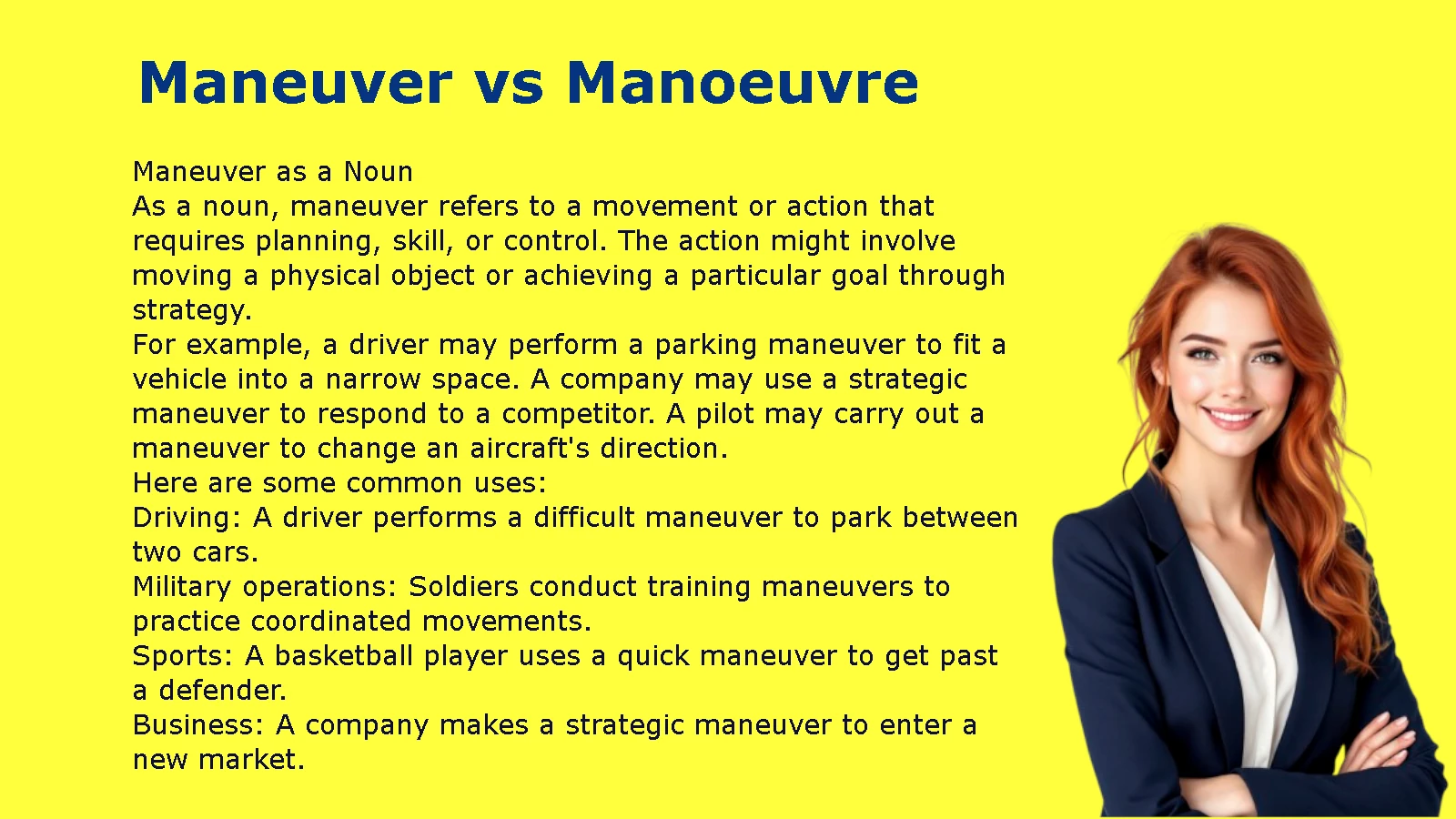
Maneuver as a Noun
As a noun, maneuver refers to a movement or action that requires planning, skill, or control. The action might involve moving a physical object or achieving a particular goal through strategy.
For example, a driver may perform a parking maneuver to fit a vehicle into a narrow space. A company may use a strategic maneuver to respond to a competitor. A pilot may carry out a maneuver to change an aircraft’s direction.
Here are some common uses:
- Driving: A driver performs a difficult maneuver to park between two cars.
- Military operations: Soldiers conduct training maneuvers to practice coordinated movements.
- Sports: A basketball player uses a quick maneuver to get past a defender.
- Business: A company makes a strategic maneuver to enter a new market.
- Politics: A leader uses a procedural maneuver to advance a proposal.
- Everyday situations: Someone makes a careful maneuver to move a sofa through a narrow doorway.
Consider this example:
The driver performed a three-point maneuver to turn the car around on the narrow street.
Here, maneuver describes a controlled sequence of movements. The driver needs to position the car carefully because there isn’t enough room for a simple turn.
The word can also describe an action intended to achieve an advantage.
The retailer’s latest pricing maneuver helped it compete with larger stores.
In this sentence, the maneuver is not a physical movement. It is a deliberate business decision.
Maneuver as a Verb
As a verb, maneuver means to move, guide, position, or direct something skillfully. It often suggests that the person must overcome an obstacle or work within limited space.
For example:
- The driver maneuvered the truck through the narrow alley.
- The pilot maneuvered the aircraft away from the approaching storm.
- The player maneuvered around two defenders.
- The manager maneuvered the team into a stronger negotiating position.
- She maneuvered the heavy cabinet through the doorway without scratching the walls.
The verb can also describe handling a complicated situation.
For example:
He maneuvered through a difficult negotiation without damaging the relationship.
This sentence uses maneuvered figuratively. The person isn’t moving through a physical space. Instead, they are navigating a challenging social or professional situation.
A useful distinction: Move is a broad word for changing position. Maneuver often suggests that the movement requires greater care, planning, skill, or strategy.
You can move a chair across a room, but maneuvering a large chair down a narrow staircase requires more control.
What Does Manoeuvre Mean?
Manoeuvre is the standard British English spelling of the same word. It describes a skillful movement, a planned action, or a strategic operation. Like maneuver, it can function as both a noun and a verb, and its meaning depends on the context.
British English uses manoeuvre in everyday writing, professional communication, journalism, technical documents, and military terminology.
Manoeuvre as a Noun
As a noun, manoeuvre refers to a controlled movement or deliberate action. It can describe a physical task, a strategic decision, or an attempt to gain an advantage.
Examples include:
- The driver completed a difficult parking manoeuvre.
- The pilot performed a series of training manoeuvres.
- The company introduced a financial manoeuvre to improve its position.
- The footballer used a clever manoeuvre to get past the defender.
- The rescue team carried out a careful manoeuvre to reach the stranded climber.
The spelling changes, but the underlying meaning remains the same.
For example:
The driver completed a difficult parking manoeuvre.
This sentence means the driver positioned the vehicle carefully to park in a challenging space. An American writer would normally spell the final word maneuver.
In business, the word can describe a strategic action rather than a physical movement.
The company used a commercial manoeuvre to protect its market share.
Here, manoeuvre refers to a calculated decision designed to improve or protect the company’s position.
Manoeuvre as a Verb
As a verb, manoeuvre means to move or guide something carefully, often to overcome an obstacle or reach a specific position.
Examples include:
- She manoeuvred her car into a tight parking space.
- The pilot manoeuvred the aircraft away from the mountain.
- The cyclist manoeuvred through the crowded street.
- The team manoeuvred into a better position before the final round.
- He manoeuvred the large table through the doorway.
The word can also describe navigating a complicated situation.
The negotiator manoeuvred through several difficult discussions before reaching an agreement.
The sentence describes strategic handling rather than physical movement.
In British English, the spelling remains manoeuvre whether you use the word as a noun or a verb. Its related forms follow the same general British spelling pattern, including manoeuvring and manoeuvred.
What Is the Difference Between Maneuver and Manoeuvre?
Maneuver and manoeuvre have the same core meaning, but they follow different regional spelling conventions. American English generally uses maneuver, while British English uses manoeuvre. The distinction also affects related forms, including the present participle, past tense, and noun describing the ability to move easily.
Spelling Difference Between Maneuver and Manoeuvre
The most visible difference is the sequence of letters.
- American English: maneuver
- British English: manoeuvre
The British form contains the letter combination oe, which the American form omits. Both spellings reflect different adaptations of a word that entered English through French.
English has many comparable spelling differences. American English often simplifies or changes certain letter patterns, while British English retains other traditional forms.
Examples include:
| American English | British English |
| Maneuver | Manoeuvre |
| Color | Colour |
| Favor | Favour |
| Center | Centre |
| Theater | Theatre |
| Analyze | Analyse |
| Traveling | Travelling |
These examples illustrate broader regional patterns, but English spelling does not follow one universal rule. For instance, American English uses analyze, while British English commonly uses analyse. Other words have different patterns, so it’s best to learn each spelling pair rather than assume that one rule covers every word.
Remember: Manoeuvre is not a misspelling of maneuver, and maneuver is not an incorrect version of manoeuvre. Each is standard in its respective variety of English.
Maneuver vs Manoeuvre: Meaning and Pronunciation
The two spellings generally share the same meaning and pronunciation within a given English variety. You don’t need to change the meaning of a sentence when switching from one spelling to the other.
For example:
- American English: The pilot executed a difficult maneuver.
- British English: The pilot executed a difficult manoeuvre.
Both sentences describe the pilot carrying out a controlled or planned movement.
The pronunciation is broadly similar, although the exact vowel sounds can vary by accent. The difference between the written forms does not create a separate definition or a new grammatical function.
Both words can also be used figuratively.
- The company made a clever maneuver to attract new customers.
- The company made a clever manoeuvre to attract new customers.
Each sentence describes a strategic action.
One practical point matters when you’re reading aloud: don’t assume that every difference in spelling produces a difference in pronunciation. Regional accents influence the way English speakers pronounce many words, even when they use the same spelling.
Maneuver vs Manoeuvre in American and British English
Regional preference provides the simplest way to choose between the two spellings.
| Region or context | Recommended spelling | Practical note |
| United States | Maneuver | Standard American English form |
| United Kingdom | Manoeuvre | Standard British English form |
| Australia | Manoeuvre | Standard British-style spelling |
| New Zealand | Manoeuvre | Standard British-style spelling |
| Canada | Depends on the style guide | Both regional influences occur; follow the publication’s convention |
| International publication | Follow the house style | Use one spelling system consistently |
These are general editorial recommendations. Individual organizations, technical standards, or publications may specify their own rules.
Canada deserves particular attention because Canadian English combines British and American influences. A Canadian publication may use British-style spellings for some words and American-style spellings for others. Don’t assume that every Canadian spelling follows one system.
For international content, identify your primary audience before you start writing. If your website mainly serves US readers, use maneuver. If it targets readers in the UK or Australia, use manoeuvre.
Which Spelling Should You Use?
Choose the spelling that matches your audience or your organization’s style guide.
Use maneuver when writing:
- Articles for American readers.
- US business reports and marketing materials.
- American academic assignments.
- Product documentation written in US English.
- Emails and professional documents following American conventions.
Use manoeuvre when writing:
- Articles for British readers.
- UK business reports and publications.
- British academic assignments.
- Technical documents following British conventions.
- Professional correspondence using British English.
For example, imagine you’re publishing a driving guide for an American audience. Your article includes the phrase parallel parking maneuver. Using the American spelling matches readers’ expectations.
If you’re preparing the same guide for a British driving school, parallel parking manoeuvre is the more appropriate choice.
The key is consistency. Switching between maneuver and manoeuvre in the same document can make the text look poorly edited, especially when the difference has no intentional purpose.
Maneuver vs Manoeuvre Examples in Sentences
Examples make the difference easier to understand because they show how each spelling works in real contexts. The sentences below use the same meaning and grammatical structure while changing the spelling to match American or British English.
Examples of Maneuver in American English
Here are examples using the American spelling.
Driving
- The driver completed a difficult parking maneuver.
- She used a careful maneuver to avoid hitting the curb.
- The instructor demonstrated the correct turning maneuver.
- Backing a trailer into a narrow driveway requires a precise maneuver.
Sports
- The basketball player used a quick maneuver to get past the defender.
- The gymnast performed a complex maneuver during the routine.
- The cyclist made a sudden maneuver to avoid another rider.
Business and strategy
- The company introduced a pricing maneuver to attract more customers.
- The manager used a strategic maneuver to resolve the disagreement.
- The retailer’s latest marketing maneuver helped it reach a new audience.
Military and aviation
- The pilots practiced a defensive maneuver during training.
- The military scheduled a series of training maneuvers.
- The aircraft performed a controlled maneuver before landing.
Everyday situations
- We used a careful maneuver to move the sofa through the doorway.
- He made a clever maneuver to avoid an awkward conversation.
- The delivery driver needed room to maneuver the truck.
Notice that maneuver can describe both physical and figurative actions. Its meaning depends on the surrounding words and situation.
Examples of Manoeuvre in British English
These sentences use the British spelling in comparable contexts.
Driving
- The driver completed a difficult parking manoeuvre.
- She used a careful manoeuvre to avoid hitting the kerb.
- The instructor demonstrated the correct turning manoeuvre.
- Reversing a trailer into a narrow driveway requires a precise manoeuvre.
Sports
- The basketball player used a quick manoeuvre to get past the defender.
- The gymnast performed a complex manoeuvre during the routine.
- The cyclist made a sudden manoeuvre to avoid another rider.
Business and strategy
- The company introduced a pricing manoeuvre to attract more customers.
- The manager used a strategic manoeuvre to resolve the disagreement.
- The retailer’s latest marketing manoeuvre helped it reach a new audience.
Military and aviation
- The pilots practised a defensive manoeuvre during training.
- The military scheduled a series of training manoeuvres.
- The aircraft performed a controlled manoeuvre before landing.
Everyday situations
- We used a careful manoeuvre to move the sofa through the doorway.
- He made a clever manoeuvre to avoid an awkward conversation.
- The delivery driver needed room to manoeuvre the lorry.
Some examples also change other words, such as curb to kerb, practiced to practised, and truck to lorry. These differences help illustrate regional writing conventions, but they aren’t required when changing maneuver to manoeuvre.
Side-by-Side Maneuver vs Manoeuvre Sentence Comparisons
The following table shows how to adapt sentences for different audiences without changing their basic meaning.
| American English | British English |
| The driver performed a difficult maneuver. | The driver performed a difficult manoeuvre. |
| She maneuvered the car into the space. | She manoeuvred the car into the space. |
| The pilot practiced several maneuvers. | The pilot practised several manoeuvres. |
| The team is maneuvering into position. | The team is manoeuvring into position. |
| The vehicle has excellent maneuverability. | The vehicle has excellent manoeuvrability. |
| The player made a clever maneuver. | The player made a clever manoeuvre. |
Only the relevant spelling changes in some of these pairs. Others also reflect the broader conventions of American and British English.
When adapting an existing article, avoid changing words unnecessarily. If your only goal is to switch maneuver to manoeuvre, you don’t need to rewrite the entire sentence. Change the target word and its related forms, then review the document for consistency.
Maneuver vs Manoeuvre: Related Word Forms
The spelling difference doesn’t end with the base word. It also affects verb forms and related nouns. Learning these patterns helps you avoid inconsistent spelling in longer documents.
Maneuvering vs Manoeuvring
Maneuvering is the standard American English form, while manoeuvring is the standard British English form. Both describe the act of moving or positioning something carefully, or the process of handling a difficult situation.
Examples:
- American: The driver is maneuvering into the parking space.
- British: The driver is manoeuvring into the parking space.
- American: Maneuvering the boat through the narrow channel requires skill.
- British: Manoeuvring the boat through the narrow channel requires skill.
The spelling difference is especially noticeable because the British form retains the oe combination.
The same distinction applies when the word functions as a gerund, which is a verb form ending in -ing that can act as a noun.
For example:
Manoeuvring through heavy traffic requires patience.
Here, manoeuvring refers to the activity of moving through traffic.
In American English, you would write:
Maneuvering through heavy traffic requires patience.
The meaning and grammatical role remain the same.
Maneuvered vs Manoeuvred
Maneuvered is the American English past-tense and past-participle form. Manoeuvred is the British English equivalent.
Examples:
- American: She maneuvered the vehicle around the obstacle.
- British: She manoeuvred the vehicle around the obstacle.
- American: The team maneuvered into a stronger position.
- British: The team manoeuvred into a stronger position.
- American: The pilot had maneuvered the aircraft safely.
- British: The pilot had manoeuvred the aircraft safely.
The American form uses -ered, while the British form uses -euvred.
This difference matters when writing in the past tense, especially if your document contains several instances of the word. Changing only the base form can leave related forms inconsistent.
For example, this sentence mixes regional conventions:
The driver maneuvered the car into position before manoeuvring around the barrier.
A consistent American version would use maneuvered and maneuvering. A consistent British version would use manoeuvred and manoeuvring.
Maneuverability vs Manoeuvrability
Maneuverability is the American English spelling, while manoeuvrability is the British English spelling. Both describe how easily a person, vehicle, machine, or object can be moved or controlled.
The term is common in engineering, automotive writing, aviation, robotics, and product descriptions.
Examples:
- American: The compact car offers excellent maneuverability in crowded streets.
- British: The compact car offers excellent manoeuvrability in crowded streets.
- American: Engineers improved the robot’s maneuverability.
- British: Engineers improved the robot’s manoeuvrability.
The word often appears in technical comparisons.
For example, a vehicle with a small turning radius may be easier to maneuver in a tight parking garage than a larger vehicle. Its maneuverability describes how readily the driver can position and turn it in restricted spaces.
In robotics, maneuverability may describe how easily a robot can change direction or move through a complicated environment. In aviation, the term can describe an aircraft’s ability to change direction or orientation under particular operating conditions.
Don’t confuse maneuverability with maneuvering. Maneuverability describes an ability or characteristic, while maneuvering describes an action or process.
Common Spelling Mistakes
Most mistakes occur when writers mix American and British spelling patterns or apply a familiar pattern to the wrong word form.
Watch out for these issues:
| Incorrect or inconsistent usage | Preferred American form | Preferred British form |
| Maneouvre | Maneuver | Manoeuvre |
| Manoeuvreing | Maneuvering | Manoeuvring |
| Maneuverred | Maneuvered | Manoeuvred |
| Maneuverability in a British-style document | Maneuverability | Manoeuvrability |
| Manoeuvred in an otherwise American-style document | Maneuvered | Manoeuvred |
The last two rows illustrate consistency problems rather than words that are inherently incorrect in every context. A spelling can be valid in one variety of English but inconsistent with the style used elsewhere in a document.
Here are practical ways to avoid mistakes:
- Choose a language setting: Set your word processor to US English or UK English.
- Use spell-checking tools: Review the document for regional spelling variations.
- Check related forms: Search for maneuvering, manoeuvring, maneuvered, and manoeuvred.
- Follow the house style: Use the spelling required by your employer, publisher, university, or client.
- Proofread the final version: Automatic tools can miss valid words that don’t match your chosen regional convention.
A spell-checker may accept both spellings because both are legitimate. Therefore, don’t rely on a red underline alone to determine which form fits your audience.
Is Maneuver or Manoeuvre More Common?
Neither spelling is universally more correct. Their frequency depends on the country, publication, and type of writing. American publications generally prefer maneuver, while British publications generally prefer manoeuvre. If you need to choose one, consider your readers rather than trying to identify a single spelling that works best everywhere.
Usage in American Publications
American English uses maneuver as the standard spelling in general writing.
You’ll commonly see the word in:
- News articles about military operations.
- Driving guides and vehicle reviews.
- Sports reporting.
- Business and political commentary.
- Technical manuals and educational material.
For example, an American automotive article might say:
The vehicle’s small turning radius makes the parking maneuver easier.
The spelling aligns with standard US conventions.
If you’re writing for an American website, consistency across related words also matters. Use maneuvering, maneuvered, and maneuverability rather than switching to British forms.
American publications may quote British sources or retain an official name’s original spelling. Such cases don’t change the general regional preference.
Usage in British Publications
British English generally uses manoeuvre in the same contexts.
Examples include:
- News reports about military exercises.
- Driving instruction materials.
- Sports journalism.
- Business analysis.
- Technical and educational writing.
A British automotive article might say:
The vehicle’s small turning radius makes the parking manoeuvre easier.
The meaning is identical to the American sentence.
British publications commonly use the related forms manoeuvring, manoeuvred, and manoeuvrability. These spellings fit the broader British convention, although an individual publisher may follow a specialized style guide.
When writing for British readers, it’s sensible to check other regional spellings in the same article. For example, British English commonly uses colour, centre, and travelling, while American English typically uses color, center, and traveling.
Choosing the Right Spelling for International Readers
International content requires a little planning. A website might attract readers from the United States, the United Kingdom, Canada, Australia, and other countries. Using one consistent variety of English makes the content easier to maintain and edit.
Consider this practical approach:
- For a US-focused website: Use American English throughout.
- For a UK-focused website: Use British English throughout.
- For an international publication: Follow the organization’s preferred style guide.
- For a translated document: Follow the spelling conventions requested by the translator, client, or target market.
- For a quoted passage: Preserve the original spelling when accuracy requires it.
A company that sells products internationally may maintain separate US and UK versions of its website. In that situation, the American version can use maneuver, while the British version uses manoeuvre.
However, don’t create separate spelling variations without a clear reason. If one international page serves all readers, a consistent editorial style is usually more practical than changing spellings in every paragraph.
How to Remember the Difference Between Maneuver and Manoeuvre
A simple memory trick can help you select the correct form quickly. Connect each spelling to its regional variety, then use the same pattern for related words.
A Simple American English Memory Trick
Remember that maneuver is the American spelling.
The easiest approach is to memorize the complete word rather than trying to derive it from a general spelling rule. English has many exceptions, and a familiar-looking pattern won’t always predict the correct spelling.
Use this short reminder:
American English = maneuver.
Examples:
- Parking maneuver
- Military maneuver
- Maneuvering a vehicle
- Maneuverability in tight spaces
If you’re writing an American article, check each related form as well. Use maneuvered in the past tense and maneuvering for the ongoing action.
A Simple British English Memory Trick
Remember that manoeuvre is the British spelling.
The oe sequence helps distinguish it from the American form. If you regularly write for a British audience, learn the base word together with its common variations.
Use this reminder:
British English = manoeuvre.
Examples:
- Parking manoeuvre
- Military manoeuvre
- Manoeuvring a vehicle
- Manoeuvrability in tight spaces
The memory trick works best when you apply it consistently across a document. Don’t memorize only the base form and overlook the related words.
A Practical Editing Tip
Set your writing software to the correct language before drafting. This simple step can help identify regional spelling inconsistencies during proofreading.
For example, if you’re using Microsoft Word or Google Docs, choose the English language variety that matches your audience when the available settings allow it.
Then follow this checklist:
- Identify the primary audience.
- Select US or UK English.
- Search for maneuver and manoeuvre.
- Check the forms ending in -ing and -ed.
- Review related nouns such as maneuverability and manoeuvrability.
- Proofread the final document for consistency.
For a long article, use your editor’s search function to find each spelling. A quick search can reveal inconsistencies that a standard spell-checker may not flag.
Frequently Asked Questions About Maneuver vs Manoeuvre
Is Maneuver or Manoeuvre Correct?
Both spellings are correct. Maneuver is the standard American English spelling, while manoeuvre is the standard British English spelling. Both words refer to a planned or skillful movement, action, or strategy. Choose the version that matches your audience or publication’s style guide.
Is Manoeuvre British or American?
Manoeuvre is the standard British English spelling. It is commonly used in the United Kingdom and other English-speaking regions that follow British spelling conventions, including Australia and New Zealand. American English generally uses maneuver instead.
Do Maneuver and Manoeuvre Mean the Same Thing?
Yes. Maneuver and manoeuvre generally have the same meaning and grammatical uses. Both can function as nouns or verbs and describe physical movements, strategic actions, or skillful handling of difficult situations. The primary difference is regional spelling, not definition.
How Do You Spell Maneuver in the UK?
The standard British English spelling is manoeuvre. For example, a British writer would normally write, The driver performed a difficult parking manoeuvre. In American English, the same sentence uses maneuver.
Is It Maneuvering or Manoeuvring?
Both forms are correct, depending on the variety of English. Maneuvering is the standard American English spelling, while manoeuvring is the standard British English spelling. Both describe the act of moving or positioning something carefully.
Which Spelling Should I Use in Professional Writing?
Use maneuver for American English documents and manoeuvre for British English documents. If your organization has a house style guide, follow its instructions. Above all, maintain consistency across the document, including related forms such as maneuvered, manoeuvred, and maneuverability.
Conclusion: Maneuver vs Manoeuvre
The difference between maneuver vs manoeuvre comes down to regional spelling conventions. Both words are correct, and both describe a planned or skillful movement, action, or strategy.
Use maneuver when writing in American English. Choose manoeuvre when writing in British English. Apply the same distinction to related forms, including maneuvering vs manoeuvring, maneuvered vs manoeuvred, and maneuverability vs manoeuvrability.
Before publishing your next article, report, or professional document, check your target audience and choose the appropriate spelling system. A consistent approach makes your writing look polished and helps readers focus on your message rather than regional spelling differences.