If you’ve ever typed liesure and wondered whether it looks right, you’re not alone. The words leisure and liesure look almost identical, so it’s easy to mix up their letters. However, only one is a correct English spelling.
Leisure is the correct spelling. It refers to free time when you’re not working or handling other responsibilities. Liesure is a misspelling and isn’t recognized as a standard English word.
You might use leisure when talking about hobbies, vacations, relaxing at home, or enjoying activities outside work. For example, you can read a book in your leisure time, take a leisurely walk, or enjoy a hobby at your leisure.
The good news is that remembering the correct spelling is simple once you understand the word and see it in context. This guide explains the difference between leisure and liesure, provides original example sentences, explores related words, and shares practical tips to help you spell leisure correctly every time.
Leisure vs Liesure: Quick Answer
Leisure is the correct spelling, while liesure is incorrect. The word leisure means free time available for relaxation, hobbies, entertainment, or other activities you choose to enjoy. You can use it as a noun in phrases such as leisure time and leisure activities. Remember to spell it with an ei, not an ie.
| Word | Correct spelling? | Meaning | Example |
| Leisure | Yes | Free time for relaxation or enjoyment | I spend my leisure time gardening. |
| Liesure | No | A misspelling of leisure | I enjoy reading in my liesure time. |
| Leisurely | Yes | Relaxed, unhurried, or done without rushing | We took a leisurely walk after dinner. |
The key difference is the order of the vowels. In leisure, the letters e and i appear in that order after the initial l. The incorrect spelling liesure reverses them.
Correct: I enjoy cycling during my leisure time.
Incorrect: I enjoy cycling during my liesure time.
If you’re writing an email, school assignment, blog post, résumé, or social media caption, always choose leisure.
What Does Leisure Mean?
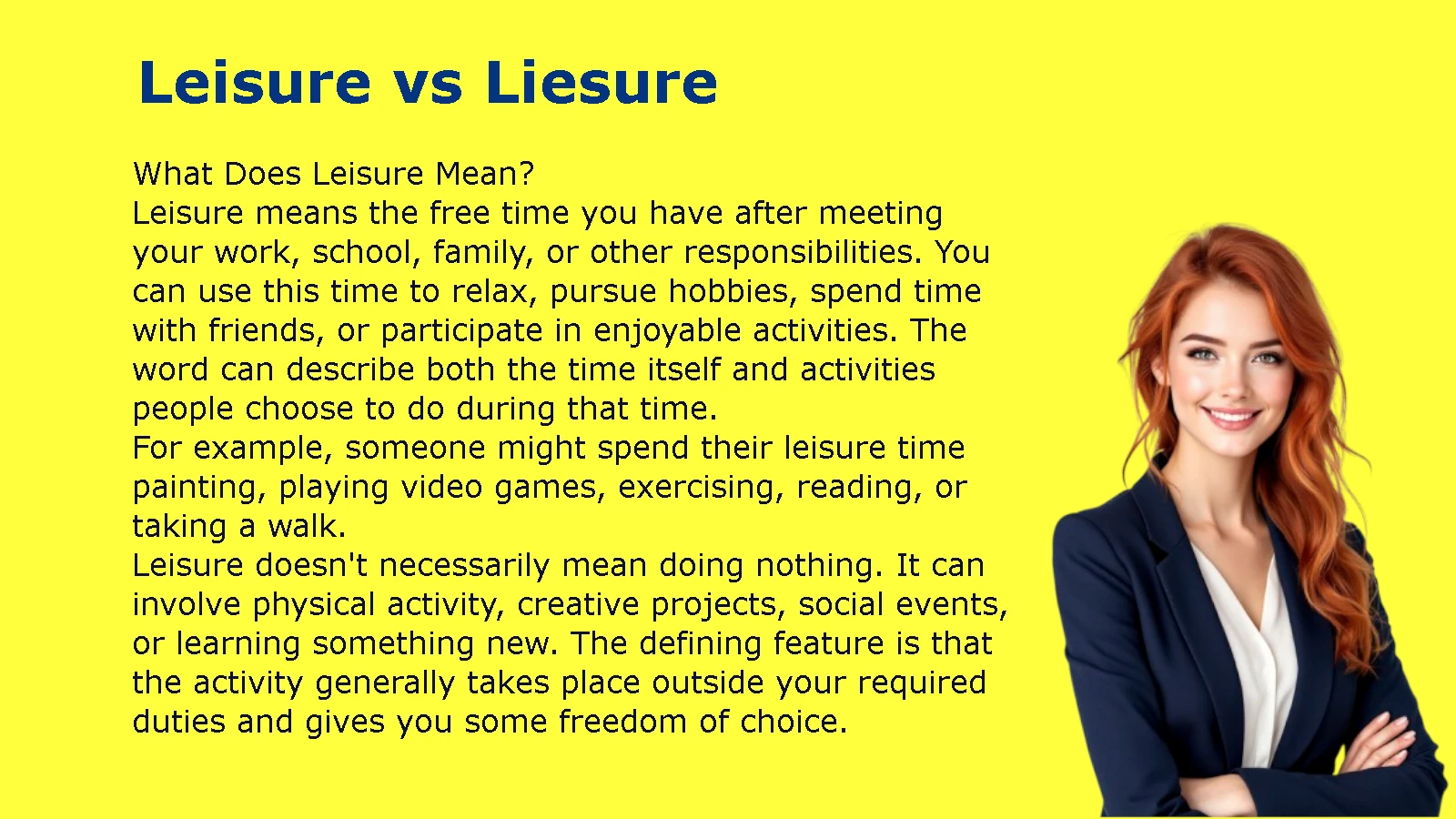
Leisure means the free time you have after meeting your work, school, family, or other responsibilities. You can use this time to relax, pursue hobbies, spend time with friends, or participate in enjoyable activities. The word can describe both the time itself and activities people choose to do during that time.
For example, someone might spend their leisure time painting, playing video games, exercising, reading, or taking a walk.
Leisure doesn’t necessarily mean doing nothing. It can involve physical activity, creative projects, social events, or learning something new. The defining feature is that the activity generally takes place outside your required duties and gives you some freedom of choice.
Leisure Meaning and Definition
The noun leisure refers to time available for activities that aren’t required by work or other obligations. It can also describe things associated with relaxation and recreation.
Consider these examples:
- Free time: I have more leisure during the summer holidays.
- Relaxation: She enjoys gardening as a leisure activity.
- Entertainment: Movies are one of his favorite leisure pursuits.
- Recreation: The town built a leisure center with a swimming pool and gym.
- Lifestyle: They moved to the countryside to enjoy a quieter life of leisure.
In each example, leisure relates to time, activities, or facilities that support enjoyment outside mandatory responsibilities.
The word often appears in everyday conversations as well as professional writing. For instance, a workplace report might discuss employees’ leisure time, while a travel article might recommend leisure activities for visitors.
Although the word frequently suggests relaxation, it doesn’t always mean complete rest. Playing tennis, hiking a mountain trail, or learning guitar can all count as leisure activities.
Leisure as Free Time or Relaxation
Leisure can mean more than simply having an empty schedule. It also involves having the opportunity to choose how you spend your time.
Imagine two people who finish work at 5 p.m. One spends the evening answering work emails because a deadline is approaching. The other closes their laptop and spends an hour painting.
Both people have time outside their regular working hours, but the second person has more opportunity to use that time for leisure.
Here are several common forms of leisure:
- Passive leisure: Reading, watching a movie, listening to music, or resting.
- Physical leisure: Swimming, cycling, hiking, or playing recreational sports.
- Creative leisure: Drawing, photography, writing stories, or playing an instrument.
- Social leisure: Meeting friends, attending parties, or enjoying family gatherings.
- Educational leisure: Learning a language, exploring a personal interest, or taking a class for enjoyment.
- Outdoor leisure: Gardening, camping, fishing, or visiting a park.
These categories can overlap. Someone who joins a photography club, for example, may combine creative, educational, social, and outdoor leisure in one activity.
Example sentences using leisure:
- My father spends his leisure time restoring old furniture.
- We visited the coast for a weekend of leisure and relaxation.
- Reading historical novels is one of her favorite leisure activities.
- The hotel offers several leisure facilities, including a gym and an indoor pool.
- He hopes to have more leisure time after retiring.
- The new park gives residents a place to enjoy outdoor leisure.
Notice that leisure doesn’t describe one particular hobby. It refers to the broader idea of free time and the activities associated with it.
Is Liesure a Word?
No, liesure isn’t a standard English word. It’s a common misspelling of leisure, usually caused by confusion about the order of the vowels. If you mean free time, relaxation, or recreational activities, write leisure. Spell-checking software may flag liesure as an error and suggest the correct spelling.
Why People Misspell Leisure as Liesure
The mistake is understandable because English spelling doesn’t always follow a predictable pattern. The letters ei and ie appear in many familiar words, and writers sometimes reverse them when typing quickly.
For example:
| Correct word | Common incorrect spelling |
| Leisure | Liesure |
| Receive | Recieve |
| Believe | Beleive |
| Piece | Peice |
| Friend | Freind |
These examples illustrate a similar letter-order problem, but they don’t all follow the same spelling rule. English has exceptions, so a single trick won’t solve every spelling question.
Several factors can explain why someone writes liesure:
- Visual confusion: The two spellings look similar, especially when you read quickly.
- Typing errors: Your fingers may enter the letters in the wrong order.
- Unfamiliarity: If you rarely use the word, you may not remember its standard spelling.
- Faulty assumptions: You might apply a familiar ie or ei pattern without checking the individual word.
- Autocorrect limitations: A writing tool may not catch every error, especially in specialized settings or poorly configured software.
The best solution is to learn the correct spelling as a complete word rather than rely entirely on a general vowel rule.
For instance, memorize the phrase leisure time instead of trying to reconstruct the spelling each time you need it.
If you see liesure in a draft, correct it to leisure. The meaning will then be clear to your readers.
Leisure vs Liesure Examples
Examples make the difference between leisure and liesure easy to recognize. The correct spelling works in sentences about hobbies, holidays, recreation, and relaxation. The incorrect spelling doesn’t become acceptable simply because readers can understand what you mean.
Leisure in Example Sentences
Here are original sentences showing how to use leisure in different contexts.
| Context | Example sentence | Why it works |
| Everyday life | I spend my leisure time listening to jazz. | Refers to free time outside required activities. |
| Hobbies | Photography has become my favorite leisure pursuit. | Describes an enjoyable personal interest. |
| Travel | We planned a leisure trip to the mountains. | Distinguishes a relaxing trip from one taken for business. |
| Work-life balance | The new schedule gives employees more leisure time. | Refers to time available outside work. |
| Sports | The community offers several leisure activities for children. | Describes recreational options. |
| Accommodation | The resort has a separate leisure area with a pool. | Refers to facilities for relaxation and recreation. |
| Retirement | She hopes to enjoy gardening and reading in her leisure years. | Connects leisure with a less work-centered lifestyle. |
| Personal choice | He prefers outdoor leisure to watching television. | Compares different ways to spend free time. |
Here are a few more examples:
- After finishing my assignments, I used my leisure time to learn basic photography.
- The village attracts visitors who want a peaceful leisure break.
- Our company introduced flexible hours to help employees protect their leisure time.
- She joined a local walking group as a leisure activity.
- The hotel caters to both business travelers and leisure guests.
- He enjoys a life of leisure now that he has retired.
- They discussed how technology has changed the way people spend their leisure time.
In formal writing, you might use leisure to discuss tourism, recreation, or work-life balance. In casual conversation, the word fits naturally into phrases such as leisure time and leisure activities.
Liesure vs Leisure: Correct and Incorrect Examples
The following comparisons show how a single spelling error can appear in different sentences.
| Incorrect sentence | Correct sentence |
| I enjoy reading in my liesure time. | I enjoy reading in my leisure time. |
| Swimming is my favorite liesure activity. | Swimming is my favorite leisure activity. |
| We booked a liesure trip to the beach. | We booked a leisure trip to the beach. |
| The hotel has a modern liesure center. | The hotel has a modern leisure center. |
| She wants a better work and liesure balance. | She wants a better work and leisure balance. |
| He enjoys a life of liesure after retirement. | He enjoys a life of leisure after retirement. |
| They offer several liesure facilities. | They offer several leisure facilities. |
The incorrect sentences remain understandable, but the spelling error can make your writing appear careless. It may also interfere with searches, document editing, or professional proofreading.
One useful editing technique is to search your document for the exact string liesure. If the word appears where you intend to discuss free time, replace it with leisure.
This quick check is particularly useful for longer documents, where a repeated spelling mistake can easily go unnoticed.
How to Spell Leisure Correctly
The correct spelling is L-E-I-S-U-R-E: leisure. The main point to remember is that the word begins with lei, not lie. If you accidentally reverse the first two vowels, you’ll produce the misspelling liesure. Learning the word visually and practicing it in a familiar phrase can help you remember the correct letter order.
A Simple Way to Remember the Spelling
The easiest approach is to memorize leisure as a complete word and connect it with a phrase you already use.
Try these techniques:
Remember the first three letters: LEI
The word starts with lei, followed by sure.
- Correct: LEI-SURE
- Incorrect: LIE-SURE
You can mentally divide the word into two parts: lei + sure. This isn’t a claim about its historical word formation. It’s simply a practical memory aid.
Memorize a familiar phrase
Choose one of these phrases:
- Leisure time
- Leisure activities
- Leisure center
- At your leisure
Say or write one phrase several times. When you need the word again, the familiar expression may help you recall its spelling.
Use the word in a sentence
Write a short sentence that relates to your own life.
For example:
“I enjoy reading during my leisure time.”
Because the sentence connects the word to a familiar activity, it gives you a meaningful context rather than an isolated spelling exercise.
Test yourself
Cover the word and try to write it from memory. Then compare your version with the correct spelling.
| Practice word | Correct spelling |
| Free time | Leisure |
| Free-time activity | Leisure activity |
| Relaxed pace | Leisurely |
| Time to do something when convenient | At your leisure |
Repeat the exercise whenever you find yourself writing liesure. Over time, recognizing the correct sequence should become more automatic.
Leisure Pronunciation
The word leisure has two common pronunciations in English, and the preferred version can vary by region and speaker.
- In many American English accents, it sounds like LEE-zher.
- Another accepted pronunciation, common in British English and also heard elsewhere, sounds like LEH-zher.
Both pronunciations refer to the same word and meaning. Neither changes the spelling.
The first syllable receives the main stress. The final part sounds like the ending in measure for many speakers.
Here are examples of the word in context:
- We have plenty of leisure time this weekend.
- The resort offers leisure facilities for guests.
- She prefers a leisurely breakfast on Sunday mornings.
Don’t confuse pronunciation with spelling. Even when someone pronounces the first vowel differently, the standard written form remains leisure.
Leisure vs. Pleasure: What’s the Difference?
Leisure describes the time available or the activity you choose to do. Pleasure describes the positive feeling you experience. The two concepts often overlap, but they aren’t interchangeable in every sentence.
For example, reading a novel can be a leisure activity, and the enjoyment you get from reading can be a source of pleasure.
| Feature | Leisure | Pleasure |
| Part of speech | Primarily a noun; also appears in related forms | Primarily a noun; also a verb |
| Main meaning | Free time or recreational activity | Enjoyment, satisfaction, or delight |
| Focus | Time and how you spend it | A feeling or experience |
| Example | Gardening is my favorite leisure activity. | Gardening gives me great pleasure. |
| Common phrase | Leisure time | A pleasure to meet you |
| Related adjective | Leisurely | Pleasurable |
Consider these sentences:
- Leisure: I reserve Sunday mornings for leisure.
- Pleasure: I take pleasure in preparing breakfast for my family.
- Both: I enjoy the pleasure of reading during my leisure time.
The final example includes both words because they express different ideas. Leisure identifies the time, while pleasure describes the enjoyment associated with it.
You can also use pleasure as a verb, as in “The music pleased the audience.” You can’t normally substitute leisure in that sentence.
Remember this distinction when writing about hobbies, free time, enjoyment, or personal satisfaction.
Leisure vs. Recreation: What’s the Difference?
Leisure is free time available for personal activities, while recreation refers to activities people undertake for enjoyment, relaxation, or refreshment. Recreation often takes place during leisure time, but the words emphasize different things. Leisure focuses on the time or broader opportunity, whereas recreation focuses on the activity.
For example, Saturday afternoon might be your leisure time. Playing basketball during that afternoon is recreation.
| Feature | Leisure | Recreation |
| Main focus | Free time and freedom from obligations | Activities that provide enjoyment or refreshment |
| Typical examples | An afternoon off, free time after work | Swimming, hiking, playing sports |
| Can describe time? | Yes | Not usually in the same broad sense |
| Can describe an activity? | Yes, as in leisure activity | Yes, as in recreational activity |
| Example | I have two hours of leisure today. | I use those two hours for recreation. |
The words can overlap in phrases such as leisure and recreation. This expression often appears in discussions about tourism, community facilities, public parks, and personal well-being.
For example:
- The city invested in leisure and recreation facilities.
- Hiking is a popular recreational activity during leisure time.
- The hotel provides leisure facilities for guests who want to swim or exercise.
- Our school organizes recreational programs after classes.
A useful way to remember the difference is to think of leisure as the available time and recreation as one way to spend it.
However, the distinction isn’t absolute. People sometimes use leisure activities and recreational activities to describe the same things.
Common Phrases With Leisure
The word leisure appears in several established English expressions. Learning these phrases helps you spell the word correctly and use it naturally in everyday conversation, academic writing, and professional communication.
Leisure Time
Leisure time is time available for activities outside work, study, and other obligations.
Examples:
- I use my leisure time to practice the piano.
- She wants more leisure time to spend with her children.
- The new work schedule gives staff greater flexibility in their leisure time.
This phrase often appears in conversations about work-life balance, personal interests, and how people organize their days.
Leisure Activities
Leisure activities are things people do during their free time for enjoyment, relaxation, or personal interest.
Examples include:
- Reading
- Gardening
- Cycling
- Playing board games
- Painting
- Swimming
- Listening to music
- Hiking
Example sentences:
- The community center offers leisure activities for people of all ages.
- His favorite leisure activities include cooking and photography.
- The survey asked participants about their preferred leisure activities.
The phrase is useful when discussing hobbies generally rather than one specific pastime.
At Your Leisure
At your leisure means at a time that suits you, without unnecessary haste or pressure.
Examples:
- Please review the document at your leisure.
- You can explore the garden at your leisure.
- Read the instructions at your leisure before starting the project.
This expression is common in polite, professional communication. It allows the other person to decide when to complete an activity.
For instance, writing “Please review the proposal at your leisure” sounds less urgent than “Please review the proposal immediately.”
However, context matters. If a task has a deadline, state it clearly rather than relying on at your leisure to communicate the timing.
Leisure and Recreation
Leisure and recreation is a common phrase for free time and the activities people pursue during it.
You might encounter it in discussions about parks, travel, sports, tourism, and public facilities.
Examples:
- The town plans to expand its leisure and recreation services.
- The resort offers a range of leisure and recreation options.
- The course explores the role of leisure and recreation in community life.
The phrase works well when you want to discuss both the time people have available and the activities they choose.
Leisure Synonyms
Several words are related to leisure, but the best alternative depends on the sentence. Some describe free time, while others refer to relaxation, entertainment, or specific recreational activities.
| Synonym or related word | Meaning | Example |
| Free time | Time available outside obligations | I use my free time to learn Spanish. |
| Recreation | Activities done for enjoyment or refreshment | Swimming is my favorite form of recreation. |
| Relaxation | The process or state of becoming less tense | Music helps me relax after work. |
| Downtime | A period of rest or reduced activity | I need some downtime after a busy week. |
| Spare time | Time left after other commitments | She writes short stories in her spare time. |
| Pastime | An activity done for enjoyment | Chess is his favorite pastime. |
| Amusement | Enjoyment or an entertaining activity | The festival offers amusement for families. |
| Hobby | An activity pursued regularly for enjoyment | Woodworking has become my main hobby. |
| Idleness | A state of inactivity or not working | He disliked idleness and preferred staying busy. |
| Ease | A state of comfort or freedom from difficulty | She settled into a life of greater ease. |
These words aren’t perfect substitutes in every context.
For example, downtime often refers to a break from work or activity. Hobby identifies a particular interest, such as gardening or painting. Recreation emphasizes enjoyable activities, while spare time refers to time left over after other commitments.
Compare the following sentences:
- “I spend my leisure time gardening.”
- “I spend my spare time gardening.”
- “Gardening is my favorite pastime.”
- “Gardening is my main hobby.”
All four sentences are natural, but each emphasizes a slightly different aspect of the activity.
If you’re looking for another word for leisure, start by deciding whether you mean free time, relaxation, or an enjoyable activity. That distinction will help you choose the most accurate alternative.
Is Leisure Spelled Differently in American and British English?
No. The word leisure has the same spelling in American and British English. Both varieties use leisure to refer to free time, relaxation, or recreational activities. The main regional difference is pronunciation, not spelling. You don’t need to change the word when writing for an American or British audience.
Here are examples of the standard spelling in common expressions:
| Expression | American English | British English |
| Leisure time | Leisure time | Leisure time |
| Leisure activities | Leisure activities | Leisure activities |
| Leisure center/centre | Leisure center | Leisure centre |
| Leisure facilities | Leisure facilities | Leisure facilities |
| At your leisure | At your leisure | At your leisure |
| Leisurely walk | Leisurely walk | Leisurely walk |
Notice the difference in center and centre. American English generally uses center, while British English generally uses centre. The word leisure itself doesn’t change.
Pronunciation varies more noticeably. Some American speakers say leisure with a first vowel like the one in see, while some British speakers use a vowel closer to the one in bed. Both regional traditions include variation, so these aren’t absolute rules for every speaker.
Here are examples for each audience:
American English:
- We spent the afternoon enjoying leisure activities at the resort.
- The hotel has a modern leisure center.
- I plan to use my leisure time to learn photography.
British English:
- We spent the afternoon enjoying leisure activities at the resort.
- The hotel has a modern leisure centre.
- I plan to use my leisure time to learn photography.
The spelling of leisure stays the same in every example.
Frequently Asked Questions About Leisure vs Liesure
Is It Leisure or Liesure?
Leisure is correct. Liesure is a misspelling. Use leisure when referring to free time, relaxation, hobbies, or recreational activities.
Correct: “I enjoy reading during my leisure time.”
Incorrect: “I enjoy reading during my liesure time.”
What Does Leisure Mean?
Leisure means free time available for relaxation, recreation, or activities you choose to enjoy. For example, playing guitar, hiking, reading, or meeting friends can all be leisure activities.
The word can also describe facilities designed for recreation, as in leisure center or leisure facilities.
Why Is Liesure Incorrect?
Liesure is incorrect because it reverses the first two vowels in the standard spelling. The correct word is spelled l-e-i-s-u-r-e.
The misspelling may result from typing too quickly or confusing the word with familiar ie and ei patterns. Memorizing the phrase leisure time can help you avoid the mistake.
How Do You Pronounce Leisure?
Two common pronunciations are LEE-zher and LEH-zher. The first is common in many American accents, while the second is common in British English and is also heard elsewhere.
The pronunciation varies by speaker and region. Both versions use the same spelling: leisure.
What Is Another Word for Leisure?
Possible alternatives include free time, spare time, recreation, downtime, and relaxation.
Choose the word that fits your meaning. Use free time when you mean time outside your obligations, recreation for enjoyable activities, and downtime when you want to emphasize rest or a break.
What Does At Your Leisure Mean?
At your leisure means at a time convenient to you, without unnecessary haste.
For example, “Please read the report at your leisure” means that the reader can choose a suitable time to read it.
If you need the report by a specific date, include that deadline in your message.
Is Leisure Time the Same as Free Time?
Yes, the expressions often mean the same thing. Both refer to time available outside work, school, and other obligations.
However, leisure time often emphasizes time for relaxation or enjoyable activities, while free time can refer more generally to any period without scheduled commitments.
For example:
- “I have some free time before my appointment.”
- “I spend my leisure time painting.”
Both sentences are correct, but the second specifically highlights an enjoyable activity.
Final Takeaway: Leisure vs Liesure
When comparing leisure and liesure, the answer is straightforward: leisure is the correct spelling, and liesure is incorrect.
The word leisure refers to free time, relaxation, hobbies, and recreational activities. You can use it in expressions such as leisure time, leisure activities, leisure facilities, and at your leisure. Its spelling stays the same in American and British English, even though pronunciation can vary by region.
To remember the correct form, focus on the first three letters: LEI, not LIE. Practicing the word in a familiar phrase, such as leisure time, can help make the spelling automatic.
Before publishing an article, sending a professional email, or submitting an assignment, check that you’ve used leisure wherever you mean free time or recreation.
Remember: you have leisure time when you can relax, pursue a hobby, or enjoy an activity of your choice. You don’t have “liesure” time because liesure isn’t the correct spelling.