Inward or inwards can be confusing because both words are correct, but they don’t always appear in the same types of sentences. If you’ve come across “inward” or “inwards” and wondered which one to use, the difference mainly depends on grammar, sentence structure, dialect, and whether you’re describing movement toward the inside or something directed internally.
The inward or inwards meaning is closely related to movement, direction, and position toward the inside. Inward can function as an adjective or adverb, while inwards is generally used as an adverb. In many contexts, the two words can be used interchangeably, especially when describing movement toward the center or inside. However, inward is more common in American English, while inwards is particularly common in British English and other varieties of English.
In this guide, you’ll learn the difference between “inward” and “inwards,” when to use each word, whether “inward” or “inwards” is more common in American and British English, and how to use both correctly in sentences. You’ll also see clear examples to make the distinction easy to understand.
By the end, you’ll know exactly when to use inward or inwards and how to choose the right word naturally and correctly in your writing.
Inward vs. Inwards: What’s the Difference?
The easiest way to understand inward vs. inwards is to separate meaning from usage.
Both words can describe movement or direction toward the inside:
The edges folded inward.
The edges folded inwards.
The meaning stays virtually identical.
The more significant difference is grammatical. Inward has several jobs in English. It can work as an adjective, an adverb, and, in some dictionaries, a noun. Inwards is primarily an adverb.
| Word | Main grammatical role | Basic meaning | Typical usage |
| inward | Adjective, adverb | Toward or on the inside | Common in American English and also standard in British English |
| inwards | Adverb | Toward the inside | Especially common in British English |
| inwardly | Adverb | In one’s thoughts or feelings | Describes an internal mental or emotional state |
So, if you’re choosing between the two in a sentence describing physical movement, either may work:
- The door swung inward.
- The door swung inwards.
But if the word modifies a noun, use inward:
- an inward curve
- an inward movement
- an inward flow
- an inward direction
Oxford specifically gives examples such as “an inward flow” and “an inward curve.”
What Does Inward Mean?
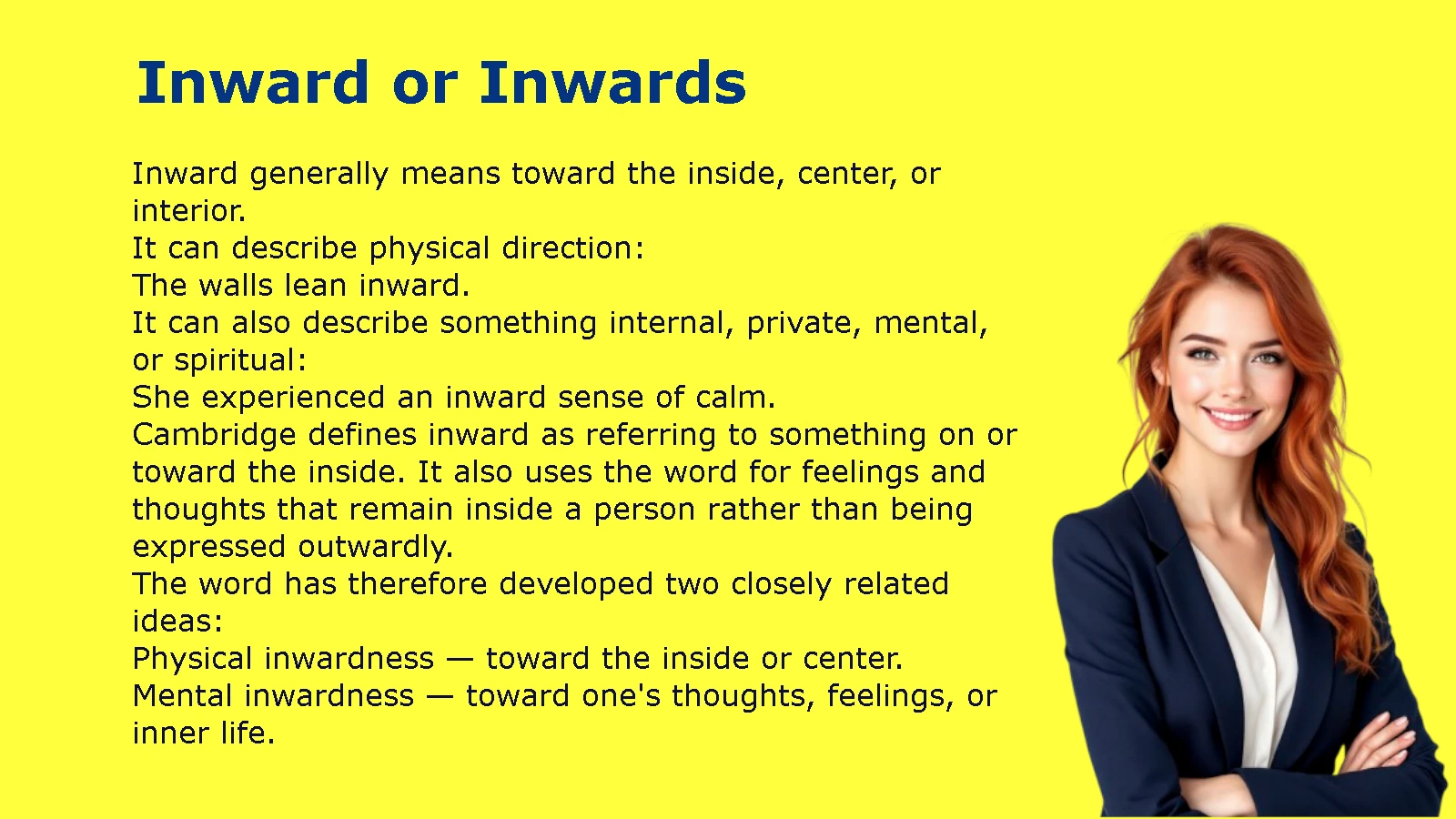
Inward generally means toward the inside, center, or interior.
It can describe physical direction:
The walls lean inward.
It can also describe something internal, private, mental, or spiritual:
She experienced an inward sense of calm.
Cambridge defines inward as referring to something on or toward the inside. It also uses the word for feelings and thoughts that remain inside a person rather than being expressed outwardly.
The word has therefore developed two closely related ideas:
- Physical inwardness — toward the inside or center.
- Mental inwardness — toward one’s thoughts, feelings, or inner life.
Inward as an Adverb
As an adverb, inward tells you the direction of an action.
Consider:
The door opened inward.
Here, inward modifies the verb opened. It tells you which direction the door moved.
More examples:
- Fold the paper inward.
- The walls curve inward.
- The wheels turned inward.
- She leaned inward to hear him.
- The edges bend inward.
- The arrows point inward.
- The crowd moved inward toward the center.
Oxford lists inward as an adverb meaning toward the inside or center. It also recognizes a figurative sense involving turning toward yourself or your own thoughts and interests.
Inward as an Adjective
Inward can also appear directly before a noun.
For example:
- an inward curve
- an inward movement
- an inward flow
- an inward breath
- an inward direction
- an inward journey
- inward feelings
- inward peace
- inward pressure
This is where the distinction between inward and inwards becomes particularly useful.
You can say:
The force caused an inward movement.
But you wouldn’t normally replace inward with inwards:
❌ The force caused an inwards movement.
The problem isn’t that inwards is an incorrect word. The problem is that inwards functions as an adverb, whereas the sentence requires an adjective to modify “movement.”
What Does Inwards Mean?
Inwards means toward the inside, center, or interior.
It is particularly common in British English. Cambridge labels inwards as mainly UK and notes that US English usually prefers inward.
For example:
The door opens inwards.
Fold the outside edges inwards.
The walls slope inwards.
The wheels point inwards.
Oxford likewise defines inwards as movement toward the inside or center and identifies it as especially British English.
Why Does Inwards Have an “S”?
The -s does not make inwards incorrect.
English has a group of directional adverbs ending in -ward or -wards, including:
- inward / inwards
- outward / outwards
- upward / upwards
- downward / downwards
- forward / forwards
- backward / backwards
- toward / towards
- afterward / afterwards
The exact preferences vary by word and variety of English. In the case of inward/inwards, the two forms have remained standard.
So don’t assume that inwards is a casual or incorrect version of inward.
It is a legitimate standard form.
Inward or Inwards in American English
If you’re writing for an American audience, inward is generally the safer choice when you’re describing movement with an adverb.
Cambridge identifies the adverb inward as mainly US and explicitly gives inwards as an alternative. Its entry for inwards says “US usually inward.”
For example, American English commonly uses:
- The door opens inward.
- Fold the edges inward.
- The wheels turn inward.
- The walls curve inward.
- He leaned inward.
- The force acts inward.
This does not mean an American speaker can never use inwards. The form exists in American dictionaries too. Collins, for example, identifies inwards as a variant of inward in American English.
The practical point is simply that inward tends to sound more natural in American English.
Inward or Inwards in British English
British English commonly uses inwards for directional movement.
For example:
- The door opens inwards.
- Fold the paper inwards.
- The walls curve inwards.
- The crowd moved inwards.
- Turn your feet inwards.
- The edges bend inwards.
Oxford labels inwards as especially British English, while also recognizing inward in British and North American English.
That means British English does not prohibit inward.
Both are available:
The door opens inward.
The door opens inwards.
The second may sound more characteristically British, but the first is still an established form.
Inward vs. Inwards in a Sentence
The best way to understand the distinction is to compare real sentence patterns.
Examples With Inward
Here are natural examples of inward as an adverb:
- The door swings inward.
- The gate opens inward.
- Fold the corners inward.
- The walls slope inward.
- The arrows point inward.
- The wheels rotate inward.
- She leaned inward.
- He turned inward to reflect on the experience.
The word can describe either physical direction or a figurative movement toward one’s thoughts and inner life. Oxford recognizes both senses.
Examples With Inwards
The same physical situations can use inwards:
- The door swings inwards.
- The gate opens inwards.
- Fold the corners inwards.
- The walls slope inwards.
- The arrows point inwards.
- The wheels rotate inwards.
- She leaned inwards.
- The edges curve inwards.
These are especially natural in British English.
Can You Replace Inward With Inwards?
Often, yes.
If inward is an adverb indicating direction, you can usually replace it with inwards without changing the basic meaning.
For example:
The door opens inward.
The door opens inwards.
Or:
The edges fold inward.
The edges fold inwards.
The important limitation is grammatical function.
When inward modifies a noun, inwards normally cannot replace it:
an inward curve ✓
an inward movement ✓
But:
an inwards curve ✗
an inwards movement ✗
So the words overlap, but they aren’t interchangeable in every grammatical position.
Inward vs. Inwards in American and British English
Regional preference is one of the biggest reasons people become confused about these words.
| Situation | American English | British English |
| The door opens ___ | inward | inwards is especially common |
| Fold the edges ___ | inward | inwards is especially common |
| The walls curve ___ | inward | inwards is especially common |
| An ___ curve | inward | inward |
| An ___ movement | inward | inward |
| ___ feelings | inward | inward |
| Turn your thoughts ___ | inward | inwards is especially common |
The table reveals an important pattern.
The American/British difference is strongest when inward/inwards acts as an adverb.
When inward functions as an adjective, the spelling does not normally change to inwards.
Cambridge and Oxford both support this distinction between the adjective inward and the directional adverbial forms inward/inwards.
Is Inwards a Correct Word?
Yes. Inwards is a correct standard English word.
There is no need to “correct” a sentence simply because someone wrote inwards instead of inward.
For example:
The door opens inwards.
is grammatically correct.
So is:
The door opens inward.
The choice is largely a matter of regional preference and style.
Cambridge specifically lists inwards as mainly UK and says US English usually uses inward. Oxford calls inwards especially British English.
Why Some People Think Inwards Is Wrong
The confusion probably comes from the fact that many American speakers encounter inward more often.
If you primarily read American English, a sentence such as:
The door opens inwards.
may look unusual.
But unfamiliar does not mean incorrect.
English contains many pairs where British and American usage favor different forms without making either form grammatically wrong.
Is Inward a Correct Word?
Yes. Inward is completely standard English.
It can function as an adjective and an adverb, and dictionaries also record noun uses.
As an adjective:
The machine creates an inward force.
As an adverb:
The machine pulls the object inward.
As a noun in certain contexts:
The inward is the inner part.
The adjective and adverb uses are by far the most important for everyday writing.
Inward vs. Inwards: Which One Should You Use?
If you’re unsure which form to choose, use this practical rule.
Use “inward” when:
- You’re writing primarily for an American audience.
- You need an adjective before a noun.
- You want a form that works naturally in both American and British English.
- You’re describing an inward direction with an adverb.
Use “inwards” when:
- You’re writing primarily in British English.
- You’re describing movement toward the inside.
- You’re following a British style guide or house style.
- The surrounding language already uses British -wards forms.
For general international writing, inward is often the simpler choice because it works as both an adjective and an adverb.
But don’t “correct” inwards merely because you prefer inward.
Common Phrases With Inward
Inward appears in many established expressions and collocations.
Inward Direction
The force acts in an inward direction.
Here, inward is an adjective modifying direction.
Inward Movement
The piston creates an inward movement.
Again, inward modifies a noun.
Inward Flow
The valve controls the inward flow of air.
Inward Curve
The road follows an inward curve.
Inward Feelings
His cheerful expression concealed his inward feelings.
Here, inward has a mental or emotional sense rather than a physical directional one.
Turn Inward
After the experience, she began to turn inward.
This can refer to becoming more focused on one’s own thoughts or feelings.
Look Inward
The organization needs to look inward and examine its own practices.
This is figurative. The organization isn’t physically moving toward its center.
Common Phrases With Inwards
Inwards is most useful when it follows a verb and describes direction.
Common patterns include:
- move inwards
- turn inwards
- bend inwards
- curve inwards
- point inwards
- fold inwards
- lean inwards
- face inwards
- look inwards
- draw inwards
For example:
The dancers turned inwards toward the center.
The metal edges bent inwards under pressure.
The panels fold inwards when the mechanism closes.
Collins also records established uses such as turn inwards and describes inwards as movement toward the inside or center.
Inward vs. Inwards: Common Mistakes
Most mistakes with these words aren’t spelling mistakes. They’re usage mistakes.
Treating Inwards as Incorrect
This is the most common misconception.
❌ “Inwards is wrong. It should always be inward.”
That’s incorrect.
Both are standard forms.
The better question is:
Which form fits the variety of English and grammatical role I’m using?
Using Inwards as an Adjective
Because inwards looks like a longer version of inward, writers sometimes put it before nouns.
For example:
❌ an inwards movement
In standard usage, write:
✓ an inward movement
Similarly:
✓ an inward curve
✓ an inward flow
Oxford explicitly treats inward as an adjective and gives examples such as inward flow and inward curve.
Assuming American and British English Must Use Different Spellings
It’s tempting to create a rigid rule:
American = inward
British = inwards
That’s too simplistic.
The regional tendency is real, but it isn’t an absolute grammatical division.
American English uses inwards too, and British English uses inward. Collins and Oxford both recognize this overlap.
A better rule is:
American English usually favors “inward” as the directional adverb, while British English especially commonly uses “inwards.”
Inward vs. Inwards vs. Inside
These words are related, but they don’t mean exactly the same thing.
Inward/inwards generally expresses direction toward the inside.
Inside usually identifies a position or destination within something.
Compare:
The door opens inward.
The door moves toward the interior.
She walked inside.
She entered an interior space.
Fold the edges inwards.
The edges move toward the center.
This distinction becomes clearer when you imagine an arrow.
Inward/inwards = → toward the center
Inside = location within the boundary
So:
The wheels point inward.
describes direction.
But:
The wheels are inside the housing.
describes location.
Inward vs. Inwards vs. Inwardly
These three forms are related, but they perform different grammatical jobs.
| Word | Typical role | Meaning | Example |
| inward | Adjective/adverb | Toward or on the inside | an inward curve |
| inwards | Adverb | Toward the inside | The door opens inwards |
| inwardly | Adverb | Internally, especially mentally or emotionally | She inwardly disagreed |
Inwardly often describes something happening inside a person’s thoughts or feelings.
For example:
She smiled politely but inwardly disagreed.
This doesn’t describe physical movement toward the center. It describes a private mental reaction.
Similarly:
He was inwardly frustrated.
The frustration exists internally, even though he doesn’t show it.
Collins distinguishes inwardly as an adverb associated with internal feelings and thoughts.
Compare These Three Sentences
The door opened inward.
Physical direction.
The door opened inwards.
Physical direction, with a form especially common in British English.
She was inwardly frustrated.
Mental or emotional state.
That distinction prevents a lot of unnecessary confusion.
Inward or Inwards: Quick Grammar Guide
Here’s the simplest way to remember the grammar.
Adverb of Direction
Use inward or inwards:
The door opened inward.
The door opened inwards.
Adjective
Use inward:
an inward movement
an inward curve
Mental or Emotional Adverb
Use inwardly when you mean internally or privately:
She inwardly questioned his decision.
This three-part distinction is more useful than trying to memorize a rigid American-versus-British rule.
How to Remember Inward vs. Inwards
Here’s a practical memory trick:
Inward can describe the thing. Inward or inwards can describe the movement.
For example:
an inward curve
describes the curve.
But:
The road curves inward.
or:
The road curves inwards.
describes the movement or direction.
There’s an even simpler version:
Before a noun → inward.
After a verb describing direction → inward or inwards.
This isn’t a complete description of every possible use, but it’s an excellent working rule for ordinary writing.
Inward or Inwards: Examples in Everyday English
The following examples show how the two forms work naturally.
Doors and Windows
- The door opens inward.
- The door opens inwards.
- The window frame bends inward.
- The panels fold inwards.
Physical Movement
- Move your hands inward.
- Move your hands inwards.
- The runners moved inward toward the center.
- The runners moved inwards toward the center.
Shapes and Objects
- The sides taper inward.
- The sides taper inwards.
- The arrows point inward.
- The arrows point inwards.
Thoughts and Feelings
- He turned inward after the experience.
- She looked inwards and reconsidered her priorities.
- She had an inward sense of calm.
- He inwardly disagreed with the decision.
The last two examples demonstrate why inward, inwards, and inwardly should not be treated as interchangeable forms.
Inward or Inwards in Formal and Academic Writing
Both forms are acceptable in formal writing.
The key is consistency.
If you’re writing an American academic paper, inward will generally fit the expected variety more naturally:
The pressure causes the walls to move inward.
If you’re writing in British English:
The pressure causes the walls to move inwards.
Neither sentence is inherently less formal.
In technical writing, inward is also useful as an adjective:
The experiment measured inward pressure.
The model predicts an inward flow.
The structure experiences an inward force.
This adjective use is one reason inward has broader grammatical flexibility than inwards.
A Note on Scientific and Technical Writing
In scientific writing, precision matters more than regional preference.
If a technical description distinguishes direction from position, make that distinction explicit.
For example:
The force acts inward, toward the center.
is clearer than using a vague phrase such as:
The force acts inside.
Likewise:
The particles move inward toward the center.
clearly describes directional movement.
A Simple Case Study: Choosing Between Inward and Inwards
Imagine you’re editing two versions of a product manual.
The first says:
The safety door opens inwards.
The second says:
The safety door opens inward.
Which should you keep?
Both are grammatically correct.
If the manual targets American customers, inward may sound more natural.
If it targets British customers, inwards may fit the expected style better.
Now consider another sentence:
The safety door has an inwards opening mechanism.
Here, the problem is different.
The issue isn’t American versus British preference. Inwards is being used as though it were an adjective modifying opening mechanism.
A clearer version is:
The safety door has an inward-opening mechanism.
That example shows why grammar can matter more than regional preference.
Inward or Inwards: Facts to Remember
Keep these points in mind:
- Both inward and inwards are correct.
- Both can mean toward the inside or center.
- Inward is especially common in American English.
- Inwards is especially common in British English.
- Inward can function as an adjective.
- Inwards is primarily an adverb.
- Inward can describe physical or figurative direction.
- Inwards can also describe physical or figurative direction.
- Inwardly usually describes an internal mental or emotional state.
- Don’t treat inwards as a spelling error.
- Don’t use inwards as an adjective before a noun.
- Choose one regional style and use it consistently when writing for a specific audience.
Oxford’s entries support the core distinction: inward works as an adjective and adverb, while inwards is an adverb used especially in British English. Oxford Learner’s Dictionaries
Frequently Asked Questions
Is inward or inwards correct?
Both are correct. Inward and inwards can both function as adverbs meaning toward the inside or center. Inward is particularly common in American English, while inwards is especially common in British English.
What is the difference between inward and inwards?
The basic meaning is usually the same when they function as directional adverbs. The main difference is regional preference. Inward is more common in American English, while inwards is especially common in British English.
There is also a grammatical difference: inward can be an adjective, but inwards is primarily an adverb.
Is inwards grammatically correct?
Yes. Inwards is a standard English word. It means toward the inside, interior, or center and is especially common in British English.
Is inward more common in American English?
Yes. Cambridge describes the adverb inward as mainly US and notes that American English usually uses inward where British English commonly uses inwards.
Is inwards more common in British English?
Yes. Oxford labels inwards as especially British English, and Cambridge labels it mainly UK.
Can inward and inwards be used interchangeably?
They can often be exchanged when they are adverbs describing direction:
The door opens inward.
The door opens inwards.
However, they aren’t interchangeable in every grammatical position. Inward can modify a noun:
an inward curve
You would not normally write:
an inwards curve
Is inward an adjective or an adverb?
It can be both.
As an adjective:
an inward movement
As an adverb:
The object moved inward.
Dictionaries recognize both functions.
Is inwards an adjective?
Generally, no. Inwards is used as an adverb.
Use inward when an adjective is needed:
an inward curve
an inward direction
What is the difference between inward and inwardly?
Inward can describe direction or something internal:
an inward movement
an inward feeling
Inwardly generally means internally, privately, or in one’s thoughts or feelings:
She inwardly disagreed.
What is the difference between inward and inside?
Inward usually expresses direction toward the inside.
Inside generally describes a location or destination within something.
Compare:
The door opens inward.
She went inside.
The first describes direction. The second describes entering an interior space.
Should I use inward or inwards in American English?
For American English, inward is generally the more natural choice when you’re using the word as a directional adverb.
The door opens inward.
That said, inwards is also a recognized English form and isn’t automatically incorrect in American writing.
Should I use inward or inwards in British English?
Both are correct, but inwards is especially common in British English for directional adverbial use.
The door opens inwards.
British English also uses inward, particularly in adjective constructions such as inward movement or inward flow.
Conclusion: Inward or Inwards?
So, inward or inwards—which is correct?
Both are correct.
The two forms generally share the meaning “toward the inside, center, or interior.” The main distinction is regional: inward is especially common in American English, while inwards is especially common in British English.
The more important grammatical rule is that inward can function as an adjective, while inwards is primarily an adverb.
So you can write:
The door opens inward.
or:
The door opens inwards.
But write:
an inward curve
not:
an inwards curve
If you’re writing for an American audience, inward will usually be the most natural choice. If you’re writing in British English, inwards is often the preferred directional adverb.
Either way, inwards is not a misspelling. It’s a legitimate English word with a long-established place in standard usage.
Quick Answer
| Question | Answer |
| Is inward correct? | Yes |
| Is inwards correct? | Yes |
| Do they have the same basic meaning? | Usually, yes |
| Which is common in American English? | Inward |
| Which is especially common in British English? | Inwards |
| Can inward be an adjective? | Yes |
| Can inwards be an adjective? | Generally no |
| Is “an inward curve” correct? | Yes |
| Is “an inwards curve” standard? | No |
| Is inwardly the same as inward? | No; inwardly usually describes an internal mental or emotional state |
The safest takeaway is simple: use “inward” and “inwards” according to grammatical function and regional style, not because one is supposedly correct and the other is wrong.