Hybridize vs Hybridise is a spelling difference between American and British English. Both words mean to cross different organisms, varieties, or elements to produce a hybrid, or to combine distinct components into a new system. American English generally uses hybridize, while British, Australian, and New Zealand English commonly use hybridise. Canadian English also commonly uses hybridize, although individual publishers may follow different conventions.
The same regional pattern appears in related words, including hybridization vs. hybridisation, hybridized vs. hybridised, and hybridizing vs. hybridising. These variations do not change the meaning or grammatical function of the words. However, scientific journals, universities, and publishers may establish their own spelling rules, so academic writers should check their style guides before submitting a manuscript.
What Is the Difference Between Hybridize and Hybridise?
The difference between hybridize and hybridise is spelling, not meaning. Hybridize is the usual American English form, while hybridise is common in British English and several other varieties of English. Both words describe the process of creating a hybrid by crossing, mixing, or combining different organisms or elements.
For example, an American botanist might write, “Researchers hybridize two plant varieties to improve disease resistance.” A British botanist could express the same idea as, “Researchers hybridise two plant varieties to improve disease resistance.”
Both sentences communicate the same information. The only difference is the letter used in the verb’s ending.
What Does Hybridize Mean?
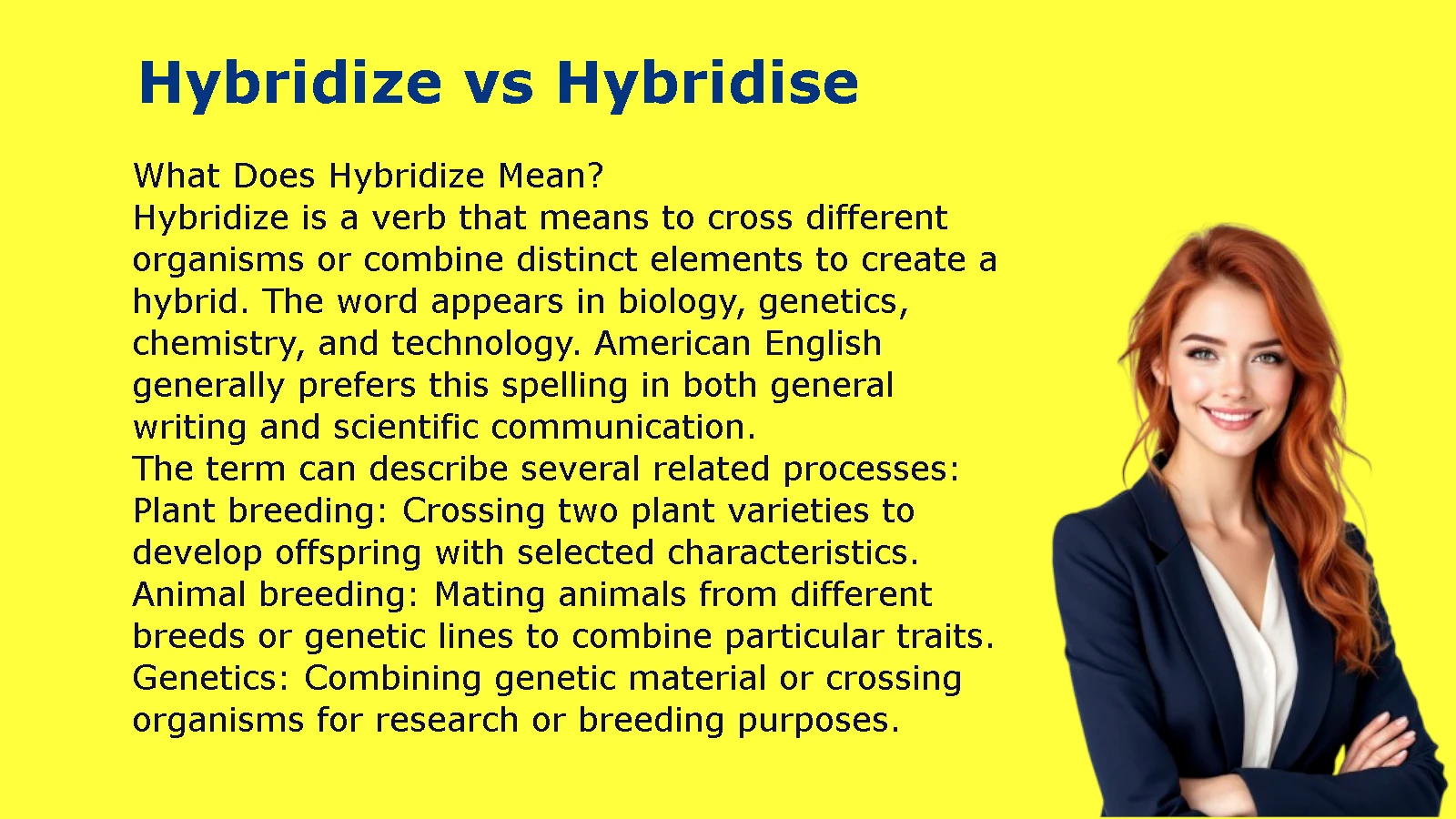
Hybridize is a verb that means to cross different organisms or combine distinct elements to create a hybrid. The word appears in biology, genetics, chemistry, and technology. American English generally prefers this spelling in both general writing and scientific communication.
The term can describe several related processes:
- Plant breeding: Crossing two plant varieties to develop offspring with selected characteristics.
- Animal breeding: Mating animals from different breeds or genetic lines to combine particular traits.
- Genetics: Combining genetic material or crossing organisms for research or breeding purposes.
- Chemistry: Mixing atomic orbitals to form hybrid orbitals in a bonding model.
- Technology: Combining different systems or approaches to create a hybrid design.
Consider this example:
“Plant breeders hybridize two tomato varieties to develop a crop that produces larger fruit and resists common diseases.”
Here, hybridize describes the deliberate crossing of plant varieties. The word does not mean that the resulting plants will automatically possess every desired characteristic. Breeders must evaluate the offspring to determine which traits appear.
In chemistry, the term has a more specialized meaning. A textbook might state, “The model describes how atomic orbitals hybridize to form orbitals used to explain molecular bonding.”
The scientific context changes, but the American spelling remains the same.
What Does Hybridise Mean?
Hybridise has the same definition as hybridize. It is the usual British English spelling and also appears in Australian and New Zealand English. Writers use it in the same scientific, technical, and general contexts as the American form.
For example:
- “The researchers hybridise two varieties of wheat to study their resistance to drought.”
- “The chemistry lesson explains how atomic orbitals hybridise.”
- “The engineering team plans to hybridise two existing technologies.”
These examples follow British-style spelling conventions. Their meanings remain identical to their American English equivalents.
The difference also appears in the past tense and present participle. British English generally uses hybridised and hybridising, whereas American English generally uses hybridized and hybridizing.
If you write for a British university, newspaper, or organization that uses standard British spelling, hybridise will usually fit the expected style. However, always follow the organization’s own rules when they specify a different convention.
Are Hybridize and Hybridise Interchangeable?
Yes. Hybridize and hybridise are interchangeable in meaning, but they are not always interchangeable in a particular document’s spelling style. Both words describe the same action and serve the same grammatical role.
You can use either form in a sentence without changing its meaning:
| American English | British English |
| Scientists hybridize the plants. | Scientists hybridise the plants. |
| The team hybridized two varieties. | The team hybridised two varieties. |
| The organisms are hybridizing. | The organisms are hybridising. |
| The study examines hybridization. | The study examines hybridisation. |
The main consideration is consistency. If an article uses American English throughout, changing to hybridise halfway through can make the writing look unedited. The reverse is equally true for a British English document.
A simple rule helps: choose the spelling convention that matches your audience or publication, then apply it to every related word form.
Hybridize vs Hybridise in American, British, and Australian English
The choice between Hybridize vs Hybridise usually depends on regional spelling conventions. American English generally favors the -ize ending, while standard British, Australian, and New Zealand English commonly use -ise. Canadian English often follows the -ize pattern for this word, although house styles can differ.
| Region or style | Preferred spelling | Past tense | Noun form |
| United States | Hybridize | Hybridized | Hybridization |
| Canada | Hybridize is common | Hybridized | Hybridization |
| United Kingdom | Hybridise is common | Hybridised | Hybridisation |
| Australia | Hybridise is common | Hybridised | Hybridisation |
| New Zealand | Hybridise is common | Hybridised | Hybridisation |
| British publications using Oxford spelling | Hybridize | Hybridized | Hybridization |
These are general preferences, not universal rules for every publication. Some British organizations retain -ize spellings, while other institutions use -ise consistently.
Is Hybridize or Hybridise Correct in the UK?
Both spellings can be correct in British English. Hybridise is the conventional choice in many British publications, but hybridize is also accepted by publishers that use Oxford spelling or another house style that retains -ize.
British English does not follow a single spelling system in every context. Some British dictionaries and publishers favor -ise for words such as organise, recognise, and hybridise. Oxford-style publications often use -ize for verbs whose endings follow that convention.
For example:
- Standard British style: “The team will hybridise the two plant varieties.”
- Oxford-style convention: “The team will hybridize the two plant varieties.”
Neither sentence is automatically wrong merely because it uses one ending instead of the other. The appropriate choice depends on the publication’s spelling policy.
If you are writing for a British audience without a specified style guide, hybridise is a sensible default. For academic submissions, check the journal’s instructions rather than relying solely on regional expectations.
Should Canadians Use Hybridize or Hybridise?
Canadian English commonly uses hybridize, although Canadian spelling includes a mixture of British and American conventions. The fact that Canadian English often retains British spellings such as colour does not mean that every verb must end in -ise.
For example:
“The Canadian research team will hybridize two crop varieties before testing their performance.”
This sentence follows a common Canadian spelling pattern. A Canadian institution may still prescribe a different style, especially when it adopts a British-oriented editorial guide.
When writing for a Canadian university, government department, or scientific publisher, follow its editorial standards. Consistency matters more than applying a broad national rule to every word.
Which Spelling Should Australian and New Zealand Writers Use?
Australian and New Zealand English commonly use hybridise, alongside related forms such as hybridised, hybridising, and hybridisation.
For example:
“The researchers will hybridise two native plant varieties to investigate their response to changing environmental conditions.”
A publication using standard Australian or New Zealand spelling would generally retain the s in the related word forms. Writers should also use the corresponding noun form, hybridisation, instead of switching to hybridization without a reason.
However, a scientific journal or international organization may impose its own editorial convention. If the journal specifies American spelling or Oxford spelling, follow that policy even when your university normally teaches a different regional form.
Hybridize vs Hybridise: Comparison of Word Forms
The spelling difference between hybridize and hybridise extends to their grammatical forms. American English generally retains the letter z throughout the word family, while British English commonly uses s. Learning the related forms helps you avoid inconsistent spelling in essays, reports, and research papers.
| Grammatical form | American English | British English |
| Base verb | Hybridize | Hybridise |
| Third-person singular | Hybridizes | Hybridises |
| Past tense | Hybridized | Hybridised |
| Past participle | Hybridized | Hybridised |
| Present participle | Hybridizing | Hybridising |
| Noun | Hybridization | Hybridisation |
| Related adjective | Hybridizable | Hybridisable |
The table shows the common regional pattern. Some dictionaries, technical publications, and editorial guides may recognize additional forms or follow a different convention.
Hybridization vs. Hybridisation
Hybridization is the usual American English noun, while hybridisation is common in British, Australian, and New Zealand English. Both nouns describe the process or result of hybridizing or hybridising.
The noun frequently appears in scientific writing.
American English example:
“The study examines the hybridization of two plant varieties and measures the characteristics of the resulting offspring.”
British English example:
“The study examines the hybridisation of two plant varieties and measures the characteristics of the resulting offspring.”
The spelling changes, but the sentence’s meaning does not.
In biology, hybridization can refer to crossing organisms or varieties. In molecular biology, it can also describe the pairing of complementary nucleic acid strands under suitable conditions. The precise meaning depends on the scientific context.
Chemistry uses the related term hybridization to describe a model in which atomic orbitals combine mathematically to produce hybrid orbitals. In that context, the noun identifies a theoretical description of bonding rather than the breeding of organisms.
When editing a scientific paper, do not treat hybridization and hybridisation as separate technical processes. They are spelling variants of the same noun.
Hybridizing vs. Hybridising
Hybridizing is the American English present participle, while hybridising is the common British English form. Both can function in progressive verb phrases or as modifiers, depending on the sentence.
American English:
- “The scientists are hybridizing two varieties of corn.”
- “The researchers documented the hybridizing process.”
- “Hybridizing selected plants can help breeders investigate inherited traits.”
British English:
- “The scientists are hybridising two varieties of corn.”
- “The researchers documented the hybridising process.”
- “Hybridising selected plants can help breeders investigate inherited traits.”
The choice of ending does not change the grammatical role of the word. Both forms can appear after a form of be, as in “are hybridizing,” or “are hybridising.”
Be careful when editing a document that uses several forms. A manuscript might contain hybridise in the introduction but hybridization in the results section. That combination may signal an inconsistent spelling policy.
For standard British spelling, use hybridise, hybridised, hybridising, and hybridisation. For standard American spelling, use hybridize, hybridized, hybridizing, and hybridization.
Hybridizable vs. Hybridisable
The adjective hybridizable is an American-style spelling, while hybridisable follows the common British pattern. The adjective describes something that can be hybridized or hybridised.
For example:
- American English: “The researchers identified two hybridizable plant lines.”
- British English: “The researchers identified two hybridisable plant lines.”
This form appears less often in general writing than hybridize or hybridization. In technical documents, it may be more natural to explain the intended meaning directly.
Instead of writing “a hybridisable material,” for example, you might write “a material that can form a hybrid structure” if that phrasing communicates the technical process more clearly.
The main lesson is simple: the spelling convention applies to the word family, but writers should still choose the most precise term for the subject.
Why Do Some British Publishers Use Hybridize?
Some British publishers use hybridize because they follow Oxford spelling or another editorial style that retains the -ize ending in eligible words. British English does not require every verb with this ending to use -ise. Both patterns appear in established British publishing.
The distinction can seem confusing because many readers associate -ize exclusively with American English. That assumption is too broad. The ending has a long history in English, and British publishers have used both forms.
What Is Oxford Spelling?
Oxford spelling is a British English convention that generally uses -ize for certain verbs where the ending is historically and morphologically appropriate. It can produce forms such as organize, recognize, and hybridize in publications that follow this style.
Other British publishers prefer -ise for these words. As a result, the spelling you encounter in a British book or journal may depend on its editorial policy rather than the author’s nationality.
Oxford spelling does not mean that every word ending in a similar sound should use z. Some words have established spellings that do not follow the same pattern. Writers should not apply a blanket substitution to all occurrences of s and z.
For the word in this article, the practical comparison is:
| Editorial convention | Typical form |
| American English | Hybridize |
| British English using -ise | Hybridise |
| British English using Oxford spelling | Hybridize |
One further point matters for science writers: the spelling convention used by a journal should not be confused with the scientific definition of the word. The editorial choice changes the written form, not the underlying concept.
Should You Use Hybridize in an Academic or Scientific Paper?
Use hybridize or hybridise according to the journal’s author guidelines. Academic publications may follow American English, standard British English, Oxford spelling, or a house style developed specifically for the journal. The publication’s instructions should determine your final choice.
Before submitting a manuscript, follow this checklist:
- Read the author guidelines. Look for a section on language, spelling, or editorial style.
- Check a recent article. Review how the journal spells comparable words such as organize, recognize, and hybridization.
- Set your word processor’s language. Choose the appropriate English locale for spelling checks.
- Search for related forms. Find every instance of hybridize, hybridise, hybridization, and hybridisation.
- Check the final proof. Automated tools may accept both spellings, so a green check mark does not guarantee consistency.
A useful approach is to create a small style sheet before writing. Record the selected spelling of hybridize, hybridization, and other frequently used technical terms. This becomes especially helpful when several researchers contribute to the same paper.
A Practical Case Study: Editing a Scientific Manuscript
Imagine that a researcher in London prepares a paper for an international journal. The introduction uses hybridise, the methods section uses hybridization, and the discussion uses hybridized.
All three forms are recognizable, but the document mixes spelling conventions.
The editor checks the journal’s instructions and finds that the publication uses American English. The editor then standardizes the relevant forms:
| Original wording | Revised wording |
| The team will hybridise the lines. | The team will hybridize the lines. |
| The hybridisation process was monitored. | The hybridization process was monitored. |
| The plants were hybridised under controlled conditions. | The plants were hybridized under controlled conditions. |
The editor does not change the scientific results or the interpretation. The revision simply aligns the spelling with the journal’s preferred style.
If the journal instead used standard British -ise spelling, the editor would make the opposite adjustments. The correct editorial decision comes from the chosen style guide, not from a belief that one regional form has a different scientific meaning.
How Hybridize and Hybridise Are Used in Different Fields
The words hybridize and hybridise appear across several disciplines. Biology uses them for crossing organisms or varieties, chemistry uses related terminology for orbital hybridization, and technology may use them to describe combining systems. The spelling convention remains the same across fields, although the technical meaning changes with context.
Biology and Genetics
In biology, hybridize or hybridise commonly describes crossing organisms from different species, varieties, breeds, or genetic lines. Researchers and breeders may use hybridization to investigate inherited traits or develop organisms with selected characteristics.
For example:
“Plant breeders hybridize two wheat varieties to investigate whether the resulting offspring show improved disease resistance.”
The British version would use hybridise and retain the same scientific meaning.
Hybridization does not guarantee a successful outcome. The offspring may inherit a mixture of traits, and some desired characteristics may not appear. Researchers must evaluate the resulting organisms and measure the traits relevant to their study.
In molecular biology, the term has another important use. Nucleic acid hybridization describes the pairing of complementary DNA or RNA sequences under appropriate conditions. Researchers can use this process in laboratory techniques to detect particular genetic sequences.
Although both uses involve the word hybridization, the processes differ. One concerns crossing organisms or genetic lines, while the other concerns the pairing of complementary nucleic acid strands.
Chemistry
In chemistry, hybridization refers to a model in which atomic orbitals combine to form hybrid orbitals that help explain molecular bonding and geometry. British-style texts may use hybridisation, depending on the publisher’s spelling convention.
For example:
“The lesson explains how atomic orbitals hybridize in a model used to describe the bonding geometry of a molecule.”
The British-style equivalent is:
“The lesson explains how atomic orbitals hybridise in a model used to describe the bonding geometry of a molecule.”
In this context, hybridize does not refer to breeding plants or animals. It describes a theoretical framework used in chemistry to explain bonding.
Students should also distinguish hybridization from related concepts such as molecular orbital theory. These approaches describe bonding in different ways, and a chemistry textbook may use more than one model depending on the topic.
When writing a chemistry report, use the spelling required by the course, institution, or publication. Do not alter a technical explanation merely to make it resemble an example from biology.
Automotive Technology
In automotive writing, the word can describe combining technologies or systems, but hybrid and hybridize do not always serve the same purpose. Technical writers often use terms such as hybrid powertrain, hybrid system, or integrate when those terms describe the technology more precisely.
For example:
“The engineers hybridize two propulsion approaches to explore a new vehicle design.”
This sentence uses hybridize in a broad sense. Depending on the actual engineering process, a more precise version might be:
“The engineers integrate an electric motor with an internal combustion engine to develop a hybrid powertrain.”
The second sentence explains the combination directly instead of relying on a general verb.
The spelling rule still applies when a writer chooses hybridize or hybridise. American English generally uses hybridize, while standard British English commonly uses hybridise.
However, do not assume that every reference to hybrid vehicles requires either verb. In many automotive contexts, hybrid vehicle, hybrid powertrain, and hybrid technology are more natural expressions.
Example Sentences Using Hybridize and Hybridise
Examples make the regional spelling rule easier to remember. Hybridize follows the common American pattern, while hybridise follows the common British pattern. You can use either spelling in equivalent sentences as long as you maintain the convention throughout your document.
Examples With Hybridize
Here are original sentences using the American English form:
- Agriculture: “The research team will hybridize two corn varieties to study their yield and drought tolerance.”
- Botany: “Gardeners sometimes hybridize related plant varieties to develop new flower colors.”
- Genetics: “The laboratory will hybridize selected genetic lines as part of its breeding research.”
- Chemistry: “The textbook explains how atomic orbitals hybridize in the model of molecular bonding.”
- Scientific writing: “The authors compare several methods used to hybridize plant material under controlled conditions.”
- Technology: “The engineers hope to hybridize two existing designs to meet the project’s performance requirements.”
Each sentence uses the American spelling. The surrounding vocabulary should also follow the intended style when other regional variants appear.
Examples With Hybridise
The following examples use the common British English form:
- Agriculture: “The research team will hybridise two corn varieties to study their yield and drought tolerance.”
- Botany: “Gardeners sometimes hybridise related plant varieties to develop new flower colors.”
- Genetics: “The laboratory will hybridise selected genetic lines as part of its breeding research.”
- Chemistry: “The textbook explains how atomic orbitals hybridise in the model of molecular bonding.”
- Scientific writing: “The authors compare several methods used to hybridise plant material under controlled conditions.”
- Technology: “The engineers hope to hybridise two existing designs to meet the project’s performance requirements.”
These examples demonstrate the spelling difference without changing the intended meaning. In a real British English publication, writers may also adjust other words to follow British spelling and vocabulary conventions.
Common Spelling Mistakes to Avoid
The most common mistake is not choosing the wrong variant. It is mixing both spelling systems without a clear reason.
Watch out for these errors:
- Switching endings: Using hybridise in one paragraph and hybridized in the next when the document follows one regional style.
- Mixing noun forms: Writing hybridisation in the introduction and hybridization in the conclusion without following a publication’s requirements.
- Assuming every British publisher uses -ise: Some British publications retain -ize through Oxford spelling or another house style.
- Treating the spellings as different scientific terms: The s and z do not create different definitions.
- Relying entirely on spell-checking: A spelling tool may accept both variants even when your document should use only one.
- Changing spelling without checking context: Before replacing a word, make sure it is actually a regional spelling variant rather than a different technical term.
A final proofreading search can catch many of these problems. Search for both spellings of the base verb and its related forms, then confirm that each occurrence matches the selected style.
Frequently Asked Questions
Is Hybridise a Spelling Error?
No. Hybridise is a standard British English spelling and is also common in Australian and New Zealand English. American English generally uses hybridize. Both forms have the same meaning, so the correct choice depends on your audience or publication’s spelling rules.
Is Hybridize American or British English?
Hybridize is standard in American English, but it also appears in British publications that use Oxford spelling or another convention that retains -ize. Therefore, the word is not exclusively American. Check the publication’s style guide if you need to decide which version to use.
Which Is Correct: Hybridization or Hybridisation?
Both spellings are correct. Hybridization is the usual American English form, while hybridisation is common in British, Australian, and New Zealand English. They describe the same process. Use the form that matches the rest of your document and the requirements of your institution or publisher.
Which Spelling Should I Use in a Genetics or Chemistry Paper?
Follow the journal’s author guidelines or your institution’s style guide. American publications commonly use hybridize and hybridization, while British publications may use hybridise and hybridisation. Some British and international journals use Oxford spelling. Consistency across the manuscript is more important than assuming that every journal follows the same regional rule.
Do Hybridize and Hybridise Mean the Same Thing?
Yes. Hybridize and hybridise have identical meanings and perform the same grammatical function. Both can describe crossing organisms, combining varieties, or other forms of hybridization. The difference lies in spelling conventions, not in the scientific process or the result being described.
Does Canadian English Use Hybridize or Hybridise?
Canadian English commonly uses hybridize, hybridized, and hybridization. Canadian spelling mixes several British and American conventions, so not every word follows one uniform pattern. For professional or academic writing, use the spelling specified by your organization or publication.
Conclusion: Choose the Right Spelling for Your Audience
The difference between Hybridize vs Hybridise comes down to regional spelling conventions. American English generally uses hybridize, while British, Australian, and New Zealand English commonly use hybridise. Canadian English often follows the -ize pattern for this word, and some British publishers also retain it through Oxford spelling.
The same pattern applies to related forms. American English typically uses hybridized, hybridizing, and hybridization, while standard British spelling commonly uses hybridised, hybridising, and hybridisation.
Remember these practical rules:
- Use hybridize for standard American English.
- Use hybridise for standard British, Australian, and New Zealand English.
- Check your publication’s guidelines before choosing a style for academic or scientific writing.
- Keep every related word form consistent throughout the document.
- Use the term that most precisely describes the scientific or technical process.
Before you publish an article or submit a research paper, search your document for both spellings and review the related noun and verb forms. A quick consistency check can make your writing clearer, more professional, and better suited to its intended audience.