The heteronyms row meaning refers to the different meanings and pronunciations of the word row. Row can mean a line of people or things, or it can mean a noisy argument. It can also refer to the act of moving a boat through water with oars.
| Question | Answer |
| What are the two meanings of row? | Row can mean a line or a noisy argument. |
| How is row pronounced for a line? | It is pronounced /roʊ/, like “go.” |
| How is row pronounced for an argument? | It is pronounced /raʊ/, like “cow.” |
| Is row a heteronym? | Yes, because it has the same spelling but different pronunciations and meanings. |
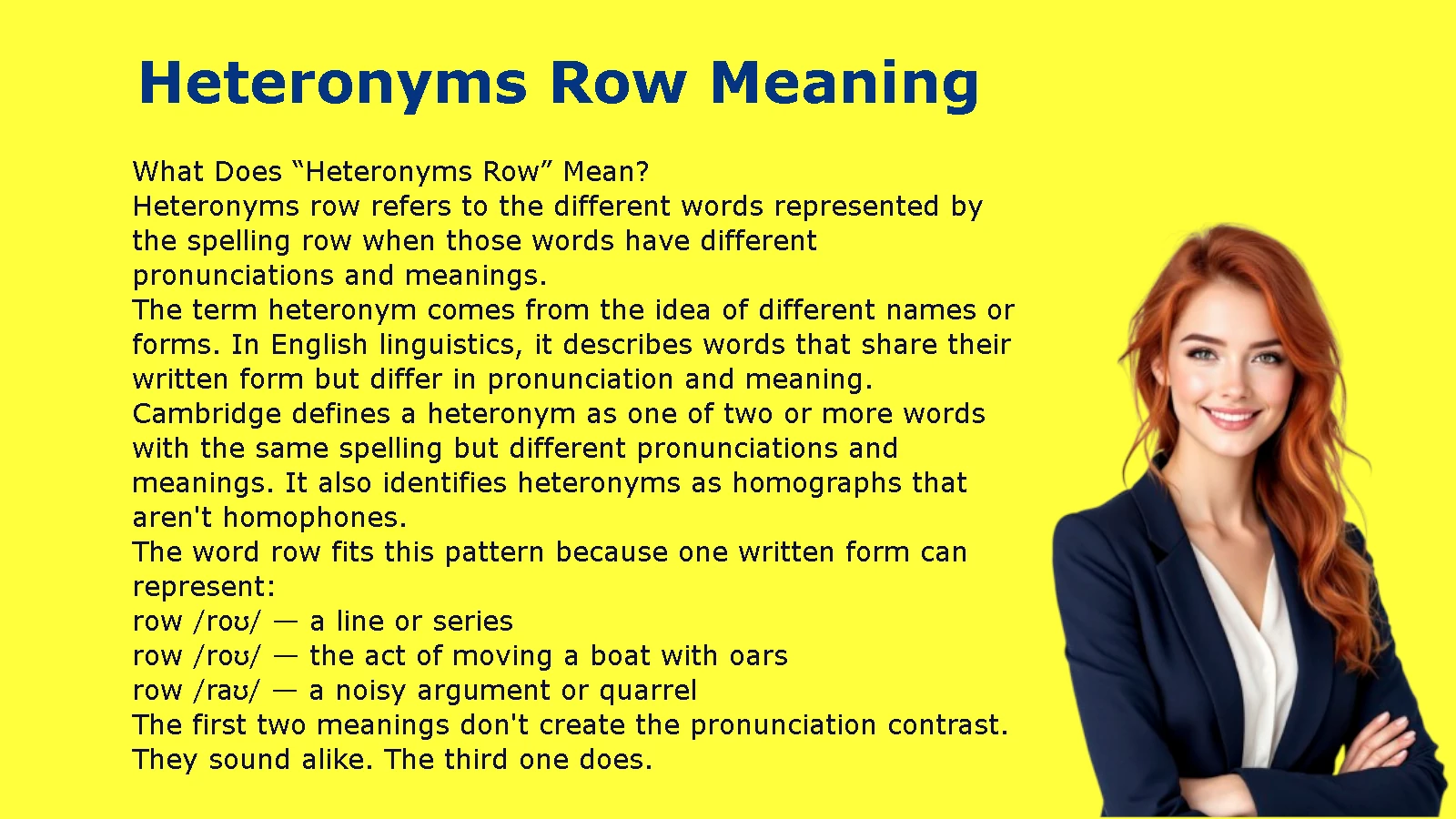
What Does “Heteronyms Row” Mean?
Heteronyms row refers to the different words represented by the spelling row when those words have different pronunciations and meanings.
The term heteronym comes from the idea of different names or forms. In English linguistics, it describes words that share their written form but differ in pronunciation and meaning. Cambridge defines a heteronym as one of two or more words with the same spelling but different pronunciations and meanings. It also identifies heteronyms as homographs that aren’t homophones.
The word row fits this pattern because one written form can represent:
- row /roʊ/ — a line or series
- row /roʊ/ — the act of moving a boat with oars
- row /raʊ/ — a noisy argument or quarrel
The first two meanings don’t create the pronunciation contrast. They sound alike. The third one does.
That distinction matters because it’s easy to oversimplify the word by saying, “Every meaning of row has a different pronunciation.” That’s not accurate.
A Simple Definition of Heteronym
A heteronym is a word with the same spelling as another word but a different pronunciation and meaning.
For example:
- lead can mean to guide someone or refer to the metal.
- tear can mean to rip something or the liquid produced by your eyes.
- wind can mean moving air or the act of twisting something.
- row can mean a line, moving a boat, or an argument.
The spelling stays the same. The sound and meaning can change.
“same spelling but different pronunciations and meanings”
That short definition captures the basic idea.
What Does “Row” Mean?
The meaning of row depends on the context. Dictionaries treat its different senses separately because they have different meanings and, in one important case, different pronunciations.
Here are the main meanings you need to know:
| Meaning of row | Part of speech | Pronunciation | Example |
| A line of people or things | Noun | /roʊ/ | We sat in the front row. |
| To move a boat with oars | Verb | /roʊ/ | They rowed across the lake. |
| An act of rowing | Noun | /roʊ/ | We went for a row on the lake. |
| A loud argument or quarrel | Noun | /raʊ/ | They had a row over money. |
| To have an argument | Verb | /raʊ/ | The two neighbors often row. |
Merriam Webster separates these meanings into different dictionary entries. Its entries include row meaning to propel a boat, row meaning a number of objects arranged in a line, and row meaning a noisy disturbance or quarrel.
Oxford also distinguishes the two major noun forms. Its row /rəʊ/ entry covers a line or series and an act of rowing, while row /raʊ/ refers to a serious or noisy argument.
Row Meaning “A Line or Series”
The first common meaning of row describes people or objects arranged in a line.
Imagine a movie theater. Ten seats sit next to each other. Those seats form a row.
The same idea works for trees, houses, students, chairs, bottles, cars, or almost anything arranged side by side.
Examples of Row as a Line
- We sat in the front row.
- A row of trees stood along the road.
- The teacher arranged the desks in three rows.
- Several houses formed a neat row along the street.
- There were six chairs in each row.
- The students stood in a row for the photograph.
Oxford defines this sense as a number of people or objects arranged in a line.
The pronunciation here is /roʊ/ in US English.
Row and Line Are Similar, but Not Always Identical
The words row and line overlap, but they aren’t interchangeable in every situation.
For example:
- a row of chairs sounds natural.
- a line of people sounds natural.
- a line of cars can work when the cars are waiting one behind another.
- rows of seats emphasizes an organized arrangement.
A row often suggests things positioned side by side, especially in an organized arrangement.
For example, a classroom might contain four rows of desks. Each row runs across the room, while the desks are arranged in columns running from front to back.
Row Meaning “To Move a Boat”
The second major meaning of row is a verb. It means to move a boat through water by using oars.
If you sit in a small boat and pull the oars through the water, you row the boat.
Merriam Webster defines this verb as propelling a boat by means of oars.
Examples of Row as a Verb
- We rowed across the lake.
- She knows how to row a boat.
- They rowed toward the shore.
- He rows every morning.
- The fisherman rowed us back to land.
- We spent the afternoon rowing on the river.
Oxford gives the same core meaning: moving a boat through water using oars.
Notice that this meaning uses the same pronunciation as row meaning a line:
row = /roʊ/
That fact is important when explaining the heteronyms row meaning. The spelling row has several meanings, but the pronunciation does not change between the line and boat senses.
Common Forms of the Verb Row
The verb changes normally according to tense and grammatical form:
| Form | Example |
| row | I row across the lake. |
| rows | She rows every weekend. |
| rowed | They rowed to the island. |
| rowing | He enjoys rowing. |
Oxford lists rowed as the past tense and past participle and rowing as the -ing form.
Row Meaning “An Argument or Quarrel”
Now comes the pronunciation that makes row a true heteronym.
When row means a loud argument, quarrel, or noisy dispute, it is pronounced /raʊ/ in standard dictionary notation.
This is completely different from the /roʊ/ sound used for a line or boat movement.
Oxford labels this sense as especially associated with British English and defines it as a serious argument or a noisy argument between people.
Merriam Webster similarly defines this row as a noisy disturbance or quarrel.
Examples of Row Meaning an Argument
- They had a row over money.
- The neighbors got into a row last night.
- A row broke out during the meeting.
- The couple had a terrible row.
- The disagreement turned into a public row.
- She left after a heated row with her brother.
In this meaning, row is generally a noun.
You can think of it as a stronger, more colorful alternative to argument, quarrel, or dispute, particularly in British English.
Row as a Verb Meaning “Argue”
The word can also work as a verb with the same pronunciation.
For example:
- They row about money all the time.
- The couple rowed over the issue.
- The children were rowing again.
Merriam Webster includes row as a verb meaning to engage in a row or have a quarrel.
So the pattern looks like this:
| Word | Pronunciation | Meaning |
| row | /roʊ/ | Move a boat |
| row | /roʊ/ | A line or series |
| row | /raʊ/ | Argue or quarrel |
The spelling doesn’t give away the answer. Context does.
Row Pronunciation: /roʊ/ vs. /raʊ/
The pronunciation difference is the heart of the heteronyms row meaning question.
Row /roʊ/
Use /roʊ/ when row refers to:
- a line of objects
- a line of people
- a line of seats
- moving a boat with oars
- an act of rowing
Examples:
We sat in the front row.
They learned to row at summer camp.
Row /raʊ/
Use /raʊ/ when row means:
- an argument
- a quarrel
- a noisy dispute
- a loud disturbance
Examples:
The neighbors had a row.
A political row broke out over the proposal.
The difference can seem small on paper because the spelling remains unchanged. When spoken aloud, however, the vowel sound clearly separates the two words.
Why Is “Row” a Heteronym?
A heteronym requires two key features:
- The spelling stays the same.
- The pronunciation and meaning change.
The word row satisfies those conditions when you compare the argument sense with the line or boat senses.
Consider these two sentences:
We sat in the front row.
The neighbors had a row.
The spelling is identical.
The meanings are different.
The pronunciations are different.
That is the classic heteronym pattern.
Cambridge explicitly includes row in its list of heteronyms alongside words such as sow, bow, tear, entrance, wound, and wind.
The Important Technical Detail
Calling row a heteronym doesn’t mean all of its dictionary senses have different pronunciations.
The two following meanings use the same sound:
- a row of chairs
- to row a boat
Both use /roʊ/.
The argument sense uses /raʊ/.
That’s the distinction worth remembering.
How Context Changes the Meaning of “Row”
English speakers rarely need to stop and consciously analyze the spelling of row. The surrounding words usually reveal the intended meaning immediately.
Think of context as a road sign. It points you toward the right definition.
Context for Row Meaning a Line
Words such as these often signal the /roʊ/ meaning connected with a line:
- seats
- chairs
- trees
- houses
- students
- desks
- bottles
- cars
- front
- back
- three
- five
For example:
There are five rows of seats in the theater.
The word seats makes the intended meaning obvious.
Context for Row Meaning Boat Movement
These words often signal the boating sense:
- boat
- oars
- lake
- river
- shore
- water
- canoe
- rowing
- paddle
- crew
For example:
We rowed across the lake before sunset.
The words rowed and lake make the meaning clear.
Context for Row Meaning an Argument
Words such as these often point toward the /raʊ/ meaning:
- argument
- quarrel
- dispute
- angry
- heated
- family
- political
- disagreement
- money
- broke out
For example:
A heated row broke out over the contract.
Here, heated and broke out strongly suggest an argument.
Examples of “Row” as a Heteronym
The quickest way to understand this word is to see it working in real sentences.
| Sentence | Meaning of row | Pronunciation |
| We sat in the front row. | Line of seats | /roʊ/ |
| A row of houses lined the street. | Line or series | /roʊ/ |
| The students stood in a row. | People arranged in a line | /roʊ/ |
| They rowed across the lake. | Moved a boat | /roʊ/ |
| She enjoys rowing on weekends. | Moving a boat | /roʊ/ |
| We went for a row on the lake. | An act of rowing | /roʊ/ |
| The couple had a row about money. | Argument | /raʊ/ |
| A political row broke out. | Dispute | /raʊ/ |
| The neighbors were rowing again. | Arguing | /raʊ/ |
This table reveals an interesting point: grammar can help you identify the meaning, but it can’t always do the whole job.
For example, row can function as a noun in both “a row of chairs” and “a row about money.” The surrounding words provide the real clue.
A Short Case Study: One Spelling, Three Meanings
Consider this short scene:
Maya sat in the second row at the theater. After the show, she watched two friends row across the lake. Later that evening, the friends had a row about where to eat.
The spelling appears three times.
Yet each instance has a different meaning.
First Row: A Line of Seats
“Second row” refers to a line of seats.
Meaning: a series or line
Pronunciation: /roʊ/
Second Row: Moving a Boat
“Row across the lake” means moving a boat with oars.
Meaning: propel a boat
Pronunciation: /roʊ/
Third Row: An Argument
“Had a row” means the friends argued.
Meaning: quarrel or dispute
Pronunciation: /raʊ/
This is why context matters more than spelling when reading a heteronym.
Is “Row” Always a Heteronym?
Not exactly.
This question deserves a careful answer because row has several dictionary entries and several related senses.
A heteronym requires a difference in pronunciation and meaning. The row meaning “line” and the row meaning “move a boat” don’t differ in pronunciation. Both use /roʊ/.
The argument meaning creates the important pronunciation contrast.
So a precise explanation would be:
Row is a heteronym because the spelling represents distinct meanings with different pronunciations, especially the /roʊ/ senses and the /raʊ/ argument sense.
That explanation avoids a common mistake: treating every dictionary sense as though it must have its own sound.
Merriam Webster’s entries make the distinction especially clear by giving separate entries for the /roʊ/ and /raʊ/ forms.
Heteronym vs. Homograph vs. Homophone
These terms often get mixed together. They overlap, but they aren’t identical.
| Term | Same spelling? | Same pronunciation? | Different meaning? |
| Heteronym | Yes | No | Yes |
| Homograph | Yes | Sometimes | Usually |
| Homophone | Usually no | Yes | Yes |
What Is a Heteronym?
A heteronym has the same spelling but a different pronunciation and meaning.
Examples include:
- row
- lead
- tear
- wind
- bow
- desert
Cambridge describes heteronyms as homographs that aren’t homophones.
What Is a Homograph?
A homograph is a word that shares its spelling with another word. The pronunciation may be the same or different depending on the particular words being discussed.
That means heteronyms can be viewed as a more specific category within the broader group of same spelled words.
What Is a Homophone?
A homophone has the same pronunciation as another word but a different spelling and meaning.
Examples include:
- two / too
- there / their
- right / write
- sea / see
These words sound alike but aren’t spelled alike.
That’s different from row, where the spelling remains the same.
Other Common Heteronyms in English
Once row makes sense, other heteronyms become easier to recognize.
| Heteronym | Meaning 1 | Meaning 2 |
| lead | To guide | A metal |
| tear | To rip | Liquid from the eye |
| wind | Moving air | To twist or coil |
| bow | To bend forward | A weapon |
| desert | To abandon | A dry region |
| refuse | To reject | Waste |
| object | A thing | To protest |
| entrance | A doorway | To delight or captivate |
| wound | An injury | Past tense of wind |
| bass | A low musical sound | A type of fish |
Cambridge includes several of these words in its explanation of heteronyms.
The pattern is remarkably consistent: one written form, multiple meanings, different sounds.
Why Do Heteronyms Exist in English?
English spelling and pronunciation didn’t develop as a perfectly synchronized system.
Words came into English from different historical sources. Pronunciation changed over centuries. Spelling conventions also developed and became standardized at different points.
As a result, words that once looked or sounded different could eventually converge in spelling.
The history of row itself shows that the meanings don’t all come from one simple source. Merriam Webster traces the boating verb to Old English rōwan. Its entry for the line meaning traces the noun to Middle English rawe, while the argument sense has a separate, uncertain origin.
That history helps explain why the same modern spelling can represent meanings that aren’t closely connected.
In other words, English spelling is more like an old city than a brand new planned neighborhood. New streets were added over centuries, old roads changed direction, and some names stayed long after the landscape around them had shifted.
Common Mistakes With “Row”
Because the spelling never changes, row can trip up English learners.
Pronouncing Every Row the Same Way
A learner may see row and automatically use /roʊ/.
That works for:
a row of chairs
and:
row a boat
It doesn’t work for:
They had a row.
In the third sentence, row means an argument and uses /raʊ/.
Confusing Row With “Road”
The pronunciation of row as a line is close to the sound in road, although the words have completely different meanings.
This becomes even more confusing with rowed, road, and rode, which are homophones in many English varieties. Oxford lists road, rode, and rowed as homophones.
For example:
- We rowed across the river.
- We drove along the road.
- She rode her bike home.
The spellings differ, but the pronunciations can match.
Assuming “Row” Always Means a Line
Many American English speakers primarily encounter row in expressions such as:
- front row
- back row
- row of seats
- row of houses
That familiarity can make the argument sense unfamiliar.
However, row meaning an argument is especially associated with British English. Oxford explicitly labels this usage as especially British and informal.
Row in American English vs. British English
The word row exists in both American and British English, but the argument sense is much more strongly associated with British usage.
In American English, speakers commonly say:
- argument
- fight
- quarrel
- dispute
- heated disagreement
For example, an American speaker might naturally say:
They had an argument about money.
A British speaker might say:
They had a row about money.
That doesn’t mean Americans never understand or use row in this sense. It simply means the word has a stronger place in British everyday vocabulary.
The line and rowing senses are ordinary English vocabulary on both sides of the Atlantic.
How to Tell Which Meaning of “Row” Is Intended
When you encounter row in writing, use this quick method.
Look at the Words Around It
Ask what the sentence is talking about.
If you see seats, chairs, trees, or desks, think “line.”
Check the Grammar
Is row acting as a noun or verb?
That can narrow down the possibilities, although it won’t always give you the final answer.
For example:
They row every weekend.
This is a verb meaning they move a boat with oars.
But:
They row every weekend.
can also describe arguing, depending on the variety of English and context.
The surrounding information remains essential.
Read the Whole Sentence
Don’t decide based on the word alone.
Consider:
The children rowed across the lake.
The lake provides the clue.
Now consider:
The children rowed about the rules.
The phrase about the rules changes everything. Here, the verb means they argued.
Context is the tie breaker.
Row vs. Line
The word row often overlaps with line, but the two words have different typical uses.
| Word | Common meaning | Example |
| row | Organized arrangement side by side | A row of chairs |
| line | People or things arranged in sequence | A line of customers |
| row | Horizontal arrangement in a grid | A row in a spreadsheet |
| line | A long narrow mark | Draw a straight line |
In a theater, for example, row is the natural word for a group of seats arranged across the room:
We sat in the third row.
In a store, however, customers waiting one behind another usually form a line.
The exact choice depends on the arrangement and context.
Row vs. Column
These two words often appear together in tables, spreadsheets, classrooms, and seating plans.
A row usually runs horizontally across an arrangement.
A column usually runs vertically.
For example:
| Name | Age | City |
| Alex | 25 | Boston |
| Maya | 31 | Denver |
| Liam | 28 | Seattle |
Each horizontal set of information is a row.
Each vertical category is a column.
That makes the phrase “row and column” useful in mathematics, computing, spreadsheets, and data organization.
Row vs. Argument
When row means an argument, it overlaps with several other words.
| Word | Typical meaning |
| row | A noisy or serious argument |
| argument | A disagreement or a discussion involving opposing views |
| quarrel | An angry disagreement |
| dispute | A disagreement, often more formal |
| fight | A physical or verbal conflict |
| debate | A structured discussion of opposing views |
The words aren’t perfect substitutes.
For example, a debate can be calm and organized. A row usually suggests conflict or noise.
Merriam Webster lists quarrel, brawl, clash, and related terms among the vocabulary associated with the argument sense of row.
Practice: Identify the Meaning of “Row”
Try these sentences before looking at the answers.
Sentence A
The students sat in the third row.
Answer: A line of seats.
Pronunciation: /roʊ/
Sentence B
We rowed across the river.
Answer: Moved a boat using oars.
Pronunciation: /roʊ/
Sentence C
The neighbors had a row about the noise.
Answer: Had an argument.
Pronunciation: /raʊ/
Sentence D
A row of flowers grew beside the path.
Answer: A line or series.
Pronunciation: /roʊ/
Sentence E
The politicians became involved in a public row.
Answer: A public dispute or argument.
Pronunciation: /raʊ/
The exercise reveals the central rule: don’t pronounce a word simply because you recognize its spelling. First identify its meaning.
Frequently Asked Questions About Heteronyms Row Meaning
Is “row” a heteronym?
Yes. Row is commonly given as an example of a heteronym because the same spelling represents different meanings with different pronunciations. Cambridge specifically lists row among English heteronyms.
What are the two pronunciations of “row”?
The main contrast is:
- /roʊ/ for a line, series, or moving a boat
- /raʊ/ for an argument or quarrel
The argument sense is especially associated with British English.
What does “row” mean when pronounced /raʊ/?
It means a loud argument, quarrel, or noisy dispute.
For example:
They had a row over money.
Oxford identifies this as a serious or noisy argument.
What does “row” mean when pronounced /roʊ/?
It commonly means either a line or series of people or things or the act of moving a boat using oars.
For example:
We sat in the front row.
or:
They rowed across the lake.
Merriam Webster lists both meanings under the /roʊ/ form.
Is “row” a homonym or heteronym?
Heteronym is the more specific term when referring to the different pronunciations and meanings.
The broader term homograph can also apply because the words share spelling. Cambridge explains that heteronyms are homographs that aren’t homophones.
Is “row” pronounced differently in American and British English?
The major distinction between /roʊ/ and /raʊ/ remains. However, exact vowel sounds can vary between regional accents.
The argument sense is particularly common in British English, while American English more often uses argument, fight, or quarrel in everyday speech. Oxford labels the argument sense especially British and informal.
Why does “row” have two pronunciations?
The different meanings have different historical origins. Merriam Webster traces the boating verb to Old English, the line noun to Middle English, and gives a separate origin for the argument sense.
Over time, different words can end up sharing the same written spelling even when their meanings and pronunciations remain distinct.
Is “row” the same as “line”?
Not always.
Row often describes people or things arranged side by side, such as a row of chairs or trees. Line has a broader range of uses and can describe people or things arranged in sequence.
Is “row” the same as “argument”?
Only in one particular sense.
When pronounced /raʊ/, row can mean an argument or quarrel. When pronounced /roʊ/, it has nothing to do with arguing.
Quick Summary of Heteronyms Row Meaning
The spelling row represents several meanings, but the key heteronym contrast comes from two pronunciations.
| Spelling | Meaning | Pronunciation | Example |
| row | A line of people or things | /roʊ/ | A row of trees lined the road. |
| row | To move a boat with oars | /roʊ/ | We rowed across the lake. |
| row | An act of rowing | /roʊ/ | We went for a row. |
| row | An argument or quarrel | /raʊ/ | They had a row over money. |
| row | To argue or quarrel | /raʊ/ | They row about everything. |
The easiest way to remember heteronyms row meaning is to connect each pronunciation with its context:
/roʊ/ → line or boat
/raʊ/ → argument
Once you recognize that pattern, the word becomes much easier to read and pronounce correctly.
More broadly, row shows why English can be both fascinating and frustrating. Three letters can point in completely different directions. The spelling stays put while the meaning changes underneath it. When that happens, context is your best guide.