Harassment or harrassment is a common spelling question because the word contains a sequence of repeated letters that can be easy to mistype. If you’ve come across both “harassment” and “harrassment” and wondered which spelling is correct, the standard English spelling is closely connected to words such as harass, harassing, harassment, bullying, intimidation, unwanted behavior, and verbal abuse.
The harassment or harrassment spelling question has a simple answer: harassment is the correct spelling, while harrassment is a misspelling. The word harassment refers to behavior that repeatedly annoys, troubles, intimidates, threatens, or distresses another person, depending on the context. Although harrassment may appear in informal writing or online searches, it is not the standard dictionary spelling.
In this guide, you’ll learn which spelling is correct, why “harassment” has only one “r,” how to pronounce and use the word, and how “harassment” differs from related terms such as “harass,” “bullying,” “intimidation,” and “abuse.” You’ll also see clear examples to make the correct spelling easy to remember.
By the end, you’ll know exactly whether to use harassment or harrassment and how to spell and use harassment naturally and correctly.
Quick Answer: Harassment or Harrassment?
Harassment is correct.
Harrassment is incorrect.
| Spelling | Status | Example |
| harassment | Correct | The company investigated the harassment complaint. |
| harrassment | Incorrect | The company investigated the harrassment complaint. |
The easiest way to remember the spelling is:
harass + ment = harassment
The base verb harass has two s letters, but only one r. Adding -ment gives you harassment.
Is Harrassment a Word?
No, harrassment is not the standard spelling of the English noun. You may encounter it online because people often make spelling mistakes, but that does not make it an accepted alternative.
When you need the standard English form, write harassment.
What Does Harassment Mean?
Harassment is unwanted behavior that annoys, upsets, intimidates, threatens, humiliates, or otherwise causes distress to another person.
Cambridge Dictionary defines harassment broadly as behavior that annoys or upsets someone. It also gives workplace and legal-context meanings involving unwanted, offensive, threatening, or repeated conduct.
The word can describe many situations, including:
- workplace harassment
- sexual harassment
- online harassment
- school harassment
- verbal harassment
- racial harassment
- religious harassment
- harassment involving threats or intimidation
The exact meaning depends on context. In ordinary conversation, someone may use harassment to describe repeated unwanted behavior. In law, however, the word can have a much more specific definition.
That distinction matters. An unpleasant interaction and legally actionable harassment are not necessarily the same thing.
Why Is Harassment Spelled With One R?
The spelling becomes easier when you start with the verb harass.
The word is spelled:
H-A-R-A-S-S
When you form the noun by adding -ment, you get:
H-A-R-A-S-S-M-E-N-T
So:
harass → harassment
The mistake in harrassment happens when writers incorrectly double the r:
har + r + assment → harrassment
That extra r does not belong there.
The Spelling Pattern
Compare the letters:
Correct: harass → harassment
Incorrect: harrass → harrassment
Notice that the correct base verb contains:
- one r
- two s letters
The noun preserves that pattern.
A Simple Memory Trick
Think of the word in two parts:
HARASS + MENT
The important visual pattern is:
HARASSMENT
You can also remember:
One R, two S’s: harassment.
That simple pattern helps prevent the most common spelling error.
Harassment vs. Harrassment: Spelling Difference
The difference between the two forms is only one letter, but that letter determines whether the spelling is standard.
| Feature | Harassment | Harrassment |
| Standard spelling | Yes | No |
| Number of r’s | One | Two |
| Number of s’s | Two | Two |
| Dictionary form | Yes | No |
| Appropriate in formal writing | Yes | No |
| Common online as a typo | Yes | Yes |
For example:
Correct: The employee reported workplace harassment.
Incorrect: The employee reported workplace harrassment.
The second sentence contains a spelling error even though most readers will understand what the writer intended.
How to Spell Harassment Correctly
The correct spelling is:
H-A-R-A-S-S-M-E-N-T
Break it into a useful word family:
- harass
- harassed
- harassing
- harasser
- harassment
The spelling becomes easier when you learn the entire family instead of memorizing one isolated word.
Harass
Harass is the verb.
The messages continued to harass the employee.
Cambridge defines harass as repeatedly annoying or upsetting someone over a period of time.
Harassed
Harassed is the past-tense and past-participle form.
She felt harassed by the repeated calls.
The word can also have a broader adjective use meaning worried, annoyed, or tired because of too many things to deal with.
Harassing
Harassing is the present participle.
The customer was warned about harassing other employees.
Cambridge lists harassing as the present participle of harass.
Harasser
A harasser is a person who harasses another person.
The company investigated the allegations against the alleged harasser.
Cambridge defines harasser as someone who annoys or upsets another person through their behavior, particularly in contexts involving unwanted or offensive sexual behavior.
Harassment
Harassment is the noun.
The organization has a policy against workplace harassment.
Harassment Pronunciation
Harassment has more than one recognized pronunciation in English.
Cambridge gives U.S. pronunciations including forms represented as /həˈræs.mənt/ and /ˈher.əs.mənt/, while British pronunciation also varies.
The important point for spelling learners is that pronunciation does not determine the number of letters in the written word.
Someone might hear the word and try to reconstruct its spelling from sound. That can contribute to mistakes such as harrassment.
When spelling the word, rely on the established written form:
harassment
rather than trying to spell it purely from pronunciation.
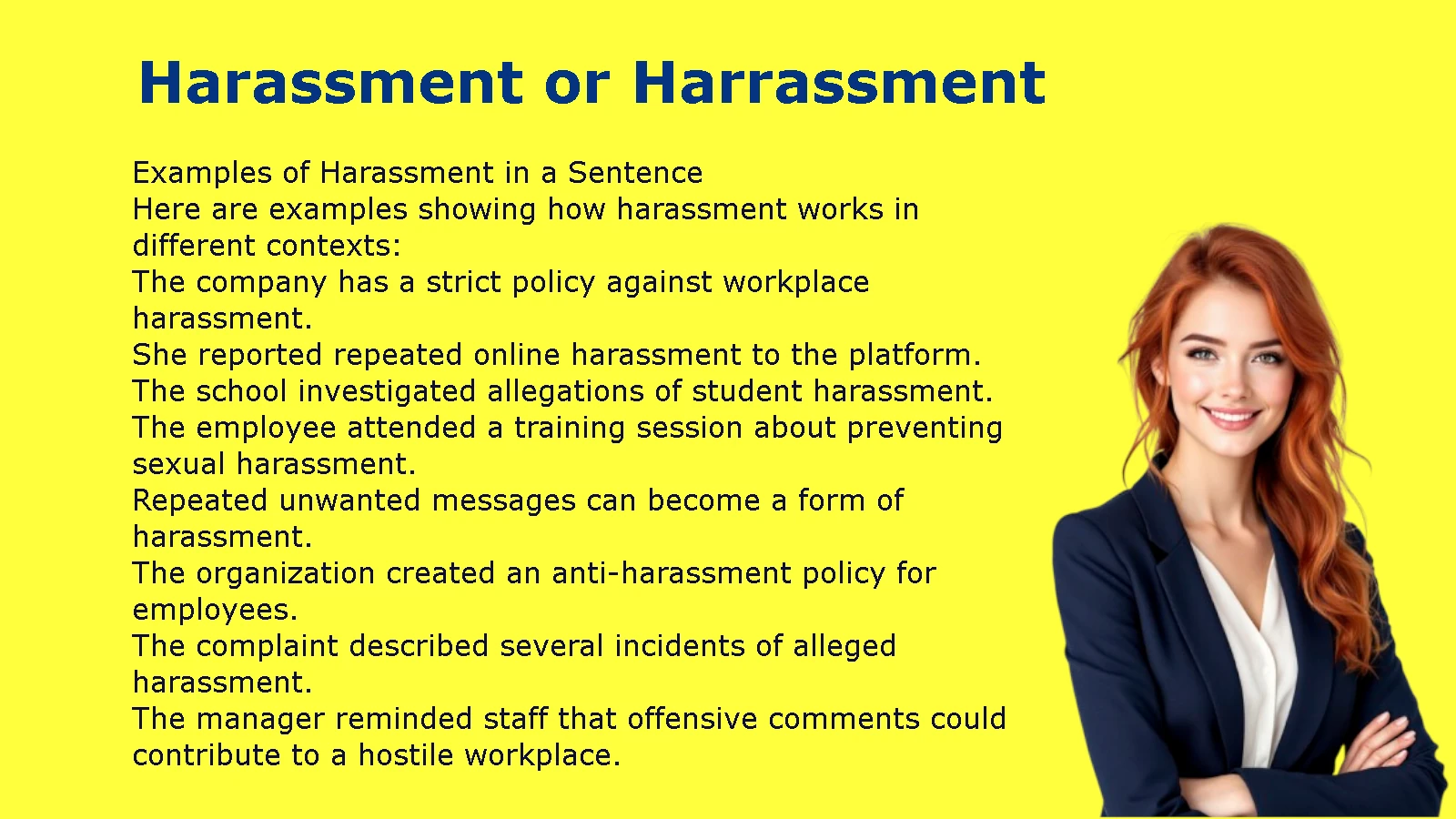
Examples of Harassment in a Sentence
Here are examples showing how harassment works in different contexts:
- The company has a strict policy against workplace harassment.
- She reported repeated online harassment to the platform.
- The school investigated allegations of student harassment.
- The employee attended a training session about preventing sexual harassment.
- Repeated unwanted messages can become a form of harassment.
- The organization created an anti-harassment policy for employees.
- The complaint described several incidents of alleged harassment.
- The manager reminded staff that offensive comments could contribute to a hostile workplace.
The examples show why context matters. Harassment is a broad term, while a phrase such as sexual harassment or workplace harassment gives the reader more information about the situation.
Harassment Examples: What Does Harassment Look Like?
In everyday usage, harassment can involve repeated or unwanted behavior directed toward another person.
Examples can include:
- repeated unwanted messages
- offensive comments
- threatening communication
- persistent unwanted contact
- insulting or degrading remarks
- intimidation
- offensive images or material
- unwanted sexual comments or advances
- repeated targeted abuse online
However, not every unpleasant interaction is automatically harassment in a legal sense.
That distinction is especially important in workplace contexts. The U.S. EEOC explains that unlawful workplace harassment involves unwelcome conduct based on protected characteristics or protected activity and that, under federal employment law, conduct generally must be sufficiently severe or pervasive to create a hostile or abusive work environment, or involve a qualifying adverse employment action.
A Practical Example
Imagine that a coworker makes one mildly inappropriate joke.
That behavior may be inappropriate and worth addressing, but it does not automatically satisfy the legal standard for unlawful workplace harassment.
Now consider a different situation in which an employee repeatedly receives degrading comments about their race from a coworker, and the behavior contributes to a hostile work environment.
The second situation raises much more serious harassment concerns, particularly under applicable employment-discrimination law.
The distinction illustrates why everyday meaning and legal meaning should not be treated as identical.
Common Types of Harassment
The word harassment appears in several established phrases. Each one adds a different context.
Workplace Harassment
Workplace harassment refers to unwanted conduct occurring in a work-related environment.
The U.S. EEOC states that workplace harassment can involve conduct based on race, color, religion, sex, national origin, age, disability, genetic information, or certain protected activities under federal employment law.
Potential examples include:
- offensive racial slurs
- discriminatory insults
- offensive jokes
- unwanted sexual conduct
- threatening behavior
- offensive images
- intimidation
- repeated derogatory comments
The person responsible does not necessarily have to be the victim’s direct supervisor. Depending on the circumstances, workplace harassment can involve supervisors, coworkers, agents, customers, clients, or other nonemployees.
Sexual Harassment
Sexual harassment is harassment involving unwanted sexual conduct or conduct based on sex.
Examples can include:
- unwelcome sexual advances
- requests for sexual favors
- sexually explicit comments
- offensive sexual images
- unwanted sexual remarks
- other unwelcome conduct of a sexual nature
The EEOC specifically identifies sexual harassment as unlawful in qualifying workplace circumstances under federal employment law.
Online Harassment
Online harassment involves unwanted or abusive behavior carried out through digital platforms.
It may occur through:
- social media
- direct messages
- online forums
- gaming communities
- messaging apps
- comment sections
Digital harassment can overlap with cyberbullying, although the terms are not always interchangeable.
StopBullying.gov explains that cyberbullying can occur through text messages, social media, forums, gaming platforms, email, and other digital environments. It can involve posting or sharing harmful or false material about another person.
School Harassment
The word can also describe unwanted conduct in educational settings.
Depending on the circumstances, examples may include:
- repeated targeted insults
- threats
- humiliating conduct
- discriminatory comments
- unwanted sexual behavior
- abusive online communication connected with school
The exact rules and legal standards depend on the institution and jurisdiction.
Harassment as a Verb and Related Word Forms
Understanding the related words makes the spelling much easier.
| Word | Part of Speech | Meaning | Example |
| harass | Verb | Repeatedly annoy, upset, or trouble someone | They continued to harass him. |
| harasses | Verb | Third-person singular form | The caller repeatedly harasses customers. |
| harassed | Verb/adjective | Past form of harass | She was harassed by repeated calls. |
| harassing | Verb/adjective | Ongoing behavior from harass | The messages were harassing. |
| harasser | Noun | A person who harasses | The alleged harasser was reported. |
| harassment | Noun | The behavior itself | The complaint concerned harassment. |
The Most Important Spelling Connection
If you remember only one relationship, remember:
harass → harassment
Not:
harrass → harrassment
The incorrect version starts with a misspelled base verb. Once the extra r enters harass, it often carries over into the noun.
Harassment or Harrassment in a Sentence
The difference becomes obvious when the two spellings appear side by side.
Correct Examples
The employee reported harassment to the human resources department.
The school has an anti-harassment policy.
The company investigated allegations of workplace harassment.
The platform provides tools for reporting online harassment.
Incorrect Examples
The employee reported harrassment to the human resources department.
The school has an anti-harrassment policy.
The company investigated allegations of workplace harrassment.
In each incorrect example, harrassment should be replaced with harassment.
Is Harrassment Ever Correct?
No. Harrassment is not the standard English spelling of the noun.
You may still see the form in:
- social media posts
- comments
- emails
- informal messages
- user-generated websites
- search queries
- documents containing spelling errors
Its appearance does not make it a valid spelling variant.
This is an important distinction for SEO and everyday language: a misspelled search query can be common without becoming a correct dictionary spelling.
If someone types harrassment into a search engine, the intended word is usually clear. Search engines can often understand the misspelling and return results for harassment. Writers, however, should still use the standard form.
Common Misspellings of Harassment
Harassment is easy to misspell because several letters appear close together.
Common incorrect forms include:
- harrassment
- harrasment
- harasment
- harasement
- harassement
- harrassmant
The exact errors vary, but most involve one of three problems:
- Adding an unnecessary r
- Removing one of the two s’s
- Changing the ending
The most important one for this comparison is harrassment.
Why People Write Harrassment
The mistake often comes from visual or phonetic interference.
Writers may remember that many English words contain doubled consonants and assume the r should be doubled. Others may mentally construct the word from an imagined form such as harrass.
But the standard verb is:
harass
That gives:
harassment
Learning the base word first is therefore one of the most reliable ways to avoid the error.
Harassment vs. Similar Words
It overlaps with several other words, but the terms are not exact synonyms in every context.
Harassment vs. Bullying
Bullying commonly refers to repeated aggressive behavior involving a power imbalance or an attempt to intimidate, dominate, or harm another person.
Harassment is broader and can include unwanted conduct in workplace, online, educational, and other contexts.
The two concepts can overlap.
StopBullying.gov notes that both bullying and harassment can involve power and control and harmful conduct, while describing harassment as unwelcome conduct that can be severe, pervasive, or persistent and create a hostile environment.
Harassment vs. Intimidation
Intimidation focuses on making someone afraid, threatened, or less willing to act freely.
Harassment can include intimidation, but it is broader.
For example, repeated insulting messages may be harassment without necessarily being described primarily as intimidation.
Harassment vs. Abuse
Abuse generally suggests harmful treatment or misuse of power.
Harassment focuses more specifically on unwanted, troubling, offensive, or threatening conduct.
A situation can involve both abuse and harassment, depending on the circumstances.
Harassment vs. Stalking
Stalking generally involves a pattern of unwanted attention, following, monitoring, communication, or other conduct directed toward a person.
Harassment is a broader category of unwanted behavior. Stalking can constitute harassment, but the two words are not interchangeable in every legal or everyday context.
Harassment vs. Discrimination
Discrimination generally concerns unequal treatment because of a protected characteristic or another legally protected basis.
Harassment can be a form of unlawful discrimination when it meets the applicable legal requirements.
The EEOC specifically describes workplace harassment as a form of employment discrimination under several federal laws.
Harassment in Formal and Professional Writing
Use harassment whenever you need the standard noun in formal English.
For example:
The company received a complaint regarding workplace harassment.
The university’s policy prohibits sexual harassment.
The organization has adopted an anti-harassment policy.
Avoid harrassment in:
- resumes
- cover letters
- business emails
- academic papers
- reports
- workplace complaints
- legal documents
- policies
- presentations
- professional websites
A spelling error can distract readers from the substance of an otherwise serious document.
Formal Alternatives Depend on Meaning
You should not automatically replace harassment with a synonym. The best word depends on what actually happened.
Possible alternatives include:
- intimidation
- bullying
- abuse
- threatening behavior
- mistreatment
- victimization
- unwanted conduct
- verbal abuse
However, these words are not interchangeable in every context.
If the subject is specifically unwanted conduct in a workplace, workplace harassment may be more precise than a vague synonym such as mistreatment.
Harassment Legal Definition: Why Context Matters
The phrase harassment legal definition can be misleading if treated as though one universal definition exists.
Legal definitions vary by jurisdiction, statute, and context.
For example, in the United States, the EEOC explains workplace harassment under federal employment-discrimination laws. The agency states that harassment is unlawful when it involves unwelcome conduct based on protected characteristics or protected activity and reaches the applicable legal threshold.
The EEOC also explains that petty slights, ordinary annoyances, and isolated incidents generally do not rise to the level of unlawful harassment unless an isolated incident is extremely serious.
That does not mean an inappropriate incident should automatically be dismissed. It means the word harassment can have a narrower legal meaning than its everyday use.
Everyday Meaning vs. Legal Meaning
| Context | Meaning of harassment |
| Everyday English | Unwanted or upsetting behavior |
| Workplace | Unwelcome conduct that may involve discrimination or protected activity |
| Online | Unwanted or abusive digital behavior |
| School | Unwanted conduct affecting students or the educational environment |
| Legal context | A term whose precise elements depend on the applicable law |
This distinction helps prevent a common mistake: treating a dictionary definition as though it were a complete legal test.
Case Study: Why the Context Changes the Meaning
Consider two simplified scenarios.
Scenario A: Repeated Unwanted Messages
A person repeatedly sends unwanted messages after being asked to stop.
In ordinary English, someone might describe this behavior as harassment because it is persistent and unwanted.
The situation may also involve other concepts, depending on the content, frequency, threats, platform rules, and applicable law.
Scenario B: Workplace Conduct
An employee repeatedly makes derogatory comments about a coworker’s race.
This is not merely a spelling or vocabulary question. In a U.S. workplace, conduct based on race can fall within the EEOC’s framework for unlawful workplace harassment when the applicable legal requirements are met.
The important lesson is that the same word can operate at different levels of meaning:
- ordinary language
- organizational policy
- employment law
- criminal law
- civil law
You need the relevant context before deciding what a particular incident legally constitutes.
Does Harassment Always Mean Repeated Behavior?
Not necessarily.
In ordinary English, harassment is often associated with repeated unwanted behavior. Cambridge’s general definition describes behavior that annoys or upsets someone, while its business/legal entry describes conduct that can include repeated unwanted contacts, insults, threats, touching, or offensive language.
Legal standards can differ.
For example, the EEOC notes that an isolated incident may still be unlawful if it is extremely serious, even though ordinary isolated incidents generally do not meet the federal workplace harassment standard.
So it is better not to use a rigid rule such as:
Harassment always requires repeated behavior.
The more accurate statement is:
Harassment commonly involves unwanted or offensive conduct, while the legal requirements depend on the applicable context and law.
Is Harassment Always Illegal?
No.
This is one of the most important distinctions to understand.
The word harassment can describe conduct in ordinary conversation without establishing that the conduct is legally prohibited.
For example, a person might say:
The constant interruptions felt like harassment.
That sentence communicates the speaker’s description of the behavior. It does not, by itself, establish that a legal violation occurred.
In U.S. employment law, the EEOC states that not every rude comment, isolated incident, or workplace annoyance is unlawful harassment. The conduct must satisfy the applicable legal standard.
The law can also differ substantially between jurisdictions, so legal questions should be evaluated under the relevant local rules.
What Is an Anti-Harassment Policy?
An anti-harassment policy is a policy designed to prevent or address harassment.
The term itself is well established. Cambridge defines anti-harassment as relating to efforts intended to prevent harassment and gives examples involving workplace policies and laws.
An organizational policy may address:
- prohibited conduct
- reporting procedures
- investigation procedures
- employee responsibilities
- confidentiality expectations
- retaliation
- disciplinary processes
- training and prevention
The exact contents depend on the organization and applicable law.
How to Remember Harassment vs. Harrassment
Use this simple formula:
HARASS + MENT = HARASSMENT
Then check the letters:
H A R A S S M E N T
There is:
- one R
- two S’s
- one M
- one E
- one N
- one T
The common incorrect spelling adds another r:
H A R R A S S M E N T
That extra r is the entire spelling problem.
Another Easy Trick
Remember the base verb:
Don’t change harass into harrass.
If the base word is spelled correctly, the noun becomes much easier:
harass → harassment
Harassment or Harrassment: Quick Comparison
| Question | Harassment | Harrassment |
| Is it correct? | Yes | No |
| Standard English spelling? | Yes | No |
| Contains one r? | Yes | No |
| Contains two s’s? | Yes | Yes |
| Used by major dictionaries? | Yes | No |
| Appropriate for formal writing? | Yes | No |
| Can appear online? | Yes | Yes, usually as a misspelling |
| Related verb | harass | harrass is incorrect |
Facts to Remember About Harassment
Here are the key points in one place:
- Harassment is the correct spelling.
- Harrassment is a misspelling.
- The correct noun comes from harass + -ment.
- Harass contains one r and two s’s.
- The noun harassment retains that spelling pattern.
- Harassment is a noun.
- Harass is the related verb.
- Harassed is the past form.
- Harassing is the present participle.
- Harasser refers to a person who harasses someone.
- Harassment can occur in workplaces, schools, online spaces, and other settings.
- The everyday meaning is broader than some legal definitions.
- Workplace harassment has specific legal standards that vary by jurisdiction.
- Not every rude or unpleasant interaction automatically constitutes unlawful harassment.
- Harrassment should not be used in professional or formal writing.
Frequently Asked Questions About Harassment or Harrassment
Is harassment or harrassment correct?
Harassment is correct. Harrassment is a misspelling.
Why is harassment spelled with one r?
The standard spelling comes from harass + -ment. The verb harass contains one r and two s’s, producing harassment.
How do you spell harassment?
The correct spelling is:
H-A-R-A-S-S-M-E-N-T
Is harrassment a word?
Harrassment is not the standard English spelling. It is a common misspelling of harassment.
What does harassment mean?
In general English, harassment refers to unwanted behavior that annoys, upsets, threatens, intimidates, or otherwise troubles another person. Cambridge gives a general definition involving behavior that annoys or upsets someone.
How do you pronounce harassment?
English has pronunciation variation. Cambridge lists multiple U.S. and British pronunciations, so pronunciation can vary by speaker and dialect.
What is the difference between harassment and bullying?
The terms overlap, but they are not identical. Bullying commonly refers to repeated aggressive behavior involving power or control, while harassment is a broader term for unwanted or offensive conduct in various settings.
Is harassment always illegal?
No. The word can be used in ordinary English without establishing a legal violation. Whether conduct is unlawful depends on the relevant law and circumstances. For example, U.S. federal employment law has specific requirements for unlawful workplace harassment.
What are examples of harassment?
Examples can include repeated unwanted messages, offensive comments, threats, intimidation, unwanted sexual conduct, discriminatory remarks, and other targeted unwanted behavior. The legal significance of a particular example depends on the applicable context.
What is the correct spelling of harassing?
The correct spelling is harassing, with one r and two s’s.
Correct: harassing
Incorrect: harrassing
What is the correct spelling of harassed?
The correct spelling is harassed, with one r and two s’s.
Correct: harassed
Incorrect: harrassed
Final Answer: Harassment or Harrassment?
If you are choosing between harassment and harrassment, choose harassment.
Harassment is the standard English spelling, while harrassment is a misspelling. The easiest way to remember it is to start with the correct verb harass and add -ment:
harass + ment = harassment
The word can describe unwanted, offensive, upsetting, threatening, or persistent behavior, but its precise meaning depends on context. In legal and workplace settings, the applicable definition can be narrower and governed by specific laws or policies.
For everyday writing, professional communication, and formal documents, there is no need to hesitate: