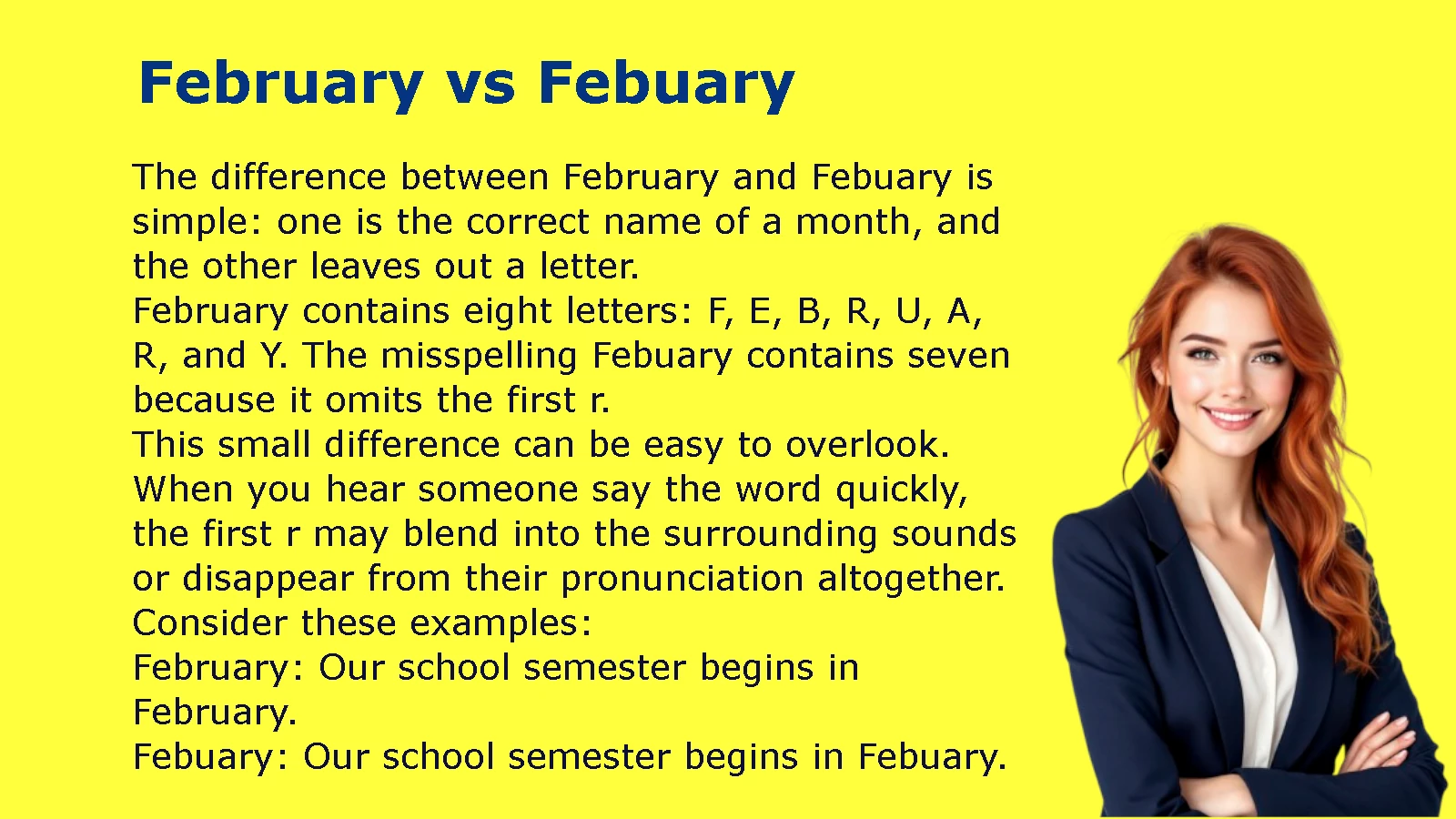
The confusion is understandable. People often search for February vs Febuary, February or Febuary, which spelling is correct, or Febuary meaning because the first r can be easy to overlook when pronouncing the word. But here’s the key point: Febuary is not an accepted standard spelling of the month’s name.
February is the correct spelling. It refers to the second month of the year, which has 28 days in a common year and 29 days in a leap year. Febuary is a common misspelling that occurs when people accidentally leave out the first r in the word.
Examples:
- February is the shortest month of the year.
- Her birthday falls in February, just before spring begins.
In this guide, you’ll learn the complete difference between February vs Febuary, including their meaning, correct spelling, pronunciation, origin, and usage. You’ll also discover why Febuary is a common mistake, along with clear examples to help you remember the correct spelling.
February vs Febuary: Quick Answer
February is the correct spelling, while Febuary is a misspelling. it is the second month of the Gregorian calendar and has 28 days in a common year or 29 days in a leap year. The word contains two r’s, even though the first r may be difficult to hear in everyday speech.
| Spelling | Correct? | Meaning |
| February | Yes | The second month of the year |
| Febuary | No | A misspelling of February |
| Febraury | No | A misspelling with the letters in the wrong order |
| Feburary | No | A misspelling with the letters in the wrong order |
Remember: Write February, not Febuary. The first r belongs between the b and the u.
For example:
- Correct: My birthday is in February.
- Incorrect: My birthday is in Febuary.
- Correct: February has 28 days this year.
- Incorrect: Febuary has 28 days this year.
In standard English, February is the accepted spelling in both American and British English. You don’t need a different spelling for either variety.
February vs Febuary: What’s the Difference?
The difference between February and Febuary is simple: one is the correct name of a month, and the other leaves out a letter.
February contains eight letters: F, E, B, R, U, A, R, and Y. The misspelling Febuary contains seven because it omits the first r.
This small difference can be easy to overlook. When you hear someone say the word quickly, the first r may blend into the surrounding sounds or disappear from their pronunciation altogether.
Consider these examples:
- February: Our school semester begins in February.
- Febuary: Our school semester begins in Febuary.
The first sentence uses the standard spelling. The second contains a spelling error, even though most readers would understand the intended meaning.
Here’s another way to compare them:
| Feature | February | Febuary |
| Standard English spelling | Yes | No |
| Number of letters | 8 | 7 |
| Contains two r’s | Yes | No |
| Refers to the second month | Yes | Intended meaning only |
| Appropriate for formal writing | Yes | No |
You might encounter Febuary in text messages, social media posts, handwritten notes, or online discussions. Its appearance doesn’t make it an accepted alternative.
When accuracy matters, use February every time.
What Does February Mean?
February is the second month of the year in the Gregorian calendar, which is the calendar used for most civil purposes around the world. It follows January and comes before March. The month has 28 days in a common year and 29 days in a leap year.
People use the word to discuss dates, birthdays, appointments, holidays, school schedules, business deadlines, and seasonal events.
February as the Second Month of the Year
February occupies the second position in the modern calendar.
The months appear in this order:
- January
- February
- March
- April
- May
- June
- July
- August
- September
- October
- November
- December
February is often associated with winter in the Northern Hemisphere and summer in the Southern Hemisphere. The season depends on where you live, so February doesn’t represent the same weather conditions everywhere.
For example, someone in the United States might associate February with cold weather, snow, and winter clothing. Someone in Australia may associate the same month with warm temperatures, outdoor activities, and summer holidays.
The word also appears in many familiar expressions and date formats:
- February birthday
- February calendar
- February weather
- February vacation
- February 14
- The end of February
Example: Our company plans to launch the new product in February.
In this sentence, February identifies the planned month without specifying an exact date.
February’s Number of Days
February is the shortest month of the year. It normally has 28 days, but it has 29 days during a leap year.
| Year type | Number of days in February |
| Common year | 28 |
| Leap year | 29 |
A leap year generally occurs every four years. However, the Gregorian calendar has an additional rule: a century year must be divisible by 400 to qualify as a leap year.
For example:
- 2024 was a leap year, so February had 29 days.
- 2025 was a common year, so February had 28 days.
- 2026 is a common year, so February has 28 days.
- 2028 will be a leap year, so February will have 29 days.
- 1900 was not a leap year because it wasn’t divisible by 400.
- 2000 was a leap year because it was divisible by 400.
This system keeps the calendar aligned with Earth’s yearly journey around the Sun.
Knowing how many days February contains is useful when calculating deadlines, planning monthly budgets, tracking subscriptions, or scheduling events. It also explains why dates such as February 29 appear only in leap years.
Why Is February Often Misspelled as Febuary?
February is often misspelled as Febuary because its spelling doesn’t always match the way people pronounce it in everyday conversation. The first r appears between two sounds that can be difficult to connect smoothly, so some speakers weaken or omit it.
When people reproduce the word from memory, they may write the version that matches what they hear instead of the standard spelling.
There are two main reasons for this mistake: pronunciation and the tendency to simplify unfamiliar letter combinations.
The Silent R in February
The first r in February is often described as silent, although its pronunciation varies among speakers. Some pronounce both r’s clearly, while others weaken the first one or omit it in casual speech.
This variation makes the spelling confusing.
Compare the written word with the way some people say it:
- Written: February
- Common casual pronunciation: The first r may be reduced or dropped.
- Incorrect written form: Febuary
The key point is that a letter can remain necessary in spelling even when speakers don’t pronounce it clearly.
English has many examples of differences between spelling and pronunciation. People may pronounce words differently depending on their accent, speaking speed, or regional habits. The standard spelling usually remains unchanged.
For example, someone might say February quickly in a sentence such as, “I’ll see you in February.” The sounds can blend together, making the first r difficult to notice.
That doesn’t mean the letter has disappeared from the written word.
If you remember only one thing, remember this: pronounce February naturally, but spell it with both r’s.
Why Pronunciation Makes the Spelling Confusing
February has an awkward sequence of sounds for some English speakers. The transition from the first r to the following vowel can feel unnatural, particularly when someone says the word quickly.
People tend to simplify difficult sound combinations in casual speech. They may also rely on the sound of a word when spelling it from memory.
This creates a familiar pattern:
- You hear someone pronounce February without a strong first r.
- You remember the sound as something like “Feb-uary.”
- You write Febuary because it matches your memory.
- You overlook the missing letter because the word still looks familiar.
The same general problem occurs with other English words whose spelling isn’t immediately obvious from their pronunciation.
For instance, people sometimes confuse Wednesday with the way they pronounce it casually, or struggle to remember the spelling of restaurant. The written form requires knowledge beyond simply reproducing each sound.
Practical lesson: If you regularly misspell February, don’t rely on pronunciation alone. Learn the word’s letter sequence and use that sequence whenever you write it.
How to Spell February Correctly
To spell February correctly, write F-E-B-R-U-A-R-Y. The first r comes immediately after the b, and the second r appears near the end, before the y.
Breaking the word into smaller parts makes it easier to remember than trying to reproduce the entire word from sound.
A Simple Trick to Remember the R
The easiest spelling trick is to remember that February has two r’s.
You can use this short reminder:
Feb-R-u-a-R-y
The unusual capital R’s draw attention to the letters that people often forget.
Another useful technique is to connect the month to a date you already know. If your birthday, an anniversary, or another annual event occurs in February, write the correct spelling beside that date.
For example:
- February 3
- February 14
- February 20
- February 28
- February 29 in a leap year
You can also practice writing the word three times:
- February
- February
- February
This may seem basic, but deliberate repetition helps reinforce the correct letter order.
For an extra check, ask yourself two questions:
- Did I put an r after the b?
- Did I include the second r before the y?
If both answers are yes, you’ve probably spelled the word correctly.
February Spelling Breakdown
Let’s examine the spelling one letter at a time.
| Position | Letter | What to remember |
| 1 | F | The word starts with F. |
| 2 | E | E follows F. |
| 3 | B | B comes before the first R. |
| 4 | R | The commonly omitted letter. |
| 5 | U | U follows the first R. |
| 6 | A | A comes after U. |
| 7 | R | The second R appears near the end. |
| 8 | Y | Y finishes the word. |
The full sequence is F-E-B-R-U-A-R-Y.
Notice how the first r separates the b from the u. If you leave it out, you produce Febuary instead of February.
A useful practice exercise is to write the word from memory, then compare your version with the correct spelling. Don’t just check whether the word looks right. Inspect the letters individually.
This method works especially well if you frequently type the misspelling automatically.
February in a Sentence
You can use February whenever you refer to the month, an event occurring during it, or a date that falls within it. The word is a proper name of a calendar month, so it begins with a capital letter in standard English.
The following examples show how to use February in everyday writing.
Examples of February in Everyday Writing
Here are original sentences that demonstrate the correct spelling in different situations.
- Personal plans: We’re planning a family reunion in February.
- Education: The university will publish its admission decisions in February.
- Business: Our team expects to finish the project by February.
- Travel: Hotel prices may change during the February holiday period.
- Weather: February mornings are often cold in our part of the country.
- Shopping: The store plans to introduce its new collection in February.
- Work: My manager scheduled the performance review for February.
- Health: The clinic will begin its vaccination campaign in February.
- Sports: The local tournament is scheduled to start in February.
- Entertainment: The film festival returns to the city in February.
Each sentence uses February as the name of a month.
Notice that the spelling doesn’t change when the context changes. Whether you’re writing about work, travel, education, or personal events, you still need both r’s.
Examples of February in Dates
February also appears in dates, deadlines, invitations, and schedules.
Here are several correct examples:
| Context | Example |
| A specific date | The meeting is scheduled for February 12. |
| A birthday | Her birthday falls on February 18. |
| A deadline | Please submit the application by February 25. |
| A date range | The course runs from February 3 to February 21. |
| A leap day | The special event took place on February 29, 2024. |
| A future event | The next conference is planned for February 2028. |
In American English, a date commonly appears as February 12, 2027, with a comma between the day and year.
You may also see abbreviated numeric formats such as 02/12/2027. However, numeric dates can be ambiguous across countries because the order of the month and day varies. Writing the month in full often makes the date clearer.
For formal documents, invitations, and business communication, spelling out February is a reliable choice when clarity matters.
February vs Febuary Examples
The easiest way to understand February vs Febuary is to compare correct sentences with incorrect ones.
In each pair below, the sentence containing February uses the standard spelling. The sentence containing Febuary includes a missing r.
| Incorrect sentence | Correct sentence |
| My vacation starts in Febuary. | My vacation starts in February. |
| We have an appointment on Febuary 8. | We have an appointment on February 8. |
| The application closes at the end of Febuary. | The application closes at the end of February. |
| Her birthday is in Febuary. | Her birthday is in February. |
| The company will release its report in Febuary 2027. | The company will release its report in February 2027. |
| I always look forward to Febuary. | I always look forward to February. |
| The school opens again in Febuary. | The school opens again in February. |
| Febuary is the shortest month of the year. | February is the shortest month of the year. |
The mistake is easy to fix: insert the missing r after the b.
A Short Editing Example
Imagine you’re writing this email to a colleague:
“Hi Alex, our planning meeting has been moved to Febuary 16. Please update your calendar.”
The message is understandable, but the month contains a spelling error.
A corrected version reads:
“Hi Alex, our planning meeting has been moved to February 16. Please update your calendar.”
The change is small, yet it makes the email more professional.
This matters in business writing because spelling mistakes can distract readers from the message. A single typo won’t automatically undermine your credibility, but repeatedly overlooking simple errors may give the impression that a document hasn’t been reviewed carefully.
Editing tip: When proofreading, check the names of months separately. Familiar words can escape your attention precisely because you recognize them so quickly.
How to Pronounce February
February has more than one common pronunciation pattern in English. Some speakers pronounce both r’s, while others weaken or omit the first r in everyday conversation.
The spelling, however, remains February regardless of the pronunciation you use.
A pronunciation guide can help explain the difference:
| Pronunciation pattern | What happens |
| Both r’s pronounced | The first and second r sounds are articulated. |
| First r weakened | The first r is less noticeable in speech. |
| First r omitted | The word may sound similar to “Feb-uary.” |
The exact pronunciation depends partly on the speaker’s accent and speaking habits.
Is the R in February Silent?
The first r in February isn’t universally silent. Some people pronounce it clearly, while others reduce or omit it. Calling it a silent r can be a useful memory aid, but it doesn’t describe every speaker’s pronunciation.
The second r is also part of the spelling, and speakers may pronounce it differently depending on their accent.
The distinction between pronunciation and spelling is important here. You don’t have to pronounce every letter in a way that makes it individually obvious, and you shouldn’t change the written form to match a casual pronunciation.
For example, both of these sentences are correctly spelled:
- February begins on a Sunday this year.
- I’ll visit my family in February.
You can say the month naturally in either sentence without changing its spelling.
If you’re learning English, try listening to different speakers and paying attention to the sound of the word. Then practice spelling it independently of how you pronounce it.
Remember: Pronunciation can vary, but Febuary isn’t an accepted alternative spelling.
Common February Spelling Mistakes
February can be misspelled in several ways. The most familiar error is Febuary, but other mistakes involve moving letters into the wrong order or leaving out part of the word.
Learning to recognize these forms can help you catch errors when proofreading your own writing.
Febuary vs. February
Febuary leaves out the first r.
- Incorrect: Febuary
- Correct: February
This error often reflects how people pronounce the month casually. To correct it, place r immediately after b.
Febraury vs. February
Febraury rearranges letters in the middle of the word.
- Incorrect: Febraury
- Correct: February
The correct sequence is B-R-U-A, not B-R-A-U.
When you type the word, pay attention to the order of the letters after the first r. The correct spelling contains rua in that part of the word.
Feburary vs. February
Feburary places the u before the first r.
- Incorrect: Feburary
- Correct: February
Although this version contains the necessary letters, their order is wrong. English spelling depends on the correct sequence, not simply on including every letter somewhere in the word.
Compare the two forms:
| Spelling | Problem |
| February | Correct letter order |
| Febuary | Missing first r |
| Febraury | Incorrect letter order |
| Feburary | Incorrect letter order |
A spell-checker may catch these mistakes, but it shouldn’t be your only line of defense. Proper names and unusual misspellings don’t always trigger obvious warnings in every application.
For important writing, combine spell-checking with a quick visual review.
Is Febuary a Word?
Febuary isn’t the standard English spelling of a month. It’s a common misspelling of February. Readers can usually infer what the writer means, but you shouldn’t use Febuary in formal writing, schoolwork, professional communication, or published content.
You might find Febuary in social media posts, informal messages, search queries, or other user-generated material. Its appearance in those places doesn’t make it a correct alternative.
It’s useful to distinguish between an error people commonly make and an accepted spelling variation.
An accepted variation is recognized as a legitimate form of a word. A misspelling is an incorrect form, even when many people use it.
For example:
- Color and colour are accepted spelling variants in different varieties of English.
- February is the standard spelling in both American and British English.
- Febuary is a misspelling, not a regional alternative.
If you’re searching for information about the month and accidentally type Febuary, a search engine will generally understand what you’re looking for. Still, your own writing should use February.
February in American and British English
February is spelled the same way in American and British English. Neither variety officially replaces the first r with a different letter or removes it from the written form.
This makes February different from words that have recognized regional spelling variations, such as color and colour.
| Feature | American English | British English |
| Correct spelling | February | February |
| Incorrect form | Febuary | Febuary |
| Number of days in a common year | 28 | 28 |
| Number of days in a leap year | 29 | 29 |
| Common abbreviation | Feb. | Feb |
The abbreviation may appear with or without a period depending on the style guide or context. For instance, Feb. 14 is common in American writing, while Feb 14 may appear in other styles.
The full spelling is usually preferable in formal prose when space isn’t limited.
Consider these examples:
- American English: The conference begins in February.
- British English: The conference begins in February.
- American English abbreviation: The conference begins on Feb. 14.
- British English abbreviation: The conference begins on 14 Feb.
The date format may differ, but the spelling of the month doesn’t.
If you’re writing for an international audience, spelling out February and using an unambiguous date format can help prevent confusion.
Frequently Asked Questions About February vs Febuary
Is it February or Febuary?
February is correct. Febuary is a misspelling that omits the first r. Always use February when writing the name of the second month of the year.
Why do people spell February as Febuary?
Many people pronounce February without clearly articulating the first r. When they spell the word from memory, they may leave out the letter because it isn’t prominent in their pronunciation.
How do you remember how to spell February?
Remember that February contains two r’s. The first comes after b, and the second appears before y. You can also practice writing F-E-B-R-U-A-R-Y until the letter sequence becomes familiar.
Is the first R pronounced in February?
Pronunciation varies. Some speakers pronounce both r’s, while others weaken or omit the first r in casual speech. The standard spelling always includes it.
Does February have 28 or 29 days?
February has 28 days in a common year and 29 days in a leap year. Leap years generally occur every four years, with an exception for century years that aren’t divisible by 400.
Is February spelled differently in British English?
No. February is the standard spelling in both American and British English. Febuary isn’t a recognized British spelling variant.
What is the abbreviation for February?
The month is commonly abbreviated as Feb or Feb. The period depends on the writing style. For example, you might write “Feb. 14” in a style that uses periods after shortened month names.
How do you spell February correctly?
Spell it F-E-B-R-U-A-R-Y. Make sure the first r appears after b and before u. The most common mistake is leaving out that first r and writing Febuary instead.
Final Takeaway: February vs Febuary
The difference between February and Febuary comes down to one missing letter.
February is correct. Febuary is a misspelling. The standard spelling contains eight letters, including two r’s, even though some speakers don’t clearly pronounce the first one.
Use these reminders to avoid the mistake:
- Write February, not Febuary.
- Remember the first r after b.
- Check the order of the letters if you often type the word incorrectly.
- Use the same spelling in American and British English.
- Write the full month name when clarity matters.
The next time you add a deadline to your calendar, write a school assignment, or prepare a business email, take a second to check the spelling.
Quick spelling check: Can you write February correctly without looking at the word? If you can remember both r’s, you’re already one step closer to making this common spelling mistake a thing of the past.
Meta Title: February vs Febuary: Correct Spelling Explained
Meta Description: February vs Febuary: Learn the correct spelling, why the first R is often missed, pronunciation differences, and easy spelling tips.