Fairy vs Faerie comes down to more than a spelling difference. Both words share historical roots, but modern fantasy often uses them to create different impressions of magical beings, enchanted realms, and supernatural folklore. The word fairy commonly brings to mind tiny, winged creatures, fairy tales, and childhood magic, while faerie often suggests ancient powers, mysterious bargains, and dangerous enchanted lands.
Understanding the fairy definition, faerie meaning, and the history of these words helps you choose the right term for everyday writing, folklore discussions, and fantasy world-building. It also explains why authors use fae, fairy, and faerie in different ways, even though their meanings overlap.
The distinction isn’t an absolute rule. Traditional folklore contains helpful, harmful, beautiful, frightening, and unpredictable supernatural beings. Modern books, films, and games have shaped these words into recognizable literary conventions, giving writers several ways to describe the magical world they want readers to imagine.
What Is the Difference Between Fairy and Faerie?
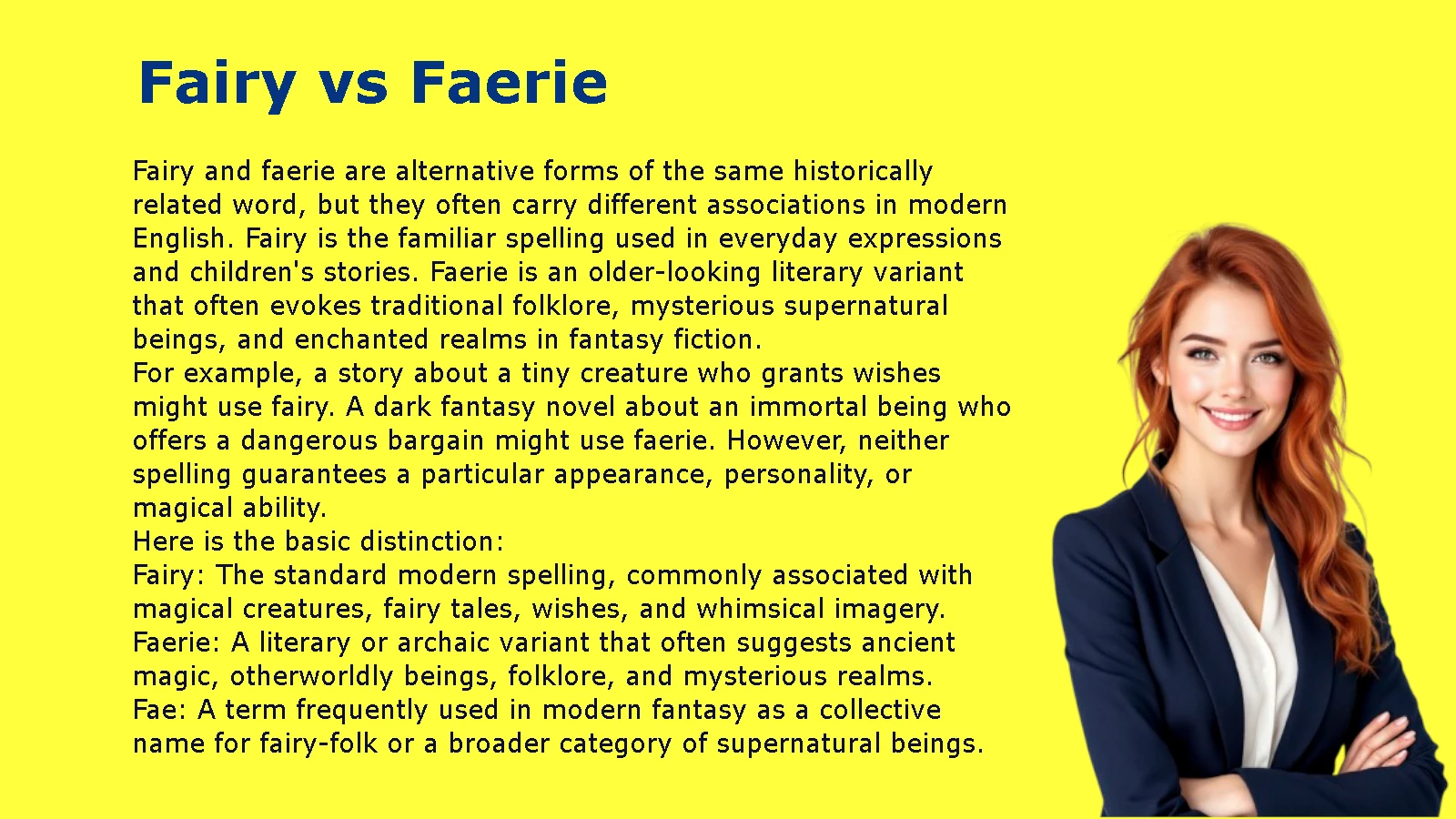
Fairy and faerie are alternative forms of the same historically related word, but they often carry different associations in modern English. Fairy is the familiar spelling used in everyday expressions and children’s stories. Faerie is an older-looking literary variant that often evokes traditional folklore, mysterious supernatural beings, and enchanted realms in fantasy fiction.
For example, a story about a tiny creature who grants wishes might use fairy. A dark fantasy novel about an immortal being who offers a dangerous bargain might use faerie. However, neither spelling guarantees a particular appearance, personality, or magical ability.
Here is the basic distinction:
- Fairy: The standard modern spelling, commonly associated with magical creatures, fairy tales, wishes, and whimsical imagery.
- Faerie: A literary or archaic variant that often suggests ancient magic, otherworldly beings, folklore, and mysterious realms.
- Fae: A term frequently used in modern fantasy as a collective name for fairy-folk or a broader category of supernatural beings.
Consider these examples:
- “A fairy granted the princess three wishes.” This sentence creates a familiar fairy-tale atmosphere.
- “The traveler entered Faerie and discovered that every promise carried a price.” This sentence suggests a mysterious world governed by supernatural rules.
Both sentences describe magical experiences. The difference lies in the atmosphere and expectations the writer creates.
The Origins of Fairy and Faerie
The history of fairy and faerie explains why the words overlap. Their modern associations developed over centuries, as English speakers adapted older words and writers reshaped supernatural folklore for new audiences.
Where Does the Word Fairy Come From?
The English word fairy developed through Middle English and Anglo-French forms connected to the Old French word faerie. Historically, faerie could refer to enchantment, supernatural influence, or the world and activities associated with fairy beings.
This earlier meaning was broader than the modern image of a tiny creature with butterfly wings. It could describe an enchanted condition, an otherworldly experience, or the supernatural realm in which extraordinary beings operated.
The word’s deeper history connects to Latin fata, meaning “the Fates.” In Roman mythology, the Fates were associated with determining the course of human life. This linguistic connection helps explain the historical relationship between ideas of destiny, supernatural power, and enchantment.
Over time, English usage increasingly favored fairy as the ordinary spelling for a supernatural creature. The older-looking spelling faerie remained available for literary and historical purposes.
The evolution can be summarized as follows:
| Stage | Word or influence | Significance |
| Latin | Fata | Connected with the concept of the Fates and destiny |
| Old French | Faerie | Associated with enchantment, supernatural influence, and fairy realms |
| Middle English | Forms related to fairy and faerie | Adapted the word into English usage |
| Modern English | Fairy | Became the standard everyday spelling |
| Modern fantasy | Faerie and fae | Gained renewed use as literary terms for supernatural beings and enchanted worlds |
The timeline shows a gradual linguistic development rather than a clean split between two unrelated words.
Why Are There Two Spellings?
The difference between fairy and faerie developed through changing spelling conventions and literary preferences. English has preserved many older spellings in literature, place names, traditional expressions, and specialized vocabulary.
Writers can also choose an archaic-looking spelling to create a particular mood. For example, faerie may feel older, more mysterious, or more connected to folklore than fairy. That impression makes it useful in fantasy novels, role-playing games, and stories about supernatural courts.
Compare these sentences:
- “A fairy lived beneath the rosebush.” The wording feels familiar and gentle.
- “A faerie noble guarded the ancient forest.” The wording suggests an elaborate supernatural society.
The spelling influences the reader’s expectations, but context does the real work. A writer could create a terrifying creature called a fairy or a gentle creature called a faerie. Neither choice would be linguistically incorrect.
Key takeaway: The words share historical roots. Their modern differences mainly reflect convention, context, and creative choice rather than two universally separate categories of beings.
Fairy: Meaning and Characteristics
A fairy is a supernatural being associated with magic, enchantment, and folklore. In contemporary popular culture, fairies often appear as small, winged creatures who help people, grant wishes, protect nature, or perform playful tricks. Traditional stories, however, portray a much wider range of fairy-like beings.
What Does Fairy Mean in Modern English?
The familiar modern fairy image developed through centuries of storytelling, illustration, theatrical performance, and children’s entertainment. Victorian-era artists and writers helped popularize delicate, winged figures, while twentieth-century films and other media made this image recognizable around the world.
Many modern fairies share several common characteristics.
Small physical size: Illustrations frequently show fairies as tiny enough to sit on a flower or hide inside a tree.
Wings: Butterfly-like or dragonfly-like wings are common in contemporary depictions, although many traditional fairy beings have no wings at all.
Magical abilities: Fairies may grant wishes, cast spells, heal plants, create illusions, or protect enchanted places.
Playful personalities: Popular portrayals often emphasize curiosity, mischief, kindness, and a sense of wonder.
Connections to nature: Gardens, forests, flowers, moonlight, and woodland settings frequently appear in fairy stories.
These characteristics describe a familiar artistic convention, not a universal definition. Older folklore includes supernatural beings who frighten travelers, punish broken promises, steal people away, or demand offerings.
The familiar image of a harmless fairy therefore represents one part of a much larger tradition.
Famous Fairy Examples in Stories and Popular Culture
Several well-known characters illustrate how modern culture uses the word fairy.
Tinker Bell from Peter Pan
<PRIVATE_PERSON> Tinker Bell is one of the most recognizable examples of a tiny, winged fairy in popular culture. Her association with Peter Pan, magical flight, and pixie dust helped establish the visual language many readers now associate with fairies.
Her character also demonstrates that fairies do not have to be perfectly kind. Tinker Bell can act jealous, stubborn, and impulsive, giving her a more complicated personality than a purely benevolent magical helper.
The Tooth Fairy
The Tooth Fairy belongs to a familiar childhood tradition in which a magical visitor exchanges a lost tooth for money or a small gift. This figure represents the comforting, playful side of fairy imagery.
Unlike a supernatural being in a dark fantasy novel, the Tooth Fairy usually exists to make an ordinary childhood experience feel special.
The Fairy Godmother
Cinderella’s Fairy Godmother represents the fairy as a magical helper. She transforms ordinary objects, provides beautiful clothing, and makes it possible for Cinderella to attend the royal ball.
Her role connects fairies with transformation, generosity, and hope.
Together, these examples show how popular storytelling has shaped the modern fairy stereotype. The familiar fairy is often small, magical, visually charming, and involved in helping or entertaining humans.
When Should You Use Fairy?
Use fairy when you want the standard modern spelling or when the context involves familiar magical creatures, established expressions, children’s fiction, or whimsical fantasy.
Common examples include:
- “My daughter dressed as a fairy for the school costume party.”
- “The fairy granted the young prince a wish.”
- “The garden looked like something from a fairy tale.”
- “She collected books about fairies, elves, and magical animals.”
The spelling also appears in established expressions such as fairy tale, fairy godmother, and fairy dust.
If you are writing a general article, a children’s story, or an everyday sentence, fairy is usually the most natural choice.
However, the word can also describe frightening or morally complicated beings. You do not need to use faerie simply because your fairy character behaves badly.
For example, “The fairy lured the traveler into the forest” is perfectly understandable. The action creates the danger; the spelling does not have to do it.
Faerie: Meaning and Folklore Associations
Faerie is an alternative spelling of fairy that often evokes older folklore, supernatural enchantment, and mysterious otherworldly beings. Modern fantasy writers frequently use it to establish an atmosphere of ancient magic, strange customs, powerful supernatural societies, and enchanted realms.
The word is particularly useful when an author wants to distinguish a complex world of fairy-folk from the familiar, whimsical image of a tiny winged creature.
What Does Faerie Mean in Fantasy and Folklore?
The word faerie has historical associations with enchantment and the supernatural. In modern fiction, writers often use it to describe a world or culture inhabited by powerful beings who follow unfamiliar rules.
These portrayals draw inspiration from several folklore traditions, especially stories about encounters between humans and mysterious supernatural neighbors. However, no single set of characteristics defines all folklore beings called fairies or faeries.
Modern fantasy faeries may have the following traits.
Human-sized or shapeshifting forms: Some appear almost human, while others change their appearance or reveal an unmistakably supernatural nature.
Unusual beauty: Authors often portray faerie nobles as captivating but unsettling, using beauty to suggest power rather than safety.
Strict customs and bargains: A faerie might demand payment for a favor, interpret a promise literally, or punish someone who breaks an agreement.
Trickster behavior: Certain fictional faeries exploit loopholes, conceal information, or use technically truthful statements to mislead others.
Political structures: Fantasy settings may organize faerie society into royal families, rival courts, ancient houses, or competing territories.
Connections to enchanted landscapes: Forests, hidden kingdoms, mysterious hills, and places where ordinary rules no longer apply are common settings.
These features create a world in which magic has consequences. A character might receive a powerful gift only to discover that accepting it creates a debt.
For example:
“A faerie queen offered the hunter a silver key. She promised it would open any door in the forest, but she never explained which doors the key would open from the other side.”
The example creates tension through the character’s uncertainty. The faerie’s danger comes from the bargain and its hidden implications, not simply from the word used to describe her.
It is also important to avoid treating every folklore tradition as if it shared one rulebook. Ideas such as Seelie and Unseelie Courts appear in particular bodies of Scottish and later literary tradition. Modern authors have expanded these ideas into broader systems of faerie politics, but those systems do not represent every historical belief.
Famous Faerie Examples in Literature
Modern fantasy provides several useful examples of how authors use fairy-folk to create intricate supernatural worlds.
The Tuatha Dé Danann in Irish mythology
The Tuatha Dé Danann are a significant group in Irish mythological tradition. They are associated with supernatural abilities, kingship, conflict, and extraordinary achievements.
They are not simply identical to the tiny winged fairies found in children’s illustrations. Their stories belong to a rich mythological tradition that modern writers may draw on when building worlds populated by powerful supernatural beings.
It is more accurate to treat them as a source of inspiration for some modern depictions of the fae than to label them universally as members of one standardized faerie species.
The high-fae in Sarah J. Maas’s A Court of Thorns and Roses
Sarah J. Maas’s fantasy series presents powerful faerie-like beings, magical territories, political alliances, and relationships shaped by supernatural power.
The series illustrates a common modern fantasy approach: fairy-folk become central participants in a complex society rather than decorative creatures who appear briefly to grant wishes.
The fairy-folk in Holly Black’s The Cruel Prince
Holly Black’s The Cruel Prince explores a dangerous fairy world filled with political ambition, rivalry, deception, and social hierarchies.
The setting demonstrates how supernatural beauty can coexist with cruelty. Characters must navigate power structures and hidden intentions instead of assuming that magical beings will behave according to human moral expectations.
These examples show why faerie and fae appeal to fantasy writers. The terms can suggest an entire supernatural culture, complete with history, customs, and conflicts.
When Should You Use Faerie?
Choose faerie when you want to evoke an archaic, folkloric, mysterious, or otherworldly atmosphere. It works particularly well in fantasy prose when the supernatural world has its own customs, dangers, or political systems.
Consider these examples:
- “The knight crossed the border into Faerie.”
- “A faerie offered the merchant a bargain that would change his life.”
- “The ancient faerie court gathered beneath the winter moon.”
- “No human could enter the faerie forest without leaving something behind.”
Notice how the surrounding details establish the mood. The words ancient, court, bargain, and winter moon help create an atmosphere of mystery.
Writers can capitalize Faerie when treating it as the proper name of a specific supernatural realm. Lowercase faerie can describe a being, a general concept, or a fictional culture, depending on the sentence and the author’s style.
For example:
- “She dreamed of visiting Faerie.” Here, the word names a particular realm.
- “A faerie watched from the trees.” Here, it describes an individual being.
This distinction is a stylistic choice, not a universal grammatical requirement. Establish your convention early and use it consistently.
Fairy vs Faerie: Key Differences at a Glance
The clearest way to compare Fairy vs Faerie is to separate spelling, historical meaning, and modern literary associations. Both terms overlap, but writers often choose them to guide the reader toward a particular kind of magical world.
| Attribute | Fairy | Faerie |
| Spelling | Standard modern English form | Archaic or literary variant |
| Historical connection | Related to older words for enchantment and fairy beings | Closely reflects the older literary form faerie |
| Common modern tone | Whimsical, familiar, playful | Mysterious, ancient, otherworldly |
| Typical appearance in popular fiction | Often tiny and winged | May be human-sized, shapeshifting, or ethereal |
| Common personality | Often helpful or mischievous | Often unpredictable in darker fantasy |
| Common setting | Gardens, fairy tales, children’s stories | Enchanted realms, supernatural courts, dark forests |
| Typical use | Everyday English and familiar expressions | Folkloric atmosphere and fantasy world-building |
| Example | “The fairy granted a wish.” | “The faerie demanded a price.” |
The table describes common modern associations rather than fixed rules.
A fairy can be cruel, and a faerie can be kind. Some fantasy authors use the words interchangeably, while others build elaborate distinctions between them.
Does Faerie Always Mean a Darker Fairy?
No. Faerie often sounds darker or more mysterious in modern fantasy, but the spelling alone does not make a creature dangerous.
The effect comes from literary convention. Readers who encounter faerie court may expect ancient customs, political intrigue, or powerful supernatural figures because many modern fantasy works use the term in that way.
A writer can reverse these expectations. A gentle faerie healer or a frightening fairy villain can work equally well if the characterization supports the choice.
The practical lesson is simple: use spelling to establish a mood, then use the story itself to define the creature.
Fae vs. Fairy: Are They the Same?
Fae is widely used in contemporary fantasy as a collective term for fairy-folk or a broad category of supernatural beings. Fairy more commonly names an individual creature or appears in familiar expressions. Faerie can serve as an alternative spelling or refer to an enchanted realm when an author establishes that meaning.
The terms overlap, and different books may define them differently.
What Does Fae Mean?
In modern fantasy, fae often describes a supernatural people or group whose members possess magical abilities and follow customs different from those of humans.
An author might use the fae to include several kinds of supernatural beings. These might have different appearances, abilities, social roles, or relationships with the human world.
The term is especially convenient when a story involves powerful courts, ancient rulers, magical bargains, or complex supernatural politics.
For example:
“The fae had ruled the northern forest for a thousand years, and every village knew the laws that governed their land.”
In this sentence, the fae refers to a group rather than one specific winged creature.
The term’s modern fantasy usage should not be confused with a complete historical classification of Celtic supernatural beings. Folklore varies across places and periods, and modern writers often combine ideas from different traditions.
How Do Fae, Fairies, and Faeries Differ in Usage?
Consider how one fictional author might distinguish the terms:
- Fairy: An individual magical being, perhaps a small creature who protects flowers.
- Fae: The broader people or supernatural category to which that creature belongs.
- Faerie: The enchanted realm where those beings live.
Here is a short example:
“A fairy messenger arrived at the castle with a warning from the fae queen. By sunset, the princess had crossed into Faerie, where even the trees remembered broken promises.”
This passage uses all three terms consistently. The fairy is an individual, the fae are a people, and Faerie is a realm.
However, this system is only one possible convention. Another author may use fairy and faerie interchangeably or use fae for only one group within a larger supernatural world.
If you are writing an article about folklore rather than fiction, avoid presenting one author’s terminology as a universal historical fact.
How to Choose Between Fairy and Faerie in Your Writing
The right spelling depends on your audience, genre, and world-building goals. You do not need to invent a complicated distinction if your story does not require one. Choose the term that communicates your intended meaning and use it consistently.
Match the Spelling to Your Story’s Tone
Start by deciding what you want readers to feel when they first encounter the creature.
Choose fairy for whimsical or familiar magic.
This spelling works well for children’s fiction, gentle fantasy, playful characters, and everyday references.
Example:
“The little fairy repaired the broken petals and sprinkled the garden with golden dust.”
The sentence creates a gentle image through the character’s actions and the surrounding details.
Choose faerie for an archaic or mysterious atmosphere.
This spelling works well when a story emphasizes ancient traditions, dangerous bargains, supernatural politics, or a hidden world.
Example:
“The faerie lord offered the soldier a crown, but the gift came with a promise that could never be broken.”
The sense of danger comes from the supernatural bargain, while the spelling reinforces the story’s tone.
Choose fae for a broader supernatural group.
This term works when your story includes a society of supernatural beings with shared customs or political structures.
Example:
“The fae had forbidden humans from entering the valley since the winter war.”
The sentence treats the fae as a people rather than a single character.
Use the following decision guide:
| Your writing goal | Suggested term | Reason |
| A familiar magical creature | Fairy | Standard and widely understood |
| A children’s bedtime story | Fairy | Matches common fairy-tale conventions |
| A mysterious supernatural noble | Faerie | Creates an archaic, folkloric tone |
| A group of magical beings | Fae | Convenient collective term in modern fantasy |
| A named enchanted kingdom | Faerie or Faerie | Works when the story establishes it as a place name |
| An ordinary expression about magical stories | Fairy tale | This is the standard spelling |
Decide Whether Faerie Is a Creature, a People, or a Realm
World-building becomes clearer when you decide how your story uses each term.
For example, imagine a fantasy novel in which humans live beside a hidden supernatural kingdom.
The author could establish three categories:
- Fairies are individual magical creatures who interact with humans.
- The fae are the wider supernatural population, including nobles, guardians, and magical creatures.
- Faerie is the kingdom beyond the human world.
This system gives the reader a clear vocabulary. It also helps the author write political conflicts and supernatural encounters without repeatedly explaining who or what each term describes.
A short passage could establish the distinction naturally:
“Fairies rarely crossed the old stone bridge. Beyond it lay Faerie, the ancient kingdom of the fae, where every guest had to obey the laws of the court.”
The sentence introduces all three terms through context instead of a long explanation.
You can use a different system if it suits your story better. Perhaps faerie describes the entire supernatural race, while fairy refers only to smaller creatures. The important point is to make your definitions clear and maintain them throughout the manuscript.
Common Mistakes to Avoid
Writers sometimes use fairy and faerie as if spelling alone determines a creature’s nature. That approach can create unnecessary confusion.
Avoid these common mistakes:
Assuming all fairies are tiny and winged. Traditional folklore and modern fiction include many other forms of supernatural beings.
Treating every faerie as evil. Dark fantasy often portrays faeries as dangerous, but the term does not automatically indicate a malicious personality.
Claiming the words have unrelated origins. Their historical development connects them, even though their modern associations can differ.
Confusing literary convention with historical fact. Seelie and Unseelie Courts, for example, belong to particular folklore and literary traditions. They do not provide a universal classification for all fairies.
Changing terminology without explanation. If your story treats fairy, fae, and faerie as separate categories, introduce those distinctions before the plot depends on them.
Replacing established expressions unnecessarily. Use fairy tale in ordinary writing. Reserve faerie tale for a deliberate stylistic choice, such as the title of a fantasy novel or a passage that intentionally evokes an older tradition.
Frequently Asked Questions About Fairy vs Faerie
Is Faerie a Real Word?
Yes. Faerie is a recognized English spelling variant of fairy with historical and literary associations. Modern fantasy writers often use it to suggest traditional folklore, supernatural beings, enchanted realms, or a mysterious atmosphere. The word is not limited to dark fantasy, and its meaning depends on context.
What Is the Plural of Faerie?
The usual plural of faerie is faeries. For example, “The faeries gathered beneath the ancient oak.” The plural of fairy is fairies, as in “The fairies danced in the moonlight.” Both forms follow their respective spelling patterns.
What Is the Difference Between Fae and Fairy?
In modern fantasy, fae often refers to a broad group of supernatural beings, while fairy commonly identifies an individual magical creature. Some authors use fae as a collective term for all fairy-folk, while others use it for a particular supernatural people. There is no universal classification that every writer follows.
Are Fairies and Faeries the Same in Folklore?
They are historically related terms with overlapping meanings. The sharper distinction between whimsical fairies and powerful, dangerous faeries appears frequently in modern fantasy, but folklore does not follow one consistent system. Different traditions describe supernatural beings with a wide range of appearances, abilities, and personalities.
Is Faerie Darker Than Fairy?
Faerie often carries a darker or more mysterious tone in modern fantasy, especially in stories involving enchanted courts, supernatural bargains, and ancient powers. However, the spelling does not guarantee a creature’s behavior. A faerie can be benevolent, and a fairy can be dangerous. Characterization and context determine the difference.
Should I Write Fairy Tale or Faerie Tale?
Use fairy tale in standard English. It is the established expression for a traditional or imaginative story involving magical events, supernatural beings, or extraordinary adventures. You can use faerie tale as a deliberate creative variation when you want to emphasize an archaic or folkloric atmosphere, but it is not the usual spelling.
Conclusion: Fairy vs Faerie Comes Down to Meaning and Tone
The difference between Fairy vs Faerie begins with spelling but extends into history, folklore, and modern storytelling. Both words share historical roots connected to enchantment and supernatural beings. Today, fairy usually feels familiar and whimsical, while faerie often evokes ancient magic, mysterious customs, and otherworldly realms.
The distinction remains flexible. Folklore does not divide every supernatural creature into neat categories, and fantasy authors regularly create their own terminology. Meanwhile, fae has become a useful collective term for fairy-folk in many contemporary fictional worlds.
If you are writing for a general audience, use fairy for familiar creatures and established expressions. Choose faerie when its older literary feel supports your intended atmosphere, and use fae when you need a broader term for a supernatural group.