Have you ever wondered what happens when police collect evidence illegally and try to use it in court? The Exclusionary Rule Meaning may seem complicated at first, but the basic idea is straightforward. This legal rule can prevent certain evidence obtained in violation of a person’s constitutional rights from being used in a criminal case.
The Exclusionary Rule is a legal principle that generally prevents unlawfully obtained evidence from being admitted in court. In the United States, it is closely connected to protections against unreasonable searches and seizures under the Fourth Amendment.
Examples:
- Police conduct an unlawful search and find evidence that they did not have the legal right to obtain.
- A court may exclude evidence collected through an unconstitutional search from a criminal trial.
The confusion is understandable. People often search for what does the Exclusionary Rule mean, Exclusionary Rule meaning in law, Exclusionary Rule meaning in simple terms, or how the Exclusionary Rule works because the rule has several exceptions and legal limitations. In other words, illegally obtained evidence doesn’t always disappear from a case automatically.
In this guide, you’ll learn the complete Exclusionary Rule Meaning, its definition, purpose, legal basis, and examples. You’ll also discover how the rule works, when courts may exclude evidence, common exceptions to the rule, and how the Exclusionary Rule relates to the Fourth Amendment and criminal proceedings.
What Does the Exclusionary Rule Mean?
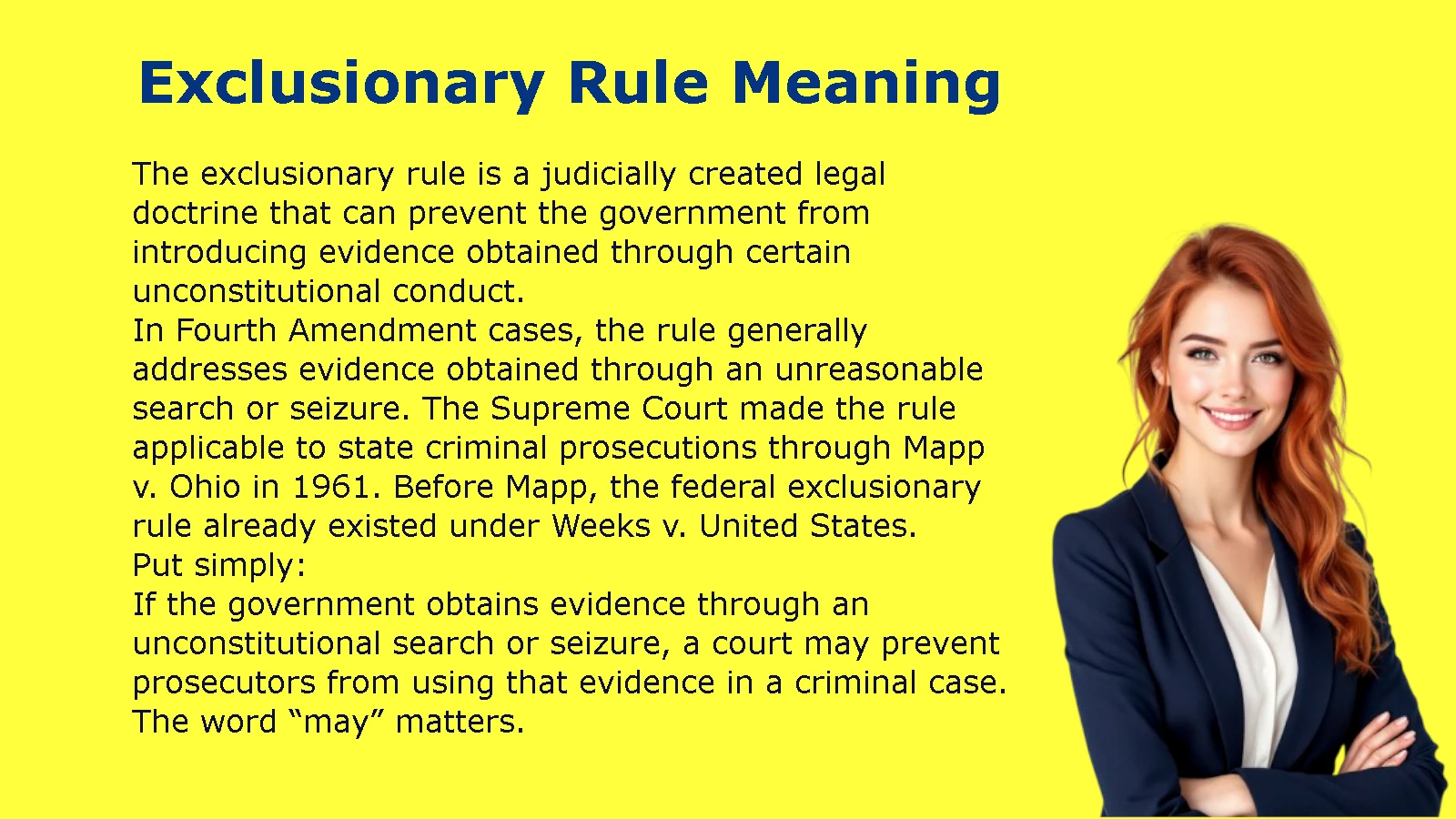
The exclusionary rule is a judicially created legal doctrine that can prevent the government from introducing evidence obtained through certain unconstitutional conduct.
In Fourth Amendment cases, the rule generally addresses evidence obtained through an unreasonable search or seizure. The Supreme Court made the rule applicable to state criminal prosecutions through Mapp v. Ohio in 1961. Before Mapp, the federal exclusionary rule already existed under Weeks v. United States.
Put simply:
If the government obtains evidence through an unconstitutional search or seizure, a court may prevent prosecutors from using that evidence in a criminal case.
The word “may” matters.
The exclusionary rule isn’t absolute. Courts recognize several exceptions and limitations. The question isn’t merely whether an officer made a mistake. Courts also ask whether the defendant’s constitutional rights were violated, whether the challenged evidence resulted from that violation, and whether an exception permits the evidence to remain admissible.
Exclusionary Rule in Simple Terms
Imagine that police suspect someone of possessing illegal drugs.
An officer enters the person’s home without a warrant, consent, or another recognized legal justification. The officer opens a locked cabinet and finds drugs.
The prosecution later wants to introduce those drugs at trial.
The defendant can challenge the search and ask the court to suppress the evidence. If the court determines that the search violated the Fourth Amendment and no exception applies, the drugs may be excluded from the prosecution’s case.
The basic chain looks like this:
Unconstitutional government conduct → challenged evidence → suppression request → court review → possible exclusion
However, the analysis can become more complicated if police had another lawful way to obtain the same evidence.
What Is the Exclusionary Rule Based On?
The exclusionary rule has its strongest connection to the Fourth Amendment.
The Fourth Amendment states:
“The right of the people to be secure in their persons, houses, papers, and effects, against unreasonable searches and seizures, shall not be violated…”
The amendment also establishes requirements for warrants, including probable cause and particular descriptions of the place to be searched and the people or things to be seized.
The Constitution itself does not expressly say, “Evidence obtained in violation of this amendment must be excluded.” The exclusionary rule developed through Supreme Court decisions as a remedy for certain constitutional violations. Modern doctrine emphasizes deterrence: excluding evidence can reduce the incentive for law enforcement to violate constitutional protections.
The Fourth Amendment and the Exclusionary Rule
A Fourth Amendment analysis generally starts with the government conduct.
Was there a search or seizure?
If so, was it reasonable?
If the government conducted a search without a warrant, did an exception to the warrant requirement apply?
For example, a warrantless search can sometimes be lawful when an officer has valid consent, when a search falls within the search incident to lawful arrest doctrine, or when probable cause and exigent circumstances justify immediate action.
So the phrase “warrantless search” does not automatically mean “illegal search.”
That distinction is crucial.
Fifth and Sixth Amendment Connections
The term “exclusionary rule” can also arise outside the Fourth Amendment context.
For example, constitutional protections involving self incrimination and the right to counsel can affect whether certain statements or evidence may be used. Cornell’s Legal Information Institute notes that Miranda v. Arizona established rules concerning improperly elicited self incriminating statements and that Sixth Amendment violations can also produce exclusionary consequences in appropriate circumstances.
Still, the Fourth Amendment remains the central setting in which people encounter the exclusionary rule.
How Does the Exclusionary Rule Work?
A suppression dispute typically follows a sequence like this:
- Police or another government actor obtains evidence.
- The defendant alleges a constitutional violation.
- The defendant challenges the evidence.
- The court determines whether the government violated a protected constitutional right.
- The court examines the connection between the violation and the evidence.
- The court considers whether an exception applies.
- The court decides whether the evidence can be used.
The process is fact specific. Two cases can involve similar police conduct yet produce different outcomes because a warrant, consent, probable cause, an intervening event, or another important fact changes the legal analysis.
What Is a Motion to Suppress?
A motion to suppress is a request asking a court to prevent particular evidence from being used.
For example, a defendant might argue:
- Police searched a home without a valid warrant.
- Officers exceeded the scope of a warrant.
- Police stopped a person without sufficient legal justification.
- Officers obtained physical evidence through an unconstitutional search.
- A statement resulted from a constitutional violation.
A successful suppression motion doesn’t necessarily end the prosecution.
If prosecutors have other admissible evidence, the criminal case can continue. The immediate result is usually that the challenged evidence cannot be used in the way the court has prohibited.
When Does the Exclusionary Rule Apply?
The exclusionary rule can apply when the government obtains evidence through a qualifying constitutional violation.
The classic example involves an unreasonable search or seizure under the Fourth Amendment.
Consider three basic situations.
| Situation | General issue |
| Police unlawfully search a home | Evidence discovered during the search may be challenged |
| Police unlawfully seize a person | Evidence discovered as a result may be challenged |
| Police obtain later evidence because of an earlier illegality | The court may analyze the fruit of the poisonous tree doctrine |
But identifying a constitutional violation is only the beginning.
Courts also examine causation, standing, exceptions, and the purpose of suppression. In modern Fourth Amendment doctrine, exclusion is closely tied to whether suppressing the evidence would meaningfully deter unconstitutional police conduct.
Directly Obtained Evidence
Direct evidence is the easiest scenario to understand.
Suppose an officer conducts an unconstitutional search of a backpack and finds a firearm inside.
The firearm is directly connected to the challenged search.
If the search violated the Fourth Amendment and no exception applies, the defendant has a strong basis for seeking suppression.
The court doesn’t need to trace several layers of evidence. The challenged item came directly from the allegedly unlawful search.
Evidence Derived From an Illegal Search
The situation becomes more complicated when the first constitutional violation leads police to additional evidence.
Suppose police unlawfully enter a home and discover information about a hidden storage unit. Officers then use that information to locate the storage unit and find additional evidence.
The second piece of evidence wasn’t physically inside the home. Yet the first search may have helped police find it.
That is where the fruit of the poisonous tree doctrine becomes important.
What Is the Fruit of the Poisonous Tree Doctrine?
The fruit of the poisonous tree doctrine is a related exclusionary principle concerning evidence derived from unconstitutional government conduct.
The metaphor is simple:
- Poisonous tree: the underlying constitutional violation.
- Fruit: evidence obtained because of that violation.
The Supreme Court has recognized that the exclusionary rule can reach derivative evidence, although exceptions can break the connection between the original illegality and later evidence.
Example of Fruit of the Poisonous Tree
Imagine this sequence:
Illegal search → police discover address → police use address to locate evidence
The defendant could argue that the evidence at the second location is tainted because officers learned about it through the illegal search.
But that doesn’t end the analysis.
Suppose prosecutors can establish that officers already had enough independent information to obtain a valid warrant for that second location. The independent source doctrine may then permit the evidence.
That’s why the “poisonous tree” metaphor is useful, but it shouldn’t be treated as an automatic rule that contaminates every later piece of evidence.
What Are the Exceptions to the Exclusionary Rule?
The exclusionary rule has several important exceptions. These exceptions reflect the Supreme Court’s emphasis on deterrence and the costs of suppressing reliable evidence when exclusion would provide little additional deterrent benefit.
The major doctrines include:
- Good faith
- Independent source
- Inevitable discovery
- Attenuation
- Limited impeachment use
Each works differently.
Good Faith Exception
The good faith exception can allow evidence when officers acted with objectively reasonable reliance on legal authority that later turns out to be defective.
A common example involves a search warrant.
If officers reasonably rely on a warrant that a judge issued, but the warrant later turns out to have a legal problem, suppression isn’t necessarily required.
The rationale is practical: if officers reasonably followed the law as they understood it, excluding the evidence may do little to deter future misconduct.
The Supreme Court has also applied the good faith rationale when police reasonably relied on binding appellate precedent that was later overturned.
In Davis v. United States (2011), the Court held that when police conduct a search in objectively reasonable reliance on binding appellate precedent, the exclusionary rule does not apply.
The doctrine therefore asks more than whether the search was ultimately unconstitutional.
It also asks whether exclusion would meaningfully deter police misconduct under the circumstances.
Independent Source Exception
The independent source doctrine applies when the government obtains evidence through a genuinely independent lawful source.
Consider this example:
Police illegally enter an apartment and see evidence inside. However, before entering, investigators already possessed information sufficient to obtain a search warrant. They later obtain the warrant using information independent of the illegal entry and lawfully search the apartment.
The evidence discovered during the valid warrant search may be admissible.
The Supreme Court addressed this principle in Segura v. United States (1984). The Court held that evidence discovered during a valid warrant search did not have to be suppressed merely because officers had previously entered the apartment unlawfully when the warrant and supporting information were independent of that entry.
The key question is:
Did the lawful source actually operate independently of the constitutional violation?
If yes, exclusion can lose its deterrent justification.
Inevitable Discovery Exception
The inevitable discovery doctrine applies when prosecutors can establish that the evidence would ultimately have been discovered through lawful means even without the constitutional violation.
The leading case is Nix v. Williams (1984).
In that case, police obtained information that led them to the location of a missing child’s body through unconstitutional questioning. At the same time, a large search party was already systematically searching the area. The Supreme Court concluded that the body would inevitably have been discovered through lawful activity and therefore allowed the physical evidence concerning the body to be admitted.
The doctrine doesn’t mean prosecutors can simply say, “We probably would have found it.”
The government must establish the factual basis for inevitable lawful discovery. In Nix, the existing search effort provided concrete evidence supporting that conclusion.
Attenuation Exception
The attenuation doctrine applies when the connection between unconstitutional conduct and the evidence becomes sufficiently weak or is interrupted by an intervening circumstance.
The Supreme Court’s decision in Utah v. Strieff (2016) provides a well known example.
Police illegally stopped Edward Strieff. During the encounter, an officer discovered that Strieff had an outstanding arrest warrant. The officer arrested him and found drugs and drug paraphernalia during the search incident to arrest.
The Supreme Court held that the evidence was admissible because the valid, preexisting arrest warrant served as an intervening circumstance that sufficiently attenuated the connection between the unlawful stop and the evidence.
The Court’s analysis involved factors developed in Brown v. Illinois, including:
- Temporal proximity
- Intervening circumstances
- The purpose and flagrancy of the official misconduct
The first factor can favor suppression when the evidence follows the unconstitutional act almost immediately. An intervening lawful event can point in the opposite direction.
Impeachment Exception
Excluded evidence can sometimes be used for a limited purpose: impeaching the defendant’s testimony.
That doesn’t mean prosecutors can simply introduce illegally obtained evidence as proof of guilt.
Instead, the Supreme Court has recognized circumstances in which such evidence can be used to challenge the credibility of a defendant who testifies. Cornell’s Legal Information Institute identifies Harris v. New York as an important authority for this principle.
The distinction matters:
Use as direct proof of guilt ≠ limited use to challenge credibility.
When Does the Exclusionary Rule Not Apply?
A constitutional violation doesn’t automatically mean that every piece of evidence connected to the incident must disappear from the case.
Several limits are important.
Not Every Warrantless Search Is Illegal
The Fourth Amendment prohibits unreasonable searches and seizures. It doesn’t require a warrant for every government search.
Recognized exceptions can permit certain warrantless searches, including searches based on consent, some searches incident to lawful arrest, and certain exigent circumstances.
Not Every Police Error Leads to Suppression
Suppression focuses on constitutional protections and the purposes served by exclusion.
Modern Supreme Court doctrine treats deterrence as central to the Fourth Amendment exclusionary rule. If suppression would not meaningfully deter police misconduct, courts may decline to apply the remedy.
The Defendant Must Have a Constitutional Interest at Stake
A person generally cannot challenge a search merely because police found evidence that incriminates that person.
The Fourth Amendment protects people against unreasonable searches and seizures of interests protected by the amendment. The defendant must have the appropriate connection to the place or property searched.
In other words, you usually can’t challenge someone else’s privacy violation simply because the evidence hurts your case.
The Rule Is Primarily a Criminal Procedure Remedy
The exclusionary rule is strongly associated with criminal proceedings. It does not operate identically across every type of government proceeding.
Cornell’s Legal Information Institute notes that the Fourth Amendment exclusionary remedy does not apply in several settings outside ordinary criminal trials, including certain civil proceedings.
That limitation is easy to miss when the rule gets summarized as “illegal evidence is inadmissible.”
The real rule is much more precise.
Why Does the Exclusionary Rule Exist?
The central modern justification is deterrence.
The logic works like this:
- The Constitution limits government power.
- Police have incentives to gather evidence efficiently.
- If unconstitutional searches always produced usable evidence, constitutional limits could become less effective.
- Suppression removes some of the benefit of unconstitutional conduct.
- That consequence can discourage future violations.
The Supreme Court has repeatedly described deterrence as a principal purpose of the exclusionary rule. In Segura v. United States, the Court emphasized the rule’s role in deterring Fourth Amendment violations.
At the same time, suppression has a cost.
If reliable evidence is excluded, a prosecution may become harder even when the defendant actually committed the offense. Courts therefore balance the expected deterrent benefit against the costs of excluding evidence.
This explains why the modern rule contains exceptions.
The Basic Policy Tension
| Concern | Argument |
| Constitutional rights | Government officials should not benefit from unconstitutional conduct |
| Deterrence | Exclusion can discourage future violations |
| Reliable evidence | Courts generally have an interest in considering relevant evidence |
| Public safety | Suppression can sometimes prevent prosecutors from using important evidence |
| Judicial efficiency | Courts may avoid exclusion when it provides little deterrent benefit |
The doctrine lives in that tension.
It’s not simply “protect rights at any cost,” nor is it “admit all reliable evidence.”
Key Supreme Court Cases on the Exclusionary Rule
Several Supreme Court decisions form the backbone of modern exclusionary rule doctrine.
| Case | Year | Main significance |
| Weeks v. United States | 1914 | Established the federal exclusionary rule for evidence obtained through an unlawful search. |
| Silverthorne Lumber Co. v. United States | 1920 | Helped establish the principle behind derivative evidence and the poisonous tree doctrine. |
| Wong Sun v. United States | 1963 | Developed important principles concerning evidence derived from unlawful government conduct. |
| Mapp v. Ohio | 1961 | Applied the Fourth Amendment exclusionary rule to state criminal prosecutions. |
| United States v. Leon | 1984 | Recognized the good faith exception for officers’ reasonable reliance on a search warrant. |
| Segura v. United States | 1984 | Applied the independent source doctrine. |
| Nix v. Williams | 1984 | Recognized the inevitable discovery exception. |
| Davis v. United States | 2011 | Applied the good faith exception where police reasonably relied on binding precedent. |
| Utah v. Strieff | 2016 | Applied attenuation after discovery of a valid, preexisting arrest warrant following an unlawful stop. |
The history stretches back further than Weeks. The U.S. Constitution Annotated traces early exclusionary principles to Boyd v. United States in 1886, while Weeks supplied the landmark federal rule in 1914. Mapp later extended the rule to the states.
Weeks v. United States
Weeks v. United States, 232 U.S. 383 (1914), is a foundational case.
Federal officers searched Weeks’s home without a proper warrant and seized papers that prosecutors used against him. The Supreme Court held that the federal government could not use evidence obtained through the unconstitutional search.
The decision established the federal exclusionary rule for Fourth Amendment violations.
Mapp v. Ohio
Mapp v. Ohio, 367 U.S. 643 (1961), transformed the doctrine by applying the exclusionary rule to state criminal prosecutions.
The case involved a police search of Dollree Mapp’s home. Officers believed they were looking for a bombing suspect. During the search, they found obscene materials and prosecuted Mapp under Ohio law. The Supreme Court held that evidence obtained through an unconstitutional search could not be used in a state criminal prosecution.
That decision made the exclusionary rule a nationwide feature of Fourth Amendment criminal procedure.
United States v. Leon
United States v. Leon, 468 U.S. 897 (1984), is the leading good faith case involving reliance on a search warrant.
The Court recognized that suppression isn’t necessarily appropriate when officers reasonably rely on a warrant later found to be invalid.
The decision reflects the deterrence based nature of modern exclusionary doctrine: if the officers acted reasonably, suppression may provide little additional incentive to improve police behavior.
Segura v. United States
Segura v. United States, 468 U.S. 796 (1984), illustrates the independent source exception.
The police had information about suspected drug trafficking before entering the defendants’ apartment. They later obtained a valid warrant based on information independent of the initial entry.
The Supreme Court held that evidence discovered through the valid warrant search did not have to be excluded merely because of the earlier entry.
Nix v. Williams
Nix v. Williams, 467 U.S. 431 (1984), established the inevitable discovery exception.
The Court concluded that the victim’s body would have been found through an ongoing lawful search even without the constitutional violation. The evidence therefore did not have to be suppressed.
Utah v. Strieff
Utah v. Strieff, 579 U.S. 232 (2016), is one of the most discussed modern attenuation cases.
The Court held that a valid, preexisting arrest warrant sufficiently weakened the connection between an unlawful stop and evidence discovered during the subsequent lawful arrest.
The decision remains important because it demonstrates how an intervening circumstance can affect the exclusionary analysis.
Exclusionary Rule Example
Consider this hypothetical case.
Case Study: The Unlawful Home Search
Police receive an unverified tip claiming that Alex has illegal drugs inside an apartment.
An officer goes to Alex’s home. Alex doesn’t consent to a search. The officer doesn’t have a warrant and doesn’t identify an exigent circumstance.
The officer enters anyway and opens a bedroom drawer. Inside, the officer finds illegal drugs.
Prosecutors charge Alex and want to introduce the drugs at trial.
Alex files a motion to suppress.
Step One: Was There Government Conduct?
Yes.
A police officer entered the home and searched a private drawer.
Step Two: Was the Search Reasonable?
The facts provide no warrant, consent, or apparent exception.
That raises a serious Fourth Amendment issue.
Step Three: Is the Evidence Connected to the Search?
Yes.
The drugs came directly from the challenged search.
Step Four: Does an Exception Apply?
That becomes the next question.
This example shows why saying “the evidence was obtained illegally, so it must be excluded” is too simplistic.
Exclusionary Rule vs. Suppression
These terms often appear together, but they aren’t identical.
| Term | Meaning |
| Exclusionary rule | The doctrine that can prevent the government from using certain improperly obtained evidence |
| Suppression | The court’s exclusion or restriction of challenged evidence |
| Motion to suppress | A defendant’s request asking the court to suppress evidence |
Think of it this way:
The exclusionary rule is the legal doctrine.
Suppression is the remedy applied by the court.
A motion to suppress is the request asking the court to apply that remedy.
Exclusionary Rule vs. Fruit of the Poisonous Tree
These concepts overlap, but they aren’t interchangeable.
| Exclusionary Rule | Fruit of the Poisonous Tree |
| Broad doctrine governing exclusion of certain improperly obtained evidence | Derivative doctrine concerning evidence connected to an underlying illegality |
| Can apply to evidence directly obtained through unconstitutional conduct | Focuses on later evidence derived from that conduct |
| Often begins with the original constitutional violation | Asks whether the violation tainted later evidence |
| Subject to exceptions | Also subject to doctrines such as independent source, inevitable discovery, and attenuation |
For example, police illegally search a house and find a notebook. The notebook is the direct evidence.
If the notebook gives police an address they didn’t previously know, and officers use that information to find another item, the second item may raise a fruit of the poisonous tree question.
But if police already knew the second address independently, the independent source doctrine could break the connection. Segura illustrates this principle.
Common Misunderstandings About the Exclusionary Rule
Does Illegal Evidence Automatically Get Thrown Out?
No.
First, the defendant must establish the relevant constitutional basis for exclusion. Then the court considers whether the evidence is sufficiently connected to the violation and whether an exception applies.
Good faith, independent source, inevitable discovery, and attenuation can all affect the result.
Does the Exclusionary Rule Dismiss a Criminal Case?
No, not automatically.
Suppression usually concerns particular evidence.
A prosecution can continue if the government has enough admissible evidence without the suppressed material.
Does the Exclusionary Rule Punish Police Officers?
Not directly.
The modern Supreme Court approach treats deterrence as the central purpose of Fourth Amendment exclusion. The rule aims to discourage unconstitutional government conduct by removing the benefit of using certain improperly obtained evidence.
Separate disciplinary, administrative, or civil consequences can exist depending on the circumstances.
Does Every Constitutional Violation Trigger the Exclusionary Rule?
No.
Different constitutional rights have different remedies. Even when a constitutional violation occurs, courts may determine that exclusion isn’t the appropriate remedy under the circumstances.
Does a Warrantless Search Always Violate the Fourth Amendment?
No.
The Fourth Amendment protects against unreasonable searches and seizures. Certain warrantless searches are lawful under recognized exceptions.
Can Excluded Evidence Ever Be Used?
Sometimes.
For example, illegally obtained evidence may be available for a limited impeachment purpose when the legal requirements for that use are satisfied. That doesn’t mean prosecutors can freely use the evidence as direct proof of guilt.
Frequently Asked Questions About the Exclusionary Rule
What is the exclusionary rule in simple terms?
The exclusionary rule generally prevents the government from using certain evidence obtained through unconstitutional conduct in a criminal proceeding. The doctrine most commonly arises from Fourth Amendment violations involving unreasonable searches and seizures.
What is an example of the exclusionary rule?
If police conduct an unconstitutional search of a person’s home and discover evidence during that search, the defendant can ask the court to suppress the evidence. If the court finds a Fourth Amendment violation and no exception applies, the evidence may be excluded.
What is the main purpose of the exclusionary rule?
Its main purpose is deterrence. The rule is designed to discourage government officials from violating constitutional protections by removing the benefit of using certain improperly obtained evidence.
What are the main exceptions to the exclusionary rule?
Important exceptions and limitations include:
- Good faith
- Independent source
- Inevitable discovery
- Attenuation
- Limited impeachment use
Each exception has its own requirements.
What is the difference between the exclusionary rule and fruit of the poisonous tree?
The exclusionary rule can prevent the government from using evidence obtained through certain constitutional violations. The fruit of the poisonous tree doctrine extends the analysis to certain derivative evidence obtained because of the original illegality.
Does the exclusionary rule apply to state courts?
Yes. Mapp v. Ohio held in 1961 that the Fourth Amendment exclusionary rule applies to state criminal prosecutions.
Is the exclusionary rule itself a constitutional right?
Modern doctrine describes the exclusionary rule as a court created remedy and deterrent, rather than an independent constitutional right. Its rationale is closely tied to constitutional protections, particularly the Fourth Amendment.
What happens when police discover evidence through an illegal search but later obtain a valid warrant?
The answer depends on how the warrant was obtained.
If the warrant rests on information genuinely independent of the illegal search, the independent source doctrine may allow the evidence. Segura v. United States provides a leading example.
What happens when police would have found the evidence anyway?
The inevitable discovery doctrine may permit the evidence if the government establishes that lawful investigative activity would have led to the same evidence. Nix v. Williams is the leading Supreme Court authority.
Exclusionary Rule Meaning: Quick Summary
The exclusionary rule meaning can be reduced to one central idea:
The government generally cannot use certain evidence obtained through unconstitutional conduct in a criminal case.
But the complete doctrine requires more precision.
The rule:
- Primarily arises in Fourth Amendment search and seizure cases.
- Developed through Supreme Court decisions rather than appearing as an express sentence in the Constitution.
- Serves a major deterrence function.
- Can apply to derivative evidence through the fruit of the poisonous tree doctrine.
- Is subject to important exceptions.
- Does not mean every constitutional violation automatically results in exclusion.
- Does not automatically dismiss a criminal case.
- Does not make every warrantless search unconstitutional.
- Can sometimes permit limited use of otherwise excluded evidence for impeachment.
The historical development is equally important. Weeks v. United States established the federal exclusionary rule in 1914, while Mapp v. Ohio extended the Fourth Amendment exclusionary rule to state criminal prosecutions in 1961. Later decisions such as United States v. Leon, Segura v. United States, Nix v. Williams, Davis v. United States, and Utah v. Strieff shaped the exceptions and limitations that define modern doctrine.
In practice, the most important question isn’t simply “Was the evidence obtained illegally?”
It’s more precise:
Did the government violate a constitutional protection, is the challenged evidence sufficiently connected to that violation, and would exclusion serve the purpose of the exclusionary rule under the circumstances?