Excercise vs Exercise is a common English spelling question, but only one form is correct: exercise. The spelling excercise is incorrect because it contains an extra C. Whether you mean physical activity, a school assignment, professional practice, or mental training, the correct spelling always follows the same pattern: E-X-E-R-C-I-S-E.
Understanding the difference between excercise or exercise also helps you avoid common spelling mistakes in everyday writing. This guide explains the correct spelling, word meaning, pronunciation, British and American usage, grammatical forms, and the difference between exercise and exorcise. You’ll also find practical examples, spelling tricks, and the Spanish translation.
Quick Answer: Excercise vs Exercise
| Question | Answer |
| Is it excercise or exercise? | Exercise is correct. |
| What does exercise mean? | Physical activity, practice, or a task designed to develop a skill. |
| Is excercise a real word? | No. It is a common misspelling of exercise. |
| Is exercise spelled differently in the UK? | No. British and American English use exercise. |
| What is the difference between exercise and exorcise? | Exercise means physical activity or practice; exorcise means to drive out an evil spirit or figuratively remove something troubling. |
Excercise or Exercise: Which Spelling Is Correct?
Exercise is the correct spelling in standard English. Excercise is a misspelling that adds an unnecessary C after the first E. Use exercise when writing about physical activity, practicing a skill, completing a school task, or using a particular right or responsibility.
The correct spelling contains nine letters:
Correct
Exercise
E-X-E-R-C-I-S-E
Incorrect
Excercise
E-X-C-E-R-C-I-S-E
Remember: Exercise contains one C, not two.
For example:
- Correct: I get enough exercise every morning.
- Incorrect: I get enough excercise every morning.
The mistake often happens because people remember the sound of the word rather than its exact letter sequence. However, pronunciation cannot always tell you how to spell an English word.
Is Excercise a Real Word?
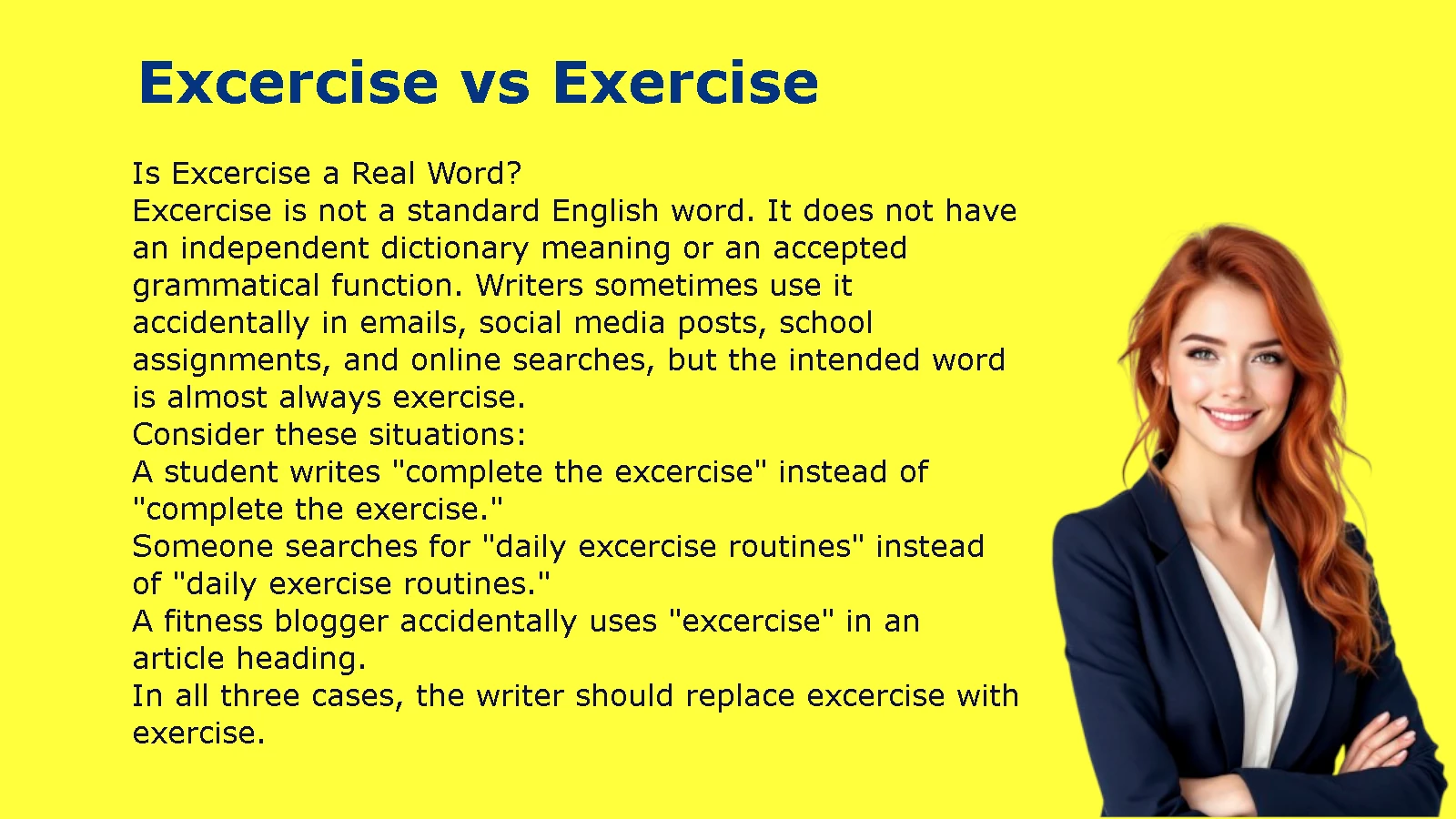
Excercise is not a standard English word. It does not have an independent dictionary meaning or an accepted grammatical function. Writers sometimes use it accidentally in emails, social media posts, school assignments, and online searches, but the intended word is almost always exercise.
Consider these situations:
- A student writes “complete the excercise” instead of “complete the exercise.”
- Someone searches for “daily excercise routines” instead of “daily exercise routines.”
- A fitness blogger accidentally uses “excercise” in an article heading.
In all three cases, the writer should replace excercise with exercise.
Search engines may understand the intended meaning of a misspelled search query and display results for the correct word. That does not make the incorrect spelling acceptable.
Why Do People Spell Exercise as Excercise?
People commonly misspell exercise because its letter sequence is not immediately obvious from its pronunciation. The combination of sounds around the middle of the word can make writers add an extra C.
Several factors contribute to this mistake:
- Sound confusion: The spoken word does not clearly highlight where each letter belongs.
- Visual confusion: Writers may remember the general appearance of the word but forget its exact spelling.
- Typing mistakes: Fast typing can introduce an unnecessary letter.
- Limited spelling practice: People who rarely write the word may struggle to remember its letter order.
- Incorrect word association: Familiar spelling patterns in other English words can influence how someone writes exercise.
A useful way to prevent this error is to memorize the word as two parts: EXER and CISE.
Write it slowly a few times, then use it in original sentences. This method builds visual familiarity and makes the correct spelling easier to recall.
Excercise vs Exercise: Meaning and Difference
Exercise is a correctly spelled English word with several meanings, while excercise is simply an incorrect spelling of that word. Exercise can describe physical movement, repeated practice, an educational task, or the use of a power or right. The two spellings have no separate standard meanings.
The difference is straightforward:
| Comparison | Excercise | Exercise |
| Correct spelling | No | Yes |
| Standard English word | No | Yes |
| Dictionary definition | No independent standard definition | Multiple accepted meanings |
| Grammatical role | None | Noun and verb |
| Sentence usage | Incorrect | Correct |
| Recommended form | Avoid | Use |
The important point is that you should not treat excercise as an alternative spelling. It is not a British spelling, an American spelling, or an informal variation.
What Does Exercise Mean?
Exercise means physical activity, practice, or an activity designed to improve a particular ability. It functions as both a noun and a verb. Its precise meaning depends on the context in which you use it.
The word has several common meanings.
As a noun:
- Physical activity that improves health and fitness.
- A task that helps someone practice a skill.
- A mental activity that develops thinking or memory.
- The use of a power, right, or responsibility.
Examples:
- Walking is an effective form of exercise.
- The teacher assigned a grammar exercise.
- Solving puzzles provides mental exercise.
- The exercise of authority requires responsibility.
As a verb:
- To participate in physical activity.
- To practice or develop a particular ability.
- To use a right, power, or responsibility.
Examples:
- I exercise before breakfast.
- Students exercise their problem-solving skills.
- Citizens exercise their right to vote.
Notice how the same word works in different situations. Its spelling remains unchanged regardless of its meaning.
Excercise vs Exercise: Spelling Comparison
The most important difference is the extra C in the incorrect form.
Look at the letter sequence:
| Position | Correct spelling |
| First letter | E |
| Second letter | X |
| Third letter | E |
| Fourth letter | R |
| Fifth letter | C |
| Sixth letter | I |
| Seventh letter | S |
| Eighth letter | E |
The correct spelling has eight letters, not nine.
This distinction matters in professional and academic writing. A spelling error in a school assignment, business proposal, fitness article, or formal email can make otherwise good writing appear less polished.
For example:
- Incorrect: The exercise program includes daily excercise.
- Correct: The exercise program includes daily exercise.
A simple spelling check can prevent this mistake.
Excercise or Exercise Examples in Sentences
The easiest way to understand the correct spelling is to see exercise used in different sentences. These examples show how the word works in fitness, education, professional communication, and everyday conversations. Remember that excercise is incorrect in every one of these contexts.
Correct Exercise Examples
Here are 10 original sentences using the correct spelling:
- Regular exercise helps people maintain good physical health.
- My doctor recommended daily exercise to improve my fitness.
- The students completed the grammar exercise before lunch.
- Walking is a simple form of exercise that requires no special equipment.
- She enjoys doing yoga as part of her morning exercise routine.
- The trainer designed a new exercise program for beginners.
- Reading challenging books provides excellent mental exercise.
- Employees participated in a workplace safety exercise.
- You should exercise caution when sharing personal information online.
- He exercises three times a week to improve his strength and endurance.
These examples demonstrate that exercise does not refer exclusively to physical fitness. It can also describe practice, training, and the use of judgment.
Incorrect Excercise Examples
The following sentences contain the common spelling mistake. Each example shows how to correct it.
| Incorrect sentence | Correct sentence |
| I need more excercise. | I need more exercise. |
| She enjoys daily excercise. | She enjoys daily exercise. |
| We completed the excercise. | We completed the exercise. |
| Regular excercise improves fitness. | Regular exercise improves fitness. |
| He started an excercise program. | He started an exercise program. |
| The teacher gave us an excercise. | The teacher gave us an exercise. |
| Physical excercise keeps you active. | Physical exercise keeps you active. |
Writing tip: When you proofread a document, search for “excercise” using your word processor’s Find feature. You can locate and correct every occurrence without reading the entire document again.
Exercise as a Noun vs Exercise as a Verb
Exercise can function as both a noun and a verb. Understanding this grammatical difference helps you use the word naturally in different sentence structures.
| Grammatical form | Meaning | Example |
| Noun | Physical activity | Exercise improves my energy levels. |
| Noun | A practice task | Complete the exercise on page 12. |
| Verb | To perform physical activity | I exercise every morning. |
| Verb | To use a right or power | Citizens exercise their legal rights. |
The word also has several related forms:
| Word form | Part of speech | Example |
| Exercise | Noun/verb | I exercise regularly. |
| Exercises | Plural noun/verb | She exercises every day. |
| Exercised | Past-tense verb | He exercised yesterday. |
| Exercising | Present participle/gerund | Exercising helps me relax. |
| Exercisable | Adjective | The option is exercisable under the agreement. |
Notice that none of these forms uses the incorrect spelling excercise.
How to Spell Exercise Correctly
The correct spelling of exercise is E-X-E-R-C-I-S-E. It contains eight letters, including one C and one S. Remembering the letter sequence helps you avoid adding an extra C or changing the order of the middle letters.
Try breaking the word into smaller parts:
- EXER
- CISE
Put the parts together:
EXER + CISE = EXERCISE
This approach makes the word easier to remember because you can focus on two shorter letter groups rather than memorizing the entire sequence at once.
Exercise Spelling Trick
A simple memory trick is to remember the phrase “One C, one S in exercise.”
The word contains:
- One E at the beginning.
- One X after the first E.
- Another E before R.
- One C in the middle.
- One S near the end.
You can reinforce this spelling with a short practice routine.
A simple three-step method:
- Write exercise five times while looking at the correct spelling.
- Cover the word and try writing it from memory.
- Use it in three original sentences.
For example:
- Exercise is important for good health.
- I exercise after finishing work.
- The teacher prepared an exercise for the class.
This technique combines visual recognition, active recall, and practical usage. It works better than repeatedly reading the same word without testing yourself.
Common Misspellings of Exercise
Excercise is not the only spelling mistake people make. Other incorrect variations include:
| Common misspelling | Correct spelling |
| Excercise | Exercise |
| Excersize | Exercise |
| Exersize | Exercise |
| Excersise | Exercise |
| Excerise | Exercise |
These errors usually involve adding, removing, or rearranging letters.
For example, some writers replace the C with an S or Z because they associate the word with similar English spelling patterns. However, exercise keeps the same spelling in standard English regardless of the writer’s location.
Remember: The correct form is always exercise. You should not use excercise, excersize, or exersize in formal or informal writing.
How to Pronounce Exercise
The word exercise is commonly pronounced with three syllables. In American English, a standard pronunciation is /ˈek.sɚ.saɪz/. In British English, a common pronunciation is /ˈek.sə.saɪz/. The first syllable receives the main stress, and the final sound resembles “size.”
Exercise pronunciation
/ˈek.sɚ.saɪz/
Common American English IPA
- Syllables: Three
- Stress: First syllable
- Ending sound: Similar to “size”
- Word type: Noun and verb
The pronunciation can confuse learners because the spoken sounds do not reveal every letter in the written word. This explains why some people accidentally write excercise.
Exercise Pronunciation in American English
American English speakers commonly pronounce exercise with three syllables and stress on the first syllable.
The middle vowel often sounds like a reduced vowel, while the final syllable contains the sound /saɪz/.
A useful way to practice is to:
- Say the first syllable clearly.
- Keep the middle syllable short.
- Finish with the familiar sound found in the word “size.”
- Avoid adding another syllable.
Try using the word in a complete sentence:
“I exercise before going to work.”
Practicing it in context helps you develop a natural rhythm instead of concentrating only on individual sounds.
Exercise Pronunciation in British English
British English speakers also pronounce exercise with three syllables and stress on the first syllable.
A common British IPA transcription is /ˈek.sə.saɪz/.
The main difference is the quality of the vowel in the middle syllable. Some British accents use a shorter or more centralized vowel than common American pronunciations.
However, the spelling does not change.
Both varieties use:
- Exercise
- Exercises
- Exercised
- Exercising
You can therefore use the same written form in British and American English without worrying about regional spelling differences.
Is Exercise Spelled Differently in British and American English?
No. Exercise has the same spelling in British and American English. Unlike words such as colour and color or organise and organize, exercise does not have separate regional spelling variations. Both British and American writers use the eight-letter form E-X-E-R-C-I-S-E.
This is useful for international communication because you do not need to change the spelling when writing for different English-speaking audiences.
| English variety | Correct spelling |
| American English | Exercise |
| British English | Exercise |
| Australian English | Exercise |
| Canadian English | Exercise |
| New Zealand English | Exercise |
Although regional spelling differences exist in English, exercise is not one of them.
Exercise Spelling UK: Is Exercise Correct in British English?
Yes. Exercise is the correct UK spelling. British writers use the same spelling as American writers when discussing physical activity, school assignments, training, or the use of a right or responsibility.
For example:
- I enjoy taking exercise in the morning.
- The children completed their English exercise.
- Regular exercise can support a healthy lifestyle.
- The instructor demonstrated a new exercise routine.
A British writer should not use excercise as an alternative spelling. The extra C is incorrect regardless of the English variety.
Useful comparison:
- British English: Exercise
- American English: Exercise
- Incorrect in both: Excercise
If you are creating content for an international audience, you can confidently use exercise throughout the article.
Exercise vs Exorcise: What’s the Difference?
Exercise and exorcise are two different English words with different meanings. Exorcise means to drive out an evil spirit or, figuratively, remove something troubling. Both are correctly spelled, but they are not interchangeable.
Their similar appearance can confuse readers, especially English learners.
| Feature | Exercise | Exorcise |
| Part of speech | Noun and verb | Verb |
| Main meaning | Physical activity or practice | Drive out an evil spirit |
| Common context | Fitness, education, training | Religious or figurative writing |
| Example | I exercise every day. | They tried to exorcise the spirit. |
| Spelling | Exercise | Exorcise |
The main difference is the position of the letters C and I and the meaning of the complete word.
What Does Exercise Mean?
Exercise has several established meanings in everyday English.
As a noun, it can refer to:
- Physical movement that supports fitness.
- A school or training task.
- Mental practice.
- The use of authority or responsibility.
As a verb, it can describe performing physical activity or using a particular right, skill, or power.
Examples:
- Regular exercise supports physical fitness.
- The students finished their mathematics exercise.
- She exercises her right to vote.
- The athlete exercises every afternoon.
In each sentence, exercise describes activity, practice, or the use of something.
What Does Exorcise Mean?
Exorcise means to attempt to remove an evil spirit from a person or place. The word traditionally appears in religious and supernatural contexts, but writers also use it figuratively to describe getting rid of an unpleasant memory, fear, or troubling feeling.
For example:
- The priest performed a ritual to exorcise the spirit.
- She tried to exorcise the painful memories of her past.
- The author used writing to exorcise his fears.
The figurative meaning is especially useful in literature and creative writing.
Consider the difference:
- Exercise your body to improve fitness.
- Exorcise a spirit to remove its supposed supernatural influence.
These expressions have completely different meanings even though their spellings look similar.
Exercise vs Exorcise Examples
The following examples show how to use both words correctly.
| Exercise example | Exorcise example |
| I exercise to stay healthy. | They attempted to exorcise the spirit. |
| The teacher assigned an exercise. | The ritual was intended to exorcise evil. |
| You should exercise caution. | She wanted to exorcise her fears. |
| The team completed a training exercise. | The story describes an attempt to exorcise a demon. |
One particularly useful distinction involves the phrase “exercise caution.”
This expression means to act carefully or avoid unnecessary risks. It does not mean to remove fear or evil.
For example:
“Drivers should exercise caution during heavy rain.”
Here, exercise means to use or demonstrate care.
How Do You Spell Exercise in Spanish?
The Spanish word for exercise is ejercicio when used as a noun. If you want to express the action of exercising or doing physical activity, the common Spanish phrase is hacer ejercicio. The English spelling exercise and the Spanish word ejercicio are different.
Here is a quick comparison:
| English | Spanish |
| Exercise | Ejercicio |
| Physical exercise | Ejercicio físico |
| To exercise | Hacer ejercicio |
| Daily exercise | Ejercicio diario |
| Exercise routine | Rutina de ejercicio |
Spanish uses ejercicio for physical activity, training, and certain practice tasks.
Exercise in Spanish Examples
Here are some practical translations:
| English sentence | Spanish translation |
| I exercise every day. | Hago ejercicio todos los días. |
| Exercise is good for your health. | El ejercicio es bueno para la salud. |
| Physical exercise improves fitness. | El ejercicio físico mejora la condición física. |
| She likes exercise. | A ella le gusta hacer ejercicio. |
| Daily exercise is important. | El ejercicio diario es importante. |
Grammar tip: Ejercicio is a masculine Spanish noun, so it commonly appears with the masculine article el, as in el ejercicio.
If you are writing in English, use exercise. When translating the word into Spanish, use ejercicio according to the sentence’s meaning.
Different Types and Meanings of Exercise
Exercise has a broader meaning than physical activity. It can describe activities that develop physical strength, improve mental abilities, reinforce academic knowledge, or prepare people for professional responsibilities. Understanding these different contexts helps you use the word accurately.
Physical Exercise
Physical exercise involves planned body movements that support fitness, strength, flexibility, or endurance.
Common types include:
Aerobic exercise
Aerobic exercise increases your heart rate and breathing. It helps improve cardiovascular endurance.
Examples include:
- Walking
- Running
- Swimming
- Cycling
- Dancing
Strength training
Strength training uses resistance to develop muscular strength and endurance.
Examples include:
- Weightlifting
- Push-ups
- Squats
- Resistance-band workouts
- Bodyweight training
Flexibility exercises
These activities help maintain or improve the range of motion in your joints and muscles.
Examples include:
- Stretching
- Yoga
- Mobility exercises
Balance exercises
Balance training develops stability and coordination.
Examples include:
- Standing on one leg
- Tai chi
- Controlled heel-to-toe walking
The word exercise works as a general term for all these activities.
Educational Exercise
An educational exercise is a task designed to help students practice knowledge or develop a specific skill.
Teachers use exercises to reinforce lessons and evaluate understanding.
Common examples include:
- Grammar exercises that teach sentence structure and punctuation.
- Mathematics exercises that develop calculation and problem-solving skills.
- Reading exercises that improve comprehension.
- Writing exercises that strengthen communication.
- Vocabulary exercises that expand word knowledge.
For example:
“The teacher gave the students a spelling exercise to help them remember commonly misspelled words.”
In this context, exercise does not mean physical activity. It describes a structured learning task.
Mental and Professional Exercise
Exercise can also describe activities that develop thinking, decision-making, and workplace skills.
Mental exercises help people practice memory, attention, and reasoning.
Examples include:
- Solving puzzles.
- Playing strategy games.
- Practicing mental arithmetic.
- Learning a new language.
- Completing memory challenges.
Professional exercises help employees prepare for workplace situations.
Examples include:
- Emergency evacuation exercises.
- Cybersecurity response exercises.
- Team-building exercises.
- Leadership training exercises.
- Customer-service role-playing activities.
A business might organize an emergency exercise to help employees understand their responsibilities during a fire or other unexpected event.
This broader usage demonstrates why exercise is an important word in education, business, healthcare, and everyday communication.
Quick Tips to Avoid the Excercise Spelling Mistake
The best way to avoid writing excercise is to remember the correct letter sequence and practice using the word in different contexts. You do not need complicated spelling rules. A few simple habits can make the correct form easier to remember.
Here are five practical techniques.
Memorize the letter sequence
Remember E-X-E-R-C-I-S-E. Pay particular attention to the single C in the middle.
Use a spelling association
Remember the phrase “One C, one S.” This simple reminder helps prevent the extra-C mistake.
Practice with original sentences
Write sentences such as:
- Exercise improves my fitness.
- I exercise every morning.
- The teacher assigned an exercise.
Using the word in different grammatical contexts reinforces its spelling.
Use a spell-checking tool
Most modern word processors identify excercise as a spelling error. However, automated tools cannot replace careful proofreading.
Read your writing aloud
Reading aloud can help you identify awkward sentences, but remember that pronunciation alone cannot guarantee correct spelling. Check the written form as well.
A Practical Spelling Check: Exercise or Excercise?
Consider this short editing example.
Original paragraph
“My doctor recommended regular excercise. I started an excercise routine last week, and I hope to excercise every morning.”
Corrected paragraph
“My doctor recommended regular exercise. I started an exercise routine last week, and I hope to exercise every morning.”
Three spelling errors corrected, including the incorrect verb form.
This example highlights an important point: exercise is the correct base spelling for both the noun and verb.
You should also remember the correct related forms:
- Exercise
- Exercises
- Exercised
- Exercising
None requires an extra C.
Frequently Asked Questions About Excercise vs Exercise
Is It Excercise or Exercise?
Exercise is the correct spelling in standard English. Excercise is a common misspelling caused by adding an unnecessary C. Use exercise when referring to physical activity, educational tasks, mental practice, or the use of a right or responsibility.
Why Is Exercise Spelled With One C?
Exercise follows the standard English spelling E-X-E-R-C-I-S-E. It contains one C followed by I-S-E. Adding another C creates the incorrect spelling excercise. Remembering the phrase “One C, one S” can help you avoid this mistake.
Is Excercise Ever Correct in British English?
No. Excercise is incorrect in both British and American English. British writers use exercise, just as American writers do. There is no regional spelling variation that makes excercise acceptable.
What Is the Difference Between Exercise and Exorcise?
Exercise refers to physical activity, practice, or a task designed to develop a skill. Exorcise means to drive out an evil spirit or figuratively remove something troubling. Both words are correctly spelled, but they have different meanings and uses.
How Do You Pronounce Exercise?
Exercise is commonly pronounced with three syllables and stress on the first syllable. Its common American pronunciation is /ˈek.sɚ.saɪz/, while a common British pronunciation is /ˈek.sə.saɪz/. The final syllable sounds similar to “size.”
What Is the Correct Spelling of Exercise in Spanish?
The Spanish noun for exercise is ejercicio. The phrase hacer ejercicio means to exercise or perform physical activity. For example, “I exercise every day” translates to “Hago ejercicio todos los días.”
Conclusion: Exercise Is the Only Correct Spelling
When comparing excercise vs exercise, the answer is simple: exercise is correct, and excercise is incorrect. The mistake happens when writers add an unnecessary C to the middle of the word.
Remember these essential points:
- Exercise contains eight letters.
- Excercise is a common misspelling.
- Exercise functions as both a noun and a verb.
- British and American English use the same spelling.
- Exercise and exorcise have different meanings.
- Ejercicio is the Spanish noun for exercise.
Whether you are writing a fitness article, completing a school assignment, preparing a business email, or improving your English vocabulary, always use exercise.
Ready to improve your spelling? Practice the word in your own sentences, review commonly confused English words, and proofread your writing before publishing or submitting it.













