Distributer vs Distributor: The correct spelling in standard English is distributor, not distributer. Both American and British English use distributor when referring to a person, company, or organization that supplies products to retailers, businesses, or customers. Although distributer may look reasonable because of the verb distribute, it is generally considered a spelling mistake.
The word distributor has several uses beyond business. It describes companies that move products through a supply chain, such as coffee distributors and electronics distributors. It also refers to an automotive component called an ignition distributor, which directs electrical current to spark plugs in certain engines. Understanding these meanings makes it easier to use the word accurately in professional, technical, and everyday writing.
| Question | Answer |
| Is it distributer or distributor? | Distributor is the correct standard spelling. |
| Is distributer correct in British English? | No. British English also uses distributor. |
| What does distributor mean? | A person or company that supplies products to retailers, businesses, or customers. |
| What is the difference between a distributor and a supplier? | A distributor typically purchases and resells products, while a supplier provides goods or services. |
| How do you pronounce distributor? | dih-STRIB-yuh-ter, with the main stress on the second syllable. |
Distributer vs Distributor: Which Spelling Is Correct?
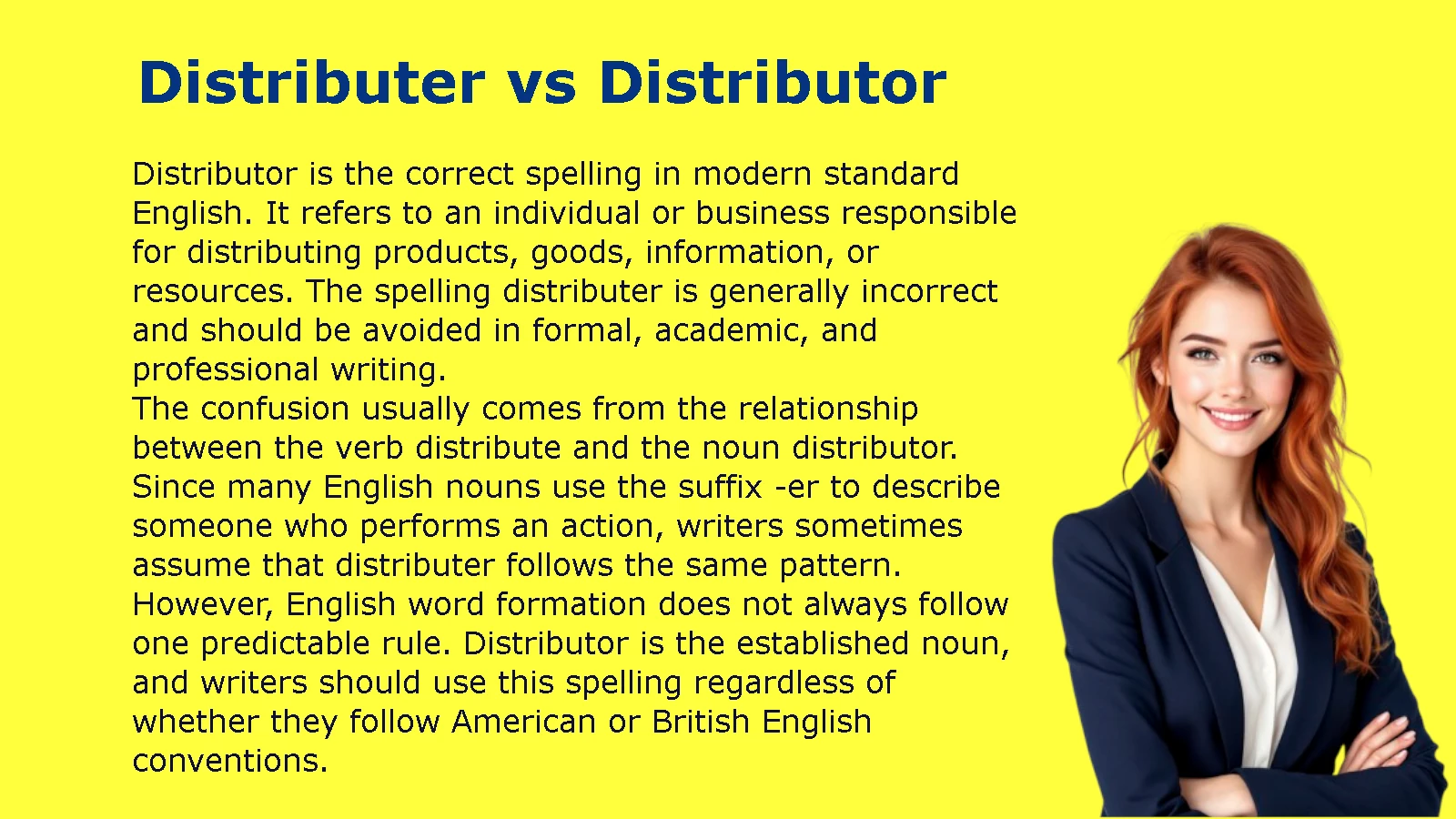
Distributor is the correct spelling in modern standard English. It refers to an individual or business responsible for distributing products, goods, information, or resources. The spelling distributer is generally incorrect and should be avoided in formal, academic, and professional writing.
The confusion usually comes from the relationship between the verb distribute and the noun distributor. Since many English nouns use the suffix -er to describe someone who performs an action, writers sometimes assume that distributer follows the same pattern.
However, English word formation does not always follow one predictable rule. Distributor is the established noun, and writers should use this spelling regardless of whether they follow American or British English conventions.
Why Is Distributor the Correct Spelling?
The word distributor comes from the verb distribute, which means to deliver, divide, or supply something among different people or places.
A distributor is someone or something that performs this action.
The standard spelling follows the established word formation:
- Distribute: The action of supplying or delivering something.
- Distributor: A person, company, or device that distributes something.
- Distribution: The process or activity of distributing something.
- Distributive: An adjective relating to distribution or the act of distributing.
The suffix -or appears in many English nouns that describe people or things performing an action.
For example:
| Verb | Correct noun |
| Distribute | Distributor |
| Distribute (in a different word family) | Distribution |
| Inspect | Inspector |
| Operate | Operator |
| Supervise | Supervisor |
| Translate | Translator |
| Conduct | Conductor |
These examples show why distributor is the established spelling rather than distributer.
One helpful way to remember it is to connect the noun directly to the verb:
Distribute → Distributor
The spelling stays consistent when you use the word in business documents, product descriptions, advertisements, and everyday communication.
Is Distributer Ever an Accepted Word?
In modern standard English, distributer is not the recommended spelling. You may encounter it in old documents, informal writing, online discussions, or material containing spelling errors. However, that does not make it the appropriate form for contemporary professional communication.
The important distinction is between a spelling that occasionally appears and one that readers, editors, and businesses should use.
Consider these examples:
- Incorrect: The company appointed a new distributer for its products.
- Correct: The company appointed a new distributor for its products.
- Incorrect: Contact the authorized distributer for replacement parts.
- Correct: Contact the authorized distributor for replacement parts.
- Incorrect: We need a reliable distributer for our coffee products.
- Correct: We need a reliable distributor for our coffee products.
Using distributor consistently helps maintain credibility, especially in business proposals, commercial agreements, product listings, and marketing materials.
Distributer vs Distributor: Quick Comparison
The difference between distributer and distributor concerns standard spelling rather than two separate meanings.
| Feature | Distributer | Distributor |
| Spelling status | Generally incorrect | Correct standard spelling |
| Standard dictionary usage | Not recommended | Established English word |
| Business writing | Avoid | Recommended |
| British English | Nonstandard | Correct |
| American English | Nonstandard | Correct |
| Meaning | Usually intended to mean distributor | Person, company, or device that distributes something |
| Professional usage | Avoid | Widely accepted |
Remember: If you are writing about a business that supplies products, an automotive ignition component, or an organization that distributes resources, use distributor.
Distributer or Distributor in British and American English
Both British and American English use distributor as the standard spelling. There is no established regional spelling difference between the two varieties. Writers in the UK should not use distributer simply because British English has different spellings for certain other words.
English does contain several well-known regional spelling differences. For example, American English generally uses color, while British English uses colour. Similarly, organize is common in American English, while organise is widely used in British English.
Distributor does not follow that pattern.
Is Distributor the Correct UK Spelling?
Yes. Distributor is the correct spelling in British English.
A UK-based business should use distributor when referring to a company that supplies products, an authorized dealer network, or a person responsible for distributing goods.
Here are some examples:
- The manufacturer appointed a new distributor in Manchester.
- Our UK distributor handles orders throughout England and Wales.
- Please contact the authorized distributor for product information.
- The company is looking for regional distributors across Scotland.
The same spelling applies to related forms:
- Distributor
- Distributors
- Distribution
- Distribute
The spelling does not change when the word appears in British business communication.
Is Distributor the Correct American Spelling?
Yes. American English also uses distributor.
US companies commonly use this term when discussing wholesale operations, retail supply chains, authorized product networks, and commercial partnerships.
Examples include:
- The distributor supplies automotive parts to local repair shops.
- We signed an agreement with an authorized distributor in Texas.
- The manufacturer works with several regional distributors.
- Our distributor manages product deliveries across the United States.
Whether you are preparing a business email in New York or a product agreement in London, distributor remains the correct choice.
Why Do People Confuse Distributer and Distributor?
Several factors explain why writers make this mistake.
1. Confusion about English suffixes
Many English nouns end in -er. Words such as teacher, worker, and manufacturer describe people who perform particular actions or jobs.
Writers sometimes apply the same pattern to distribute and produce distributer.
However, distributor is the established noun.
2. The spelling of the original verb
The verb distribute ends in -te. Writers may assume that adding a suffix requires keeping the final spelling pattern unchanged.
The resulting confusion makes distributer look plausible even though distributor is correct.
3. Pronunciation influences spelling
People sometimes spell words according to how they hear them. Because the final syllables of distributor and distributer can sound similar in casual speech, the distinction may not be obvious.
4. Typing and autocorrect mistakes
Someone writing quickly may accidentally type distributer. If a spell-checking tool does not flag the error, the incorrect spelling can remain in the final document.
A useful solution is to remember the complete word rather than trying to construct it from individual sounds.
Distributor Definition: What Does Distributor Mean?
A distributor is a person, company, or organization that supplies products from manufacturers to retailers, businesses, or other customers. Distributors help products reach the market by managing activities such as purchasing, inventory storage, transportation, wholesale sales, and customer service.
The term appears in several industries, including food and beverages, electronics, pharmaceuticals, automotive parts, and consumer goods.
For example, a coffee manufacturer may produce packaged coffee but rely on a distributor to deliver it to supermarkets, restaurants, and independent cafés.
The distributor acts as an intermediary between the manufacturer and the businesses that sell or use the product.
Distributor Meaning in Business
In business, a distributor is an important participant in the supply chain.
A supply chain describes the network of organizations, people, and processes involved in producing and delivering products to their final customers.
A typical product supply chain may look like this:
Manufacturer → Distributor → Retailer → Consumer
Each participant performs a different role.
- Manufacturer: Produces the goods.
- Distributor: Purchases or receives the goods and organizes their supply to other businesses.
- Retailer: Sells products directly to consumers.
- Consumer: Purchases and uses the final product.
Not every business follows this exact structure. Some manufacturers sell directly to retailers or consumers, while others use several distribution levels.
For example, a smartphone manufacturer may work with national distributors, regional wholesalers, and authorized retailers. This arrangement allows the manufacturer to reach customers in different locations without managing every individual sale.
Distributors may also operate under specific commercial agreements.
An authorized distributor has permission from a manufacturer or brand owner to distribute its products. Depending on the agreement, the distributor may receive exclusive territory rights, access to wholesale pricing, or permission to use certain brand materials.
What Does a Distributor Do?
A distributor handles several activities that help manufacturers move products into the market.
Its responsibilities depend on the industry, business model, and distribution agreement.
Common responsibilities include:
Purchasing products
Distributors often purchase goods in bulk from manufacturers. Buying larger quantities can help them obtain wholesale pricing and maintain a steady inventory.
Managing inventory
Many distributors operate warehouses where they store products until retailers or other customers place orders.
They monitor stock levels, organize storage, and manage replenishment.
Handling transportation
Distributors coordinate product deliveries between manufacturers, warehouses, retailers, and commercial customers.
Some operate their own delivery fleets, while others work with third-party logistics providers.
Building customer relationships
A distributor may maintain relationships with hundreds of retailers or business customers.
It can help these customers select products, place orders, understand availability, and resolve supply problems.
Supporting sales and marketing
Some distributors promote products through sales representatives, trade shows, advertising campaigns, and retailer partnerships.
Providing after-sales assistance
Depending on the product and agreement, distributors may handle warranty coordination, technical support, replacement requests, and product information.
A strong distributor does more than transport goods. It helps manufacturers maintain market access while giving customers a convenient way to purchase products.
Distributor Example Sentences
The following sentences show how to use distributor correctly in different situations.
- The manufacturer selected a new distributor to expand its presence in Europe.
- We contacted the authorized distributor to check the product warranty.
- The local distributor supplies electronic equipment to several retail stores.
- Our coffee distributor delivers fresh products to restaurants every Monday.
- The company signed an agreement with a regional distributor.
- Several distributors attended the annual trade exhibition.
- The automotive distributor provides replacement parts to independent repair shops.
- Retailers can order products directly from the distributor’s warehouse.
Notice that distributor works in both singular and plural contexts.
Distributor as a Noun: Word Forms and Related Terms
Understanding the related forms helps you use distributor correctly in different sentences.
| Word | Part of speech | Meaning | Example |
| Distribute | Verb | To deliver or supply something among different people or places | They distribute products nationwide. |
| Distributor | Noun | A person or company that distributes products | The distributor handles wholesale orders. |
| Distributors | Plural noun | More than one distributor | Three distributors serve the region. |
| Distribution | Noun | The process of delivering or supplying goods | Distribution costs increased. |
| Distributed | Past tense / past participle | Supplied or delivered | The company distributed the products yesterday. |
| Distributable | Adjective | Capable of being distributed | The funds were distributable among the partners. |
Grammar tip: Distributor is a countable noun. You can write a distributor, the distributor, or several distributors. Its plural form adds -s without changing the main spelling.
Distributor vs. Supplier: What Is the Difference?
A distributor typically purchases products from manufacturers and resells them to retailers, dealers, or other businesses. A supplier provides goods, materials, or services to another organization. Although their responsibilities sometimes overlap, the two terms describe different roles in the supply chain.
For example, a company supplying raw coffee beans to a roasting business is a supplier. A wholesale company purchasing packaged coffee from a roaster and reselling it to cafés may operate as a distributor.
Key Differences Between a Distributor and a Supplier
| Feature | Distributor | Supplier |
| Main role | Moves products through a distribution network | Provides goods, materials, or services |
| Typical source | Manufacturers or other wholesalers | Manufacturers, producers, service providers, or other businesses |
| Customers | Retailers, dealers, and commercial buyers | Businesses, distributors, retailers, or consumers |
| Inventory | Often maintains inventory | May maintain inventory or supply on demand |
| Supply chain position | Usually an intermediary | Can occupy several positions |
| Main activities | Purchasing, storage, logistics, and resale | Providing or producing the required goods or services |
| Example | Regional electronics distributor | Raw material supplier |
The most important distinction is that supplier describes a broader role.
A supplier may manufacture products, provide raw materials, sell finished goods, or deliver services. A distributor usually focuses on moving products from their source to other businesses or customers.
Distributor vs. Supplier Examples
Consider three practical examples.
Example 1: Electronics industry
A company manufactures laptops and sells them to a national distributor.
The distributor purchases large quantities and supplies independent computer stores. Those stores then sell the laptops to consumers.
In this arrangement:
- The laptop manufacturer produces the goods.
- The distributor purchases and resells them.
- The computer store acts as the retailer.
Example 2: Coffee industry
A coffee farm produces green coffee beans and sells them to a roasting company.
The roasting company processes and packages the beans. A wholesale coffee distributor purchases the finished products and supplies cafés and restaurants.
The farm and roasting company both supply products, while the wholesale distributor manages downstream distribution.
Example 3: Clothing industry
A textile manufacturer supplies fabric to a clothing manufacturer.
The clothing manufacturer produces shirts and sells them to a wholesale distributor. The distributor supplies retail stores across several regions.
This example shows how several suppliers and distributors can participate in one product’s journey.
Can a Supplier Also Be a Distributor?
Yes. A company can perform both roles, depending on how it operates.
For example, a food wholesaler may purchase packaged goods from manufacturers and distribute them to supermarkets. It supplies products to supermarkets while also functioning as a distributor within the manufacturer’s sales network.
The terms describe different business responsibilities rather than completely separate types of organizations.
When evaluating a potential business partner, look at its actual responsibilities:
- Does it manufacture the products?
- Does it purchase goods from other companies?
- Does it maintain warehouses?
- Does it resell products to retailers?
- Does it manage delivery and regional sales?
These details provide a clearer picture of whether the business operates as a supplier, distributor, or both.
How to Pronounce Distributor Correctly
The word distributor is commonly pronounced dih-STRIB-yuh-ter in American English. It contains four syllables, with the main stress on the second syllable. British speakers may use slightly different vowel sounds, but the standard spelling remains distributor in both varieties of English.
Distributor Pronunciation in American English
The American English pronunciation can be represented using the International Phonetic Alphabet (IPA):
/dɪˈstrɪbjətər/
Break the word into four syllables:
- Di
- Stri
- Byu
- Ter
The strongest emphasis falls on the second syllable.
When saying the word, avoid giving equal stress to every syllable. The stressed portion should sound more prominent than the surrounding syllables.
Distributor Pronunciation in British English
British English speakers also pronounce the word with the main stress on the second syllable.
However, the final vowel and the treatment of the letter r can vary by accent.
For example, many speakers in England use a non-rhotic accent, meaning they do not pronounce the final r in the same way as most American speakers.
These pronunciation differences do not affect the spelling.
Whether you speak with an American, British, Australian, or other English accent, the written form remains distributor.
Common Pronunciation and Spelling Mistakes
Several mistakes can occur when people pronounce or write distributor.
- Misplacing the stress: Giving the first syllable more emphasis than the second.
- Confusing pronunciation with spelling: Assuming that distributer is correct because it may seem to match the spoken sound.
- Dropping syllables: Rushing through the middle of the word until its pronunciation becomes unclear.
- Mixing up the suffix: Using -er instead of the established -or ending.
The easiest way to avoid these problems is to learn the complete word and practice using it in natural sentences.
Distributor Meaning in Different Industries
The meaning of distributor depends on its context. In business, the word usually describes a company or person that supplies products through a commercial network. In automotive engineering, it can refer to a mechanical and electrical component that directs ignition current to an engine’s spark plugs.
This broader meaning explains why the same word appears in business agreements, product catalogs, repair manuals, and technical discussions.
What Is a Distributor in the Automotive Industry?
An automotive distributor is an ignition-system component found in many older gasoline-powered vehicles.
Its primary function is to direct high-voltage electrical current from the ignition coil to the correct spark plug at the appropriate point in the engine’s firing sequence.
A traditional ignition distributor contains several important components:
- Distributor cap: Houses electrical terminals that connect to the spark plug wires.
- Rotor: Rotates inside the cap and directs electrical current toward the appropriate terminal.
- Shaft: Connects the distributor’s movement to the engine.
- Ignition points or electronic components: Help control the timing of the ignition process in different distributor designs.
The distributor helps ensure that each cylinder receives a spark at the correct time.
For example, in a four-cylinder gasoline engine, the ignition system must deliver sparks in the proper firing order. The distributor helps coordinate this process in engines that use a traditional distributor-based ignition system.
Modern vehicles often use distributorless ignition systems, including coil-on-plug designs. These systems control ignition electronically and do not require a traditional mechanical distributor.
What Is a Distributor Cap?
A distributor cap is the insulating cover fitted to the top of a traditional automotive ignition distributor.
It contains electrical terminals connected to the engine’s spark plug wires. As the rotor turns inside the cap, it directs high-voltage electricity toward the correct terminal, allowing the spark plug to ignite the air-fuel mixture inside the cylinder.
The distributor cap is an important part of older ignition systems.
A damaged or worn cap can cause several engine problems.
Common warning signs include:
- Difficulty starting the engine.
- Engine misfires.
- Rough idling.
- Reduced engine performance.
- Hesitation during acceleration.
- Visible cracks or corrosion around the cap terminals.
Moisture, heat, age, and electrical wear can damage the cap over time.
A mechanic may inspect the cap and rotor when diagnosing ignition problems in an older vehicle.
Important distinction: An automotive distributor cap has nothing to do with a commercial product distributor. The same word describes two different things because both perform a distributing function.
What Is a Coffee Distributor?
A coffee distributor is a company or individual that supplies coffee products to businesses, retailers, or other customers.
Coffee distributors play an important role in connecting coffee producers and roasters with the businesses that sell or serve coffee.
Their products may include:
- Whole coffee beans.
- Ground coffee.
- Instant coffee.
- Single-serve coffee products.
- Coffee capsules and pods.
- Commercial coffee supplies.
- Related equipment and accessories.
For example, a coffee roaster may produce several blends but lack the resources to deliver them to hundreds of cafés.
A coffee distributor can purchase the packaged products, store them in a warehouse, and deliver them to customers across different regions.
This arrangement allows the roaster to focus on production while the distributor manages wholesale sales and logistics.
Illustrative business case study:
Imagine a small coffee roasting company based in Chicago.
Initially, it sells directly to five local cafés. As demand grows, the company receives orders from restaurants and retailers in neighboring states.
Managing every delivery becomes expensive and time-consuming.
The company partners with a regional coffee distributor that already has warehouse space, delivery vehicles, and established relationships with food-service businesses.
The arrangement provides several advantages:
- The roaster reaches more commercial customers.
- Cafés receive products through a reliable supply network.
- The distributor earns revenue through wholesale sales.
- The manufacturer reduces the need to manage every individual delivery.
This example illustrates how distributors create value beyond simply transporting products.
Other Examples of Distributors
Distributors operate in many industries. Their responsibilities vary depending on the products they handle and the customers they serve.
Pharmaceutical distributors
These companies supply medicines and healthcare products to pharmacies, hospitals, clinics, and other authorized customers.
They must follow applicable storage, handling, traceability, and regulatory requirements.
Food and beverage distributors
They supply packaged foods, beverages, frozen products, and ingredients to supermarkets, restaurants, hotels, and catering businesses.
Temperature-controlled transportation may be necessary for certain products.
Electronics distributors
They supply computers, smartphones, electronic components, networking equipment, and accessories to retailers and commercial buyers.
Some specialize in authorized product distribution, while others focus on wholesale components.
Automotive parts distributors
These businesses supply replacement parts, filters, batteries, ignition components, and other vehicle-related products to garages, repair shops, and retailers.
Software distributors
Software distributors help vendors reach resellers, managed service providers, and business customers. Their responsibilities may include licensing, account management, and technical support.
Although these businesses serve different markets, they share a common purpose: helping products or services reach the people and organizations that need them.
Common Mistakes When Using Distributor
Writers sometimes confuse distributor with similar-looking words or use it incorrectly in business contexts.
Understanding the distinctions can prevent spelling mistakes and improve sentence clarity.
Writing Distributer Instead of Distributor
This is the most direct mistake associated with the keyword.
Because distributer looks similar to the correct spelling, it can easily slip into emails, product descriptions, and business documents.
Incorrect: We need a reliable distributer for our new product line.
Correct: We need a reliable distributor for our new product line.
Incorrect: The company contacted its authorized distributer.
Correct: The company contacted its authorized distributor.
A simple spelling check can prevent this mistake.
Confusing Distributor With Distribution
Although distributor and distribution belong to the same word family, they have different grammatical functions.
Distributor is a noun referring to a person, organization, or device that distributes something.
Distribution is a noun describing the process, activity, or arrangement through which something is distributed.
Compare these sentences:
- The distributor manages deliveries across the region.
- The distribution of products takes place every week.
The first sentence identifies the organization responsible for distributing goods. The second describes the activity itself.
Confusing Distributor With Supplier
Distributor and supplier sometimes describe the same business, but they are not interchangeable in every situation.
A supplier provides products or services to another business. A distributor usually purchases or receives products and resells them through a distribution network.
For example:
- The manufacturer selected a supplier for its packaging materials.
- The manufacturer appointed a distributor to supply finished products to retailers.
The first business provides materials used in production. The second moves finished goods into the market.
Using Distributor Incorrectly in a Sentence
Here are more examples showing how to correct common writing mistakes.
| Incorrect sentence | Correct sentence |
| We contacted the distributer. | We contacted the distributor. |
| They are an authorized distributer. | They are an authorized distributor. |
| The distributer supplies our stores. | The distributor supplies our stores. |
| Several distributers attended the meeting. | Several distributors attended the meeting. |
| The company needs a new distributer in London. | The company needs a new distributor in London. |
| Contact your local distributer for assistance. | Contact your local distributor for assistance. |
Pay particular attention to the plural form. The correct plural is distributors, not distributers or distributerss.
How to Remember the Correct Spelling of Distributor
Remembering distributor becomes easier when you connect it to its base verb, distribute.
Instead of memorizing two separate words, learn them as part of the same word family.
Remember the Connection Between Distribute and Distributor
The most useful spelling trick is:
Distribute → Distributor
The correct noun contains the same recognizable beginning as the verb.
You can also remember other related forms:
- Distribute products.
- A product distributor.
- Product distribution.
- Regional distributors.
Reading these forms together reinforces the correct spelling.
Use the Distributor Spelling Trick
Try this simple memory technique:
- Start with the verb distribute.
- Identify the person or company performing the action.
- Use distributor as the noun.
- Remember the final -or ending.
For example:
“The company distributes products.”
“The company is an authorized distributor.”
This approach works because it connects spelling with meaning and grammar.
Check Your Spelling in Professional Writing
Correct spelling matters when you communicate with customers, suppliers, retailers, and manufacturers.
A spelling mistake may not change the meaning of a sentence, but repeated errors can make business communication look careless.
Use these practical checks:
- Search your documents for distributer and replace it with distributor where appropriate.
- Add distributor to frequently used business vocabulary.
- Review product descriptions before publishing them.
- Check spelling in contracts and distribution agreements.
- Use a reliable spell-checking tool.
- Keep terminology consistent across websites, catalogs, and marketing materials.
If you manage a business website, check category pages, product descriptions, and supplier information too. A single incorrect spelling can appear repeatedly across multiple pages if your website uses shared templates.
Frequently Asked Questions About Distributer vs Distributor
Is It Distributer or Distributor?
Distributor is the correct spelling in standard modern English. Distributer is generally considered a misspelling. Use distributor in business communication, academic writing, product descriptions, and everyday sentences.
Is Distributer a Correct Word in British English?
No. Distributor is the standard spelling in British English. The United Kingdom does not use distributer as an accepted regional spelling. American English follows the same spelling convention.
What Is the Difference Between Distributer and Distributor?
The difference is spelling rather than meaning. Distributor is the correct standard English form, while distributer is generally an incorrect variation. Both are usually intended to refer to someone or something that distributes products or resources.
What Does Distributor Mean in Business?
A distributor is a person or company that supplies products from manufacturers to retailers, wholesalers, dealers, or other customers. Its responsibilities may include purchasing, storing, transporting, marketing, and selling goods.
What Is the Difference Between a Distributor and a Supplier?
A supplier provides goods, materials, or services to another business. A distributor typically purchases products from manufacturers and resells them through a commercial network. A business can perform both roles.
What Is a Distributor Cap in a Car?
A distributor cap is a component of a traditional automotive ignition system. It directs high-voltage electrical current from the ignition coil, through the rotor, to the correct spark plug wire. It is commonly found in older gasoline-powered vehicles.
Conclusion: Always Use Distributor, Not Distributer
When comparing Distributer vs Distributor, the correct choice is straightforward: distributor is the standard spelling in both American and British English.
Although distributer may appear logical because of the verb distribute and the common -er suffix, it is not the recommended modern spelling.
Remember these key points:
- Distributor is the correct standard English spelling.
- Distributer is generally a spelling mistake.
- Both British and American English use distributor.
- A distributor can be a person, company, or device that distributes something.
- In business, distributors connect manufacturers with retailers and other customers.
- In automotive terminology, a distributor directs ignition current to spark plugs in certain engines.
- A distributor cap is a component of a traditional vehicle ignition system.
Whether you are writing a business proposal, describing a coffee supplier, explaining a supply chain, or discussing an automotive component, use distributor to keep your writing accurate.













