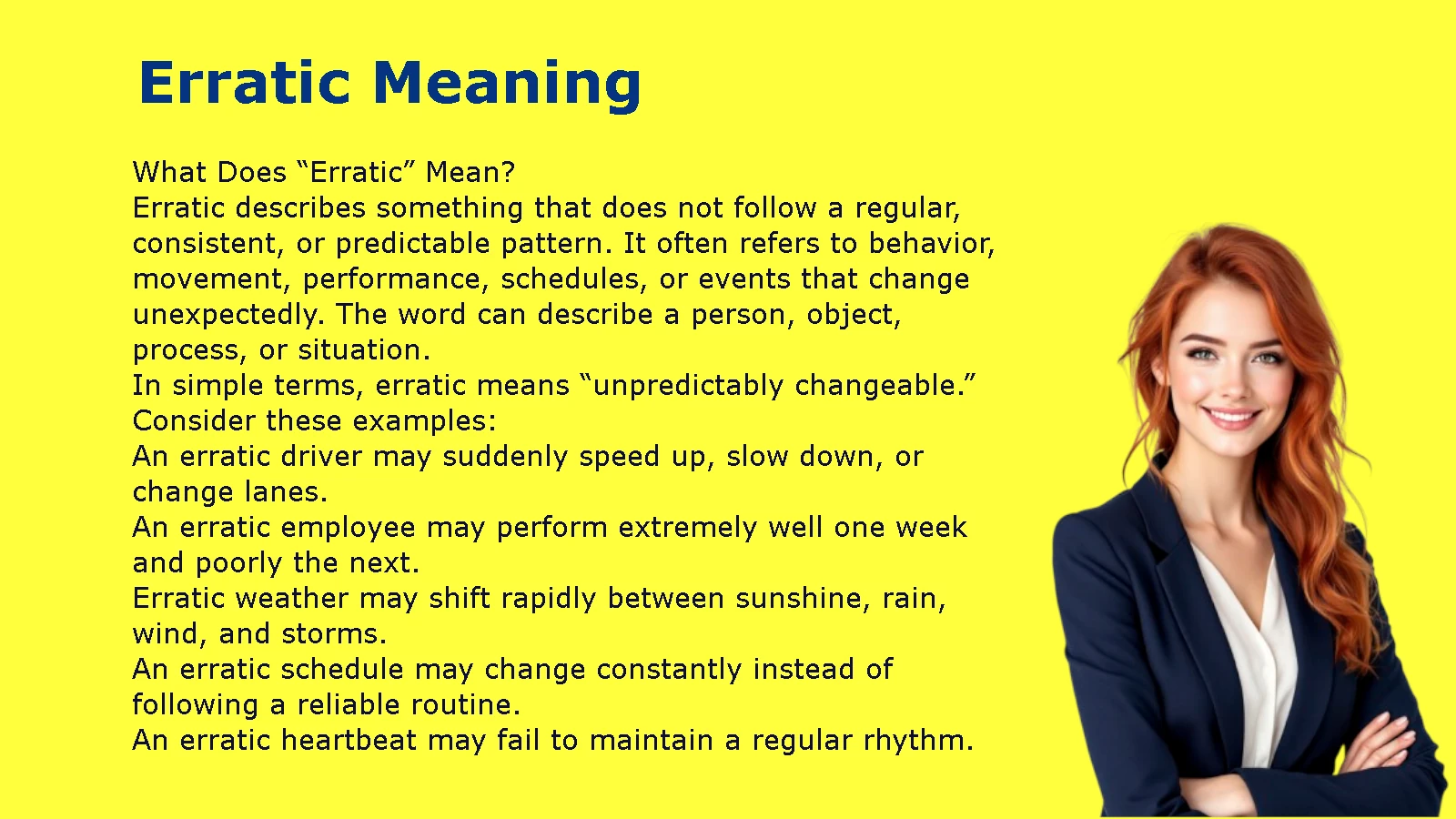
Erratic describes something that is unpredictable, irregular, or inconsistent rather than following a steady or expected pattern. If you’ve come across the word “erratic” and wondered what it means, how it is used, or why someone or something might be described as erratic, the term can apply to behavior, movement, performance, decisions, emotions, weather, and other situations that lack consistency.
The erratic meaning refers to something that behaves or changes in an unpredictable, irregular, or inconsistent way. However, the exact meaning can depend on the context. Terms such as unpredictable, inconsistent, irregular, unstable, unpredictable, and changeable are related to erratic, but they can have slightly different uses and levels of meaning.
In this guide, you’ll learn what “erratic” means, how the word is used in sentences, what it means to describe someone or something as erratic, and how “erratic” differs from related words such as “unpredictable” and “inconsistent.” You’ll also see clear examples to make the meaning easy to understand.
By the end, you’ll know exactly what erratic means and how to use this useful word naturally and correctly.
What Does “Erratic” Mean?
Erratic describes something that does not follow a regular, consistent, or predictable pattern. It often refers to behavior, movement, performance, schedules, or events that change unexpectedly. The word can describe a person, object, process, or situation.
In simple terms, erratic means “unpredictably changeable.”
Consider these examples:
- An erratic driver may suddenly speed up, slow down, or change lanes.
- An erratic employee may perform extremely well one week and poorly the next.
- Erratic weather may shift rapidly between sunshine, rain, wind, and storms.
- An erratic schedule may change constantly instead of following a reliable routine.
- An erratic heartbeat may fail to maintain a regular rhythm.
The word usually implies more than ordinary change. Change itself isn’t necessarily erratic. Something becomes erratic when the changes seem irregular, difficult to predict, or lacking a stable pattern.
Simple Definition of Erratic
You can remember the definition this way:
Erratic = irregular + unpredictable + lacking consistency.
For instance, imagine a train that arrives every day at exactly 8:00 a.m. That’s a regular schedule.
If it arrives at 7:45 one day, 8:20 the next, 9:05 another day, and occasionally doesn’t arrive at all, its schedule is erratic.
What Does Erratic Mean When Describing a Person?
When you describe someone as erratic, you’re saying their behavior, decisions, emotions, or actions are difficult to predict.
For example:
His erratic behavior worried his coworkers.
This doesn’t necessarily tell us exactly what he did. It tells us that his behavior lacked consistency and that people couldn’t easily anticipate his next action.
You might describe someone as erratic if they:
- Frequently change their decisions
- React very differently to similar situations
- Act unpredictably
- Make sudden changes without explanation
- Alternate between unusually high and low levels of performance
- Follow no obvious pattern in their actions
Calling someone erratic can sound critical, so use the word carefully when describing a real person.
What Does Erratic Mean in Everyday Situations?
You don’t need a dramatic situation to use erratic.
The word works for ordinary situations involving inconsistent patterns.
For example:
My internet connection has been erratic all morning.
This means the connection isn’t behaving consistently. It may work for five minutes, disconnect, return briefly, and then become slow again.
Another example:
Her attendance has been erratic this semester.
The attendance doesn’t follow a dependable pattern.
The important question is always:
Does the thing you’re describing behave in a way that’s difficult to predict or noticeably inconsistent?
If yes, erratic may be a good fit.
Erratic Meaning in Different Contexts
The meaning of erratic stays broadly the same across different situations, but the specific thing that becomes unpredictable changes.
Erratic Behavior
Erratic behavior refers to actions or reactions that are unpredictable, inconsistent, or unusually changeable.
For example:
The manager’s erratic behavior made meetings difficult to manage.
The manager might approve an idea one day and reject an almost identical idea the next. The problem isn’t simply that the manager changes their mind. The problem is the lack of a recognizable pattern.
Other examples include:
- The child became increasingly erratic after missing several nights of sleep.
- His erratic behavior confused everyone at the meeting.
- The player’s erratic decision-making cost the team several opportunities.
- Her mood had become erratic over the course of the week.
Erratic Movement or Driving
Movement can be erratic when it changes direction, speed, or rhythm unpredictably.
The car was moving erratically through traffic.
This suggests that the driver wasn’t maintaining a predictable course or speed.
You might also say:
- The bird flew in an erratic pattern.
- The ball took an erratic bounce.
- The machine’s arm made an erratic movement.
- The cyclist’s erratic movements made passing dangerous.
Notice that erratic doesn’t necessarily mean completely random. A movement can have some pattern while still being irregular enough to make prediction difficult.
Erratic Weather
Weather is often called erratic when conditions change unexpectedly or don’t follow the pattern people normally expect for a particular time or place.
Spring weather can be remarkably erratic.
One afternoon might be warm and sunny, followed by cold rain the next morning.
Other examples:
The region experienced erratic rainfall throughout the summer.
Erratic temperatures made it difficult for farmers to plan the growing season.
Here, erratic emphasizes unpredictable variation rather than simply bad weather.
Erratic Performance or Results
An athlete, employee, student, business, or machine can have erratic performance when results fluctuate considerably.
Consider a salesperson who closes:
- 2 deals in January
- 14 in February
- 1 in March
- 11 in April
- 3 in May
You could describe that sales performance as erratic because it lacks consistency.
For example:
The team’s erratic performance made its playoff prospects difficult to predict.
This usage is particularly common in sports, business, education, and technology.
Erratic Schedules, Habits, and Routines
A schedule is erratic when it doesn’t follow a dependable timetable.
His erratic work schedule made it difficult to plan family activities.
An erratic sleep schedule might involve sleeping at 10 p.m. one night, 2 a.m. the next, and 7 p.m. another night.
You could also describe:
- Erratic eating habits
- Erratic work hours
- Erratic attendance
- Erratic study habits
- Erratic posting schedules
- Erratic production schedules
The common thread is simple: there is no reliable rhythm.
Erratic Markets, Prices, or Trends
Financial markets and prices can also behave erratically.
The stock experienced erratic price movements during the trading session.
This means the price moved unpredictably, perhaps rising sharply, falling suddenly, recovering, and then dropping again.
An erratic market isn’t necessarily a market that always goes down. It can move dramatically in either direction without establishing a stable trend.
Examples of “Erratic” in a Sentence
Here are original examples showing how erratic works in different contexts.
Examples About People and Behavior
- His erratic behavior made his friends unsure how he would react.
- The supervisor’s erratic decisions frustrated the entire department.
- She became increasingly erratic when she was under pressure.
- An erratic leader can make long-term planning difficult.
- The student’s erratic participation made it hard to judge her progress.
About Movement and Driving
- The truck made an erratic turn without signaling.
- The patient’s eyes showed erratic movement during the test.
- The drone began flying in an erratic pattern.
- The ball took an erratic bounce after hitting the uneven surface.
- His erratic driving made the passengers nervous.
Examples About Weather and Nature
- Erratic rainfall damaged several crops.
- The unusually erratic temperatures confused the plants.
- The bird’s erratic flight pattern made it difficult to photograph.
- The region has experienced increasingly erratic weather patterns.
Examples About Work and Performance
- Her erratic performance prevented the team from relying on her results.
- The company’s sales have been erratic since the product launch.
- His erratic attendance affected the project’s timeline.
- The software showed erratic performance after the update.
- The player’s erratic shooting cost his team several points.
in Casual Conversation
You can also use erratic in everyday speech:
My Wi-Fi has been really erratic lately.
His sleep schedule is pretty erratic.
The bus service has become erratic this month.
Her work hours are so erratic that we rarely see each other.
These examples show why erratic is useful: it can describe almost anything that repeatedly refuses to settle into a predictable pattern.
Erratic Synonyms
The closest erratic synonyms include unpredictable, inconsistent, irregular, and unstable. However, these words aren’t perfect substitutes in every sentence.
Choosing the right synonym depends on exactly what you want to emphasize.
| Word | Main idea | Example |
| Erratic | Irregular and difficult to predict | His erratic behavior confused everyone. |
| Unpredictable | Difficult to anticipate | The weather is unpredictable. |
| Inconsistent | Fails to remain the same | Her performance is inconsistent. |
| Irregular | Doesn’t follow a normal pattern | The payments are irregular. |
| Unstable | Lacks steadiness or is likely to change | The situation remains unstable. |
| Random | Appears to lack a deliberate pattern | The numbers were selected randomly. |
| Unreliable | Cannot consistently be depended on | The old car is unreliable. |
Unpredictable vs. Erratic
Unpredictable emphasizes that you can’t confidently anticipate what will happen.
Erratic often goes a step further by suggesting that something repeatedly behaves in an irregular or inconsistent way.
Compare:
The weather is unpredictable.
This means you can’t easily forecast it.
The weather has been erratic.
This suggests that the weather has been changing irregularly or behaving unusually.
The words overlap heavily, but erratic often highlights irregularity, while unpredictable highlights difficulty of prediction.
Inconsistent vs. Erratic
Inconsistent means something doesn’t remain consistent.
Her work is inconsistent.
Maybe she produces excellent work sometimes and mediocre work at other times.
Erratic can carry the same idea but often suggests more fluctuation or unpredictability:
Her performance has been erratic.
The second sentence makes the changes sound more pronounced or difficult to anticipate.
A useful shortcut:
- Inconsistent = doesn’t maintain the same standard.
- Erratic = changes unpredictably or follows no steady pattern.
Irregular vs. Erratic
Irregular simply means something doesn’t happen at regular intervals or doesn’t follow a normal pattern.
He has irregular working hours.
Erratic tends to carry a stronger sense of unpredictability.
He has an erratic work schedule.
The first sentence describes variation. The second suggests that the variation is particularly unpredictable.
Unstable vs. Erratic
Unstable means something lacks stability or may change, collapse, or deteriorate.
The political situation is unstable.
Erratic means something behaves irregularly or unpredictably.
The government’s response has been erratic.
A situation can be unstable without being erratic, and vice versa.
For example, a company’s profits might be erratic because they rise and fall unpredictably. The company’s financial position could still be stable overall.
Random vs. Erratic
These words are often confused.
Random means that something occurs without a predictable or deliberate pattern.
Erratic means something behaves irregularly or unpredictably.
A sequence of randomly generated numbers is random.
A machine that suddenly speeds up and slows down is erratic.
You generally shouldn’t use random as a direct replacement for erratic when describing someone’s behavior. Saying someone is “erratic” suggests inconsistent or unpredictable behavior. Saying someone is “random” can sound more casual and may imply that their actions or comments seem unrelated or arbitrary.
Erratic Antonyms
The opposite of erratic depends on context, but common antonyms include:
- Consistent
- Predictable
- Stable
- Regular
- Reliable
- Steady
- Uniform
- Dependable
For example:
Her performance was erratic.
Opposite:
Her performance was consistent.
Or:
The bus service has become erratic.
Opposite:
The bus service is reliable and regular.
The best antonym usually depends on what aspect of erratic you want to reverse.
Is “Erratic” a Negative Word?
Erratic is usually neutral in a dictionary sense, but it often carries a negative tone in everyday communication. That’s especially true when you use it to describe a person’s behavior, work performance, driving, or decision-making. The word can also function as a straightforward technical description.
For example:
The machine produces erratic readings.
That’s mostly descriptive.
But:
His erratic behavior is becoming difficult to tolerate.
That’s clearly critical.
When “Erratic” Sounds Critical
Calling someone’s behavior erratic can suggest that you see it as problematic.
Compare:
She changed her plans.
This is neutral.
She made an erratic change to her plans.
Now the change sounds unusual, unpredictable, or poorly considered.
That’s why you should be careful when using the word in professional or interpersonal situations.
When “Erratic” Simply Describes Irregular Behavior
The word isn’t automatically insulting.
For example:
The sensor produced erratic readings because of electrical interference.
Nobody is being criticized. The word simply describes an irregular technical result.
Likewise:
The region experienced erratic rainfall.
This is a factual description of changing weather conditions.
How Tone Changes the Meaning
Context determines whether erratic sounds neutral or negative.
| Sentence | Likely tone |
| The machine showed erratic readings. | Technical/neutral |
| The weather has been erratic. | Descriptive |
| His performance was erratic. | Mildly critical |
| Her erratic behavior concerned the staff. | Clearly negative |
| The market remained erratic. | Analytical |
When describing people, consider whether inconsistent, unpredictable, or another softer word communicates your meaning more precisely.
Erratic vs. Unpredictable: What’s the Difference?
Erratic and unpredictable overlap, but they emphasize different things. Unpredictable focuses on the difficulty of knowing what will happen next, while erratic often emphasizes repeated irregular changes or a lack of a stable pattern.
When to Use “Erratic”
Choose erratic when you notice a pattern of irregular changes.
The employee’s performance has been erratic all year.
This suggests repeated fluctuations.
When to Use “Unpredictable”
Choose unpredictable when you mainly want to say that an outcome cannot be anticipated.
The final outcome is unpredictable.
The outcome may not have repeatedly changed. You simply don’t know what will happen.
Side-by-Side Examples
Erratic:
The patient’s heart rate became erratic.
The emphasis is on an irregular rhythm.
Unpredictable:
The patient’s response to the treatment was unpredictable.
The emphasis is on uncertainty about the outcome.
That’s a subtle difference, but it can make your writing much more precise.
Erratic vs. Inconsistent: What’s the Difference?
Erratic and inconsistent are close synonyms, but inconsistent often focuses on variation in quality, behavior, or results, while erratic emphasizes irregularity and unpredictability.
How Inconsistency Differs From Unpredictability
Suppose a student scores:
95, 94, 96, 93, 95.
That’s relatively consistent performance.
Now imagine the scores are:
96, 61, 89, 42, 97.
The performance is clearly inconsistent.
You could also call it erratic, particularly because the results fluctuate sharply.
However, the two words don’t always carry exactly the same force.
Someone can be inconsistent without being highly unpredictable. For example, a person might always perform well in the morning and poorly in the afternoon. That’s inconsistent, but there’s still a pattern.
Examples That Show the Distinction
The team’s results are inconsistent.
This emphasizes varying results.
The team’s results are erratic.
This suggests more unpredictable fluctuations.
His attendance is inconsistent.
He doesn’t attend regularly.
His attendance is erratic.
His attendance changes in a particularly irregular or unpredictable way.
How to Use “Erratic” Correctly
Using erratic correctly is easier when you focus on the relationship between the subject and its pattern.
Ask yourself:
What is changing, and why does the change seem irregular or difficult to predict?
If you can answer that question, you’ll usually know whether erratic fits.
Common Sentence Patterns
These structures are especially natural:
Erratic + noun
erratic behavior
erratic movement
erratic performance
erratic weather
erratic schedule
erratic heartbeat
erratic results
erratic communication
Subject + be + erratic
His behavior was erratic.
The machine became erratic.
Her attendance has been erratic.
Something + behaves/moves/operates + erratically
The vehicle was moving erratically.
The software was operating erratically.
The patient was breathing erratically.
Common Nouns Used With “Erratic”
Some combinations occur naturally because the concepts fit closely together:
- Erratic behavior
- Erratic movement
- Erratic performance
- Erratic weather
- Erratic schedule
- Erratic heartbeat
- Erratic driving
- Erratic communication
- Erratic attendance
- Erratic results
- Erratic growth
- Erratic demand
- Erratic prices
- Erratic rainfall
These phrases are useful because they let you describe irregularity without writing a long explanation.
Common Mistakes to Avoid
Mistake 1: Treating “erratic” as a synonym for “bad.”
Erratic doesn’t simply mean bad.
An erratic performance can include excellent results and terrible results. The defining feature is inconsistency or unpredictability, not poor quality alone.
Mistake 2: Using “erratic” for any change.
Change doesn’t automatically mean erratic.
A temperature that rises steadily from 60°F to 75°F isn’t erratic. It’s changing in a predictable direction.
Mistake 3: Assuming “erratic” always means random.
Erratic behavior can have causes and may even contain some underlying pattern. It simply doesn’t appear stable or predictable enough.
Mistake 4: Using “erratic” when “irregular” is more precise.
If you only mean that something doesn’t happen at regular intervals, irregular may be better.
For example:
The payments arrived at irregular intervals.
That’s more precise than calling the payments erratic if unpredictability isn’t the main point.
Erratic Pronunciation
The word erratic has three syllables, and the stress falls on the second syllable.
The pronunciation can be represented in IPA as /ɪˈrætɪk/ in American English.
When saying it aloud, pay attention to the stressed middle syllable. The word begins with a short vowel sound, followed by the stronger RAT sound, and ends with a short ik sound.
The most common pronunciation mistake is placing the stress on the first syllable. English speakers generally stress the middle syllable.
How to Pronounce “Erratic” in American English
American English pronunciation is approximately:
/ɪˈrætɪk/
The word contains three syllables:
- First syllable: unstressed
- Second syllable: stressed
- Third syllable: unstressed
The middle syllable carries the strongest emphasis.
How to Pronounce “Erratic” in British English
British English uses essentially the same stress pattern and a very similar pronunciation.
Regional vowel differences may occur, but the important feature for learners remains the same:
Stress the second syllable.
Where to Place the Stress
Think of the rhythm as:
uh-RAT-ik
The second syllable should stand out.
If you’re learning the word for conversation, practice it inside a sentence rather than repeating the word alone:
The weather has been erratic this week.
That helps you learn both the pronunciation and its natural rhythm.
Word Forms of Erratic
The adjective erratic has several related forms and grammatical uses.
Erratically
Erratically is the adverbial form.
It describes an action performed in an irregular or unpredictable way.
The car was moving erratically.
The system behaved erratically after the restart.
The athlete performed erratically throughout the season.
The distinction is simple:
- Erratic = adjective
- Erratically = adverb
Compare:
His behavior was erratic.
He behaved erratically.
Erraticism
Erraticism is a noun related to erratic behavior or thought, but it is considerably less common in ordinary modern conversation than erratic and erratically.
For everyday writing, you’ll usually communicate more naturally by using phrases such as erratic behavior, erratic movement, or unpredictable behavior.
Erratic as a Noun
In specialized contexts, erratic can also function as a noun.
A glacial erratic is a large rock or boulder that a glacier transported from its original location and deposited somewhere else.
For example:
The enormous boulder is a glacial erratic left behind by retreating ice.
This is a completely different context from describing unpredictable behavior.
So, erratic can function as:
- Adjective: an erratic schedule
- Adverb form: moving erratically
- Noun in geology: a glacial erratic
The geological noun comes from the idea of something that has wandered or been displaced from its original position.
Origin and History of the Word “Erratic”
The history of erratic helps explain why the modern meaning centers on wandering and irregularity.
The word ultimately traces back to the Latin erraticus, meaning wandering or roving. It relates to the Latin verb errare, meaning to wander or go astray.
That original idea is still visible in modern English.
Think about something that wanders instead of following a straight path. Its movement isn’t fixed. It changes direction.
Over time, that physical idea expanded into a broader figurative meaning.
A person can have an erratic pattern of behavior. A machine can behave erratically. Weather can be erratic. A market can experience erratic fluctuations.
In each case, the underlying concept remains similar:
Something isn’t staying on a predictable course.
This connection is useful because it gives you a mental image for remembering the definition. Imagine a person wandering along a road, repeatedly changing direction instead of following a straight route. That’s the core idea behind erratic.
Quick Comparison: What Does Erratic Mean?
The easiest way to understand erratic meaning is to compare it with closely related words.
| Word | Basic meaning | Main idea | Example |
| Erratic | Irregular or unpredictable | No steady pattern | His behavior was erratic. |
| Unpredictable | Difficult to anticipate | You can’t know what comes next | The weather is unpredictable. |
| Inconsistent | Not staying the same | Results or behavior vary | Her performance is inconsistent. |
| Random | Without a predictable pattern | No deliberate or apparent order | The numbers were randomly selected. |
| Unstable | Lacking steadiness | Likely to change or deteriorate | The situation is unstable. |
| Irregular | Not following a normal pattern | Deviates from regularity | The payments are irregular. |
| Reliable | Consistently dependable | Can be trusted to perform as expected | The service is reliable. |
| Consistent | Remaining steady | Doesn’t fluctuate significantly | His work is consistent. |
| Predictable | Easy to anticipate | Expected pattern or outcome | Her response was predictable. |
| Steady | Stable and regular | Little unexpected variation | The company has shown steady growth. |
The most important distinction is this:
Erratic describes a lack of dependable pattern.
That pattern can involve movement, behavior, performance, timing, results, or conditions.
Frequently Asked Questions About “Erratic”
What does erratic mean in simple words?
Erratic means unpredictable, irregular, or inconsistent. Something is erratic when it doesn’t follow a steady pattern and changes in ways that are difficult to anticipate. For example, an erratic schedule keeps changing rather than following consistent hours.
Is erratic a positive or negative word?
Erratic is usually neutral as a definition but often sounds negative in everyday use. Calling someone’s behavior erratic can suggest that their actions are concerning or difficult to manage. In technical contexts, however, it can be purely descriptive, such as “erratic readings” from a sensor.
What is a synonym for erratic?
Common synonyms include unpredictable, inconsistent, irregular, unstable, unreliable, and random. The best choice depends on context. Unpredictable emphasizes uncertainty, inconsistent emphasizes variation, and irregular emphasizes a failure to follow a normal pattern.
What does it mean when someone is erratic?
When someone is erratic, their behavior, decisions, reactions, or performance are difficult to predict. They may change their approach suddenly, respond differently to similar situations, or fail to maintain a consistent pattern.
Is erratic the same as unpredictable?
Not exactly. The words overlap, but unpredictable focuses on the difficulty of anticipating an outcome, while erratic often emphasizes repeated irregularity or inconsistency. Someone can be unpredictable without showing a long-term erratic pattern.
What is the opposite of erratic?
Common opposites include consistent, predictable, stable, regular, steady, and reliable. The best antonym depends on the context. For behavior, consistent may work best; for movement, steady may be more natural; for a service, reliable is often the better choice.
Final Takeaway: What Does “Erratic” Mean?
The simplest way to remember erratic meaning is:
Erratic describes something that behaves irregularly, inconsistently, or unpredictably instead of following a stable pattern.
You can use the word for people, behavior, movement, weather, schedules, performance, technology, markets, and many other situations.
The word becomes especially useful when ordinary change isn’t enough to describe what you’re seeing. If something repeatedly shifts in a way that makes its next move difficult to anticipate, erratic may be exactly the word you need.
Remember these distinctions:
- Erratic = irregular and difficult to predict
- Unpredictable = difficult to anticipate
- Inconsistent = doesn’t maintain the same level or pattern
- Irregular = doesn’t follow a normal pattern
- Unstable = lacks steadiness
- Reliable = consistently dependable
Once you understand that core distinction, you’ll have little trouble using erratic naturally.
Want to sharpen your vocabulary further? Explore related word-meaning and synonym guides to learn the subtle differences between words that look interchangeable but carry different shades of meaning.
Meta Title: Erratic Meaning: Definition, Examples & Synonyms
Meta Description: Learn the meaning of erratic, with clear examples, synonyms, antonyms, pronunciation, usage tips, and comparisons with similar words.













