Economize vs Economise is a spelling choice that depends mainly on the variety of English you use. Economize is the standard spelling in American English, while economise is common in British, Australian, and New Zealand English. Both words have exactly the same meaning: to save money, reduce expenses, or use resources carefully.
The difference comes down to American vs. British spelling, not grammar or meaning. However, there is one important exception: Oxford spelling, a British publishing convention that retains the -ize ending in many words. Understanding this distinction will help you choose the right spelling for financial writing, business reports, academic papers, and everyday communication.
This guide explains the regional spelling rules, compares related word forms such as economizing and economising, and provides practical examples to help you write consistently.
Economize vs Economise: The Quick Answer
Economize is preferred in American English, whereas economise is common in standard British English and many other Commonwealth varieties. Both spellings mean to spend less, avoid waste, or use money and resources efficiently. Neither spelling is inherently wrong; the appropriate choice depends on your audience, publication style, and regional spelling convention.
Here is the basic rule:
- American English: Economize
- British English: Economise is common, although economize is also accepted in Oxford-style writing.
- Australian English: Economise is generally preferred.
- New Zealand English: Economise is generally preferred.
- International business writing: Follow your organization’s preferred style guide and remain consistent.
For example, an American financial adviser might write, “Families should economize during periods of rising inflation.”
A British financial adviser could express the same idea as, “Families should economise during periods of rising inflation.”
The sentences communicate the same message. Only the spelling changes.
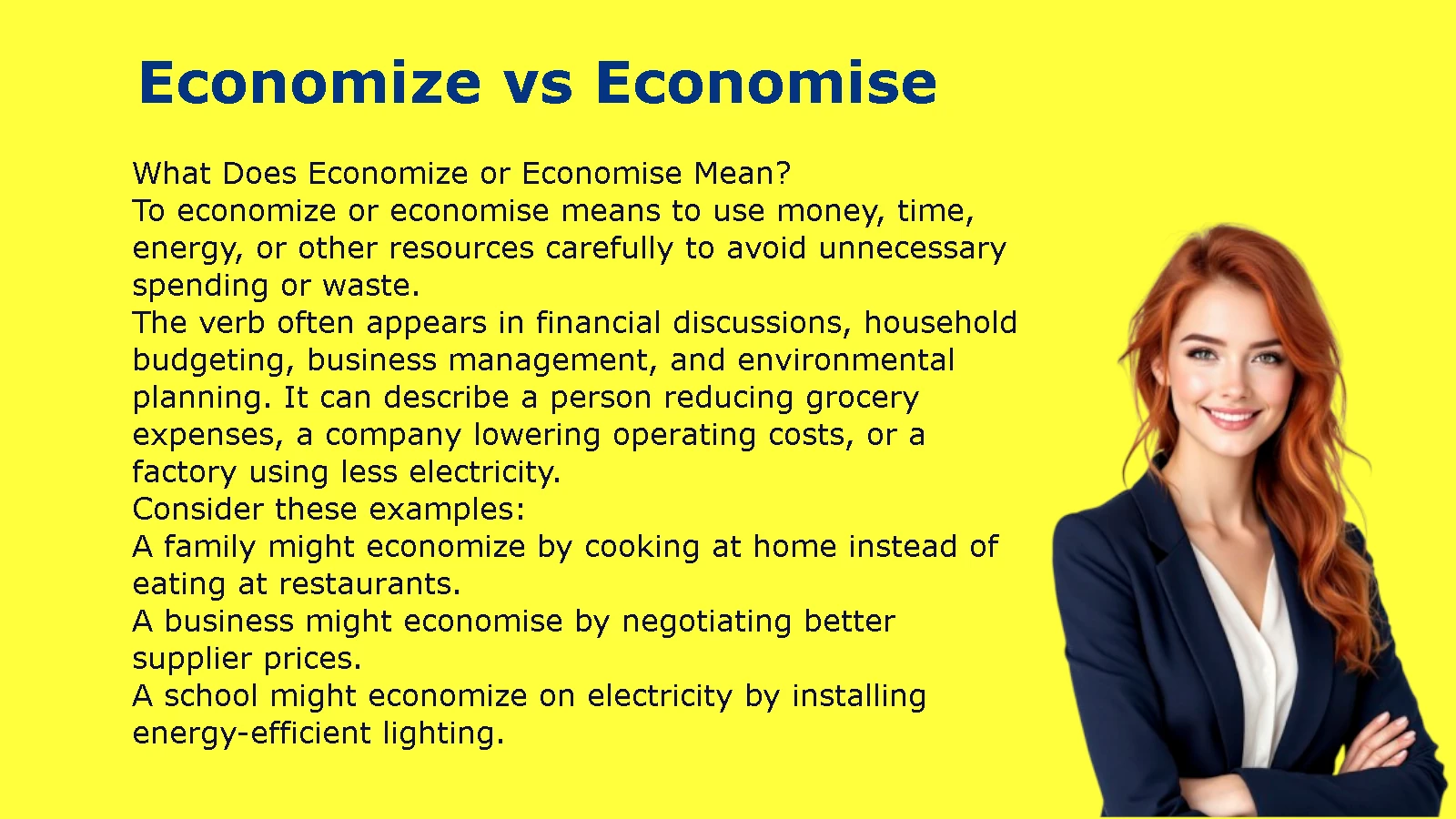
What Does Economize or Economise Mean?
To economize or economise means to use money, time, energy, or other resources carefully to avoid unnecessary spending or waste.
The verb often appears in financial discussions, household budgeting, business management, and environmental planning. It can describe a person reducing grocery expenses, a company lowering operating costs, or a factory using less electricity.
Consider these examples:
- A family might economize by cooking at home instead of eating at restaurants.
- A business might economise by negotiating better supplier prices.
- A school might economize on electricity by installing energy-efficient lighting.
- A traveler might economize by using public transportation instead of renting a car.
In each case, the goal is to achieve a desired result while using fewer resources.
The word does not necessarily mean spending as little as possible. Instead, it suggests making sensible choices about how to use available resources.
Economize vs Economise in American and British English
The main difference between economize and economise comes from regional spelling conventions. American English generally favors the letter Z in this word, while mainstream British English commonly uses S.
Both conventions are established forms of English. Your choice should reflect the audience you are writing for rather than a belief that one spelling is universally correct.
Is Economize Correct in American English?
Yes. Economize is the standard American English spelling.
American English generally uses -ize in words such as organize, recognize, realize, and economize. This convention appears in American dictionaries, newspapers, educational materials, business documents, and financial publications.
The same spelling pattern carries through the verb’s related forms.
Examples include:
- The company plans to economize without reducing product quality.
- We economized on groceries by planning our meals before shopping.
- The manufacturer is economizing on electricity to reduce production costs.
- She economizes by comparing prices before making major purchases.
- An economizer can help certain heating and cooling systems use energy more efficiently.
Notice that the spelling remains consistent throughout the word family. American writers use economize, economized, and economizing rather than switching to the corresponding -ise forms.
Economize in American Financial Writing
The word frequently fits discussions about personal finance and business efficiency.
For example, a personal finance article might explain how households can economize during periods of inflation. A company report might describe efforts to economize on transportation, packaging, or energy expenses.
In these contexts, the word suggests controlling costs while maintaining reasonable quality or performance.
Compare these sentences:
- “The company will economize by eliminating unnecessary administrative expenses.”
- “The company will cut costs by eliminating unnecessary administrative expenses.”
Both are correct, but the emphasis differs slightly. Economize describes the practice of using resources carefully. Cut costs more directly emphasizes reducing expenditure.
That distinction makes economize useful in formal reports and practical budgeting advice.
Is Economise Correct in British English?
Yes. Economise is a common and standard spelling in mainstream British English.
British spelling frequently uses -ise in words that American English spells with -ize. Examples include organise, recognise, realise, and economise.
British writers typically maintain the same pattern in related forms:
- Economise
- Economised
- Economising
- Economises
- Economiser
For example:
- Households often economise when living costs increase.
- The business economised by reducing unnecessary travel.
- The council is economising on energy consumption.
- She economises by buying only what she needs.
- The system includes an economiser designed to improve efficiency.
These spellings are appropriate for readers who expect mainstream British English conventions.
Economise in British Business and Everyday Writing
British writers can use economise in conversations about household expenses, corporate budgets, public spending, and environmental sustainability.
Consider this example:
“A small business can economise by reviewing recurring subscriptions, renegotiating supplier contracts, and reducing avoidable energy use.”
The word describes a general approach to managing resources rather than one specific cost-cutting action.
It also works naturally in everyday conversation:
“We’re trying to economise this month, so we’re eating out less often.”
The wording is direct, natural, and appropriate for informal British English.
Which Spelling Do Australia and New Zealand Use?
Economise is generally preferred in Australian and New Zealand English. Both varieties share many spelling conventions with British English, although individual publishers and organizations may establish their own rules.
In practical writing, the -ise form is a suitable default for Australian and New Zealand audiences.
Examples include:
- Australian households may economise by comparing electricity plans.
- New Zealand families can economise by preparing meals at home.
- A local business might economise on fuel by planning delivery routes.
- Schools may economise on resources by reducing unnecessary printing.
The same principle applies to related forms. Writers generally use economised and economising rather than economized and economizing when following mainstream Australian or New Zealand spelling.
However, regional preference does not mean every publication must use the same form. An international company may require a particular house style across all its offices. In that situation, follow the organization’s instructions.
Economize vs Economise: Spelling Comparison Table
The easiest way to understand the difference is to compare the complete word forms side by side.
| Word form | American English | Mainstream British English |
| Base verb | Economize | Economise |
| Past tense | Economized | Economised |
| Past participle | Economized | Economised |
| Present participle | Economizing | Economising |
| Third-person singular | Economizes | Economises |
| Related noun | Economizer | Economiser |
The table shows a consistent pattern: the spelling difference usually remains throughout the word family.
Economize vs Economise Example Sentences
The following examples show how both spellings work in ordinary sentences.
| American English | British English |
| We need to economize on electricity. | We need to economise on electricity. |
| The company economized on travel expenses. | The company economised on travel expenses. |
| The family is economizing on groceries. | The family is economising on groceries. |
| She economizes whenever possible. | She economises whenever possible. |
| The building uses an economizer to improve energy efficiency. | The building uses an economiser to improve energy efficiency. |
Each pair communicates the same idea. The spelling changes to match the chosen regional convention, but the grammar and meaning remain the same.
Is Economize or Economise More Formal?
Neither spelling is inherently more formal. Both work in professional reports, academic writing, financial advice, and casual communication.
Formality depends on the surrounding sentence and context.
For example:
- Formal: The organization will economize on operational expenditure while maintaining service standards.
- Neutral: We need to economise on electricity this winter.
- Conversational: We’re trying to economize, so we’re skipping a few restaurant meals.
The first sentence uses formal business language. The second is a straightforward statement. The third uses a conversational contraction.
All three can be correct regardless of whether the writer chooses American or British spelling, provided the spelling matches the selected style.
Why Do Some British Writers Use Economize?
Although economise is common in mainstream British English, economize is also an accepted spelling in British publishing. The reason is a convention known as Oxford spelling.
Oxford spelling generally favors -ize endings in words where the suffix is appropriate, including many words that other British style guides spell with -ise. This convention is not a mistake or an attempt to use American English.
Understanding the difference helps explain why British publications sometimes use spellings that resemble American English.
Understanding Oxford Spelling
Oxford spelling is a British English spelling convention associated with Oxford University Press and used by various publishers and writers.
Under this convention, words such as organize, recognize, realize, and economize retain the letter Z.
Other British spelling conventions commonly use organise, recognise, realise, and economise.
The distinction reflects different approaches to spelling, not a disagreement about the words’ meanings.
Here is a simple comparison:
| Word | Common British -ise form | Oxford-style -ize form |
| Organize | Organise | Organize |
| Recognize | Recognise | Recognize |
| Realize | Realise | Realize |
| Economize | Economise | Economize |
| Standardize | Standardise | Standardize |
Oxford spelling is sometimes associated with the historical development of the -ize suffix, which has roots in Greek word formation through French and Latin. However, the spelling convention is not based on a simple rule that every word with a particular Greek origin must use Z.
Some words have established spellings that do not follow the general pattern. For that reason, writers should consult their chosen style guide when a particular word is uncertain.
Is Oxford Spelling the Same as American English?
No. Oxford spelling and American English overlap, but they are not identical.
Oxford spelling retains -ize in many words while preserving other British conventions. American English has its own established spelling patterns, including forms such as color, center, and traveling.
A writer using Oxford spelling may therefore write:
“The organisation aims to economize on energy while improving its environmental performance.”
This sentence combines the British spelling organisation with the Oxford-style form economize. That combination can be consistent within the appropriate editorial style.
By contrast, a writer following mainstream British spelling might write:
“The organisation aims to economise on energy while improving its environmental performance.”
Both sentences are acceptable under their respective conventions.
Economize vs Economise in International Writing
International writing does not follow one universal spelling system. Businesses, academic publishers, international organizations, and news outlets may use American English, mainstream British English, Oxford spelling, or a customized house style.
For global content, the best approach is to establish a spelling policy before publishing.
Use these practical guidelines:
- For a US-focused website: Prefer economize and other American spellings.
- For a UK-focused website: Prefer economise unless the publisher follows Oxford spelling.
- For an Australian or New Zealand audience: Use economise as the usual default.
- For an international company: Follow its documented editorial policy.
- For an academic paper: Check the institution’s or journal’s style guide.
Consistency matters because readers notice when a document switches between spelling conventions.
For instance, a financial report that uses economize in one section and economising in another may look as though two editors applied different rules. Even when readers understand the text, inconsistent spelling can weaken the document’s professional appearance.
A Practical Case Study: Choosing a Spelling for a Global Website
Imagine a company publishes budgeting advice for customers in the United States, the United Kingdom, and Australia.
Its editorial team has three options:
| Strategy | Example | Best use |
| American English | Economize | Content primarily written for US readers |
| Mainstream British English | Economise | Content primarily written for British or similar Commonwealth audiences |
| Oxford-style spelling | Economize | Content following an established -ize British editorial convention |
Suppose the company publishes one global English-language blog instead of separate regional versions. The editors should select a house style and apply it across articles, email campaigns, landing pages, and downloadable guides.
If the company later creates a dedicated British website, it may choose economise for that version to align with local expectations.
The important lesson is simple: choose a spelling policy based on the publication’s needs, not by mixing forms whenever either one looks familiar.
Economizing vs. Economising: How to Spell Related Forms
The difference between economize and economise does not disappear when the verb changes tense or takes a suffix. Writers generally retain the same regional spelling pattern throughout the word family.
This consistency helps prevent errors in reports, articles, and educational materials.
American and Oxford Forms of Economize
American English and Oxford spelling commonly use the following forms:
- Economize: Base verb
- Economizes: Present-tense form for he, she, it, or a singular noun
- Economized: Simple past tense and past participle
- Economizing: Present participle and gerund
- Economizer: A person or device that economizes
Examples:
“The company plans to economize on transportation costs.”
“The department economized by reducing unnecessary purchases.”
“The factory is economizing on water through a recycling system.”
“An economizer can improve the efficiency of certain heating and cooling systems.”
These examples show that the Z remains in the related forms.
British and Commonwealth Forms of Economise
Mainstream British, Australian, and New Zealand spelling generally uses the following forms:
- Economise: Base verb
- Economises: Present-tense form for he, she, it, or a singular noun
- Economised: Simple past tense and past participle
- Economising: Present participle and gerund
- Economiser: A person or device that economises
Examples:
“The company plans to economise on transportation costs.”
“The department economised by reducing unnecessary purchases.”
“The factory is economising on water through a recycling system.”
“An economiser can improve the efficiency of certain heating and cooling systems.”
The meaning remains unchanged. Only the spelling follows a different convention.
How to Use Economizing and Economising Correctly
Both economizing and economising can function as present participles or gerunds.
A present participle often appears in a continuous verb phrase:
- American: “The household is economizing on groceries.”
- British: “The household is economising on groceries.”
A gerund functions as a noun:
- American: “Economizing on energy can reduce monthly bills.”
- British: “Economising on energy can reduce monthly bills.”
The grammar is the same in both examples. The difference lies in the regional spelling.
Writers should also remember that economizing does not automatically mean making every possible cut. It describes careful resource management, which may involve prioritizing essential expenses and removing waste rather than simply choosing the cheapest option.
Common Economize vs Economise Mistakes to Avoid
Several mistakes can make an otherwise clear article look inconsistent.
Mixing regional spellings
Incorrectly inconsistent: “The company will economize on energy while economising on transport.”
This combination may be intentional in a document that quotes different sources or follows a specialized policy. However, it is usually inconsistent in ordinary prose.
More consistent American version: “The company will economize on energy while economizing on transport.”
More consistent British version: “The company will economise on energy while economising on transport.”
Assuming one spelling is always wrong
Using economise in an American document may conflict with the document’s spelling policy, but the word itself is not an invented or meaningless form. Likewise, economize is not restricted to American English because Oxford spelling also uses it.
Changing the spelling when the tense changes
Writers should not assume that the base verb follows one regional convention while the past tense follows another. Choose the matching word family.
Confusing spelling with meaning
Neither economize nor economise means something different from the other. You do not need to choose one based on whether you are discussing money, energy, or time.
How to Keep Your Spelling Consistent
A few practical steps can prevent regional spelling errors:
- Set your word processor to American English, British English, Australian English, or the required language variant.
- Check whether your organization has a house style.
- Search your document for both spellings if you suspect a mixture.
- Review related forms such as economized, economising, and economiser.
- Use a consistent policy across headings, tables, captions, and body text.
For website owners, the same principle applies to existing content. If your website targets American readers, review older pages for British spelling variants when updating them. If your site serves a British audience, check for American forms that conflict with your editorial style.
You do not need to change every accepted variant indiscriminately. Focus on the spelling convention your publication has chosen.
What Is the Difference Between Economize, Save, and Cut Costs?
Although economize is closely related to save and cut costs, the words do not always communicate exactly the same emphasis.
Understanding these related meanings helps writers select the most precise verb.
| Word or phrase | Main meaning | Example |
| Economize | Use resources carefully and avoid waste | We need to economize on electricity. |
| Save | Keep money or resources instead of using them | We save money by cooking at home. |
| Cut costs | Reduce expenses directly | The business cut costs by renegotiating its lease. |
| Conserve | Protect or use a resource sparingly | The community conserves water during droughts. |
| Budget | Plan how money will be allocated | We budget for groceries and household bills. |
| Reduce spending | Spend less than before | The family reduced spending on entertainment. |
Economize is especially useful when the focus is on efficiency and careful use.
For example, a business can economize by improving its delivery routes. It may deliver the same number of orders while using less fuel. The company has reduced waste without necessarily lowering the quality of its service.
By contrast, cutting costs may involve a direct reduction in expenditure, such as canceling a subscription or closing an unprofitable location.
The distinction makes economize a useful choice in financial advice, operational planning, and sustainability discussions.
Does Economize Always Mean Spending Less Money?
No. Economize can refer to using nonfinancial resources more efficiently, including electricity, water, fuel, time, and materials.
For example:
- A manufacturer may economize on raw materials by reducing production waste.
- A household may economize on water by fixing leaks.
- An office may economize on paper by moving suitable documents to digital formats.
- A delivery company may economize on fuel by improving route planning.
These actions can also reduce expenses, but the word’s focus is broader than money alone.
A useful rule is to use economize on when identifying the resource being managed carefully.
Examples include:
- Economize on fuel
- Economize on electricity
- Economize on household expenses
- Economize on materials
- Economize on time
The phrase economize on is especially common when the writer wants to identify a particular area of reduced consumption or expenditure.
Frequently Asked Questions About Economize vs Economise
Is Economise a Spelling Error?
No. Economise is a standard spelling in mainstream British English and is also used in Australian and New Zealand English. American English generally prefers economize. The correct choice depends on your intended audience and the spelling convention you follow.
Is Economize Correct in British English?
Yes. Economize is accepted in British English, especially under Oxford spelling conventions. However, many British publications prefer economise. Check the relevant style guide if you are writing for a British publisher, school, or organization.
Do Economize and Economise Mean the Same Thing?
Yes. Both words mean to use resources carefully, avoid waste, or reduce unnecessary spending. There is no difference in their definitions, grammatical function, or standard pronunciation based solely on the Z-versus-S spelling.
Should I Write Economizing or Economising?
Use economizing in American English and Oxford-style writing. Use economising when following mainstream British, Australian, or New Zealand spelling conventions. Keep the same pattern in related forms such as economized and economised.
Which Spelling Is Better for International Business Writing?
Neither spelling is universally better for international business writing. Choose the form that matches your company’s editorial policy or your primary audience. If your organization already follows a style guide, use it consistently across reports, emails, websites, and presentations.
What Is the Difference Between Economizer and Economiser?
Economizer is the common American and Oxford-style spelling, while economiser is common in mainstream British spelling. Both can refer to a person who economizes or to a device that improves resource efficiency. In technical writing, check the terminology preferred by your industry or manufacturer.
Conclusion: Economize or Economise?
The choice between Economize vs Economise depends on your spelling convention, not on the word’s meaning.
Use economize when writing in American English or following Oxford spelling. Choose economise when following mainstream British, Australian, or New Zealand conventions.
Both spellings describe the same action: spending carefully, avoiding waste, and using resources efficiently. The same regional pattern usually applies to related forms, including economized/economised, economizing/economising, and economizer/economiser.