Disappearance vs Dissapearance is a common spelling comparison because the incorrect form “dissapearance” adds an extra s. The correct spelling is “disappearance,” which refers to the act or process of no longer being visible, present, or available. If you’ve come across both spellings and wondered which one is correct, the key difference is simple: disappearance is the standard English spelling, while dissapearance is a misspelling.
The disappearance vs dissapearance distinction is mainly about spelling, not meaning. Disappearance is formed from the verb disappear and the suffix -ance, while dissapearance incorrectly doubles the s. Related words such as disappear, vanished, missing, absence, reappearance, and disappearance can help explain how the correct spelling is used in different contexts.
In this guide, you’ll learn whether “disappearance” or “dissapearance” is correct, what disappearance means, why “dissapearance” is wrong, and how to use the correct spelling in sentences. You’ll also see clear examples and useful comparisons to help you avoid this common spelling mistake.
By the end, you’ll know exactly how to spell disappearance correctly and why dissapearance should be avoided in formal and everyday writing.
Disappearance vs Dissapearance at a Glance
The quickest answer is simple: disappearance is correct, while dissapearance is incorrect.
| Spelling | Correct? | Word Type | Meaning |
| disappearance | ✅ Yes | Noun | The act or fact of disappearing |
| dissapearance | ❌ No | — | Misspelling of disappearance |
| disappear | ✅ Yes | Verb | To become impossible to see, find, or notice |
| disappeared | ✅ Yes | Verb | Past tense of disappear |
| disappearing | ✅ Yes | Verb/participle | Present participle of disappear |
For example:
- Correct: The police investigated the man’s disappearance.
- Incorrect: The police investigated the man’s dissapearance.
The difference is not one of meaning or regional preference. Dissapearance is simply a spelling error.
Correct spelling
Disappearance
Common incorrect spelling
Dissapearance
Basic meaning
Disappearance means the fact or process of someone or something disappearing, becoming lost, becoming impossible to find, or no longer being visible or present. Cambridge defines it as the fact of someone or something disappearing, while Oxford also includes the sense of no longer existing or becoming impossible to see.
Is Disappearance or Dissapearance Correct?
Disappearance is the correct spelling.
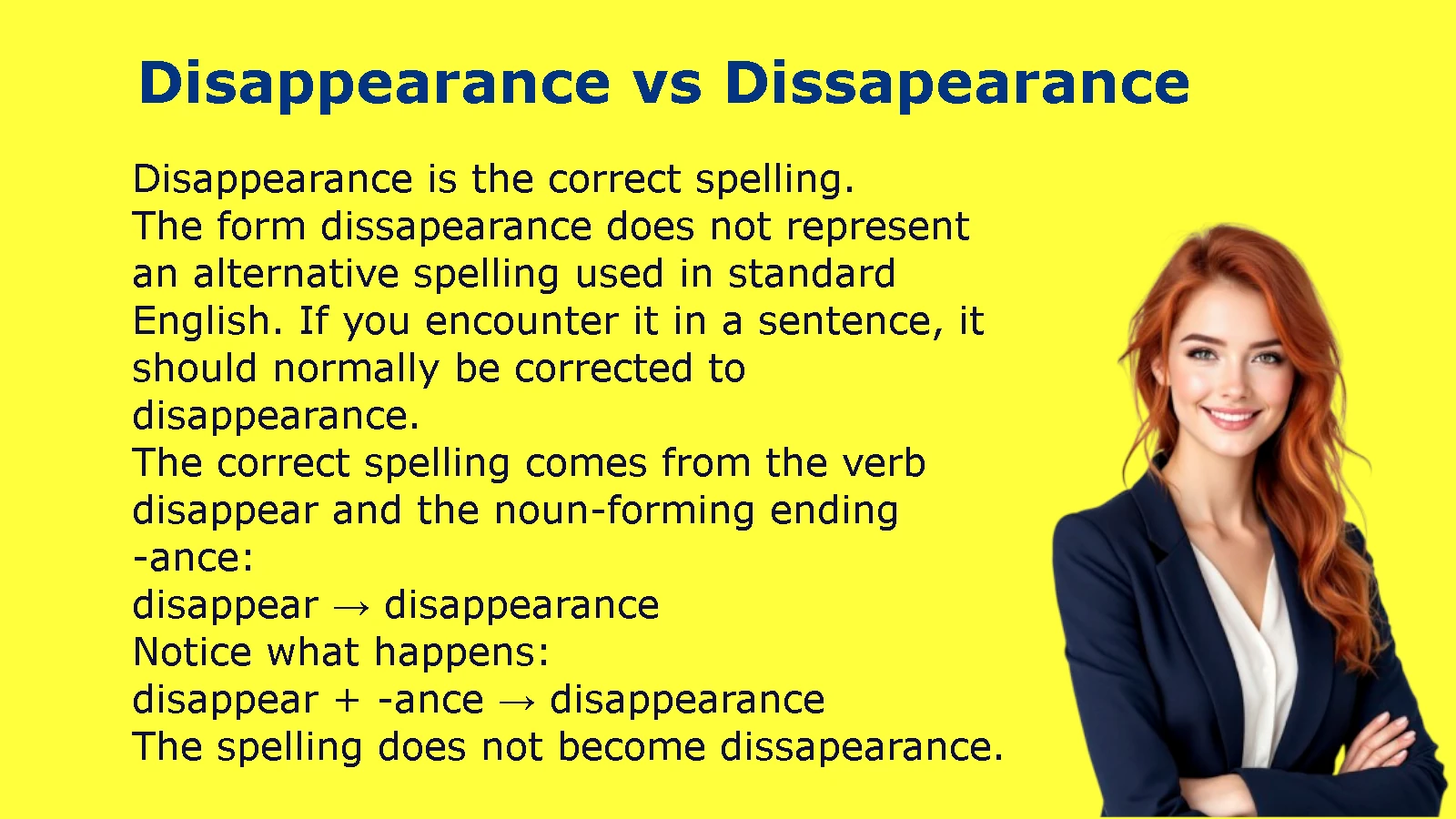
The form dissapearance does not represent an alternative spelling used in standard English. If you encounter it in a sentence, it should normally be corrected to disappearance.
The correct spelling comes from the verb disappear and the noun-forming ending -ance:
disappear → disappearance
Notice what happens:
disappear + -ance → disappearance
The spelling does not become dissapearance.
Why the correct form looks confusing
The word contains several letters that are easy to misplace:
d i s a p p e a r a n c e
A common mistake is to add another s:
d i s s a p p e a r a n c e
That produces dissapearance, which is incorrect.
Another error is to remove one of the p letters:
disapearance
That is also incorrect.
The safest approach is to remember the base word first:
disappear → disappearance
Once you know how to spell disappear, you only need to recognize the noun form.
What Does Disappearance Mean?
Disappearance is a noun describing the fact, act, or process of disappearing.
Cambridge gives the core meaning as the fact of someone or something disappearing. Its American dictionary also describes it as a state or condition in which a person or thing cannot be seen or found.
Oxford gives two useful senses:
- Something or someone becomes lost or impossible to find.
- Something no longer exists or becomes impossible to see.
That means disappearance can apply to both physical absence and figurative or gradual loss.
Disappearance of a person
When a person cannot be found, you can describe the event as their disappearance.
The police began investigating her disappearance.
Here, the word refers to the person’s absence and the circumstances surrounding it.
Disappearance of an object
The word can also describe something that is missing.
The disappearance of the documents caused concern.
The documents were previously present but could no longer be found.
Disappearance of something visible
A visible object, feature, or phenomenon can also disappear.
The disappearance of the fog revealed the mountains.
The fog is no longer visible, so disappearance describes its vanishing.
Disappearance in a figurative sense
The word doesn’t always refer to something literally vanishing.
The gradual disappearance of traditional practices has changed the community.
Here, disappearance means that the practices are becoming less common or ceasing to exist.
Why Is Dissapearance Incorrect?
Dissapearance is incorrect because standard English spells the noun as disappearance.
The extra s is the central problem.
Compare the two forms:
| Correct | Incorrect |
| disappearance | dissapearance |
| disappearance | dissapearance |
The correct word begins with dis-, followed by appear:
dis + appear + ance
The incorrect version effectively makes the beginning look like:
diss + appear + ance
That is not the standard spelling of the word.
The connection with disappear
A useful spelling check is to move backward to the verb.
disappearance comes from disappear.
Compare:
- disappear
- disappeared
- disappearing
- disappearance
All four forms retain the spelling pattern disappear.
This gives you a practical way to catch the error. If you already know that disappear is spelled with one s after di, don’t introduce another s when forming disappearance.
Disappearance Spelling Breakdown
Breaking the word into recognizable parts makes it easier to remember.
| Part | Form | Role |
| Prefix | dis- | Forms a word associated with separation, reversal, removal, or negation in many words |
| Base | appear | Relates to becoming visible or present |
| Ending | -ance | Forms a noun |
| Full word | disappearance | The act or fact of disappearing |
The most useful spelling pattern is:
dis + appear + ance = disappearance
You don’t need to memorize dissapearance as a competing form. Treat it as a common typing or spelling error.
A simple visual trick
Keep these two words together:
disappear → disappearance
The shared opening helps reinforce the correct spelling.
Disappearance vs Dissapearance Examples
Seeing the two forms in context makes the distinction clearer.
Correct Examples With Disappearance
The disappearance of the painting was reported immediately.
Here, disappearance is a noun referring to the fact that the painting was no longer where it was expected to be.
The child’s disappearance prompted a search.
The noun describes the event or situation involving the child becoming missing.
The sudden disappearance of the clouds surprised everyone.
This example uses the word for something visible that vanishes.
Scientists studied the gradual disappearance of the ice.
Here, the word describes a process rather than one sudden event.
The disappearance of the old building changed the appearance of the neighborhood.
The noun refers to the building no longer being present.
Incorrect Examples With Dissapearance
These sentences contain the common misspelling:
The dissapearance of the documents caused problems.
Correct it to:
The disappearance of the documents caused problems.
Another example:
Police investigated her sudden dissapearance.
Correct:
Police investigated her sudden disappearance.
One more:
The gradual dissapearance of the species concerned researchers.
Correct:
The gradual disappearance of the species concerned researchers.
The meaning in these sentences does not need to change. Only the spelling needs correction.
Common Sentences Using Disappearance
The noun disappearance works in many different grammatical contexts.
Personal disappearance
The sudden disappearance of the student led to an investigation.
Missing object
We noticed the disappearance of several files from the cabinet.
Natural phenomenon
The disappearance of the snow exposed the grass underneath.
Gradual change
The disappearance of the old signs took place over several years.
Figurative use
The disappearance of trust made the relationship difficult to maintain.
Formal context
The report examines the disappearance of several historical records.
Scientific context
Researchers observed the gradual disappearance of the species from the region.
Everyday context
I was surprised by the disappearance of my keys.
These examples demonstrate an important point: disappearance isn’t limited to missing people. It can describe anything that becomes absent, invisible, lost, or nonexistent, depending on context.
Disappearance Meaning and Usage
Disappearance as a Noun
It names an event, condition, process, or fact rather than describing an action performed by a subject.
Compare:
The magician disappeared.
Here, disappeared is a verb.
The magician’s disappearance surprised the audience.
Here, disappearance is a noun.
This distinction is particularly useful when deciding which form belongs in a sentence.
| Sentence | Word | Part of Speech |
| The bird disappeared. | disappeared | Verb |
| The bird’s disappearance was sudden. | disappearance | Noun |
| The bird is disappearing. | disappearing | Verb/participle |
| The bird may disappear. | disappear | Verb |
Disappearance in Formal Writing
The noun appears naturally in reports, academic writing, journalism, legal contexts, and other formal settings.
Examples include:
- the disappearance of evidence
- the disappearance of a person
- the gradual disappearance of a tradition
- the disappearance of a species
- the sudden disappearance of funds
Oxford specifically gives examples involving police investigations and the disappearance of plant and animal species.
Disappearance in Everyday English
The word also works perfectly well in ordinary conversation.
I can’t explain the disappearance of my wallet.
The cookies’ disappearance remains a mystery.
The disappearance of the stain was unexpected.
For casual situations, people may choose simpler expressions such as going missing, vanishing, or being gone. Still, disappearance is not unusually formal.
Disappear vs Disappearance
Both are related but perform different grammatical jobs.
Disappear is a verb. It describes the action or process of becoming absent, invisible, or impossible to find.
Disappearance is a noun. It names that event or process.
| Word | Part of Speech | Meaning | Example |
| disappear | Verb | To become impossible to see, find, or notice | The bird began to disappear into the trees. |
| disappeared | Verb | Past form of disappear | The bird disappeared into the trees. |
| disappearing | Verb/participle | Present participle of disappear | The bird is disappearing from view. |
| disappearance | Noun | The act or fact of disappearing | The bird’s disappearance was sudden. |
Compare the sentence structures
Verb:
The man disappeared during the night.
Noun:
The man’s disappearance was reported the next morning.
The first sentence focuses on what happened. The second treats the event itself as the subject of discussion.
Disappeared vs Disappearance
These forms can look similar, but they cannot simply replace each other.
Disappeared
Disappeared is the past tense and past participle of disappear.
The cat disappeared from the garden.
It tells us that the cat became absent or could no longer be seen.
Disappearance
Disappearance is a noun.
The cat’s disappearance worried the family.
It identifies the event or fact of the cat becoming absent.
A useful test
If the word describes what someone or something did, you may need the verb.
The documents disappeared.
If the word names the event itself, you may need the noun.
The disappearance of the documents caused concern.
This simple distinction can prevent both grammatical and spelling errors.
Other Words Related to Disappearance
The word family surrounding disappearance includes several useful forms.
| Word | Word Type | Meaning |
| appear | Verb | Become visible or noticeable |
| appearance | Noun | The act or fact of appearing; also someone’s outward look |
| disappear | Verb | Become absent or impossible to see or find |
| disappeared | Verb | Past tense of disappear |
| disappearing | Verb/participle | Present participle of disappear |
| disappearance | Noun | The act or fact of disappearing |
| reappear | Verb | Appear again |
| reappearance | Noun | The act or fact of appearing again |
Understanding this word family helps explain why disappearance has the spelling it does.
The key relationship is:
appear → disappear → disappearance
The spelling of the base verb remains visible inside the longer noun.
Disappearance Synonyms
Several words can be related to disappearance, but their meanings are not always identical.
| Word | Typical Meaning | Example |
| vanishing | The act of becoming absent or invisible | The vanishing of the mist was gradual. |
| absence | The state of not being present | His absence was noticed immediately. |
| departure | Leaving a place | Her departure was unexpected. |
| evaporation | Changing from liquid to vapor; also figurative loss | The evaporation of the water was rapid. |
| fading | Gradually becoming weaker or less visible | The fading of the light was noticeable. |
| withdrawal | Moving away or removing something | The withdrawal of support changed the situation. |
Disappearance vs absence
These words overlap but aren’t identical.
Absence focuses on the fact that someone or something isn’t present.
His absence was obvious.
Disappearance often emphasizes the event or process by which someone or something became absent.
His sudden disappearance caused concern.
Disappearance vs vanishing
Vanishing often suggests a more noticeable or complete act of becoming invisible or absent.
The magician’s vanishing amazed the audience.
Disappearance is broader and can be neutral or formal:
The disappearance of the records remains unexplained.
Common Misspellings of Disappearance
Dissapearance is not the only spelling error people make. The word’s length and repeated letters create several opportunities for mistakes.
| Common Error | Correct Form |
| dissapearance | disappearance |
| disapearance | disappearance |
| dissappearance | disappearance |
| disapperance | disappearance |
| disappearence | disappearance |
The most important distinction is that disappearance contains:
dis + appearance
Written continuously:
disappearance
It does not contain:
- dissa…
- disa…
- dissapp…
- disappe…ence
Why these mistakes happen
Long words are easier to misspell because writers often rely on sound rather than visual memory.
When spoken, several parts of disappearance can blend together. A writer may then reconstruct the spelling incorrectly.
Another factor is the related word appearance, which already contains a double p:
appearance
When dis- is added:
dis + appearance = disappearance
The combination can look visually dense, which makes the spelling worth checking.
How to Remember the Spelling of Disappearance
A reliable memory trick is to start with the shorter word.
Remember disappear first
Write:
disappear
Then turn it into the noun:
disappearance
This is easier than trying to memorize the entire word from scratch.
Use the word family
Keep these together:
- appear
- appearance
- disappear
- disappearance
Notice the relationship:
appear → appearance
and:
disappear → disappearance
Remember the exact sequence
The correct word contains:
dis + appear + ance
So:
disappearance
Not:
dissapearance
A quick spelling test
When you’re unsure, ask yourself:
“What is the verb?”
The answer is:
disappear
Then add the noun ending:
disappearance
That gives you the correct spelling without having to guess.
Disappearance in a Sentence
Here are examples showing how the word works in different contexts.
A person going missing
The police launched an investigation after the woman’s disappearance.
An object going missing
The disappearance of the missing file delayed the project.
Something becoming invisible
The disappearance of the fog revealed the road.
A gradual decline
The disappearance of the old tradition occurred over several generations.
Something ceasing to exist
The species’ disappearance from the region concerned researchers.
Oxford specifically recognizes this broader sense of something no longer existing, not merely something becoming temporarily difficult to find.
A change in a situation
The disappearance of the problem allowed the team to move forward.
A literary context
The mysterious disappearance became the central event of the novel.
A formal report
Investigators documented the disappearance of several records.
A scientific context
The study examined the gradual disappearance of the organism from its former habitat.
A casual context
The sudden disappearance of my sandwich is still unexplained.
The final example is informal, but grammatically natural. The word can function in both everyday and formal English.
A Simple Case Study: Choosing the Correct Form
Imagine that you’re proofreading this sentence:
The dissapearance of the old bridge changed the landscape.
At first glance, the sentence looks fine because dissapearance resembles the correct word.
Step One: Identify the word’s job
The word names an event: the bridge is no longer present.
Therefore, a noun is required.
Step Two: Identify the related verb
The verb is:
disappear
Step Three: Form the noun
The noun is:
disappearance
Step Four: Check the spelling
Compare:
❌ dissapearance
✅ disappearance
Final sentence
The disappearance of the old bridge changed the landscape.
This method works because it uses the word family instead of relying on visual guessing.
Disappearance vs Dissapearance: Quick Answer
If you only need the answer, remember this:
Disappearance is correct. Dissapearance is incorrect.
Disappearance is a noun meaning the act, fact, or process of someone or something disappearing. Cambridge and Oxford both recognize disappearance as a standard English noun.
The easiest spelling pattern to remember is:
disappear → disappearance
You can also break it down as:
dis + appear + ance → disappearance
The extra s in dissapearance does not belong there.
Frequently Asked Questions
Is disappearance or dissapearance correct?
Disappearance is correct. Dissapearance is a misspelling.
Correct: The disappearance was unexpected.
Incorrect: The dissapearance was unexpected.
How do you spell disappearance?
The correct spelling is:
D-I-S-A-P-P-E-A-R-A-N-C-E
A useful way to remember it is:
dis + appear + ance = disappearance
What does disappearance mean?
Disappearance means the fact or process of someone or something disappearing, becoming impossible to see or find, or, in some contexts, ceasing to exist. Cambridge and Oxford both give definitions covering these uses.
Why is dissapearance wrong?
Dissapearance contains an extra s after dis. The standard spelling is based on disappear:
disappear → disappearance
Therefore, the correct form is disappearance, not dissapearance.
Is disappearance a noun?
Yes. Disappearance is a noun.
For example:
The police investigated the disappearance.
The related verb is disappear:
The man disappeared.
What is the difference between disappear and disappearance?
Disappear is a verb, while disappearance is a noun.
The bird disappeared.
The bird’s disappearance surprised us.
The first describes an action or process. The second names the event or fact.
What are the common misspellings of disappearance?
Common errors include:
- dissapearance
- disapearance
- dissappearance
- disapperance
- disappearence
The standard spelling is always disappearance.
What is another word for disappearance?
Depending on context, possible alternatives include vanishing, absence, fading, departure, evaporation, and withdrawal. However, these words have different shades of meaning and should not automatically replace disappearance.
Conclusion
The disappearance vs dissapearance question has a straightforward answer: disappearance is the correct spelling.
The incorrect form dissapearance adds an unnecessary s. The easiest way to avoid this mistake is to connect the noun with its related verb:
disappear → disappearance
The word is a noun that can describe a person, object, visible phenomenon, tradition, species, document, or other thing becoming absent, impossible to find, invisible, or nonexistent. Dictionary sources support both its basic sense of disappearing and its broader use for something ceasing to exist.
Keep these forms straight:
| Correct Form | Function |
| disappear | Verb |
| disappeared | Past-tense verb |
| disappearing | Present participle |
| disappearance | Noun |
So, whenever you’re deciding between disappearance and dissapearance, choose disappearance.