Cutup can have several meanings depending on the context. It may describe a humorous or playful person, refer to something that has been cut into pieces, or relate to the cut-up technique used in writing and art. Because of these different uses, understanding the context is important when figuring out what cutup means.
| Question | Answer |
|---|---|
| What does cutup mean? | A humorous, playful, or mischievous person. |
| Is cutup one word or two? | Cutup is commonly written as one word when referring to a person. |
| What is a cutup person? | Someone who jokes around and behaves in a playful or funny way. |
| Can cutup have other meanings? | Yes. Its meaning can change depending on the context. |
What Does Cutup Mean?
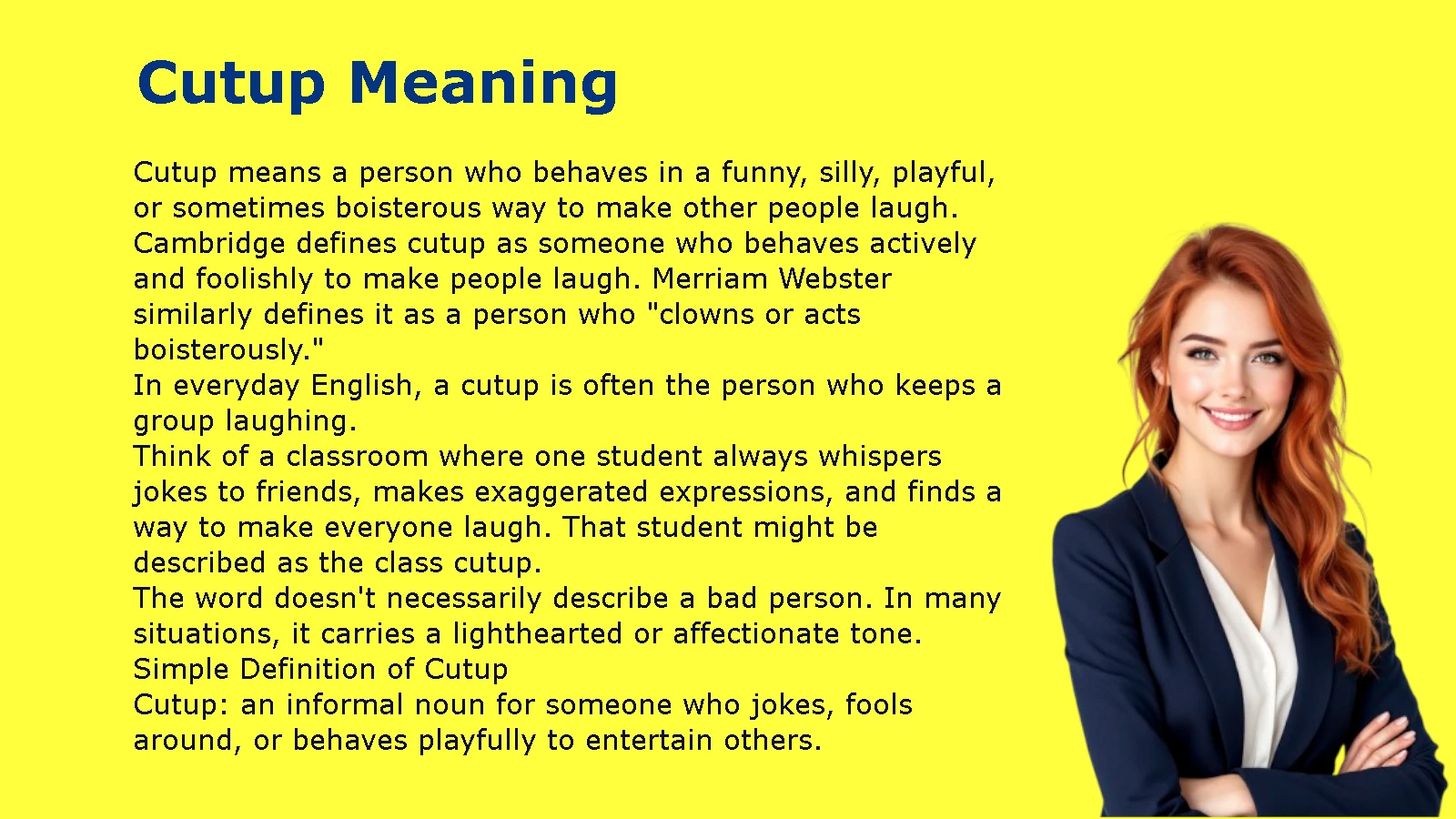
Cutup means a person who behaves in a funny, silly, playful, or sometimes boisterous way to make other people laugh.
Cambridge defines cutup as someone who behaves actively and foolishly to make people laugh. Merriam Webster similarly defines it as a person who “clowns or acts boisterously.”
In everyday English, a cutup is often the person who keeps a group laughing.
Think of a classroom where one student always whispers jokes to friends, makes exaggerated expressions, and finds a way to make everyone laugh. That student might be described as the class cutup.
The word doesn’t necessarily describe a bad person. In many situations, it carries a lighthearted or affectionate tone.
Simple Definition of Cutup
Cutup: an informal noun for someone who jokes, fools around, or behaves playfully to entertain others.
Cutup Meaning at a Glance
| Word | Part of speech | Meaning | Example |
| cutup | Noun | A person who jokes or acts silly | He’s a real cutup. |
| cut up | Verb | To cut something into pieces | Cut up the apple. |
| cut up | Verb | To behave playfully or noisily | The kids were cutting up. |
| cut-up | Noun/adjective | A specialized or context dependent form | They created a cut-up poem. |
The key distinction is straightforward: cutup usually names a person, while cut up usually describes an action or behavior.
Cutup Definition
The main dictionary meaning of cutup is a person who acts like a clown, jokes around, or behaves in a lively way to get attention or make people laugh.
Dictionary.com labels the noun informal and defines it as a prankster or show-off. Collins likewise describes a cutup as someone who clowns or plays practical jokes to attract attention.
Merriam Webster gives the noun meaning as a person who clowns or acts boisterously. Its dictionary record lists the first known use of the noun meaning in 1843.
So, depending on the situation, a cutup might be:
- A jokester
- A prankster
- A funny person
- A class clown
- A playful troublemaker
- A show-off
- Someone who loves making people laugh
These terms overlap, but they aren’t identical.
For instance, a comedian usually makes humor part of a performance. A prankster focuses more on practical jokes. A cutup can simply be someone who acts silly and keeps others entertained.
What Is the Pronunciation of Cutup?
The word cutup has two syllables.
Its pronunciation is commonly represented in IPA as /ˈkʌtˌʌp/. Cambridge gives American and British pronunciations that differ slightly in the realization of the first consonant, while the basic two syllable structure remains the same.
The stress falls primarily on the first syllable.
You may also see the word written as cut-up, particularly in some dictionaries or contexts. However, cutup is an established one word noun in American English.
What Does Cutup Mean in a Sentence?
The easiest way to understand cutup is to see how it works in real sentences.
Examples of Cutup in Sentences
- My brother is a real cutup.
- Everyone knew Jake as the class cutup.
- She’s a cutup when she’s around her friends.
- He was always a cutup at family gatherings.
- Don’t take him too seriously. He’s just a cutup.
- The teacher called him a cutup because he was always making jokes.
- My uncle is such a cutup that dinner is never boring.
- She looks serious at work, but she’s a complete cutup with her friends.
- The little boy became known as the neighborhood cutup.
- He was a notorious cutup in high school.
Notice something important in all these examples: cutup functions as a noun.
You can replace it with phrases such as joker, jokester, or funny person, depending on the context.
Cutup Meaning in Different Contexts
The basic meaning stays fairly consistent, but the tone can change depending on where and how you use the word.
Cutup in Casual Conversation
In casual conversation, cutup often sounds friendly or amused.
Someone might say:
“My cousin is such a cutup.”
That statement usually suggests that the cousin jokes around and makes people laugh. It doesn’t automatically mean the person causes serious trouble.
The surrounding conversation provides the emotional clue.
If someone says, “He’s a cutup, and everyone loves having him around,” the word sounds positive.
If someone says, “He’s a cutup who never takes anything seriously,” it can sound more critical.
Cutup in School
Cutup frequently describes a student who jokes around in class.
A teacher might describe a student as a class cutup if the student regularly:
- Tells jokes
- Makes funny faces
- Distracts classmates
- Plays harmless pranks
- Tries to make other students laugh
- Acts silly during lessons
Merriam Webster provides a similar example involving a student who was always a cutup at school, telling jokes and acting silly.
The word can therefore describe both the student’s personality and their classroom behavior.
Cutup as a Personality Description
Calling someone a cutup can suggest that humor is a regular part of their personality.
For example:
“Sarah is a cutup.”
This sounds like a description of Sarah’s character. It suggests that she enjoys joking around.
Compare that with:
“Sarah was cutting up during the meeting.”
Now you’re describing a specific behavior rather than labeling Sarah as a person who is generally a cutup.
That small grammatical difference changes the sentence.
Is Cutup a Positive or Negative Word?
Cutup is usually neutral to mildly positive, but its tone depends heavily on context.
When used affectionately, it describes someone who brings energy and humor to a group.
For example:
“Grandpa’s a real cutup. He has everyone laughing before dinner even starts.”
Here, cutup is clearly positive.
However, the same word can become mildly critical when someone’s joking disrupts an important situation.
“The student was a cutup during the exam.”
In this context, the behavior isn’t welcome.
So, cutup doesn’t automatically mean “bad” or “good.” The speaker’s attitude and the situation determine the tone.
When Cutup Sounds Positive
It can suggest someone is:
- Funny
- Entertaining
- Playful
- Lively
- Cheerful
- Mischievous
- Good at making people laugh
When Cutup Sounds Negative
It can suggest someone is:
- Distracting
- Noisy
- Attention seeking
- Immature
- Disruptive
- Unable to take something seriously
The safest interpretation is a person who likes to joke or clown around. Then let the context tell you whether that behavior is appreciated.
Cutup vs. Cut Up
This is the most important distinction to understand.
Cutup and cut up look almost identical, but they don’t always serve the same grammatical purpose.
Cutup as a Noun
Use cutup when you mean a person who jokes, fools around, or acts like a clown.
Example:
He’s a real cutup.
Here, cutup is a noun.
You could replace it with joker:
He’s a real joker.
The basic idea remains similar.
Cut Up as a Verb
Use cut up as a phrasal verb when describing an action.
One common meaning is to divide something into smaller pieces.
Cut up the vegetables before you cook them.
Here, cut up means to cut the vegetables into pieces.
Merriam Webster lists this literal meaning alongside other meanings of the phrasal verb.
Cut Up Can Also Mean to Act Silly
Interestingly, cut up has another informal meaning related to the noun cutup.
It can mean to behave in a comic, boisterous, or unruly way.
For example:
The kids were cutting up at the party.
This doesn’t mean anyone was physically cutting something. It means the kids were acting silly, making noise, or clowning around.
Cutup vs. Cut Up Table
| Form | Grammar | Meaning | Example |
| cutup | Noun | A person who jokes or acts silly | He’s a cutup. |
| cut up | Phrasal verb | Divide something into pieces | Cut up the paper. |
| cut up | Phrasal verb | Behave playfully or noisily | The children were cutting up. |
| cut-up | Adjective | Divided into pieces | Serve the cut-up fruit. |
An Easy Memory Trick
Remember:
Cutup = the person.
Cut up = usually the action.
So:
- He’s a cutup. → person
- Cut up the bread. → action
- They’re cutting up. → playful behavior
That simple distinction will prevent most spelling mistakes.
Is Cutup One Word or Two?
When cutup refers to a person who jokes or acts silly, dictionaries recognize it as a one word noun.
Cambridge lists cutup as a noun, while Merriam Webster also gives it as a noun with the definition of someone who clowns or acts boisterously.
However, cut up remains a separate two word phrasal verb.
This means you shouldn’t decide between one word and two words based only on pronunciation. Instead, look at the grammatical role and meaning.
Compare:
My brother is a cutup.
versus:
My brother cut up the old newspaper.
The first sentence describes a person. The second describes an action.
Synonyms for Cutup
Several English words have meanings close to cutup, although each one carries its own shade of meaning.
Cambridge’s thesaurus includes terms such as clown, funny person, jester, buffoon, prankster, practical joker, comedian, joker, jokester, humorist, wag, and wisecracker among related words.
Joker
A joker is someone who likes making jokes.
He’s always been a joker.
This is probably one of the closest everyday alternatives to cutup.
Jokester
A jokester is someone who frequently tells jokes or enjoys joking.
Everyone knows Maria as a jokester.
It emphasizes a person’s love of jokes more than their general silly behavior.
Clown
Clown can describe someone who behaves foolishly or tries to make people laugh.
Stop clowning around and get back to work.
As a noun, however, clown can sometimes sound more negative than cutup.
Prankster
A prankster is someone who plays practical jokes.
He was the office prankster.
This word works best when actual tricks or practical jokes are involved.
Comedian
A comedian is someone who performs comedy, often professionally.
She became a successful comedian.
Calling a person a comedian doesn’t necessarily mean they’re a cutup. A comedian may perform prepared material, while a cutup might simply joke around in ordinary situations.
Goofball
Goofball is an informal word for someone who behaves in a silly or eccentric way.
You’re such a goofball.
It often sounds affectionate.
Cutup Examples for Everyday English
Here are more examples showing different shades of the word:
- My dad is a cutup whenever guests come over.
- Everyone remembers him as the class cutup.
- She’s a natural cutup who can make almost anyone laugh.
- He was a cutup as a child and never completely outgrew it.
- The new employee turned out to be a real cutup.
- My sister becomes a cutup whenever she’s nervous.
- The comedian played the role of a lovable cutup.
- He’s a cutup, but he knows when it’s time to be serious.
- Nobody expected the quiet student to be such a cutup.
- The family cutup kept everyone entertained during the long trip.
- Her friends describe her as a complete cutup.
- The teacher tolerated his cutup personality as long as he didn’t disrupt the lesson.
These examples show why context matters. Cutup can describe harmless humor, playful behavior, or behavior that becomes distracting.
How to Use Cutup Correctly
Using cutup correctly isn’t difficult once you remember that the standard noun refers to a person.
Use Cutup When You Mean a Person
Correct:
James is a cutup.
Correct:
She was the cutup of the group.
Correct:
Everyone knew him as a cutup.
These sentences use cutup as a noun.
Don’t Use Cutup as the Ordinary Verb for Cutting
Incorrect:
Cutup the apple.
Correct:
Cut up the apple.
When you mean physically dividing something into pieces, use the two word phrasal verb cut up.
Use Cutup Mainly in Informal Situations
Because dictionaries label the noun informal, it works best in casual conversation, personal writing, dialogue, and relaxed descriptions.
In a highly formal report, you might choose a more precise term such as comedian, prankster, disruptive student, or jokester, depending on what you actually mean.
Common Mistakes With Cutup
A few mistakes appear again and again because cutup and cut up look so similar.
Mistake: Writing “Cutup” for the Verb
Incorrect:
Please cutup the vegetables.
Correct:
Please cut up the vegetables.
The verb phrase needs two words.
Mistake: Writing “Cut Up” for the Person
If you’re using the noun meaning “a person who jokes around,” the established form is cutup.
Correct:
He’s a cutup.
Mistake: Assuming Cutup Always Means “Funny”
A cutup generally behaves humorously, but the word can also imply boisterous, disruptive, or attention seeking behavior.
A cutup may be entertaining at a party and annoying during a serious meeting.
Mistake: Assuming Cutup Is Always an Insult
It isn’t.
Calling someone a cutup can be affectionate:
My grandfather was a real cutup. Everyone loved his jokes.
The context determines whether the word praises someone’s humor or criticizes their behavior.
Cutup in American English
Cutup is especially associated with American English. Cambridge labels the noun as US, while Collins explicitly identifies its noun usage as American English.
The word has a long history. Collins dates the noun to 1775–85 in its etymological information, while Merriam Webster records the first known use of the noun in the relevant sense as 1843. The difference reflects different dictionary dating conventions and historical evidence.
Its meaning developed from the older verb phrase cut up, which has been used for much longer.
Merriam Webster dates the first known use of the verb cut up to 1580.
Other Meanings and Related Uses of Cut-Up
The word family gets more interesting when you move beyond the everyday meaning of cutup.
Cut-Up as a Literary Term
Cut-up can also refer to a literary technique in which existing text is cut into pieces and rearranged to create a new composition.
Wiktionary records cutup as a noun for a work produced through this type of aleatory literary technique.
This is a completely different context from calling someone a cutup.
For example:
The writer experimented with the cut-up technique to create a new poem.
The meaning here has nothing to do with a person who jokes around.
Cut-Up as an Adjective
You may also encounter cut-up as an adjective describing something that has been divided into pieces.
For example:
The recipe calls for cut-up vegetables.
Here, cut-up describes the vegetables. It doesn’t describe someone’s personality.
Dictionary.com specifically notes this use when discussing food that has been divided into pieces.
Cutup vs. Joker vs. Prankster vs. Clown
These words overlap, but choosing the right one makes your writing more precise.
| Word | Main idea | Typical tone |
| Cutup | Someone who jokes or acts silly | Informal, often playful |
| Joker | Someone who likes making jokes | Neutral to positive |
| Jokester | Someone who frequently jokes | Informal, playful |
| Prankster | Someone who plays practical jokes | Playful or mischievous |
| Clown | Someone who acts foolishly or comically | Can be positive or negative |
| Comedian | Someone who performs comedy | Usually professional or performance based |
| Goofball | Someone who behaves in a silly way | Informal and often affectionate |
| Buffoon | Someone who behaves foolishly | Usually negative |
This comparison highlights an important point: cutup is broader than prankster but more informal than comedian.
A person doesn’t need to perform comedy or play practical jokes to qualify as a cutup. They simply need to have a tendency to clown around or entertain people.
Case Study: Understanding Cutup Through Context
Consider three situations involving the same person, Alex.
Situation One: Family Dinner
Alex tells funny stories and makes everyone laugh.
Someone says:
“Alex is such a cutup.”
The meaning is positive. Alex’s humor makes the gathering more enjoyable.
Situation Two: Classroom
Alex keeps making jokes while the teacher is explaining an important lesson.
The teacher says:
“Alex is becoming a real cutup.”
Now the word carries a mildly negative tone. Alex’s behavior is distracting others.
Situation Three: Formal Meeting
Alex interrupts an important business discussion with repeated jokes.
A colleague says:
“This isn’t the time to be a cutup.”
The word now clearly criticizes the behavior.
The person hasn’t changed. The context has.
That’s why learning the emotional tone of a vocabulary word matters just as much as memorizing its dictionary definition.
Facts About the Word Cutup
Here are the key facts worth remembering:
- Cutup is a noun when it refers to a person who jokes or acts silly.
- It is generally informal.
- The word is strongly associated with US English in major dictionaries.
- It can describe someone who clowns, jokes, or behaves boisterously.
- Its tone can be affectionate, humorous, neutral, or mildly critical.
- Cut up is a separate phrasal verb.
- Cut up can mean physically dividing something into pieces.
- Cut up can also mean behaving in a playful or unruly way.
- The noun is historically derived from the verb phrase cut up.
- The noun’s first known use is dated to 1843 by Merriam Webster.
- Cut-up can also appear in literary contexts, particularly when discussing the cut-up technique.
Frequently Asked Questions About Cutup
What does cutup mean?
Cutup means a person who likes to joke, fool around, clown, or behave playfully to make people laugh. It is an informal noun.
Is cutup one word?
Yes. Cutup is an established one word noun when it means a person who jokes or acts silly.
Example: He’s a cutup.
However, the related verb cut up is written as two words.
What is another word for cutup?
Common alternatives include joker, jokester, clown, prankster, goofball, comedian, and buffoon. The best synonym depends on the person’s specific behavior and the tone you want.
Is calling someone a cutup an insult?
Not necessarily. Cutup can be affectionate or complimentary when it describes someone who makes others laugh. It can also sound mildly critical when the person’s joking becomes disruptive or inappropriate.
What is the difference between cutup and cut up?
Cutup is commonly a noun meaning a person who jokes or acts silly.
Cut up is a phrasal verb. It can mean to divide something into pieces or, informally, to behave in a silly or boisterous way.
Can cutup describe a funny person?
Yes. A cutup is often someone who entertains others through jokes, playful behavior, or clowning around.
What does cut up mean when talking about behavior?
When used as a verb, cut up can mean to behave in a comic, playful, boisterous, or unruly way.
For example:
The children were cutting up during the party.
This means they were behaving playfully or noisily rather than literally cutting something.
Is cutup formal English?
No. Major dictionaries classify the noun as informal, so it’s most natural in casual conversation and relaxed writing.
What does “class cutup” mean?
A class cutup is a student who frequently jokes, acts silly, or tries to make classmates laugh. Depending on context, the term can sound affectionate or describe behavior that distracts from the lesson.
Final Takeaway: Cutup Meaning
The simplest way to remember the cutup meaning is this:
A cutup is a person who likes to joke, clown around, or act silly to make people laugh.
The word is informal and often has a playful tone. It can describe the funny person at a family gathering, the student who keeps making jokes in class, or the friend who can turn almost any quiet moment into a comedy routine.
The biggest point to remember is the difference between cutup and cut up:
Cutup = a person who jokes or acts silly.
Cut up = usually a verb phrase describing an action or behavior.
Once you spot that grammatical difference, the word becomes much easier to understand and use correctly.