Have you ever wondered whether croissant or croisant is the correct spelling? The difference between Croissant vs Croisant may seem like a minor spelling mistake, but it can be confusing because the word comes from French and its spelling doesn’t always match how English speakers pronounce it.
Croissant is the correct spelling in English. It refers to a crescent-shaped French pastry made from a layered, buttery dough. Croisant is an incorrect spelling and is commonly used as a misspelling of croissant. The correct form keeps the French spelling, even when the word appears in everyday English.
Examples:
- I ordered a buttery croissant with my coffee.
- She picked up a fresh croissant from the bakery.
The confusion is understandable. People often search for croissant vs croisant, croissant or croisant, which spelling is correct, or croissant meaning in English because the pronunciation can make the spelling difficult to remember. And here’s the kicker: croisant may look like a reasonable alternative, but it isn’t the standard spelling of the word.
In this guide, you’ll learn the complete difference between Croissant vs Croisant, including their meaning, pronunciation, origin, correct spelling, and usage. You’ll also see why croissant is correct, why croisant is a common misspelling, and how to use the word correctly in clear everyday examples.
Croissant vs Croisant: Which Spelling Is Correct?
Croissant is the correct spelling.
Croisant is an incorrect spelling of the same word. It doesn’t represent a separate type of pastry or an accepted alternative spelling in standard English.
| Spelling | Status | Meaning |
| croissant | ✅ Correct | A crescent-shaped pastry |
| croisant | ❌ Incorrect | Common misspelling of croissant |
| croissants | ✅ Correct plural | More than one croissant |
The important difference is the second s in the middle of the word:
crois + sant → croissant
The incorrect version drops that letter:
crois + ant → croisant
That missing s changes the spelling even though readers will usually understand what the writer means.
The standard dictionary form is croissant. Cambridge lists it as an English noun and gives both British and American pronunciations.
You can also verify the French spelling through Larousse’s French dictionary entry for croissant, which uses croissant, not croisant, for the pastry.
Quick Answer: Croissant or Croisant?
If you only need the answer, remember this:
Croissant is correct. Croisant is a misspelling.
A croissant is a light, curved pastry traditionally associated with French cuisine. The plural is croissants.
What Does Croissant Mean?
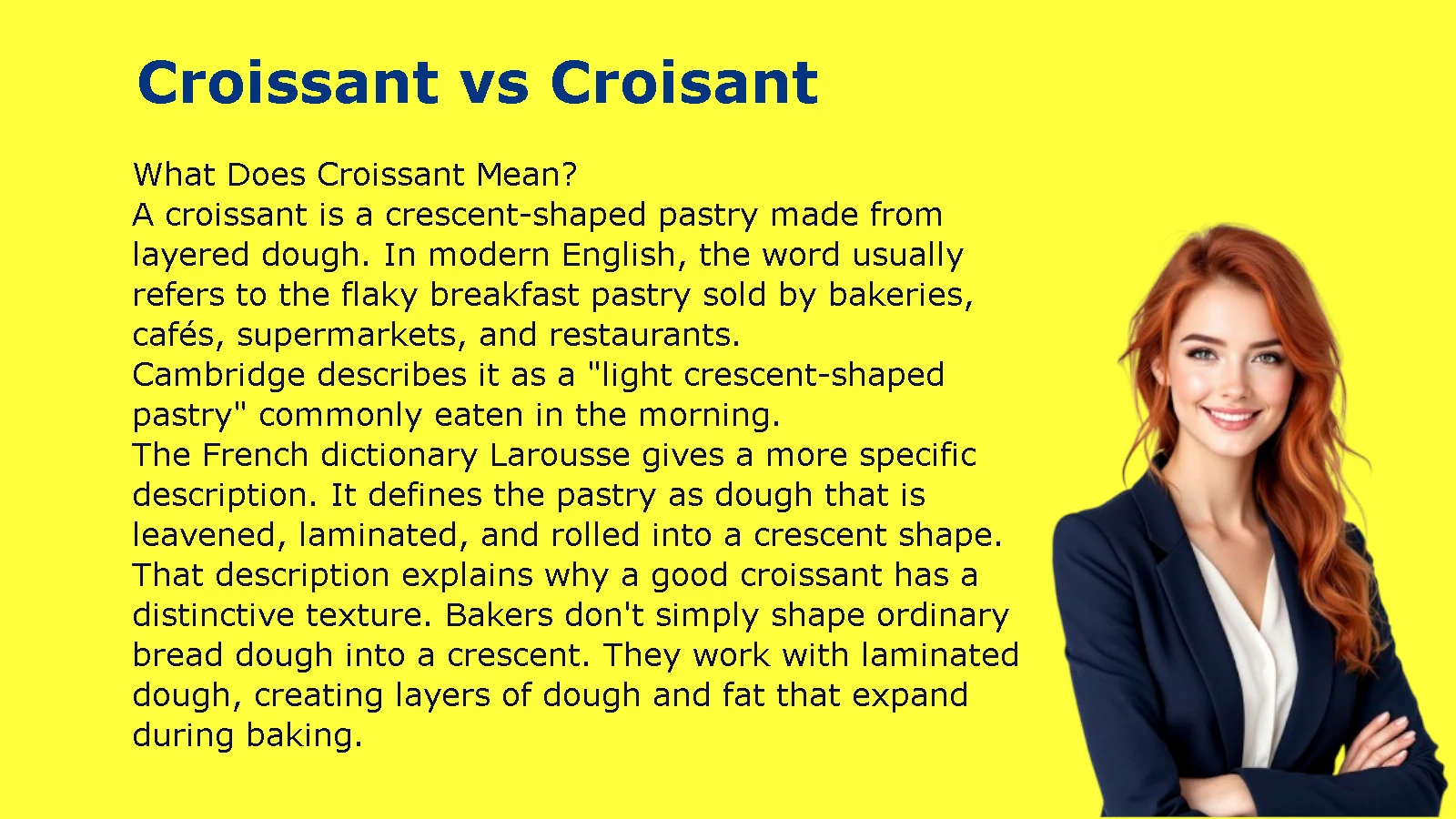
A croissant is a crescent-shaped pastry made from layered dough. In modern English, the word usually refers to the flaky breakfast pastry sold by bakeries, cafés, supermarkets, and restaurants.
Cambridge describes it as a “light crescent-shaped pastry” commonly eaten in the morning.
The French dictionary Larousse gives a more specific description. It defines the pastry as dough that is leavened, laminated, and rolled into a crescent shape.
That description explains why a good croissant has a distinctive texture. Bakers don’t simply shape ordinary bread dough into a crescent. They work with laminated dough, creating layers of dough and fat that expand during baking.
A well-made croissant typically has:
- A curved or crescent-like shape
- A crisp outer surface
- Distinct flaky layers
- A tender, airy interior
- A buttery or rich flavor
- Yeast-leavened laminated dough
The word can also appear in names for different varieties, including butter croissant, almond croissant, and chocolate croissant. Larousse, for example, lists expressions such as croissant aux amandes and croissant au beurre.
Why Is Croisant Incorrect?
The easiest way to understand croisant vs croissant is to look closely at the spelling.
The correct word contains two s letters together:
croissant
The misspelling contains only one:
croisant
That makes the middle of the word the key spelling trap.
Correct
c r o i s s a n t
Incorrect
c r o i s a n t
The extra s isn’t decorative. It’s part of the established spelling of the French word and its standard English form.
This kind of mistake happens often with borrowed words. English has adopted thousands of words from French and other languages, but their original spelling sometimes doesn’t match the spelling patterns English speakers expect.
In this case, pronunciation makes the problem even easier to understand.
When you hear croissant, you don’t necessarily hear every letter distinctly. That can lead someone to reconstruct the spelling as croisant.
It’s similar to remembering a person’s name from hearing it once. You may know exactly who you mean, yet still write the name incorrectly.
Croissant Spelling: How to Spell It Correctly
The correct spelling is:
C-R-O-I-S-S-A-N-T
The most useful part to remember is:
CROISSANT
Pay particular attention to SS in the middle.
A simple memory trick is to treat the word as three visual chunks:
CROI + SS + ANT
The middle SS acts as your spelling checkpoint.
If you write croisant, stop and ask:
“Where did the second S go?”
That quick check can prevent the most common spelling error.
A Simple Croissant Spelling Trick
Think:
CROI + SS + ANT = CROISSANT
The word contains SS before ANT.
So:
- ❌ croisant
- ✅ croissant
This isn’t about changing the pronunciation. It’s simply a visual spelling cue.
Why Do People Spell Croissant as Croisant?
The mistake is understandable because croissant isn’t spelled the way many English speakers would naturally predict from hearing it.
Several factors can contribute to the confusion.
The Pronunciation Doesn’t Reveal Every Letter
The American English pronunciation can sound quite different from what the written spelling suggests. Cambridge gives the US pronunciation as /kwɑːˈsɑ̃ː/ and also records an American variant with a more English-style ending.
That means a person who learns the word by conversation may know how to say it long before learning how to spell it.
The Word Comes From French
The spelling also reflects its French origin.
In French, croissant has meanings beyond the pastry. Larousse lists croissant as a noun for a crescent shape and for the pastry, while the related adjective means “growing” or “increasing.”
That broader French background helps explain why the spelling may feel unfamiliar to English learners.
People Often Write What They Hear
When someone doesn’t know the established spelling, they may create a phonetic approximation.
That’s how forms such as croisant can appear.
The writer isn’t necessarily confusing two different foods. In most cases, croisant is simply an attempt to spell croissant from memory.
How Do You Pronounce Croissant?
The pronunciation of croissant varies somewhat between English varieties.
Cambridge lists the following English pronunciations:
- UK: /ˈkwæs.ɒ̃/
- US: /kwɑːˈsɑ̃ː/
It also gives an American dictionary pronunciation of /krəˈsɑnt/ as a variant.
The French pronunciation is different from the common English pronunciations. Larousse gives the French pronunciation as [krwasɑ̃].
The important point is that pronunciation differences don’t create a different spelling.
Whether someone uses a more French-influenced pronunciation or a common American English pronunciation, the standard spelling remains:
croissant
Croissant Pronunciation vs Spelling
| Aspect | Correct information |
| Standard spelling | croissant |
| Common misspelling | croisant |
| French word | croissant |
| US pronunciation | /kwɑːˈsɑ̃ː/ |
| UK pronunciation | /ˈkwæs.ɒ̃/ |
| French pronunciation | [krwasɑ̃] |
| Plural | croissants |
The spelling therefore shouldn’t be reconstructed from the sound alone.
If the word gives you trouble, memorize the written form separately.
Is Croisant a Word?
Croisant is not the standard spelling of the pastry’s name in English.
If you see croisant in a text, the writer most likely intended croissant.
This distinction matters because a spelling mistake can still appear frequently online. Search engines, social media, user-generated content, menus, comments, and informal messages can contain misspellings. A word’s appearance on the internet doesn’t automatically make it a standard dictionary spelling.
For formal writing, use croissant.
That includes:
- School assignments
- Business writing
- Restaurant menus
- Food articles
- Product descriptions
- Recipes
- News writing
- Marketing copy
- Professional emails
- Academic work
A useful rule is simple:
If you’re referring to the pastry, write croissant.
Croissant vs Croisant in a Sentence
Seeing the two forms in context makes the difference easier to remember.
Correct Examples
- I ordered a croissant with my coffee.
- She bought two croissants from the bakery.
- The almond croissant was still warm.
- We had a butter croissant for breakfast.
- He chose a chocolate croissant instead of a muffin.
- The bakery makes fresh croissants every morning.
Incorrect Examples
- I ordered a croisant with my coffee.
- She bought two croisants from the bakery.
- The almond croisant was still warm.
In each incorrect example, replace croisant with croissant.
The same correction applies to the plural:
- ❌ croisants
- ✅ croissants
The plural simply adds s to the correctly spelled singular form.
Croissant vs Croisant: Correct Usage at a Glance
| Example | Correct? | Reason |
| I ate a croissant. | ✅ | Correct spelling |
| I ate a croisant. | ❌ | Missing the second s |
| She bought three croissants. | ✅ | Correct plural |
| She bought three croisants. | ❌ | Misspelled plural |
| This croissant is flaky. | ✅ | Standard usage |
| This croisant is flaky. | ❌ | Incorrect spelling |
The pattern is consistent. Croissant is the base spelling, and croissants is the normal plural.
What Is the Plural of Croissant?
The plural of croissant is croissants.
You don’t need to change the word internally. Simply add -s:
croissant → croissants
Examples:
- One croissant
- Two croissants
- Several croissants
- Fresh croissants
- Chocolate croissants
This is worth mentioning because a writer who already struggles with the singular spelling may carry the mistake into the plural.
For example:
- ❌ croisant → croisants
- ✅ croissant → croissants
The second s remains in both forms.
Is Croissant a French Word?
Yes. Croissant is a French word.
In French, it isn’t limited to the pastry. The word has several related meanings. Larousse identifies croissant as a noun for a crescent shape and specifically for the crescent-shaped pastry. It also lists croissant as an adjective meaning something that is growing or increasing.
The noun connected with the pastry is tied to the idea of a crescent, which describes its curved shape.
Larousse also connects the noun croissant with the verb croître, meaning to grow or increase.
That connection makes the shape-related meaning easier to understand.
The pastry’s name isn’t an arbitrary string of letters. It belongs to a wider French word family.
Croissant Meaning in French
In French, croissant can refer to a crescent shape or the pastry itself.
For example, croissant de lune means crescent moon. Larousse lists this usage along with the pastry sense.
The word also works as an adjective:
croissant can mean growing or increasing.
For example, French uses nombre croissant for a number or quantity that is increasing.
English speakers generally encounter the noun through the pastry, so the food meaning has become much more familiar in everyday English.
What Makes a Croissant Different From Ordinary Bread?
A croissant isn’t simply a crescent-shaped piece of bread.
Its defining feature is the laminated dough.
Lamination involves repeatedly layering dough with fat and folding the dough so it develops many thin layers. During baking, moisture turns into steam and helps separate those layers.
The result is the texture people associate with a good croissant:
- Crisp outside
- Delicate flakes
- Visible layers
- Airy interior
- Rich, buttery character
Cambridge describes croissants as light, curved pastries, while Larousse specifically identifies the pastry as made from leavened and laminated dough.
That distinction matters because the word croissant describes a particular kind of pastry, not simply any bread shaped like a crescent.
Croissant vs Croisant: A Practical Case Study
Imagine three people writing the same sentence after visiting a bakery:
“I bought a croissant for breakfast.”
The first person has seen the word many times and writes croissant.
The second person has heard the word mostly in conversation and writes croisant.
The third person isn’t sure and checks a dictionary before publishing a restaurant review.
The third approach produces the reliable result:
croissant
This small example shows why spelling knowledge matters. The writer who relies only on sound can easily lose the second s. The writer who checks the established spelling avoids the error.
Case Study: A Restaurant Menu
Consider a menu listing:
- Butter Croissant
- Almond Croissant
- Chocolate Croissant
All three use the same spelling because croissant is the established name of the pastry.
A menu that says Butter Croisant doesn’t describe a different pastry. It simply contains a spelling mistake.
For businesses, this matters more than it might seem. Menu text becomes part of a restaurant’s public-facing identity. Correct spelling makes the content look polished and trustworthy.
Case Study: A School Assignment
Suppose a student writes:
“My favorite breakfast pastry is a croisant.”
The meaning is obvious, but the spelling is incorrect.
The correct version is:
“My favorite breakfast pastry is a croissant.”
The sentence structure doesn’t need to change. Only the spelling does.
That’s the hallmark of this particular error: the writer usually has the right word in mind but writes the wrong form.
Common Croissant Spelling Mistakes
The most important mistake is croisant, but people can produce other variations when trying to remember the word.
| Misspelling | Correct form |
| croisant | croissant |
| croisants | croissants |
| croissaint | croissant |
| croisont | croissant |
| croisssant | croissant |
Not every variation appears with the same frequency, and none should be treated as an accepted alternative spelling simply because it occasionally appears in informal writing.
The safest approach is to learn one standard form:
croissant
Then use the same spelling every time.
Croissant vs Croisant: Why the Second S Matters
At first glance, the second s can look insignificant.
It isn’t.
Spelling works through established sequences of letters. Removing one letter can turn a correct word into a misspelling even when the pronunciation and meaning remain obvious.
Compare:
croissant
with:
croisant
The eye catches the difference immediately once you know what to look for.
A useful proofreading habit is to scan the middle of the word:
croiSSant
Those two s letters are the part most likely to disappear.
How to Remember the Correct Croissant Spelling
A few simple techniques can make the spelling stick.
Remember the Double S
The most direct trick is:
croi + SS + ant
Think double S.
Write It With the Key Letters Emphasized
When learning the spelling, temporarily write:
CROI-SS-ANT
The hyphens aren’t part of the word. They’re simply a visual reminder.
Connect It to the French Spelling
Because croissant is a French word, remembering that the original French spelling contains ss can help reinforce the correct form.
Use It in a Sentence
Instead of memorizing the word by itself, write:
I had a croissant with coffee.
Then use it again:
The bakery sells fresh croissants.
Repeated use in meaningful sentences makes the spelling easier to recall.
Croissant Spelling: Common Questions About Usage
Should You Write Croissant With a Capital Letter?
Usually, no.
Croissant is a common noun, so it normally appears in lowercase:
I ordered a croissant.
It can be capitalized at the beginning of a sentence:
Croissant is one of the pastries on the menu.
A capital letter can also appear when the word forms part of a proper name or branded expression.
Is Croisant an Alternative Spelling?
No. Croisant should not be treated as an alternative spelling of croissant in standard English.
It’s best understood as a misspelling.
Is Croissant Only Used for Breakfast?
No.
Croissants are strongly associated with breakfast and morning meals. Cambridge’s definition reflects that common association.
However, people can eat them at any time. They can appear in lunches, snacks, desserts, catered events, and sandwiches.
The word itself doesn’t mean “breakfast pastry.” It names the pastry.
Can You Say Croissant for More Than One?
Yes, but use the plural:
one croissant
two croissants
The plural is formed by adding s to the correctly spelled singular.
Croissant vs Croisant: The Difference in One Table
| Feature | Croissant | Croisant |
| Standard spelling | Yes | No |
| Refers to the pastry | Yes | Intended to, but misspelled |
| French spelling | Yes | No |
| Standard English usage | Yes | No |
| Correct in formal writing | Yes | No |
| Plural | croissants | Incorrect form: croisants |
| Main issue | Correct spelling | Missing the second s |
There isn’t a complicated distinction between the two forms.
Croissant is the word. Croisant is the error.
Croissant vs Croisant: Final Answer
If you’re deciding between croissant vs croisant, choose croissant.
The correct spelling is:
C-R-O-I-S-S-A-N-T
The incorrect spelling is:
C-R-O-I-S-A-N-T
The difference is the second s.
A croissant is a light, crescent-shaped pastry associated with French cuisine. Dictionaries such as Cambridge and Larousse recognize croissant as the standard form.
The word also has a broader French connection to the idea of a crescent and to the verb croître, meaning to grow or increase.
So when you’re writing about the pastry, don’t let the pronunciation trick you into dropping a letter.
Remember: CROI + SS + ANT = CROISSANT.
Frequently Asked Questions About Croissant vs Croisant
Is it croissant or croisant?
Croissant is correct. Croisant is a misspelling.
Is croisant a correct spelling?
No. The standard spelling is croissant.
How do you spell croissant?
Spell it C-R-O-I-S-S-A-N-T.
The easiest part to remember is the double s in the middle.
What does croissant mean?
A croissant is a light, crescent-shaped pastry made from laminated, leavened dough.
How do you pronounce croissant?
English has more than one accepted pronunciation. Cambridge gives /kwɑːˈsɑ̃ː/ for US English and /ˈkwæs.ɒ̃/ for UK English.
Is croissant a French word?
Yes. Croissant is French. In French, it can refer to a crescent shape or the pastry, and the related adjective can mean “growing” or “increasing.”
What is the plural of croissant?
The plural is croissants.
For example:
We bought four croissants from the bakery.
Why do people spell croissant as croisant?
The most likely reason is that the spelling doesn’t closely match what many English speakers hear when the word is pronounced. The missing second s is an easy mistake to make when writing the word from memory.
Can croisant mean something different from croissant?
Not in the standard English usage relevant to this spelling comparison. Croisant is generally a misspelling of croissant, not the name of another pastry.
Is croissant only a pastry?
In English, the word is most commonly associated with the pastry. In French, however, croissant has broader meanings connected with a crescent shape and with something that is growing or increasing.
Is “croissant” the same spelling in French and English?
Yes. English uses the French spelling croissant for the pastry.
Which is correct: croisant or croissant?
Croissant is correct.
If the word refers to the familiar crescent-shaped pastry, croissant is the spelling to use in standard English.
Conclusion
The croissant vs croisant question has a straightforward answer: croissant is correct, while croisant is a misspelling.
The main spelling trap is the double s in the middle. Once you remember CROI + SS + ANT, the word becomes much easier to write correctly.
The meaning is just as useful to remember. A croissant is a crescent-shaped pastry made from layered, leavened dough. The French word also has broader meanings connected with a crescent and with growth or increase.
So the next time the spelling feels uncertain, don’t guess from the pronunciation.
Write it this way:
croissant.
And if you’re writing about more than one, use:
croissants.