A charlatan is a person who falsely claims to have special knowledge, skills, or abilities in order to deceive others. The word often describes someone who pretends to be an expert or professional but is not genuine or trustworthy.
| Question | Answer |
| What does charlatan mean? | A charlatan is someone who pretends to have knowledge or skills they do not actually possess. |
| Is charlatan an insult? | Yes, it is usually used negatively to describe a dishonest or fake person. |
| What is an example of a charlatan? | Someone pretending to be an expert to trick people into trusting them could be called a charlatan. |
| Is charlatan a noun? | Yes, charlatan is a noun. |
A confident assertion doesn’t prove that someone has real expertise. A charlatan may make bold claims without having the knowledge or qualifications to support them.
What Does Charlatan Mean?
The word charlatan means a person who falsely claims to possess knowledge, ability, or expertise. The term has a particularly strong association with people who make impressive claims to gain trust, money, influence, or attention.
According to Merriam Webster, a charlatan is someone who pretends to have knowledge or ability. Cambridge similarly defines the word as someone who pretends to have skills or knowledge they don’t have, particularly in medicine.
The central idea looks like this:
False claim → appearance of expertise → deception → benefit or influence
A person doesn’t become a charlatan simply because they make a mistake. Everyone gets things wrong sometimes. The word points toward false claims of expertise or ability, often combined with an intention to mislead.
Charlatan Meaning in Simple English
A charlatan is someone who acts like an expert without really being one.
Imagine someone wearing a doctor’s coat, using complicated medical terms, and confidently selling a miracle treatment. However, the person has no medical training and the treatment has no legitimate basis.
That person isn’t simply inexperienced.
They are presenting themselves as something they aren’t. That’s where charlatan fits.
Charlatan Definition
| Feature | Details |
| Word | Charlatan |
| Part of speech | Noun |
| Plural | Charlatans |
| Basic meaning | A person who pretends to have knowledge or skills they don’t actually have |
| Common association | Fake expertise, quackery, deception |
| Tone | Strongly negative |
| Pronunciation | /ˈshär-lə-tən/ |
| Related noun | Charlatanism |
| Related adjective | Charlatanic / charlatanical |
The Oxford Learner’s Dictionaries gives the core definition as a person who claims to have knowledge or skills that they don’t really have. It also lists two common pronunciations in English.
Charlatan Meaning in Different Contexts
Although charlatan has one central meaning, the word can appear in several settings.
Charlatan in Medicine
Medicine is one of the oldest and most familiar contexts for the word.
A person who falsely claims medical knowledge or promotes ineffective treatments may be called a medical charlatan. This usage overlaps closely with quack. Merriam Webster specifically lists quack as a medical sense of charlatan.
For example:
The doctor warned patients to avoid the charlatan selling an untested cure.
Here, charlatan suggests that the person isn’t merely mistaken. The accusation is that the person pretends to possess medical expertise they don’t have.
Charlatan in Business
The word can also describe someone who presents themselves as a business expert without having the knowledge or experience they claim.
For example:
The investor discovered that the supposed financial adviser was a charlatan.
The person may use impressive language, credentials, or confident predictions to appear credible. The issue is the gap between the claimed expertise and the real expertise.
Charlatan in Science
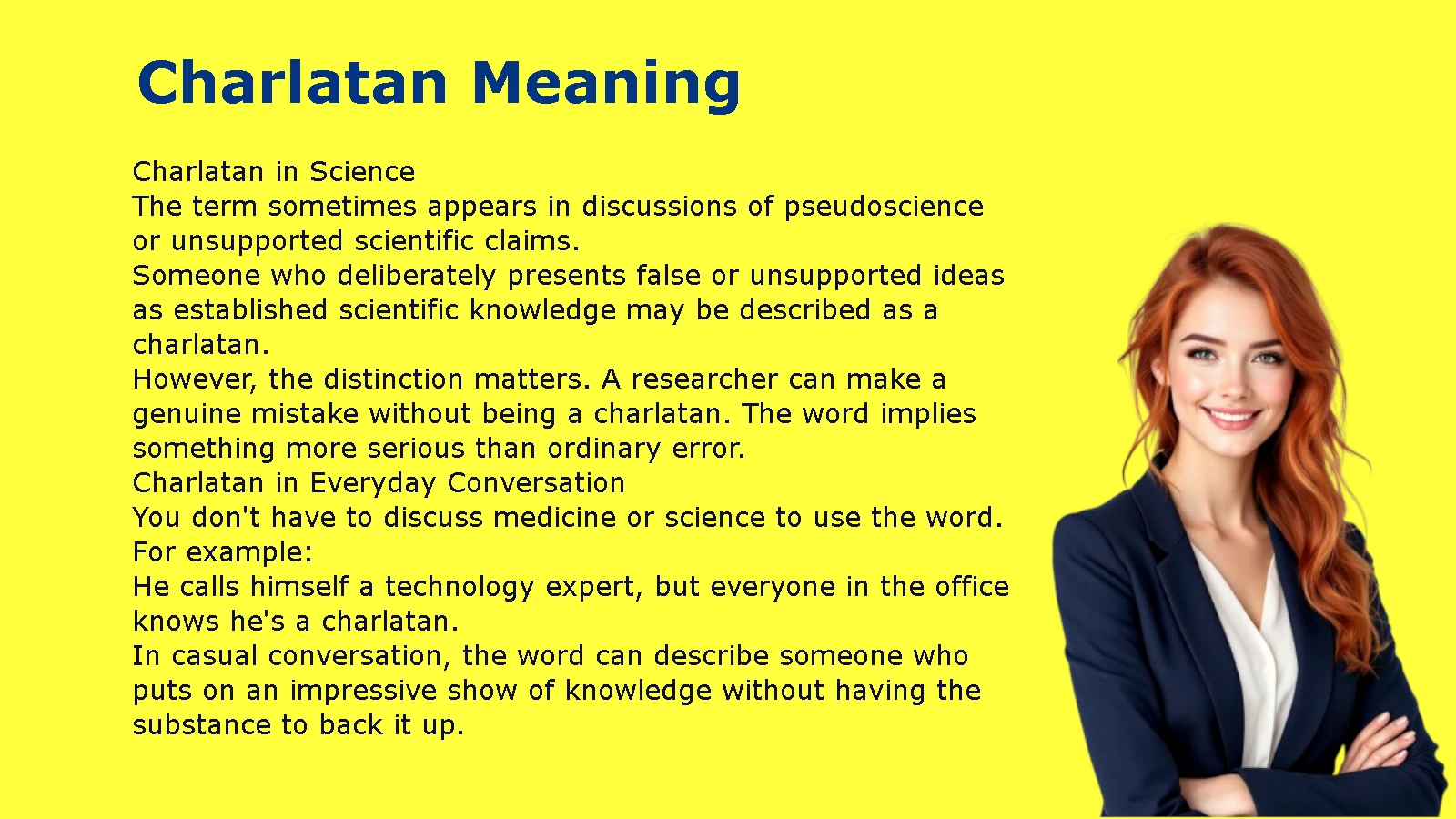
The term sometimes appears in discussions of pseudoscience or unsupported scientific claims.
Someone who deliberately presents false or unsupported ideas as established scientific knowledge may be described as a charlatan.
However, the distinction matters. A researcher can make a genuine mistake without being a charlatan. The word implies something more serious than ordinary error.
Charlatan in Everyday Conversation
You don’t have to discuss medicine or science to use the word.
For example:
He calls himself a technology expert, but everyone in the office knows he’s a charlatan.
In casual conversation, the word can describe someone who puts on an impressive show of knowledge without having the substance to back it up.
Charlatan Examples in Sentences
Seeing the word in context makes its meaning much easier to understand.
- The doctor exposed the self proclaimed healer as a charlatan.
- She realized that the financial adviser was a charlatan after his investment promises repeatedly failed.
- The scientist dismissed the online doyen as a charlatan who misrepresented basic research.
- The villagers believed the traveling healer until they discovered he was a charlatan.
- Anyone can sound convincing, but confidence alone doesn’t turn a charlatan into an expert.
- The author portrays the mysterious professor as a charming charlatan.
- His impressive vocabulary couldn’t hide the fact that he was a charlatan.
- The company hired what appeared to be a consultant but later discovered that he was a charlatan.
- The magician was an entertainer, not a charlatan, because he never claimed that his tricks were genuine supernatural powers.
- Calling someone a charlatan suggests more than simple incompetence.
Notice the last two examples. Charlatan depends heavily on context.
A magician who openly performs tricks isn’t necessarily a charlatan. If that magician claims the tricks demonstrate genuine supernatural abilities and uses those claims to deceive customers, the label becomes much more appropriate.
What Makes Someone a Charlatan?
Several characteristics commonly appear when people use the word charlatan.
They Claim Expertise
First, the person presents themselves as knowledgeable or skilled.
They may claim to be a doctor, scientist, financial expert, spiritual adviser, business consultant, or another type of authority.
They Lack the Claimed Expertise
The person’s actual knowledge or ability doesn’t match the image they present.
That’s the crucial gap.
Someone who knows little about a subject but openly admits it isn’t necessarily a charlatan. A charlatan presents limited or nonexistent expertise as genuine expertise.
They Create an Appearance of Authority
Charlatans often rely on presentation.
They might use technical vocabulary, impressive titles, dramatic demonstrations, selective evidence, elaborate promises, or confident speeches to make their claims appear credible.
In other words, the packaging can be part of the deception.
They Mislead People
Deception sits near the heart of the word.
Merriam Webster’s definition focuses on pretending to possess knowledge or ability, while its examples and synonyms connect the term with fraud, fakery, and false claims.
They May Seek a Benefit
Money is a common motive, but it isn’t the only one.
A person might seek:
- Money
- Customers
- Fame
- Social influence
- Professional status
- Political influence
- Personal attention
- Authority
- Followers
Therefore, a charlatan doesn’t have to be selling something for money.
Charlatan vs. Fraud vs. Con Artist
These words overlap, but they aren’t interchangeable in every situation.
| Word | Main meaning | Main emphasis |
| Charlatan | Someone who pretends to have expertise or abilities | False expertise |
| Fraud | Someone or something involving deliberate deception | Deception or dishonest gain |
| Con artist | Someone who deliberately tricks people | A scheme or confidence trick |
| Impostor | Someone who pretends to be someone else or something they aren’t | False identity |
| Quack | Someone who falsely claims medical knowledge or promotes dubious medical treatment | Fake medical expertise |
| Scammer | Someone who deceives people, usually for an advantage | Fraudulent scheme |
| Pretender | Someone who claims or acts as though they possess something they don’t | False claim |
The easiest distinction is this:
A charlatan specializes in the appearance of expertise.
A con artist may trick someone without pretending to be an expert. An impostor may assume another person’s identity. A fraud may commit deception in many different ways.
A charlatan, by contrast, often makes people think, “This person knows what they’re talking about.”
Charlatan vs. Quack
Quack is one of the closest synonyms for charlatan, especially in medical contexts.
A quack traditionally refers to someone who falsely claims medical knowledge or promotes questionable medical treatments. Merriam Webster identifies quack as a medical definition of charlatan.
Consider these examples:
The doctor called the seller a quack.
This strongly suggests fake or unreliable medical expertise.
The doctor called the seller a charlatan.
This also suggests false expertise, but the word can apply beyond medicine.
So, while quack has a narrower medical association, charlatan has a broader range.
Charlatan vs. Impostor
An impostor pretends to be someone or something they aren’t.
For example:
The impostor claimed to be a government official.
The focus here is on identity.
A charlatan doesn’t necessarily pretend to be another specific person. Instead, the person may pretend to possess a particular skill, knowledge, or authority.
For example:
The self proclaimed scientist was a charlatan.
The person may genuinely be who they say they are. The deception concerns their expertise, not necessarily their identity.
Charlatan vs. Fraud
The word fraud has a broader meaning.
A person can commit fraud by lying about financial information, forging documents, manipulating transactions, or deceiving someone for an unlawful benefit.
A charlatan is more specifically associated with false claims of knowledge, skill, or expertise.
That’s why someone can be a fraud without being a charlatan.
However, a charlatan can certainly behave fraudulently.
Synonyms for Charlatan
Several words can replace charlatan, depending on the context.
Merriam Webster’s thesaurus includes terms such as fraud, fake, pretender, quack, deceiver, mountebank, faker, impostor, phony, hoaxer, humbug, trickster, swindler, scammer, and bluffer.
Closest Synonyms
- Quack
- Fraud
- Fake
- Pretender
- Impostor
- Deceiver
- Faker
- Mountebank
- Phony
- Humbug
Synonyms by Context
| If you mean… | A useful alternative |
| Fake medical expert | Quack |
| Dishonest person | Fraud |
| Fake person or thing | Fake |
| False identity | Impostor |
| Person who tricks others | Con artist |
| Person making false claims | Pretender |
| Person using deception | Deceiver |
| Person running a scam | Scammer |
| Person who acts important without substance | Humbug or mountebank |
Not every synonym has exactly the same force. Charlatan carries a distinctive idea of someone posing as knowledgeable or skilled.
Antonyms of Charlatan
The natural opposites of charlatan describe people whose knowledge or expertise is genuine.
Common antonyms include:
- Expert
- Professional
- Specialist
- Authority
- Master
- Adept
- Virtuoso
- Genuine practitioner
- Qualified professional
Merriam Webster lists expert, master, professional, virtuoso, authority, adept, and related terms among the antonyms or near antonyms of charlatan.
The simplest contrast is:
Charlatan = pretends to have expertise
Expert = genuinely possesses expertise
How to Use Charlatan in a Sentence
Because charlatan is a noun, it normally refers directly to a person.
Common patterns include:
- a charlatan
- the charlatan
- that charlatan
- a medical charlatan
- a political charlatan
- a self proclaimed charlatan
- charlatans
Singular Examples
He was exposed as a charlatan.
The journalist investigated the alleged expert and discovered that he was a charlatan.
She refused to trust the charlatan selling miracle treatments.
Plural Examples
The internet has made it easier for charlatans to reach large audiences.
Several charlatans competed for the wealthy client’s attention.
The plural form is simply charlatans.
Is Charlatan Always About Money?
No.
Money frequently appears in situations involving charlatans because false expertise can be used to sell products, services, treatments, courses, investments, or advice.
However, financial gain isn’t part of the basic definition.
A person might pretend to be an expert because they want status, influence, admiration, followers, or authority.
For example:
He wasn’t selling anything, but his colleagues considered him a charlatan because he repeatedly claimed expertise he didn’t possess.
The key issue is the false presentation of ability or knowledge, not necessarily the person’s financial motive.
Is Charlatan a Negative Word?
Yes. Charlatan is strongly negative.
Calling someone a charlatan doesn’t simply mean, “This person isn’t very good.”
It suggests something closer to:
“This person is pretending to have expertise that they don’t genuinely possess.”
That’s a serious accusation, particularly when you’re describing a real person.
Compare these statements:
He is inexperienced.
This means he lacks experience.
He is uninformed.
This means he lacks knowledge.
He is incompetent.
This means he lacks the ability to perform something properly.
He is a charlatan.
This suggests that he presents himself as knowledgeable or skilled despite not genuinely possessing that expertise.
The last statement carries a much stronger accusation of deception.
Can Someone Be a Charlatan Without Being Completely Fake?
Yes.
The word doesn’t necessarily mean that everything about a person is false.
Someone could have genuine knowledge in one area while falsely claiming advanced expertise in another.
For example, a person might have real experience as a personal trainer but falsely claim to be a medical specialist. Calling that person a charlatan could focus on the false medical expertise, not every aspect of their background.
This distinction matters because expertise isn’t all or nothing.
Someone can be:
- Highly knowledgeable in one field
- Moderately skilled in another
- Completely unqualified in a third
- Dishonest about their qualifications
Context determines whether charlatan is an accurate description.
Is a Person Who Makes a Mistake a Charlatan?
Not necessarily.
This is one of the most important distinctions to understand.
Suppose a teacher gives incorrect information because they misunderstood a complicated topic. That mistake doesn’t automatically make the teacher a charlatan.
Now imagine the same person repeatedly claims to be a leading authority on the topic despite having no relevant training, deliberately invents credentials, and knowingly presents false information as expert knowledge.
That situation is much closer to charlatan.
The difference is the gap between ordinary error and false expertise.
Is a Charlatan a Liar?
A charlatan may lie, but the words aren’t identical.
Liar is a broad term for someone who tells falsehoods.
Charlatan is more specific. It describes someone who presents themselves as possessing knowledge, skill, ability, or authority they don’t genuinely possess.
For example:
He lied about his age.
That doesn’t make him a charlatan.
But:
He claimed to be a medical expert despite having no medical training.
That could make charlatan an appropriate description if the claim is deliberately deceptive.
Historical Origin of Charlatan
The history of charlatan is almost as colorful as the people the word describes.
English borrowed the word through French from Italian ciarlatano. Merriam Webster traces it to Italian ciarlatano, which it identifies as an alteration of cerretano, literally referring to an inhabitant of Cerreto in Italy.
Historical accounts connect the word with traveling sellers who promoted supposed medicines and remedies. Merriam Webster notes that people claiming medical skills they didn’t truly possess traveled through Italy in the early 16th century and sold medicines of little or no value.
Another part of the word’s history connects it with Italian ciarlare, meaning “to chatter” or “to prattle.” The Oxford Learner’s Dictionaries also traces the word through French and Italian and connects it with ciarlare.
When Did Charlatan Enter English?
Merriam Webster gives 1618 as the first known use of charlatan in English.
Other dictionaries give slightly different dating information because historical records can distinguish between the first recorded appearance, earlier forms, and the development of the modern sense. The Oxford English Dictionary describes the word as partly borrowed from French and partly from Italian.
So the safest historical summary is:
French charlatan ← Italian ciarlatano ← earlier Italian forms associated with hawkers, quacks, and chatterers.
Charlatanism Meaning
Charlatanism refers to the behavior, methods, or practices associated with a charlatan.
For example:
The article criticized the charlatanism behind the company’s miracle health claims.
The word focuses on the practice or behavior, rather than the individual.
Compare:
- Charlatan = the person
- Charlatanism = the deceptive practice or behavior
Etymological sources date charlatanism to the early 19th century in English.
Charlatanry Meaning
Charlatanry is another related noun referring to the practices or behavior of a charlatan.
It is less common in everyday English than charlatanism, but it can appear in formal, literary, or historical writing.
For example:
The physician devoted his career to exposing medical charlatanry.
The suffix changes the focus from the person to the practice.
Charlatanic and Related Forms
You may encounter several related forms:
| Word | Meaning |
| Charlatan | A person who falsely claims expertise |
| Charlatans | Plural form |
| Charlatanism | The practices or behavior of a charlatan |
| Charlatanry | Charlatan practices or behavior |
| Charlatanic | Relating to a charlatan |
| Charlatanical | Another adjective form related to charlatans |
These forms aren’t equally common. Charlatan is by far the most useful word for everyday writing.
A Simple Case Study: The Fake Health Expert
Consider a hypothetical example.
A man creates a website claiming that he has discovered a revolutionary treatment for a serious illness. He has no medical qualification, provides no reliable evidence, and uses dramatic testimonials to persuade people to buy his treatment.
Why might charlatan fit?
First, he claims specialized expertise.
Second, he lacks the qualifications needed to support that claim.
Third, he creates an appearance of authority.
Fourth, he uses those claims to influence other people.
The important point isn’t simply that his treatment doesn’t work. The stronger issue is that he presents himself as possessing expertise he doesn’t actually have.
That is the heart of the word charlatan.
A Second Case Study: The Fake Business doyen
Imagine a person who describes himself as a successful investment strategist.
He publishes photographs of luxury cars and expensive offices. He claims to have a secret strategy that guarantees enormous returns. Yet his supposed business history doesn’t withstand basic verification.
If he deliberately creates the appearance of financial expertise without actually possessing it, someone might describe him as a charlatan.
However, the label should be based on evidence rather than simply on disagreement with someone’s advice.
That’s an important point because being wrong isn’t enough.
Why the Word Charlatan Is Stronger Than “Fake”
The word fake can describe almost anything:
- A fake product
- A fake identity
- Fake credentials
- Fake documents
- Fake confidence
- Fake expertise
Charlatan narrows the idea.
It paints a picture of someone who performs expertise.
The person may sound convincing. They may use impressive language. They may even surround themselves with symbols of authority. But underneath that polished exterior, the claimed knowledge or ability doesn’t hold up.
That’s why the word often feels sharper than simply calling someone a “fake.”
Common Mistakes With Charlatan
Using Charlatan for Any Inexperienced Person
An inexperienced person isn’t automatically a charlatan.
He is new to the job.
This describes inexperience.
He pretends to be an experienced professional despite having no relevant knowledge.
This moves closer to charlatan.
Assuming Charlatan Always Means Scammer
A scammer typically deceives people as part of a scheme, often for personal gain.
A charlatan focuses more specifically on false expertise or ability.
The two concepts can overlap, but they aren’t identical.
Assuming Charlatan Only Applies to Doctors
Medicine has a long connection with the word, but its meaning is broader.
You can describe a person as a charlatan in contexts involving:
- Business
- Science
- Finance
- Politics
- Education
- Self help
- Technology
- Spiritual claims
- Consulting
The common thread is false expertise.
Confusing Charlatan With Impostor
An impostor primarily pretends to be someone else or assumes a false identity.
A charlatan primarily pretends to possess knowledge, skills, or authority.
That small distinction can make a big difference.
Treating Charlatan as an Adjective
Charlatan is primarily a noun.
Correct:
He is a charlatan.
You can also use related adjective forms such as charlatanic when appropriate.
Charlatan in Formal and Informal Writing
Charlatan works in both formal and informal contexts, although it carries a fairly serious tone.
Formal Example
The report criticized the promotion of unverified treatments by medical charlatans.
Informal Example
That guy is a charlatan. He doesn’t know what he’s talking about.
The word itself is not slang. It has a long history in English and appears in dictionaries and serious writing.
Still, because it makes a strong accusation, use it carefully when referring to an actual person.
Charlatan in Literature and History
The idea behind the word has appeared in literature for centuries.
Traveling sellers, fake healers, self proclaimed experts, swindlers, and performers who blurred the line between entertainment and deception have all provided fertile ground for the concept.
The historical association with medicine is particularly strong. Early charlatans could travel from place to place, attract crowds, make dramatic claims, and sell supposed remedies.
That image helps explain why the modern word still carries a sense of showmanship mixed with deception.
A charlatan isn’t merely someone who lacks knowledge.
The classic image is someone who knows how to make a lack of knowledge look like expertise.
Charlatan vs. Expert: The Core Difference
The easiest way to remember the word is to compare it with its opposite.
| Charlatan | Genuine expert |
| Claims knowledge | Demonstrates knowledge |
| May exaggerate qualifications | Accurately represents qualifications |
| Relies heavily on appearance | Can support claims with evidence |
| May use deception | Values accuracy |
| Pretends to have expertise | Has real expertise |
| Often makes inflated promises | Usually recognizes limits |
Real experts can be wrong. That’s worth emphasizing.
Expertise doesn’t mean perfect knowledge. A qualified scientist can make a mistake. A doctor can misdiagnose a patient. A financial analyst can make an inaccurate prediction.
What separates genuine expertise from charlatanism is not perfect accuracy. It’s the relationship between actual knowledge and claimed knowledge.
How to Remember Charlatan Meaning
Think of the phrase:
“Fake expert.”
That’s the quickest memory shortcut.
Then add one more idea:
A charlatan doesn’t merely lack expertise. A charlatan pretends to have it.
That distinction captures the word’s essential meaning.
Frequently Asked Questions About Charlatan Meaning
What does charlatan mean?
Charlatan means a person who pretends to have knowledge, skills, or expertise that they don’t actually possess. The term often describes someone who makes false claims to gain trust, influence, money, or status.
What is a charlatan person?
A charlatan is someone who presents themselves as an expert or authority without genuinely having the knowledge or abilities they claim to possess.
Is charlatan an insult?
Yes. Charlatan is a strongly negative term because it suggests that someone falsely presents themselves as knowledgeable or skilled.
What is an example of a charlatan?
A person who has no medical training but claims to be a doctor and sells ineffective treatments as legitimate medical cures could be described as a charlatan.
What is the best synonym for charlatan?
The closest synonym depends on the context. Quack works especially well for fake medical expertise, while fraud, fake, pretender, impostor, and deceiver can work in broader situations.
What is the opposite of charlatan?
Common opposites include expert, professional, specialist, authority, and genuine practitioner.
Is a charlatan the same as a liar?
Not exactly. A liar tells falsehoods, while a charlatan specifically presents false or exaggerated claims of knowledge, skill, ability, or expertise.
Is a charlatan always a scammer?
No. The terms overlap, but charlatan focuses on false expertise. A scammer can deceive people without pretending to be an expert.
What is charlatanism?
Charlatanism means the methods, behavior, or practices associated with a charlatan. It describes the practice rather than the individual.
What is the plural of charlatan?
The plural is charlatans.
What part of speech is charlatan?
Charlatan is a noun. It names a person who falsely claims knowledge, skills, or expertise.
How do you pronounce charlatan?
In American English, dictionaries give the pronunciation approximately as SHAR luh tun. Oxford lists /ˈʃɑːlətən/ and /ˈʃɑːrlətən/ among its English pronunciations.
Charlatan Meaning: Quick Summary
Charlatan means a person who pretends to have knowledge, skills, or expertise they don’t genuinely possess.
The word is especially useful when someone creates a false appearance of expertise to deceive or influence others. It has a long association with fake medical practitioners, but modern English uses it much more broadly.
| Question | Answer |
| What does charlatan mean? | A person who falsely claims knowledge or expertise |
| Part of speech | Noun |
| Plural | Charlatans |
| Simple synonym | Fake expert |
| Medical synonym | Quack |
| Other synonyms | Fraud, pretender, impostor, faker |
| Opposite | Expert or genuine professional |
| Related noun | Charlatanism |
| Tone | Strongly negative |
| Origin | French, from Italian ciarlatano |
| First known English use | 1618, according to Merriam Webster |
Ultimately, the easiest way to remember charlatan meaning is this: a charlatan is someone who makes a performance out of expertise they don’t truly have. The person may sound convincing, look impressive, or make grand promises. What matters is the gap between the expertise they claim and the expertise they actually possess.