Central Casting is more than just a name associated with actors—it refers to a well-known casting organization that provides background actors and other performers for film, television, and entertainment productions. If you’ve come across the phrase “Central Casting” and wondered what it means, where it comes from, or how it is used, the term is closely connected to casting, background actors, extras, television shows, movies, auditions, and entertainment production.
The Central Casting meaning refers to the organization Central Casting, which specializes in providing background performers, often called extras, for entertainment productions. The phrase can also appear in a broader figurative expression, such as “straight out of Central Casting,” which describes someone who looks or behaves exactly like the stereotypical person needed for a particular role or situation.
In this guide, you’ll learn what “Central Casting” means, where the name comes from, how Central Casting works, what a background actor does, and how the phrase “straight out of Central Casting” is used in everyday English. You’ll also see clear examples to help you understand both the literal and figurative uses of the term.
By the end, you’ll know exactly what Central Casting means and how to recognize and use this distinctive entertainment-related expression naturally and correctly.
Quick Answer: What Does Central Casting Mean?
Central casting can have two related meanings.
First, Central Casting refers to a real organization associated with supplying actors, particularly background actors and extras, for film and television productions. Dictionary.com defines the literal term as an agency or studio department responsible for hiring actors, especially bit players or extras.
Second, from central casting, out of central casting, and especially straight out of central casting are figurative expressions. They describe someone or something that fits a familiar stereotype, archetype, or expected image extremely well.
For example:
The detective looked straight out of central casting.
This means the detective looked exactly like the stereotypical image of a movie detective.
The phrase can be complimentary, neutral, or critical, depending on context. It may praise someone for perfectly fitting an expected role, or it may suggest that the person or character is predictable or stereotypical. Cambridge Dictionary specifically recognizes both the stereotypical-character sense and the sense of someone who exactly matches an expected type.
What Does Central Casting Mean?
The basic idea behind central casting is simple: imagine a place where people are supplied for familiar roles in movies.
If a director needs someone who looks like a stereotypical cowboy, detective, military officer, professor, or politician, you can imagine the person arriving as though a casting department selected them specifically for that role.
That imaginary picture is the foundation of the modern expression.
The Literal Meaning of Central Casting
Central Casting is a real American casting organization. It was established in Los Angeles in 1925 and became associated with providing background actors and extras for Hollywood productions. Central Casting’s own historical material states that it opened its doors on December 4, 1925.
Its role was particularly important for large film productions that needed many people to populate scenes.
A movie might require:
- Restaurant customers
- Office workers
- Soldiers
- Shoppers
- Pedestrians
- Party guests
- Prisoners
- Western townspeople
- Hospital staff
- Crowd members
These people may not have been the stars or principal characters, but they helped make fictional scenes look populated and believable.
Oxford defines central casting as a company or department that supplies actors, usually for small or stereotypical film roles.
The Figurative Meaning of Central Casting
The figurative meaning developed from this Hollywood association.
When someone says a person is “from central casting,” they are suggesting that the person looks or behaves exactly like the expected example of a particular type.
Consider these descriptions:
- A cowboy with a weathered face, boots, hat, and rugged manner
- A detective wearing a trench coat and speaking in a serious voice
- A professor with glasses, a tweed jacket, and a distracted manner
- A stern military general with an authoritative presence
- A glamorous celebrity who looks perfectly suited to a movie premiere
In each case, the person appears to fit a recognizable image.
That is what central casting meaning is ultimately about: someone or something appears almost perfectly selected for a familiar role or type.
What Does “Straight Out of Central Casting” Mean?
“Straight out of central casting” means that someone or something looks or behaves exactly like the expected example of a particular type.
It is the most recognizable form of the expression.
For example:
He looked straight out of central casting as a Wild West sheriff.
The sentence does not mean that the sheriff actually came from Central Casting. It means his appearance and manner fit the familiar image of a Wild West sheriff so closely that he seemed as if a casting director had selected him for the part.
Central Casting explains that the phrase eventually came to describe people who possess traits associated with established stereotypes or archetypes.
Examples of “Straight Out of Central Casting”
Here are some natural examples:
- The actor looked straight out of central casting as a 1940s detective.
- With his white hair and formal manner, he looked straight out of central casting as a university professor.
- The bartender was straight out of central casting, complete with a thick mustache and friendly grin.
- She seemed straight out of central casting as the tough-but-kind police captain.
- The villain looked straight out of central casting.
The expression works especially well when the person strongly resembles a familiar fictional or cultural image.
What Does “From Central Casting” Mean?
“From central casting” has essentially the same figurative idea.
If someone says:
She is a senator from central casting.
they may mean that she looks, speaks, dresses, or behaves exactly like the conventional image of a senator.
The expression does not necessarily mean the person is fake or insincere. The meaning depends on the writer’s context.
Compare these:
He looked like a quarterback from central casting.
This may simply describe someone who has the stereotypical physical appearance and manner associated with a quarterback.
By contrast:
The movie’s villain was from central casting.
This may suggest that the villain was highly predictable and based on a familiar movie stereotype.
Cambridge Dictionary distinguishes these two broad uses: the phrase can describe a character that is based on an unoriginal common idea, or a person who is exactly what you would expect that type of person to be.
What Does “Out of Central Casting” Mean?
“Out of central casting” is another variation of the same expression.
It can be used to say that someone looks as though they were selected specifically to represent a recognizable type.
For example:
The old prospector looked as if he had walked out of central casting.
This sentence creates a visual comparison between the person and a stereotypical movie character.
The expressions from central casting, out of central casting, and straight out of central casting overlap heavily in meaning.
| Expression | Basic meaning |
| from central casting | Fits a familiar type |
| out of central casting | Looks or behaves like a stereotypical character |
| straight out of central casting | Fits the expected image almost perfectly |
| a character from central casting | A character built around a familiar type |
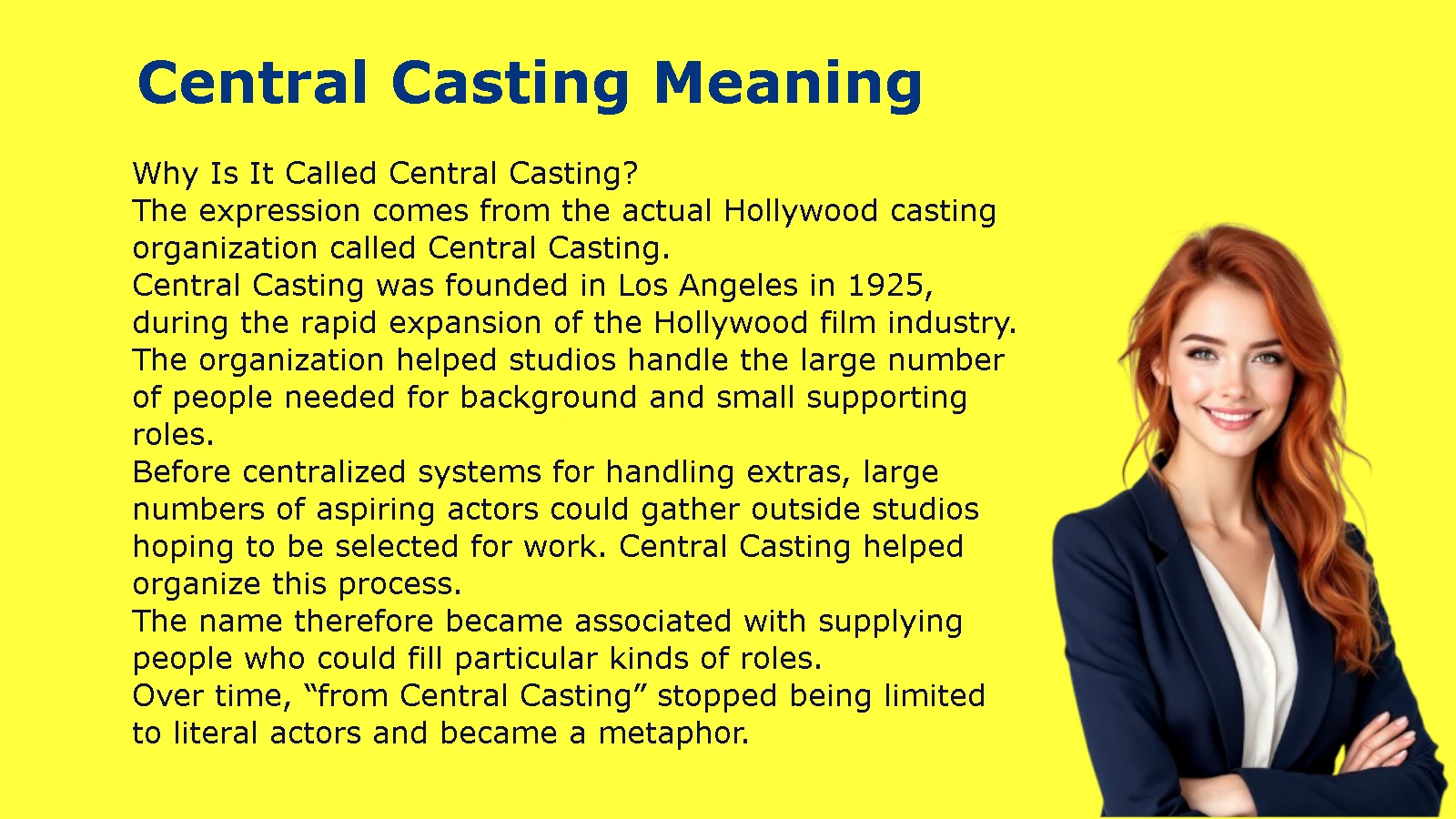
Why Is It Called Central Casting?
The expression comes from the actual Hollywood casting organization called Central Casting.
Central Casting was founded in Los Angeles in 1925, during the rapid expansion of the Hollywood film industry. The organization helped studios handle the large number of people needed for background and small supporting roles.
Before centralized systems for handling extras, large numbers of aspiring actors could gather outside studios hoping to be selected for work. Central Casting helped organize this process.
The name therefore became associated with supplying people who could fill particular kinds of roles.
Over time, “from Central Casting” stopped being limited to literal actors and became a metaphor.
The History Behind the Expression
Central Casting’s own historical account says that expressions involving people coming “out of Central Casting” appeared in newspapers as early as the late 1920s. At first, those references were literal: they described people who had actually been hired through or sent from Central Casting.
A notable early figurative example appeared in 1953, when Los Angeles journalist Gene Sherman described an older people who looked as though he had walked out of Central Casting for the role of a kindly old prospector.
That usage illustrates the transition from literal casting to metaphor.
By the late 1960s, Central Casting reports that the expression had entered mainstream American usage and was being applied to many kinds of people, including athletes, astronauts, and Santa Claus lookalikes.
Dictionary.com places the origin of central casting in the 1925–30 period, matching its connection with the Hollywood organization.
How “Central Casting” Became an Idiom
The evolution makes sense when you break it into stages.
The Literal Stage
Central Casting was a real source for actors and extras.
A person could literally be sent or hired through Central Casting.
The Movie-Character Stage
Because movies repeatedly used recognizable character types, audiences became familiar with the visual language of casting.
People knew what a stereotypical cowboy, detective, professor, gangster, or military officer was supposed to look like.
The Figurative Stage
Writers eventually began using “from central casting” metaphorically.
Instead of saying someone was actually supplied by a casting agency, the phrase suggested that the person looked as though a casting agency had selected them for that exact role.
That figurative meaning remains common today.
Central Casting Examples in Real Sentences
The best way to understand the expression is to see how it works in different situations.
| Example | What it means |
| He looked straight out of central casting as a cowboy. | He strongly resembled the stereotypical image of a cowboy. |
| She was a politician from central casting. | She fit a familiar image of a politician. |
| The movie has a villain straight out of central casting. | The villain closely resembles a conventional movie villain. |
| He looks like he came from central casting. | His appearance strongly matches a recognizable role. |
| The professor seemed straight out of central casting. | He had the expected appearance or manner of a stereotypical professor. |
| The general was right out of central casting. | He looked exactly like the expected type of military general. |
Central Casting in Movies and Television
Movies and television provide the most obvious context.
Suppose a film introduces a detective who wears a trench coat, speaks in a gravelly voice, works late at night, and constantly looks suspicious.
A reviewer might call him:
A detective straight out of central casting.
The writer is pointing out that the character closely follows an established image.
That observation can be positive if the character is intentionally classic and entertaining.
It can also be negative if the reviewer thinks the character is too predictable or unoriginal.
Central Casting in Everyday Conversation
The phrase is not restricted to actors.
You can use it when describing a real person who strongly resembles a familiar type.
For example:
With his cowboy hat, boots, and Southern drawl, he looked straight out of central casting.
The speaker is not claiming that the person is literally an actor.
The phrase simply creates a vivid comparison.
Central Casting in Journalism
Journalists often use the expression when a person’s appearance, career, background, or public image fits an established archetype.
For example, a newspaper might describe a candidate as someone “from central casting” if the person has the conventional appearance and biography associated with a particular political role.
Current dictionary examples show the phrase continuing to appear in journalism and commentary. Dictionary.com, for example, lists recent examples involving politicians, athletes, and public figures.
Is “Central Casting” Positive or Negative?
There is no single emotional meaning.
Context determines whether the expression sounds complimentary, neutral, or critical.
Positive Use
Someone might say:
He is straight out of central casting for the role.
Here, the speaker may mean that the person is perfectly suited to the role.
The phrase can communicate admiration for how naturally someone fits a particular image.
Neutral Use
A writer may simply be describing an appearance:
With his gray hair and round glasses, he looked like a professor from central casting.
The writer may not be praising or criticizing him.
The phrase simply highlights the resemblance.
Critical Use
The phrase can also point out that someone is stereotypical or predictable.
For example:
The film’s villain is straight out of central casting.
Depending on the review, this could mean the villain is deliberately classic, or it could mean the character lacks originality.
Cambridge specifically marks one sense as disapproving when the expression describes fictional characters based on common ideas rather than original characterization.
Central Casting Meaning in Politics
The expression is also used in political writing and speech.
In politics, “from central casting” generally means that a politician, candidate, official, or public figure fits a familiar political image.
For example, someone might be described as looking like a “senator from central casting” because their appearance, speaking style, background, or manner matches the conventional image associated with a senator.
This does not automatically mean the speaker supports or opposes the person.
The phrase is about fit with an expected type, not a political policy position.
What Does “Central Casting” Mean in Politics?
In a political context, the phrase can describe characteristics such as:
- Appearance associated with a particular political role
- A recognizable public-speaking style
- A conventional professional background
- A familiar campaign image
- Traits associated with a political archetype
- A person who appears especially suited to a public role
For example:
He looked like a governor straight out of central casting.
The sentence focuses on the person’s appearance or presentation rather than making a factual claim about their policies.
The Trump “Central Casting” Example
Donald Trump used the expression while discussing former Massachusetts senator Scott Brown in January 2016.
At a rally in New Hampshire, an audience member suggested Brown as a possible vice-presidential choice. Trump responded by calling Brown “central casting” and praised his appearance and family. The Washington Post reported the exchange at the time.
Central Casting itself also notes Trump’s use of the expression when discussing politicians or civil servants who “look the part.”
This is a useful example because it demonstrates how the phrase can be used outside entertainment.
Central Casting vs. Similar Expressions
Several English expressions communicate a related idea, but they are not identical.
| Expression | Meaning |
| Straight out of central casting | Fits a familiar type extremely well |
| From central casting | Appears to fit an expected type |
| Looks the part | Has the appearance expected for a role |
| Fits the stereotype | Matches a common image of a type |
| Classic example | Represents a familiar example of something |
| Textbook example | Closely matches the standard characteristics |
| Perfect for the role | Seems especially suited to a particular role |
“Central Casting” vs. “Looks the Part”
Looks the part is broader.
You can say:
She looks the part of a lawyer.
This simply means her appearance seems suitable for that role.
Straight out of central casting adds a stronger idea of a familiar or stereotypical image.
“Central Casting” vs. “Fits the Stereotype”
These expressions are closely related, but fits the stereotype is more direct.
If someone says:
He fits the stereotype of a Hollywood director.
they explicitly refer to a stereotype.
If they say:
He looks straight out of central casting.
they communicate the same general idea through a movie-related metaphor.
Is Central Casting a Real Organization?
Yes.
Central Casting is a real casting organization, not an imaginary place created by the idiom.
It was established in Hollywood in 1925 and became known for supplying background actors and extras. Central Casting celebrated its 100th anniversary in 2025.
The organization’s history is important because it explains why the expression exists in the first place.
The idiom would be much harder to understand without its Hollywood connection.
What Does Central Casting Actually Do?
Central Casting has historically specialized in providing people for background roles and related casting needs.
Background actors help create believable environments.
Imagine a restaurant scene with only the two main characters sitting at a table. Without anyone else in the restaurant, the scene could look artificial.
Add servers, diners, people walking past, and other customers, and the fictional restaurant suddenly feels populated.
That is where background casting becomes important.
Is “Central Casting” One Word or Two?
Central casting is written as two words.
When referring to the organization, it is normally capitalized:
Central Casting
When using the expression generically, lowercase is common:
He looks like he came from central casting.
The capitalization therefore helps distinguish the proper organization from the figurative expression.
| Form | Typical use |
| Central Casting | The actual organization |
| central casting | Generic or figurative expression |
| from central casting | Idiomatic expression |
| out of central casting | Idiomatic expression |
| straight out of central casting | Common extended idiom |
Common Mistakes When Using “Central Casting”
Thinking It Always Refers to Hollywood
The expression originated in Hollywood, but modern speakers frequently use it outside the entertainment industry.
A politician, athlete, professor, businessperson, or ordinary stranger can all be described as being from central casting.
Assuming It Is Always a Compliment
It is not.
The phrase can praise someone for fitting a role perfectly, but it can also criticize a character for being too stereotypical.
Always examine the surrounding sentence.
Confusing the Organization With the Idiom
These are different uses:
She registered with Central Casting.
This refers to the organization.
She looks straight out of central casting.
This is figurative.
Assuming “Central Casting” Means “Best Actor”
The expression is not specifically about acting ability.
Someone can be “straight out of central casting” because of their appearance, personality, background, behavior, or overall image.
The key idea is resemblance to an expected type.
How to Use “Central Casting” Correctly
The expression usually works best when you identify the role or type that the person resembles.
For example:
He looked straight out of central casting as a detective.
She was a politician from central casting.
The actor was straight out of central casting for the role of a cowboy.
The old man looked as if he had walked out of central casting.
The phrase can appear in both casual and polished writing, although it is more idiomatic than formal.
Common Sentence Patterns
These structures are particularly natural:
- straight out of central casting
- from central casting
- out of central casting
- a character from central casting
- a person straight out of central casting
- looks like he came from central casting
- looks as though she walked out of central casting
Central Casting Meaning in Different Contexts
The meaning remains basically the same across contexts, but the type being referenced changes.
| Context | What “central casting” suggests |
| Movies | A character fits a familiar cinematic type |
| Television | Someone resembles a recognizable TV character |
| Everyday speech | Someone strongly resembles a familiar type |
| Journalism | A person fits a recognizable public archetype |
| Politics | A politician appears to match an expected political image |
| Sports | An athlete resembles the conventional image of their position or sport |
| Workplace | Someone fits the familiar image of a particular profession |
This flexibility is one reason the expression has survived well beyond its original Hollywood setting.
A Simple Case Study: Understanding the Phrase in Context
Consider this sentence:
The new mayor looked straight out of central casting.
By itself, it does not tell you exactly what the speaker means.
Now imagine the surrounding description says:
He had silver hair, a perfectly tailored suit, a deep voice, and decades of experience in public service.
The phrase now becomes clearer.
The writer is saying that the mayor looks exactly like the conventional image of a movie or television mayor.
Now change the context:
The movie’s villain was straight out of central casting, with a black coat, sinister laugh, and predictable plan.
Here, the phrase is more likely critical.
The writer is suggesting that the villain resembles a familiar movie stereotype rather than being especially original.
The words are identical, but the context changes the tone.
Central Casting: Key Facts to Remember
Here are the essential facts to keep in mind:
- Central Casting is a real organization.
- It was established in Los Angeles in 1925.
- Its work has included supplying background actors and extras.
- Central casting also developed a figurative meaning.
- From central casting means someone fits a familiar type.
- Out of central casting has the same basic figurative sense.
- Straight out of central casting is the most familiar extended form.
- The expression can refer to appearance, behavior, personality, background, or overall presentation.
- It can be positive, neutral, or critical, depending on context.
- In critical contexts, it may suggest that a character is predictable or stereotypical.
- The phrase is now used well beyond movies and television.
FAQs About Central Casting Meaning
What does central casting mean?
Central casting can refer literally to a casting organization that supplies actors, particularly background actors and extras. Figuratively, from central casting or straight out of central casting means that someone closely matches the familiar image of a particular type.
What does “straight out of central casting” mean?
It means that someone or something looks, acts, or behaves exactly like the expected example of a particular type.
For example, a stereotypical cowboy might be described as being “straight out of central casting.”
What does “from central casting” mean?
From central casting means that a person or character appears to fit a familiar stereotype or archetype.
It can be used literally in historical references to Central Casting, but modern usage is often figurative.
Is Central Casting a real company?
Yes. Central Casting is a real casting organization founded in Hollywood in 1925. Its history is directly connected to the origin of the figurative expression.
Why do people say “straight out of central casting”?
The expression comes from the idea that Central Casting supplied actors who could fill particular movie roles. Saying someone is “straight out of central casting” therefore suggests that the person looks as though they were specifically selected to play a familiar role.
Is “central casting” positive or negative?
It can be either.
It may be complimentary when someone perfectly fits a desired role. In other contexts, it simply describes a person’s appearance. However, it can sound critical when it implies that a character is predictable, stereotypical, or lacking originality.
What does central casting mean in politics?
In politics, central casting can describe a politician or public official who strongly fits a familiar image associated with that role.
For example, a writer might call someone a “senator from central casting” because their appearance or manner matches a conventional image of a senator.
What does “central casting” mean when describing a person?
It means the person seems to fit a recognizable type unusually well.
If someone looks exactly like your mental picture of a cowboy, professor, detective, or politician, you might say that person is straight out of central casting.
Is “central casting” an idiom?
Central casting itself can refer literally to the organization, while expressions such as “from central casting” and “straight out of central casting” are idiomatic uses.
Is central casting one word or two?
It is two words: central casting.
When referring to the actual organization, Central Casting is capitalized. The figurative expression is commonly written in lowercase.
Conclusion
The central casting meaning is closely tied to Hollywood, but you do not need to be talking about movies to use the expression.
Central Casting is a real organization established in Los Angeles in 1925 to help supply background actors and extras. Its name eventually became part of a broader English expression.
Today, when someone is described as “straight out of central casting,” the speaker usually means that the person fits a familiar type so perfectly that they seem as though they were specifically selected for the role.
The phrase can describe a cowboy who looks like a movie cowboy, a detective who resembles a classic screen detective, a professor who matches the familiar professor stereotype, or a politician who fits a recognizable public image.
The important point is context. Central casting can be complimentary when someone seems perfectly suited to a role, but it can also be critical when a character appears predictable or stereotypical.
Once you understand the Hollywood origin, the expression becomes much easier to interpret: someone from central casting is, figuratively, someone who looks like they were made for the part.