When you write an email, complete a school assignment, or prepare a business report, a small spelling mistake can change how your message looks. One common example is Asess vs Assess. Both spellings may look similar, but only one is correct in standard English.
Assess is the correct spelling, while asess is a misspelling. The verb assess means to evaluate, examine, judge, or estimate something. For example, a teacher may assess a student’s progress, a doctor may assess a patient’s condition, or a business owner may assess the risks of a new project.
The easiest way to remember the spelling is to notice the two pairs of double S letters in a-ss-e-ss. Once you recognize this pattern, you can avoid the mistake in everyday writing. In this guide, you will learn the meaning of assess, discover how to use it in original sentences, compare it with access, and practice a few simple spelling techniques.
Asess vs Assess: Which Spelling Is Correct?
Assess is the correct spelling of the English verb that means to evaluate or judge something. Asess is a misspelling and should not be used when you intend to write the verb assess. The correct word contains four letter S’s, arranged in two pairs. Remembering this pattern can help you spell it correctly in emails, essays, reports, and everyday conversations.
Is Asess a Word?
No. Asess is not the standard English spelling of the verb used to describe evaluating, examining, or judging something. It is usually a typographical error caused by leaving out one of the repeated S letters.
Because English contains many words with double letters, it is easy to overlook one when typing quickly. However, the missing letter makes asess incorrect in standard writing.
Consider these examples:
- Incorrect: The teacher will asess our writing skills.
- Correct: The teacher will assess our writing skills.
- Incorrect: We need to asess the cost before buying the equipment.
- Correct: We need to assess the cost before buying the equipment.
- Incorrect: The manager must asess the team’s performance.
- Correct: The manager must assess the team’s performance.
In each corrected sentence, the meaning stays the same. Only the spelling changes.
If you see asess in a document, the simplest correction is to replace it with assess. You do not need to rewrite the entire sentence unless it contains other errors.
Assess: The Correct Spelling
Assess is a verb used when someone examines information, considers evidence, or makes a judgment about something.
Here are the key facts about the word:
| Feature | Explanation |
| Correct spelling | Assess |
| Incorrect variant | Asess |
| Part of speech | Verb |
| Pronunciation | /əˈses/ |
| Number of letters | 6 |
| Number of S’s | 4 |
| Number of double S pairs | 2 |
| Noun form | Assessment |
| Common synonyms | Evaluate, judge, appraise, estimate |
| Common contexts | Education, business, healthcare, finance, and everyday decisions |
The word has six letters: A, S, S, E, S, and S. The first two S’s appear after the A, while the final two appear after the E.
The pronunciation has two syllables, with the stress on the second syllable. The ending sounds like ess, which may help you remember the final pair of S letters.
Spelling tip: Do not write a-s-e-s-s. Instead, remember the complete pattern: a-ss-e-ss.
Definition and Meaning of Assess
Assess means to examine, evaluate, or judge the nature, quality, value, condition, or importance of something. People use the word when they need to understand a situation, measure performance, estimate costs, or make an informed decision. Its exact meaning depends on the context, but it generally involves gathering information and reaching a judgment.
Assess Meaning in Everyday English
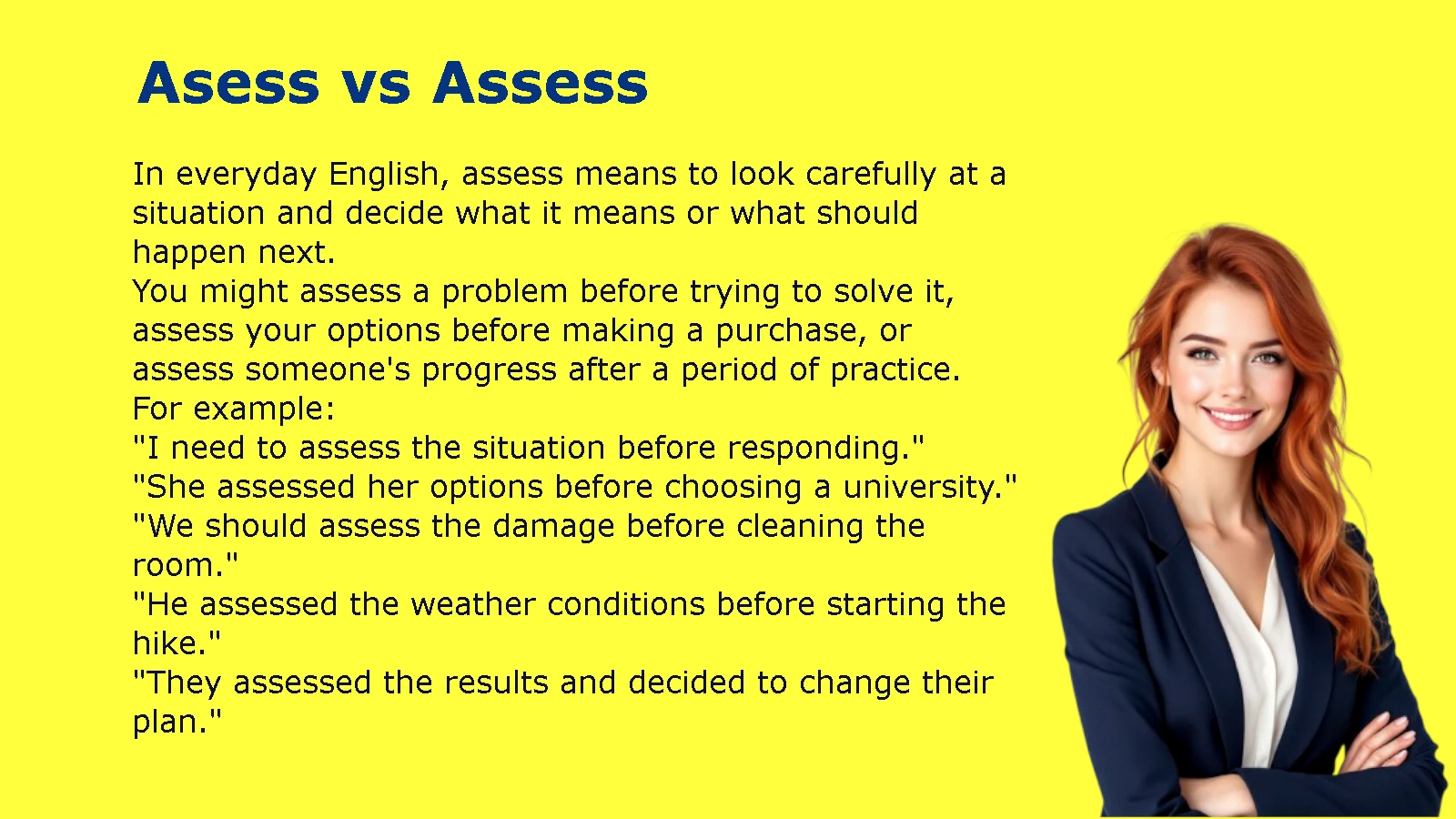
In everyday English, assess means to look carefully at a situation and decide what it means or what should happen next.
You might assess a problem before trying to solve it, assess your options before making a purchase, or assess someone’s progress after a period of practice.
For example:
- “I need to assess the situation before responding.”
- “She assessed her options before choosing a university.”
- “We should assess the damage before cleaning the room.”
- “He assessed the weather conditions before starting the hike.”
- “They assessed the results and decided to change their plan.”
In these examples, assess describes a thoughtful process rather than a random guess.
For instance, imagine that your laptop suddenly stops working. Instead of immediately buying a new one, you check the battery, charger, screen, and software. You are assessing the problem because you are examining the available information before deciding what to do.
The word is especially useful when a decision requires care, evidence, or comparison.
Assess Meaning in Education
Teachers and schools use assess to describe the process of checking a student’s knowledge, understanding, skills, or progress.
An assessment may involve a written test, an oral presentation, a classroom activity, a project, or a practical demonstration.
Examples include:
- “The teacher will assess each student’s reading skills.”
- “The school uses short quizzes to assess understanding.”
- “The instructor assessed our presentations based on clarity and accuracy.”
- “Parents met with the teacher to assess the child’s progress.”
- “The final project will help assess students’ problem-solving abilities.”
Assessment does not always mean giving a grade. A teacher may assess a student’s work to identify strengths, discover areas that need improvement, or decide which lesson to teach next.
For example, if most students answer a science question incorrectly, the teacher may conclude that the class needs another explanation of the topic. The teacher has used the assessment results to make a practical decision.
Assess Meaning in Business and the Workplace
In business, assess often means evaluating performance, costs, opportunities, risks, or results.
Managers use assessments to decide whether a project is on schedule, employees need training, or a new strategy is working.
Examples:
- “The manager will assess the team’s progress before the deadline.”
- “We need to assess the risks before launching the product.”
- “The company assessed customer feedback after the campaign.”
- “Our supervisor will assess the quality of the finished work.”
- “The business owner assessed the costs before hiring additional staff.”
Consider a small business that plans to introduce a new product. Before investing money, the owner reviews production costs, customer demand, expected sales, and possible competition.
The owner is assessing the opportunity. This process helps reveal whether the idea is practical and financially sensible.
In professional writing, assess can sound more precise than look at or think about because it suggests a deliberate evaluation.
However, the word does not automatically mean that the evaluation is formal or scientific. You can assess a situation informally by considering the facts and making a reasonable judgment.
Assess Meaning in Finance and Real Estate
In financial and property contexts, assess can refer to estimating value, calculating an amount, or determining a charge.
The exact meaning depends on the situation.
For example:
- “The county will assess the property’s value.”
- “The bank assessed the financial risks of the loan.”
- “The insurance company sent an expert to assess the storm damage.”
- “The local authority assessed the property for tax purposes.”
- “The accountant assessed the company’s outstanding liabilities.”
When a property is assessed, an authority or professional may examine its characteristics and estimate its value for a specific purpose. A tax assessment, for example, may help determine the value used in calculating property taxes.
In insurance, assessing damage may involve inspecting a building, documenting losses, and estimating repair costs.
Important distinction: Assessing a value does not necessarily mean determining the final sale price. An assessment is an evaluation made for a particular purpose, and the final amount may depend on other factors.
How to Use Assess in a Sentence
The verb assess is useful whenever you need to describe examining something before making a judgment or decision. You can use it in casual conversations, schoolwork, business documents, healthcare discussions, and financial reports.
The following examples show how the word works in different contexts.
Assess Examples in Everyday Sentences
These examples demonstrate common uses of assess in daily life.
- “Before buying the used car, I asked a mechanic to assess its condition.”
- “She took a few minutes to assess the situation.”
- “We assessed the weather before planning our picnic.”
- “The coach assessed the players’ fitness before the tournament.”
- “He assessed the available options and chose the least expensive one.”
- “The family assessed the damage after the heavy rain.”
- “I need to assess my priorities before accepting another task.”
- “They assessed the problem and found a simple solution.”
In each sentence, someone examines information or a condition before reaching a conclusion.
For example, the mechanic does not simply look at the car. The mechanic checks its condition to help the buyer understand possible problems.
Assess Examples in Business and Education
In professional and academic settings, assess often appears alongside words such as performance, progress, quality, skills, results, and understanding.
| Context | Example sentence | What is being assessed? |
| Business | The director will assess the project’s progress on Friday. | Project progress |
| Education | The teacher assessed the students’ writing skills. | Writing ability |
| Recruitment | The hiring panel will assess each candidate’s experience. | Candidate qualifications |
| Marketing | We assessed customer responses to the new advertisement. | Customer reactions |
| Management | The supervisor assessed the team’s performance. | Work quality |
| Training | The instructor assessed our ability to use the equipment safely. | Practical skills |
Notice that the word can take different forms depending on the sentence.
- Assess: We assess the results every month.
- Assesses: She assesses each application carefully.
- Assessed: The team assessed the risks yesterday.
- Assessing: We are assessing the available options.
- Assessment: The assessment revealed several areas for improvement.
These forms are useful to recognize because the spelling mistake can occur in more than one tense.
For example, write “The manager assessed the results,” not “The manager asessed the results.”
Assess Examples in Finance and Property
Use assess when describing the evaluation of financial information, property, damage, or costs.
- “The appraiser will assess the house before the sale.”
- “The insurance adjuster assessed the damage to the roof.”
- “The company assessed the financial impact of the new policy.”
- “The accountant assessed the business’s current expenses.”
- “The authority assessed the property for tax purposes.”
- “The lender assessed the applicant’s ability to repay the loan.”
These examples show that the word can describe both an evaluation and an estimate.
In the sentence “The appraiser will assess the house,” the appraiser examines the property to estimate its value for a specific purpose. In “The company assessed the financial impact,” the company examines expected costs or consequences before making a decision.
Common Sentence Patterns With Assess
Learning common sentence patterns can make it easier to use assess naturally.
| Sentence pattern | Example |
| Assess + a situation | We need to assess the situation carefully. |
| Assess + someone’s ability | The coach assessed the player’s ability. |
| Assess + the risk | The team assessed the risk before proceeding. |
| Assess + the value | An expert assessed the value of the painting. |
| Assess + whether | The committee assessed whether the proposal was practical. |
| Assess + something as + description | The inspector assessed the damage as minor. |
The last pattern needs particular care. When you write that someone assessed something as minor, you are describing the judgment they reached. The wording should reflect the actual evidence rather than an unsupported conclusion.
Can You Use Assess for People?
Yes. You can use assess when evaluating someone’s skills, performance, condition, or suitability for a particular role.
For example:
- “The interviewer assessed the candidate’s communication skills.”
- “The doctor assessed the patient’s symptoms.”
- “The coach assessed the athletes’ fitness levels.”
- “The manager assessed each employee’s progress.”
However, context matters. When assessing a person, it is usually clearer and more respectful to identify the specific quality being evaluated rather than make a broad judgment about the person’s worth.
For example, “The interviewer assessed her technical skills” is more precise than “The interviewer assessed her as a person.”
How to Remember the Correct Spelling of Assess
The easiest way to remember assess is to focus on its letter pattern rather than memorizing the whole word as a single unit.
The Double S Rule
The word assess contains two pairs of double S letters.
Break it into parts:
A + SS + E + SS = ASSESS
The first pair follows the letter A. The second pair comes after the letter E.
This visual pattern makes the spelling easier to check. If you write only one S in either position, you have missed part of the correct spelling.
Compare the two forms:
- Incorrect: A-S-E-S-S
- Correct: A-S-S-E-S-S
A simple proofreading technique is to pause briefly before submitting a document and check both pairs of S letters.
This is especially helpful when writing quickly, using a phone keyboard, or editing a long document with many similar words.
A Simple Visual Memory Trick
Imagine the word as two connected units:
ASS + ESS = ASSESS
This is a spelling aid, not a division into meaningful word parts. It simply helps you remember the arrangement of the letters.
You can also connect the word with its meaning:
- Assess: Examine or evaluate.
- Assessment: The process or result of evaluating.
- Assessor: A person who evaluates something, often property or value.
For example, if you are reviewing a report, tell yourself: “I must assess the report, so I need the spelling with both pairs of S letters.”
Connecting spelling with meaning makes the word easier to recall when you need it.
Practice the Spelling in Short Sentences
Writing the word in context can reinforce the correct letter pattern.
Try completing these sentences:
- The teacher will ______ our progress.
- We need to ______ the risks before investing.
- The mechanic assessed the car’s ______.
- The company completed an ______ of its expenses.
- The doctor will ______ the patient’s condition.
Answers:
- assess
- assess
- condition
- assessment
- assess
Pay attention to the difference between assess and assessment. The noun adds the ending -ment, but the original double S pairs remain in place.
Common Spelling Mistakes to Avoid
Although asess is the main error discussed here, other mistakes can occur when people type the word quickly.
| Incorrect spelling | Correct spelling |
| Asess | Assess |
| Asses (when the intended word is the verb) | Assess |
| Asessed | Assessed |
| Asessing | Assessing |
| Asessment | Assessment |
The form asses is an actual English word in other contexts, including the plural of ass. However, it is not the correct spelling of the verb assess. The intended meaning determines which word you need.
Similarly, assessed, assessing, and assessment must retain the original double S pairs.
Practical tip: If you repeatedly make this mistake, add assess to your device’s personal dictionary only after confirming the correct spelling, or use your writing software’s spell checker to catch errors before sending important documents.
Assess vs. Access: What’s the Difference?
Both are different words with different meanings. Assess means to evaluate, examine, or judge something. Access means to enter, reach, obtain, or use something. Although the words look and sound similar, they are not interchangeable.
Assess vs. Access Comparison Table
| Feature | Assess | Access |
| Part of speech | Usually a verb | Verb or noun |
| Main meaning | Evaluate or judge | Enter, reach, obtain, or use |
| Common situations | Reviewing risks, skills, costs, or performance | Opening files, entering buildings, or using services |
| Example as a verb | We need to assess the damage. | I need to access the file. |
| Example as a noun | Not commonly used as a noun in standard modern English | Students have access to the library. |
| Related noun | Assessment | Access |
The most important distinction is the action being described.
When you assess something, you examine it to understand its condition, quality, value, or importance.
When you access something, you gain the ability to reach or use it.
Assess vs. Access Examples in Sentences
Compare these sentences:
Using assess:
“The technician will assess the computer’s condition.”
This means the technician will examine the computer to determine whether it works properly or needs repairs.
Using access:
“The technician will access the computer’s files.”
This means the technician will open or reach the files stored on the computer.
Here are more examples:
- “The manager assessed the report.” The manager evaluated its quality or content.
- “The manager accessed the report.” The manager opened or retrieved it.
- “The doctor assessed the patient.” The doctor evaluated the patient’s condition.
- “The patient accessed the online health portal.” The patient entered or used the portal.
- “The team assessed the security risks.” The team evaluated possible dangers.
- “The team accessed the secure database.” The team gained entry to the database.
These examples show why choosing the right word matters. A single spelling change can alter the meaning of a sentence.
How to Choose Between Assess and Access
If you are unsure which word to use, ask yourself what action the sentence describes.
Choose assess when you mean:
- Evaluate a situation.
- Judge performance or quality.
- Estimate property value.
- Examine possible risks.
- Determine the condition of something.
Choose access when you mean:
- Open a document.
- Enter a building.
- Use an online account.
- Retrieve information.
- Gain permission or ability to reach a resource.
A useful test is to replace the word with evaluate.
For example, “We need to assess the damage” becomes “We need to evaluate the damage.” The meaning remains similar, so assess is appropriate.
However, “I cannot access the account” cannot naturally become “I cannot evaluate the account” if you mean that you are unable to log in. In that case, access is the correct word.
A Practical Case Study: Assess or Access in a Workplace Email?
Imagine that a project manager is preparing an email about a delayed software project.
The manager wants the technical team to review the problems and open a shared report.
Here is an incorrect version:
“Please asess the system errors and make sure you can assess the project report.”
This sentence contains two different issues. The first is a spelling mistake, and the second is a word choice error if the manager means opening the report.
A clearer version is:
“Please assess the system errors and make sure you can access the project report.”
Why is this version better?
- Assess the system errors: The team should examine the errors and determine their severity or possible causes.
- Access the project report: The team should open or retrieve the report.
- Correct spelling: The word assess includes both pairs of S letters.
- Clear instructions: Each verb describes a different task.
This example illustrates an important lesson: spelling accuracy and word choice work together. Correcting asess to assess fixes the spelling, but understanding assess vs. access ensures that the sentence communicates the intended action.
Conclusion: Remember the Correct Spelling of Assess
When comparing Asess vs Assess, the answer is straightforward: assess is correct, and asess is a misspelling. The word means to evaluate, examine, judge, or estimate something, and it is common in education, business, healthcare, finance, and everyday communication.
The easiest way to remember the spelling is A + SS + E + SS. The word contains six letters and four S’s arranged in two pairs.
Also, remember the difference between assess and access. Use assess when you evaluate something, and use access when you enter, reach, or use something.
Before sending an email, submitting an assignment, or publishing a report, take a moment to check your spelling. This small habit can make your writing clearer and more professional.
Frequently Asked Questions
Is Asess a Word?
No. Asess is a misspelling of assess when you intend to use the English verb meaning to evaluate or judge something. The correct spelling contains two pairs of double S letters.
How Do You Spell Assess Correctly?
The correct spelling is assess: A-S-S-E-S-S. Remember the pattern A + SS + E + SS to avoid leaving out a letter when typing.
What Does Assess Mean?
Assess means to evaluate, examine, judge, or estimate something. For example, a teacher assesses a student’s understanding, while an appraiser assesses a property’s value.
What Is the Noun Form of Assess?
The noun form is assessment. It describes the process or result of evaluating something. For example, “The teacher completed an assessment of the students’ writing skills.”
How Many S’s Are in Assess?
There are four S’s in assess. They appear in two pairs: the first pair follows A, and the second pair follows E.
What Is the Difference Between Assess and Access?
Assess means to evaluate or judge something, while access means to enter, reach, obtain, or use something. For example, you assess a report to evaluate its quality, but you access a report to open or retrieve it.













